South Korea eyes manure as fertilizer crunch worsens

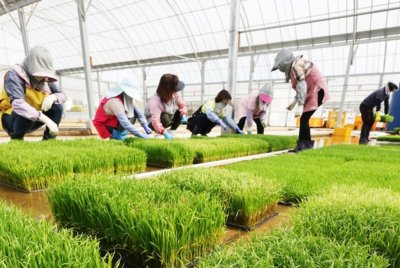
Employees tend rice seedlings at a nursery operated by the state-run National Institute of Crop Science in Suwon, South Korea, 16 April 2026, ahead of the rice planting season. Photo by YONHAP / EPA
April 29 (Asia Today) — Instability in South Korea’s fertilizer supply is growing in the aftermath of the war involving Iran, as the prolonged closure of the Strait of Hormuz disrupts routes for importing raw materials used in fertilizer production.
The Korea Pork Producers Association said Wednesday the price of urea, the largest component among chemical fertilizers, has surpassed $700 per ton, the highest level since October 2022.
“South Korea has a structural limitation because it depends heavily on imports for fertilizer raw materials,” an association official said. “Rising chemical fertilizer prices and supply instability caused by uncertainty in international affairs are directly increasing the burden on crop farmers.”
Amid the pressure, compost and liquid fertilizer made from livestock manure are emerging as alternatives.
The association said resource recycling of livestock manure into compost and liquid fertilizer could gradually reduce dependence on chemical fertilizers while helping stabilize food security.
According to an association survey, the potential fertilizer value of livestock manure is high enough to meet 46% of the nitrogen needs and 100% of the phosphate needs of farmland.
The Ministry of Agriculture, Food and Rural Affairs has pursued measures to improve the quality of compost and liquid fertilizer and change perceptions among crop farmers since the Cabinet decided in 2006 to ban ocean dumping of livestock manure. A key measure was the July 2006 plan to promote natural circulation agriculture using livestock manure compost and liquid fertilizer.
A decade after the plan was implemented, production facilities and technology for livestock manure recycling have improved significantly. Liquid fertilizer made from livestock manure is now being used as a substitute for chemical fertilizer at greenhouse farms.
Compost quality has also steadily improved, leading to a sharp increase in exports to Southeast Asian countries.
Livestock manure compost and liquid fertilizer have shown strong effects in reducing fertilizer costs and greenhouse gas emissions. In an experiment by Sangji University, the use of filtered liquid fertilizer instead of chemical fertilizer at a greenhouse farm reduced fertilizer costs by 600,000 won ($406) per hectare and cut greenhouse gas emissions by 382.6 kilograms of carbon dioxide.
Most greenhouse farms using the fertilizer also showed major improvements in soil electrical conductivity, indicating the role of livestock manure compost and liquid fertilizer in soil improvement.
The alternatives also contributed to higher crop output and income. A spinach greenhouse farm using liquid fertilizer produced by the Pocheon Livestock Cooperative’s natural circulation agriculture team saw early harvest output rise 53%, while income per 10 ares reached 7.56 million won ($5,118), up 247% from an average year.
Despite those benefits, livestock manure compost and liquid fertilizer remain less convenient than chemical fertilizer in terms of labor and usability. Experts say policies are needed to develop products that crop farmers can use more easily.
“To promote the recycling and use of livestock manure, we will prepare and pursue policies to remove institutional and structural barriers, including restrictions on spreading and the burden of transport costs,” said Park Jung-hoon, head of the ministry’s food policy office.
Livestock farmers also plan to work with crop farmers to help establish a circular farming system linking livestock and crop production.
— Reported by Asia Today; translated by UPI
© Asia Today. Unauthorized reproduction or redistribution prohibited.
Original Korean report: https://www.asiatoday.co.kr/kn/view.php?key=20260429010009418