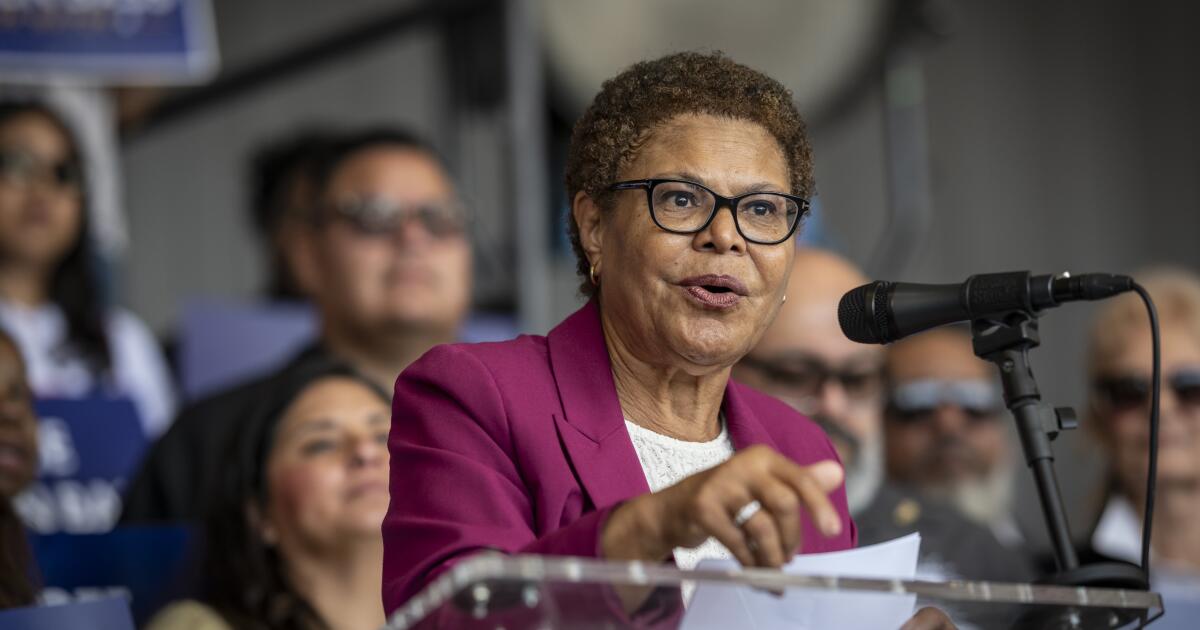
Los Angeles Mayor Karen Bass is once again dealing with blowback for being out of town when a massive fire ignited.
The fire at a cold storage facility in Boyle Heights began burning Wednesday, hours after Bass departed for the dedication of the Barack Obama Presidential Center in Chicago.
Since arriving back in Los Angeles around 6 p.m. Thursday, Bass has been to the scene of the fire numerous times, declared a local emergency, hosted five press conferences, met with local leaders and families affected by the fire, and distributed masks and air purifiers.
But her quick return and public appearances have not stopped some from drawing parallels to last year’s Palisades fire. Bass was in Ghana on a diplomatic trip when the deadly inferno spread amid extraordinarily high Santa Ana winds that forecasters had warned about for days.
While the scale of the destruction in Boyle Heights doesn’t compare to the 12 lives and thousands of homes lost in the Palisades fire, Angelenos are having flashbacks as toxic smoke hovers over parts of the region.
Bass, who is running for reelection, said in an interview that she rarely travels and always worries about what could happen when she does — whether it’s a fire or a big car accident. She also said she chose Chief Jaime Moore to lead the Los Angeles Fire Department because she trusts him to handle a crisis like this fire.
“I was in Chicago three hours away, and I was there 24 hours,” Bass said, noting that she was in constant communication with the chief during her brief trip.
A May poll by the UC Berkeley Institute of Governmental Studies, which was co-sponsored by The Times, found that 57% of likely Los Angeles voters had unfavorable views of Bass, while 35% had favorable views.
Bass, who served in Congress for more than a decade, was designated by then-President Biden to be part of his official delegation to attend the inauguration of Ghanaian President John Dramani Mahama. She was captured in photos at an embassy cocktail party in Accra as the Palisades fire exploded Jan. 7, 2025.
Last week, there was no warning that anything was amiss when she left the city. But any echoes of the Palisades fire could damage Bass’ image as she campaigns against City Councilmember Nithya Raman in the November runoff election.
“We’re talking about a fire, and she’s out of town, so it completely and totally reinforces that narrative of January 2025, and that’s not helpful,” said Fernando Guerra, director of the Center for the Study of Los Angeles at Loyola Marymount University.
Guerra said while Bass can do much of her job from another city for a day, a mayor is often faulted for not being front and center during an emergency.
“With today’s tech and instant communication, is it really that different that she’s in Chicago making calls than at City Hall?” he said. “But it has always been the case for executives that, symbolically, it is their job to be at the point of the crisis to assure those that are impacted directly, and the city as a whole, that they have the situation under control.”
Guerra said it didn’t help that Kevin Marchetti, the owner of the cold storage facility operating in the burning building, contributed the maximum, $1,800, to Bass’ reelection campaign last year.
Raman declined to comment on Bass’ handling of the Boyle Heights fire.
The blaze ignited Wednesday at the nearly 500,000-square-foot cold storage facility run by a company called Lineage, beginning on the roof, which caused a partial collapse and moved the flames into the building, where 85 million pounds of food are stored.
Firefighters have been battling the flames for seven days now, and smoke has made air dangerous to breathe in neighborhoods across the Los Angeles region.
Bass’ absence from the city soon caught the eye of right-wingers, with Spencer Pratt, who ran against her in the nonpartisan primary election, and Steve Hilton, who is running for governor, among those critiquing her.
“I don’t know what’s wrong with Karen Bass that she seems to keep leaving the city every time something happens,” Hilton said at a Monday press conference in Boyle Heights.
Pratt, who lost his house in the Palisades fire and came in third in the primary, drew the comparison directly.
“Karen was sipping cocktails in Chicago when the Boyle Heights Fire erupted, just as she was sipping cocktails in Ghana when our Palisades Fire erupted. I warned you all … what happened to us will happen to all of LA,” he posted on X on Sunday.
As she flew back to L.A. from Ghana, Bass repeatedly reminded her staff that she could make calls from the military flight, her text messages showed. But during one call or Zoom with her staffers, she had technical problems, texting, “I am listening don’t know why you can’t [hear] me.”
Moore, the new chief, has appeared to be in lockstep with the mayor during the Boyle Heights fire, saying she has been an active partner.
About 30 minutes after the fire began, Moore was on the scene. Ten minutes after he arrived, he was on the phone with Bass, he said.
Over the next day, while Bass was in Chicago, Moore estimated that they spoke six times over the phone.
Moore said her absence was a non-issue.
“Until Mayor Bass goes through our 20-week drill tower, and she learns to fight a fire and she can stand next to me on a hose line, I don’t need her in this city,” Moore told The Times on Tuesday.
“She’s our mayor. She was doing exactly what she needed to do,” he added. “She answered the phone. She provided me exactly what I needed, and that was, ‘Whatever you need to do, you do it.’”
In 1973, Tom Bradley became L.A.’s. first Black mayor by assembling Black, Jewish, white and Latino liberals into a coalition that ended decades of conservative white rule at City Hall.
Bradley’s election transformed Los Angeles politics and began what has been, for the most part, a 50-year reign of moderate Democrats. Year after year, the election map has changed, but liberal centrists have usually remained on top.
But as Mayor Karen Bass seeks reelection, she is struggling to unite her traditional base as she faces attacks from Democratic Socialists of America Councilwoman Nithya Raman on the left and Republican reality TV star Spencer Pratt on the right.
Some political experts in L.A. say mainstream Democrats are floundering as they try to patch together their coalitions in an era when poll after poll shows the city’s residents frustrated with the status quo.
“Overwhelmingly, Angelenos feel Los Angeles doesn’t work,” said Fernando Guerra, founding director of the Center for the Study of Los Angeles at Loyola Marymount University. “You have this liberal regime that has dominated from ‘73 to ‘26 and it’s stagnant.”
Traditional voting patterns, political experts agree, are unraveling as L.A.’s mounting housing costs create new political fault lines in this city of 3.9 million. The devastating 2025 wildfires, along with enduring problems of homelessness, declining city infrastructure and traffic, have exacerbated discontent.
It’s still possible Bass can pull off reelection in the nonpartisan mayoral race and some coalition of centrist Democrats can survive. But the fact that she is unlikely to avoid a runoff when U.S. incumbents typically win at a 90% rate, Guerra said, shows that L.A.’s mainstream Democratic institutions are hollowing out.
“The problem is not Bass,” Guerra said, adding: “Any regime that lasts for that long begins to fall upon itself. … It stagnates and stops being innovative, and just becomes protective of the ingrained interests that have nurtured that coalition.”
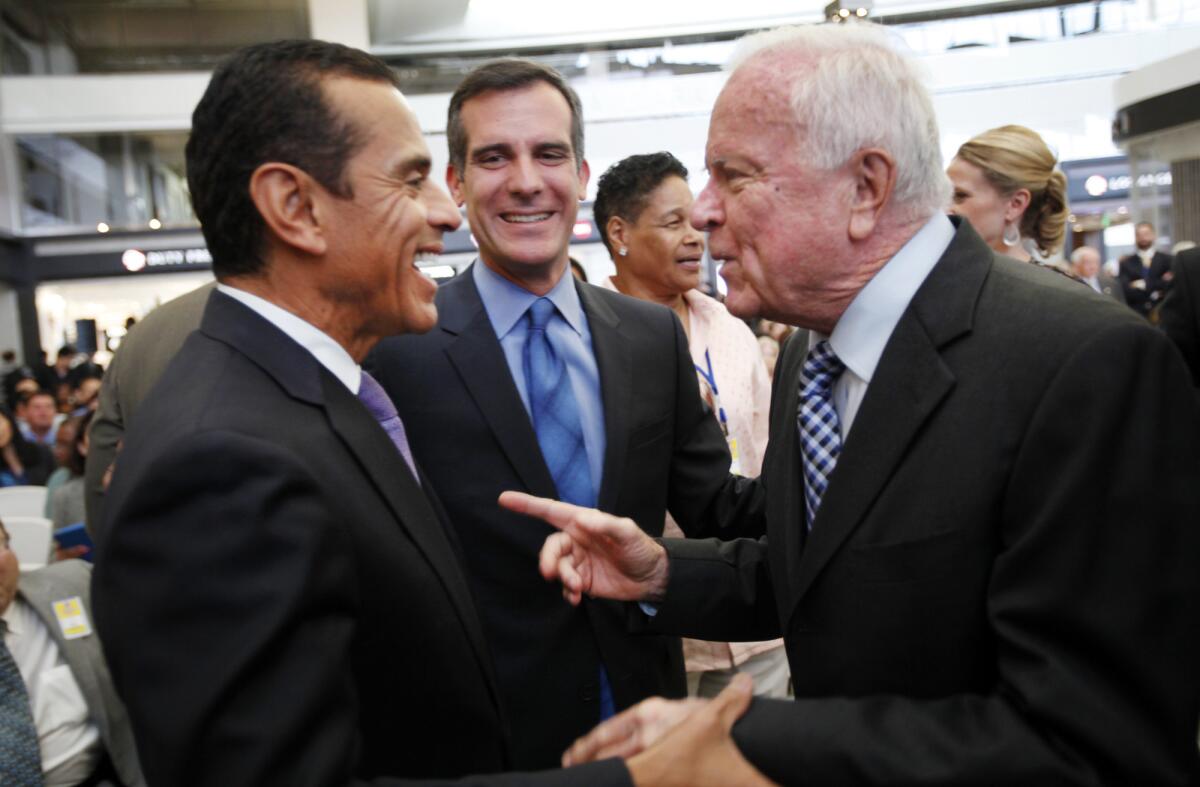
Former L.A. Mayors Antonio Villaraigosa, Eric Garcetti and Richard Riordan.
Most political observers in L.A., however, are confident that the city’s future is not conservative.
The DSA, a decentralized anti-capitalist group, has made inroads in L.A. as it advocates for rental protections, defunding the police and a Green New Deal. Over the last six years, Angelenos have elected four DSA-backed City Council members and a DSA-recommended city controller.
“L.A. is clearly a city that is steadily moving to the left,” said Jim Newton, executive director of UCLA Blueprint magazine and a veteran political journalist who worked for the L.A. Times for 25 years.
“People are unhappy, but they’re not unhappy enough to vote for a Republican,” Guerra agreed. “They have been looking at the other alternatives: the Democratic Socialist party that is the challenge to the establishment.”
Some caution, however, that it is too early to map out Los Angeles’ political future.
“I think everything is up for grabs,” Sonenshein said, noting that he expected more competition for Latino and Asian voters, young voters and even older Democrats. “Certainly, younger voters are completely up for grabs. It’s just hard to know where they’re going to end up. … Small shifts in the primary can make a very big difference.”
L.A. rose as the Republican stronghold of California.
As a massive influx of white Midwesterners descended on L.A. after the 1885 opening of the Santa Fe railroad, conservative white civic leaders — including the owners of the L.A. Times — touted the city as the GOP counterpart to progressive, union-friendly San Francisco. Liberal Black and white Angelenos were shut out of citywide power.
The purpose of the Bradley coalition, Sonenshein said, was to “break open the stranglehold of a city establishment that was … unresponsive to the diversity of the community.”
Bradley, an even-keeled attorney and former police officer, was well positioned to bridge L.A.’s racial divides. As a police community relations officer, he had cultivated relationships with Jewish business owners. He was an early supporter of L.A.’s first Latino City Council member, Edward Roybal, and had already united Black and Jewish Angelenos in the 10th District as the city’s first Black City Council member.
L.A. City Councilman Tom Bradley and Mayor Sam Yorty in a TV studio just before the start of a debate during their 1973 campaign for mayor.
(Los Angeles Times)
After his 1973 win, as waves of new immigrants moved to L.A., Bradley brought more Latinos and Asian Americans into the fold. A conscious alliance of minority communities reelected Bradley, helping him become the longest-serving mayor in L.A. history.
But by the 1990s, frustration had swelled over L.A.’s crime, pollution and poverty. Bradley’s popularity plummeted after Black motorist Rodney King was brutally beaten by LAPD officers in 1991 and riots erupted across the city the next year when a largely white jury acquitted the officers. More than 60 people were killed.
As Bradley prepared to step down, Democrats struggled to find a successor who could unite liberal Black, white, Latino and Asian Angelenos.
Still, some were skeptical that Richard Riordan, a Republican venture capitalist, would win. Riordan was a moderate, easygoing philanthropist, Newton said, and Republicans at the time made up 30% of L.A.’s registered voters, double their number now. Even so, he noted, “there were people who thought this is just not what this city is, the city doesn’t need a multimillionaire white guy Republican.”
Voters thought differently. After securing the support of San Fernando Valley Republicans and Democratic centrists and making small inroads among Latinos, Riordan became the first Republican L.A. mayor elected in 36 years.
The Bradley coalition was “a spent force,” Sonenshein said. “But new players were emerging in prominent roles, working to forge new types of alliances and, at times, temporary coalitions.”
When California voters in 1994 passed the anti-immigrant Proposition 187, which barred undocumented immigrants from receiving many public services, Latino participation in L.A. politics surged. Asian Americans also began to rise.
But after Bradley, there was no single Democratic coalition in the city.
When Antonio Villaraigosa challenged James Hahn in 2001 and 2005, Sonenshein said, Hahn drew support from the Black community and the Valley, Villaraigosa from Latinos and liberals. When Eric Garcetti defeated Wendy Greuel in 2013, Greuel had strong support in Black South L.A., but Garcetti managed to win with the white and Latino vote.
“People have to piece it together, because the Democrats have such a larger edge in L.A. than they did in Bradley’s age,” he said. “It’s almost a kind of entrepreneurial thing: You’ve got to go out and build a majority each time, and those alliances shift.”
There were still challenges from the right. But in 2022, when billionaire real estate developer Rick Caruso ran against Bass on a centrist law-and-order platform, he switched his party affiliation from Republican to Democratic. Some saw that as a recognition that a Republican could not win in L.A.
Like Bradley, Bass is a pragmatic politician with a long record of forging relationships behind the scenes.
In the 1990s, she founded the grassroots Community Coalition to combat the public health crises that plagued South L.A. amid the crack-cocaine epidemic.
But as Bass presides over a City Hall that is almost entirely dominated by Democrats, discontent is spreading. Polls show a substantial portion of the electorate views her unfavorably because of her handling of the Palisades fire.
Guerra said the lack of affordable housing had created a unique moment: Even after the King riots, the Northridge earthquake and the O.J. Simpson trial, he said, Angelenos were still invested in living in the city.
“You could still buy a home. You could still see yourself nurturing L.A., but also L.A. nurturing you,” Guerra said.
For Guerra, centrist Democrats have been so successful at inclusion they have struggled to identify priorities.
“There are too many members of the coalition and there are too many of the members who have veto power, which then leads to paralysis,” Guerra said. “The paralysis is what’s led to the lack of innovation, the failure to pursue policies that make sense for the greater good.”
The dysfunction, he said, is particularly clear on housing.
“Every NIMBY in every neighborhood, in every council district, is like, ‘We want housing, but not here,’” Guerra said. “That, replicated everywhere, leads to paralysis and no housing.”
It has also led to renters becoming a rising political constituency — a big shift from the Bradley era, when homeowners were the city’s dominant voters.
But that doesn’t mean working-class Angelenos have a bigger voice now in L.A. politics. Instead, the middle class is splintering along generational lines.
“Middle-class young folks graduating from college, who have extraordinary amounts of debt, cannot buy homes,” said Sara Sadhwani, a politics professor at Pomona College. “The city still has issues with food insecurity and low-wage worker protections, but those are not the issues dominating anymore.”
While L.A. Democrats have long focused on assembling coalitions of Black, Latino, Asian American and other minority activists, Sadhwani said, what was often not spoken about was the role of the city’s “nonprofit industrial complex.”
“Nonprofits have a huge role,” she said, noting that Bass came of that world. “Their politics are shifting.” Before 2020, she said, progressives focused on racial justice, immigration reform, and creating an economy that respects the work of immigrants; now, the focus is largely on homelessness and policing.
“What it means to be a progressive today,” Sadhwani said, “is actually quite different from what it was to be a progressive even just five years ago.”
Even as L.A. is clearly still a Democratic stronghold, Republicans say there are signs that some Angelenos are not in lockstep with liberal activists.
Donald Trump’s share of the vote in L.A. in the last three presidential elections, they note, climbed from 16% in 2016 to 21% in 2020 and 27% in 2024. And there is evidence that voters, at least at the county level, are questioning some criminal justice reforms.
Los Angeles Mayor Antonio Villaraigosa, pictured here on the cover of Newsweek, helped reshape the city’s Democratic coalition
(David McNew / Getty Images)
With Republicans making up about 15% of L.A.’s registered voters, Rob Stutzman, a GOP strategist, said Pratt might win enough independent voters and disaffected Democrats to make it past the primary. But he would then struggle to get more than 50% in the runoff.
“The math just isn’t there, but in addition to that it’s the stink of Trump,” Stutzman said. “The tribal politics of today make a Republican victory in L.A. very difficult.”
Raman stunned L.A.’s political establishment in 2020 when she was elected L.A.’s first DSA-backed City Council member.
As she runs for mayor, the Los Angeles chapter of the DSA hopes to expand its power as it endorses a new slate of 2026 candidates for City Council, city attorney and L.A. school board.
Richard Riordan, the last elected Republican mayor of Los Angeles.
(Los Angeles Times)
Raman is clearly betting that a big, viable part of the electorate is to Bass’ left, Newton said.
The DSA, Newton said, had done a good job in recent years of identifying renters’ interests and advancing them to usher in a “newer, younger, probably more progressive edge to the city’s politics.”
But so far, Raman, who has aligned herself with the DSA on issues such as renter protections but deviated on police spending, is struggling to unite the organization.
The Harvard and MIT graduate caught the DSA and her fellow City Council members off guard when she entered the mayoral race just before the filing deadline.
After building momentum, the DSA’s failure to rally around a 2026 mayoral candidate could hurt the movement for several election cycles, Guerra said.
“This dissension is setting them back,“ Guerra said. “They really do have an opportunity to elect a DSA mayor.”
Bass has seized on Raman’s lack of support in City Hall to critique her coalition-building skills.
“If you want to be the mayor and you can’t get along with people who are your colleagues on council,” Bass said recently, “I don’t know how you’re supposed to govern at all.”
In the end, the outcome of L.A.’s mayoral race may not depend so much on Bass’ ability to inspire her traditional Democratic coalition. The question is whether a new generation can find a way to represent a mass of Angelenos with bold new visions and coalitions of their own.