ACTRESS Rebecca Ferguson shimmers in silver — before smooching her co-star during filming for her upcoming movie.
Rebecca, 42, and Greta Lee, 43, were seen locking lips for the untitled flick in London.
Rebecca dazzled in a silver dress at the Birmingham premiere of the Peaky Blinders filmCredit: GettyRebecca and Greta Lee are seen locking lips for the untitled flick in LondonCredit: Click News and Media
Greta revealed earlier this month she is starring in a romance featuring two women.
It comes after Rebecca dazzled in a silver dress at the Birmingham premiere of the Peaky Blindersfilm.
We revealed last year how Peaky Blinders fans were treated to a first look teaser of the upcoming The Immortal Man film which sees Cillian Murphy return as Tommy Shelby.
Rebecca joined the cast of hit series The Peaky Blinders for its return in movie format.
The actress played a a magical, palm-reading gypsy who visits reclusive Tommy Shelby at his home.
Greta revealed earlier this month she is starring in a romance featuring two womenCredit: Click News and MediaRebecca and Greta look candid for the cameraCredit: Click News and Media
The film was met with mixed reviews, and featured Barry Keoghan taking over the reins from Cillian Murphy’s Shelby.
Rebecca is set to feature in the third instalment of the Dune trilogy.
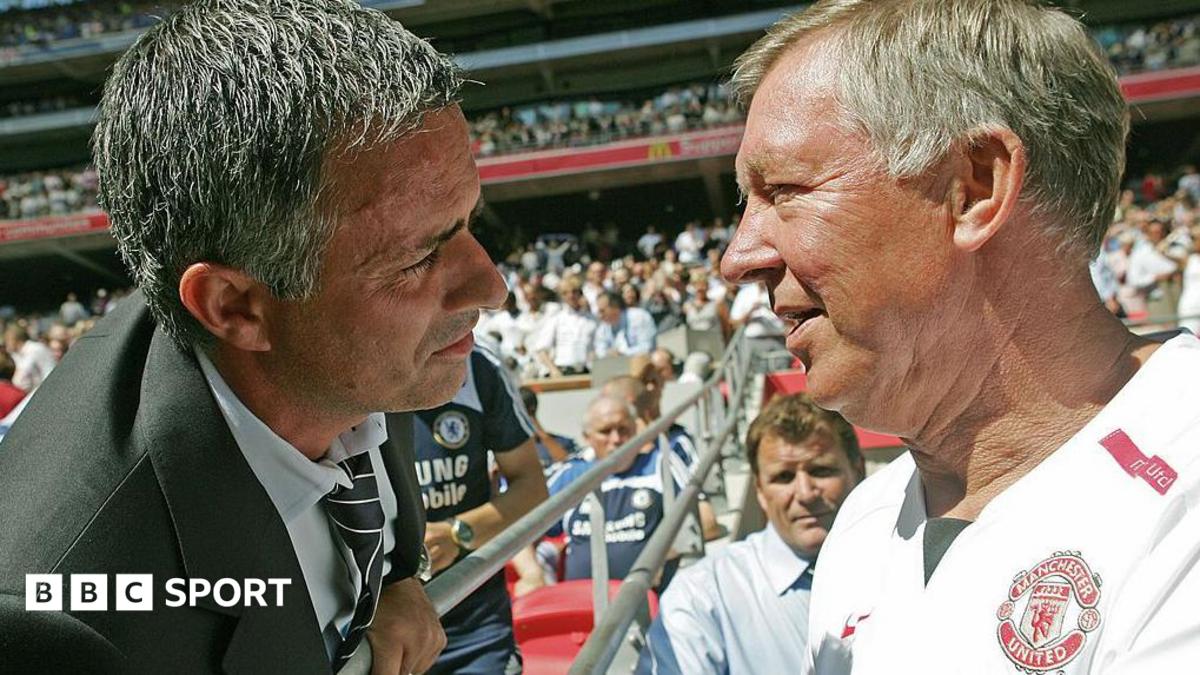
After years of speculation, Jose Mourinho has confirmed that he agreed to replace Sir Alex Ferguson at Manchester United in 2013, before changing his mind and re-joining Chelsea instead.
“When I left Real Madrid, I signed to go to Manchester United after Sir Alex,” the 63-year-old coach – now back at Real for a second spell – said in a new Netflix documentary series about his career.
“He was offered the job, yes,” confirmed Ferguson, who won 13 Premier League titles over 26 years at Old Trafford before retiring in 2013.
“I sat him down and explained the situation,” he added: “As far as I was concerned, he was accepting. And then, within hours, it changed.”
What changed was that Mourinho felt he could not turn down a return to Chelsea, where he had won consecutive Premier League titles in 2005 and 2006.
“One night, he phoned me and he was crying and he says, ‘Alex, I can’t take it. I’ve given my word to Chelsea and I’m not going to break my word’,” said the former United boss.
“The reason he gave to me, I could understand, but I was disappointed.”
Mourinho said he was “very flattered” to be offered the job of replacing Ferguson “because Manchester United has an incredible appeal”.
“But one thing is love for football, another thing is love for a certain club,” he explained.
“I think this is more powerful than love for football and fundamentally, after Real Madrid, I needed to feel that I’m loved.
“For me to lose the chance to be the coach to succeed Sir Alex Ferguson was dramatic, but I don’t regret (it) because it was a decision that I made with my heart.”
After returning to Stamford Bridge in 2013, Mourinho went on to win his third Premier League title as well as the League Cup.
In May 2016, he got a second chance to take over at United, succeeding Louis van Gaal.
Over a two-and-a-half year spell at Old Trafford, Mourinho won League Cup and Europa League titles before being sacked in December 2018 following a slump in results.
He returned to another of his old clubs, Real Madrid, in May this year. Mourinho’s last spell there ended in acrimony as he fell out with club captain Iker Casillas and other players.
On the eve of his Real reunion, the combative manager and former Spain goalkeeper Casillas spoke candidly about the reasons behind those differences.
Mourinho also spoke about difficulties he has faced with former Chelsea owner Roman Abramovich, who hired him twice and sacked him both times.
When Craig Ferguson left CBS’ “The Late Late Show” in December 2014, fulfilling a pledge made public the previous April, it was assumed by some that it had something to do with not being offered the chair being vacated by his illustrious lead-in, David Letterman. (Stephen Colbert, you may be aware, was named the new “Late Show” host.) Others simply couldn’t believe anyone would just walk away from such a job, which Ferguson had held for two weeks shy of 10 years, because, even in the less prestigious 12:30 time slot it seemed like a prize — but mostly because he was so good at it.
“That’s one of the odd things about that particular genre of television,” he told me in 2016. “The minute I started at 12:30, the question became when and do you want and how are you going to get 11:30? But I never wanted 12:30, never mind 11:30. Why is that a thing?”
Ferguson went on to other things. He’s hosted game shows (currently the CW’s “Scrabble,” with puckish energy); toured as a stand-up (he’s on the road into June); hosted a history-themed panel show, “Craig Ferguson: Join or Die”; launched “Joy, a Podcast,” which is as close as he’s come to the confessional freestyling of “The Late Late Show”; and published “Riding the Elephant: A Memoir of Altercations, Humiliations, Hallucinations & Observations.”
His latest show, premiering Saturday on CNN, is “American on Purpose,” which shares a title with his first memoir, a reference to the Scottish-born Ferguson becoming an American citizen. Timed generally to the 250th anniversary of the United States, it finds Ferguson in a five-episode crazy quilt of observations, interviews, inquiries, stunts, games and documentary vignettes forming a comical, but not unserious, somewhat wayward look at American ideas and ideals — freedom of speech, capitalism, patriotism, individualism and immigration. It’s a vision wide enough to include monster trucks, lowriders, underground comedy, Miami street art, Texas barbecue and haggis tacos, dreamed up by Ferguson and executed by celebrity chef Marcus Samuelsson.
Ferguson, a Scotsman, having haggis tacos on “American on Purpose.”
(CNN)
“You know me,” Ferguson said when we spoke over video call recently. “Less format is better for me always.”
His caveat to the producers was that he wouldn’t “make an anti-American show. I wouldn’t make a show pointing out everything that’s wrong. I feel that’s a market that’s heavily catered to. I’m not a f—ing idiot, I’m not making propaganda, I won’t make a jingoistic show. But I want to make a show which is celebratory,” Ferguson says. “And I want to be clear that the show I make for CNN will be the same as if I was making it for Fox News. It has to be my point of view, which is upbeat without being dumb — I hope. I feel like we got pretty close.” This conversation has been condensed and edited for clarity.
A good friend of mine, an Englishman, recently became an American citizen and had only wonderful things to say about the naturalization ceremony, the diversity of his fellow new Americans, and the graciousness of the people conducting it. What was your experience?
My ceremony was in Pomona fairgrounds in 2008. And I think it was 2,000 of us; I think it was 1,999 new Mexican Americans and one new Scottish American. And it was f—ing wonderful. And it is moving. I kind of wish it for my friends who are born here, American citizens, because you have to remove your everyday, “Oh my God, did you see the news today” cynicism, and remember what this place is about — freedom, second chances, third chances, escape, representation, individualism, different ideas coexisting in one country, wildly different points of view somehow managing to get along. That is f—ing beautiful. What I still feel as an immigrant American is a certain gratitude that doesn’t leave you. I’m not blind to the faults of the United States. Show me a country that doesn’t have faults. We talk about the bloody past. Show me a country that doesn’t have a bloody past. Humans have a bloody past. I’m not saying there’s nothing wrong, but I’m not looking at that in this show. I’m looking at what makes me feel great about this place, and it is a great place, an aspirational place. To my mind, we are still the big foam finger number one. I don’t think there’s anyone can touch us for … unusualness. We’re really unusual.
It’s a very optimistic show. Is that how you feel personally about the future of the country, and humanity?
Like most people, I have my moods. I got a real boost of optimism [hanging out] with very clever academics who kind of guard the Declaration of Independence in Philadelphia. And you say to them, “People say the country’s never been this divided.” They always laugh. They laugh at the idea it’s never been as bad as this, the rhetoric has never been this hateful. They’re like, “It’s always been like this. It’s always been an argument. The whole point of this place is that it is an argument.” The guys who started this country, some of them hated each other with just as much venom and outrage and indignance as political players hate each other today. I find that quite encouraging. Like I said, I’m not blind to the fact that there are issues and faults and deep things to worry about. But that’s not what this show’s about. It’s as if I was a musician, and I decided to write a happy song. People say, “Why aren’t you sad?” I’m like, “Well, I get that sometimes, but this song is a happy song, this is a rock song. I’ll do a power ballad later on.” It’s not terrible to to do something upbeat every now and again.
What did you discover in the course of making the show?
There were many things, actually. In L.A., I did a kind of run around with the guys who make the lowrider cars, and the community and the story of how that came about are really fascinating, a kind of parallel run of the rise of the automobile in America, but how it was taken on by the Mexican culture. Another that really stuck with me was in the Everglades, when I was with the Gladesman there, finding out that a large percentage of them [were descended from] displaced Scottish peasants, cleared out of the Highlands to make room for sheep for the landowners; they went to Canada, and they drifted all the way down to the southern tip of the United States. These guys there could trace their ancestry back to 100 miles from where I grew up. Americans would be kicked out of most of the countries of the world. So it makes us awesome. I mean, 40% of this country can trace themselves through Ellis Island, through that administration building in New York. That’s insane.
Ferguson at Venice Beach in a segment on the show.
(CNN)
When did you get interested in history?
In Scotland, we’re surrounded by it all the time. There’s a lot of stuff still lying around from a long time ago. American history became interesting to me because it was so attached to Scotland. The Scottish Enlightenment is really kind of the origin story of the Declaration of Independence. Knowing that the philosophy that was coming out of Edinburgh in the 1700s was directly feeding into what these guys were doing, it felt like the continuation of a certain strain of Scottish history. It didn’t end with “Highlander” or “Shrek.”
There’s a road movie element to the series. Do you take trips around the country on your own time?
All the time. I don’t think you can know the United States unless you’ve driven across it at least a couple of times. If you can take a car from New Orleans to Northeastern Maine, Florida to Washington state, it’s worth doing. One of the things that was in the engine for me when I started this [series] was, I’ve seen over the years a lot of — probably more in Britain than in America — lazy kind of pseudo-intellectual documentaries where somebody will say, “Well, you know, the thing about America is…” Well, which America are you talking about? And they will go and get some guy that lives on his boat in Fort Lauderdale with a hat that’s got “Who Farted?” written on it and tell you that’s America. That guy’s there and he’s awesome, but it’s not the whole story. You know what I mean? It’s like saying “Well, you know, Hitler was a vegetarian.” That’s true, he was. But it’s not really the whole f—ing story, is it?