Federal Aviation Administration

FAA clears smallest Boeing 737 Max to fly

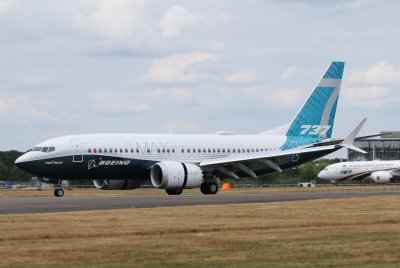
A Boeing Max 737 is seen on display in 2018 at the Farnborough International Air Show in Farnborough, United Kingdom. The Federal Aviation Administration has certified the Boeing Max 737 7 model to fly after years of delays. File Photo by Cityswift/Flickr

Aug. 3 (UPI) — After years of delays, the Federal Aviation Administration has certified the Boeing 737 Max 7, the smallest model in that line, to fly passengers.

The FAA delayed the certification for reasons including the redesign of an engine anti-icing system and other safety and manufacturing issues. In addition, there was increased inspection after Max 8 models, which had already been certified, crashed in 2018 and 2019.

“The approval reflects years of sustained work to resolve complex technical issues and complete a thorough review of the airplane’s design and supporting safety analyses,” the FAA said in a statement.

“Throughout the process, the FAA performed or directly reviewed significant work involving flight controls, system safety assessments, human factors, flight-crew alerting and other novel, complex or safety-critical areas, while also requiring testing, design changes, and additional analysis when necessary.”

Airlines will now need to work the planes into schedules, so it may take a while before passengers see them. They had originally expected to have the Max 7 models flying before the COVID-19 pandemic.

“This important certification validates the rigor of our airplane’s design and recognizes the determination and resilience of our 737 MAX development team,” said Stephanie Pope, Boeing Commercial Airplanes president and CEO, in a statement Monday.

Boeing’s stock rose about 8% in Monday afternoon trading following the news.

The company is still waiting on certification of the 737 Max 10 model, the largest in the line, which has also been delayed for years.

In mid-July, the FAA resumed allowing Boeing to issue airworthiness certificates for its 737 Max aircraft and 787 Dreamliners. The manufacturer lost that authority after the Max 8 crashes, which killed more than 300 people. It has since escalated production of those airplanes.
Source link

SpaceX scrubs launch of 13th test flight for massive Starship rocket

July 16 (UPI) — SpaceX on Thursday scrubbed the planned 13th test light of its massive Starship megarocket just seconds before it was set to lift off from the company’s Texas Starbase.

The launch was abruptly canceled just before the “Super Heavy” booster was about to ignite its multiple engines.

“Standing down from today’s flight test attempt,” launch commanders posted on X, without immediately offering a further explanation.

It remained unclear when another launch would be scheduled.

In the build-up to the planned launch, the company says it is aiming to fine-tune the performance of third version of the most powerful rocket ever built with Thursday’s mission — specifically the Super Heavy booster.

During the 12th test flight May 22 it encountered several hiccups, including slight differences in engine startup at separation stage causing the directional flip of the booster to be off by approximately 90 degrees.

The booster was supposed to perform a sustained burn to a controlled landing in the gulf, but the engine failure meant it fell back to Earth instead in a “hard splashdown,” SpaceX said in its launch report.

The Federal Aviation Administration said there were no reports of public injury or damage to public property from the mishap.

In response, SpaceX said in a blog post that “the startup sequence has been modified to be more robust to timing variability and more reliably flip in the desired direction, which is done to increase overall performance.”

Also during Flight 12, the Super Heavy booster encountered problems when attempting its boostback burn in which five of its 33 engines malfunctioned when attempting to re-light. This caused the boostback burn to end early.

“The Super Heavy on this upcoming flight has hardware modifications to improve re-light reliability along with updates to engine alarms and aborts to match the conditions seen in the multi-engine flight environment,” Space X said.

The Starship system has two parts: the Super Heavy booster and the spacecraft itself, also called Starship, or sometimes just “Ship.”

Flight 12 was the first launch of the third version of the system, which is the first capable of deep-space flight. Plans call for Starship to carry Artemis 4 astronauts to the surface of the moon in a mission set for late 2028.

In another notable element of Thursday’s Flight 13, Starship for the first time will carry V3 Starlink satellites to space as the company aims to “greatly expand” its communications network’s capacity and user speeds.

As part of this initial test, Starship is set to deploy 20 satellites which will extend solar arrays and antennas in a bid to connect with the larger Starlink constellation via high-capacity lasers as they will be on the same suborbital trajectory as Starship.

Those satellites are designed to burn up on reentry into the Earth’s atmosphere approximately 20 minutes after deployment.

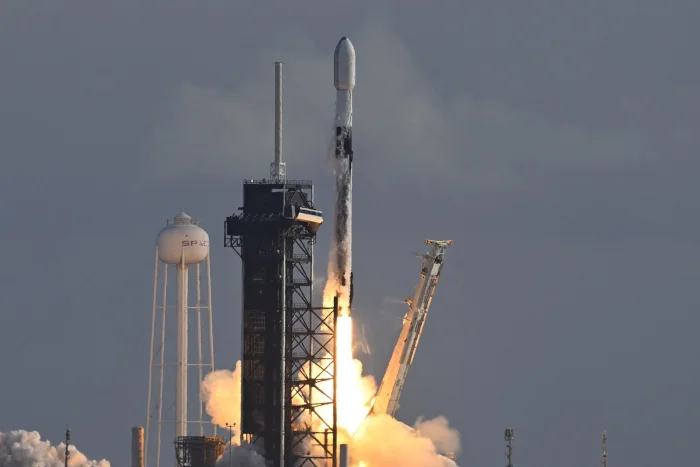
The SpaceX Falcon 9 rocket launches 29 of its Starlink satellites on mission 6-99 from Launch Complex 39A at the Kennedy Space Center in Florida on December 17, 2025. Photo by Joe Marino/UPI | License Photo

Source link

Ex-CIA agent charged with stealing $40M in gold bars from the agency

May 28 (UPI) — A former CIA agent is accused of stealing nearly $40 million worth of gold bars and about $2 million in cash from the agency, and lying to the agency about his education, military history and pilot license.

David J. Rush of Virginia, who is described in a criminal complaint as a former senior executive with a top secret clearance, was arrested last week and charged with theft of public funds, The Washington Post, USA Today and NBC News. He also claimed about $77,000 of paid military leave for which he wasn’t entitled.

The FBI searched Rush’s home last week and found 303 gold bars that weighed 2.2 pounds each and are estimated to be worth about $40 million, according to an affidavit written by Special Agent Matthew Johnson, USA Today reported.

The FBI seized the gold from the home along with about $2 million in cash and 35 luxury watches, many of which were Rolexes.

From November 2025 and March 2026, Rush requested and received “a significant quantity of foreign currency and tens of millions of dollars in gold bars for work-related expenses,” the affidavit said. When the government visited the storage facility where it was supposed to be stored, most of it was missing. The documents don’t list the reason he needed so much money and gold.

Rush had been in the Navy and was honorably discharged in 2015. But he allegedly told the agency that he was in the reserves for 10 years and took 744 hours of military leave during that time adding up to about $77,000, the affidavit said.

The affidavit alleges that Rush claimed to have a bachelor’s degree from Clemson University and a master’s degree from Rensselaer Polytechnic Institute. An FBI investigation found no record of him attending either school. He also claimed to have been a Navy pilot, but the investigation found no record of that, and the Federal Aviation Administration has no pilot’s license registered to Rush.

Rush is in the custody of the U.S. Marshals Service. He waived his right to a preliminary hearing, and a detention hearing is set for June 5.

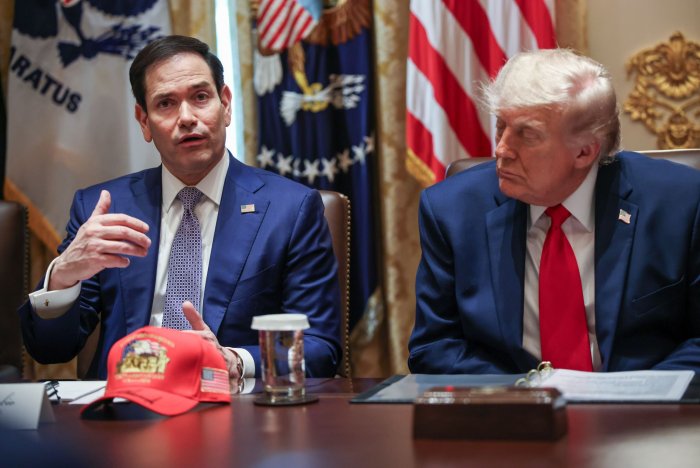
Secretary of State Marco Rubio and President Donald Trump participate in a Cabinet meeting in the Cabinet Room of the White House on Wednesday. Photo by Samuel Corum/UPI | License Photo

Source link

FAA tells SpaceX to investigate booster failure during test launch

May 27 (UPI) — The Federal Aviation Administration on Wednesday ordered SpaceX to investigate why a booster for its Starship rocket system failed during a test flight Friday, grounding the megarocket for a time.

The FAA declared the incident a “mishap” that involved the Super Heavy first-stage booster as it separated from the main ship and returned to the Gulf of Mexico after launch. The booster was supposed to perform a sustained burn to a controlled landing in the gulf, but a possible engine failure meant it fell back to Earth instead in a “hard splashdown,” SpaceX said in its launch report. The FAA said there were no reports of public injury or damage to public property from the mishap.

“The FAA will oversee the SpaceX-led investigation, be involved in every step in the process, and approve SpaceX’s final report, including any corrective actions,” the agency statement said.

“A mishap investigation is designed to enhance public safety, determine the root cause of the event, and identify corrective actions to avoid it from happening again,” the statement continued. “A return to flight of the Starship-Super Heavy vehicle is based on the FAA determining that any system, process, or procedure related to the mishap does not effect public safety.”

This means that another launch is less likely before the company’s planned initial public offering in June, TechCrunch reported.

The Starship system has two parts: the Super Heavy booster and the spacecraft itself, also called Starship. This was the first launch of the third version of the system, which is the first capable of deep-space flight. Plans call for Starship to carry Artemis 4 astronauts to the surface of the moon in a mission set for late 2028.

The Starship portion of the overall system did make it to space during this test launch, although it also lost one of its Raptor 3 vacuum engines there. Overall, this and other portions of the launch, including deployment of satellites and simulators, were considered a success.

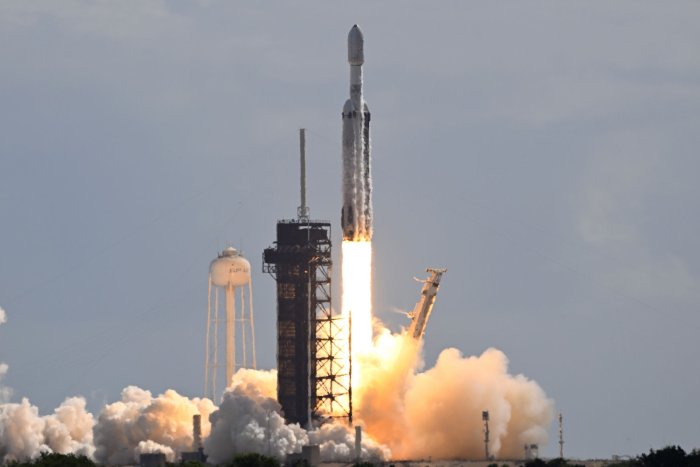
The SpaceX Falcon Heavy rocket launches the ViaSat-3 F3 satellite from Launch Complex 39A at the Kennedy Space Center in Florida on April 29, 2026. Photo by Joe Marino/UPI | License Photo

Source link

2-day NTSB hearing on UPS plane crash in Louisville begins

Members of the National Transportation Safety Board and FBI agents walk the runway looking for evidence from the UPS Flight 2976 MD-11 that crashed in November at the Louisville Muhammad Ali International Airport in Louisville, Ky. The NTSB hearing began Tuesday morning in Washington, D.C. File Photo by John Sommers II/UPI | License Photo

May 19 (UPI) — The National Transportation Safety Board began its two-day hearing on Tuesday on the deadly UPS cargo plane crash in Louisville, Ky., that killed 15 people on Nov. 4.

The NTSB released the agenda of the hearing as soon as it began at 8 a.m. EDT in Washington, D.C. The hearing will continue to 6 p.m. Tuesday, and 8 a.m. to 1 p.m. Wednesday at the NTSB Boardroom and Conference Center in Washington.

The NTSB has investigative hearings to find the facts and circumstances of transportation accidents or incidents under investigation, a press release said. The hearing is open to the public, but only NTSB board members, investigators, witnesses and parties to the hearing are allowed to participate.

The crash is the deadliest in the history of UPS. All three crew members on UPS Flight 2976 died, as well as 12 others on the ground, several of whom were working or shopping at nearby businesses. The crash also injured about 23 others.

The NTSB’s preliminary report showed that fatigued and overly stressed connecting pylons likely caused the left engine to detach from the McDonnell Douglas MD-11. The engine fell from the aircraft as it was taking off from the Louisville Muhammad Ali International Airport. The aircraft crashed into the ground and burst into flames. The fully fueled flight was intended for Honolulu.

The preliminary report said cracks caused by fatigue and signs of excessive mechanical stress were found in the pylon that connected the left engine to the wing. The plane was 34 years old and had recently undergone maintenance in San Antonio.

The engine-mounting hardware was last inspected in October 2021. It wasn’t due for another inspection until the aircraft completed 7,000 more flights, the NTSB said. The preliminary report showed no apparent pilot errors.

The NTSB invited several groups to participate in the hearing: the Federal Aviation Administration, UPS, The Boeing Company, GE Aerospace, Teamsters Airline Division, Independent Pilots Association and Collins Aerospace.

The hearing panel includes accident investigators and engineers. They will hear from nine witnesses on Tuesday. A new panel will hear from four witnesses from the FAA and Boeing on Wednesday.

In January, UPS announced it was retiring all MD-11 planes and was reducing its workforce by 30,000.

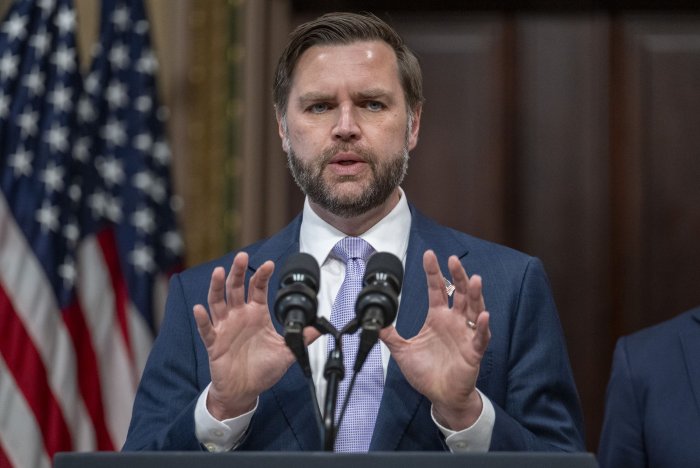
Vice President JD Vance speaks during a news conference on anti-fraud initiatives in the Indian Treaty Room of the Eisenhower Executive Office Building at the White House on Wednesday. Photo by Daniel Heuer/UPI | License Photo

Source link