WITH its cobbled roads, charming streets and historic buildings, Rye is considered one of the most beautiful destinations in England.
And it’s set to make a TV appearance too as the East Sussex town was used as the backdrop in a new period TV series coming to Netflix.
Rye in East Sussex will make an appearance in a new Netflix seriesCredit: AlamyPride and Prejudice starring Emma Corrin will air this autumnCredit: Netflix
Last year, Rye transformed into the fictional town of Meryton for a new television adaptation of Pride and Prejudice.
TV crew and cast descended on the town in September to create a time-warp setting for Jane Austen’s novel.
Sign up for the Travel newsletter
Thank you!
Actors were spotted wearing period costumes and the streets were dressed to look like the 1800s.
The Netflix series is set to be released this autumn starring Emma Corrin as Elizabeth Bennet, and Jack Lowden as Mr Darcy.
The town is popular with tourists thanks to its traditionally English look and has even been dubbed the ‘new Cotswolds‘ by country lifestyle experts at Welligogs.
The experts described it as having a “storybook atmosphere” filled with “antique shops and independent boutiques”.
For shopping Mermaid Street is the place to be – it was also selected as being one the prettiest streets in Britain by The Telegraph.
While it might be miles away from Oxfordshire and Gloucestershire, Rye shares lots of the same qualities as towns found in the Cotswolds like pretty cottages and independent shops.
The Cotswolds has rivers running through its villages, while Rye offers a beach escape for those who want to check out the seaside instead.
Camber Sandsis just 10-minutes away in the car to get from the town to the dunes.
Mermaid Street in Rye is considered one of the most beautiful streets in BritainCredit: Alamy
Head of Sun Travel (Digital) Caroline McGuire said: “The medieval town of Rye in East Sussex isn’t strictly seaside, but you can see the sea from its cobble streets and it has a harbour where boats sail out to the English Channel.
“Plus, if you go back as far as the 15th century, the sea came much closer to the foot of the hill the town is built on.
“It’s the perfect place to spend a day out – taking an hour and six minutes on the train from Kings Cross St Pancras.”
“If you fancy a morning on the beach, a bus runs from the town to the stunning Camber Sands beach – a three-mile stretch of golden sand backed by dunes.”
The town of Rye can easily be reached from London – it’s an hour from St PancrasThe town is 10-minutes from the rolling dunes of Camber SandsCredit: Alamy
She continued: “Or you can for a six-mile circular walk from Rye to Winchelsea beach.
“Back in the town after lunch, there are plenty of fantastic pubs to choose from, my favourites being the 12th century Mermaid Inn and the George In Rye, as well as the Globe Inn Marsh on the outskirts of the town.
“Equally, you could book a taxi and check out Tillingham vineyard in nearby Peasmarsh, with its Michelin Green Star wine tours and excellent pizzas.”
“Make sure to save some time to rummage through the many, many antiques shops, as well as Knoops hot chocolate shop and the wonderfully old fashioned Britcher and Rivers sweet shop.”
Meta, parent company of Instagram and Facebook, is on trial over claims it sought to hook young users on its platforms despite mental health concerns.
Published On 26 Aug 202626 Aug 2026
The top executive at Instagram has admitted that few teenagers have used a feature meant to counter addiction before it was turned on by default, as hearings in a landmark trial against its parent company, Meta, continue in the United States.
Adam Mosseri testified on Tuesday as Meta’s trial – over accusations that it designed its platforms, including Facebook, to be addictive to young people – entered its second week.
Recommended Stories
list of 3 itemsend of list
Mosseri, who has led Instagram since 2018, denied any suggestion by US states suing Meta that Instagram had stalled by not making the “Take a Break” feature the default setting for teenagers until September 2024, nearly three years after its launch.
“Most teens didn’t want it,” Mosseri said. “We decided to push forward with it anyway.”
Mosseri is a central witness in the lawsuit brought by 29 US states, in what experts call the biggest legal test yet of social media’s effects on young users.
Four of the states – California, Colorado, Kentucky and New Jersey – have accused Meta of designing the platforms to hook young users, driving anxiety, depression and even suicide, while misleading consumers about the platforms’ safety.
All 29 states say Meta violated US federal law by improperly collecting and employing the personal data of children under 13 while they used its platforms.
The states are seeking approximately $200bn in damages from Meta.
‘Designed to fail’
Meta has rejected accusations that it sought to addict children, saying its research showed no clear link between adolescents’ social media use and a lack of wellbeing.
Under questioning from Jason Slothouber, a lawyer for Colorado, Mosseri acknowledged that the percentage of teenagers using Take a Break was in the low single digits before Instagram made it the default.
Take a Break encourages teenage users to close the app after a certain amount of time. Mosseri had estimated in a December 2021 blog post that more than 90 percent of teenagers who turned the feature on kept it on.
That number, however, referred to the number of those who had turned on the feature.
When asked whether Meta had disclosed its low adoption, which had reached only 1 or 2 percent of accounts, Mosseri admitted the company had not, but said the safety features were later turned on by default in Teen Accounts, which launched in 2024 and have parental controls.
Former Meta employees have said that features such as Take a Break and Quiet Mode were difficult to find and not widely used, casting doubt on whether they represented a serious effort by the company to limit screen time for young users.
“In my experience, Take a Break is a feature that’s designed to fail,” Arturo Bejar, a former Meta engineering director, testified last week.
George Volichenko, a data scientist who worked on safety features at Instagram in 2022 and 2023, likewise stated on Monday that adoption rates of such features were “very low” and that company leadership had declined to approve turning on Quiet Mode by default for young teenagers.
He added that turning on such features automatically would have had a “notable negative impact” on user engagement.
The trial could last six weeks.
Jurors are expected to issue an advisory verdict. US District Judge Yvonne Gonzalez Rogers will decide whether Meta is liable and, if so, determine any civil penalties and changes to Facebook and Instagram.
Weekly insights and analysis on the latest developments in military technology, strategy, and foreign policy.
The U.S. Navy’s Ford class aircraft carriers have been very much in the news in the past week, with huge changes to the core design now potentially on the horizon. Whether or not radical changes to the catapults, weapons elevators, and island superstructure on future ships in the class actually materialize remains to be seen. However, the design has already been changing in various other ways. This includes adding back in a feature that had been found on all Nimitz class carriers and other Cold War-era flattops before it – dedicated radar illuminators to guide surface-to-air missiles.
The Mk 95 radar illuminators on John F. Kennedy were particularly visible in pictures released last week of the ship leaving port in Newport News, Virginia, to begin acceptance sea trials. The carrier, also known by its hull number CVN 79, made its maiden voyage in January, and the Navy hopes to take formal delivery of the ship before the end of the year.
The future USS John F. Kennedy is seen leaving port to begin acceptance sea trials on August 12, 2026. A Mk 95 radar illuminator is seen on a sponson on the port side of the ship’s stern. HIIA close-up look at the Mk 95 radar illuminator. HII
The Mk 95 traces back to the 1970s and was originally designed to support the employment of surface-launched RIM-7 variants of the Sparrow missile. All versions of the RIM-7 use semi-active radar guidance, which requires the launch platform to ‘illuminate’ the target.
As an example of the mode of operation for the RIM-7, if a ship were to detect an incoming cruise missile or some other kind of aerial threat, it would cue the missile in the right direction, fire it, and then use illuminators like the Mk 95 to ‘paint’ the target in radar energy. The missile’s seeker would then passively home in on the reflected radar energy through the terminal phase of flight.
When it was first introduced, the Mk 95 was part of a larger fire control suite that also brought an important new level of automation compared to previously available capabilities. Some earlier illuminators on Navy ships even had to be manually operated by sailors on deck.
Today, Mk 95s are found on a variety of U.S. and foreign naval vessels, including the Navy’s Nimitz class carriers. Some versions of the illuminators have camera systems to further help spot and track incoming threats, which have also been upgraded over the years. Improvements in associated combat systems also mean they have become better able to manage available illuminators to allow for as many engagements simultaneously as possible.
A Mk 95 radar illuminator, among other things, seen at the stern end of the Nimitz class aircraft carrier USS George Washington. USNClose-up looks at improved Stalker Long-Range Electro-Optical Infrared Laser Sensor System (SLREOSS) cameras mounted on Mk 95 illuminators. Ball Aerospace
The RIM-7 family has since been supplanted in U.S. Navy service with the improved RIM-162 ESSM. Block 1 variants of the ESSM also use semi-active radar guidance and have the same general mode of operation as their predecessors. New Block 2 versions, which began entering service in the early 2020s, have semi-active and active modes, the latter of which does not require any illumination in the terminal phase. In addition, the new missiles feature a data link, allowing them to receive targeting updates after launch, helping cue them to the target area, which further reduces the need for an illuminator in the initial phases of flight. It is also very valuable for longer-range engagements beyond the horizon, especially against low-flying cruise missiles.
A Block 1 ESSM seen just after launch. USNA RIM-162 Evolved Sea Sparrow Block 2 missile. Canadian Department of National Defense
At present, the defensive armament suite on Ford class aircraft carriers includes two 21-round launchers for RIM-116 Rolling Airframe Missiles (RAM), three Mk 15 Phalanx Close-In Weapon Systems (CIWS) armed with 20mm Vulcan cannons, four 25mm cannons on Mk 38 mounts, and various small arms. There are also two eight-cell Mk 29 launchers, a design that also dates back to the 1970s and was originally designed to fire RIM-7 Sparrows. The Mk 29 has since been adapted to fire Block 1 ESSMs, but there were issues in integrating Block 2 versions owing to the increased weight of those missiles, at least in the past.
“CVN 79 and follow-on Ford class ships will be upgraded to a mix of new RAM variants Block 2A and 2B, plus a mix of ESSM Block 1 and Block 2,” according to an annual report from the Pentagon’s Office of the Director of Test and Evaluation (DOT&E) covering work on the program during the 2025 Fiscal Year.
The Navy’s most recent annual budget proposal for Fiscal Year 2026 does note work to modify the Mk 29 launchers to support Block 2 ESSM capability, but the current state of those efforts is unclear. The service is also pursuing an entirely new launcher to replace the aging and increasingly unsupportable Mk 29, as well as a follow-on to the Block 2 ESSM.
Even with integration of the Block 2 ESSM, Ford class carriers will still have to provide ‘illumination’ in order to employ Block 1 versions of the missile, which remain in active Navy inventory. As noted, Block 2 variants can be employed in a semi-active radar homing mode, as well.
This all brings us to the matter of the DBR, which was intended to be the main radar on all members of the Ford class. The DBR consists of two distinct radar systems, the AN/SPY-3, an X-band active electronically scanned array (AESA) type, and the AN/SPY-4, an S-band phased array. On paper, this was set to be a powerful combination. In a defensive scenario, the SPY-3 would be used for horizon search, generating high-fidelity target tracks, and otherwise helping direct interceptors like the ESSM to their targets. The volume search SPY-4 would provide additional long-range search and tracking functionality. Being able to fuse all that data for the dual arrays together, while also leveraging the specific capabilities of the quick-scanning AESA SPY-3, would only offer even greater benefits.
A look at the front of the island superstructure on Ford showing two fixed-face arrays that are part of the DBR. USN
As part of the original Ford design, DBR also serves as host of other functions, including helping to provide air traffic control in support of flight operations. This also allowed the Navy to pare down the total number of distinct radars on the ship compared to the Nimitz class. This, in turn, directly factored into the design of a smaller and more angular flight deck island on the Ford class. Just this week, TWZ published a separate detailed piece on the island, and the reasons for its location so far back on the flight deck. This followed reports this past weekend that President Donald Trump is pushing the Navy to reposition the structure on future ships in this class on aesthetic grounds.
“Here’s the one thing that I think I screwed up. I think I’m responsible for at least a billion-dollar cost of overrun because I wanted to reduce the number of radars,” retired Navy Capt. Tal Manvel, who served for a time as Program Manager for Future Carriers, said during a presentation at the U.S. Naval Academy Museum in 2015. “I did not appreciate that the complexity of that is not just increasing scale like with a mechanical system, like in the propulsion plant, but the complexity of the software-hardware interface.
A detailed comparative look at the radar configurations and island designs on the Nimitz class carriers USS Ronald Reagan (CVN-76) and USS George H.W. Bush (CVN-77), as well as the USS Gerald R. Ford (CVN-78), from Tal Manvel’s 2015 presentation. U.S. Naval Academy Museum capture
“That’s my fault. I screwed up on that because I thought that this would be significant,” Manvel continued. “It turns out to be a big cost driver up front, and that’s one of the reasons why the Ford has this challenge of cost.”
You can watch Tal Manvel’s full 2015 presentation below.
Shifley Lecture: USS Ford-class carrier design
The Navy has since made the decision to replace the DBR on Ford class carriers primarily with the AN/SPY-6(V)3, also known as the fixed-face version of Raytheon’s Enterprise Air Surveillance Radar (EASR).The AN/SPY-6(V)3 has three antenna arrays compared to the DBR’s six. John F. Kennedy and future ships in the class will also feature an AN/SPQ-9B horizon search radar and the Mk 9 Tracker Illuminator System – which includes the Mk 95 illuminators – to provide additional functionality that was originally supposed to come from the DBR.
A side-by-side comparison for the islands on the future USS John F. Kennedy, at left, and the USS Gerald R. Ford, at right. HII/USN
As an aside, the DBR was originally a core component of the Zumwalt class stealthy destroyer design, and was to be deeply integrated with the ship’s unique combat system, but suffered from similar technical and reliability issues in that setting, as well. The Navy subsequently decided to eliminate the S-band arrays on those ships as a cost-cutting measure. As it stands now, the USS Gerald R. Ford is the only ship the service expects to operate with the full DBR. The Navy has plans to eventually replace the DBR on that carrier with the EASR and other radars, too. Several variants of the AN/SPY-6 are also increasingly being integrated onto a host of different Navy ships, as seen in the graphic below.
RTX
The need for the Mk 95 illuminators on the Ford class could evolve further over time, including as the Block 2 ESSM enters more widespread service and with the development of the planned follow-on missile. TWZ has previously noted that the total number of Mk 95s has been reduced on at least some Nimitz class carriers for reasons that are still not entirely clear.
John F. Kennedy is also expected to bring along other important, but less visible improvements, which are set to be carried over to future ships in the class. This includes upgrades to the ship’s combat management system and a Block II version of the Navy’s Cooperative Engagement Capability (CEC) networked sensor architecture.
The Ford class program, overall, continues to face major delays and cost growth due to a host of technical issues and other factors that go well beyond problems with the DBR. The Navy had originally hoped to receive John F. Kennedy in 2022. Work on the next two ships in the class, the future USS Enterprise and USS Doris Miller, is also running behind schedule.
Another look at the future USS John F. Kennedy as it headed out for acceptance sea trials last week. HII
As highlighted in John F. Kennedy‘s recent sea trials, the Ford class design is already evolving in notable ways, particularly when it comes to the radar suite.
Special thanks to user @lfx160219 on X for bringing the Mk 95 radar illuminators on the future John F. Kennedy to our attention.
Progressive candidates for governor in Wisconsin and U.S. Senate in Minnesota are making their final pushes ahead of Tuesday’s election, increasing the pressure on a Democratic establishment that has spent the year on its heels.
The primaries come a week after Abdul El-Sayed narrowly defeated Rep. Haley Stevens in Michigan’s divisive and costly U.S. Senate primary. El-Sayed’s victory has energized the left while stoking fears among Democratic Party leaders that the shift to the left, particularly in battleground states like Michigan and Wisconsin, will make it more difficult to win in November.
Wisconsin’s chaotic primary pits progressive against governor’s pick
In Wisconsin, democratic socialist Francesca Hong is trying to win a four-way Democratic primary for governor where her top opponent has been endorsed by popular Gov. Tony Evers, who isn’t seeking a third term.
Evers got behind Milwaukee County Executive David Crowley on July 18, the same day Crowley reentered the race after dropping out 10 days earlier. Crowley rejoined after the candidate he backed, Lt. Gov. Sara Rodriguez, ended her candidacy amid a campaign finance scandal.
Evers and Crowley were crisscrossing the state together in the last days before final ballots are cast Tuesday.
Evers and more establishment Democrats were hoping to finally coalesce around Crowley in the final days of the chaotic primary that saw two other candidates drop out, most notably former Lt. Gov. Mandela Barnes on July 29.
Barnes and Rodriguez, who were both seen as potential front-runners, remain on the ballot and absentee votes already cast for them can’t be undone.
Republicans are spending to influence the Democratic primary
Republicans are putting money behind Hong, thinking she will be the better matchup for Republican U.S. Rep. Tom Tiffany in November. The Republican Governors Association has spent nearly $3.6 million through its Right Direction Wisconsin PAC on ads contrasting Hong with President Donald Trump and playing up her liberal policies.
Crowley and other Democrats argue the ads are meant to bolster Hong’s standing in the primary because Republicans see her as the easier opponent.
Evers projected confidence at a rally that attracted hundreds of people in Hong’s hometown of Madison on Sunday night, saying Crowley was the best chance Democrats had to defeat Tiffany.
“We’re going to win this thing,” Evers said, telling the Crowley supporters that Tiffany would be “the worst governor in the history of Wisconsin.”
“If Tom Tiffany wins in November that will be like electing Donald Trump as governor of the state of Wisconsin,” he said.
Crowley urged Democrats to come together after the primary to beat Tiffany.
“Our ultimate goal is to make sure we don’t have a MAGA extremist occupying the governor’s office,” Crowley said.
Tiffany, one of the most conservative members of Congress, is endorsed by Trump.
The president called Hong a communist in remarks on Wednesday, where he mentioned a 2020 social media post by Hong calling for Thanksgiving to be canceled. Asked about the post this week, Hong reversed herself and said that Thanksgiving was her favorite holiday.
Trump won Wisconsin in 2016 and 2024, and Republicans have held majorities in both chambers of the Legislature since 2011. Holding onto the governor’s office is key to Wisconsin Democrats’ effort to gain full control of state government for the first time in 16 years.
In the race to replace Tiffany, U.S. Transportation Secretary Sean Duffy’s son-in-law Michael Alfonso is in a five-person Republican primary. Alfonso, who is trying to represent Duffy’s old congressional district, has Trump’s endorsement.
Minnesota primary comes in wake of immigration enforcement surge
In neighboring Minnesota, voters are choosing between moderate U.S. Rep. Angie Craig and progressive Lt. Gov. Peggy Flanagan in a Democratic U.S. Senate primary that’s playing out in the aftermath of Trump’s aggressive immigration enforcement surge in the state.
The race has been shaped by the killing of Renee Good and Alex Pretti by federal immigration officers in Minneapolis, confrontations that were caught on camera and fueled a backlash to Trump’s immigration policies.
Both Craig and Flanagan spent the weekend traversing the Twin Cities metro area.
In a driveway in suburban Eagan on Sunday, Craig spoke to the angst among Democratic primary voters who feel that Washington isn’t working for them. Members of Congress need to stop trading stocks and becoming lobbyists when they leave office, she said, and the U.S. needs to restrict the flood of corporate campaign spending.
“But the only way we pass any of the progressive policies that all of us here support is by winning elections and taking damn majorities,” she said.
Unlike in Wisconsin, where the incumbent governor has endorsed a candidate in the race to succeed him, Minnesota Gov. Tim Walz has not gotten involved in the Senate primary. But his wife, Gwen Walz, has endorsed Craig and campaigned with her on Sunday.
Flanagan campaigned Saturday with U.S. Sen. Chris Van Hollen, a Maryland Democrat, who helped her make the case that Washington needs a shake-up to root out the deep-pocketed forces propping up a broken status quo.
“It is big corporations, it’s special interests who are putting their thumb on the scale in our elections across the country,” Flanagan said. “And it’s not just Republicans. It’s Democrats, too.”
The race has been one of the most expensive Minnesota has seen, with millions of dollars backing both candidates, but disproportionately falling in Craig’s favor.
Whoever wins the primary will be the front-runner to replace retiring Democratic Sen. Tina Smith in November. Minnesota voters haven’t elected a Republican to a statewide office since 2006.
Mike Lindell, the founder of MyPillow, is a top Republican candidate in the governor’s race. He’s endorsed by Trump, and he was a prominent promoter of falsehoods about election fraud. U.S. Sen. Amy Klobuchar is in a six-person primary on the Democratic side.
Democratic struggles also on display in other states’ primaries Tuesday
Two veteran Democratic incumbents in Connecticut face challenges from the left.
Moderate Democratic Gov. Ned Lamont is running for a third term but faces progressive state Rep. Josh Elliott. The Democratic nominee will face Republican state Sen. Ryan Fazio in November.
Longtime Democratic U.S. Rep. John Larson, 78, is running for a 15th term and his age and health have been major issues in the four-person race.
Former Hartford Mayor Luke Bronin narrowly won the party’s endorsement at its state convention in May. Other candidates are Hartford Board of Education member Ruth Fortune and state Rep. Jillian Gilchrest.
In Vermont, two Democrats are running in for a chance to take on Republican Gov. Phil Scott.
Former child advocacy organization CEO Aly Richards boasts endorsements from former Democratic Govs. Howard Dean and Madeleine Kunin. She faces economist Amanda Janoo.
EUROPE’S biggest pumpkin festival is returning this autumn for its most immersive experience ever.
The iconic pumpkin patch, loved by celebs, welcomes thousands of visitors every year and it’s set to make an epic return.
Tulleys Farm is the ultimate autumnal day outThe farm’s famous pumpkin experience is back for 2026
Tulleys Farm has become an annual tradition that’s a must-do around Halloween for many Brits.
The West Sussex attraction boasts Europe‘s largest pumpkin patch with 1.5million pumpkins in over 100 varieties available to pick and take home.
Sign up for the Travel newsletter
Thank you!
Set across more than 100 acres of sprawling Sussex countryside, Tulleys Farm is just a 45-minute drive from central Brighton.
Priding itself on offering “more than just pumpkin picking”, the farm has so much on offer and has levelled up for 2026, preparing to welcome guests for its “best season yet”.
Opening its gates once again from September 19 until October 31, Tulleys new Pumpkin Festival will offer the ultimate autumnal experience.
Nestled in the newly created Pumpkin Valley, the festival will bring live entertainment, tasty seasonal food, unique shopping and roaming performers for families to enjoy.
Tulleys Pumpkin Festival will run from September 19 until HalloweenCredit: AlamyVisitors can pink pumpkins, eat, drink and enjoy the new Pumpkin ValleyCredit: Alamy
The enchanting attraction promises some magical escapism, as guests “wander along winding paths, with wooden bridges leading across gentle streams and peaceful ponds”.
Speaking about the new experience, Tulleys Farm co-owner, Sam Beare, said: “We have always believed the Pumpkin Festival should evolve every year. We are excited to introduce the Pumpkin Valley for 2026.
“Our vision with Pumpkin Valley was to create something truly unique, an area that pushes the boundaries and immerses guests in an entirely new world,” he added.
“The Pumpkin Festival is so much more than just picking a pumpkin, it’s an experience for all generations and we look forward to welcoming our guests back for what we believe will be our best season yet.”
Guests can visit by night, too, for an even more marvellous experience.
The after-dark events, kicking off from September 26, offer illuminated woodland trails, spectacular photo opportunities, delicious cocktails and tasty treats, live music along with an unforgettable atmosphere.
Tulleys will no doubt be as popular as ever this year, so its advised to book in advance, with tickets available from £8.95 per person.
While the company is known for offering a more luxurious travel experience for passengers in business and first class seats, Emirates has now revealed a brand new upgrade for economy travellers
14:34, 24 Jul 2026Updated 14:34, 24 Jul 2026
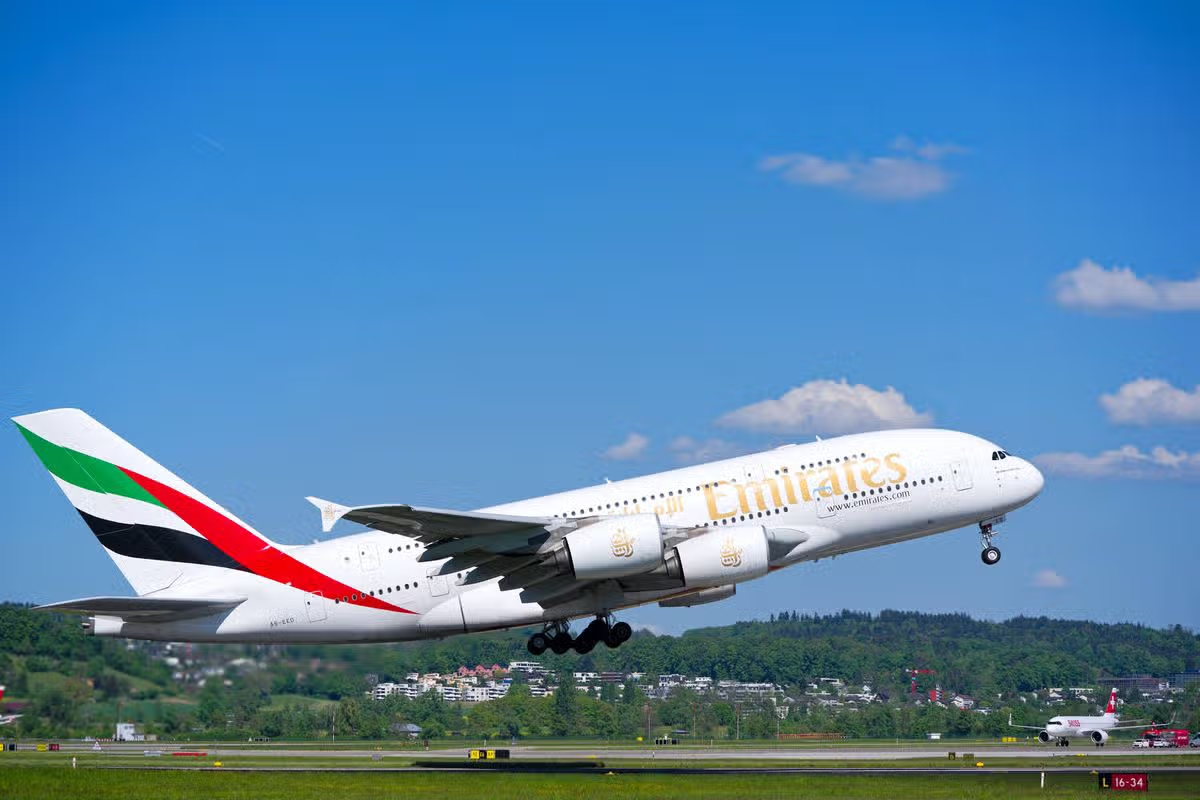
Emirates has upgraded the seats in its cheaper economy class (stock image)(Image: Getty Images)
But that doesn’t mean its cheaper, economy class is uncomfortable. The airline has upgraded economy seats in its newer A350 planes to provide more legroom. The on-screen entertainment system has also been given an upgrade. Passengers can also choose to pay an extra fee to enjoy Wi-Fi services on their flight – something budget airlines like Ryanair don’t always offer.
But now, the airline has revealed one more upgrade to their economy seats, and claims to be the first in the world to have upgraded seats’ pillows to provide more support for the passengers’ heads.
Emirates upgrades economy class seats
Taking to Instagram, the airline shared a video with the reveal, writing in the caption of the post: “Emirates just added something to Economy that no other airline has.
“Introducing the U-Dream adjustable headrest – just one of the many ways we’re continuing to invest in Emirates Economy. From thoughtful comfort to award-winning in-flight entertainment, every detail is designed to make your journey even better.”
Content cannot be displayed without consent
The clip showed a female passenger seated in an economy seat aboard an Emirates plane, before pulling down two sections of cushioning behind her head, one on either side, creating a makeshift travel pillow that makes nodding off on the plane considerably easier. The clip went on to explain that, while the carrier is widely recognised for its more premium offerings in business and first class cabins, it is equally committed to delivering a comfortable journey for those travelling in economy.
Branded the U-Dream, the ground-breaking adjustable headrest boasts flexible inward-folding wings designed to cradle the head and neck, enabling passengers to unwind in comfort throughout their journey.
To date, the headrests have been fitted on three A350 aircraft, with plans to install them across all of the airline’s A350s and the majority of its Airbus A380s and Boeing 777s.
Fans have different responses to the news
Viewers were quick to flock to the comments section to share their opinions. While the majority seemed to be happy with the upgrade, some also pointed out some of their worries with the headrests, such as how hygienic they would be.
“Personally, I will never use this new tool as they are never cleaned,” one person wrote. Another said: “U dream: Pre-seasoned headrests, comes with free dried drool flavor from previous passengers.”
Someone else also pointed out: “This doesn’t address the root issue. When people sleep/doze on the plane, their heads fall forward, not sideways; therefore, they really need something that supports the front of their neck and head/face.”
But despite the skepticism, the majority of fans seemed to be excited about the upgrade, with one person saying: “THANK YOU EMIRATES.”
Someone else said: “@emirates taking things up a level AGAIN!” A third person also commented: “”Honestly a simple but beautiful solution.”
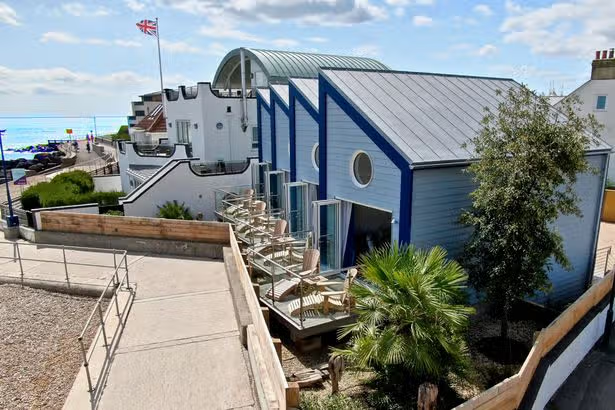
Swap the everyday grind for uninterrupted sea views, boutique beach-suite living, and endless coastal adventures with a 5 night stay in a luxurious Beach Suite courtesy of Beachcroft Hotel and Suites
Meta has rolled back its ‘Muse Image’ AI feature after widespread backlash over privacy and consent. The tool allowed users to generate AI images of people by simply ‘@ mentioning’ public Instagram accounts. The negative reaction was swift and global – forcing Meta to say it ‘missed the mark’.
Imagine Cruising has launched its new Americas Collection for 2027-28, featuring five luxury tailor-made holidays combining cruises with land excursions to destinations including New York, South America and Antarctica – with prices starting from £2,999 per person including flights, accommodation, transfers and tours.
The Met Office has issued a series of amber and red heat alerts this week as temperatures are set to rise close to 40C in some parts of the UK, with the RAC urging drivers without air conditioning to postpone non-essential journeys
An expert has spoken about driving in the UK this week (stock)(Image: CHUNYIP WONG via Getty Images)
Britain is being battered by a sweltering heatwave this week, with temperatures threatening to nudge close to 40C in some areas of the country. In response, the Met Office has issued a raft of amber and red heat warnings.
Britons are also being urged to keep their fluid intake up and remain vigilant for signs of heat-related illness brought on by the scorching conditions.
Some people may look to escape the heat by jumping into their car and cranking up the air conditioning. However, one motoring expert has cautioned drivers that even if their vehicle is available to them, they should think twice before getting behind the wheel this week.
In a statement published on the RAC‘s website, the organisation’s road safety spokesman Rod Dennis warned that motorists without air conditioning in their vehicles should consider putting off their journeys altogether.
Explaining his reasoning, he said: “Red extreme heat warnings are rare and we urge everyone to take them seriously this week. Drivers whose vehicles don’t have effective air conditioning should strongly consider postponing any non-essential car journeys until the Met Office’s weather warnings are lifted and temperatures drop.
“If this isn’t possible, our best advice is to travel during cooler times of day. This is especially important for anyone travelling with vulnerable people, including young children and older adults, who are at greater risk from the intense heat.”
Red heat warnings, set to take effect on Wednesday and Thursday this week, have been put in place owing to the exceptionally high temperatures forecast across the south and south-east of the UK.
Temperatures are expected to soar so dramatically that some forecasters believe records for June could be shattered. The current record for the hottest June day stands at 35.6C, set in Southampton in 1976 and in Camden Square, London, in June 1957.
The last time Britain endured a prolonged spell of temperatures reaching as high as 40C was roughly four years ago, in July 2022.
In a statement addressing the warnings, Met Office Deputy Chief Forecaster Mark Sidaway made it clear that red warnings are not handed out lightly, and are reserved solely for the most extreme weather conditions.
He said: “Red warnings are reserved for the most severe events and we’re expecting severe and significant impacts from this heatwave, with health impacts likely for many, even beyond those who are normally more vulnerable to the heat.
“The last time the UK recorded temperatures this high was in July 2022, but on this occasion the heat is expected to be accompanied by high humidity.”
Meanwhile, Dr Agostinho Sousa, Head of Extreme Events and Health Protection at the United Kingdom Health Security Agency, added: “We are urging health and social care services across the country to ensure they are prepared.
“A red heat health alert indicates a risk to life for even the healthy population, but simple actions like staying hydrated, avoiding the sun during the hottest part of the day, and keeping your home cool can make a big difference.”
You can now make our guides your own by saving individual recommendations for later — mixing and matching from food to fun and everything in between — with the confidence that your choices are backed by L.A. Times experts.
Saving is simple. Visit any of our local guides, find something that interests you and look for the “Save” button. From there, you can choose a category in which to save your item, such as Food & Drink or Things to Do.
Not an L.A. Times subscriber? Don’t worry. You can register for a free account to get saving on many of our guides. Once you’ve saved a few items, check out your personalized save dashboard at latimes.com/saved/guides. You can also find it in the site account dropdown menu.
Call it a wish list, bucket list or checklist — the dashboard is all yours. Revisit your saves, remove ones you don’t want and even see your items on a personal map.