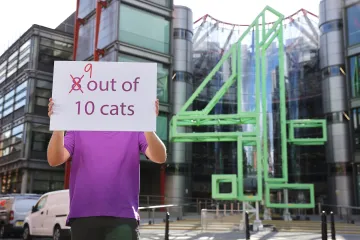
Naga announced last month that she was vacating her seat on the sofa, having been with the BBC morning programme since 2009, and now talk has turned to who will replace her.
Coral has now shared some odds and Sally – who is already one of the presenters on the programme – is the clear frontrunner for Naga’s job.
She currently has odds of 1/2, with Coral’s John Hill saying: “Sally Nugent is already a familiar face on BBC Breakfast, and our odds makes her the clear favourite to replace Naga Munchetty on the popular early-morning programme.”
Sally started her career at BBC Radio Merseyside and also worked at BBC North West Tonight and BBC News.
She became a part of the BBC Breakfast team as a sports presenter and then in 2021 it was announced that she was going to be a regular presenter from Mondays to Wednesdays. She usually hosts the programme alongside Jon Kay.
Other TV stars whose names are in the mix include BBC Morning Live host Helen Skelton, who is currently at 5/1 to succeed Naga when she bids farewell to the programme.
Sarah Campbell, who already hosts the programme, has odds of 7/1, while former BBC Breakfast business presenter Steph McGovern is on 6/1. Journalist Tina Daheley is listed at 8/1, while Emma Vardy and Luxmy Gopal, both hosts on the show, are at 10/1 and 12/1 respectively.
Broadcaster and newsreader Victoria Derbyshire is also considered a potential candidate for Naga’s role, and is currently at 14/1.
Naga confirmed last month that she was leaving BBC Breakfast and that she will assume the role of presenting 5 Live Breakfast five days a week from January.
“It has been a privilege to be part of the BBC Breakfast TV team for the past 17 years, working alongside an incredibly talented and hard-working group of journalists who are not only outstanding colleagues but also great friends,” she said in a statement.
“Presenting a flagship programme on 5 Live is an opportunity that was simply too good to pass up. It will take a huge amount of work and require 100% of my focus and energy, and I’m really looking forward to throwing myself into the role.”
For a true sense of getting away from it all, few things rival an island escape. We’d love to hear about your favourite under-the-radar islands in Europe, whether it’s a remote Scandinavian archipelago or an airport-free Mediterranean outpost that’s managed to avoid the package holiday crowds.
The best tip of the week, chosen by Tom Hall of Lonely Planetwins a £200 voucher to stay at a Coolstays property – the company has more than 3,000 worldwide. The best tips will appear in the Guardian Travel section and website.
Keep your tip to about 100 words
If you have a relevant photo, do send it in – but it’s your words we will be judgingfor the competition.
We’re sorry, but for legal reasons you must be a UK resident to enter this competition.
The competition closes on Monday 17 August at 10am BST
It’s early afternoon on an unusually hot and sunny Yorkshire day. I’m standing on my paddleboard on the tidal section of the River Esk, near Whitby’s New Bridge, as cars stream across. The 28-mile-long Esk is special, as it is the only major river in Yorkshire that flows directly into the North Sea.
Ahead of me is a bustling marina, the famous abbey and the West and East piers. The town is full to the brim with visitors in search of the best fish and chips, amusement arcades and tales of Dracula and Captain Cook. Later, in the autumn, goths in their finery will parade the cobbled streets.
Here on the river, however, it is tranquil. A salmon leaps from the water to my right, bubbles rise from the seaweed beneath my board, and to my left, the riverbank absorbs abandoned boats into its grassy knolls. On an evening paddle, you might spot the crews from one of the town’s three main rowing clubs (Whitby Coastal, Friendship or Fisherlads).
A few miles inland from Whitby, the Esk passes under the Larpool Viaduct. Photograph: Maciej Olszewski/Alamy
You can launch from the slipway at the far end of the marina back car park near Coates Marine. Arriving by train or bus, it’s a few minutes’ walk from the station. Launch about one and a half hours before high tide and head right towards the New Bridge and Ruswarp. Be mindful, this section of the river is tidal and water levels do drop.
After taking in the magnificent view, I turn and paddle towards Ruswarp, a couple of miles inland, passing under the Larpool Viaduct, which carries the 22-mile Cinder Track. Branches of willow trees droop elegantly into the water offering welcome shade. Swans glide past and Highland cattle graze nonchalantly in the fields. A couple hike the path that runs alongside the river.
I first paddled on the Esk with my young sons in 2006. Twenty years later, it still remains a peaceful, hidden gem. We hired kayaks from Ruswarp Pleasure Boats (established 1874) just above the weir, which also rents rowing boats and now paddleboards. For a £5 fee, it offers a private jetty to launch your own craft, which is ideal as access to the river is very limited along this stretch. There is free parking on the roadside here, and with the number 95 bus stop (Arriva) nearby, public transport is an option. Paddle up to Perry’s Plants garden centre at Briggswath just before Sleights and then turn back.
You’ll pass the Waterside restaurant and Whitby Wellbeing’s wild sauna along the way, so family and friends can eat, sweat or dip while you float along, letting the river carry your worries away. Afterwards, nip to Botham’s in Sleights for some Resolution tea and lovely iced lemon buns. I promise, it’ll be a grand paddleboarding day out in Yorkshire. Jo Moseley is the author of Stand-Up Paddleboarding in Great Britain
Wild camping on the Dart in Devon
Sian Lewis wild camping next to the River Dart. Photograph: Sian Lewis
On the uplands of Dartmoor, two tributaries – the East Dart and West Dart – join beneath ancient woodland at the well-named hamlet of Dartmeet. They entwine as the River Dart, which flows for 47 miles from open moor into steep wooded valleys and passes peat bogs and tors, oak forest, market towns and rolling pasture before it runs into the sheltered waters of the south Devon coast.
Its upper reaches retain a pristine wildness that feels increasingly rare in southern England. The Dartmoor national park is criss-crossed by some of the cleanest bodies of water in the country, home to salmon, sea trout and otters, while the wooded valleys below are rich remnants of ancient temperate rainforest.
The Dart’s name is thought to derive from an old Celtic word meaning “river where oak trees grow”, and the lower banks are indeed lined with native oak trees, thick with mosses and ferns. It may be one of Britain’s smaller protected landscapes, but Dartmoor feels remarkably untamed. You can cross it on foot in a few days, yet it’s surprisingly easy to lose yourself in the rolling mists, twisting woodlands and miles of open moorland of this ethereal landscape.
The River Dart runs past tors in the Dartmoor national park. Photograph: Maciej Olszewski/Alamy
It’s that sense of freedom that keeps drawing me back. I love nothing more than stuffing a tent into my rucksack and heading out on foot for a riverside camp, following the Dart and its web of streams and creeks until I find a quiet bend or grassy bank for the night. I fall asleep to the steady rush and rumble of the water and wake up early for a swim in one of its deep, crystal-clear pools before packing up and walking on.
I can roam about like this because Dartmoor is the only place in England where wild camping is legally permitted. In the national park, “backpack”, or wild camping, is allowed for one or two nights in some areas, provided you stay away from roads and settlements and leave no trace of your visit.
Sometimes, I have company on the riverbanks. I’ve huddled in bivouac bags with friends and woken totally covered in sparkling droplets of dew. I’ve camped on the water’s edge and woken in the middle of the night to what sounded like an invading army around my tent. It turned out to be a troop of scouts, arriving spectacularly late at their campsite and gamely pitching flimsy-looking tents by the light of their headlamps. And once, at dusk, I think I glimpsed the sleek head of an otter slipping into the current. But more often than not, once evening falls and I sit by the door of my tent watching the water darken, I have the Dart all to myself. Sian Lewis
Fishing on the Dove in the Peak District
Andy Pietrasik considers his tactics beside the Dove. Photograph: Andy Pietrasik
There’s a trout rising upstream from where I am standing on the bank of the River Dove in Beresford Dale, on the border of Staffordshire and Derbyshire. I mark the spot – just beyond that overhanging tree branch – and rue the fact that it will make casting a fly without getting snagged tricky. I need to get into the river and wade over to the other bank for a clear shot. But it’s a steep drop to the water and the pools look deep in this stretch; deep enough to go over my chest waders. I walk back downstream to a spot where I can safely enter the fast-flowing river, but realise it’s going to be a long wade upstream. Too long and splashy, which will disturb any fish and scatter them. So, I get out again and walk back to where I first spotted the feeding trout. I am caught in indecision, and repeat this pattern several times before giving up on this particular quarry.
The meander at this section of the river has formed a little peninsula, and standing in the middle of it is a fishing hut, where I go to drink a coffee and consider my tactics. This isn’t any old fishing hut, however. This one is a substantial structure, built from stone, with pillars framing the door and with an inscription in Latin, “Piscatoribus Sacrum” (Sacred to all Fishermen).
The ‘little fishing house’ constructed on a peninsula in the Dove by the poet Charles Cotton. Photograph: Andy Pietrasik
In the lintel stone is a cypher of intertwined letters: CC and IW, for Charles Cotton, the poet who built this “little fishing house” on his estate in 1674, and Izaak Walton, who wrote The Compleat Angler in 1653. Cotton added “Instructions how to angle for a trout or grayling in a clear stream” to accompany the fifth edition of Walton’s book, considered to be the first technical manual of fly-fishing and one of the most reprinted books in the English language.
The River Dove is the spiritual home of fly-fishing because of Walton and Cotton, and it still holds a mythical place in fishers’ minds. As someone who grew up on the Staffordshire-Derbyshire border, and fished the Dove where it joins the River Trent at Newton Solney in my youth, I was well aware of the river’s special status. But, at that age, I wasn’t about to give myself the extra homework of reading a 17th-century treatise on fishing and nature. Instead, an English teacher who fished furnished me with the only line I needed to know: “you will find it one of the purest crystalline streams you have seen.”
The stretch of the Dove I’m fishing – called the Temple beat after Cotton’s fishing house – races and tumbles through a narrow tree-lined dale hemmed in by limestone crags. Near the bridge above a section known as the Pike Pool, a family is splashing and paddling in the early summer sunshine. There’s a popular 4-mile loop that starts at Hartington village, and the path is too busy with walkers to fish, so I enter the river at the bridge and wade and fish “the vale it winds through like a snake” until I spot the rising trout and stop for my coffee break.
Later that day, I lose all sense of time in the hypnotic flow of catching and releasing a series of small wild brown trout. Just beyond the fishing house, someone has carved a large hole into the base of a dead oak tree, the perfect place to sit and watch dippers skit along the banks and damselflies dance upon the surface. A little further on, a large Hereford cow is drinking from the river, framed by overhanging trees and with a verdant conical hill in the background. The scene strikes me as being a pastoral masterpiece, much like The Compleat Angler. Andy Pietrasik
A day ticket on the Temple beat can be booked through Fishing Breaks from £65
Kevin Rushby and Stevie: the Severn gets a finer ‘start in life’ than the Wye. Photograph: Kevin Rushby
It will prove to be the best of hikes, and in some ways the worst. I start out early from Eisteddfa Gurig on the A44, hoping to get going while the day is cool. My plan is to visit the sources of two of Britain’s greatest rivers – the Severn and the Wye which, by a fluke of geography, lie a couple of miles apart on a mountain ridge in mid-Wales.
The path leads me up Pumlumon Fawr, a 752-metre (2,467ft) massif with magnificent views to the Irish Sea. The day is scorching hot and the bald sheep-nipped hills look only an inch of topsoil away from becoming a desert. Of the two rivers, the Severn gets the finer start in life. There is a marker post next to a deep, dark pool of water that is being squeezed from the bog. In ancient times, humans worshipped springs, but there are no garlands here, only a few sea shells carried upstream by hikers from the Bristol Channel on the 224-mile (360km) Severn Way.
A short walk downstream brings me into a deep valley where the Severn, already gathering force, bounces through ferny glades. It feels as if someone is caring for this river, determined to give it a good start in life. There is a useful car park further down the valley, but I cut away through the forest to find the origin of its twin, the Wye.
I have hopes of a dip in a mountain pool, but there are misgivings. Arguably the loveliest river in Britain, the Wye has been hitting headlines for a severe decline in water quality. Dead salmon have been found, algal blooms reported. Campaigners, however, have scored a major victory in creating a charter of rights, including the right to flow and be free of pollution. Significant authorities, including Powys and Herefordshire, have adopted it. There is hope.
A footbridge over the River Severn in Hafren forest, close to the river’s source. Photograph: Maddie Red/Alamy
The first omen is the defunct Nant Iago lead mine, a reminder that human impact on the environment is nothing new. Government statistics show that about 900 miles (1,500km) of our rivers and estuaries are still contaminated by 19th-century mines. I skirt around the old workings and walk up the valley. In the wrinkles of this hillside, the Wye has a moorland birth, a harsh ordeal. No sooner has the clean, bright water started out than it’s being crapped in by sheep and messed about by humans. Any thought of a dip in a pool, or even a sip from the source, is brutally quashed.
The moorland/forested contrast with the Severn is not unplanned: scientists have been controlling and assessing these non-identical twins since a time when flood risks and algal blooms were not issues. Whatever their conclusions, however, our expectations of rivers remain pitifully low. In 17th-century Britain, by contrast, salmon were so plentifully available for people to fish for themselves that there was little market for them.
I carry on down the Wye Valley Walk, a 136-mile route whose leaping salmon logo is looking sadly inappropriate. After a few miles, I turn west up a side stream that has a toxic reddish tint. Only a Martian would take a dip. This has become a grim trudge, but finally, up a side valley, I stumble on deep pools alive with tiny frogs. Spruce and pine have been planted. There are orchids and bog asphodels. Then, a magnificent golden-ringed dragonfly settles next to me. My spirits are restored. Maybe the Wye can bounce back. I set off for nearby Llangurig where there’s a pub, the Bluebell Inn, and a tearoom. Kevin Rushby
Canoeingthe Tay in Perthshire
Ailsa Sheldon and her teenage son canoe the Tay.
The Tay is Scotland’s longest river (117 miles) and Britain’s mightiest, discharging more water than the longer Thames and Severn combined. Rising on the slopes of Ben Lui in Argyll, gathering strength from Highland burns before widening through Perthshire and eventually reaching the North Sea at Dundee.
It’s the middle stretch, from Killin to Dunkeld through Highland Perthshire, that I love best. At Killin, we’ve happily lost whole afternoons to picking wild raspberries, skimming stones and climbing trees. My boys climbed their first Munro here, Ben Lawers, when their legs were much shorter. We should have had beautiful loch views from the top, but reached the summit in cloud instead. They loved it.
Further along the banks at Lawers and Kenmore is where my sisters and I head for restorative escapes: alternating freezing loch swims with a hot tub has become our preferred form of therapy.
I’ve often walked by the river, but was curious to see it from a different angle: by canoe. Aberfeldy is a two-hour drive north from Edinburgh, so it’s an early start for me and my son Louis, 15. We’re welcomed at Beyond Adventure with coffee and a briefing, then transferred upriver with two long orange canoes and our instructor, Kevin Meldrum.
Our route begins on the River Lyon just before its confluence with the Tay. In this calm eddy, we get a quick lesson in paddling and turning the boat. Louis is 6ft-plus and I am not, which seemed a recipe for paddling in circles. Kevin keeps us right, and Louis soon learns to calmly counteract any erratic paddling on my side. We meet the Tay over a gentle rapid and begin paddling downstream. We settle into the river’s rhythm, learning to read the current and steer around camouflaged anglers patiently waiting for salmon, and spotting herons standing guard in the shadows.
Kingfishers can sometimes be spotted on the banks of the Tay. Photograph: Alex Cooper/Alamy
The banks of the Tay are changing, thanks to the returning beaver population. We don’t spot any (they emerge at dusk), but we do see evidence of stripped bark and felled trees by the river. Paddling into a tree-lined eddy, we admire a carefully constructed beaver lodge.
We pull the canoes ashore on a little island for a picnic lunch, and as we eat our sandwiches, there’s a flash of iridescent turquoise. My first ever sighting of a kingfisher.
It’s great to be on the water with a guide who knows the river so well. At each stretch of rapids, we’re set a route, and navigate each one facing downstream, still smiling. As we return to Aberfeldy, we paddle under General Wade’s Bridge, unchanged since it was built in 1733. We’ve been on the water for three hours, but it feels all too soon when we approach the Beyond Adventure base. Reluctant to leave, we find a deep, peaty pool for a swim.
Heading home, we stop for a pizza (a teenage second lunch) and cold drinks at The Taybank in Dunkeld. Watching the Tay flow past the beer garden, I realise the river looks different to me now. Once you’ve travelled with it, it’s hard not to wonder what’s waiting around the next bend. Ailsa Sheldon Beyond Adventure offers half-day discovery canoeing tours from £63 adults, £47.25 children, £199.50 for a family (two adults, two children)
You don’t always have to travel far from home to have an adventure or a truly memorable break. We want to hear about your favourite holiday in the UK – particularly in more under-the-radar destinations, such as less-visited beach resort, a town that deserves to be noticed or in a remote area of coutryside. Or perhaps it involved a fun or unusual activity that has stayed in the memory.
The best tip of the week, chosen by Tom Hall of Lonely Planetwins a £200 voucher to stay at a Coolstays property – the company has more than 3,000 worldwide. The best tips will appear in the Guardian Travel section and website.
Keep your tip to about 100 words
If you have a relevant photo, do send it in – but it’s your words we will be judgingfor the competition.
We’re sorry, but for legal reasons you must be a UK resident to enter this competition.
The competition closes on Monday 10 August at 10am BST
Your responses, which can be anonymous, are secure as the form is encrypted and only the Guardian has access to your contributions. We will only use the data you provide us for the purpose of the feature and we will delete any personal data when we no longer require it for this purpose. For alternative ways to get in touch securely please see our tips guide.
If you’re having trouble using the form click here. Read terms of service here and privacy policy here.
The Odyssey actor said he loved the ‘creamy shredded chicken dish’ for its taste and ‘sentimental reasons’
Tom Holland plays Telemachus in Christopher Nolan’s film, The Odyssey(Image: Jamie McCarthy/Getty Images)
Tom Holland’s been doing the rounds promoting Spider-Man and The Odyssey this month, and during an appearance on the podcast Dish, he shared a classic 60s dinner that holds a special place in his heart – and it could boast a number of health benefits.
Holland, who plays Telemachus in Christopher Nolan’s film, recorded the episode with hosts Nick Grimshaw and Angela Hartnett the day after England played against Mexico in the World Cup. Starring alongside his wife in the film, Zendaya, who plays Athena, he raved about a dish called Chicken Véronique.
And according to WebMD, one of its ingredients, chicken, could help with weight management and, as a result, reduce the risk of heart disease and high blood pressure. The health experts explain: “Research suggests that 25-30 grams of protein per meal can help us feel more full.
“Protein-rich meals can make us feel fuller despite us eating less, which helps to promote better weight management. Healthier weight leads to improvements in risk factors for heart problems, such as high triglyceride levels and high blood pressure.
“A food rich in protein, chicken can help with weight management and reduce the risk of heart disease.”
The health experts also note that chicken is a lean protein that provides the amino acids our bodies need to build and maintain muscle, which becomes more important as we age. A higher-protein diet can also help support bone density.
Because of this, eating chicken can help keep muscles strong and bones healthier. This can lower the risk of injuries and conditions like osteoporosis.
So the chicken in Tom Holland’s dish could actually provide some benefits to our health. But as with everything, always make sure you are having a healthy and balanced diet, as while a dish may include a healthy ingredient or two, it doesn’t always make the dish itself healthy.
‘
During the podcast, Holland’s younger brother, Sam, who is a chef, shared a pre-recorded video, explaining that their mum and Granny Tess “cooked Chicken Véronique and an apple crumble on a beach in Thailand for the cast and crew of Impossible”.
Now, 15 years later, and it’s “our favourite family meal” especially after Tom has a “long stint away” filming, Sam said, calling it a dish he loves for many “sentimental reasons.”
Tom shared the same memories, re-calling: “We were making a movie in Thailand. It was my first ever film. It was a real family.
“The crew were such lovely people, and we would always go down to this beach called Memories Beach. Cast and crew would be down there every weekend – all weekend.
“We started cooking down there, we became friends with the people that ran the beach bar, and they would let us cook. The English guys would cook one week, and then the Italians would cook the next week.
“Naomi Watts was the star of that movie. So, my granny roasted two chickens in her oven at her house in Thailand. She then drove it through the jungle to this beach, because you had to kind of go down this dirt road for about 25 minutes.
“She made Chicken Véronique. It’s like a kind of creamy shredded chicken dish, but then you peel and roast the grapes. And then you shred the potatoes. It’s absolutely delicious.
“So now if I’ve ever been away and I come home to the family house for dinner, that’s always what we always have.”
Host and chef Angela Hartness replied: “Now you’ve mentioned it’s a really old, classic French dish. And one that you’d have had in the ’60s.”
While they did not cook the classic dish during the podcast, they did cook a dish Tom called a “treat” – spicy pork and pineapple skewers with Greek salad.
Spicy pork & pineapple skewers – full recipe
Ingredients
500g pack British diced pork shoulder
½ supersweet medium pineapple
Vegetable oil, for griddling
1 satsuma, halved
2 salad onions, thinly sliced
For the marinade
1 satsuma, juice
2 clove/s garlic, crushed
1 tbsp Cooks’ Ingredients Turkish Pepper Flakes
1 tsp cayenne pepper
1 tsp smoked paprika
2 tsp ground coriander
½ tsp ground cumin
1 tbsp light soy sauce
1 tbsp olive oil
Method
Soak 8 wooden skewers in cold water for at least 30 minutes to prevent them burning. In a mixing bowl, combine the marinade ingredients and add a few cracks of black pepper. Add the pork (halve any large pieces) and stir to coat. Cover and marinate in the fridge for at least 30 minutes, or preferably overnight.
Peel, core, then cut the pineapple half into 24 chunks. Thread 3-4 pieces of pork and 3 pieces of pineapple alternately onto each skewer and discard any remaining marinade.
Heat a griddle pan over a medium-high heat, brush the pan lightly with oil, then cook half the skewers for 12-15 minutes, turning twice, until the pork is cooked through with no pink meat, juices that run clear, and is charred in places. Keep hot, while you cook the second batch.
Char the satsuma, cut-side down, on the hot pan. Serve the skewers scattered with the salad onions and the warm satsuma juice, squeezed over at the table. Perfect with a leafy salad on the side, if liked
Angela Hartnett serves this recipe with a village Greek salad. You can find check out the recipe for that and handy cooking tips and tricks on the Waitrose website here.
WITH the summer holidays in full swing, many Brits are swapping their passports for a classic road trip.
Rising travel costs and endless airport queues have seen more and more Brits opt for a staycation this year.
The classic road trip is becoming even more popular, as Brits opt for a staycation over a holiday abroadCredit: SWNS
The UK’s best road trip routes have officially been ranked, as a record number of Brits ditch trips abroad for the UK’s best scenery.
From beautiful coastlines, to tranquil national parks, these 10 scenic routes showcase the highlights of the British countryside.
Sign up for the Travel newsletter
Thank you!
Lake District Scenic Loop, England
The Lake District’s Scenic Loop shows off the very best of the glacial lakes and landscapesCredit: Alamy
The Lake District’s Scenic Loop, catching the very best of the region’s mountaineous terrain and glacial lakes, ranks as Britain’s favourite road trip.
Driving routes such as the Keswick-Borrowdale-Buttermere loop, or the larger Ambleside-Keswick-Ullswater circuit, are road trip favourites, letting you enjoy the very best of the landscape.
The North Coast 500 boasts historic castles, stunning beaches, and beautiful sceneryCredit: PA
Scotland’s famous 516-mile-long North Coast 500 ranks second, praised for its dramatic scenery.
Boasting historic castles and stunning beaches, this sprawling route offers a phenomenal snapshot of the Northern Highlands.
Atlantic Highway, South West England
Stretching 70 miles from Devon to Cornwall, the Atlantic Highway is the third most popular routeCredit: Getty
The Atlantic Highway, the scenic 70-mile stretch from Barnstaple in North Devon, to Newquay in Cornwall, takes third place.
Travellers taking this coastal route can take in the beautiful beaches, spectacular cliffs, and enjoy delicious seafood on the way.
Snowdonia’s Coast Way, Wales
Drivers along Snowdonia’s Coast Way see regular sightings of dolphins, porpoises and sealsCredit: Alamy
Spanning roughly 49 to 80 miles along the region’s western coastal mountains, Snowdonia’s Coast Way boasts views of sandy beaches and historic mountains.
With frequent sightings of dolphins, porpoises and seals, along with seaside towns to enjoy, this scenic route places fourth.
Yorkshire Dales Scenic Drive, England
Visitors of the Yorkshire Dales can enjoy the valleys of Wensleydale, Swaledale, and Wharfedale on their journeyCredit: Alamy
A drive through the Yorkshire Dales takes you through an area renowned for its pretty villages and windswept moors.
Placing fifth, the route’s combination of greenery and the inviting valleys of Wensleydale, Swaledale, and Wharfedale, keep Brits coming back year after year.
Jurassic Coast Trip, South Coast of England
Devon’s Jurassic Coast is England’s first natural UNESCO World Heritage SiteCredit: Alamy
Achieving sixth place, the 95-mile-long Jurassic Coast route takes holidaymakers straight through England’s first natural UNESCO World Heritage Site.
This road trip shows off England’s best geological features, stretching between Old Harry Rocks in Dorset and Exmouth in East Devon.
Causeway Coastal Route, Northern Ireland
The Causeway Coastal Route shows off almost all of Northern Ireland’s coastlineCredit: Getty
The Causeway Coastal Route shows off Northern Ireland’s rocky terrain between the cities of Belfast and Derry.
Considered one of the most scenic drives in the world, and full of opportunities to explore castles, beaches and historic towns, Ireland’s coastal journey ranks seventh.
Dartmoor Explorer Route, Devon
The ancient woodlands of Dartmoor National Park is a great place to explore on a road tripCredit: Getty
The open moorland and historic villages of Devon’s Dartmoor National Park is a great way to enjoy the south of England’s gorgeous scenery.
Placed at eighth, a drive through the ancient woodlands takes you to the heart of Devon.
Pembrokeshire Coastal Drive, Wales
West Wales’s best scenery can be seen through the rugged cliffs of the Pembrokeshire CoastCredit: Getty
Spanning as far as 180 miles, a road trip through Pembrokeshire Coast National Park places ninth.
This route guides you through the best west Wales scenery from rugged sea cliffs, medieval castles, and harbour towns.
Hadrian’s Wall Route, Northumberland
Hadrian’s Wall is one of the best kept Roman structures in the countryCredit: Getty
The 73 mile coast-to-coast route, stretching from Newcastle-upon-Tyne to Cumbria, is a beautiful way to enjoy this artefact of the Roman Empire.
Ranking tenth on the list, this road trip offers stunning viewpoint hikes and historic market towns.
Dervla Murphy’s A Place Apart persuaded me to see Northern Ireland differently. Cycling through the country during the Troubles, she looked beyond headlines to find generosity and ordinary lives. Following in her footsteps, you can walk the walls of Derry and stand beside the Giant’s Causeway, where the landscapes are every bit as striking as she described. Yet it is the people you remember most. Conversations begin easily in pubs and cafes, with local people quick to recommend a favourite beach or walk. I went looking for the places Murphy described. I left with the conversations she promised I’d find. James
Profile
Readers’ tips: send a tip for a chance to win a £200 voucher for a Coolstays break
Show
Guardian Travel readers’ tips
Every week we ask our readers for recommendations from their travels. A selection of tips will be featured online and may appear in print. To enter the latest competition visit the readers’ tips homepage
–
Sarajevo, Bosnia and Herzegovina
Inspired by Priscilla Morris’s Black Butterflies
Photograph: Aleksandr Medvedkov/Shutterstock
I read Black Butterflies by Priscilla Morris during a long, hot Covid afternoon and was immediately intrigued by the city of Sarajevo. The book is set during the siege, but I was captivated by the description of the buildings mixing east and west. Last year, I finally went and experienced the beautiful city for myself. The surrounding mountains and the old town, mixed with haunting memories unapologetically left in view by way of bullet holes in buildings and “roses” in the pavement [to mark where mortars fell], gave off a unique atmosphere. There are hints of old Eastern European glamour, Middle Eastern rituals and precious hope for the richness of a hard peace to remain in place. It’s a place that took my heart and showed me that it’s OK, things change but we carry the memories for a reason. Louise
Porquerolles, France
Inspired by Georges Simenon’s My Friend Maigret
Photograph: Telly/Shutterstock
As a Georges Simenon fan, I had always enjoyed the novel My Friend Maigret, set on the island of Porquerolles off the French Mediterranean coast. Nearing 80 years old, I decided it was now or never to visit and resolved to travel by train. So, it was Eurostar to Gare du Nord, RER across Paris to Gare de Lyon, then on to Toulon (despite missing my booked train), a slow train to Hyères, a bus to the port and a boat to Porquerolles. Visiting the sites described in the novel was such a pleasure. I became “Porquerolled” and an addict of the unique atmosphere (and the island wine). Leigh
San Francisco
Inspired by Armistead Maupin’s Tales of the City
Photograph: Chris LaBasco/Shutterstock
It has to be Armistead Maupin’s Tales of the City series. Originally a daily serial in the San Francisco Chronicle, these wonderful novels paint the city as a place of kindness, beauty and pleasure. It made me and my wife Nic commit to two years of saving so we could live like the Barbary Lane gang for a fortnight. San Francisco didn’t disappoint. Weird, gorgeous and fascinating, it’s a city that rewards ambling and curiosity, just as Maupin suggests. Fraser
Orkney, Scotland
Inspired by Amy Liptrot’s The Outrun
Photograph: Harald Schmidt/Shutterstock
I read The Outrun by Amy Liptrot and went on to have a wonderful three-week holiday in Orkney and Shetland. I travelled solo and met the best of people. I stayed in Amy’s mum Jane’s B&B and she took me birdwatching. It was a time to recover from a challenging year and enjoy the peace and beauty of the islands while never feeling lonely. I spent a week in the Papay hostel and walked all around the island. My sister lives in Shetland now and I plan to return soon. Amanda
Bognor Regis, England
Inspired by RC Sherriff’s The Fortnight in September
Photograph: Eye Ubiquitous/Alamy
The Fortnight in September by RC Sherriff, written in the heyday of British seaside holidays, harks back to a time when resorts like Bognor Regis were magical summer destinations that an ordinary family would look forward to all year. The descriptions of the bandstand, beach and lovely walks inspired a trip to Bognor to retrace the family’s steps. Bognor may have seen better days, but it was a perfect base for days out in the Sussex countryside, and there’s still little to beat a stroll along the promenade of this fading seaside town, sun shining and ice-cream in hand. Patricia
Provence, France
Inspired by Émile Zola’s Contes Choisis
Photograph: Serts/Getty Images
While studying French A-level back in the 80s, I read Émile Zola’s Contes Choisis short stories, which made me long to explore Provence. I loved the book, and its visual descriptions made me hanker to see the area for myself. More than 10 years later, I finally got to visit the area, by which time I’d also discovered the works of Cézanne and Matisse. Provence was a glorious feast for all the senses. I have visited a few times now and am always impressed by the beauty. I still have my book, and it is a wonderful reminder of the inspiration of A-levels. Sandra
The Apennines, Italy
Inspired by Eric Newby’s Love and War in the Apennines
Eric Newby’s Love and War in the Apennines inspired my wife and I to spend a month hiking in the mountainous area running the length of central Italy. Newby’s praise for the brave honest people who sheltered him, as a fleeing prisoner of war, in stone cottages and freezing farmyard barns was uplifting. They helped him learn Italian, and the book also delights in showing how he met his wife Wanda, an Italian-Slovenian woman, while hiding from the Nazis. Newby depicts loving, tight communities in towns like Fiumalbo, which we enjoyed visiting and where we were given a warm welcome. When we mentioned Signor Newby and showed his book, we were met with smiles by local people. It felt like we were part of an appreciative, heartfelt legacy created by the writer and those he met. Peter
Naples
Inspired by Elena Ferrante’s My Brilliant Friend
Photograph: Alessandro Tortora/Getty Images
In 2018, after devouring the novel My Brilliant Friend by Elena Ferrante, my lifelong friend and I decided to visit Naples. The book explores two childhood friends who bonded and grew up in various edgy neighbourhoods around Naples in the 50s, exploring social class and poverty. Naples has always had a bad press, focusing on crime and shabbiness. We had wonderful times visiting the places mentioned in the book. We felt safe, were welcomed and fed. Chiaia is mentioned in the book as a waterfront renowned for its promenade along Via Francesco Caracciolo. Carol
Prince Edward Island, Canada
Inspired by LM Montgomery’s Anne of Green Gables
Photograph: James Schwabel/Alamy
My favourite childhood books, read countless times, were the Anne of Green Gables series by LM Montgomery, set in a rural community on Prince Edward Island, Canada. The snowy winters, enchanting woods, winding country lanes, and red sandstone cliffs along the coast captured my imagination, leaving a lasting impression. At the age of 44, I made the journey there myself. My first day was a bitter disappointment, with torrential rain and thick mist obscuring the island’s beauty from dawn until dusk. However, the second day more than made up for it. Under clear skies, I enjoyed a perfect coastal boardwalk, a truly magical visit to Green Gables itself, and finished the day with a wonderful lobster meal. Katharine
This popular tourist town started as a small fishing village and is now an iconic British location
03:34, 30 Jul 2026Updated 07:32, 30 Jul 2026
This seaside town had a lot to offer – but the beach wasn’t one of them(Image: Getty Images)
Summer is here and the temperature is rising. If you’re like me and live in a city with no easy access to the beach, fleeing the urban sprawl for a seaside town is a very tempting idea. It was this idea that struck my boyfriend and I a few weeks ago when we decided to get out of London for the day and head to the coastal city of Brighton for some fresh air and sunshine.
I had visited before, but never as an adult. On the weekend we decided to take our trip, temperatures in London were forecast to soar above 30°C, and it felt like the perfect excuse to escape the capital and breathe in some fresh sea air.
Brighton may now be one of the UK’s best-known seaside destinations, where millions flock every summer but it didn’t always feel that way.
From fishing village to tourism hotspot
In the 18th century this once small fishing settlement began to become a tourist destination for Britain’s wealthy. At the time, there was a belief that sea air, bathing in the ocean and even drinking seawater could have health benefits – and so Brighton became one of the UK’s first wellness retreats.
It was also a favourite of King George IV who created the Royal Pavilion – one of the city’s most iconic landmarks.
He’s not the only member of the elite who loved Brighton.
The city’s mix of history, creativity and seaside charm continues to draw artists and performers and it is easy to see why.
The city of Brighton has long since been a haven for famous creatives. From DJ Fatboy Slim to Oscar winner Cate Blanchett, Brighton has been home to all sorts of famous people.
When the railway arrived in the 19th century, it became more accessible for people from London (like my boyfriend and myself) which helped Brighton become even more popular now.
Today, Brighton is still an incredibly popular place to visit – and the railway is still letting Londoners flock to the sea in droves, as we found out.
Joining the crowds
The moment my boyfriend and I arrived at London Bridge to catch our train,it became abundantly clear we had no chance of getting a seat. It seemed almost everyone in London had decided to spend the day by the seaside.
The carriages were so rammed that the train bypassed several stops and took us directly to Brighton. As we travelled towards the coast alongside droves of heat-weary Londoners, I quickly realised that spending the day on the beach was not at the top of my agenda.
For one thing, I hadn’t brought a swimming costume. For another, I’m from New Zealand, where beaches are often made up of pristine white sand and, even at the height of summer, can be blissfully quiet.
The prospect of squeezing onto Brighton’s pebbles alongside thousands of strangers held absolutely no appeal.
Instead, we hopped off our train and headed for North Laine.
And escaping them
Tucked away in the heart of Brighton, North Laine is a vibrant maze of colourful streets and winding lanes packed with independent shops, boutiques, cafés and restaurants.
While much of the bank holiday crowd had gravitated towards the seafront, North Laine felt noticeably calmer.
We wandered through the lively streets, dipping in and out of shops as we went. There was everything from jewellery and homeware to driftwood art and vintage clothing, with something to suit almost every taste.
For me, it was the perfect way to while away an afternoon — and a far more appealing alternative to fighting for a patch of pebbles.
After a few hours of browsing, we had worked up an appetite and began the hunt for somewhere to eat.
We settled on Mange Tout, an independent French restaurant tucked away in North Laine.
Having travelled from London during a bank holiday heatwave, we had prepared ourselves for a scramble to find a table or the prospect of being added to a lengthy waiting list.
Instead, we had our pick of tables.
We sat outside in the glorious sunshine, watching the world drift by. It felt worlds away from the mayhem we knew was unfolding on the seafront.
For lunch, my boyfriend ordered a breakfast bun while I tucked into moules marinière. We washed it all down with a couple of drinks — we were on holiday, after all.
Seeing the sea – and the surprise cost
After lunch, we decided we couldn’t visit Brighton without at least catching a glimpse of the sea.
We made our way back through North Laine towards the coast, stopping in several shops we had overlooked during our first walk.
Eventually, the ocean came into view.
I had expected the beach to be busy, but the sheer number of people sprawled across it had to be seen to be believed.
As far as the eye could see in both directions, the pebbled shore was packed with sunbathers, paddlers and groups sheltering beneath umbrellas.
Out at sea, jet skis darted back and forth while one particularly intrepid snorkeller ventured further and further from the shore.
In the distance, the outline of a wind farm stretched across the horizon. Curious to get a closer look, we decided to head down the pier.
Entry to the pier cost £1 each — another surprise — and as we made our way along it, we passed through an enormous arcade roughly halfway down. It was one of two arcades on the pier and, much like the beach, it was absolutely heaving.
The space was dark, deafening and so stifling that I felt as though I had tumbled straight off the pier and into the water below. Horrified, I quietly turned to my boyfriend and asked: “Why does this even exist? Who comes to the beach just to be inside?”
He immediately replied: “How often do you think the weather is actually good here?”
He had a point.
The pier was certainly an experience — although not one I would particularly rush to repeat. That said, if I were seven years old, I imagine it would feel utterly magical.
There were fairground rides, candy floss and doughnuts, all accompanied by the sound of waves lapping beneath your feet. Sadly, I’m 31, and the thrill of a fairground ride is well and truly lost on me.
Will I ever return?
Once we reached the end of the pier, we agreed it was time to make our way back to London.
But not before making one final stop in North Laine for a well-earned end-of-day pint.
Brighton’s beach may be its biggest draw, particularly when temperatures climb above 30°C, but for me, the city’s real charm was found away from the packed pebbles.
And while I may not have been tempted to join the crowds on the beach, I’ll happily return to explore more of Brighton’s vibrant streets.
The town of Menton on the French Riviera is beautiful at any time of the year but becomes even more of a treat during the annual Lemon festival (Fête du Citron, 10-28 February 2027). Its microclimate, courtesy of the Alps to the north blocking colder winds, gives Menton lemons a distinct fragrance, flavour and quality that set them apart. For me, the event transformed a damp cold UK winter into a fortnight of colour, taste and light. There were food tastings, salads made with lemons, tarts, cakes and pies all full of zesty colour and flavour at stalls and markets in the town. There are sculptures made from citrus fruit, parades and exhibitions in the Golden Garden of Light (Jardins Biovès). More than a food festival, it’s a celebration of what nature can give to the world. April
Veneto’s Tiramisù World Cup
Photograph: Stefano Mazzola/Getty Images
Last autumn, I discovered there is an annual Tiramisù World Cup. I was staying in Treviso (the lovely town near Venice where the dessert originated) during the three-day event featuring tastings, demonstrations from local chefs and a judging contest involving the public. There’s also folk music in the streets, and restaurants offer promotional prices on set meals from about €20 for two courses. In fact, sitting in a mini gondola, prosecco in one hand, bowl of tiramisu in the other, gliding along a canal past ornate houses while the distant snow-capped mountains of the Dolomites sparkled in the sunshine, certainly aided my appetite for food and life. Peter
Profile
Readers’ tips: send a tip for a chance to win a £200 voucher for a Coolstays break
Show
Guardian Travel readers’ tips
Every week we ask our readers for recommendations from their travels. A selection of tips will be featured online and may appear in print. To enter the latest competition visit the readers’ tips homepage
–
A cheeky celebration in Tuscany
The Gota Cotta festival takes place in the village of Colle di Val d’Elsa. Photograph: Silvan Bachmann/Alamy
The Gota Cotta festival in Tuscany (4 October) is a celebration of local meat – pork cheeks. It was a niche product, falling out of favour, but a group of local butchers created the festival to celebrate the local delicacy. It takes over the medieval hilltop town of Colle di Val d’Elsa in Siena province with stalls selling everything from pasta to gelato – all made with pork cheek. There’s also excellent wine and craft beers … all in the most beautiful setting. Rebecca Nicholl
Switzerland knows its onions
Models made from onions on display at the Bern onion fair. Photograph: Alistair Scott/Alamy
I stumbled across Zibelemärit, Bern’s annual onion fair, on a chilly November morning. The old town was packed with farmers selling beautifully braided onions, garlic and seasonal produce. The streets were filled with tempting aromas from stalls frying onion tarts and serving steaming bowls of onion soup and cafes selling sweet onion-shaped pastries. A mug of warming glühwein was the perfect accompaniment. It was a wonderfully local event and chatting to growers about their harvest made me feel part of a genuine celebration of Swiss farming traditions. Zibelemärit takes place on the fourth Monday in November. Susanna
The Italian town devoted to leeks
Photograph: Lorenza photography/Alamy
You have to admire the town of Cervere in Piedmont, south of Turin, which is so devoted to its leeks that it has erected a permanent pavilion called the Palaporro (porro is Italian for leek) for its annual festival, called Fiera del Porro Cervere (7-22 November). Book ahead for the sit-down tasting menu, or buy leeky treats such as gratin and risotto to take away, as we did. During the sagra, the town centre is packed with stalls, many heaving with the distinctive bunches of extra-long local leeks. Our favourite part was taking a shuttle bus down to the sandy leek fields in the valley, where enthusiasts explained the traditional cultivation techniques. Martha
Farmers and brass bands in North Yorkshire
Photograph: Alan Wise/Alamy
Malton is a little village in North Yorkshire that punches way above its size when it comes to food festivals. The annual festival is worth a visit in late spring (29-30 May 2027), but so are the monthly farmers’ markets that bring together incredible local suppliers and makers. Plus, there’s a good chance of hearing a top-class brass band while you mooch and taste. Bloomin’ marvellous! Beth
The Wylam Brewery Photograph: Ben Hughes/Food Battles
Wylam Brewery’s street vendor food battles in Newcastle upon Tyne showcase local independent eateries serving their bestselling dishes to win a chance at being crowned the culinary King of Newcastle at the final Battle Royale (28 & 29 August). The competitions are wittily titled, for example Lord of the Wings for the chicken wings competition (23 & 24 October) and Argie Bhaji (27 & 28 November) for Indian street food. The concept is simple: each event offers different cuisines from pizza to pan-Asian to plant-based. The winner of each event is the vendor with the most pre-paid tokens. Set in the idyllic Exhibition Park, with DJs playing into the night, locals know not to miss these summer festivals. Carly Bamborough
‘A proper northern’ affair in Bolton
Photograph: Paul Heyes
Bolton food & drink festival (28-31 August) is brilliant because it feels properly northern: busy streets, good smells, live music and families everywhere. It is not trying to be too polished, which is why it works. You can wander from stall to stall, try something different, grab something sweet for the kids and still feel like you are part of the town. The best bit is the atmosphere. Chefs, local businesses, music and people all come together in one place. It is simple, affordable and full of energy. For a family day out, it is hard to beat. Nicholas Pearce
The pride of Plymouth
Photograph: Roy Perring/Alamy
Plymouth Flavour Fest, at the end of May each year, ranks among the finest food gatherings I’ve experienced anywhere. Boutique delicatessens form neat rows, with smartly dressed stallholders presenting produce with infectious pride. Pies, salamis, chillies, confectionery, preserves, hot food – all the good stuff laid out irresistibly. Take a cool bag and budget for things you never knew you needed. Plymouth’s Armada Way is perfect for the event, never claustrophobic when busy. A short stroll takes you to the Hoe, perfect for munching on a treat overlooking one of the finest harbours in the world. Good food brings out the best in people and, for a few hours at least, the world is put to rights. Grant Wyness
‘Ireland’s culinary playground’
Photograph: Valerie O’Sullivan/Visit Ireland
Every October, the charming fishing town of Dingle transforms into Ireland’s ultimate culinary playground. The Dingle food festival (2-4 October) brings more than 60 venues to life for the famous Taste Trail, where pubs, galleries and shopfronts serve up local seafood, artisan cheeses and much more. Add bustling market stalls, cookery masterclasses and workshops, live street music and a strong zero-waste ethos, and you’ve got a weekend that celebrates the best of Irish food, drink and hospitality, all with Irish small-town warmth. John O’Kelly
There are few pastimes more relaxing than messing about on the river. Whether it’s paddling along an urban waterway, navigating a historic canal in a narrowboat, spotting the wildlife on an estuary walk, or a towpath bike ride, we’d love to hear how you like to spend time on your favourite river or canal in the UK or Ireland.
The best tip of the week, chosen by Tom Hall of Lonely Planetwins a £200 voucher to stay at a Coolstays property – the company has more than 3,000 worldwide. The best tips will appear in the Guardian Travel section and website.
Keep your tip to about 100 words
If you have a relevant photo, do send it in – but it’s your words we will be judgingfor the competition.
We’re sorry, but for legal reasons you must be a UK resident to enter this competition.
The competition closes on Monday 27 July at 10am BST
Your responses, which can be anonymous, are secure as the form is encrypted and only the Guardian has access to your contributions. We will only use the data you provide us for the purpose of the feature and we will delete any personal data when we no longer require it for this purpose. For alternative ways to get in touch securely please see our tips guide.
If you’re having trouble using the form click here. Read terms of service here and privacy policy here.
We know what makes a good holiday, and it’s all of the above. But where can you find all of these things, and still get deals for as little as £159 per person?
From African islands to Spanish resorts – our favourite beach resorts won’t break the bank either. Pictured: Urla in Turkey is barely known by some Brits, but it is just as beautiful as the more famous resortsCredit: Alamy
The Sun’s team of travel experts have named some of their top places to go for a beach holiday, whether you love a bit of culture or just time sunning it up by the pool.
Along with cheap flights, hotels and cocktails, none of these will break the bank – and they come expert approved.
Urla, Turkey
Brits love a bit of Turkish coastline, with millions of us visiting the country’s beach resorts each year. But when I told friends I was visiting the coastal town of Urla in Turkey’s Izmir region (pictured above) a couple of summers ago, I was met with blank faces.
Unsurprising then, that there were hardly any Brits wandering the quaint streets of the town, which looks out over the Aegean sea.
Featured as one of Conde Nast Traveller’s Places To Visit in 2024, we swam in the sea at a local beach club during the day and hit up a couple of the local vineyards, then gorged on delicious food and cocktails at night.
And it really is delicious food, as the town is home to several restaurants that feature in the fancy Michelin food guide. However, that doesn’t mean you have to pay Michelin prices everywhere – this is after all, an article about cheap destinations.
At the Bulls**t Pub near the seafront, you can get a burger and fries with a small beer for 450 Turkish lira (£7) and at the highly rated Evba Urla neighbourhood restaurant, you can get a huge Turkish breakfast for the same price.
Accommodation varies in prices, with several chic boutique hotels as well as family guesthouses from £500 a week for a family of four in August, while airlines offering flights include Pegasus, easyJet and SunExpress from £132 return in late-August. – Caroline McGuire, Head of Travel (Digital)
Djerba, Tunisia
Marina on island at Tunisia and blue sky in background Mid summerCredit: Getty
With eight miles of powdery soft white sands lapped by azure blue waters, Sidi Mahres on the Tunisian island of Djerba could give the Caribbean a run for its money.
And yet the island just off the coast of the North African country offers incredible value for money with 4* hotels a fraction of what you’d pay in Europe.
You’ll also get so much more than just a great beach here. From the bustling souks to Djerbahood – a maze of winding lanes covered in vibrant street art – there’s plenty to keep the culture vultures happy too.
The island’s hotel zone has plenty of all-inclusive hotel options – I stayed at the beachfront 5* Radisson Blu Palace Resort & Thalasso.
With huge pools, four restaurants and three bars it also has the biggest Thalasso spa on the island for the ultimate pampering.
Seven nights’ all-inclusive is from just £488pp with easyJet Holidays, including flights from the UK, luggage and transfers. – Lisa Minot, Head of Travel
Gran Canaria, Spain
Everyone knows Gran Canaria, but it is one of the best Spanish islands for guaranteed good weather all year roundCredit: Alamy
If I’m heading to the beach, it needs to be hot enough for me to catch a killer tan.
That’s why Gran Canaria ranks highly for me as a beach destination.
The Spanish island’s proximity to the Western Sahara means temperatures are usually soaring and sunshine is pretty much guaranteed year round. Plus, it’s fly-and-flop heaven.
The last time I visited, I spent the majority of my time on a sun lounger with a book, having cocktails handed to me every hour by a doting poolside waiter. It was pure bliss.
With the southern side of the island completely geared up for holidaymakers, you may not be getting the most authentic foods and experiences, but the positive of that is being able to stick to what you love.
Fancy sushi for dinner? There’ll be a restaurant nearby. Want to spend all-night partying with fellow holidaymakers? Take your pick of beach bars and clubs.
TUI has package holidays from £487pp in August for a family of four. – Sophie Swietochoswki, Assistant Travel Editor
Agadir, Morocco
Agadir is a great winter spot for hot, and cheap, beach holidaysCredit: Getty
Warm in winter, surfing every morning and mega cheap shopping – what’s not to love about Agadir?
I rave about Morocco when it comes to affordable holiday destinations, and in particular love Agadir and Taghazout which are known for their epic surf scene, with beaches far quieter than its Spanish counterparts.
I stayed at the adult-only Pickalbatros White Beach Resort resort (from £484 for three days & flights with TUI) where my days were spent lounging by the pool.
There was no fighting for sunbeds because there’s so many to choose from, and once I was in position with a good book, skillful rollerblading waiters whizzed cocktails to me and pool staff tried to tempt me into aquarobics.
Outside the resort, you can explore the souks for homeware that is a fraction of the price in the UK, or go on tours of Agadir Oufella fortress and the marina.
Or just sit by the beach and watch people taken out by waves – whatever takes your fancy. Package holidays are crazy cheap too. I’m talking seven night breaks for £159 each, including flights in winter. – Kara Godfrey, Deputy Travel Editor
Île de Ré, France
Il de Re may be small, but it makes up for it for its old-timey feel and world-class oystersCredit: Getty
This dinky French island – connected to the mainland via bridge – feels like it’s trapped in a long-gone era with its traditional restaurants serving fresh seafood, the charming harbour littered with bobbing sail boats and its towering fort that was built back in 1625.
Cars are permitted on the island, but the best way to get around is by bike – you could easily cycle around the periphery in four hours, stopping off at authentic bars and gorgeous beaches as you go.
If escapism is what you’re after, that’s exactly what you’ll get. The streets rarely feel overcrowded and the laissez-faire attitude of those that live there is contagious.
Make sure to potter into the chic main town of Saint-Martin-de-Ré. The UNESCO-listed World Heritage site is simply gorgeous with rows of old-fashioned houses with pastel-coloured shutters overlooking the cobblestone streets.
If you’re into seafood, you’re in luck. This island is THE place to sample oysters.
La Cabane du Feneau (reachable by bike) is a renowned oyster hut, buried in the salt marshes, that serves them freshly-shucked with quality views to match the quality food.
Eurocamp has 7-night breaks in one of their 2-bed lodges at their La Grainetiere park on Ile De Re in the last week of July for £917. – Sophie Swietochoswki, Assistant Travel Editor
Sardinia, Italy
Cagliar has far fewer crowds than the more popular OlbiaCredit: Getty
Between the end of last year and the beginning of this year, Sardinia was named several times as the place to go in 2026.
The small limestone island looks as if it has been carved out of rocks from the ocean floor, sitting closer to Africa than mainland Italy – and as a result, you can expect a dry, warm climate and the smell of fresh herbs across the island.
While lots of Brits head to Olbia in the north, the south of the island around the capital – Cagliari – is the real gem and boasts less crowds, especially when staying at the adults only Baia di Chia Resort.
Lounging by the pool with a spritz in hand while overlooking the bay, I made the excellent decision of ordering a freshly-made pistachio tiramisu straight to my sunbed.
While indulgent and comforting it was the perfect holiday treat to enjoy while soaking up the 38C sun.
If you were to do one thing, make sure you walk along the beach to Torre di Chia – a historic defensive tower that sits on top of a hill with the ocean directly below.
Baia di Chia Resort has 7 nights on a half board basis plus flights from £1267pp in September, based on two people sharing. – Cyann Fielding, Travel Writer
Valetta, Malta
Valetta shouldn’t be overlooked as a holiday destinationCredit: Alamy
Funnily enough, I also found myself strangely at home in Malta – if I wanted to, I could find English breakfast at any hotel, red telephone boxes, and a pub called The Queen Victoria.
The good thing about a country that is relatively tiny is that a normal taxi ride to another city takes about 10 minutes and is roughly €5.
Don’t expect sandy beaches in Valetta – but it still has beautiful, if not slightly rocky, swimming spots such as St Elmo Bay (or take a day trio to Gozo if you really crave soft sands).
Bar-hopping in the centre of Valletta during happy hour was my happiest time though, where I found mojitos for under €10 (£8.50) or €2.50 (£2.13) cold pints.
Don’t be fooled by the miniature size of this island – you’ll find plenty to do no matter your interest, from culture to coast and history to great grub.
Holiday Pirates has 7-night package holidays in August from £399pp for a family of four, a short drive down the coast from Valetta in St Pauls Bay. Dharshinee Krishna Naidu, Travel Writer
Marsa Alam, Egypt
Marsa Alam is set to take over from Hurghada as a popular resortCredit: Getty
There can’t be many beaches in the world where you can step off a wooden pier into waters where you can swim with dugongs – gentle giant sea cows – and wild sea turtles.
Further down the coast from Hurghada, its own airport with direct TUI flights each winter mean you’ll spend less time in transfer buses.
And the joy of the newly built all-inclusive resorts on this stretch of coastline – including the Jaz Elite Amara where I stayed this year – is their great value for winter sun with temperatures averaging 22C to 26C even in February.
With wide, sandy beaches and calm seas where you can snorkel for free to explore the colourful corals and marine life, it offers Maldives-style water fun for far less.
Seven nights’ all-inclusive at the Jaz Elite Amara is from £1,105pp with TUI in November, when there are average highs of 27C. – Lisa Minot, Head of Travel
Crete, Greece
Don’t go straight to the main cities, and instead head to the south of Crete insteadCredit: Alamy
Crete has long been a favourite European island destination for Brits, but instead of heading to the busy resorts in the west, travel south to Ella Rocrita Resort.
This family-friendly resort sits on a portion of the coast that feels untouched, with miles of hills and olive groves surrounding you.
On the resort itself, you can stay in a villa-style suite with a swim up room, creating you only little slice of the Greek haven.
You won’t be short on pools, as across the resort there are different sized pools with different features depending on if you are with the kids or your partner.
I spent an entire day lounging at the spa, where I dipped in and out of different hydrotherapy pools, steam rooms and saunas.
The best spot? Head up to the roof where you will find a pool that sits at the highest point in the resort, overlooking the surrounding hills, beach and lagoon littered with flamingos.
Travel Supermarket has package holidays from £459pp for a family of four in late August. – Cyann Fielding, Travel Writer
Cape Verde
Hot all year round and a short flight time makes Cape Verde a great holiday choiceCredit: Alamy
Cape Verde has been a household name in the UK for around 10 years now, thanks to its year-round sunshine, relatively short flight time and affordable all-inclusive hotels.
It is certainly the place for those seeking winter sun, with the average highs reaching 24C in December and thanks to its proximity to the equator, temperatures don’t diffier too much in mid-summer.
For those who like a bit of adrenaline, there’s kite-surfing along the aptly named Kite Beach (you’ll need strong arms), plus quad-biking on the desert landscape that makes up the bulk of the inner island.
The beautiful beaches, as well as adventure activities and watersports, were all within a short drive of our hotel, the Riu Palace Santa Maria, south of the island of Sal and near the idyllic beach town of Santa Maria.
My favourite spot was the excellent rustic beach bar called Ole Brazil selling the best caipirinhas I’ve ever drunk for £3.50.
And right next door is the popular LobStar restaurant, which is perfectly placed to receive the best of the daily catch brought in by the local fishermen every afternoon.
TUI has package holidays from £692pp for a family of four this August.. – Caroline McGuire, Head of Travel (Digital)
Marbella, Spain
The beach at Marbella is much nicer when there are no crowdsCredit: Getty
Everyone knows the party town of Marbella – but let me pitch it to you as a place to go when the beach clubs are closed.
This is when you see the real side to the Spanish city, where the cobbled streets are quiet and the flowers are still in full bloom.
Take your time browsing the shops for clothes and trinkets, without the crowds, and walk into wine bars, no reservations required.
We stocked up on foodie bits to take back for a hotel picnic, which included a €2.50 (£2.13) bottle of wine which was remarkably delicious.
The Hard Rock Hotel I stayed at is all kinds of fun – think music-themed massages and doughnuts on guitar walls – and its less than £100 a night off season.
Throw in some £16.99 Ryanair flights to Malaga and you’ve got yourself a bargain break. – Kara Godfrey, Deputy Travel Editor
Kalamata, Greece
Kalamata is lesser known that its more popular Greek neighbours, but has some of the warmest seasCredit: Alamy
You’ve dug out your swimsuit, rushed down to the beach and leapt into the water… only to find its freezing cold. Not in Kalamata, however.
The sea is one of the warmest in Greece due to the shallow waters of the Messinian Gulf.
Escape the hot Greek sun by jumping head first or spend the days lounging under the sun with a cold beer in your hand.
Aside from smoky Kalamata olives, my favourite thing about hitting the beach in the southern Peloponnese region is the food culture, which costs less than a Boots Meal Deal back home.
I spent my afternoons gorging on grilled sardines laid on sourdough with a touch of lemon or finding street vendors that have charcoal grilled sweetcorn.
What’s better than being in a Mediterranean paradise with a full stomach and a frosty drink in your hand?
Love Holidays have 7-night package holidays from 349pp for a family of four this August. – Dharshinee Krishna Naidu, Travel Writer
The MV Kestrel has been taking boat tours out from Enniskillen on Lower Lough Erne for as long I can remember. We were brought out as primary schoolchildren on a geography field trip and I was recently a passenger for a civilised stag party. It’s popular for a reason: the tour (adults £15, under-12s £11) passes the old alma mater of Oscar Wilde and Samuel Beckett (Portora Royal School), and stops at the sixth-century monastic settlement on Devenish island. The silence out here has to be heard (or rather not heard) to be believed. The lough is beautiful regardless of the weather – and with this being Fermanagh, if you don’t like the weather just give it 10 minutes. Tom
A fun-packed day on Glasgow’s riverside
The Riverside Museum was designed by Zaha Hadid Architects. Photograph: Joseph King/Alamy
My family loves a day trip to Glasgow’s Riverside Museum (free entry) on the north bank of the Clyde, quite near the Kelvingrove art gallery. It’s a great place for all generations to explore, and we love that it has interactive displays for children and a wealth of detail on Glasgow’s technological and industrial past for adults. Quite often there will be pop-up events, and the museum regularly runs holiday activities and workshops for families. It also has a purpose-built skateboarding spot outside and just over the Govan footbridge, there is the Maple Leaf, a newly opened artisan bakery that produces Scotland’s best croissants. Katie
Bowled over by Bolsover in Derbyshire
Bolsover Castle. Photograph: Eye35/Alamy
I’ve lived 30 minutes from Bolsover Castle (adults from £15.38, children from £7.65, free for English Heritage members) for more than three years, but only decided to visit when trying to entertain my visiting parents and nephews (aged from two to 75). It was brilliant. The site has gardens and ruins to explore, a wall you can walk on and a castle to climb, but we also loved the interactive activities. In the basement, my nephew was wide-eyed at how his voice echoed through the chambers. Sarah Rose
Profile
Readers’ tips: send a tip for a chance to win a £200 voucher for a Coolstays break
Show
Guardian Travel readers’ tips
Every week we ask our readers for recommendations from their travels. A selection of tips will be featured online and may appear in print. To enter the latest competition visit the readers’ tips homepage
–
A wetland wonder in London
Walthamstow Wetlands. Photograph: Abs/Alamy
Not many Londoners know that there is a real treasure of a nature reserve just 20 minutes from the city centre by tube, perfect for a free family day out. The Walthamstow Wetlands is a protected area in the Lee valley, easily reached via Tottenham Hale station. I often spend a day there with my kids in spring and summer. We make up a picnic together, take a bird guide, a flask of tea and a pair of binoculars each. That, and a sense of curiosity and appreciation, is all you need for a great family day out. My teenagers especially enjoy the circular bird walk, viewing platforms and hides to enjoy unusual wildlife. There are also guided walks and talks about the wildlife. Nigel
Hidcote’s gardens. Photograph: Nick Hatton/Alamy
Inspired by a family reading of Laurie Lee’s As I Walked Out One Midsummer Morning, we decided to follow his footsteps and have a walking day in the Cotswolds. It was brilliant. The sweet rolling hills stretching from Broadway to Bourton-on-the-Water are easy on the feet and easy on the eye for youngsters, parents and grandparents alike. The paths are well signposted and straying into little villages like the Slaughters – with their honey-coloured houses, village greens, pubs and tea rooms – is a joy. And don’t miss the National Trust’s Hidcote and Upton House for heavenly buildings, gardens and views over the Cotswolds. Nicoletta
Be inspired by Isaac Newton in Lincolnshire
The apple tree at Isaac Newton’s home is still alive. Photograph: Martin Bache/Alamy
The National Trust’s Woolsthorpe Manor (adults from £15, children from £7.50), with its mix of history, science and a great picnic spot, has everything for a brilliant outing. It’s where Isaac Newton grew up and sheltered from the plague, and the house tells this story in a fascinating, family-friendly way. The gardens are a beautiful and peaceful spot to enjoy an ice-cream – next to the famous apple tree, of course. The discovery centre’s activities and experiments are brilliant for budding scientists of all ages. It’s our favourite stop off the A1 – a lovely day out which packs a punch for its small size. Laura K
A green man figure at the Forbidden Corner. Photograph: John Morrison/Alamy
The Forbidden Corner (adults from £16.99, children from £14.99, pre-booked tickets only) on the Tupgill Park estate on the eastern edge of the Yorkshire Dales offers a day of mysteries and surprises. We loved exploring its maze of tunnels, secret doors, strange statues and hidden passages. It’s wonderfully quirky and just as entertaining for adults as for children. We also walked round the estate, discovering the herb garden and Fish Temple. We enjoyed a picnic, but you could eat in the cafe or restaurant. Susanna B
A magical woodland in Gloucestershire
Photograph: Image Professionals/Alamy
Puzzlewood (adults from £9.90, children from £8.50) is one of our favourite hidden gems in the UK. Within the ancient Forest of Dean, this magical woodland feels as if you’ve stepped into a fairytale. Our children loved winding through the twisting paths, clambering over mossy rocks and discovering hidden corners, while we enjoyed the peaceful atmosphere and spotting TV and film locations. There’s also a small farm, picnic areas and a cafe, making it easy to spend the whole day here. If your family enjoys outdoor adventures with a touch of magic, I can’t recommend Puzzlewood highly enough. Susanna Callaghan
A country park in Bedfordshire
Photograph: Andrew Greaves/Alamy
Rushmere country park in Bedfordshire is our favourite summer day out. Our boys love the woodland play areas and den-building, while the walking trails through the trees are perfect even on hot days because there is plenty of shade. We usually take a picnic and stay the whole day there without spending very much at all. There are wildlife trails, cycling routes and lots of open space for football or games. It feels miles away from everyday life, and is perfect for families wanting an affordable summer adventure. Nicola Hart
Fruit-picking in Surrey
Fruit grown at Crockford Bridge farm is used in gelato on sale in its barn
When my family needs an easy summer day out, we head to Crockford Bridge farm in Surrey to fill our baskets with juicy strawberries, raspberries and rhubarb before rewarding ourselves with homemade gelato from local favourites Gelateria Danieli, served in the Wilding Barn. There are up to 24 flavours – some made using fruit grown on the farm – plus excellent vegan sorbets. Afterwards, the children can burn off any remaining energy in the playground. We leave with sticky fingers, punnets of fruit and the feeling we’ve made the most of a summer afternoon. Carrie
Saulkrasti’s long beaches and scented pine forests are an hour from Riga on the frequent local train. The forests come right down to the long, long sandy beach and the relaxing and well-marked trail takes you the 4km from Saulkrasti station through the trees to the big dune and blue river at Balta Kapa. We enjoyed a July picnic in the forest and occasional dips in the Mediterranean-warm Baltic, before returning happy to Riga. Bruce
Brittany’s cool sandy beaches
Dinard. Photograph: Hemis/Alamy
We went on a lovely family holiday on the Côte Emeraude in Brittany last August. It was perfect weather, in the low twenties. We stayed in an Airbnb in Dinard with our three-year-old. It was the perfect starting place for day trips to this lovely part of Brittany. Just opposite St Malo, but less touristy, it has amazing family-friendly beaches, crepes and cidre, fun street parties and cool sandy beaches. There are also great art galleries and markets. You can get to St Malo easily from Paris on the train. Gaia
A Finnish beach – with volleyball and a sauna
Yyteri, Finland. Photograph: Pavel Dudek/Alamy
I was lucky enough to chance upon Yyteri beach while cycling around south-west Finland last summer. I intended to spend a day there resting from the saddle but found it so relaxing and uplifting I stayed a week. Being around 3km long meant the sands were never crowded. I was asked to join a local beach volleyball team who then invited me for a sardine, song and sauna evening later on! The beach is also right next to the Yyteri nature trail, which had spectacular sand dunes. Impromptu swim and song parties start at midnight as the sun sets – don’t be afraid of joining in! Pete
Profile
Readers’ tips: send a tip for a chance to win a £200 voucher for a Coolstays break
Show
Guardian Travel readers’ tips
Every week we ask our readers for recommendations from their travels. A selection of tips will be featured online and may appear in print. To enter the latest competition visit the readers’ tips homepage
–
Exploring the far north-east of Norway
The Steilneset memorial to executed ‘witches’ in Vardø, Norway. Photograph: Daniela Baumann/Alamy
In June, I spent a week way up in Varangerfjord in north-east Norway with four friends, where we took a 10-minute boat trip to the island of Hornøya (booking required, from £95 per person with Explore 70 Degrees or Skua Nature). Another day trip involved taking the road leading north to the abandoned fishing village of Hamningberg with its pristine timber homes, left untouched by German troops in the second world war as they retreated in 1945. The village became deserted in the 1960s as fishing from its small harbour became unviable and there are free-roaming reindeer along the roadsides. And in Vardø itself is the magnificent Steilneset Memorial commemorating the 91 people, mostly women, burned at the stake for witchcraft in 1621. Natalie Keene
A family beach break in Poland
Sopot pier is the longest wooden pier in Europe. Photograph: Kamil Suchta/Getty Images
My kids and I spent a glorious week in Poland last August, enjoying the fine white sand beaches of Sopot, a 20-minute train or taxi ride from the beautiful Hanseatic city of Gdansk. We enjoyed strolling the Sopot pier (the longest wooden pier in Europe at 511.5 metres) and sampling pierogi on Monte Cassino Street, with its crooked house. OK, the Baltic Sea was a bit “refreshing”, but it was a small price to pay for such a fun (and good value) beach break. Kate
Spectacular vistas on Donegal shores, Ireland
Fanad Head Lighthouse. Photograph: Zoonar /Alamy
If you want quiet unspoilt beaches alongside spectacular scenery, you can’t beat the Fanad peninsula in Donegal, where my father grew up. The Rathmullan and Ballymastocker beaches on Lough Swilly are long strands of pale sand. The road between them offers spectacular vistas as the lough heads into the Atlantic. Visit Fanad Head lighthouse before settling on the peaceful Atlantic beaches of Ballyhiernan. For somewhere just a little busier head farther west to the Gaeltacht village ofDownings. As you travel you’ll be able to admire the lovely mountainous landscape affording views across the Mulroy and Lough Swilley estuaries and the Atlantic. Brendan
Akureyri in summer. Photograph: Noppawat Tom Charoensinphon/Getty Images
Although Iceland is expensive, we found many attractions in the northern town of Akureyri to be good value. Staying at Saeluhus hotel in one of its bungalows we had a great view across the spectacular Eyjafjörður fjord, which teems with whales in the summer. City buses are free, so travelling around town is easy. We found the Forest Lagoon to be a haven of peace, unlike Reykjavik’s more crowded Blue Lagoon. It’s a set among trees, with blissful pools, saunas and swim-up bars. Even cheaper is the municipal geothermal pool, brimming with activities. The city is walkable and friendly, dotted with cool restaurants and cafes. Hannah Angle
Blissful rain in northern Spain
Sculpture on the promenade at Gijón. Photograph: Marit Xu 22/Alamy
A workmate in Madrid came back from his June holiday in Gijón, on Spain’s north coast, and announced with glee that it had rained all seven days of his break. Desperate to escape the oven that is Madrid in July, we followed suit. Unfortunately it only rained on three of our days but it coincided with the Semana Negra literary festival, which was a great way to spend those wet days (including an interview with John Banville in which he detailed his hatred of summer!) It never gets cold up there in July, but one day it reached 27C and some of the daytime events were cancelled due to “extreme heat”. We stayed at the Silken Ciudad hotel (doubles from £300 for 2 nights). Eve
Baltic beauty and Hanseatic history in north Germany
Eldena Abbey. Photograph: Gacro 74/Alamy
The beautiful Hanseatic town of Greifswald on the River Ryck is only a few miles from the Baltic coast along a well-kept path. As well as a quiet and extensive beach, the village of Wieck also features both ancient and modern attractions: a state-of-the-art flood barrier system; and the ruins of the 12th-century Eldena Abbey, which local Romantic artist Caspar David Friedrich introduced into many of his landscapes, no matter where they were situated geographically. From Greifswald, the local train takes you parallel to the coast to the bustling port of Stralsund, with yet more majestic gothic brick churches, and a ferry across to the island of Rügen – a popular destination in its own right. Barbara Forbes
Winning tip: soft white sands of southern Sweden
Powdery sand and dunes at Sandhammaren on the Baltic Sea. Photograph: Juniors Bildarchiv/Alamy
Sitting on the soft white sand of Sandhammaren beach in the far south of Sweden last summer, gazing out at clear aqua marine waters made me feel as if I was on a Greek island – without the stifling heat. The beach is on the south-eastern tip of Skåne province and offers so much more than swimming and sunbathing. We explored the nature reserve behind the beach, home to elk and a wide range of birdlife. The 19th-century lighthouse is open for guided tours and there’s a pop-up kiosk for drinks and snacks, such as sardine rye bread and sandwiches for under £5. The beach stretches forever up the coast and nearby Löderups Strandbad made for a great base – a peaceful seaside location full of white wooden cottages. We shared some mornings with stray elks and deer before heading on to the sands. Nicholas
There are several new additions to the new series too, including Olivia Attwood and her mum Jennifer, Harry and Matt aka Nitro and Legend from Gladiators.
And now, it’s been confirmed that radio DJ and The Saturdays singer Mollie King will make an appearance on Friday’s episode (July 9) with her partner, former cricketer Stuart Broad.
Mollie is best known for being a member of chart-topping girl group The Saturdays. She also appeared on Strictly in 2017 and partnered with AJ Pritchard. Mollie was eliminated in the semi-final in December, finishing in fifth place.
As well as telly work, Mollie also has her own BBC Radio 1 alongside Matt Edmondson, in which they co-host from Mondays to Thursdays. Talking about her Gogglebox appearance, Mollie said: “Getting to do Celebrity Gogglebox with Stuart was such a lovely experience.
“Between juggling busy schedules, there’s nothing I enjoy more than switching off together in front of the TV, so it felt really special to share a little bit of that with viewers.”
Mollie added: “We had so many laughs filming it and, although I can’t promise we agreed on every programme, we had the best time.”
Meanwhile Stuart said about his appearance: “Celebrity Gogglebox was a genuinely enjoyable experience and a chance to show what Mollie and I are really like when the remote control is up for grabs. We had plenty of opinions, a few disagreements and a lot of laughs along the way.”
Other new faces on the latest series of Gogglebox include Strictly star George Clark and content creator Max Balegde comedian and actor, Julian Clary and actor and television presenter, Nigel Havers.
Talking about being on Celebrity Gogglebox Strictly 2025 finalist George Clarke also said: “I loved it, mainly because it gave me a full excuse to take the mick out of Max on national TV.
“He reacts to everything, so you’re never bored. It’s so easy to get into as well, you just sit there, say exactly what you’re thinking, and before you know it, we’ve gone completely off track!”
Coronation Street legend Nigel Havers also shared: “It’s a dream come true working with Julian on Gogglebox. I can’t think of a better way to spend an evening… (Julian wrote this).”
Celebrity Gogglebox airs every Friday at 9pm on Channel 4.
Enjoying the local produce is one of the great pleasures of travel – and a trip that coincides with a food festival is a win-win. We’d love to hear about foodie festivals you’ve discovered on holiday in Europe or the UK – from tiny village affairs to well-established events that draw the crowds, tell us where you went, what you ate and why it was so good.
The best tip of the week, chosen by Tom Hall of Lonely Planetwins a £200 voucher to stay at a Coolstays property – the company has more than 3,000 worldwide. The best tips will appear in the Guardian Travel section and website.
Keep your tip to about 100 words
If you have a relevant photo, do send it in – but it’s your words we will be judgingfor the competition.
We’re sorry, but for legal reasons you must be a UK resident to enter this competition.
The competition closes on Monday 13 July at 10am BST
Your responses, which can be anonymous, are secure as the form is encrypted and only the Guardian has access to your contributions. We will only use the data you provide us for the purpose of the feature and we will delete any personal data when we no longer require it for this purpose. For alternative ways to get in touch securely please see our tips guide.
If you’re having trouble using the form click here. Read terms of service here and privacy policy here.
As someone with Cypriot roots and distant Greek heritage, I’m often asked the question: which is the best island? People lean in, expecting a secret – some tiny, untouched haven, known only to locals. My answer is always the same: Crete. With its fiercely proud identity, warm communities and exceptional food, it feels both deeply Greek and entirely itself.
For our anniversary weekend, my husband and I head to Lassithi, in the island’s far eastern corner. As a chef and food writer, I’m drawn to the area’s reputation for exceptional produce: Sitia extra virgin olive oil, creamy xigalo cheese, mountain honey and an abundance of excellent tavernas.
After an early start, we check into our hotel and freshen up. The Sand Suites is a new, adults-only retreat with just seven suites and a pathway leading directly to the wide, sandy Almyros beach and its clear shallow waters. Our suite is a serene hideaway with a private pool overlooking dramatic mountains.
Photograph: Guardian Graphics
For our first evening, we head to Karnagio in the pretty harbour town of Agios Nikolaos, a 10-minute drive up the coast (or a 45-minute walk). We’re told it offers the perfect introduction to the flavours of Lassithi. Despite a warning from Dimitri, the knowledgable manager at the Sand Suites, we order far too much food. We begin with Cretan classics: dakos (barley rusks softened with grated tomato, olive oil and mizithra cheese), alongside mizithropitakia (delicate mizithra-filled pies). More plates arrive. Spring onion-topped fava, tender horta (wild greens dressed generously with lemon), followed by melt-in-the-mouth sauteed lamb with locally made pasta and torched anthotyro cheese. Weeks later, and I am still thinking about that lamb.
Sand Suites, near Agios Nikolaos.
Eventually, we admit defeat. Unfazed by the unfinished dishes, the waiters arrive with a tray of complimentary sweets. Then comes a small carafe of raki. “Only if you join us,” I tell our waiter in my Cypriot-Greek. He needs little encouragement. “Yamas!” we declare, raising our glasses before downing the fiery spirit. The glasses are refilled. I know I’ll regret it in the morning, but we drink again, buoyed up by good food and excitement.
The next morning, fuelled by a delicious breakfast of fresh juice, coffee, pastries and freshly cooked eggs, delivered to our room, we jump in the car and drive half an hour south-east down the coast to Evotry, a roadside bakery that we are told to visit early to stand any chance of getting the best of the day’s bakes. Inside, it is a treasure trove: cakes and biscuits, alongside trahana (cracked wheat fermented with yoghurt), are all made by Stefanos and his wife Maria. Like many families in Greece, they press their homegrown grapes each September to make petimezi – a dark, naturally sweet grape molasses. As well as being sold in bottles, it also forms the base of many of their bakes, most notably kalitsounia (traditional Cretan sweet cheese pies). Found all around Lassithi, here they are distinct: Stefanos does not use refined sugar, relying solely on his petimezi for sweetness. We leave with a box and some cookies, and regret travelling with hand luggage only.
En route to our next stop of Mochlos, we are told about a 3,000-year-old olive tree so make a detour. The road climbs into the mountains, winding and steep. The tree is exactly as expected – vast and commanding, yet somehow gentle, like a great grandmother rooted in the landscape. We sit beneath its branches and eat the kalitsounia, surrounded by birdsong and the hum of bees.
We carry on east to Mochlos, a peaceful fishing village steeped in Minoan history on the far side of Mirabello Bay, and settle into Ta Kochilia, a waterfront taverna, for lunch. Octopus hangs drying in the sun; the sea sits just beyond the edge of the path. We keep things simple: grilled squid, horiatiki (Greek salad) and bread with local olive oil. The squid is tender, slightly charred, perfect. As always, there is fruit at the end, followed by something sweet – here, halva dusted with cinnamon – and strong Greek coffee, which briefly resets us before we continue inland.
Dakos at Karnagio, in Agios Nikolaos. Photograph: Georgina Hayden
After a 10-minute drive into the hills above Mochlos, we arrive at Nektaria’s Kitchen, an open-air cookery school where every detail, from the rustic tables and benches built by Nektaria’s father Tassos, to the wood-fired oven and herb-filled demonstration kitchen, feels considered.
On Nektaria’s website a range of four-hour cookery classes are on offer, from vegetarian and meat menus to olive oil tours and local wine tastings. However, I get the impression that whatever it is you want to learn, Nektaria will be able to teach you.
Over coffee, we chat with Nektaria, her partner, her father, her best friend. We are offered homemade treats: more kalitsounia, this time perfumed with orange blossom, and mounds of biscuits – spiced melomakarona and almond honey patouda, both traditionally made for celebrations. A slow-cooked joint of pork is pulled out of the wood oven to entice us to stay and join them for a meal later on. And while the food is delicious, it is Nektaria herself who is the star of the show. Having left a career in finance just four years ago, it is clear what she has created is less a cookery school than a gathering point – a life reorganised around food, hospitality and community.
We begin our last full day in quaint Kritsa, one of Crete’s oldest villages, just a 15-minute drive inland from our hotel. A winding main street is dotted with a range of shops, traditional cafes and a fascinating natural history museum and tapestry centre.
We begin at the women’s cooperative, where biscuits and cakes are being prepared for nearby restaurants. A demonstration is also being set up in the outdoor kitchen and dining area. We stock up on boxes of syrupy sweet pastries and a bag of skioufichta, a type of rolled Cretan pasta, ready to recreate the lamb dish from Karnagio on our return home.
The writer with the eponymous chef of Nektaria’s Kitchen, in Kavousi. Photograph: Georgina Hayden
Our penultimate stop is an olive oil tasting at the family-owned Mourello, where visitors can book a range of olive oil experiences. Escaping the midday heat, we’re seated in a cool, quiet room overlooking valleys of olive groves. Over two hours, Eleni guides us through her family’s growing, harvesting and pressing process in such detail that I leave feeling I could semi-confidently turn my hand to making my own olive oil. We taste and compare different grades and types. Mourello’s Vedema oil is outstanding – peppery, punchy and silky. We leave with several bottles under our arms.
For our last evening we drive up into the hills again to the village of Kroustas. Sitting at 520m above sea level, the view over Mirabello Bay is dramatic. We’ve booked a table at Xatheri, a destination restaurant that feels deeply rooted in family life and is much loved in the area. Chef Konstantinos has built the menu around recipes from his parents and grandmother, who we are told has just stopped by to check in on service. We start with one of her recipes, dolmadakia, small, delicate stuffed vine leaves. Goat stew arrives rich and slow-cooked, tossed through spaghettoni and topped with aged graviera cheese. And finally gamopilafo, also known as “wedding rice”, which feels appropriate given it’s our anniversary. It is deeply comforting and impossibly rich.
Despite protesting, dessert appears – a generous slice of galaktoboureko, a just-set vanilla cream encased in crisp syrupy filo, which is somehow light enough to avoid being cloying. There is dessert wine, then raki, of course. We leave not just full, but slightly reoriented – already thinking about returning to this calm corner of Crete.
The trip was provided by Simpson Travel, which offers a week at the Sand Suites from £1,124pp B&B, including flights and car hire
Celebrity Gogglebox fans were left baffled after a famous face failed to make an appearance on the programme
Celebrity Gogglebox fans confused as favourite ‘goes missing’ and replaced(Image: Channel 4)
A familiar face on Celebrity Gogglebox was missing from the latest instalment.
The Channel 4 spin-off show returned to screens on Friday (July 3) for a brand new episode, welcoming back firm favourites, such as Denise Van Outen and Johnny Vaughan, Nick Grimshaw and niece Liv and pals Richie Anderson and Ellie Simmonds.
There are several new additions to the new series too, including Olivia Attwood and her mum Jennifer, and Harry and Matt aka Nitro and Legend from Gladiators.
Finishing off the line-up are Strictly star George Clark and content creator Max Balegde, as well as comedian and actor, Julian Clary and actor and television presenter, Nigel Havers.
But for the latest instalment of the beloved show, instead of comedians Babatunde Aleshe and Mo Gilligan – who film in South London – making an appearance, Mo was with fellow comedian and I’m A Celebrity star Eddie Kadi, with Babatunde absent.
Reacting to Babatunde being missing, one confused person wrote on X: “Where’s @BabatundeComedy tonight @MoTheComedian?” Meanwhile on Gogglebox’s Instagram, Mo shared a video of him and Eddie which also left fans puzzled by Babatunde’s absence. “BABATUNDE?! WHERE THE HELL IS HE?!” declared a second fan. A third wrote: “Where’s Babatunde?”
Meanwhile, talking about being on Celebrity Gogglebox, new star Olivia Attwood said it “was chaotic but in the best possible way”. She explained: “It’s not often that we agree on things which I think the viewers may find entertaining.
“My family are huge fans of the show so it’s a real honour to be a part of such an iconic British programme.”
Strictly 2025 finalist George Clarke also said: “I loved it, mainly because it gave me a full excuse to take the mick out of Max on national TV.
“He reacts to everything, so you’re never bored. It’s so easy to get into as well, you just sit there, say exactly what you’re thinking, and before you know it, we’ve gone completely off track!”
Coronation Street legend Nigel Havers also shared: “It’s a dream come true working with Julian on Gogglebox. I can’t think of a better way to spend an evening… (Julian wrote this).”
Celebrity Gogglebox airs at 9pm on Friday at Channel 4
We first noticed Milos as we travelled home from Crete, flying directly above it and deciding that was where we must go next. It didn’t disappoint. The island was calm, peaceful and strikingly beautiful. Milos isn’t well known, but it should be; the true home of the Aphrodite of Melos, displayed in the Louvre, Paris as the Venus de Milo. The northern coast was spectacular, shaped by volcanic activity and particularly picturesque. Sarakiniko is the perfect stop for photographs with its white rock. Truly an unforgettable trip. Chris Rimell
Profile
Readers’ tips: send a tip for a chance to win a £200 voucher for a Coolstays break
Show
Guardian Travel readers’ tips
Every week we ask our readers for recommendations from their travels. A selection of tips will be featured online and may appear in print. To enter the latest competition visit the readers’ tips homepage
–
Chasing waterfalls on the Pelion peninsula
Damouchari. Photograph: Iosif Lucian Bolca/Alamy
We visited the incredibly beautiful Pelion peninsula in east, central Greece, and based ourselves in the tiny town of Damouchari, staying at the Kastro Studios above the village shop with a prime position overlooking the harbour and a one-minute walk to the white pebble beach. We swam in the harbour and off the beach, snorkelling with interesting fish and crustaceans, and took a very hot walk (take plenty of water) along the coast to the Fakistra beach where we cooled off under a waterfall and my daughter spent the afternoon doing handstands in the sea. Our walks included eating home-cooked meals at tiny roadside restaurants and drinking very strong coffee under a 1,000-year-old plane tree in a village square. A perfect, slow and really memorable trip full of exploration and fun. Layla Astley
Beach boat trips on Symi
Goats roam the beach at Marathounda Bay. Photograph: Image Image/Alamy
Getting the ferry from hectic Rhodes, we had heard that something special was waiting for us on Symi. Tucked away just off the Turkish coastline, this hidden little island in the Dodecanese was the perfect place to switch off for a week. Every day was a different boat trip to a new beach, such as Marathounda Bay, with its free-ranging goats searching for scraps between the sunbeds and stones. However, the true highlights were the shaded tavernas found on the edge of each shore where we refreshed ourselves to our hearts’ content with seafood, salad and a cold Mythos. Steve
Strolling around Venetian palazzos on Syros
A vivid sunset at Agios Stefanos. Photograph: Hercules Milas/Alamy
Syros – the administrative capital of the Cyclades – is a wonderful place. Between relaxed strolls around Venetian palazzos (large houses) and swimming off the rocks in Ermoupoli, we got a bus to the other side of the island to Galissas beach. Here, after asking locals, we made an anecdotal map and hiked to Agios Stefanos, a chapel in a cave almost in the sea. Watching the sunset there was a magical experience. The story goes that a fisher was saved here from being dragged under the sea by a giant octopus, after praying to Saint Stephen, and so he built this chapel to thank him. Rosie
The healing power of Hydra
Hydra proved perfect for a quiet, relaxing holiday. Photograph: Jen Lombardo/Alamy
After my mum, June, died, our family decided to go somewhere warm of heart and chose Hydra in the Saronic Gulf, off the east coast of the Peloponnese. Still rumpled from our flight, we took a ferry from Piraeus and sailed off towards a kindly family hotel, the Hydroussa. A tiny, car-free island with a long history was explored in an afternoon. We mostly just took dips (in the clearest seas I’ve ever swum in), read, ate, remembered and gently healed. Dawn
An archaeological gem near Preveza
The remains of ancient Kassopi. Photograph: Clairy Moustafellou/Alamy
The little-known archaeological site of ancient Kassopi was one highlight of our visit to the charming little port of Preveza, on the central west coast. The mountainside was drowning in wildflowers, and the bees, butterflies and lizards were our only companions – apart from the warden who seemed agreeably surprised to see us. We had the entire site to ourselves and wandering through the remains of the city and its third-century BC theatre, with an azure sea in the background, was an unforgettably romantic and quintessentially Greek experience. Later that day, we went dolphin-watching in the Ambracian Gulf, followed by wonderful Preveza prawns for dinner. Gerald Willmore
Most guidebooks recommend doing a day trip to Antiparos from Paros, its much bigger neighbour, but we stayed for five days – the best decision of our trip to the Cyclades. Like stepping back decades into a much less-touristed Greece, the island has a modest beauty and peaceful aura that charmed and calmed us. We stayed in Statheros Garden and enjoyed morning dips in the turquoise waters at Panagia beach, just a few metres away. Paros is only a few minutes away by ferry so there’s plenty of scope for exploring beyond beautiful Antiparos Town and Sifneiko bay. Alice
Amorgos is as epic as in the Big Blue
The path up to the monastery of Hozoviotissa. Photograph: Lemonan/Getty Images
The Big Blue is a film I have watched countless times and seeing the 11th-century monastery of Amorgos rise out of the rock face as Eric Serra’s soundtrack kicks in has stayed with me. Seeing it in real life when I travelled to this most charming of Greek islands was truly unforgettable. Ed Simpson
A true adventure on Kefalonia and Ithaca
Our reader Dan enjoyed a motorboat adventure from Kefalonia. Photograph: Jon Taylor/Alamy
As a boy, I went to Kefalonia with my parents and stayed in the fishing village of Fiskardo in the north. Beautiful beaches, fantastic food and sun aplenty, yet a highlight for me was hiring a small motorboat with my father and darting across the bay to the island of Ithaca. We may have got a little carried away exploring, leading to us running out of fuel and having to be rescued! Nevertheless, it was a true adventure. My father passed in 2022, and our speedboat adventure is a memory I hold dear to this day. Dan Law-Jones
Winning tip: wildlife deep in the Vikos gorge
The Vikos gorge harbours a wide array of wildlife, from snakes to bears. Photograph: George Pachantouris/Getty Images
We’ve just returned from a road trip in beautiful northern Greece, a highlight of which was the awe-inspiring Vikos gorge – the deepest gorge in Europe by ratio of depth to width. We frequently saw tortoises trundling along on our hiking route through the gorge, and also had a brief encounter with a horned viper (one of Europe’s most venomous snakes), underlining the array of wild creatures that are resident here, which include brown bears, wolves, Egyptian vultures and wild boar. We enjoyed the tranquility of the Voidomatis Springs, a crystal clear pool at the bottom of the gorge. It’s a perfect place for a dip if you’re feeling brave – the water is a bracing 4-7C year round! Beatrice
THE WORLD CUP is well underway with some of England’s top stars already breaking football records – but where do these guys get to when they aren’t kicking around a ball?
Prior to the 2026 World Cup, the England head coach told the England team to head off on their post-season holidays to either the US or Caribbean so they could get used to the time zone and heat for the World Cup.
Sign up for the Travel newsletter
Thank you!
The team jetted off to West Palm Beach in Florida and stayed at the luxury Belgrove Resort and Spa.
But each player has also been to a whole host of other spots across the globe – and you might even be surprised by some.
Harry Kane
Lapland, Finland
Over Christmas last year the England captain headed to Lapland in Finland with his family.
His wife, Katie Goodland, shared some snaps on her Instagram showing the family enjoyed dog sledding, spotting reindeer in the snow, heading on fairy light-lit walks among the trees etc.
On one night they even saw the Northern Lights and Kane’s kids enjoyed snowmobiling as well.
In addition, while in Lapland you can head off to Santa Claus Village and send postcards home.
Alternatively, families can have a go at making gingerbread.
Flights to Rovaniemi in October from £22 per way.
Jordan Pickford
Dubai, UAE
Back in January, Jordan Pickford and his wife were spotted flying back from Dubai.
The United Arab Emirates city is well known for its warm climate as well as its architecture such as the Burj Khalifa.
From the city you can also head out to the desert to try sand surfing or dune buggying.
You could fly from the UK to Dubai for £156 per way in July.
Jude Bellingham
Cannes, France
Four weeks ago, Jude posted some snaps of a lavish holiday in Cannes, France, with his 20-year-old brother, Jobe Bellingham.
The duo, along with other friends, enjoyed time on yachts as well as heading to La Mome – a fine dining restaurant that is famous for its foccacia dipped in olive oil and serving up fresh, local seafood.
One of the images appears to show Hôtel Martinez, which is a five-star Art Deco hotel on the Boulevard de la Croisette.
Inside, the hotel has yacht-inspired rooms and boasts a two-star Michelin restaurant.
Rooms cost from around £1,400 a night.
Flights to Nice Côte d’Azur Airport cost from £23 in July.
Dubai, UAE
The pro footballer also recently visited Dubai in the United Arab Emirates.
In the city, make sure to visit the Dubai Frame, which is a 150-metre structure with one side framing Old Dubai and the other side framing New Dubai.
You can even walk across a glass bridge on the structure.
You could fly from the UK to Dubai for £156 per way in July.
Jordan Henderson
Lapland UK
Jordan Henderson has previously visited LaplandUK, showing fans you don’t have to travel far to have a magical time.
The midfielder at Brentford enjoyed the experience alongside his family, seeing reindeer and of course visiting Santa.
LaplandUK now has two experiences in the country, with the original in Ascot and a more recently opened site in Manchester.
Tickets to the experience tend to range between £65 and £195 per person, but included in that you get to hang out with the elves and even make your own toy.
Declan Rice
Dubai, UAE
While the pro footballer often visits Dubai for warm-weather training camps, Declan Rice also heads on holiday to the popular spot.
And over the years he has visited the city on many occasions, sometimes even with other pros such as Mason Mount.
While in Dubai, make sure to head to some of the city’s beaches such as Kite Beach which is a great spot for watersports as well as beach volleyball.
Alternatively, head to Sunset Beach, which is known for having a more relaxed vibe and being the ideal stop to watch the sunset.
You could fly from the UK to Dubai for £156 per way in July.
Marcus Rashford
Barcelona, Spain
Last year, Marcus Rashford shared a few snaps of a holiday in Barcelona.
The holiday pics make sense considering the star plays as a forward for La Liga club Barcelona.
But Barcelona is a great city to visit – you can head down the famous La Ramblas and spot human statues.
And of course, enjoy some of the local restaurants serving tapas.
The Spanish city is also home to many designs by the famous architect Antoni Gaudí, including the Sagrada Familia – the tallest church in the world, that has been built over the past century.
Flights from the UK to Barcelona cost as little as £15 one-way in July.
Bukayo Saka
Lagos, Nigeria
Saka was born in London to Nigerian parents yet often heads to Nigeria in the summer.
He has previously been seen visiting Lagos and Kwara State.
Lagos is Africa’s largest city and is home to around 24million people.
The coastal city is home to the Nike Art Gallery, which spans across five floors and is home to thousands of contemporary and traditional Nigerian artworks.
Make sure to head to the Lekki Conservation Centre too, where you will find Africa’s longest canopy walkway with wetlands home to monkeys and tropical birds.
And for a beach day, stop by Elegushi Beach where you’ll also find a number of beach clubs and oceanfront restaurants.
One-way flights to Lagos from the UK cost from £263 in July.
Ollie Watkins
Lake Como, Italy
Back in 2024, Aston Villa and England strikerOllie Watkins proposed to Ellie Alderson at the Mandarin Oriental on Lago di Como.
The five-star resort hotel can be found in the village of Blevio, which is on the eastern side of Lake Como.
Across the hotel, you will find nine villas with a total of 75 rooms and suites.
There are also two villas with balconies overlooking the lake and with views of the Alps.
The hotel also has a huge spa with an indoor pool and another infinity pool outside on the edge of the lake.
A room costs from £1,162 per night.
But there are many other nice spots to visit and stay nearby.
For example, just down the road you could stay at Casa Giulietta Caronti, which also boasts views of the lake.
The B&B even has seven new suites with hot tubs inside, costing from just £112 per night.
You’d also be just a few minutes from downtown Como and Cernobbio.
Flights to Milan cost from £15 per way in July.
Estelle Manor, The Cotswolds
Estelle Manor is a Grade II listed country estate and hotel in Oxfordshire – which Watkins recently posted a pic of himself at on Instagram.
The hotel only opened in 2023 but has become well-known for its stylish rooms and Walled Garden.
There are also four restaurants onsite, as well as a kid’s club.
Rooms at the hotel cost from £575 per night.
But if that is outside of your budget, don’t worry as the Cotswolds is home to an abundance of pretty places to stay.
For example, you could head down the road to the Artist’s Residence near South Leigh.
The pretty pub with rooms boasts a thatched roof and dates back to the 16th century.
Inside the rooms feature a whimsical vibe, with minibars and Nespresso coffee machines.
Some rooms even have vaulted ceilings and free-standing bath tubs.
And staying costs a fraction of the price compared to Estelle Manor, with rooms from £153 per night.
Villa Ephrussi de Rothschild in Saint-Jean-Cap-Ferrat, France
The Villa Ephrussi de Rothschild overlooks the Mediterranean Sea and is the very spot Watkins got married at.
Built between 1907 and 1912, the villa is home to a massive collection of art as well nine themed gardens.
The villa was even designed to mimic the deck of a cruise ship, with visitors able to see the sea whichever side of the villa they are on.
The villa is open to the public to visit adult tickets costing €18 (£15.51) and children’s tickets costing €12 (£10.34).
Flights to Nice Côte d’Azur Airport cost from £23 per way in July.
Positano, Amalfi Coast, Italy
In another Instagram post, Ollie Watkins was recently spotted in Positano on the Amalfi Coast.
The town is famous for its pastel-coloured buildings stagger across the cliffs.
When visiting you can head to a number of beach clubs as well.
Make sure to walk along the waterfront and head to the 300-metre beach to soak up the sunshine.
For a quieter spot, drop by Fornillo Beach which is a secluded pebble cove.
Flights to Naples Airport cost from £31 per way in July.
Capri, Italy
The famous footballer was also spotted staying in another luxury Italian hotel – Jumeirah Capri Palace.
Found in Anacapri on the island of Capri, the hotel boasts a unique medical spa as well as a Michelin-starred restaurant.
There are also two pools at the hotel, an outdoor terrace with panoramic views and a fancy wine cellar.
Though, it will set you back around £3,444 per night.
Instead, a short drive away you could stay at Hotel Belvedere e Tre Re, which directly looks over the beach and glistening turquoise water.
And it costs from £216 a night instead of a few grand.
It is also closer to another spot the star was spotted at as well – Da Paolino Lemontrees.
The famous restaurant is known for its tables that sit directly under hundreds of real lemon trees.
Open since the 1970s, the much-loved restaurant often attracts celebs with other notable figures that have dined there including Beyonce and Mariah Carey.
Make sure to visit the dessert room, which has an entire buffet dedicated to all things sweet including traditional Italian desserts and lemon-infused treats.
Flights to Naples Airport cost from £31 per way in July.
Beaches in the UK are set to be busier than ever during the summer months, but there’s one hidden gem without any crowds that has unspoilt golden sand and pristine blue waters
This beautiful beach in the UK is by far my favourite, and it never gets busy(Image: Getty Images)
Beaches can become overwhelmed with holidaymakers, particularly during the summer months, but there’s one hidden gem boasting golden sands that I return to time and again.
The sight of densely packed umbrellas, desperately searching for somewhere to settle down for the day, weaving through swimmers while drifting on a lilo and fighting over the last Cornetto at the ice cream stand, is hardly what you’d call a relaxing day in the sunshine. And with the UK basking in balmy temperatures, British beaches are anticipated to be more crowded than ever.
To be fair, you can hardly blame anyone for descending on their nearest stretch of coastline when the UK is blessed with glorious sunshine. After all, there’s nothing quite as refreshing as a dip in the rolling waves with a gentle sea breeze on your face.
Yet there are plenty of alternatives, well away from the heaving masses. So, for that perfect coastal day out, there’s one breathtaking shoreline in Wales that I cannot recommend highly enough.
Tucked away on the south-western tip of the Pembrokeshire coast in West Wales lies the spectacular Marloes Sands Beach. Just a 30-minute drive from the town of Haverfordwest and sitting on the boundary of the Pembrokeshire Coast National Park, you’ll be welcomed by miles of unspoilt golden sand and inviting blue waters set against dramatic, rugged landscapes.
Framed by towering coastal cliffs with unique rock formations, it not only offers a stunning backdrop for a seaside outing but also keeps it somewhat under the radar. So for my family and me, who visit regularly, we’re treated to plenty of room and expanses of golden sand.
We’ve never had to battle for that coveted patch on the beach or fretted about accidentally splashing into someone in the crystal-clear waters — it truly is a haven away from the crowds. What’s more, dogs are permitted on the beach throughout the year, so they’re free to race about, plunge into the surf and dig for gold until their hearts’ content.
And that’s not all. Marloes Beach has even been graced by Hollywood, as scenes from the film ‘Snow White and the Huntsman’, starring Kristen Stewart and Charlize Theron, were filmed there in September 2011.
Yet with any hidden gem destinations, there can be drawbacks.
There are no amenities on the beach, so you’ll need to come prepared and bring your own provisions. The walk down can also be somewhat demanding.
I mean, I’ve always relished the 0.5-mile winding path down from the National Trust car park, passing through meadow fields, but understandably, when you’ve got children and picnic hampers in tow, it’s more of an ordeal. But after the trek down, armed with a sun umbrella and bodyboard, it’s absolutely worth it for a day on this pristine stretch of coastline.
What’s more, on your way back up, you can treat yourself to an ice cream from the van that’s occasionally parked close by, or just a short distance from the car park, there’s the café, Runwayskiln, serving up sweet treats and chilled drinks.
Just make sure to plan your visit and check the tide times beforehand. At high tide, sections of the beach can become cut off, so provided you plan ahead and keep track of the time, you’ll be basking in the sunshine in your own little slice of paradise.
Do you have a travel story to share? Email webtravel@reachplc.com
BEAUTIFUL Britain is packed with postcard towns and villages that look like they’ve been plucked straight from the pages of a storybook.
From chocolate-box cottages tucked away in the Cotswolds to hidden Highland havens and medieval bridges – you don’t need to board a flight to find a little bit of magic.
The charming village of Cockington in Devon is home to pretty thatched cottagesCredit: AlamyThe town of Burford is often referred to as the ‘gateway’ to the CotswoldsCredit: Alamy
Even better, a fairytale escape doesn’t have to come with a royal price tag.
Whether you fancy sipping craft ales by a roaring log fire in Scotland, playing a game of Poohsticks in the Peak District, or exploring a village dedicated to cheese, you can also do it on a budget.
Our travel team has rounded up the most enchanting UK villages to visit this summer – with stays starting from £20 per night.
The Scottish Highlands
Head of Travel, Lisa Minot
Head of Travel Lisa Minot recommends a visit to Carrbridge in the Cairngorms National ParkCredit: Lisa Minot
It’s a little slice of Highland heaven. A picture-perfect scene of a babbling brook and ancient bridge surrounded by pine forests – but it is one with a slightly darker past.
The village of Carrbridge in the Cairngorms National Park is known for its famous Packhorse Bridge.
First built in 1717, it was used to transport coffins across the raging River Dulnain when waters rose.
Over time, what is now the oldest stone bridge in the Highlands has fallen into disrepair but looks all the prettier for its decrepit state.
The village itself, set in the grand, wild majesty of the Cairngorms, has other claims to fame including the Golden Spurtle World Porridge Making Championship.
Every October, chefs from around the world descend on the village hall to battle over oatmeal concoctions.
For travellers looking to refresh after a hike through the surrounding mountains, The Cairn is a lively pub in the heart of the village with a roaring open fire, huge selection of single malt whiskies and craft ale and lots of local game on the menu.
There’s also plenty of artisan treasures to pick up at the Carrbridge Artists Studio.
And keep your eyes peeled when you wander the village and surrounding Ellan Wood.
Massive wooden sculptures of red squirrels, owls and folklore figures abound, created in the annual chainsaw carving championships that are hosted in the village every year.
Stay in Carrbridge
If you click on a link in this box, we will earn affiliate revenue
The Cairn Hotel on the main street of Carrbridge offers budget-friendly stays in a double room from £60 per night.
There are three bridges crossing the river in Ashford in the Water, including Sheepwash BridgeCredit: Alamy
Set in the picturesque Peak District National Park, Ashford in the Water is a pretty village that looks like something from a children’s picture book.
At the heart of the village is Sheepwash Bridge, a medieval stone bridge that stretches over the River Wye. As the name suggests, the river was once used by farmers to wash their sheep before shearing.
Take a stroll over the hump of historic cobbles to watch the ducks drift past. Visit England even named this spot the best place in the country to play a classic game of Poohsticks.
Head further into the village to find charming limestone cottages with manicured gardens, as well as the Holy Trinity Church, which dates back to the 12th century.
The village hosts several unique events throughout the summer, too. The Well Dressing & Flower Festival in June sees the villages’ wells adorned with flower displays, while the Ashford Sheepwash lets you watch the farmers guide their ewes through the river.
Head to the Riverside House Hotel and sit down to a tasty breakfast starting from £8. The hotel dates back to 1620, and its stone exterior is covered with a blanket of climbing ivy.
Five minutes down the road you’ll find the market town of Bakewell, where it would be rude not to try a famous cherry-topped tart.
Stay in Ashford in the Water
If you click on a link in this box, we will earn affiliate revenue
Stays at the Riverside House Hotel start from £180 per room, working out to £90pp per night.
Alternatively, book a stay 20 minutes down the road at the YHA Hartington Hall: a 17th century property with 124 rooms that feels more like a stately home than a hostel.
If you don’t mind sharing a room, you won’t find many hostels more beautiful than this for your money. Dorm rooms start at £20 per night.
Deputy Travel Editor Kara Godfrey recommends strolling down Mermaid Street in RyeCredit: Alamy
When the town’s own main road is called Mermaid Street, it’s no wonder Rye is often compared to the storybooks.
It is steep and cobbled so leave the princess heels at home.
But let down your hair at the aptly named Mermaid Inn, at over 800 years of age, it’s one of the oldest in the UK – even visited by some British queens too.
(Live out your princess dreams up Ypres Tower too, for some of the best port views).
There’s souvenir shopping galore so pick-up some artwork, books, or homeware.
Don’t forget a decadent hot chocolate at Knoops – this was the original shop before its rollout across the UK and worth the price.
Stay in Rye
If you click on a link in this box, we will earn affiliate revenue
You can stay in a bell tent in the woods in Rye, surrounded by local ducks, goats and chickens, from £99 per night.
Visit the jaw-dropping landscapes of Cheddar Gorge on a trip to the village in SomersetCredit: Alamy
A village named after one of Britain’s favourite foods – what could be better?
Cheddar takes its name seriously and the main road that cuts through the village centre, leading up to the famous Cheddar Gorge, is littered with themed pubs, cafes and shops dedicated to the dairy product.
It’s all a little cheesy, but you’ve just got to embrace it.
In need of a new frock? Gorge-ous Boutique is the place to head. Feeling peckish? I’m still dreaming of the cheese rarebit that I devoured at Cafe Gorge a few months back.
Although very little cheddar is actually produced in the village nowadays, you can still get your hands on some local stuff at The Cheddar Gorge Cheese Company – the only place to still sell it.
I’d recommend opting for the cave-aged variety which is left to mature in Gough’s Caves for a year or so, giving it a deep and rich flavour.
Pop into the caves while you’re here, too. It’s pretty cool to be able to take in such an ancient structure – the stalactites in here are a staggering 500,000 years old.
Stay in Cheddar
If you click on a link in this box, we will earn affiliate revenue
Westmill, Hertfordshire
Travel Reporter, Alice Penwill
Travel Reporter Alice Penwill recommends a visit to Westmill in HertfordshireCredit: Alamy
If you didn’t know it was there, you’d miss it. But just next to the larger town of Buntingford is the charming village of Westmill.
To get to it, you’ve got to head down a bumpy track, or walk across rolling fields.
There’s no noisy traffic, in fact, it’s so incredibly quiet you’re likely just to hear the bleating of sheep.
Westmill has thatched-roof cottages, a village green, a charming tea room and a pub loved by locals called The Sword Inn Hand.
In fact, it’s been rated among the Top 100 Restaurants for Outdoor Dining in the UK for 2026 by OpenTable.
And it was also named the ‘Best Pub’ in Hertfordshire by The Telegraph thanks to its “cheerful crackling log fires in winter, a pretty garden with country views in summer, generous portions of good locally sourced food, local ales and superb service”.
Stay in Westmill
If you click on a link in this box, we will earn affiliate revenue
Knaresborough, North Yorkshire
Deputy Travel Editor, Kara Godfrey
The market town of Knaresborough in North Yorkshire has a giant picturesque viaductCredit: Alamy
Knaresborough might technically be a town, but to me it gives big village vibes.
Not only does it feel small, but its postcard-perfect viaduct feels like something from a storybook, especially when a train runs along the top at the same time as errant row boats underneath.
Even its main attraction Mother Shipton’s Cave sounds like it’s make-believe.
One of England’s oldest tourist attractions, it is the “birthplace of a famous prophetess” with magic seemingly woven throughout…
Otherwise the historic market town is perfect for a souvenir or two followed by afternoon tea.
Stay in Knaresborough
If you click on a link in this box, we will earn affiliate revenue
Stay at The Mitre Inn, a cosy pub with rooms by the train station, from £130 per night for a double.
Visit the Rose Cottage tea gardens of Cockington for a delicious and traditional cream teaCredit: Alamy
YOU wouldn’t believe that this stunning, quaint village is just a short walk from the beach and bustling towns on the English Riviera…
Cockington is a small village set back from Torquay seafront, where you will find thatched cottages, open meadows, a manor house and a thatched pub with a sprawling garden.
It is the ideal day out or retreat from the busy seaside.
Head to The Drum Inn for a tipple or if you prefer to keep it Devonshire, make sure to visit The Weavers Cottage Tea Garden for a traditional cream tea including freshly made scones.
At the top end of the village you’ll find Cockington Court, with stables home to a number of independent makers including glassblowers and blacksmiths.
Stay in Cockington
If you click on a link in this box, we will earn affiliate revenue
There’s aren’t many places to stay in the village itself, but nearby Torquay has numerous wallet-friendly spots.
This includes The Charterhouse, a four-star hotel with its own pool, with rooms from £77 a night.
Visit the village of Ballygally in Northern Ireland for a haunted castle backed by rolling green hillsCredit: Alamy
Picture a 17th century castle facing the sea, backed by rolling green hills of farmland – that’s the storybook village of Ballygally in County Antrim.
Right on the castle’s doorstep lies a golden crescent of beach, watching the morning mist roll over the Irish Sea.
Head in the opposite direction of the sea and you’ll find bright green hills dotted with grazing sheep that look, from a distance, like cotton wool balls with legs – the kind you’d draw as as child.
To make your visit all the more magical, venture out by car to Glenariff Forest Park. Here there are waterfall walks and gorges connected by old wooden bridges, where deer and red squirrels wander.
The beachfront castle of Ballygally is now a Hastings Hotel, and is the only 17th century castle in Northern Ireland in which you can stay overnight.
It’s famously haunted by resident ghost Lady Isabella Shaw. Brave guests can even peek inside her untouched ‘Ghost Room’ in one of the castle’s turrets.
If that’s not enough whimsy for you, then you can sit down to a Game of Thrones-themed afternoon tea for £36pp, or explore the property’s enchanting gardens hidden behind its weathered stone walls.
Stay in Ballygally
If you click on a link in this box, we will earn affiliate revenue
You can stay in a double room at Ballygally Castle Hotel from £120 per night.
This also gives you access to attractions such as the Ghost Room, and interactive exhibits like pointing a musket through the castle’s original loopholes.
A visit to the stunning Corfe Castle in dorset comes with plenty of spectacular viewsCredit: Getty
The charming Corfe Castle, named after the old fortress ruins that are tucked away at the edge of the village, has a cutesy, old-world feel to it.
Sat a little way back from the coast in Dorset, this place is filled with artsy tea shops selling homebaked cakes piled high with buttercream and boutiques flogging antiques and second-hand goods.
I visited in peak autumn which made the village come alive with colour – fiery red ivy was dripping from the stone cottages and crunchy leaves were littering the winding paths.
Pop into the wonky Castle Inn for a pint in the cosiest setting. It’s all stone interiors and timber beams smothered in multi-coloured fairy lights.
The castle is a National Trust site and well worth a visit.
Its crumbling ruins are perched high on a hill and great fun for little kids with a wooden pillory for posing in and giant catapult.
For a properly good cuppa and wedge of cake, head to By the Castle.
Stay near Corfe Castle
If you click on a link in this box, we will earn affiliate revenue
If you don’t mind staying in a hostel, you can stay at the YHA Swanage from £31 per night.
The hostel is 250 metres from Swanage’s Blue Flag sandy beach, and 14 minutes’ drive to Corfe Castle.
Visit the village of Burford for old school sweet shops and rows of charming cottagesCredit: Getty
You can’t get much more of a quintessential Cotswolds town than Burford.
The cobbled high street is littered with old school sweet shops and quaint cafes (Huffkins and Hunters are popular with the locals).
At the end of the road is a tiny bridge running over the River Windrush – perfect for taking the kids to feed the ducks.
Its reluctance for any big chains has kept it feeling like stepping back in time, instead the town is mainly taken up with whimsical honeysuckle-lined cottages and churches.
The Prince of Burford is one of the classier hotels, with four poster beds in the pub rooms if you need somewhere to stay.
Make sure to pop into Burford Garden Centre too – it’s one of the fanciest in the country and you might even spot a celeb or two.
Stay in Burford
If you click on a link in this box, we will earn affiliate revenue
For a budget-friendly base to explore Burford, you can stay at the Travelodge Burford Cotswolds from £36 per night.
Totnes Castle in Devon is one of the UK;s best-preserved Norman moat and bailey castlesCredit: Alamy
OVER the years Totnes in Devon has earned many nicknames as the hippy capital of the UK.
But this unique town is like no other I’ve ever visited, with a high street clear of major brands – instead you’ll find independent coffee shops and lots of local artists selling their work.
At the bottom end of the high street, you’ll also find the River Dart, which makes for a nice walk to watch the boats bob up and down.
Half-way up the high street, you can visit Totnes Castle too, which is a motte-and-bailey castle.
Make sure to peruse the bookstores too – there are many of them, each with their own specialism.
Stay in Totnes
If you click on a link in this box, we will earn affiliate revenue
Grantchester, Cambridgeshire
Travel Reporter, Alice Penwill
Stroll through the meadows or enjoy a picnic by the River Cam in GrantchesterCredit: Alamy
Having watched episodes of Grantchester growing up, I was looking forward to visiting and seeing whether it had that charming old England feel to it. And it did.
The village just south of Cambridge is filled with old-fashioned pubs like The Green Man where lots of the residents enjoy a tipple.
I’ve never seen anything like the Orchard Tea Garden which is set literally in an apple orchard surrounded by trees and filled with fold out deckchairs and picnic tables.
If you’re a fan of the countryside like I am, take a stroll through the meadows by the River Cam.
Stay near Grantchester
If you click on a link in this box, we will earn affiliate revenue
For an affordable place to stay, book a room at the Travelodge Cambridge Fourwentways from £31 per night.
If you have a head for heights, then you can “walk with the gods” on the Sentiero degli Dei. It’s cut into the vertiginous hillside high above the Amalfi coast, offering heavenly views all the way to Capri and beyond. Ten breathtaking kilometres later, you’ll rejoin the earthly hordes of Instagrammers in the undeniably beautiful but crowded Positano. A super-convenient combined bus and ferry ticket from Travelmar takes you from any of the coastal towns to the start of the walk, in the lovely hamlet of Bomerano, in Agerola, and from Positano back to your base. Brian
Profile
Readers’ tips: send a tip for a chance to win a £200 voucher for a Coolstays break
Show
Guardian Travel readers’ tips
Every week we ask our readers for recommendations from their travels. A selection of tips will be featured online and may appear in print. To enter the latest competition visit the readers’ tips homepage
–
A stunning hike to Poland’s Eye of the Sea
Morskie Oko lake in the Tatra mountains. Photograph: Gosiek B/Getty Images
The Five Lakes hike in the Tatras is the most beautiful in Poland. Starting from the parking lot at Palenica Białczańska, you gain elevation as you head south along a tumbling stream. After two hours, you arrive at the first of five glittering lakes surrounded by an amphitheatre that forms the border with Slovakia. Stop at Dolinie Pięciu Stawów hut to enjoy a hearty żurek (sour rye soup) as you contemplate the lake-pocked landscape. Fortified, climb southeast until, cresting the ridge, Morskie Oko (“Eye of the Sea”), the most storied lake in Poland, comes into view, glittering far below and engulfed by sheer mountain walls, including Poland’s highest peak. At the lakeside hut, you’ll have earned a Żywiec lager. Now, whether to follow the gentle trail back to the car park or push on to Rysy, 1,100m above … Ryan
Cold dips and butterflies in Georgia
The Ushguli to Mestia route passes ancient settlements with stone towers. Photograph: Eval/Getty Images
The Svaneti region of Georgia is a hiker’s dream. The Ushguli to Mestia route on the Transcaucasian Trail passes through some of the most dramatic and beautiful mountain landscapes I’ve ever encountered. Ancient stone towers, glacial pools perfect for a cold dip, meadows thick with wildflowers and butterflies, and the occasional wild horse made it feel like a film set. The villages are genuinely welcoming, the food is hearty and the biodiversity stopped me in my tracks. No photograph comes close to capturing it. If you haven’t considered Georgia for hiking, move it to the top of your list immediately. Aoife
Saunas and reindeer in Swedish Lapland
Midnight sun in Abisko national park. Photograph: Natalia Golubnycha/Alamy
Over seven days last summer we walked a section of the Kungsleden Trail from Abisko to Nikkaluokta in Swedish Lapland, in the Arctic Circle – and it was a magical experience. It was surprising even to us that we managed to find a holiday that suited a group of four teenagers and two adults. By the end, we all agreed that the lack of internet was a bonus not a bug. The walking was testing enough to be a challenge but also left enough time for card games and enjoying the saunas along the way. The huts we stayed in were great and allowed our packs to be kept light. A highlight was spotting reindeer on the last day. Paul
Wildflowers and strudel in Austria
A view of the Wildschönau valley from on high. Photograph: Image Professionals/Alamy
The beautiful Wildschönau valley in Austria offers amazing hiking options accessible for the whole family. We hiked between 10 and 15 miles every day exploring this amazing landscape. The meadows of wildflowers were breathtaking. The cable cars in Niederau and Auffac allow you to explore higher routes offering 360-degree panoramas with a little less effort. The signposting of routes was incredible and the free buses allowed us to travel throughout the area easily. The climb to the top of Joelspitze was our highlight, spotting beautiful gentian flowers on the way there, and finishing with an apple strudel as reward at the end. Barbara
A canyon walk in northern Spain
The Ruta del Cares gorge offers one of the best walks in the Picos de Europa. Photograph: Image Professionals/Alamy
The Ruta del Cares in Spain’s Picos de Europa is the most incredible hike my daughter and I have ever undertaken. The first 45 minutes from Poncebos take you steeply uphill into the canyon, past abandoned shacks and along spectacular, well-trodden tracks, which plateau out. As a vertigo sufferer myself, I found the track is always just wide enough. The canyon narrows and the path takes you through a series of tunnels before reaching the idyllic hamlet, Caín, and waterfalls where you can dip your feet. You can grab a drink and snacks before returning back to Poncebos. Joe
The Ellbachseeblick viewpoint in the Black Forest. Photograph: Mauritius Images/Alamy
Hike through the beautiful Black Forest from Kniebis to Baiersbronn (about 7 miles). Take the bus from Freudenstadt to Kniebis, then follow trails via the stunning Ellbachseeblick viewpoint and Sankenbach waterfall before descending into Baiersbronn. After the hike, enjoy an outdoor swim at Baiersbronn’s lido or relax with a meal in town, before taking the train back to Freudenstadt. Public transport is included with the Konus card if staying in Freudenstadt (or other participating Black Forest locations). George
Family-friendly highs in Switzerland
The hike to Kleine Scheidegg gives great views of the Bernese Alps, including the Eiger, Jungfrau and Mönch. Photograph: Eva Bocek/Alamy
Last year, my family and I took the cable car up Männlichen, in Switzerland and walked the Panoramaweg at its top. At 3 miles to Kleine Scheidegg, where you can take a train down, this is manageable for little legs and gives glorious views of the Eiger and the Bernese Oberland. Wild and unspoiled it is not, but it boasts the most incredible alpine playground, and if you stop in Wengen on your way up, there is a trail of marble runs that enchanted my children for hours. Frances
Watching dolphins in the Algarve, Portugal
A view from the coast path of Ponta da Piedade. Photograph: Image Broker/Alamy
My most memorable European hike was the coastal path from Ponta da Piedade to Praia da Luz in Portugal’s Algarve. While most visitors crowd the famous beaches, the 7-mile trail threads between honey-coloured cliffs, hidden coves and wildflowers, with Atlantic views almost every step of the way. My tip is to start at sunrise and pack a lightweight breakfast. The early light turns the limestone cliffs gold, the temperature is perfect for walking, and you’ll often have long stretches of path entirely to yourself. We stopped on a clifftop ledge to watch dolphins offshore – a simple moment that made the whole day unforgettable. Steven
Winning tip: cliffside views of Lake Garda, Italy
The Ponale is carved into the rock in Riva del Garda. Photograph: Isaac 74/Getty Images
The highlight of our recent holiday was the stunning 6-mile walk along the Ponale Path, stretching from Riva at the top of Lake Garda to the Ledro valley. This beautiful cliffside trail takes you through old tunnels carved into the rock and treats you to the most spectacular views of the lake below. Along the route, we encountered lush green fields, picturesque little farmhouses nestled among vineyards and even a cascading waterfall. To top it all off, we enjoyed a refreshing pint and lasagne in the sunny beer garden at Bar sul Ponale before beginning the walk back. Bev