John Slattery lunged at the chance to explode his image in ‘Gail Daughtry’
John Slattery was jet-lagged in Budapest late one night after a day of shooting the 2025 drama “Nuremberg” when his old “Mad Men” co-star and friend Jon Hamm texted him with the kind of pitch that would send many actors sprinting in the opposite direction.
Would he be willing to play an out-of-work version of himself who hadn’t had a gig in a decade and was shamelessly coasting on his “Mad Men” fame?
Reading the script for “Gail Daughtry and the Celebrity Sex Pass” through the haze of fatigue, Slattery fixated on that one detail: “Hasn’t worked in 10 years, huh?” he recalls by phone from his home in New York. “I had to go: Wait a second. Let me IMDb myself.”
As it happens, the 63-year-old Slattery — best known for his four-time Emmy-nominated turn as the silver-haired ad executive Roger Sterling on “Mad Men” — has racked up some 30 film and TV credits since that show ended in 2015. Still, he says he was happy to detonate his cool, unflappable persona in the latest comedy from “Wet Hot American Summer” and “Role Models” filmmaker David Wain.
The gleefully unhinged “Gail Daughtry,” which premiered earlier this year at Sundance and opens Friday, casts Slattery as a washed-up version of himself who is enlisted by a Midwestern woman (Zoey Deutch) who flies to Los Angeles determined to cash in on a celebrity sex pass with Hamm after discovering her fiancé cheated on her with Jennifer Aniston.
For Slattery, what begins as an exercise in comic self-demolition gradually becomes the movie’s biggest surprise, with the actor turning a desperate, delusional version of himself into its most unexpectedly lovable character.

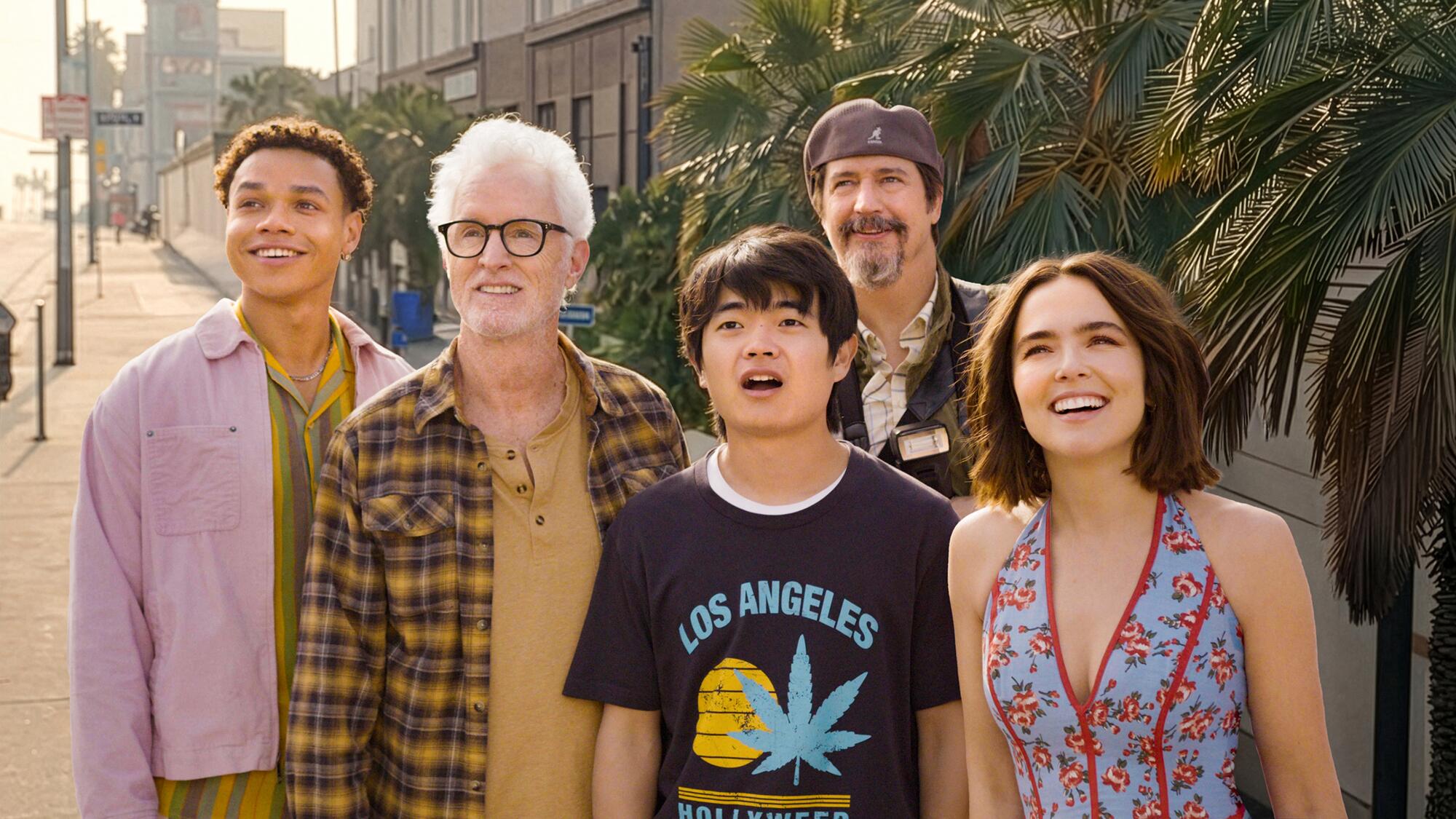
From left, Miles Gutierrez-Riley, John Slattery, Ben Wang, Ken Marino and Zoey Deutch in the movie “Gail Daughtry and the Celebrity Sex Pass.”
(Sundance Institute)
Speaking with The Times, Slattery reflected on cheerfully becoming the butt of the joke, why broad comedy is anything but easy and what it’s like navigating Hollywood at a moment when fading away feels a little less far-fetched than it once did.
Actors spend years building a certain cool image, but within seconds of appearing onscreen in this movie, you’re whining, farting and generally making an ass of yourself. What appealed to you about that?
I never considered it risky. Not that it was foolproof, but it was just such a silly idea and I was a fan of David Wain and those guys anyway. These kinds of comedies take skill and experience. I mean, you have to be really smart to make a movie this stupid.
You’re always looking for something that’s different and this was such a funny way to depart from myself — ironically, by playing myself. It seems like the wildest character I’ve played in a while, and it’s me. I thought: What kind of research am I supposed to do? Am I supposed to watch myself and imitate myself? But there was really nothing to do. You just learn the lines and show up.
Was there ever a moment where you thought: This is either going to be really funny or the end of my career?
I didn’t have that feeling on this. There’s nothing funnier to me than a confident moron. My favorite thing in the world to watch or try to do is somebody who has full confidence in their idiocy.
I’m not somebody who dives into the deep end right away. First I want to know I can trust the people in charge of what I’m about to deliver to them. If I do all this, whose hands am I leaving it in? With David, that wasn’t even a consideration. He’s just so good at what he does, and that gives you permission to just go all in.
Have you always been able to laugh at yourself or is that something that’s gotten easier as you’ve gotten older?
I come from a large family of piss-takers. They’re all really good at ball-breaking and really funny. My mother had six kids, and all her brothers had five or six kids. I had a million cousins, and they will shred you. Somebody would always knock your feet out from under you if you took yourself too seriously.

John Slattery and Jon Hamm in a scene from the AMC drama “Mad Men.”
(Frank Ockenfels / AMC)
Every successful actor probably has a nightmare that one day the phone stops ringing and you’re coasting on fading glory. Did you ever have that feeling after “Mad Men” ended?
After going through COVID and the strike and directing an independent movie [2023’s black comedy “Maggie Moore(s)”], which doesn’t pay very well, I hadn’t acted in a while. I was like: Oh, I wonder if this is going to continue. I don’t know.
The business has contracted. It seems like there’s an endless list of titles on every streaming menu, and yet they’re making less and people are struggling. So I’m glad to be working. I’ve had a pretty lucky run of late and I’m not taking it for granted.
At this point in your career, what makes you say yes to something?
Money. [laughs] No, it’s really the same as it’s always been. You always want a big, fat, juicy part, but sometimes it’s just a functioning part in a really good story.
You kind of roll with the punches. You do something, you have some success with it and then you get a lot of offers for things that are a lot like that. If that’s all that comes in, you pick the best one and keep going. People say, “Well, it’s not ‘Mad Men.’” And you go, “Well, what do I need to do that again for? I did that.”
This is a perfect example of something that’s every bit as interesting and fun in a completely different way. If they could all be like this one, I could die tomorrow. You want them all to be this fun, because they’re not. Sometimes you’re stuck in a courtroom all day and it’s pretty dry. This was anything but that.
Hollywood feels like a deeply anxious place right now. You’ve worked through a lot of different eras of this business. How does this moment compare?
I have a job coming up, so that’s always hopeful. Having just come off something, and knowing you’re about to do something else, gives you a sense of security. But there’s definitely a palpable anxiety. You hear it when people get jobs: “Thank God.” Or, “It’s about time.” Or, “I don’t care what it is, I’m going to do it.”
I was listening to Taylor Sheridan recently talking about how people who don’t tell stories are governing the telling of stories. That’s more than disconcerting. And now AI is the overlord of all that. It’s very strange.
It’s always been a youth-oriented business. There are definitely more movies about people who are 27 than people who are 63. Maybe it all kind of shakes out. I don’t know. Sometimes I wish it were 1943 and I was in a suit playing a detective.
I would watch that movie. Meanwhile, Hollywood doesn’t make many broad theatrical comedies like this anymore. Why do you think that is?
I don’t know why the studios have given up on comedies in movie theaters. They used to be the thing, right? Those big Will Ferrell movies were huge moneymakers.
Maybe this will turn the tide. When you think about the condition of the country right now, and how pissed off and divided everybody is, you roll out this silly, smart-but-stupid comedy, and it seems like the perfect amelioration of everybody’s anxiety. Go get some popcorn and laugh your ass off. You’ll feel better.