FEW questions could strike fear into the hearts of parents faster than being asked by their children, “Can we play with slime?”
Messy, sticky, often neon in colour, kids seem to universally LOVE slime, while all grown-ups can think of is the nightmare clearing up.
Sign up for the Travel newsletter
Thank you!
Kids universally LOVE slime toysCredit: Supplied
Which is why iconic toy shop Hamleys has come up with a brilliantly clever workaround this spring.
It has transformed the basement of its flagship store in London’s Regent Street into a hands-on sensory, slime playground.
For £15 a ticket, parents can book children into a professional slime-making workshop run by Gootopia, who you might call professional “slimologists”.
I took my three children aged five, eight, and 12, and they all loved getting messy in the hands-on class – and best of all it wasn’t taking place in my kitchen!
Kids are allocated their own work station and all the components to mix their own slime in a big metal bowl.
Then, under instruction, they are let loose to create their gooey concoction from scratch, mixing it and watching in wonder as it seemingly transforms into slime before their eyes.
They can then knead and stretch to their hearts content.
Once they have created the perfect gooey consistency, an array of paint colours are on offer to turn their masterpiece whichever shocking shade of their choice.
Kids are also invited to wield glitter – that other kryptonite substance for parents – and shake it with abandon over their slime.
And my little girl Estella also loved adding strawberry- shaped sprinkles to hers.
Once their creation is complete, the real fun starts.
The Gootopia experts, who patrol the class, show the children how to perform fun tricks with their slime, such as turn it into giant bubbles.
And at the end of the experience, the slime can be safely contained in screw-top plastic pots for transportation home, much to my kids’ delight.
Of course, there’s plenty more entertainment to be had elsewhere in Hamleys, with additional events throughout the Easter holidays including treasure hunts and Lego experiences.
We finished off our craft-making visit by visiting all seven floors of this wondrous toy store, taking in the free toy demos, new magic shows and meeting costumed characters.
We also checked out the newly opened Pokemon area of the store, crammed full of cuddly teddies, themed games and merchandise.
Messy craft and toy shopping in one day, no wonder my three had the slime of their lives.
GO: Gootopia at Hamleys costs £15pp. The experience runs until April 12 and can be booked at hamleys.com.
EXCLUSIVE: I Love LA has landed in the UK with the launch of HBO Max and it features the daughter of a Hollywood star.
21:56, 01 Apr 2026Updated 21:56, 01 Apr 2026
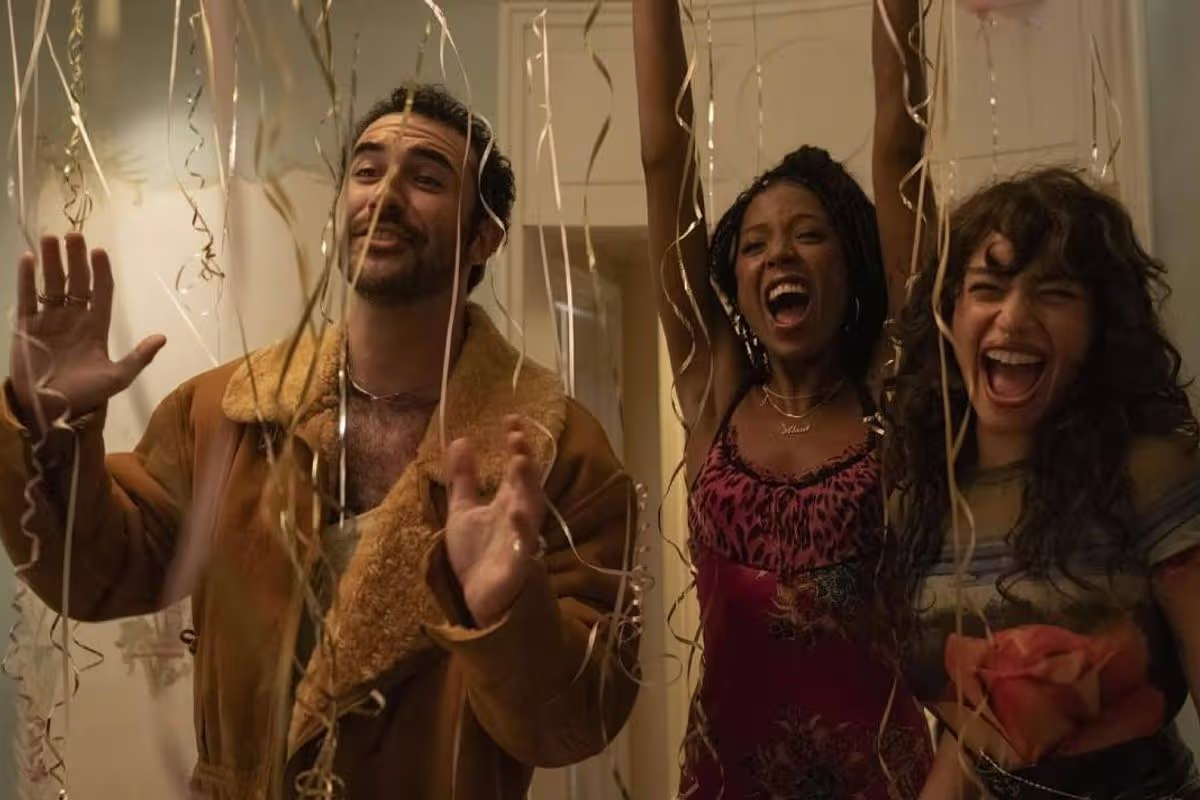
I Love LA is now available to watch on HBO Max(Image: HBO MAX)
An I Love LA actress has shared the unexpected familial link her father has with one of her co-stars.
HBO Max has finally made its way to the UK, dropping an abundance of hit shows, including I Love LA, a sitcom about Maia (played by Rachel Sennott) whose life becomes chaotic with the return of her influencer friend Tallulah (Odessa A’zion).
They are joined by other stars such as Jordan Firstman, Gossip Girl’s Leighton Meester, as well as actress True Whitaker as Maia and Tullulah’s close friend Alani Marcus.
Film buffs may best recognise Whitaker though as the youngest daughter of actor Forest Whitaker, famed for movies such as The Last King of Scotland, The Butler and Rogue One: A Star Wars Story.
But it wasn’t until True got to the set of I Love LA that she discovered that her dad was already very well acquainted with one of her co-stars.
Speaking to Reach Plc, Whitaker explained: “My dad in the show, Keith David, is a friend of my dad’s.
“When I was on set shooting the last episode, I Facetimed my dad being like ‘Hey, do you know this guy? This is my dad.’
“And he [Forest Whitaker] was like ‘Keith?!’ and Keith was like ‘Forest!’
“And apparently my dad is the reason Keith moved to LA. They did Platoon together when they were in their 20s so it was kind of cute to see them reminisce.”
Also starring actors William Dafoe and Charlie Sheen, 1980s film Platoon followed the story of a young American volunteer as he deals with the horrors of warfare in Vietnam.
While Whitaker was behind the role of supporting character Big Harold, actor Keither David played veteran soldier King.
True also shared her famous father’s pride at her landing a major role in I Love LA after first featuring in his drama Godfather of Harlem.
She explained: “He’s extremely proud of me. Even his assistant pulled me aside and was talking to me and got emotional and was like ‘you have no idea.’
“My dad apparently had just been gloating to everybody and was stoked to see me in this light.
“And for me to be able to use my comedic skills, because obviously in the house I’m annoying and loud and funny but now I can actually utilise it.”
“More visitors, more energy, more reasons to spend time by the sea.”
The post added that there will be “pop-ups landing throughout the year” as well.
The pier can be found on Bournemouth Beach, which features golden sand and stretches for seven miles.
On the pier, there are a number of different attractions including RockReef – an indoor climbing centre at the end of the pier, that has 28 themed walls of different difficulties, costing from £20 per session.
There’s also PierZip – the world’s first pier-to-shore zip line – which costs £27 per person.
Kids can have a go at the aerial course, suspended six metres above the ground, costing £11.50 per person.
And they can venture into the Piercave, which features three tunnels to crawl through and a large ball pit.
It also costs £11.50 per person.
Or they could try the Leap of Faith or drop down the Vertical Slide.
A two-hour session including the climbing, aerial course, Piercave, Vertical Slide and Leap of Faith costs £36 per person.
After burning energy at the different attractions, visitors can grab something to eat at Key West Restaurant where you can pizza costs as little as £14.95 or a cream tea will set you back £9.50.
If you just need a caffeine fix, then you can opt for Coffee Reef, where you can pick up a latte, cappuccino or flat white for £4.50.
There’s also a news and gift shop as well as a beach shop selling seaside essentials such as buckets and spades.
It comes after the pier suspended its entry fee last yearCredit: AlamyThe pier is located on Bournemouth Beach which stretches for seven milesCredit: Alamy
The pier is also a 10 to 15-minute walk from Bournemouth town centre.
Many people have taken to social media to express their excitement for the news.
One person said: “Love this! The right decision.”
The pier previously announced in April last year that it was temporarily suspending the entry fee for 2025, to make it more accessible to the local community.
Since the entry fee was scrapped, the pier has seen more visitors and engagement.
According to the Bournemouth Echo, Sarah Hunter, Managing Director of Adventure Attractions, said: “Increasing accessibility to the pier has always been our ambition, and the response over the past year has been incredibly positive.
“Continuing the toll suspension allows us to build on that momentum and ensure the pier remains a place everyone can enjoy, all year round.”
The entry fee will be suspended until the end of the current pier operator’s term, which includes 2026, 2027, 2028 and up to the end of October 2029.
Our favourite UK hotels
*If you click on a link in this box, we will earn affiliate revenue.
Margate House, Kent
This stylish boutique hotel is in a seaside townhouse, a short walk from Margate’s coolest bars and restaurants. Decked out with plush velvet sofas, candles flickering and striking independent art, inside feels like a warm welcome home. Rooms are stunning, especially the ones that give you a glimpse of the sea.
The Alan looks extremely grand, being built into a beautiful Grade II listed building. Spread across six floors, with 137 rooms, each one looks like a fancy design magazine. From the concrete coffee tables to the pink plastered walls, the industrial-inspired designs perfectly replicate the history of the city.
This historic hotel has welcomed the likes of Charles Dickens and Lillie Langtry through its doors. Rooms have richly-patterned carpets with super soft bed linen and premium toiletries in the bathroom. Go for a superior room for extra goodies including bathrobes and snack boxes.
This Cambridge hotel is in the ideal spot, within walking distance to bars, shops and hotspots like the university colleges and Parker’s Piece. The inside couldn’t be prettier, with huge stained glass windows, grand chandeliers, and rooms with enormous clawfoot bath tubs.
THE Cotswolds are well-known for having celebrity visitors and the tiny village of Batsford even welcomed an unlikely A-Lister this week.
Gossip Girl actress Blake Lively was spotted there earlier this week on a visit to the region.
Sign up for the Travel newsletter
Thank you!
Blake Lively enjoyed a recent visit to the Cotswolds village of BatsfordCredit: InstagramThe Batsford Arboretum is a popular attraction with 1,500 species of treeCredit: Alamy
Blake Lively posted snaps of herself exploring the English countryside, including a tiny spot called Batsford.
She and her family visited the Falconry Centre – which coincidentally is right next to Batsford Arboretum, one of the biggest attractions in the area.
Batsford Arboretum is home to a unique collection of some of the world’s most beautiful and rare trees, shrubs and bamboos all spread across 60 acres.
There are over 1,500 tree species from Japanese maples to pines and oaks.
One of the rarest is nicknamed the ‘dinosaur tree’.
The species was believed to be extinct for two million years before it was discovered in 1994.
Two of its off-spring were then planted at Batsford Arboretum in 2007 – and you can see them there today.
The arboretum brings in lots of visitors and is open year-round, but lots say one of the best times to go is in autumn when the leaves change colour.
Another added: “The arboretum is interesting whatever the season. From snowdrops through to autumn displays.
“Even in the depth of winter it is a pleasure to appreciate the architectural structure of the mature trees – and somewhere there is always something in flower. The collection of Daphnes is particularly noteworthy.”
Tickets into Batsford Arboretum for adults start from £10.90 and day tickets for children start from £3.15.
It also has a visitor centre where the café, garden centre and gift shop are – all of which are completely free to enter.
One visitor even called it “the best I’ve been to in a long time.”
After having a gander around the plants, head to the café which serves lunch, and a range of freshly baked cakes.
The huge Batsford House is on the estate of a Victorian country house built in 1892, but is a private residence and isn’t open to the public.
Batsford Arboretum Garden Centre is a popular spotCredit: AlamyBlake Lively was in the area visiting Prue Leith who lives in Moreton-in-MarshCredit: Instagram
Blake Lively was in the Cotswolds visiting former Celebrity Bake Off judge, Prue Leith, who lives just 5-minutes from Batsford in Moreton-in-Marsh.
Blake Lively and her family set up shop at Soho Farmhouse in Great Tewwhich opened 10 years ago.
The hotel is surrounded by 100 acres of countryside, and has 113 bedrooms, cabins along with a health club, spa and gym.
There are indoor and outdoor pools, sunken hot tubs as well as plenty of activities like horse riding, clay pigeon shooting, tennis and padel.
When it comes to celebrities, Blake Lively isn’t the only one that’s been spotted in the Cotswolds.
It offers world-famous sporting and medieval history, amazing food, and charming independent shops perfect for an Easter weekend staycation
Nicola Roy Multimedia content creator
03:08, 28 Mar 2026
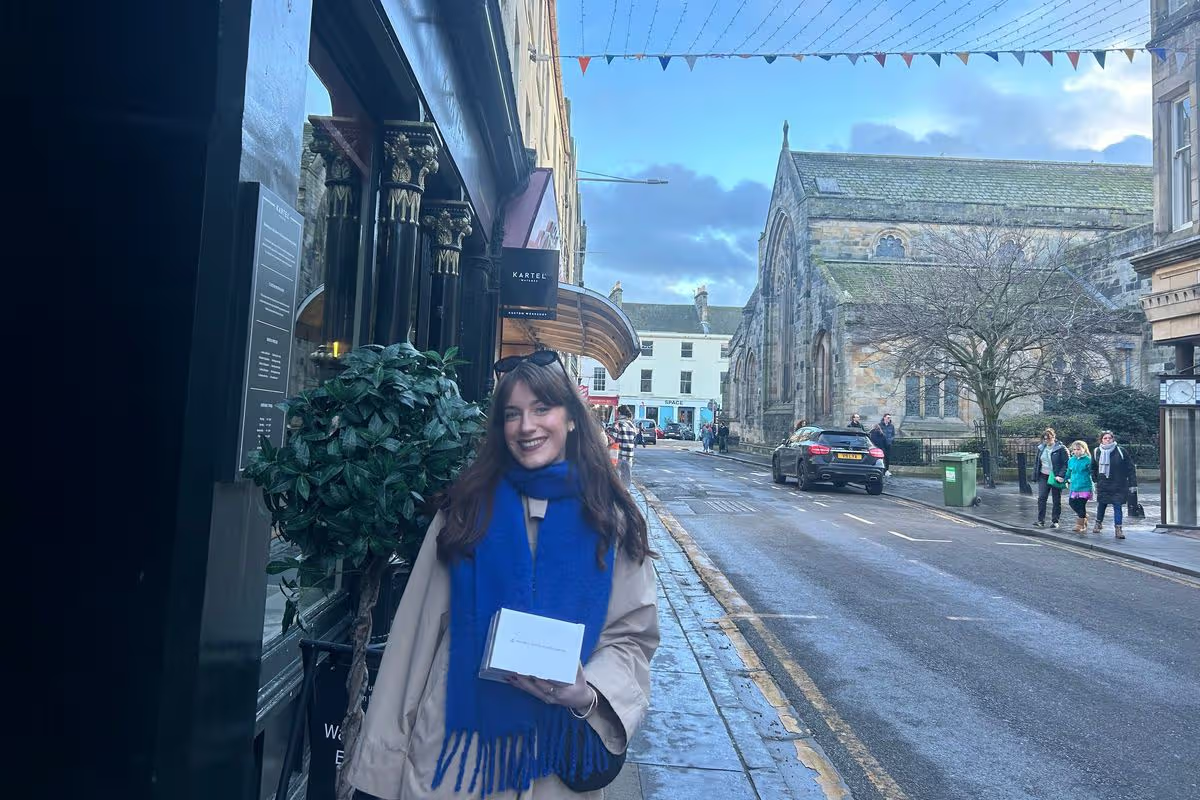
The town is an absolute must-visit in spring(Image: Nicola Roy)
The Easter bank holiday weekend is nearly upon us, and if you’ve managed to get a few days off work and want to make the most of it, a staycation is ideal.
And if you’re after somewhere boasting exceptional food, stunning scenery, rich heritage and an truly charming atmosphere, there’s one destination that’s worth a visit.
Home to one of Britain’s oldest universities, St Andrews on Scotland’s east coast is genuinely one-of-a-kind. Where else could you stumble upon a 170 year old pub just moments away from an Oliver Bonas? It’s a place I’ve returned to so many times, but every visit reveals something different to explore.
On a recent weekend getaway to Lower Largo, a small village in Fife, we decided to spend the afternoon exploring St Andrews. From Edinburgh it’s roughly an hour and a half by car, while from Glasgow it takes about an hour and three quarters.
Whether you’re passionate about the sport or not, most people probably know that St Andrews is best known for its golfing heritage.
The Old Course, one of the world’s most famous courses, features an iconic structure that you have to get a photo with, regardless of how often you’ve visited.
The Swilcan Bridge, built over 700 years ago, was our first stop on this trip. Positioned on the course’s 18th hole, strolling onto the green feels surreal, but it offers the perfect photography moment.
You’ll inevitably encounter fellow tourists there, so you may need to queue briefly for your picture, but it’s worthwhile. Conveniently, there’s a fantastic pub named the Jigger Inn just a two-minute stroll away, which was our next stop for some food.
With roots dating back to the 1850s, the Jigger Inn is a cosy, inviting pub with crackling fires that overlooks the golf course. There’s an excellent array of beverages at the bar, or you can settle down and order food, which is exactly what we did.
You can’t convince me there’s a better combination than a caesar salad, chips and wine, and the Jigger Inn did all of these perfectly.
Well nourished, it was then time to venture into the actual town itself. It’s not the biggest, and most of the shops and attractions are located on one of about three main streets, but you could easily wander around for hours without getting bored.
St Andrews is a truly unique place with distinct medieval influences that remain very apparent as you wander around the town. The university began teaching in 1413, which is utterly mind-boggling to think about, especially as it’s still a flourishing educational institution today.
There’s no denying that it’s an incredibly affluent area. Students from across the globe flock here to study, and the multiculturalism only enhances its appeal. It’s also famously the location where William and Catherine met and sparked their romance.
One of the main attractions is the remains of St Andrews Cathedral, situated near the seafront. Constructed way back in 1158, it was formerly Scotland’s largest church. Little remains of the original structure today, and it has since been converted into a graveyard.
Unfortunately, protective barriers surrounded numerous graves due to possible safety concerns, but it’s still a haunting yet fascinating spot to wander through.
There’s so much going on in St Andrews that you can easily forget that the sea is right there. Just past the Old Course sits the West Sands Beach, which famously appeared in that memorable opening sequence of Chariots of Fire.
Had the weather been warmer, this would have been an ideal spot for a walk, but the fierce wind was battering us from all directions so we opted to retreat to the shelter of the town centre.
St. Andrews boasts an excellent range of shops, from high street names like H&M and Jo Malone to unique boutiques and retailers you won’t find elsewhere. As a passionate book lover, I was eager to check out Topping and Company, a well-known family-run bookshop with a handful of branches throughout the UK.
The team were welcoming and helpful, and the range of titles available was outstanding. An entire display of signed first editions greeted visitors at the shop entrance, and the bookcases appeared to extend upwards and deeper into the shop endlessly.
It’s the sort of place where you could easily spend hours browsing – and rack up quite a bill too. Luckily, I succeeded in limiting myself to just one book, which demonstrated admirable self-control on my part.
There was just one final destination to visit on our trip, and if you like a sweet treat, you’ll want to hear about it.
You can’t visit St Andrews without stopping at Fisher and Donaldson. Founded in Fife in 1919, this family bakery is known for one thing and one thing only – its fudge doughnuts.
Widely regarded as the very best in Scotland, these indulgent delights are filled with fresh custard and topped with a delicious fudge icing.
Naturally there are other cakes and biscuits available, but the fudge doughnut honestly beats everything else on offer. We brought some home to enjoy with a coffee later on, and it’s fair to say they didn’t last very long.
St Andrews is just a wonderful place to spend the day or even the weekend if you prefer taking things at a slightly more relaxed pace. It’s brilliant regardless of the weather, but I can’t wait to return in the summer when it’s a little warmer.
NEWLY reopened in the UK last year, The Hide Hotel is one for the families who love the great outdoors.
Here is everything you need to know
Sign up for the Travel newsletter
Thank you!
The Hide has some beautiful viewsCredit: As Per Licence – 2024It is great for families tooCredit: As Per Licence – 2024
Where is The Hide Hotel?
Right up in the hills on the edge of Chatsworth Estate in Chesterfield lies this The Hide Hotel.
You’ll most likely need a car to get there although there is a bus stop outside that connects to Chatsworth and Bakewell.
What is the hotel like?
The thick stone-walled hotel is complete with dog and boot washing facilities, a roaring log fire in its restaurant and a tasty local pint for walkers to reward themselves with after a ramble in the Peaks.
The views across the moorland are breathtaking, and while the building is 200 years old, it was given a complete refurb last year, so all the furnishings look shiny and new.
All neutral tones with cosy throws strewn over the beds, rooms at The Hide Hotel are comfortable and inviting.
You can choose from double, triple, quad, or like us a bunk room, where a family of four could happily stay in the king size beds and very cute cabins.
Rooms cost from £79 per night including breakfast. See here.
What is there to eat and drink at the hotel?
There’s a great restaurant focusing on big plates of ribs, brisket, burgers and more.
They also offer a terrific range of stone baked pizzas and the cooked breakfasts are worth waking up for.
For something more refined, The Beeley Inn, also owned by the Chatsworth Estate, is well worth a visit.
Here we enjoyed whipped goats cheese with balsamic beetroot, and local lamb saddle with hispi cabbage.
What else is there to do there?
There’s a footpath out of the back door that leads directly to Chatsworth House (albeit via a 9km walk), where guests can book multi-entry tickets for their stay.
The Hide is also right at the entrance to The Peak District National Park which has amazing rambles for all abilities.
You’ll find a handy walking guide in every bedroom, and the staff are super knowledgeable and inspired us to climb the nearby snow topped Mam Tor, an unforgettable experience.
Is the hotel family friendly?
Yes, there are four-person rooms with bunk beds and king beds, so perfect for families, although kids re an extra £15 a night.
They also have everything else from high chairs to cots, and a play area in the restaurant with toys and games.
The hotel team are also on hand to recommend family-friendly activities.
is it accessible?
The hotel has accessible rooms, with wide entry bathrooms as well.
Some of the rooms sleep up to four peopleCredit: As Per Licence – 2024
A new play area has opened at Crystal Palace Park and it is free to visitCredit: kiddoadventures / FacebookThe park features a number of slides, swings and climbing framesCredit: kiddoadventures / FacebookMany of the different elements of the playground are also accessibleCredit: HTA Design
The park features “hands-on play” with a “world shaped by scales, skeletons and stories from deep time”.
There are a number of pathways to explore with dinosaur-details as well as a few different shaped slides on the embankment.
A huge dinosaur-like skeleton also offers kids the chance to climb and hide, with the curving tail forming a play trail.
In the sandpit, which is shaped like a dinosaur’s footprint, young children can also dig and discover fossils.
The new playground replaces an old one that had become rundown over the years.
After enjoying the new play park, make sure to head on the dinosaur trail to see around 30 Grade-I listed statues scattered across the park.
These are the world’s first life-sized prehistoric animal sculptures which were all inspired by fossils found by Victorian palaeontologists over 170 years ago.
Many of the dinosaurs look rather different to how we imagine dinosaurs now and that is because the statues were created from the scientific information Victorians had at the time.
It is free to visit the park as well as the sculptures, which can be found across islands and lakes in the park.
And by this summer, there will be a new £17.75million Visitor Centre.
There’s even a climbing frame and trail that looks like a dinosaur skeletonCredit: kiddoadventures / FacebookAcross Crystal Palace Park you can also see 30 Grade-I listed dinosaur sculpturesCredit: Alamy
It will be a single-storey and will have an ‘Interpretation and Activity Room’ which will showcase the park’s history and future through a number of displays, objects and information panels.
The park’s Grand Centre Walk is also being restored to create more space for events, with the path becoming wider and a new entrance being built at Penge Gate.
In total, the park’s revamp is expected to cost around £52million.
Emmerdale’s Aaron Dingle actor Danny Miller has candidly opened up about his father in an emotional update on Good Morning Britain
Joe Crutchley Screen Time Reporter
10:42, 23 Mar 2026Updated 10:43, 23 Mar 2026
Emmerdale’s Danny Miller emotional as he makes heartbreaking confession about famous dad(Image: ITV)
Emmerdale’s Danny Miller has spoken out about his father amid his dementia battle, revealing he misses him “so much”.
The Aaron Dingle actor has been incredibly open in recent months about his father Vince, who is living with dementia. Vince is a well-known star in the showbiz world as a singer, compere and comedian.
And on Monday (March 23) Danny appeared on Good Morning Britain where he spoke about Vince in an emotional update. He said: “It’s sad, and, you know, me and my dad were thick as thieves at one point, and, you know, losing him over and over again is awful.”
Admitting he misses the man his dad was, Danny added: “I live a couple of hours drive from my dad now, which breaks my heart, but I have my own family.”
He continued: “I’ve got a job up in Yorkshire, on Emmerdale, and being around in Manchester isn’t easy anymore, so I moved my family up there, and it was kind of a really tough thing to do, because I’m not there for my dad as much as I’d like to be. I miss him terribly.
“But you know, the days where I do see him again, I often get, you know, a good visit, and I usually find if I play Matt Monroe – my dad was a comedian, but he’s a singer as well – and Matt Monroe was a friend of his.”
Danny went on: “I played it one day, and he just kind of pointed at it, and he said, 10th of December, 1970, whatever, and I Googled it, and he was right. I think it was either his birthday or when the single was released, and from then on I kind of thought, I’m gonna do that, so I do it as a normal thing. Now I’ll put it on the side and just play and just talk to him normally. I tend to get a better visit.“
Danny then spoke about his Emmerdale co-star Charley Webb, whose mum Helen passed away last week following a 12-year battle with Alzheimer’s. He said: “Charley Webb is a good friend of mine. She was on here [GMB] with you guys not long ago, talking about her mum’s Alzheimer’s, and unfortunately, she passed, and it’s so sad.”
Danny continued: “Charley was a massive inspiration for me to why I spoke out about it. It made me want to talk out, it made me want to be vulnerable, and allow myself to sort of put out an unfiltered video.”
He added: “I wanted to just try and allow people to see me to be someone completely different and be vulnerable and talk about these things in hope that it will sort of resonate with somebody somewhere and they can relate to it and go, actually, I’m going to go out and get a memory test.
“That is the beginning of how to sort of get that diagnosis for dementia and it’s something that, you know, I want to fly the flag for because I don’t want dementia to destroy the families as it’s destroyed ours.”
The GMB host then pointed out how Danny’s father had a very successful career as a compere comedian and “knew lots of influential and important people”.
Danny then went on to reveal what it is like now having a conversation with his father. He shared: “There’s good days and bad days. There was a time last week where I didn’t know if I’d be sat here, because, you know, he’s up and down with his general health anyway, but dementia does always make it feel somewhat worse, and there’s all water infections that, so, your urine infections that suddenly make them more confusing. And then his health declined. He looked, he looked ill.”
When asked if his father is sometimes unaware of who Danny is, the actor replied: “No, that will break my heart. I’m not there yet. We’re not there yet, luckily, but it will break my heart.” Admitting he misses his father “so much”, Danny said: “He used to call me a lot and just ranted and then put the phone down without even saying, how are you? And I’d give anything back to have those conversations.”
Known as the ‘king of comperes’, Danny’s father Vince worked as the VIP host at Manchester United for almost 30 years. He also worked at Old Trafford for 29 years and often interviewed football legend, Sir Alex Ferguson.
No stranger to rubbing shoulders with famous faces throughout his 65-year career, Vince has also worked with Johnny Mathis and Shirley Bassey and even spoke at comedian Bernard Manning’s funeral.
When Vince was 82, he announced that he would be officially retiring from the showbiz and entertainment world. He told Manchester Evening News: “I’ve no upset about it, the time is now to get out while you’re on top, you don’t want people saying ‘not him again’!”
To celebrate his retirement, Danny put together a charity bash in which he paid tribute to his dad, dubbing him the “best in the business”. On stage, Vince said: “I’ve had a great career, I’ve done it all as a presenter, comedian, singer, I’ve been very fortunate. As Edith Piaf said, Je Ne Regrette Rien, no regrets!”
Emmerdale airs Monday to Friday at 7:30pm on ITV and ITVX
OUR Spotlight On column looks at the best things to see and do in popular holiday destinations, as well as som lesser known spots.
This week, we’re looking towards more tropical climates and shining the light of the Caribbean island of Puerto Rico.
Sign up for the Travel newsletter
Thank you!
Here’s everything you need to know about a holiday to Puerto RicoCredit: AlamyPuerto Rico has been put on the map after Bad Bunny’s performanceCredit: AFP
The Sun’s Deputy Travel Editor Kara Godfrey visited the island and raved about it.
She said: “I don’t know why more Brits don’t visit Puerto Rico when planning a Caribbean island.
“The food and drink scene is amazing – after all, its the home of the pina colada, and you can get the local Medalla Light beer for just $2.50 (£1.84) at some bars.
“My highlight was a food tour of San Juan with The Spoon Experience, where we had amazing coffee, ice cream and snacks.
This compact Caribbean island, which is the birthplace of the rapper and musician, is full of glorious landscapes from lush rainforests to sparkling beaches.
But the top thing for the bucket list has to be a visit to El Yunque National Forest, where visitors can swim beneath waterfalls and spot exotic birds.
The island is home to three of only five bioluminescent bays in the world, including the brightest at Mosquito Bay in Vieques.
HIDDEN GEM
For a real taste of local life, head to the Piñones neighbourhood – also known as the “soul of the island”.
Afro-Caribbean heritage comes alive here through vibrant street food, such as alcapurrias, a tyoe of fried fritter made with with grated yuca and sometimes green banana.
Explorers should ditch the beach and head to Puerto Rico’s Central Mountain Region instead.
This area is known for its coffee production so sampling the freshly roasted brews is a must.
Make sure to try Creole-inspired dishes at traditional taverns while soaking up sweeping interior views.
BEST VIEW
If you don’t fancy trekking up the mountains, then Alma Hotel rooftop bar in Old San Juan is the next best thing.
You can drink in the views, which are undeniably spectacular at sunset, alongside a cocktail.
From this high vantage point you’ll be able to gaze out across the terracotta rooftops, and sparkling bay.
Knock back a plate of oysters alongside a canella old fashioned made with cinnamon-infused bourbon, rosemary syrup and orange bitters.
RATED RESTAURANT
Cocina Abierta in San Juan served a menu of reinterpreted classics like mofongo, traditionally made from mashed and fried green plantains, except here its made with peking duck.
Plates are bold, elegant and sophisticated.
A five-course tasting menu costs around £64 a head and booking is recommended.
Bacoa Finca y Fogón is another great spot that offers farm-to-table dining with a focus on sustainable cooking.
Made up of a maze of candlelit rooms, this chic bar not only serves up creative cocktails, it also hosts regular live music nights.
It’s chaotic, fun, and quintessentially Puerto Rican.
The James Beard award-winning Identidad Cocktail Bar is another top spot for cocktail lovers.
Try the whisky highball which celebrates typical Caribbean ingredients like Glenlivet Caribbean (a type of whisky) muddled with ginger, vanilla, cardamom, bitters and soda.
HOTEL PICK
Dreamcatcher by DW is a boutique vegetarian hotel with just nineteen rooms, that sits a ten-minute drive from Old San Juan.
Quirky suites feature stained-glass windows, old hacienda archways and concrete soaking tubs.
Guests can unwind on tropical terraces in breezy hammocks.
The medieval town boasts cobbled streets, Tudor architecture and rich history – including the reportedly ‘haunted’ Inn that dates all the way back to 1420
The street is at the heart of the town(Image: Getty)
Preserved precisely as it was during mediaeval times, this picture-perfect town boasts a rich history, which is vividly displayed through its stunning architecture.
Nestled in East Sussex, Rye is a hilltop town featuring cobbled streets, charming buildings and a deeply-rooted history. Many buildings remain untouched to preserve their original character, serving as key attractions for the town’s tourism and heritage.
Just two hours from London, this scenic destination isn’t quite a seaside location, but it’s near enough to provide the perfect stopping point between your journeys to the coast.
Indeed, over the years the town has shifted further inland, due to changing coastlines, and whilst no longer on the waterfront, it was once home to a bustling port, now reclaimed by nature.
During mediaeval times, when the town was firmly established with its layout and architecture, it served as a major seaport and ‘cinque port’, which helped to protect against French invasions.
Today it provides the ideal day trip with independent shops, boutique hotels, delicious food spots, and historical landmarks.
Mermaid Street
This charming high street in Rye is frequently described as one of the most attractive in the entire country, with beautifully constructed buildings positioned along a delightful cobbled lane.
One visitor said on TripAdvisor: “A very quaint cobblestone street from the early mediaeval times; some of the buildings were outstanding and well worth a visit and walk up the hill.”
Another visitor commented: “Mermaid Street was definitely one of the highlights of our trip to Rye, and I recommend you set aside at least half an hour to explore this stunning street and take some great photos.”
This charming lane features timber-framed houses from centuries past, many of which enjoy protected status to preserve their historical significance.
Several of the properties, for instance, display plaques bearing distinctive names, including The House with Two Front Doors and The House Opposite, and tourists frequently stop to take photographs outside them.
Whilst it remains a picturesque, Instagram-worthy spot today, it was previously quite the opposite, regarded as one of the town’s most deprived areas. An 1891 census showed it had a notorious reputation as a rat-infested street where more than 70 children crammed into cramped homes, generating a chaotic environment in the locale.
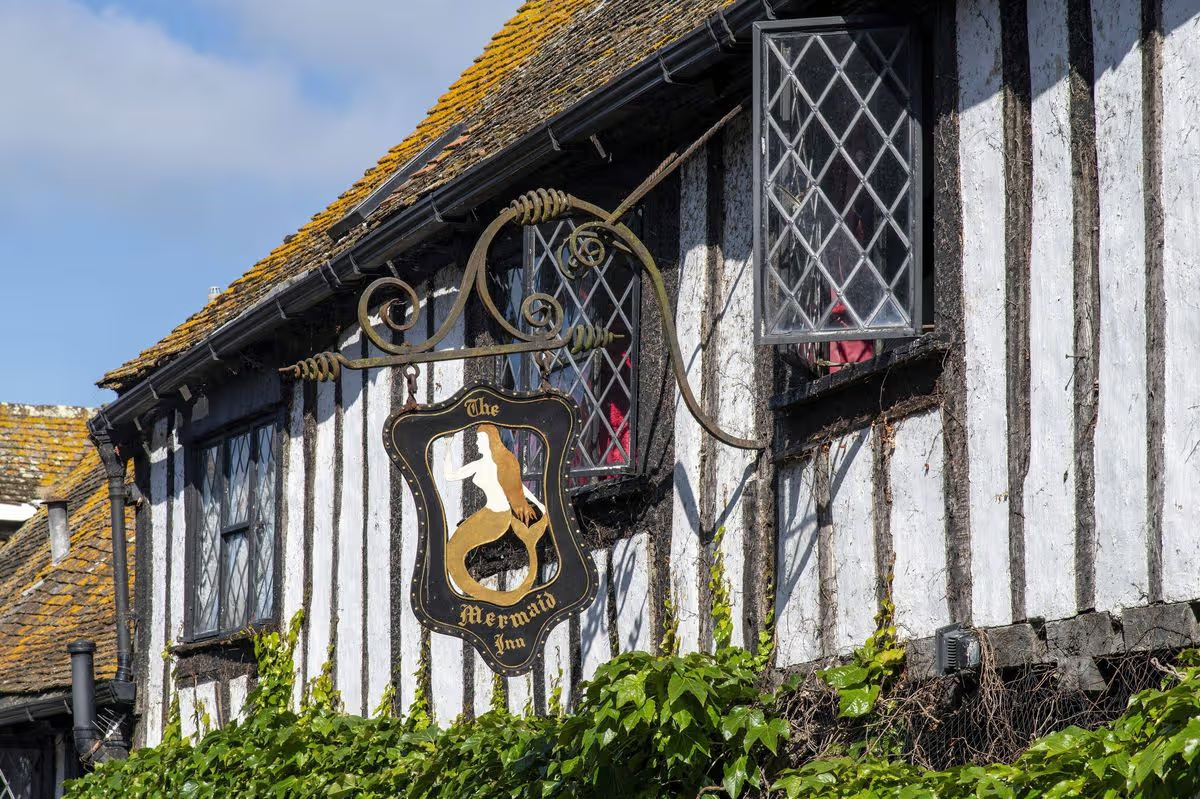
Situated at the very centre of the road, and believed to have given the street its name, is the Mermaid Inn, a hotel that’s been described as one of Britain’s most haunted.
Haunted Hotel
Spanning more than 600 years, this establishment, which offers bed and breakfast accommodation, is a genuine historical treasure, complete with spine-chilling tales to match.
The Mermaid Inn boasts cellars originating from 1156, whilst the structure itself dates to 1420, providing an authentic step back in time for guests and day-trippers alike.
With its sloping ceilings, creaking floorboards and labyrinth of staircases, the building is brimming with character and has been modernised to accommodate an excellent restaurant and two bars, alongside a spacious patio.
For visitors not planning an overnight stay, exploring indoors remains an option. Fortunately, on the final Sunday of each month the proprietor provides a guided tour through the historic rooms as you journey back through the centuries.
After visiting the hotel, one guest said: “We have stayed at the Mermaid Inn a few times before and have never been disappointed. If you go to Rye, you really have to stay at The Mermaid.
“As soon as you walk into this place, you feel the atmosphere of its history, a real step back in time, a time to leave the fast pace of life behind as you enjoy this wonderful place, a feeling of privilege of actually staying there.”
Yet it has a reputation of another kind entirely, thanks to its considerable age, having witnessed countless visitors pass through its doors, while others seemingly refuse to depart, as their spirits linger on.
Multiple rooms are believed to harbour various ghosts, each with their own unique tales, and some guests actively request these particular rooms for precisely that reason.
Take Room 19, the Hawkhurst room, where a guest once reported encountering a gentleman perched on her bed, dressed in period attire. Meanwhile, Room 1 is haunted by a lady in white, or grey, who prefers to sit in a chair beside the fireplace – her favoured haunting location.
In fact, their website catalogues every spectre said to inhabit its premises and the tales that have evolved over time as guests continue to report eerie encounters during their stay. One such instance is tied to room 10, with Fleur De Lys.
The website reveals: “Several years ago, a bank manager and his wife were awakened to find a man walking through their bathroom wall and across the centre of the room. They were so frightened that they spent the rest of the night downstairs in one of the lounges and made the porter bring all their luggage downstairs, plus their clothes.”
While the Europa League will continue to offer respite from an otherwise difficult season for Forest, the additional games present challenges.
Forest will take on Porto in the quarter-final on 9 and 16 April, welcome Aston Villa to the City Ground in between the two legs and then host Burnley the following weekend.
Winning games means positive momentum and that can only be a help when it comes to fighting to stay in the league.
But it also means more games and Pereira, who is set to take charge in his first European quarter-final, must find the balance between keeping his side in the top flight and managing the demands of competing in Europe.
“When we win it’s different,” Pereira said.
“The spirit is different, the energy is different and the boys deserve it because they are a fantastic group, very good players and with team spirit, character – we showed everything today.
“I don’t have any doubt that we have the quality and we will compete to achieve our targets.”
Yates added: “That winning feeling is special, you want to keep that momentum going.
“Momentum at this stage of the season is huge. We’re not going to get ahead of ourselves. Recover now, focus on Tottenham now and keep building, keep getting those wins.
I visited a unique British city which has plenty of character, a liberal vibe and a thriving art scene, but it’s often overshadowed by its posher neighbour
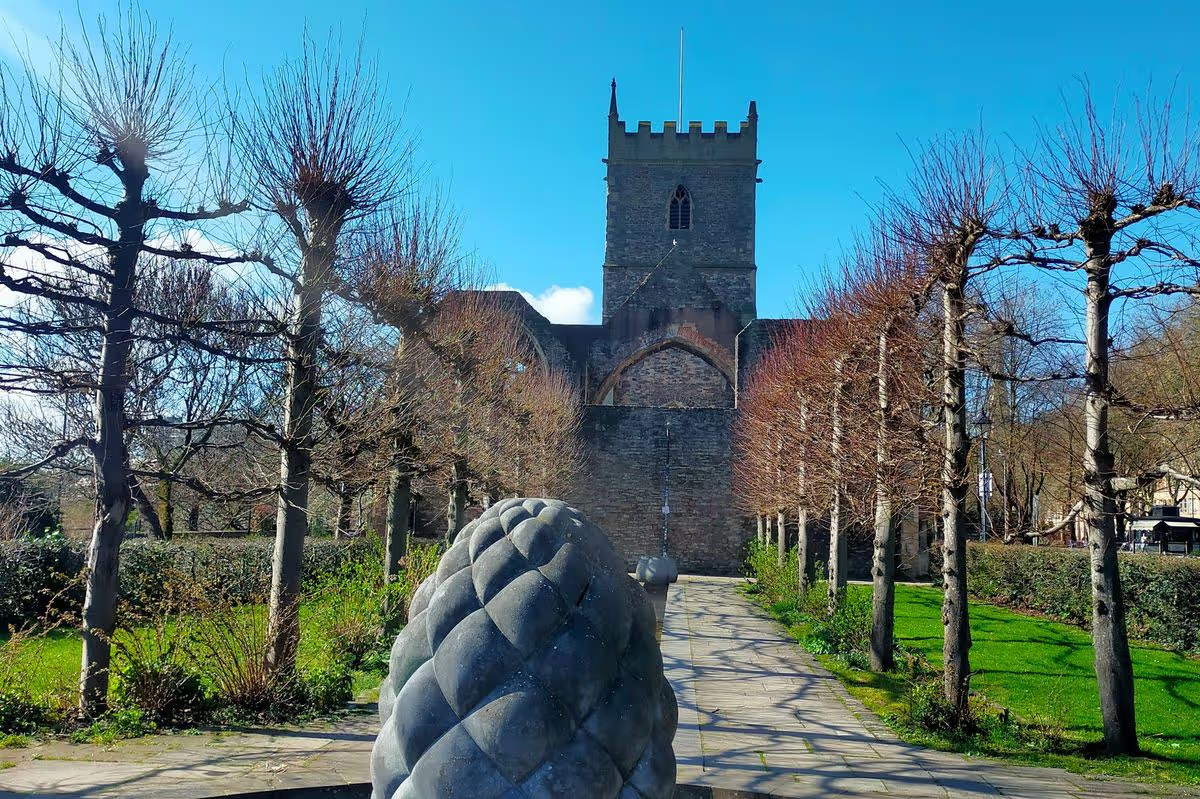
The city’s Castle Park is a relaxing place to spend time in(Image: Katie Oborn)
Britain boasts numerous cities waiting to be explored, and it’s remarkable how distinctive each one is, moulded by its heritage, residents, and surrounding terrain. I recently returned to a British city I’ve visited before, and whilst much has evolved in this vibrant metropolis over the years, it frequently gets overlooked because of its more celebrated neighbour.
I’ve been travelling to Bristol for several decades now, and the city conjures up warm memories of the Lakota nightclub from the late 1990s – the night spot is still open.
This urban centre has always possessed a rebellious “soul” with an independent spirit – and in recent years, the Green Party have effectively assumed complete control of Bristol City Council. During my visit to the city, I was struck by how spotless it was in the shopping area – and also how welcoming locals were.
As with everywhere else I’ve travelled to recently, there appears to be substantial construction underway in Bristol as the need for new housing continues to surge, but the city also boasts some striking, well-maintained period buildings.
I observed that many of the historic structures in Bristol were constructed from the same stone as those in the neighbouring city of Bath – and Bristol is frequently overshadowed when compared to the more conventionally picturesque city of Bath.
Nevertheless, Bristol possesses its own distinctive appeal and a progressive atmosphere, the city has a multicultural population alongside a flourishing arts culture, as well as some excellent retail and culinary destinations.
Bristol’s historic structures, constructed from a honey-hued limestone (referred to as Bath stone), contrast strikingly with the contemporary cityscape, whilst numerous modern buildings in Bristol have been decorated in vibrant colours, enhancing its distinctive charm.
A trip to Bristol can often prove more budget-friendly than Bath, and the city boasts excellent transport connections including a train service to London taking merely one hour and 30 minutes.
During my visit to Bristol I was accommodated at the Clayton Hotel on Broad Street, this four-star establishment occupies what was formerly a historic printworks location – with the structure dating back to approximately 1900.
The hotel’s striking Art Nouveau facade was created by William James Neatby, who served as the principal designer at Royal Doulton throughout the late 1800s to the early 1900s.
Broad Street itself proved fascinating, as upon exiting the hotel and glancing right, positioned just at the street’s end stood an ancient church, St Johns, which I’ve since learnt originates from medieval times and sits within the original city walls.
Visitors can pass through an archway of St Johns church (Nelson Street) to reach a main thoroughfare and considerably newer section of the city, creating the genuine sensation of travelling back in time; this district comprises Bristol’s old town.
Stumbling upon remnants of Bristol’s historic quarters is captivating, and nestled within the charming Castle Park in the city stands another church (St Peter’s) which traces its origins to the 11th century, encircled by a Physic Garden – and spending time here allows you to envision the lives that once unfolded in centuries past.
Today, Bristol city centre sits just 30 minutes from Bristol Airport with regular buses and coaches ferrying passengers back and forth – and there are rail connections or coaches to South West locations including Cornwall or Devon.
Many people mistakenly believe that Bristol sits within Somerset, but the city and its surrounding areas are actually an independent county corporate, established as far back as 1373, with a present-day unitary authority council.
The About Bristol website put it clearly: “Bristol is the largest city in the south west of England, with a population of approximately half a million.
“The city lies between Somerset and Gloucestershire and has been politically administered by both counties in part at various times. However, Bristol is historically a county in its own right and is properly entitled the City and County of Bristol.”
So what makes Bristol “better” than Bath, well there’s the Banksy claim to fame and the Banksy trail – and I’ve encountered a couple of these iconic works on previous trips.
Then there’s the nightlife. During this visit I attended an experimental gig at Strange Brew and the vibe was edgy yet inviting (that encapsulates Bristol perfectly I’d say).
Bath is undeniably a beautiful city to explore, but it exudes an air of affluence, whereas Bristol, rich in its own history, has a more down-to-earth vibe – and there are far fewer tourists to navigate around.
Indeed, Bristol made headlines in 2020 when a historical contentious bronze statue of Bristol-born slave trader Edward Colston was defaced and toppled during an anti-racism protest nearly six years ago – and this certainly raised some eyebrows at the time.
Those involved were making a stand and delivering a significant message, despite many labelling the statue’s toppling as vandalism at the time.
This act by protesters will also be etched in history as those responsible spotlighted Colston’s involvement in the Atlantic slave trade, in a manner that brought it to the attention of a wider audience – and I believe Bristol will always possess a rebellious spirit, it’s simply the nature of the city.
TOY stores can often be a place of pure happiness for children – and one of the most famous stores in the UK is making even more reasons to visit.
Hamleys in London is the world’s oldest toy shop, with its first site opening back in 1760 under the name Noah’s Ark.
Sign up for the Travel newsletter
Thank you!
Hamleys in London is the world’s oldest toy shopCredit: Getty
Originally in High Holburn, the much-loved toy storeis now on Regent Street, where it has stood since 1881.
Across seven floors there are thousands of toys to explore and each year the store welcomes around five million visitors.
And now there is even more of a reason to go as the giant toy store is launching lots of new events – and most of them are free.
Keane Herman, Business Head Hamleys UK, said: “As the finest and oldest toy shop in the world, Hamleys has been creating magical moments for children and families for more than 266 years.
“By keeping our eye on what’s current, trending and relevant, we continue to elevate the experiences we create in store.
“There is always something happening at our Regent Street flagship.
“From live toy demonstrations and interactive play experiences to dance parties and puppet shows, it is this sense of energy and theatre that makes Hamleys so special.
“We pay close attention to what resonates with children and parents, and to the trends shaping the world of play, so that we can continually offer fresh and memorable experiences.”
Last year, the store launched the Hamleys Bus and Lights Your at Christmas which proved to be such a success that the store is bringing it back for Easter this year.
And the store has already hosted a number of brand pop-ups including one with dessert brand Vnilla, who are well-known for creating banana pudding just like the famous Magnolia Bakery’s in New York.
Herman added: “These events and experiences are a natural extension of our daily in-store theatre, giving children the chance to be even more hands-on and to immerse themselves in the magic of play.
“Our heritage is incredibly important to us, but what keeps Hamleys thriving is our commitment to continually evolving.
“Families come to Hamleys not just to shop, but to make memories together, and that sense of wonder is something we are proud to deliver for every new generation.”
Coming up, there are lots of daily events at Hamleys to enjoy.
New events include slime workshopsBut kids can also meet the famous bear every dayCredit: Alamy
For example, every day at 10am (or 12pm on Sundays) when the store opens, there is an opening ceremony with Hamley Bear, who you can also meet at 1pm and 2:30pm each day.
At the weekends, the Hamleys Beary Grand Parade takes place at 4pm each day with dancing and singing.
This is followed by Mr Monkey’s Puppet Show at 4:30pm, where Mr Monkey is searching for his next big adventure.
And then at 5:30pm there is the Hamleys Dance Medley, where magical moments from the toy store’s history are brought back to life, including a princess’s first ball and a pirate’s first adventure.
Between March 28 and April 12 (the Easter school holidays), there are loads of events on as well.
For example, you could watch Chef Choco’s Chocolatiers Puppet Show, where you can learn about the secrets of sweet making and even become a sweet maker yourself.
The show will be on every day throughout the period, at 4:30pm.
On March 28, catch Midnight in the Toyshop come to life at Hamleys, with Ballerina and Rebel Racer giving a live performance.
There are lots of experiences on throughout the Easter holidays tooCredit: Alamy
Performances will be at 11am, 12pm, 1pm, 2pm, 3pm and 4pm.
If your kids love slime, then make sure to head to the Hamleys Regent Street Basement from March 24 to April 12 for a Gootopia Experience Zone, where kids can create their own slime and take home a ‘gooey masterpiece’.
The experience will cost £15.99 per person.
Every day at 4pm between March 28 and April 12 there will also be a Hamleys Rainbow Ribbons Parade across every floor of the store.
Also, over the Easter school holidays there will be Hamleys Storytime, with tales of Peter Rabbit and Charlie and the Chocolate Factory every day at 12pm, 1pm, 2pm and 3pm.
Towards the end of the Easter holidays on April 6, families can meet the Playmobil Pirates at 12pm, 1pm, 2pm, 3pm and 4pm.
And last but not least, each day at 1pm and 2:30pm there will be a Hamley and Hattie Easter meet and greet.
And the toy store has a wealth of events on, with more coming in the futureCredit: Getty
Officially launching on March 17, there will also be a new Pokémon destination on the Regent Street store’s fourth floor.
The new Pokémon area will feature interactive experiences such as character appearances, and on March 21, a launch event will be held with Pokémon-themed candy floss and activities for visitors.
Later in early April, a Tubbz zone will open inside the Regent Street store in the basement.
In the zone, visitors will be able to grab iconic pop culture characters that have been transformed into cosplaying ducks.
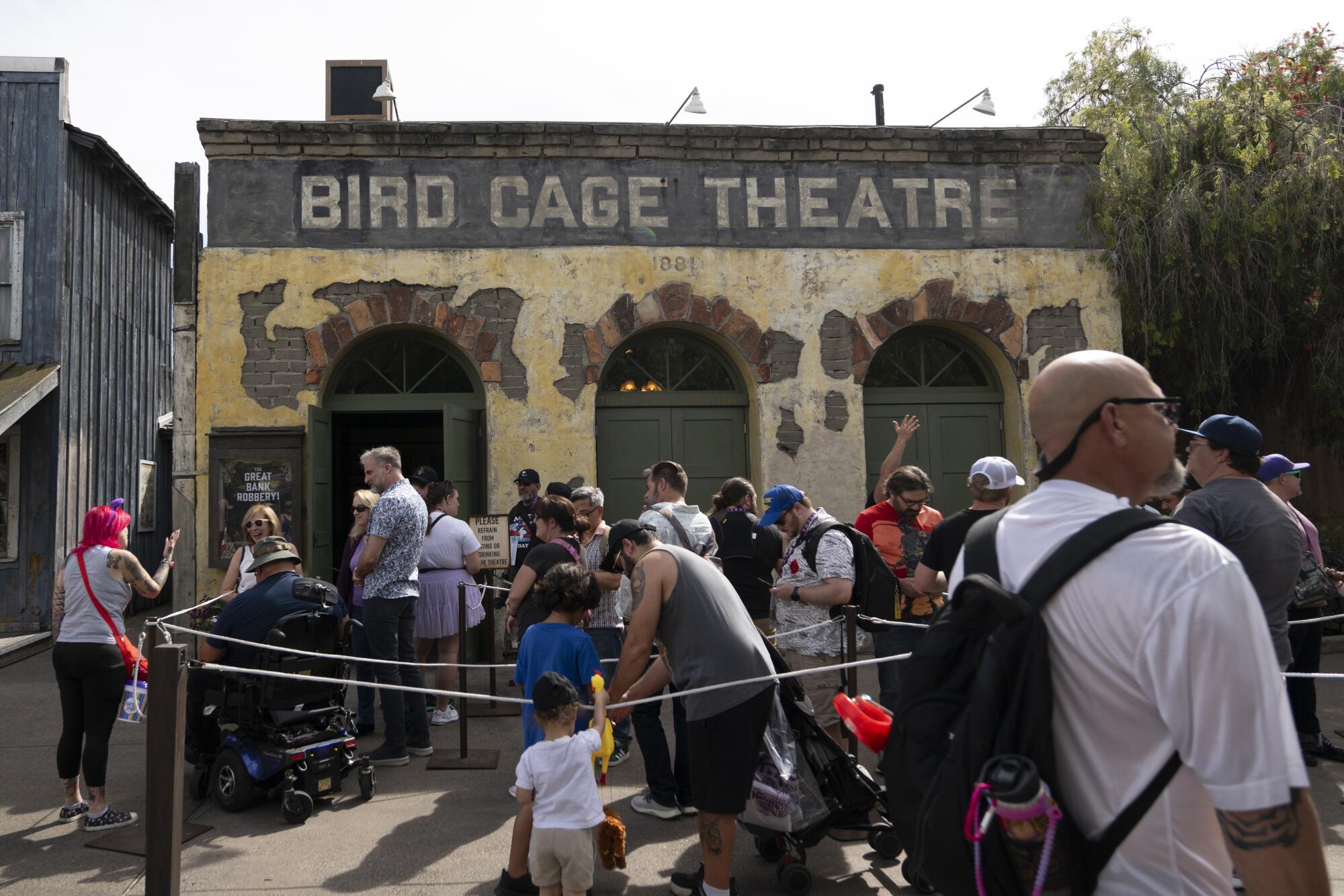
The Bird Cage Theatre has stood inside Knott’s Berry Farm for 72 years — albeit not always soundly. Long framed by a tin roof and a tent, the theater had a reputation for discomfort, as it was a source of punishing heat and the occasional mouse sighting.
“It was hot, it stunk and it was dirty,” says Payden Adams, the park’s VP of entertainment.
Still, though it has long felt like an endangered species, the Bird Cage Theatre is one of Southern California’s most historic revival houses, a place for vaudeville-style, fourth-wall-breaking shows that deviate from the expected theme park fare. To quote the theater’s most recent production, its entertainment can be “flirtatious and a little bit saucy.”
Knott’s Berry Farm’s Bird Cage Theatre is modeled after a historic venue in Tombstone, Ariz.
(Kyusung Gong / For The Times)
Opened in 1954, the Bird Cage Theatre has specialized in vaudeville-style melodramas.
(Knott’s Berry Farm)
And now, against all odds, the Bird Cage is getting a second life. Knott’s Berry Farm recently completed a renovation designed to keep it thriving for another 72 years. Gone is the tarpaulin roof: The Bird Cage is now a fully enclosed, soundstage-like structure. And blessedly, it has modern air conditioning.
The theater reopened this past weekend with “The Great Bank Robbery,” a 30-minute-plus show in which audiences are encouraged to boo, hiss and swoon over the characters, a Bird Cage tradition since 1954. Characters are caricatures, be it a villain that feels plucked from a cartoon western, complete with a purring raccoon for a sidekick, to a greedy wannabe politician of a bank manager. Though set in Ghost Town with period garb, there are modern flourishes, such as tongue-in-cheek nods to the theme park’s attractions and a damsel in distress who ultimately proves to be anything but.
Though it once operated as a daily theater, the Bird Cage is today most active during holidays and seasonal events, such as the park’s annual Boysenberry Festival, which also began this weekend. Popular summer show “Miss Cameo Kate’s Western Burle-Q- Revue” is a 20-minute cabaret-style performance, complete with a torch song and a slightly risqué cancan finale.
When it’s running, the Bird Cage is a must-see attraction. Live theater in theme parks can feel like a moving target, as conventional wisdom often argues that today’s smartphone-addled guests are after thrills and more attention-grabbing, interactive experiences. But when it works, such as during the over-the-top silliness of “The Great Bank Robbery,” or at Universal Studios’ “Waterworld”-themed stunt show, it can offer guests some of the most memorable, personal moments at the parks.
The Bird Cage Theatre reopened this past weekend with the show “The Great Bank Robbery.”
(Kyusung Gong / For The Times)
“You’re not wrong, especially when it comes to attention spans. We experience that,” says Adams, who oversaw the theater’s restoration. “The way we’ve pivoted and navigated is just ensuring our shows are tight and clean. It might be a little over 30 minutes, but audiences are engaged. In melodramas, we ask the audience to participate, and we can train them how to participate beforehand. When you see characters, even when they’re heightened or over-the-top, people still connect with them.”
The Bird Cage Theatre first opened in the summer of 1954, its facade a near-replica of the original Bird Cage in Tombstone, Ariz. That the family-focused Knott’s would nod to the Arizona locale is an oddity in and of itself, as the actual theater had a bawdy reputation. Stories today speak of a place that initially opened with grand ambitions but eventually succumbed to gambling and prostitution.
At Knott’s, the theater was built around existing structures, although park founder Walter Knott, according to the book “Knott’s Preserved” by Chrstopher Merritt and J. Eric Lynxwiler, often talked about completing it as a full tribute to the Arizona space. That never really happened.
Knott’s re-created the original wallpaper of the Bird Cage Theatre for its remodeling.
(Kyusung Gong / For The Times)
And yet over the years the Bird Cage won over audiences thanks to programming from Vaudeville veterans. Early on, students from nearby colleges would appear at the space, including Steve Martin, whose signed photograph graces a celebrity wall in the Bird Cage’s introductory hall. Donna Mills and singer Rick Nelson have graced the Bird Cage’s horseshoe-shaped stage, as have Dean Jones and Skip Young.
It was, to say the least, a quirky place to perform. “Knott’s Preserved” tells of a show in which a mouse once sat at the base of the stage, and quotes Martin as reminiscing over performances affected by the weather. “When it rained, no one could hear each other because the rain was beating so hard on that tarp,” Martin said.
None of that should be a problem anymore, although returning guests will likely feel they’re in a familiar space. Though the Bird Cage has been outfitted with modern lighting capable of new theme park tricks and projections, the rig is hidden among curtains designed to re-create the look of the original tent. Lights, in bird cage enclosures, still hang above the audience seating area, which has room for about 250 guests.
The Bird Cage Theatre at Knott’s Berry Farm now has a properly enclosed roof and air conditioning.
(Kyusung Gong / For The Times)
And along the way a few discoveries were made. Adams says that when they began stripping away wooden walls added sometime in the 1970s, they found the Bird Cage’s original wallpaper, a scarlet-red strip that surrounds the space with flower-adorned bird cages. Not all of it could be salvaged, so Knott’s meticulously re-created the look. With the new-old wallpaper intact, Adams estimates that guests can count about 11,055 bird cages throughout the theater.
The original pieces will be preserved in the park and gifted to important Bird Cage players. Adams jokes, “If you have a mailing address for Mr. Steve Martin, I have a gift to send him.”
ROB Reiner’s friends held back tears at the Oscars as the ceremony honored the late director and his wife, Michele Singer Reiner, after their tragic deaths.
The couple died in December 2025 after being brutally attacked in their Los Angeles home, and their son, Nick Reiner, is the primary suspect in their murders.
Sign up for the Showbiz newsletter
Thank you!
Rob Reiner’s famous friends held back tears at the Oscars as the ceremony honored the late director and his wife, Michele Singer ReinerCredit: Instagram/michelereinerBilly Crystal gave a speech honoring the late couple Sunday nightCredit: ABCRob and his wife received a special tribute from longtime friend Billy CrystalCredit: GettyRob and his wife Michele died on December 14, 2025Credit: ABC
Hollywood was shocked by the loss of Rob, 78, and Michele, 70, and it was expected that there would be a special tribute to them at the 98th Academy Awards held at the Dolby Theatre at Ovation Hollywood on Sunday.
Rob famously rewrote the ending of When Harry Met Sally after meeting his wife, Michele, while shooting the film.
“I first met Rob Reiner in 1975. When I was cast as his best friend in an episode of All in the Family,” Billy’s began in his tribute.
“Rob said, it was fun playing your best friend, why don’t we keep it going. And it was a thrill to see him evolve from a great comic actor to a master storyteller.
“His first film was This Is Spinal Tap. You could stop right there … The comedy was turned up to an 11.”
Billy went on to discuss Rob’s other iconic films, including Stand By Me.
“Audiences then lined up to see his funny, charming films, so he gave them misery!” Billy continued.
Most read in Entertainment
“My friend Rob’s movies will last for lifetimes. Because they were about what makes us laugh and cry and what we aspire to be, far better in his eyes, far kinder, far funnier, far more human.”
“And when Michele Singer entered his life, they were unstoppable. A gifted photographer, she not only produced films with Rob, but it was her energy that had them working tirelessly to fight social injustice in the country that they both loved.
“Rob and Michele Reiner became the driving force in the landmark decision for marriage equality across the United States. And their loss is immeasurable.”
He said Rob told him several times that “it meant everything to him that his work meant something to you.”
“And for us, who had the privilege of working with and knowing him and loving him, all we can say is, ‘Buddy, what fun we had storming the castle.”
Billy’s speech concluded with several actors joining him on stage, including Kathy Bates, Demi Moore and Mandy Patinkin.
More late stars honored at the Oscars
Diane Keaton was also honored at the Oscars’ In Memoriam tribute.
Rachel McAdams, who starred alongside the late actress in The Family Stone, took the stage to honor Diane.
“For over 50 years, luminous on screen and indelible in life, believe me when I say there isn’t an actress of my generation who is not inspired by and enthralled with her absolute singularity,” she said.
“She wore so many hats, literally and figuratively, actress, artist, author, activist, but no hat more important to her than being a mother to her two children.
“She meant so much to so many of us. I remember she used to sing this old Girl Scout song on set, which is just so her: ‘Make new friends, but keep the old. One is silver, and the other is gold. A circle is round, it has no end. That’s how long I’ll be your friend.’
“And so to our friend, Diane Keaton, celebrating a life in silver and gold, a legend with no end.”
Diane, a four-time Academy Award nominee, died in October 2025 of bacterial pneumonia.
Other stars were honored during the In memoriam segment, including Robert Duvall, known for his roles in The Godfather and Apocalypse Now, Robert Redford, known for All the President’s Men and The Sting and Catherine O’Hara, known for her role in Home Alone and Schitt’s Creek.
“She made us laugh until we cried,” Rachel said of Catherine at the Oscars.
Diane Keaton died in October 2025 of bacterial pneumoniaCredit: Getty ImagesCatherine O’Hara died in January 2026 at the age of 71 after being rushed to the hospital while having difficulty breathingCredit: REUTERSRobert Duvall, known for his role in The Godfather, died at the age of 95 in February 2026Credit: AFP via Getty Images
The death of Rob Reiner
Corey Feldman, who portrayed Teddy Duchamp in Stand by Me, was reportedly not asked to participate in the tribute to Rob, despite being one of the main characters alongside Jerry and Wil.
A source recently told the Daily Mail that Corey was “devastated” by the apparent snub and “wanted nothing more than to honor Rob.”
In January, Rob was subtly recognized at the Golden Globes by host Nikki Glaser, who ended the show wearing a Spinal Tap cap, a reference to the filmmaker’s 1984 film, This Is Spinal Tap.
The comedian also closed the ceremony, saying, “This one went to 11. Thank you, guys, for an amazing night,” a reference to the movie’s famous moments between Rob and co-star Christopher Guest.
Rob and Michele allegedly had their throats slit while lying in bed, and Nick, who had been diagnosed with schizophrenia and was battling a drug addiction, has been charged with their murders.
The incident occurred hours after the trio attended Conan O’Brien’s holiday party, where Rob and Nick had an explosive fight about Nick’s behavior.
Last month, Conan O’Brien, host of the 98th Academy Awards, broke his silence about the tragedy during a sit-down with The New Yorker.
“I knew Rob and Michele, and then increasingly got closer and closer to them, and I was seeing them a lot,” the talk show host said.
“My wife and I were seeing them a lot, and they were so — they were just such lovely people.
Most Awarded Oscar Winners of All Time
Best Director:
John Ford — 4 wins
The Informer (1935)
The Grapes of Wrath (1940)
How Green Was My Valley (1941)
The Quiet Man (1952)
Frank Capra — 3 wins
It Happened One Night (1934)
Mr. Deeds Goes to Town (1936)
You Can’t Take It with You (1938)
William Wyler —3 wins
Mrs. Miniver (1942)
The Best Years of Our Lives (1946)
Ben-Hur (1959)
Best Actor in a Leading Role:
Daniel Day‑Lewis — 3 wins (most in history)
My Left Foot (1989)
There Will Be Blood (2007)
Lincoln (2012)
A slew of actors are tied in second place having won 2 Oscars, including: Marlon Brando, Tom Hanks, Dustin Hoffman, Sean Penn, Anthony Hopkins, and more.
Best Actress in a Leading Role:
Katharine Hepburn — 4 wins
Morning Glory (1933)
Guess Who’s Coming to Dinner (1967)
The Lion in Winter (1968)
On Golden Pond (1981)
Frances McDormand — 3 wins
Fargo (1996)
Three Billboards Outside Ebbing, Missouri (2017)
Nomadland (2020)
Meryl Streep — 3 wins (two lead, one supporting)
Kramer vs. Kramer (1979) — Supporting Actress
Sophie’s Choice (1982) — Lead Actress
The Iron Lady (2011) — Lead Actress
Best Actor in a Supporting Role:
Walter Brennan — 3 wins
Come and Get It (1936)
Kentucky (1938)
The Westerner (1940)
Many actors are tied for the second place honor with 2 nominations, including: Michael Caine, Denzel Washington, Gene Hackman, Jack Nicholson, Christoph Waltz, and Mahershala Ali.
Best Actress in a Supporting Role:
Dianne Wiest —2 wins
Hannah and Her Sisters (1986)
Bullets Over Broadway (1994)
Shelley Winters — 2 wins
The Diary of Anne Frank (1959)
A Patch of Blue (1965)
Maggie Smith — 2 wins
The Prime of Miss Jean Brodie (1969) — Lead Actress
California Suite (1978) — Supporting Actress
“And to have that experience of saying goodnight to somebody and having them leave and then find out the next day that they’re gone. … I think I was in shock for quite a while afterward. I mean, there’s no other word for it. It’s just very — it’s so awful. It’s just so awful.”
Conan also admitted that it was still “hard for me to comprehend” what happened to his friends.
The U.S. Sun exclusively revealed that Nick could inherit his family’s $196million fortune even if he’s found guilty of his parents’ deaths.
This would be the case if Nick is found legally insane, which, by California law, would still entitle him to the inheritance.
Nick has been charged with two counts of first-degree murder and faces a maximum sentence of life in prison if convicted.
Rob and Michele were murdered in their Los Angeles home in December 2025Credit: GettyTheir son, Nick, was accused of their killings and has been charged with has been charged with two counts of first-degree murderCredit: Instagram/romyreinerNick pleaded not guilty to the murders in court earlier this weekCredit: Getty
As the 63-year-old returns to our screens this weekend, here’s an insight into the life of the fan-favourite actress.
Hollywood marriage
Alex Kingston was married to none other than Schindler’s List and Harry Potter legend Ralph Fiennes, after they met as students at the Royal Academy of Dramatic Art (RADA) in 1983.
They dated for a decade, married in 1993 but divorced in 1997 after Fiennes had an affair with his Hamlet co-star Francesca Annis who was 18 years his senior.
For the latest showbiz, TV, movie and streaming news, go to the new **Everything Gossip** website.
After discovering the affair, Alex found it too difficult to stay in London and so started a new life in Los Angeles and joined the cast of ER in 1997.
Previously speaking about the break-up to the Daily Mail, she shared: “I was feeling worthless, that I would never find anyone else as good as my husband, which is ridiculous, but I had so little self-esteem.
“Divorce is awful, but it is also something I don’t regret happening to me because it has shaped who I am now.”
She went on to marry her second husband, German writer Florian Haetel, two years later and had their daughter Salome Violetta Haertel.
Their marriage wasn’t to last either though as they separated in 2009 and divorced four years later.
Two years after her second divorce, the star went on to marry TV producer Jonathan Stamp with the pair still happily together.
Strictly
Alex competed in Strictly Come Dancing 2025 with partner Johannes Radebe and proved to be a fan-favourite with BBC viewers.
However, she didn’t get the best critique from harsh judge Craig Revel-Horwood when he jibed that Alex looked like she was having a “midlife crisis” during her Halloween Week salsa routine to Mousse T Fellow’s Horny.
Reacting to the unexpected comment to Prima Magazine, she said: “When I did the Strictly Halloween ‘Horny’ number, I wasn’t fully aware of the scathing critique Craig had given me about looking like a woman who is having a midlife crisis.
“I didn’t realise that he was saying it or know about the follow-through in terms of people saying, ‘That’s just outrageous, how dare you say something like that?’
“It was a little mean-spirited for Craig to say that and also I just felt like it’s exactly the opposite of what I’m trying to advocate.
“It’s like, no, if you want to dance and swing a devil’s tail around and you’re in your 90s, do it. I mean, this is your life. So live it!”
Health scare
Alex was diagnosed with and treated for uterine cancer in 2024 and, after a hysterectomy and radiation, she is now in remission.
The star initially dismissed symptoms including boating as a sign of aging but suffered a “shocking” haemorrhage while on stage at Chichester Festival Theatre.
It was after this incident that Alex was given the unexpected diagnosis, telling the BBC: “I never went down the cancer road in my head.
“It was a shock, because I have a very positive outlook on life in general.
“Even though my body was telling me there was something very seriously wrong.”
Alex added that it was this experience in 2024 that pushed her to say yes to Strictly Come Dancing the following year as “life is too short”.
Alex appears on Saturday Kitchen on BBC One on March 14 at 10am
WHEN you look at the London skyline, you probably think of the London Eye, Big Ben, the Shard and the Gherkin – but for decades another iconic landmark as been part of that set.
While the BT Tower has been closed to the public for decades it could be turned into a hotel by as soon as 2030.
Sign up for the Travel newsletter
Thank you!
The BT Tower closed to the public in 1971 after a bomb explodedCredit: Reuters
The Grade-II listed building opened in 1965, measuring 177metres tall and was originally known as the Post Office Tower.
Inside, the building was used to carry phone and TV signals, but also had a revolving restaurant – Top of the Tower – and viewing platforms.
The viewing platform closed to the public in 1971 after a bomb exploded but the restaurant remained open until the end of its lease in 1980.
To date, American hotel chain MCR – who bought the concrete structure clad in glass from BT for £275million – has revealed little plans about what the hotel will look like.
However, recent reports have revealed that a Shoreditch-based architecture firm and the same team behind the immersive attraction Outernet on Tottenham Court Road, Orms, have been appointed to transform the landmark into a boutique hotel.
The initial ideas and plans for the needle-like building are expected to be revealed at the first public consultation, which is due to be held in May.
But to get a taste of Orms’ style, other projects the firm has worked on include the transformation of Camden Council’s brutalist headquarters into the famous Standard hotel back in 2019.
They are also the firm behind The Ribbon, which is a new nine-storey venue on Oxford Street, recently announced as the location of London’s flagship Harry Potter store – which will be one of five across the planet.
Previous reports also suggest that the rotating restaurant will reopen for the first time since 1980.
The restaurant, that was run by Butlin’s with Sir Billy Butlin himself opening the site, used to seat about 120 diners on an three metre-wide track, with the restaurant rotating a full 360 degrees once every 22 minutes.
Famous diners included The Beatles and Muhammed Ali.
Thanks to the building’s height and nothing in the surrounding area obstructing it (this was to not interrupt communication signals from the tower) it has amazing panoramic views of London.
It is hoped when MCR reopen the building, the viewing platforms will feature as a major part of the hotel, with potentially the best views of the city.
In 2024, tycoon Tyler Morse – the man behind the purchase of the landmark – spoke to The Times about what the hotel will be like and said: “It’s about telephony. It’s about the telegraph era. But with all the modern amenities.”
It was then revealed in 2024 that the landmark will be transformed into a hotelCredit: Alamy
He added that the “billions of miles of telephone wire” would be woven into the hotel wallpaper and an infinity poolwould be built to look over the city.
Originally, when MCR bought the tower, Heatherwick Studio in Camden were going to oversee the redevelopment – the same firm behind Coal Drops Yard in King’s Cross.
However, this week a spokesperson told Architect’s Journal: “Heatherwick Studio and MCR had been working together on the development of the BT Tower.
“We are no longer involved and wish MCR every success for the future of the project.”
Architect’s Journal added that Historic England are happy with the initial plans for the 177metre-tall building, with Tom Foxall, region director at Historic England commenting: “The emerging scheme will reinforce the significance of the Grade II-listed tower’s extraordinary architecture, ensuring its iconic presence remains on the London skyline, while also reconfiguring its internal spaces in ways that will bring both public enjoyment and economic growth.”
WE celebrate a century of Winnie-the-Pooh this year and, like Christopher Robin, I grew up playing Poohsticks in Ashdown Forest.
I was seven when I realised I had a fierce competitive streak. Raised in East Sussex, Ashdown Forest was a regular day out for my family.
Sign up for the Travel newsletter
Thank you!
Ashdown Forest in Sussex is the world famous home of Winnie The PoohCredit: SuppliedYou can play Poohsticks at the original crossing where author AA Milne invented the gameCredit: Supplied
I often dragged along my beloved Tigger, a raggedy stuffed tiger toy and my favourite of the Pooh crew.
A born hustler, I’d play Poohsticks with my brother — throwing twigs into the river to see whose could travel fastest. The prize? Chewits.
An hour from London, Ashdown Forest is famously the birthplace of Winnie-the-Pooh.
Sandwiched between East Grinstead and Crowborough, the 6,500-acre ancient woodland inspired author AA Milne, who lived with his family in Hartfield, on the fringes of the forest.
His charming tales of Winnie-the-Pooh and friends are based around the capers his son, Christopher Robin, had in that forest, playing with his favourite teddy bear and other stuffed toys, namely Piglet, Tigger, Eeyore and Kanga.
“Who needs Disneyland when you can play in the real Hundred Acre Wood?”, I’d tell my own kids when they were young, as we romped through the Enchanted Place, Galleon’s Leap and Eeyore’s Gloomy Place. And I’d win at Poohsticks.
A century later and Pooh’s Hundred Acre Wood is just as cool.
The best way to see it is to follow the Pooh Walk, a three-mile circular route starting from Gills Lap. You can also book a guided Pooh Trek and see more key story spots like Roo’s Sandy Pit and the Heffalump Trap, and the memorial to AA Milne and his illustrator EH Shepard.
Keep your eyes peeled for Owl’s House, hidden high in a tree, and Piglet’s House, which has a balcony and little door in the trunk.
Pooh’s House, just past Poohsticks Bridge, still has “Mr Sanderz” carved in the wood above the door, just like in the books, and honey pots left in tribute.
Poohsticks Bridge is, of course, the highlight. The original crossing, where Milne and his son first played the game, was built in 1907.
I challenge my dog Miss Babs to a game. But it’s an easy win for me as she’s reluctant to let go of her stick.
Like the little yellow bear, I also have a fondness for honey. After our muddy romp around the woods, Miss Babs and I head back to Hartfield for tea and cake.
With its red-brick oast houses and clapboard-fronted cottages, it’s easy to see why AA Milne loved this village. The appropriately-named Bear Inn is worth a peek.
This cosy, 15th-century pub serves great locally-sourced food, including a different freshly-prepped sandwich each day for £15, or burgers and beer-battered cod for £18.
Pooh Corner is an 18th-century cottage and former village shopCredit: Alamy
Above the pub are four rooms, each named after Pooh characters. Pooh Corner is an 18th-century cottage and former village shop where Milne and Christopher Robin, below with his bear, bought sweets.
It houses a gift shop and “Pooh-seum” — a museum about AA Milne, where I learn Christopher Robin named his bear after a Canadian black bear called Winnipeg (Winnie) from London Zoo, while Pooh is after a local swan.
There are of photos and memorabilia to capture your imagination.
And if you’re “rumbly in your tumbly”, as Pooh says, the tearoom serves cream teas, cakes and smackerels like crumpets with butter and Pooh-shaped toast with honey.
Turns out you needn’t go far for an adventure — just follow the bear . . .
Paris also knows food and wine better than any other city and you can pick up a glass of very decent red wine for as little as €6.
There’s no better reason to visit than that.
STREETS MADE FOR WALKING?
WHY pound the pavements when you can whizz about in an old- fashioned Citroen 2CV, poking your head from its roll-back sunroof to gawp at all the key landmarks?
The 2CV was France’s answer to the VW Beetle, often starring in post-war films.
Paris is France’s beating heartCredit: Supplied
Today, however, it is the main mode of transport for Vintage Car Tour Paris, which offers customisable itineraries led by locals.
For a brief few hours, I was taken back to glam 1950s Paris, ticking off the cobblestoned streets of Montmartre, cruising by the pretty courtyards of the Latin quarter and posing at top attractions seen in the movies.
ANYTHING FOR BUCKET LIST?
CLIMBING the steps to Montmartre’s star attraction, the Basilique du Sacre-Coeur, is a must.
The view from the top is breathtaking and makes the steep climb worth it, although there is a funicular if you prefer.
It costs around €2. Like any big city, the area can attract a few individuals who prey on tourists for cash, so be wary if you’re climbing the main steps.
There is a quieter set of stairs to the left, where the funicular is, if you’re worried.
WHERE SHOULD I EAT?
THE famous Clown Bar, in the 11th arrondissement, is a foodie’s dream.
The menu features just six typically French dishes, enabling the kitchen to serve fresh ingredients — all of a very high quality.
Le Clown Bar Restaurant is a foodie’s dreamCredit: Getty
The bistro’s signature item is its veal sweetbreads — succulent and rich, served with a parsnip puree, sauteed mushrooms and a veal gravy.
There are plenty of options for non-meat eaters, too.
I loved my Mediterranean red tuna starter — delicate, tangy and delicious, marinated and served raw like a ceviche in a pickled broth.
For a sophisticated setting, head to Kinugawa restaurant on the top floor of SAX hotel, not far from the Champ de Mars and with views of the Eiffel Tower sparkling at night.
The menu is Franco-Japanese, with its star dishes being melt-in-the-mouth miso-marinated black cod, Wagyu beef sliders and delicious lamb chops with garlic and rosemary, the best I’ve ever tasted.
I FANCY A DRINK…
YOU can’t go wrong with a cocktail at the Little Red Door in the trendy Marais district.
It is listed in the top 50 bars in the world and, despite its reputation for creating mind-bending beverages, the vibe is unpretentious.
The view of the Sacre Coeur BasilicaCredit: Getty Images
Staff are happy to serve traditional cocktails alongside more creative options.
My first drink was the Cepe, which consisted of coffee, caramel and mezcal, which was a bit like having a boozy coffee with sparkling water. Amazingly, it worked.
Those after something light and refreshing should try the Aquaponie, a muddle of lemon, sweet clover and two different types of French vodka.
WHERE SHOULD I STAY?
IF you’re celebrating a special occasion, the 5H SAX Paris in the 7th arrondissement ticks every box.
Built in 1899, the property was once a telephone exchange, but today it houses a sumptuous spa and 118 rooms.
Rooms at the 5* SAX Paris start from around £500 per nightCredit: Supplied
Mine featured traditional French windows overlooking a garden area where there’s a heated swimming pool and Jacuzzi.
For those on a tighter budget, the Hilton Garden Inn Paris La Villette is just a 45-minute drive from the airport and only 300 metres from the Metro, making for a perfect pitstop.
GO: Paris
GETTING THERE: The Eurostar from London St Pancras International to Paris Gare du Nord from £35 each way.
STAYING THERE: Rooms at the 5H SAX Paris start from around £500 per night. Rooms at the Hilton Garden Inn Paris La Villette start from around £100 per night.
The 60-year-old star is perhaps most recognised for playing the lead character in the BBC mystery drama series Jonathan Creek, which aired from 1997 through to 2016. He’s also been the only regular panellist on the BBC quiz show QI since it launched in 2003, remaining longer than its initial presenter, Stephen Fry.
Alan launched his career in stand-up comedy, and has embarked on numerous live tours, with his latest taking place last year. The entertainer has also penned three well-received memoirs: My Favourite People and Me (2009), Just Ignore Him (2020), and White Male Stand-Up (2025).
Alan is scheduled to feature on James Martin’s Saturday Morning later today (March 7). Today’s instalment will also showcase chef Sami Tamimi and horticulturist David Domoney, alongside James preparing dishes in his Hampshire kitchen, reports the Express.
Ahead of his appearance on James Martin’s ITV programme, fans might be intrigued to discover that Alan has a famous wife.
The comic is married to writer and former literary agent Katie Maskell. Katie studied English and Drama at Warwick University, before finishing a one-year postgraduate qualification at London drama school, East 15.
She notably won Waterstones’ £5,000 Children’s Book Prize in 2010 for her novel, The Great Hamster Massacre. Alan and Katie’s paths crossed backstage during a QI recording in 2005, with the couple getting engaged six months later.
Their wedding took place in 2007, with comedian and Strictly Come Dancing champion Bill Bailey serving as Alan’s best man. The pair share three children. Their eldest daughter, Susie, arrived in 2009, their son, Robert, in 2011, and their youngest, Francis, was born in 2016.
Alan previously revealed how he first met his wife during an appearance on The One Show last year. In the episode, presenter Alex Jones remarked: “Everybody loves, of course, QI. And we heard the story that that’s where you actually met your wife.”
“Yeah, it’s true. 20 years ago,” Alan confirmed. An image of the couple then flashed up on screen, prompting Alex to joke: “She’s beautiful. [You’re] punching, Alan… She’s stunning.”
Alan then elaborated: “I saw her in the audience at QI and just as I saw her, this is what happened right, we had a stunt set up with a sugar glass, which is a glass that can smash, right? And then Arthur Smith, a brilliant comedian, was on the other team and he had a glass, and he thought that was a sugar glass. It wasn’t a sugar glass.
“He threw it in our direction, I forget who was on my team. And as it came towards me, I thought, ‘I’ve just spotted someone in the audience I wanna talk to afterwards and this could end my career. This could finish me.'”
The star concluded: “I nearly died, but in fact, it hit the desk and broke. It was very funny, and I met her in the green room afterwards. Luckily for me, she wasn’t wearing her glasses, so she couldn’t see what I looked like.”
James Martin’s Saturday Morning will air at 9.30am on ITV1 today (Saturday, March 7), whilst QI is available to stream on BBC iPlayer
For the latest showbiz, TV, movie and streaming news, go to the new Everything Gossip website
For a moment, Ireland threatened to run off into the night.
After Jacob Stockdale ended his five-year wait for an international try, Ireland celebrated a second try against Wales just 10 minutes into Friday’s Six Nations game when Jack Conan crashed over.
But the home support’s excitement at the possibility of a thumping turned to frustration when the try was ruled out for Tom O’Toole’s knock on.
It set up a nervy night for Ireland when their post-England euphoria was quickly forgotten as they set about keeping a stubborn and spirited Wales side quiet.
In their record away win over England, Ireland ruthlessly built up a 22-0 lead before the hosts replied.
On Friday, though, a hard-hitting Welsh defence stopped the hosts from building an insurmountable advantage.
And when asked for his observations, Ireland head coach Andy Farrell was quick to both praise Wales after they provided his side a more uncomfortable examination than England last time out.
“I actually thought Wales did fantastically well to stay in the game,” he said.
“Like Caelan [Doris, Ireland captain] said, if it goes to 14 points, it’s a different game you’re looking at, but they played tough, they hung on in there and kept it close on the scoreboard. I thought they were tremendous tonight.
“It was a proper Test match and for us to come away with a bonus-point win, we’d certainly take that with how the game unfolded, because it was a different game to the game that we played last time round.
“In regards to, we weren’t playing rugby on the front foot because of how well they defended, I thought they were excellent in contact and set-piece.”