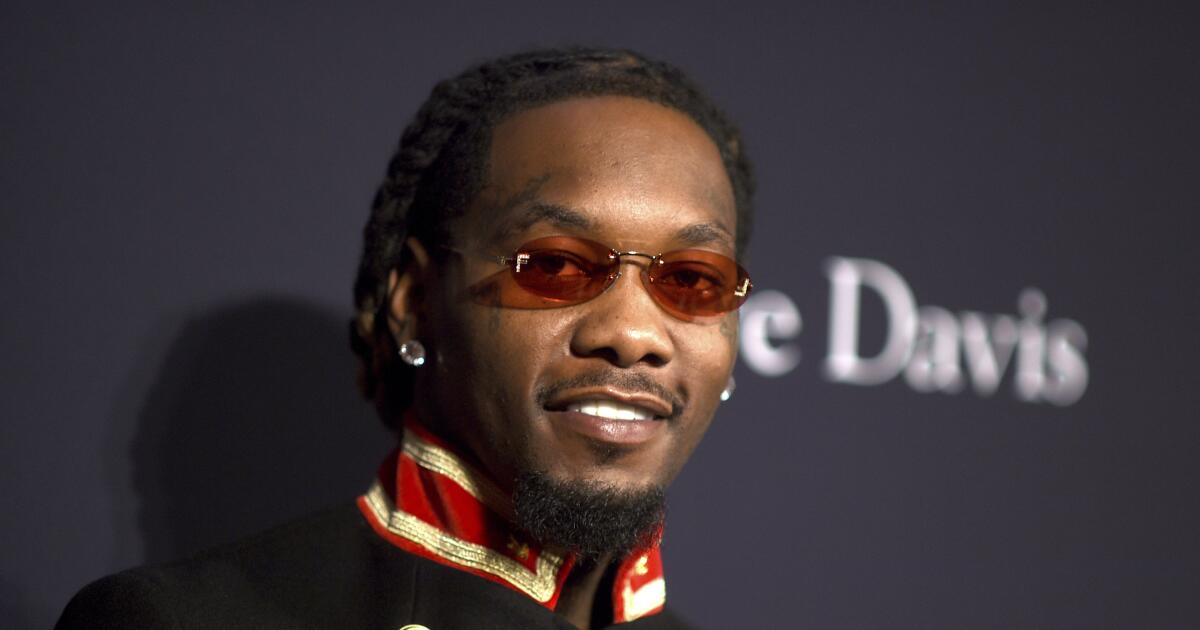
Offset was shot near the Seminole Hard Rock Hotel & Casino in Hollywood, Fla., on Monday evening and is currently listed as stable, a spokesperson for the rapper told The Times.
“We can confirm Offset was shot and is currently at the hospital receiving medical care,” the spokesperson said in a statement. “He is stable and being closely monitored.”
The Seminole Police Department said in a statement that officers responded to an incident in the valet area of the hotel and casino shortly after 7 p.m. One person was transported to Memorial Regional Hospital in Hollywood with non-life-threatening injuries.
Police detained two people in connection with the incident, and an investigation remains ongoing. The scene has been secured and operations at the Hard Rock are continuing as normal, police said.
The circumstances around the shooting remain unclear.
The 34-year-old rapper, whose real name is Kiari Cephus, gained prominence as a member of the Atlanta rap trio Migos, which was founded in 2008 and rose to hip-hop fame in 2013 with the breakout hit “Versace.” The group, whose members included rappers Quavo, Takeoff and Offset, achieved major mainstream stardom in 2016 through “Bad and Boujee,” which shot to No. 1 on the Billboard Hot 100.
The three members grew up together in the Atlanta area. Takeoff was Quavo’s nephew, while Offset is a close family friend.
In 2022, the group split up due to differences between Offset and Quavo. In November of that year, Takeoff, whose real name is Kirsnick Khari Ball, was fatally shot outside of a bowling alley in Houston. He was 28 years old.
Patrick Xavier Clark was indicted by a grand jury in the murder of Takeoff in May 2023. He has pleaded not guilty and the case is awaiting trial.
Since the breakup of Migos, Offset has focused on his solo career, releasing his album “Set It Off” in 2023, which features artists including Travis Scott, Don Toliver, Future and Cardi B. He released his latest album, “Kiari,” in August.
Times staff writer Emily St. Martin contributed to this report.
PHOENIX — Candace Parker, Elena Delle Donne, Chamique Holdsclaw and the 1996 U.S. Olympic women’s basketball team will be enshrined in the Naismith Memorial Basketball Hall of Fame later this year.
Parker, Holdsclaw and members of the 1996 Olympic team were all in attendance Friday at halftime of the UConn-South Carolina game during the women’s NCAA Final Four, where the selections were announced, as was Amar’e Stoudemire and Mike D’Antoni.
They will be joined by longtime NBA official Joey Crawford, NBA coach Doc Rivers and Gonzaga coach Mark Few in the Hall of Fame.
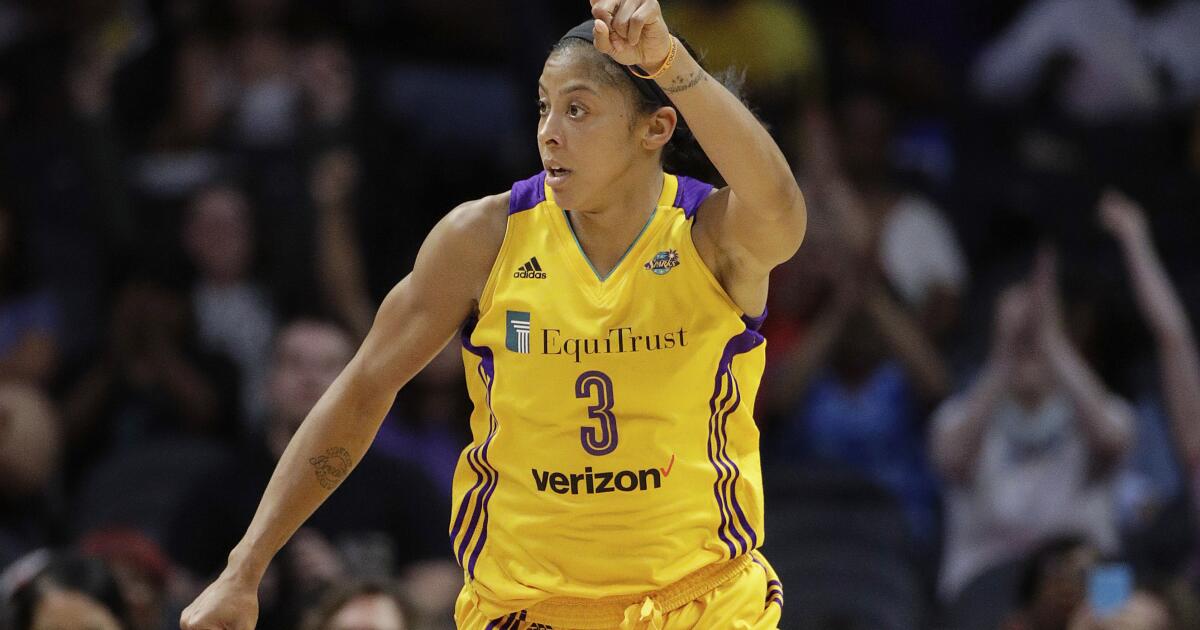
Parker won three titles in the WNBA with three different teams: Los Angeles, Chicago and Las Vegas. She is the only player in league history to win both the MVP and Rookie of the Year in the same season.
She also won two titles while playing in college for Tennessee under Hall of Fame coach Pat Summitt, plus two Olympic gold medals and two WNBA MVP awards.
Delle Donne won two league MVP awards in 2015 and 2019, the second of which came when she led the Washington Mystics to their lone WNBA championship. Delle Donne became the first player in league history to shoot more than 50% from the field, 40% from three-point range and 90% from the free-throw line.
Holdsclaw won three straight titles at Tennessee from 1996-98, the first team to accomplish that. The 1998 championship was Tennessee’s first undefeated season at 39–0 and the Vols also set an NCAA record for the most wins in a season. Holdsclaw went on to have an 11-year WNBA career.
Stoudemire, who was the only NBA player in this year’s class, was Rookie of the Year in 2003 and became six-time All-Star. He spent the first eight years of his career with the Phoenix Suns, where he teamed with D’Antoni.
Rivers has nearly 1,200 victories on his resume, which puts him eighth on the all-time wins list. He led the Boston Celtics to the NBA championship in 2008 and also was in charge of the Los Angeles Clippers during their Lob City era.
Few has won more than 770 games at Gonzaga in his career at the school. He set the NCAA Division I men’s coaching record by winning 81 games in his first three years at the school.
Crawford officiated 2,561 regular-season NBA games and 50 Finals games over his 39-year career. He retired in 2016.
The enshrinement ceremony will take place in August at the Hall of Fame in Springfield, Mass.
NELLY Furtado has silenced body shamers in a curve-hugging strapless red gown, as she was honored with a Hall of Fame award.
The iconic singer, 47, has faced cruel comments about her figure since her return to the spotlight, but defied the haters to accept the coveted achievement.
Sign up for the Showbiz newsletter
Thank you!
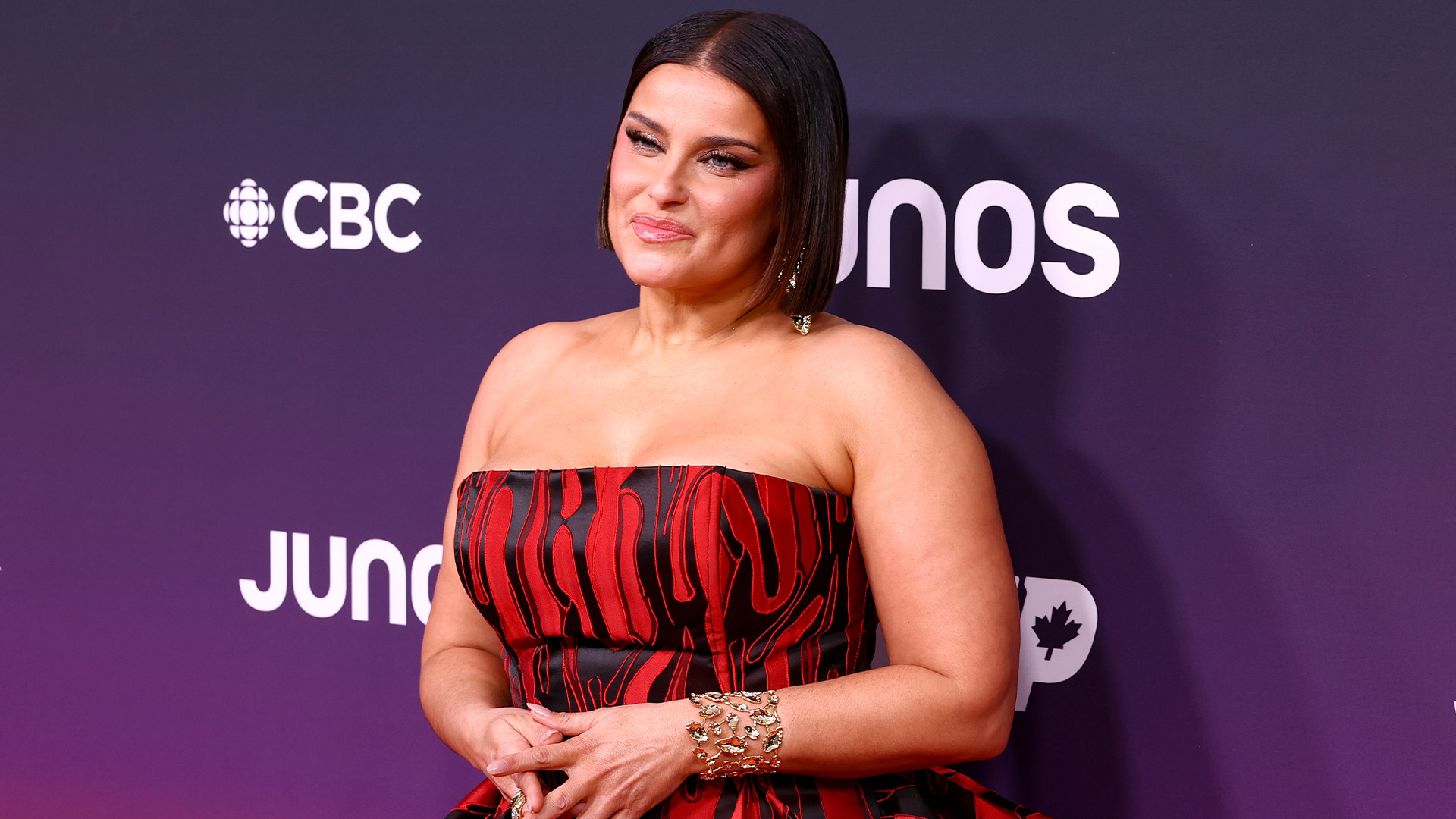
Nelly Furtado looked incredible as she was inducted into the Canadian Hall of FameCredit: GettyThe singer looked stunning in her red dress as she made her speechCredit: GettyThe singer wowed on the red carpet at the beginning of the nightCredit: GettyNelly first launched to fame in the early noughtiesCredit: Getty
Nelly looked stunning in her dress, as she was inducted into the Canadian Music Hall of Fame at the 2026 Juno Awards.
The stunning star oozed sex appeal in the incredible dress as she collected her gong.
The Grammy Award winning artist wore her brown locks tied back, and she accessorised with huge earrings.
Nelly beamed and threw her arms in the air as she walked on stage to be inducted into her native country’s Hall of Fame.
Addressing the audience, the thrilled star said: “Honestly, I’m just really proud to be Canadian. I live in Canada.
“I make my music in Canada.
“I work with Canadian musicians, songwriters, producers because I totally believe in the Canadian dream.
“Please believe it, too.”
Most read in Entertainment
It comes after Nelly revealed how she was retiring from performing, after 25 years in the spotlight.
Taking to Instagram last October, the Grammy winner made an emotional post expressing gratitude for her career but that she felt it was time for a change.
Addressing fans, Nelly said: “I have decided to step away from performance for the foreseeable future and pursue some other creative and personal endeavours that I feel would better suit this next phase of my life.
“I have enjoyed my career immensely, and I still love writing music as I have always seen it as a hobby I was lucky enough to make into a career.
Nelly showed off her fabulous curves in her stunning dressCredit: Getty
“I’ll identify as a songwriter forever.”
Nelly shot to fame in 2000 with her debut album Whoa, Nelly!.
The record was a huge success and spawned the single I’m Like A Bird which went was played on radio stations around the world.
The star is also well known for her song Promiscuous as well as her collaboration with singer James Morrison on Broken Strings.
Another huge hit for Nelly was her chart topping song Maneater.
Nelly recently revealed she was retiring from performingCredit: Splash
Perhaps it was predictable that reality TV would become a pipeline into American politics. After all, political theater was the ultimate unscripted spectacle before reality TV became a genre unto itself.
Consider the raw drama of the first televised presidential debate, where a sweaty Richard Nixon and confident John F. Kennedy traded barbs. Or Anita Hill’s should-have-been-damning testimony against then-Supreme Court justice candidate Clarence Thomas during Senate Judiciary Committee hearings in 1991. Or President George W. Bush’s 2003 “mission accomplished” speech from a carrier off the coast of California, mere weeks into a war in Iraq that lasted years.
Modern programmed reality TV isn’t political theater, but it has become a springboard into modern politics for some stars of the genre. From President Trump to Dr. Oz, Caitlyn Jenner to Sean Duffy, campaigns and political offices are littered with the names of former cast members from reality series. Here’s a list of the most memorable jumps from trash TV to the smoldering dumpster of 21st century politics.
Donald Trump, president of the United States, ’The Apprentice’
Before he was a two-time president of the United States, Trump was one of America’s most recognizable make-believe bosses thanks to his 14-season run on NBC’s reality competition “The Apprentice,” created by reality TV kingmaker Mark Burnett. With his practiced executive scowl and scripted boardroom catchphrase, “You’re fired!,” the show burnished his image as a decisive billionaire dealmaker, even as his real-life business results were far less impressive. Off camera, Trump’s businesses filed for Chapter 11 bankruptcy protection six times between 1991 and 2014. Never mind. It was his knack for showmanship, and his undying need for attention, that proved the perfect entry into post-decorum politics. How does pretending to be in charge on a middling reality competition qualify anyone to safely and successfully run the most powerful nation on Earth? It doesn’t. Sleep tight.
Sean Duffy, Transportation secretary, ’The Real World’ and ‘Road Rules: All Stars’
Sean Duffy first appeared on MTV’s “The Real World: Boston,” where he was introduced as a flirtatious, conservative lumberjack/student hybrid. In short, he was a casting director’s dream. He later joined “Road Rules: All Stars,” where he met his future wife Rachel Campos-Duffy. Trading hot tub confessionals for courtrooms, Duffy became a Wisconsin district attorney and then a congressman. By 2025, he’d risen to secretary of Transportation under Trump, completing a career arc from staged arguments with pretend roommates to heated exchanges with the press about the effects of a government shutdown on airport safety. Dude.
After a fiery confirmation hearing, Mullin is now Trump’s second secretary of Homeland Security in the 2.0 administration, following the disastrous tenure of wannabe reality show star Kristi Noem. Mullin was not a reality star per se, but in his role as a professional mixed martial arts (MMA) fighter he performed in cages for live, streaming and pay-per-view cable audiences. As an early 2000s champ in the sport, Mullin boasted an undefeated 5-0 record and the Oklahoma chapter of the National Wrestling Hall of Fame inducted him in 2016. How do these MMA skills, or his former life running the family plumbing business qualify him to protect the national security of this great nation? It’s unclear, but his fighting instincts have already resulted in a viral moment out of a 2023 Senate hearing, when he challenged Teamsters President Sean O’Brien to a physical fight, offering to “finish it here.” Now he’ll be running the DHS. What could go wrong?
Omarosa Manigault Newman, former assistant to Trump and director of communications for the office of public liaison, ‘The Apprentice’
Newman became one of reality television’s more memorable villains thanks to her run on “The Apprentice,” where her Machiavellian ways and unapologetic ambition revolted viewers and impressed her fake boss. She would eventually parlay that dubious notoriety into more than one role in the first Trump White House. Her tenure was brief, ending in a high-profile departure and her accusation that Trump is a “racist, a bigot and a misogynist.” She then wrote a book, “Unhinged: An Insider‘s Account of the Trump White House.” Perhaps she’ll adapt her written account into a reality show, only to reignite her fame and win the White House. From there? She’d hire Trump, of course, then swiftly end his run on the show with two simple words: “You’re Fired!”
Spencer Pratt, Los Angeles mayoral candidate, ‘The Hills’
Best known as one-half of reality TV’s most polarizing couple on “The Hills,” Pratt built a reputation as a needling instigator, often leaning into the role of villain with annoying enthusiasm. After stints on other reality shows such as “Big Brother U.K.,” he began speaking out about local California issues, including wildfire recovery and environmental policy. Earlier this year Pratt, a Republican, announced that he would be running for mayor of Los Angeles in the upcoming mayoral election, challenging incumbent Karen Bass. Does he really want to govern the Left Coast, or is his candidacy a ploy for a new reality show? Let’s hope it’s the latter.
Caitlyn Jenner, California gubernatorial candidate, ‘Keeping Up With the Kardashians’
An Olympic gold medalist long before reality TV fame, Jenner reentered public consciousness through a show about nothing. The hit series relaunched her into the spotlight as a member of one of America’s most visible families. Using that fame, she ran as a Republican in 2021 in California’s gubernatorial recall election, positioning herself as a political outsider. Her campaign leaned heavily on her life story — from her athletic achievement to her personal reinvention — but she failed to keep up with the competition.
Clay Aiken, U.S. congressional candidate, ‘American Idol’
Aiken rose to fame as the earnest, vocally gifted runner-up on “American Idol” circa 2003. His polite demeanor, impressive vocal range and dramatic rendition of “Bridge Over Troubled Water” earned him a devoted fanbase known as the “Claymates.” Aiken went on to have a semi-successful music career before running for Congress in North Carolina as a Democrat in 2014. Aiken made the mistake of leaning into his strengths as a thoughtful, policy-oriented candidate rather than relying on his past achievement as a vapid reality show contestant. He lost, of course.
Jim Bob Duggar, Arkansas state House representative and state Senate candidate, ’19 Kids and Counting’
As the patriarch of TLC’s “19 Kids and Counting,” Jim Bob Duggar became synonymous with a conservative Christian lifestyle when the show aired in 2008; it garnered high ratings and ran for 10 seasons. He espoused many of the same ideals as an elected official in the Arkansas House of Representatives from 1999 to 2003, before leaving the political stage for reality TV. But the show was canceled in 2015 when the Duggars’ eldest son, Josh, admitted to molesting several girls, some of whom were his sisters. A conviction on child pornography charges followed. (More recently, his brother Joseph was charged with child sex abuse.) Jim Bob Duggar attempted a political comeback in 2021 when he ran for a vacated seat in the Arkansas state Senate, leaning on what he believed was his reputation as an upstanding family man. Reality bit back, and he lost.
Mehmet Oz, U.S. Senate candidate and administrator of Centers for Medicare & Medicaid Services, ‘The Dr. Oz Show’
Like so many questionable figures Americans came to trust in the 2000s, Dr. Oz got his start as a frequent guest on “The Oprah Winfrey Show.” He went on to launch “The Dr. Oz Show,” where he dispensed health advice to millions of viewers. His blend of seemingly measured medical guidance and on-camera charisma appealed to viewers who were tired of looking at egg-headed doctors, like the kind who practice real medicine off screen. He announced his candidacy for the U.S. Senate in Pennsylvania as a Republican in 2021, focusing on an anti-establishment platform. He lost the general election to Democrat John Fetterman, but the doctor is still in. Trump appointed him administrator of the Centers for Medicare & Medicaid Services.
Sarah Palin, former Alaska governor and vice presidential nominee, ‘Sarah Palin’s Alaska’
File this under “Folks who tried to reinvent themselves on reality TV after tanking in politics.” Sarah Palin served as the ninth governor of Alaska before being selected as Sen. John McCain‘s running mate ahead of the 2008 presidential election. After losing to Barack Obama and Joe Biden, she veered away from politics, a decision that probably had nothing to do with an ethics scandal dubbed Troopergate that involved Palin. Burnett saw an opportunity, producing the 2010 TLC reality series “Sarah Palin’s Alaska.” It followed the Palin family engaging in activities such as fishing, prospecting for gold and camping in the region. In short, it looked like a tourism ad for Alaska and was canceled after one season. It also failed to kickstart her political career. She lost her 2022 bid for Alaska’s U.S. House seat, failing in both a special election and her general election comeback attempt. Apparently it isn’t Sarah Palin’s Alaska, after all.
A CLIP of a ‘baby’ Louis Tomlinson on Waterloo Road, long before he was a global superstar, has tickled fans.
The BBC soap dug through the archives to unearth a blink-and-you’ll-miss-it cameo from former One Direction star Louis.
Sign up for the Showbiz newsletter
Thank you!
Louis Tomlinson has re-appeared in an old clip from soap Waterloo RoadCredit: BBCOne Direction star Louis can be seen in the resurfaced footageCredit: BBC
The clip shows a baby-faced Louis playing an extra during the show’s very first series in 2006.
In the footage, a concerned-looking Louis can be seen in the background of the school playground as fan-favourites Janeece Bryant (Chelsee Healey) and Donte Charles (Adam Thomas) get into a heated row.
To help fans catch the four-second appearance, the clip has been given the slow-motion treatment, asking: “Can you spot One Direction’s Louis Tomlinson in Waterloo Road?”
The Sun were the first to reveal at the start of the year that Zara and Louis had begun dating each other just weeks after she split from long-term partner, reality star Sam Thompson.
Singer-songwriter Louis is embarking on a world tourCredit: Getty
NO ONE could ever have imagined that little Maura Higgins from a sleepy Irish town would go on to be one of the country’s most famous exports.
Not least her sisters – Becki and Louise – who have sat watching her meteoric rise to fame from the peripheries. There are few relationships closer than that of siblings, but what happens when celebrity gets in the way? Here, we take a look at their now very complicated dynamic – and reveal why Maura’s decision to miss Louise’s wedding had a lasting impact and how imitation isn’t always the highest form of flattery when it comes to Becki.
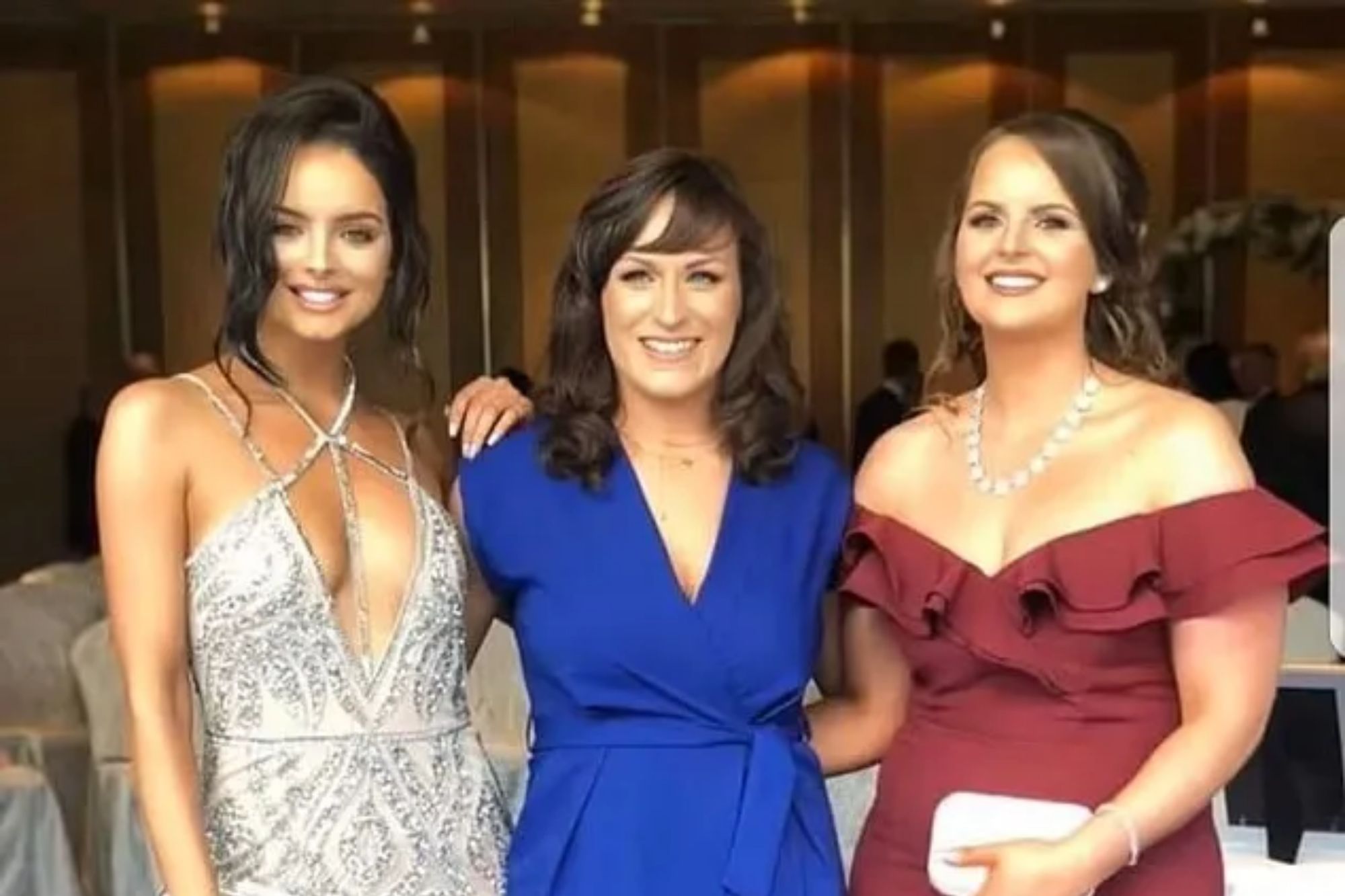
Maura Higgins with sisters Louise (centre) and Becki (right)Becki has attempted to follow in her sister’s footsteps with an online careerCredit: Instagram/@beckihiggins
When Maura, now 35, chose to apply for Love Island, she already knew her older sister Louise was getting married that summer.
Astonishingly, fitness instructor Louise, 38, gave her blessing for her to miss her big day – but whisperings at the time suggested not everyone in the family agreed with the move.
She made it very clear what her intentions were when she chose fame over Louise’s wedding.
It was certainly risky, but it paid off massively. From the very first moment Maura appeared on screen in 2019 on Love Island, her family – which also includes her brother, who has never been named publicly – realised life would never be the same again.
An insider explained: “Maura was from a very tight-knit family and grew up in a place where everyone knew everyone. When she became well known, of course, things changed.
“At times, she’s not always been able to support her sisters as much as she would like. She made it very clear what her intentions were when she chose fame over Louise’s wedding.
“Louise has spent years just trying to get on with her life, while Becki has been hanging off her coattails, desperate for even some semblance of her success.
“Like all sisters, there is a level of competitiveness and jealousy that just doesn’t exist in other relationships. It’s fair to say it’s very complicated.”
Today, Maura is a huge star both in the UK and in America – rubbing shoulders with A-listers and really putting her home town of Longford on the map in a way no one could ever have dreamed of.
But it has meant Maura has missed out on a series of huge life events – most notably her sister’s wedding.
When Louise walked down the aisle with long term fiance Mark Kelly at a private ceremony at Abbeyshrule Church, outside Ballymahon, Maura was busy cementing herself in the Love Island hall of fame.
Even Maura’s ex-boyfriend, James Finnegan, attended the big day, having grown very close to the family.
A source told us at the time: “Louise got engaged in 2016, and the wedding was planned over a year ago. So Maura would have known that when she applied for Love Island.
“But Maura and Louise are very close, and her sister fully supports her decision to go on Love Island.
“In fact, she’s happy for Maura and is delighted she’s been given an amazing opportunity to find love and further her career.”
Louise made the decision to distance herself from the limelight as much as possible at that time.
Mimicking Maura
But Becki, Maura’s younger sister, who is now 31, grabbed the chance of fame with both hands.
She chatted about Maura whenever she got the chance and even appeared on Virgin Media One’s Ireland AM for a fashion segment.
Maura was delighted, gushing that she was “so proud”.
Becki, mum Sharon, Maura and Louise were all incredibly close growing upCredit: Instagram/@beckihigginsMaura rose to fame on Love Island in 2019Credit: Rex FeaturesMaura returned to visit her family for her niece’s Holy Communion in 2024Credit: Instagram/@beckihigginsMaura no longer speaks to her dad Seamus
She started joining Maura on nights out and built up her own social media presence.
Becki, however, has never quite managed to break into the limelight fully – despite her best efforts. She regularly posts images of herself glammed up for a night out and clearly shares Maura’s same cheeky sense of humour, judging by some of her more risky posts.
She has just 3.5k followers but has still managed to land herself a few paid ads here and there.
‘Scared and alone’
As Maura’s fame grew, her schedule became busier and busier – she moved to London and her once close relationship with her sisters felt the strain.
Maura has said she felt “scared” and “very alone” during that period of her life.
It wasn’t long until Becki and Louise stopped posting publicly about their sister – they couldn’t keep up with her endless achievements.
Maura tried to get back to see Louise’s children as much as possible and is particularly close to her niece Isabelle. While she may not always be around, she made sure she was there for Isabelle’s first Holy Communion in 2024, calling her a “best friend for life”.
When she found out her nephew, believed to be her brother’s son, was being bullied in 2022, she showed up at his school to pick him up – no doubt scaring the bullies off for good.
Maura was very close to her siblings while growing up, and their bond became even tighter when her parents, Sharon and Seamus, split up.
The break-up was a defining moment in all their lives.
Maura candidly said: “It was a very nasty break-up and a lot went on, like, things I would never want to talk about because I wouldn’t want to be saying things about my mum or dad.”
She has reached new heights of fame ovr the last 12 monthsCredit: SplashBecki has built up her own online followingCredit: Instagram/@beckihigginsBecki has always shown her support for her sisterCredit: Instagram/@louise_h87Maura’s ex James Finnegan attended her sister Louise’s wedding without her
She added: “When the break-up happened, my mum was trying to keep a roof over four kids and herself, and we were all in school, it was very, very hard and I remember seeing my mum struggle a lot.”
Maura continued: “She had a nervous breakdown, she collapsed in the kitchen in front of all of us and only my older sister, she was a lot older at the time, she knew how to like put her on her side and call the ambulance.
“I don’t know why I remember this, but I remember, mammy has a rare blood type and my older sister knew to say that to the paramedics.”
Cutting contact
After appearing on Love Island, Maura ended up cutting all contact with her dad, which is said to have left him blindsided.
She explained: “My dad spoke to me not very nice. I’m not saying it was just a bit of an argument. It was horrendous where I physically couldn’t breathe after the phone call.
“I thought to myself, ‘I wouldn’t let a partner talk to me like that. I wouldn’t let a friend talk to me like that. I’m not going to let my dad talk to me like that’.
“But also, I think if I dig deep, I don’t think I’ve ever forgiven my dad for not being there for me when my best friend passed away. And he wasn’t there for me.”
The sisters were bonded by the horror. Tragically, Becki suffered more heartache when another close friend passed away at the start of the year.
As she laid him to rest on January 23rd, Maura was in New York filming The Drew Barrymore Show.
It was a real sign of just how far apart their lives had become. Maura’s future is no doubt going to be bright – but what part, if any, her sisters will play isn’t as clear.
Maura is now one of the most sought after stars on the telly both in the UK and AmericaCredit: Instagram
The puck that Hughes smacked into the net in overtime to give the United States its first men’s Olympic hockey gold since the 1980 “Miracle on Ice” was seemingly forgotten amid the raucous celebration.
But this week, the Hockey Hall of Fame began displaying that puck along with the one Megan Keller knocked into the net in overtime to give the U.S. women’s team gold in Milan. The International Ice Hockey Federation apparently secured the frozen vulcanized rubber disks immediately after the games and handed them to the Hall of Fame located in Toronto.
Hughes is happy “his” puck surfaced but believes he is the rightful owner of a piece of memorabilia that David Kohler, president of SCP Auctions, estimated might be worth $1 million.
“I don’t see why Megan Keller or I shouldn’t have those pucks,” Hughes told ESPN. “I’m trying to get it. Like, that’s [B.S.] that the Hockey Hall of Fame has it, in my opinion. Why would they have that puck?”
Hughes might not like the answer. The provenance of the puck is similar to that of a basketball or football used in a notable moment. It is dissimilar to a historic home run because a baseball leaves the field of play, and the owner becomes the fortunate fan.
“Because of the increasing value of memorabilia, ownership of items has become standardized over the last decade or so,” said an expert who agreed to speak anonymously because they work in the acquisition of such items. “Whoever purchased the puck owns it. Jerseys belong to the team, shoes and gloves to the player, the puck to whoever supplied it to the Olympics.”
That would be the International Ice Hockey Federation, the governing body of the Olympics hockey tournament. The IIHF employees who immediately secured those precious pucks amid gold-medal bedlam apparently did their job well.
“The puck was designated for archival preservation with the Hockey Hall of Fame to ensure its long-term safekeeping and historical recognition,” an IIHF spokesperson said.
The pucks are featured in an “Olympics ‘26” display that also contains a hockey stick used by Brady Tkachuk of the U.S. team and a U.S. jersey worn by four-time Olympian Hilary Knight.
It might strike some as odd that the display is in Canada, where fans are mourning the loss to the United States, but that’s been the location of the Hall of Fame since it was established in 1943. HOF president Jamie Dinsmore said in a statement that the display contains “donated items,” although it is unclear whether the IIHF has donated or merely loaned the pucks to the HOF.
“The Olympics ’26 display will help ensure that these unforgettable Olympic moments are preserved for our guests from around the world to experience,” Dinsmore said.
Meanwhile, Hughes told ESPN he wants the puck to become the property of one particular fan — his father, who collects memorabilia for him and his brothers Quinn and Luke. All three play in the NHL.
“I wouldn’t even want it for myself. I’d want it for my dad. I know he’d just love, love having it,” Hughes said. “When I look back in my career, I don’t collect too many things for myself, but my dad’s a monster collector for the three of us. I know he would have a special place for it.”
Or it could be sold at auction, where certainly it would pay for any dental work Hughes needs after getting teeth knocked out during the gold-medal game. Various auction houses have estimated the value of the puck to be from $40,000 to $1 million.
Should he acquire the puck, though, Hughes might not even consider selling it. The first pick of the 2019 NHL draft, he signed an eight-year, $64 million contract extension with the New Jersey Devils four years ago.
Hall of Fame high school football coach Bob Johnson, who turned El Toro and Mission Viejo into powerhouse high school football programs and became one of the winningest coaches in state history, has died. He was 80. He had been battling Alzheimer’s.
“I feel for the family,” Mission Viejo football coach Chad Johnson (no relation) said Wednesday.
Johnson passed early Wednesday morning,
Johnson won six Southern Section titles coaching at Mission Viejo and three at El Toro while winning 338 games, the second winningest in Orange County history and in the top five in state history, according to the Orange County Register.
His two sons, Rob and Bret, were standout high school quarterbacks before enrolling at USC and UCLA, respectively. Rob made it to the NFL. Both became coaches after their playing days were completed. Rob still coaches as an assistant at Mission Viejo.