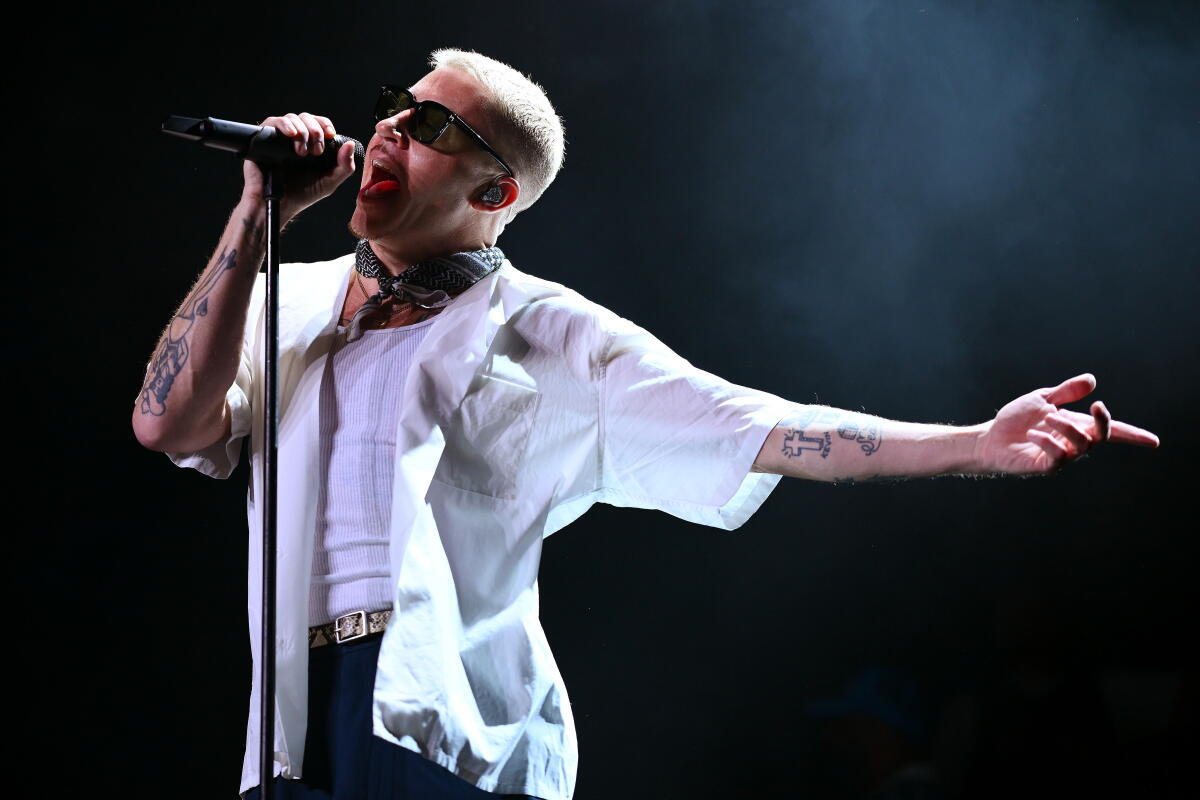
Macklemore says ‘being apolitical during a genocide doesn’t work’, promises to donate proceeds to Palestinian causes.
Grammy Award-winning rapper Macklemore has announced a string of shows in support of Palestine after he was controversially dropped from Ed Sheeran’s United States tour after speaking out against Israel’s genocidal war on Gaza.
The 43-year-old American rapper, who has almost 40 million monthly listeners on Spotify, announced his Free Palestine Tour on Thursday, with shows set to take place in Dublin, Paris and London in late October.
Recommended Stories
list of 3 itemsend of list
Macklemore said he will be joined by other musicians and will announce their names soon. He added that US shows are currently being organised.
He said all proceeds raised from the tour will be donated to causes supporting the Palestinian people and the wider movement.
“If these last couple of weeks have shown us anything, it’s that something has shifted over the last three years,” Macklemore said in a statement.
“There has been a collective awakening around Palestinian liberation, the power of billionaires that try to censor that call, and what we expect from artists right now. It’s 2026. Being apolitical during a genocide doesn’t work anymore,” he continued.
“People are asking artists to show up, educate themselves and be in community. To use the stage for more than entertainment. To push back when the call for a Free Palestine is met with attempts to silence it.”
English punk rap duo Bob Vylan have expressed their support for the tour, responding to Macklemore’s Instagram post with a heart emoji. The British YouTuber and influencer known as Chunkz, who has more than four million followers on Instagram, also praised Macklemore.
Attempts to silence Macklemore
On September 4 at New Jersey’s MetLife Stadium, Macklemore, who was one of Sheeran’s opening acts, expressed support for Palestine.
“A big part of the reason why I wanted to do this tour in the first place is so I could stand up in stadiums like this and say two words that are very near and dear to my heart: ‘Free Palestine’ … My message is for peace; love for all human beings to be treated with dignity, respect, and equality,” Macklemore told the audience at the time.
Soon after, the rapper announced that he had been dropped from the Sheeran tour.
Venue owner Robert Kraft later confirmed that Macklemore was barred from performing at his Gillette Stadium in Foxborough, Massachusetts. Kraft denounced what he described as the rapper’s “broader history of antisemitic rhetoric and imagery” and argued that such actions led him to decide that allowing Macklemore to perform at his venue “would cross that line”.
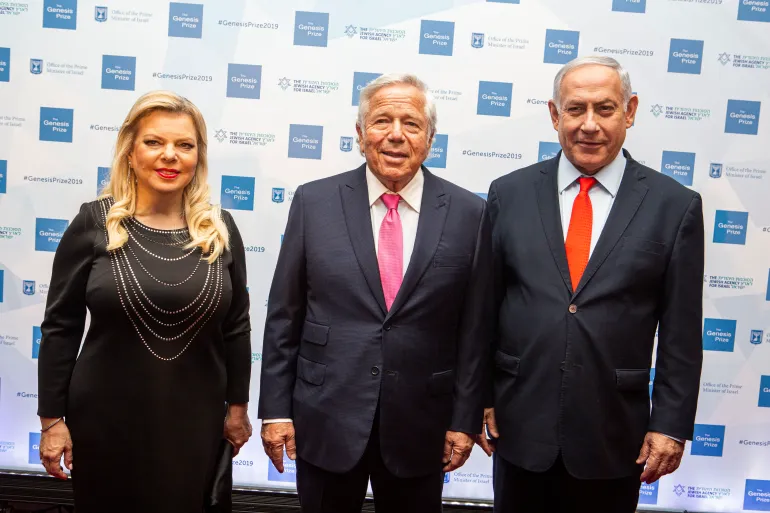
Kraft is a Jewish-American billionaire and has donated to several Israeli causes. Israeli Prime Minister Benjamin Netanyahu, who is the subject of an arrest warrant issued by the International Criminal Court (ICC) for war crimes and crimes against humanity, said in 2019 that Israel did not have a “more loyal friend” than Kraft.
From left, Sara Netanyahu, Robert Kraft and Israeli Prime Minister Benjamin Netanyahu at the Genesis Prize at The Jerusalem Theater on June 20, 2019 [File: Getty]
Macklemore claimed Sheeran and his team removed him from the tour following pressure from Kraft.
He alleged that Kraft rallied the owners of the remaining stadiums that the tour would include and persuaded them not to allow him to perform. The rapper said that Kraft then told Sheeran the tour would not go ahead unless he was dropped.
Neither Kraft nor Sheeran have commented on Macklemore’s allegations that stadium owners were contacted by Kraft.
Qatar’s Prime Minister Sheikh Mohammed bin Abdulrahman bin Jassim Al Thani has called on states to respect sovereignty as a condition for security in the Middle East, warning against “cycles of escalation” after “an earthquake” caused by the US-Israeli war on Iran.
The region needs a “framework in which sovereignty is respected” and no state can pose a “threat to another”, Sheikh Mohammed said on Sunday at the opening of the Qatar Economic Forum’s UN General Assembly-adjacent event in New York City.
Recommended Stories
list of 3 itemsend of list
Sheikh Mohammed – who is also Qatar’s foreign minister – described the economic fallout from the US-Israel war on Iran as “an earthquake” with “its shock waves” reaching far beyond the borders of the Middle East, “challenging assumptions about security and stability”.
“During the crisis, almost every conversation began with security and de-escalation, then turn[ed] to energy supplies, shipping routes, and with our investments, plans will continue. These were different expressions of the same question. When so much is being disrupted, what can still be relied upon?”
He said that Qatar has weathered the test to the “foundations” of the country’s economy and security, but acknowledged that the ongoing conflict in the region is having an impact.
“Permanent security cannot be built through arrangements that leave any state permanently exposed to insecurity,” Sheikh Mohammed said. “We must address the sources of tensions and build confidence.”
Reporting from New York, Al Jazeera’s Kristen Saloomey said that message “no doubt will be repeated” when Gulf leaders meet US President Donald Trump on Tuesday during the UN General Assembly.
Qatar’s $38bn domestic investments
The PM also outlined a domestic shift in Qatar’s investment strategy by pledging more than $38bn in spending on Qatari infrastructure over the next five years.
“That’s meant to attract private investors and send a message of Qatar’s resilience,” Saloomey said, while the PM is nonetheless acknowledging that the ongoing conflict is “having an impact on the region”.
The UNGA starts on Monday and ends on Friday.
The situation in the Middle East and its global ramifications are expected to be high on the agenda during speeches and diplomacy.
Also on Sunday, Qatar’s Foreign Ministry spokesman, Majed Al-Ansari, told US media in New York that the mediation efforts by his government are ongoing to restart talks between Tehran and Washington to end the US-Israel war on Iran.
Ed Sheeran’s Loop tour, in the span of less than two weeks, became an unexpected lightning rod for controversy and conversation about artist activism amid Israel’s deadly war in Gaza. Still, the show will go on.
Sheeran’s tour will proceed as planned, The Times has learned. He is scheduled to play on Saturday at Lincoln Financial Field in Philadelphia. The venue also confirmed on Wednesday that the Saturday concert is still a go, but that supporting acts have yet to be finalized.
A representative for Sheeran’s tour did not immediately respond to requests for additional information, including who will be the new supporting acts.
In a rapid turn of events since rapper and former opening act Macklemore called for Palestinian liberation onstage earlier this month, Sheeran — the singer of inoffensive hits including “Thinking Out Loud” and “Shape of You” — fell out with the fellow Grammy winner, witnessed all supporting acts drop from his lineup and defended himself against accusations of complicity in silencing criticism of Israel. Additionally, Sheeran confronted scrutiny over his largely apolitical public presence. He attributed this to his longtime desire to “bring people from all backgrounds and cultures together” via his music and performances.
“I am not complicit. I have my personal views on this devastating conflict,” he wrote Tuesday on Instagram. “Just because I choose not to speak publicly, it doesn’t mean I don’t have them, and it doesn’t mean I don’t care. Nor does it mean I don’t support causes in my own, personal way.”
Ahead of Sheeran’s first concert since the scrutiny surrounding Macklemore’s performance, read on for what preceded the fallout of Sheeran’s Loop tour.
Macklemore goes from “Thrift Shop” to “Hind’s Hall”
Macklemore performs at Rod Laver Arena on May 15, 2024, in Melbourne, Australia.
(Morgan Hancock / Getty Images)
Before hitting the stage for Sheeran’s Loop tour, Macklemore famously burst onto the music scene in 2012 as part of the duo Macklemore & Ryan Lewis. The pair gained popularity for the then-inescapable hit “Thrift Shop,” the fourth single off their acclaimed debut album, “The Heist.”
The duo gained further notoriety with hits “Can’t Hold Us” and same-sex marriage anthem “Same Love.” They notoriously bested Kendrick Lamar at the 2014 Grammy Awards in the rap album category. Lamar was nominated for his striking debut “Good Kid, M.A.A.D City.”
A year after releasing their 2016 album, “This Unruly Mess I’ve Made,” the duo announced an indefinite hiatus. Macklemore focused on his solo work, including collaborations with Kesha, Lil Yachty and Skylar Grey. In recent years, Macklemore has taken on a new purpose with his platform.
Macklemore, like many musical acts including Kehlani, Finneas and Irish rap group Kneecap, became a vocal supporter of the Palestinian cause after Israel began its offensive in Gaza in the wake of the Hamas attacks on Oct. 7, 2023. The rapper has channeled his views on the conflict into his music, releasing his protest song “Hind’s Hall” in May 2024. The song calls for a ceasefire, an end to Israeli occupation in Gaza and highlights pro-Palestinian protests on college campuses.
Ed Sheeran announces his Loop tour
Ed Sheeran performs during iHeartRadio Kiss 108’s Jingle Ball 2025 at TD Garden on Dec. 14, 2025, in Boston, Mass..
(Scott Eisen / Getty Images for iHeartRadio)
Last September, Sheeran unveiled his plans to hit the road to promote his eighth studio album, “Play.”
The British “A Team” singer announced at the time that his tour would begin June 2026 with a stop at Arizona’s State Farm Stadium and would run through early November. The announcement did not disclose the supporting acts set to share the stage with him, but informed fans the singer would perform shows across large venues including Inglewood’s SoFi Stadium in August and a pair of performances at MetLife Stadium in New Jersey.
The concerts at MetLife Stadium would later embroil Sheeran, his tour, Macklemore — and somehow pop star Pink — in controversy.
Macklemore calls to ‘Free Palestine’: Performance or ‘propaganda?’
When Macklemore took the MetLife Stadium stage as the supporting act for Sheeran’s Sept. 4 and 5 concerts, he did not mince words in his message. During his set, Macklemore criticized Israel for its war in Gaza and accused it of genocide of Palestinians. He also projected an edited version of his “Hind’s Hall” music video, which features footage of pro-Palestinian college encampments and protests and military strikes in Gaza.
Video of Macklemore’s performance spread online, drawing ire from some Jewish advocacy groups including StopAntisemitism, which accused Macklemore on Instagram of turning “a mainstream event into a political nightmare against the Jewish state.” Pop star Pink, who is Jewish, shared StopAntisemitism’s post to her Instagram story. She faced backlash for the repost and later clarified in a three-part statement that she took issue with the imagery Macklemore displayed during his performance. She also accused the rapper of taking “the mic to tell all the Jews in the stadium that it wasn’t about them.”
In the wake of Macklemore’s performance, the Israeli American Council and the Anti-Defamation League also decried Macklemore’s performance on social media, with the former publishing a petition calling on Sheeran to remove the rapper from the remaining shows of his tour.
“Freedom of expression does not give anyone the right to turn someone else’s stage into a platform for political propaganda,” the Israeli American Council said on Instagram.
Amid the mounting backlash, Macklemore defended his stance and shared video on social media of his full address to the MetLife crowd. “I said ‘Free Palestine.’ I want those words to be loud and clear so that the people in Gaza all the way to the occupied West Bank know that we have not forgotten them,” he tells concertgoers in his introduction to “Hind’s Hall.”
“To all my Jewish brothers and sisters, criticism of Israel, criticism of apartheid, being against genocide in no way is a criticism of you,” he adds, according to video of his address. “My message is for peace, love for all human beings to be treated with dignity, respect and equality.”
The fallout begins: Macklemore fired from Loop tour
Whether Macklemore would remain on Sheeran’s tour amid the public outcry remained uncertain, until he confirmed his status earlier this week. He said in a lengthy statement shared to Facebook that his continued, vocal support for Palestinians amid Israel’s war in Gaza has cost him professionally.
The rapper said he was removed after “some difficult conversations” with Sheeran. He also went into depth about the inner workings that led to his removal from the tour, including conversations between Sheeran and wealthy venue owners, including billionaire Robert Kraft, whose Kraft Group owns Gillette Stadium in Massachusetts, where Sheeran is set to play later this month.
“Ed told me that Kraft said I would not be allowed to perform in his stadium,” Macklemore wrote. “Ed also told me that Kraft had rallied some of the other stadium owners and collectively they gave him an ultimatum: if Macklemore stays on the tour, you will not be allowed to play in our venues.”
Sheeran in a separate statement shared on Tuesday confirmed he had conversations with Kraft but did not speak to the alleged ultimatum. The singer also said removing Macklemore from the tour “was the promoter’s decision, it was not mine” and that Macklemore’s contract was with its promoter. Messina Touring announced on Monday it had dropped Macklemore from the remaining tour dates “after discussions with stakeholders.”
Additionally, Macklemore wrote that Sheeran’s “typical apolitical stance was being challenged” amid the public scrutiny and “he couldn’t get past his public facing, ‘I don’t take sides.’”
Sheeran appeared to address that criticism, writing in his missive that attendees at his concerts “do not expect a political forum.” The singer also wrote he thinks there can be different ways to work toward peace.
“If we only focus on shouting the loudest, nothing will ever change,” he wrote.
Macklemore said in his Monday statement he was hopeful this turn of events would not mean an end to his friendship with Sheeran and he was grateful for the opportunity to play on tour, regardless.
“I didn’t need 10 Shows from Ed. I needed 2,” he wrote. “Two chances to stand in front of 90,000 people and say … ‘Free Palestine.’”
Supporting acts depart tour in solidarity
Grammy winner Finneas was among the supporting acts who announced their departure from Ed Sheeran’s tour on Tuesday.
(Monica Schipper / Getty Images)
Hours after Sheeran shared his side to the controversy, numerous musical acts including Grammy winner Finneas and folk band Beoga, Sheeran’s backing band, pulled from the Loop tour in solidarity with Macklemore and in support of Palestinians.
“Artists must not be silenced when they speak up for the oppressed. I have decided to withdraw from my upcoming tour dates with Ed Sheeran,” wrote Finneas, who has been a vocal supporter of Palestinians. “I stand with Palestine and its people.”
Pop band Lukas Graham and Irish singer-songwriter Aaron Rowe, both billed as supporting acts for several upcoming dates on Sheeran’s tour, voiced support for the Palestinian people and spoke against the inner workings that led to Macklemore’s removal.
In its statement, Lukas Graham wrote: “Money doesn’t give you the right to own the conversation. Nobody’s bank balance should decide who gets to speak or which suffering we’re allowed to acknowledge.”
Rowe in his Instagram statement said that Sheeran “has been a friend to me and has changed my life” but that he is sympathetic to the Palestinian cause. “As Irish people we know all too well about genocide, forced famine and violent occupation,” he wrote. The “Hey Ma” singer accused elites of leveraging their power to “silence the rightful voices” and criticism of Israel.
“I need to be true to myself and my ancestors who resisted colonisation, and fought for a freedom that I enjoy today in Ireland,” Rowe continued.
Macklemore announced Wednesday that he will donate his earnings from his shows with Sheeran to charities supporting Palestinians. He also invited Kraft to match his donation and reaffirmed his dedication to the Palestinian cause.
“This is what this has always been about,” he wrote. “Not me. Not a tour. Not the headlines or the controversy.”
The North American leg of Sheeran’s Loop tour is scheduled to end Nov. 7 at Raymond James Stadium in Tampa, Fla. — the same venue that platformed controversial rapper Ye (formerly Kanye West) earlier this summer.