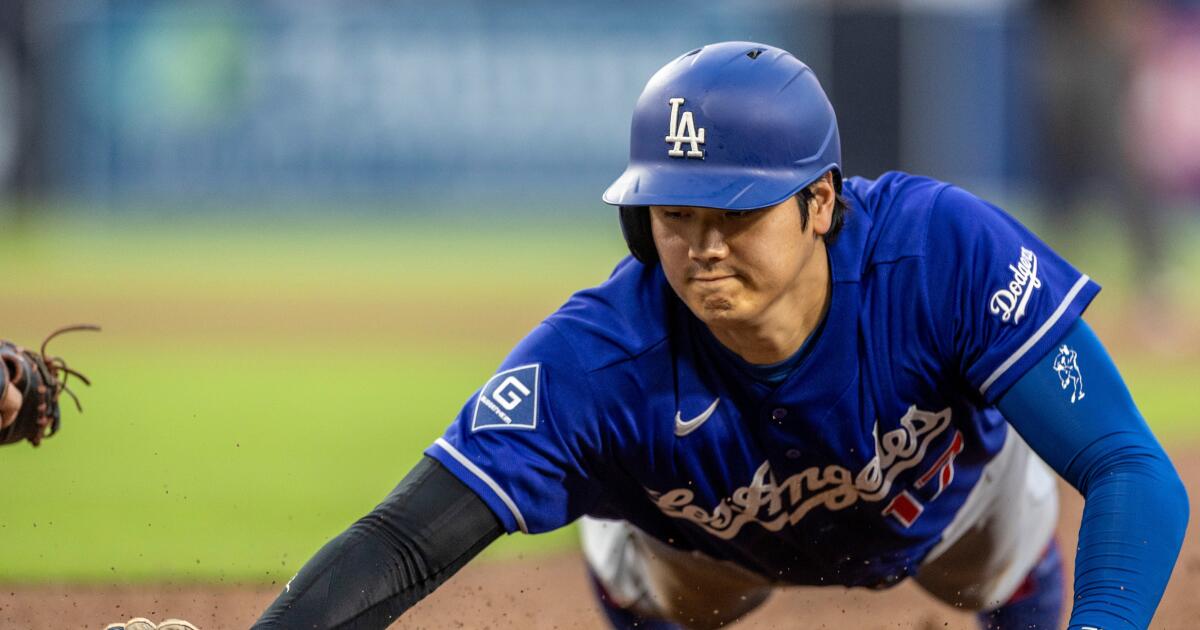
Dodgers lose to the Padres
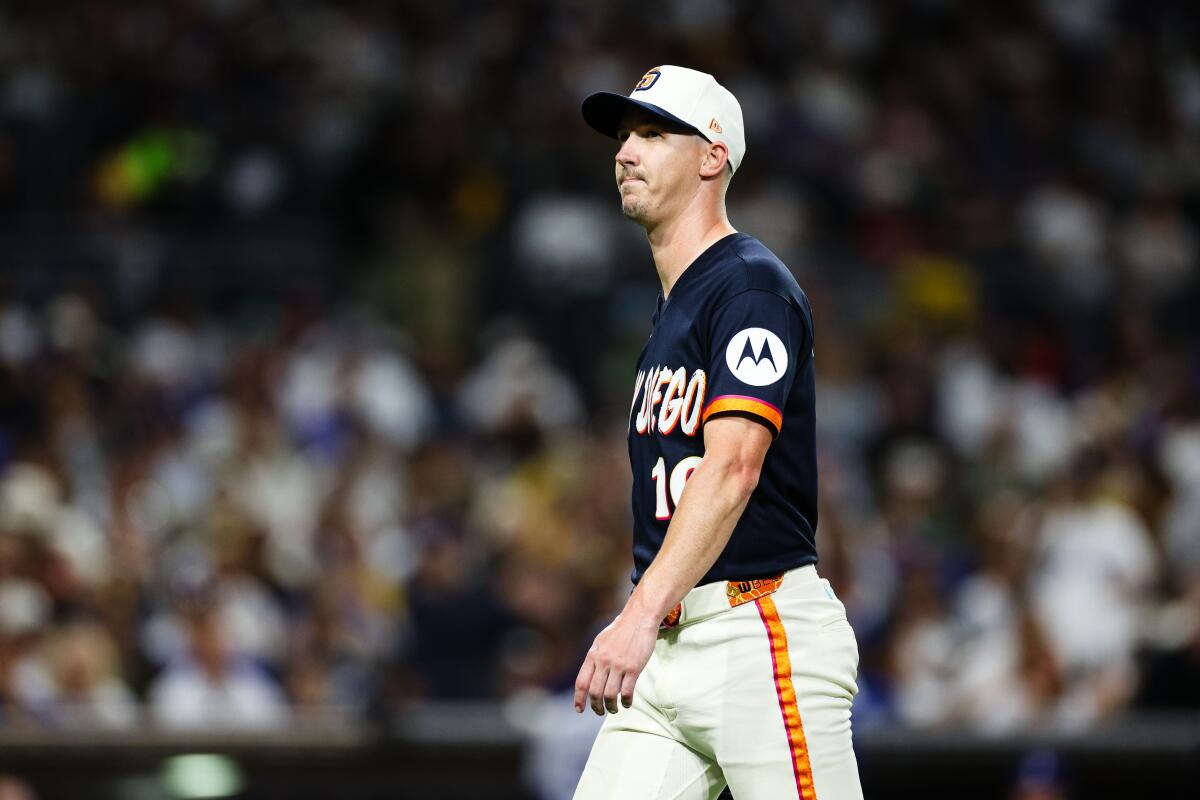
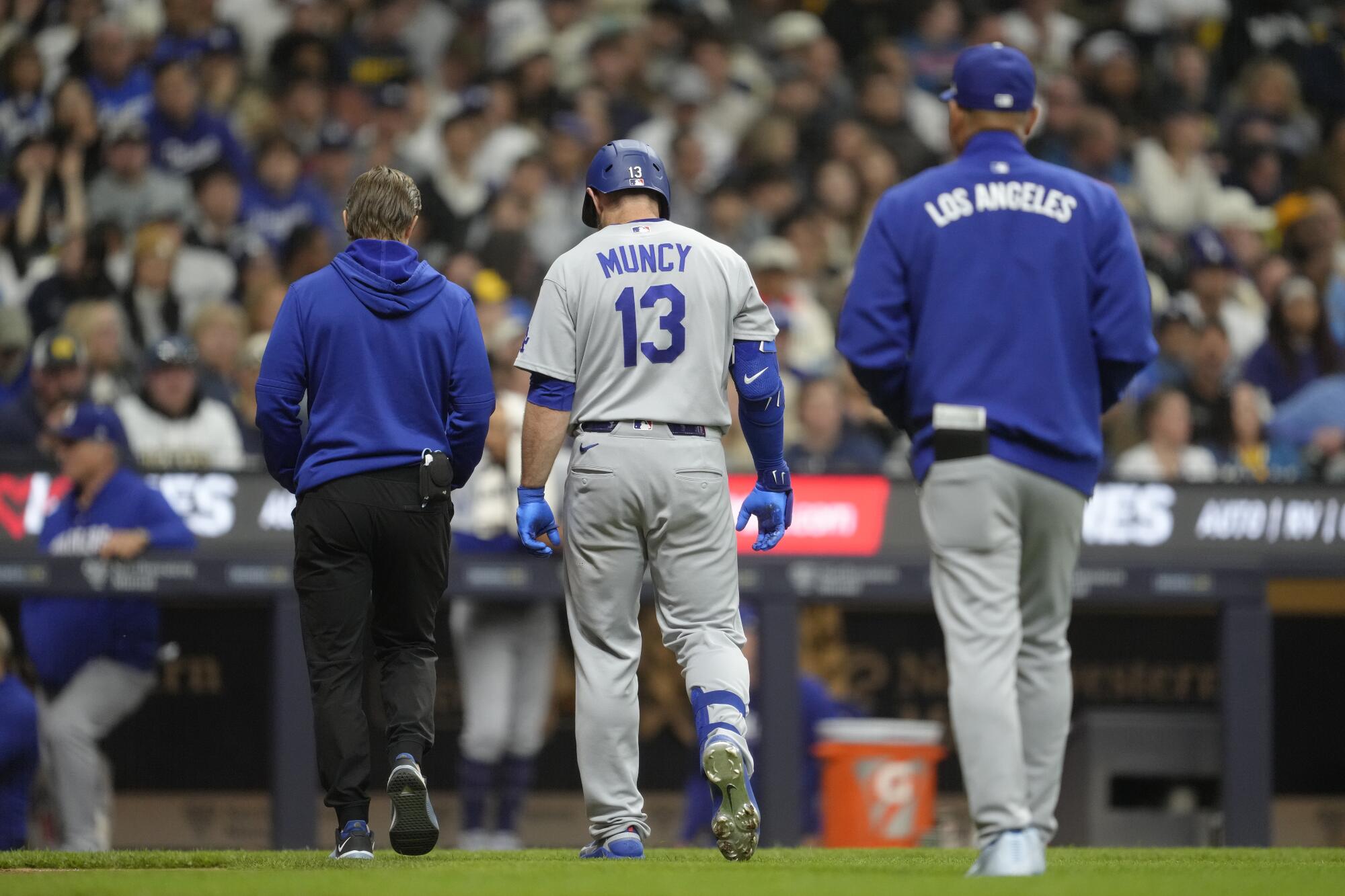
From Maddie Lee: The Dodgers entered the late innings Monday in an unenviable position: trailing the Padres, whose biggest strength is their bullpen.
“When they have a lead they don’t relinquish it too often,” manager Dave Roberts said after the Dodgers’ 1-0 loss Monday. “You know the numbers — when they’re ahead in the seventh inning they don’t lose. You do have to be a little more aggressive and capitalize when you do get those chances.”
Including Monday, the Padres are 20-2 when leading after six innings, 21-1 when leading after seven, and they have a perfect 22-0 record when leading after eight.
Even when Padres closer Mason Miller got off to an uncharacteristically wild start in the ninth inning Monday, the Dodgers failed to capitalize.
He walked Freddie Freeman and Kyle Tucker on nine pitches. And the next three batters — Will Smith, Max Muncy and Andy Pages — all have proven their ability to do damage in clutch moments.
But it was Miller on the mound, a rare reliever who could actually challenge for the Cy Young Award.
“In this kind of series, you know you’re going to have close games,” Freeman said after the game. “And we just couldn’t get it done.”
Continue reading here
Dodgers give injury updates on Blake Snell, Tyler Glasnow, Brusdar Graterol
Why Dodgers’ 2017 pitch to Shohei Ohtani remains relevant: ‘Acquiesce and accommodate’
Dodgers box score
MLB standings
Get the latest on L.A.’s teams in the daily Sports Report newsletter.
By continuing, you agree to our Terms of Service, which include arbitration and a class action waiver. You agree that we and our third-party vendors may collect and use your information, including through cookies, pixels and similar technologies, for the purposes set forth in our Privacy Policy such as personalizing your experience and ads.
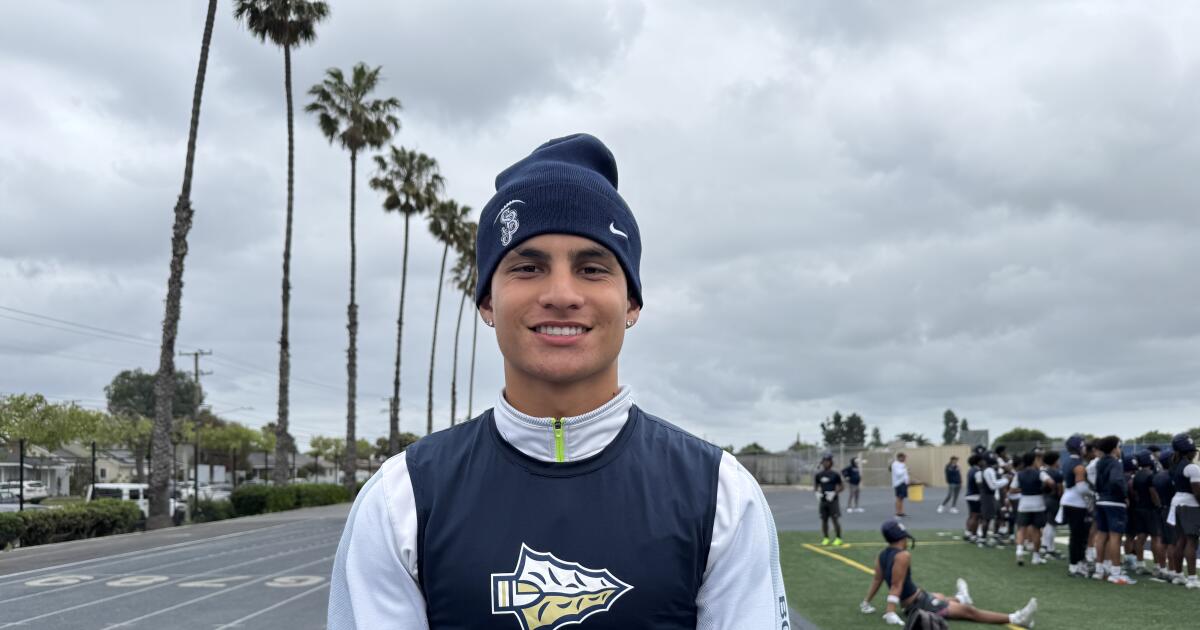
Justin Turner finds new life with the Tijuana Toros
From Bill Shaikin: Justin Turner did not wear the correct jersey one day, and now he would pay for his sin.
His teammates formed two lines, one facing the other. Turner snaked through the gauntlet, as his teammates playfully slapped and shoved him around.
Turner is 41, an All-Star and World Series champion, one of the most beloved players in Dodgers history. Yet there he was on a gloomy Saturday afternoon in a 50-year-old stadium in Tijuana, subjecting himself to a mashup of a kangaroo court and a hazing ritual, three hours before he would play in a uniform with six advertisements on the jersey and four more on the pants.
“Justin doesn’t have to be here,” said former major leaguer Roberto Kelly, the manager of the Tijuana Toros. “He doesn’t need this to continue his life.”
For the first time in 17 years, Turner is not playing in the major leagues. No team wanted him.
In Tijuana, whether he decides to end his career here or elsewhere, he has nurtured a special bond with his son and emerged as an improbable tourist attraction for Dodgers fans.
Continue reading here
Angels spoil no-hitter, get walk-off win
Adam Frazier singled, leading off the ninth inning for the first hit against Athletics starter J.T. Ginn, and Zach Neto followed with a two-run homer that gave the Angels a 2-1 victory Monday night.
Neto drove a 2-0 sinker 413 feet to center field, stunning Ginn and the A’s while ending a six-game losing streak for the Angels. It was their third walk-off win this season.
Ginn (2-2) struck out 10 and issued one walk on 105 pitches. He also hit Neto with a pitch in the sixth.
Continue reading here
Angels box score
MLB standings
This day in sports history
1909 — In his first title defense Jack Johnson fights ‘Philadelphia’ Jack O’Brien to a no decision in 6 rounds in Philadelphia, Pennsylvania to retain his world heavyweight crown.
1923 — Zev, a 19-1 long shot ridden by Earl Sande, wins the Kentucky Derby by 1½ lengths over Martingale.
1935 — NFL adopts an annual college draft to begin in 1936.
1965 — West Ham United of England win 5th European Cup Winner’s Cup against 1860 München of West Germany 2-0 in London.
1973 — Secretariat, ridden by Ron Turcotte, rallies from last with a powerful move on the clubhouse turn to win the Preakness Stakes by 2½ lengths over Sham. There is controversy over the timing of the race as original teletimer time was 1:55 for the 1 3/16-mile race. Pimlico amends it to 1:54 2/5, two days later.
1974 — The Philadelphia Flyers beat the Boston Bruins 1-0 to win the Stanley Cup in six games.
1979 — Spectacular Bid, ridden by Ron Franklin, wins the Preakness Stakes by an easy 5½ lengths over Golden Act.
1984 — Stanley Cup Final, Northlands Coliseum, Edmonton, AL: Wayne Gretzky scores twice as Edmonton Oilers beat NY Islanders, 5-2 for a 4-1 series win; Oilers first SC title.
1990 — Hobart wins its 11th straight NCAA Division III lacrosse championship, beating Washington College of Maryland 18-6. The Statesmen, winners of every final since the tournament’s inception in 1980, are 100-3 in Division III in that time.
1991 — Willy T. Ribbs becomes the first Black driver to make the lineup for the Indianapolis 500.
2001 — Manchester United lose 3-1 to Tottenham at White Hart Lane but win English Premier League title for the 3rd consecutive season.
2004 — NHL Western Conference Final: Calgary Flames beat San Jose Sharks, 4 games to 2.
2007 — Curlin, ridden by Robby Albarado, nips Kentucky Derby winner Street Sense by putting his head in front on the final stride, winning the Preakness Stakes in a riveting finish. The winning time was a blazing 1:53.46, equaling the stakes record of 1:53 2/5.
2007 — English FA Cup Final, Wembley Stadium, London (89,826): Chelsea beats Manchester United, 1 – 0 (a.e.t.); Didier Drogba scores 116′ winner for Blues’ 4th title.
2007 — NHL Eastern Conference Final: Ottawa Senators beat Buffalo Sabres, 4 games to 1.
2008 — NHL Western Conference Final: Detroit Red Wings beat Dallas Stars, 4 games to 2.
2012 — I’ll Have Another overtakes Bodemeister down the stretch to win the Preakness. Like the Kentucky Derby, I’ll Have Another races from behind to beat pacesetter Bodemeister, who also finished second in the Derby. I’ll Have Another, ridden by Mario Gutierrez, covers the 1 3/16 miles in 1:55.94.
2012 — UEFA Champions League Final, Munich: Chelsea beats Bayern Munich, 4-3 on penalties after a 1–1 draw at the end of extra time; Blues’ first title.
2014 — Lucy Li becomes the youngest player to qualify for the U.S. Women’s Open by winning the sectional qualifier at Half Moon Bay in California. The 11-year-old Li shoots rounds of 74 and 68 on the par-72 Old Course and surpasses Lexi Thompson as the youngest competitor in a U.S. Women’s Open when she tees off at Pinehurst on June 19. Thompson was 12 when she qualified for the 2007 Open.
2015 — The NFL announces it is moving back extra-point kicks and allowing defenses to score on conversion turnovers. The owners approve the proposal to snap the ball from the 15-yard line on PATs to make them more challenging.
2017 — LeBron James scores 30 points, Kevin Love had 21 points and 12 rebounds, and the Cleveland Cavaliers steamroll the Boston Celtics 130-86 to take a 2-0 lead in the Eastern Conference finals and tie an NBA record with their 13th straight playoff victory.
2018 — Justify holds off several hard-charging challengers and win the Preakness Stakes on a sloppy, slippery track. Ridden by Mike Smith, the 2-5 favorite wins by a half-length after completing the race in 1:55.93. Bravazo edges Tenfold for second. Trainer Bob Baffert ties D. Wayne Lukas’ record with his 14th Triple Crown victory and matches 19th-century trainer R.W. Walden with his seventh Preakness title.
2018 — English FA Cup Final, Wembley Stadium, London: Chelsea beats Manchester United, 1-0; Belgian international Eden Hazard scores 22′ penalty.
2019 — PGA Championship Men’s Golf, Bethpage State Park: Defending champion Brooks Koepka leads wire-to-wire; wins despite 5 bogeys on last 8 holes by 2 strokes from world #1 Dustin Johnson.
Compiled by the Associated Press
This day in baseball history
1910 — Cy Young won the 500th game of his career as the Cleveland Indians beat the Washington Senators, 5-4, in 11 innings.
1910 — Boston beat the Pirates 6-3 for the first time in 26 tries.
1933 — For the first time in major league history, brothers on opposite teams hit home runs in the same game. Boston Red Sox catcher Rick Ferrell homers off his brother Wes Ferrell in the 2nd inning, but the Cleveland Indians pitcher returns the favor as he homers in the 3rd on a pitch called by his sibling. It is the only time that the Ferrell brothers homer in the same game.
1942 — Paul Waner of the Boston Braves got his 3,000th career hit off Pittsburgh’s Rip Sewell in a 7-6, 11-inning loss to the Pirates.
1956 — Pittsburgh’s Dale Long hit a ninth-inning homer against the Chicago Cubs. It was Long’s first of eight straight games with a homer.
1962 — Stan Musial of St. Louis became the NL career hits leader. The 41-year-old got a ninth inning single for his 3,431st hit and moved past Honus Wagner. The Cardinals beat the Dodgers, 8-1.
1968 — After hitting 10 home runs in six games, Frank Howard of the Washington Senators was stopped by pitcher Earl Wilson of Detroit, which won the game 5-4.
1976 — Carl Yastrzemski has the only three-homer game of his illustrious career, going deep three times in a 4-for-4 day in a 9-2 Red Sox win over the Tigers. He victimizes three different pitchers: Dave Roberts, Steve Grilli and John Hiller.
1979 — After a bitter six-week strike, the major league umpires return to work. During the work stoppage, the men in blue were replaced by amateur and minor league arbiters.
1981 — Pittsburgh’s Jim Bibby gave up a leadoff single to Terry Harper of the Atlanta Braves, then retired the next 27 batters for a 5-0 one-hitter. Bibby also hit two doubles.
1998 — Mark McGwire hit three two-run homers against Philadelphia. It was the second time this season and fourth time in his career McGwire hit three homers in a game. McGwire became the 12th player to have two three-homer games in a season.
2000 — Jason Kendall hit for the cycle and drove in a career-high five runs, leading Pittsburgh to a 13-1 rout of St. Louis. Kendall had a two-run homer in the first inning, an RBI single in the second, a double in the third and a two-run triple in the eighth.
2004 — Atlanta’s 45-year-old Julio Franco broke his own record for the oldest player to hit a pinch-hit homer. Franco, who had a pinch-hit homer two weeks earlier against San Diego, hit a two-out, two-run homer to tie the score at 4 in the eighth. The Braves lost 6-4 in 11 innings to the Diamondbacks.
2008 — Boston’s Jon Lester shut down Kansas City 7-0 for the first no-hitter in the majors this season. The 24-year-old lefty, who survived cancer to pitch the World Series clincher for the Red Sox last fall, allowed two baserunners, walking Billy Butler in the second inning and Esteban German to open the ninth. Jason Varitek catches his fourth no-hitter, tying Ray Schalk for the major league record; one of Schalk’s no-hitters was later removed from the official records, making Varitek the first backstop to have four official no-hitters to his name.
2009 — Washington became the fourth team in major league history to score at least five runs in each game of a six-game losing streak. The Nationals lost 8-5 in 10 innings to Pittsburgh after they rallied to tie the score with a run in the ninth, but another letdown from a bullpen with a collective 1-14 record allowed them to join the 1929 Pirates, 2004 Cincinnati Reds and 2005 Texas Rangers.
2010 — CF Angel Pagan hits the first inside-the-park homer in the history of Nationals Park.
2011 — After sitting on the bench for most of the season so far, veteran 1B Jason Giambi has the first three-homer game of his career in the Rockies’ 7 – 1 win over Philadelphia. He hits homers in his first three at-bats, driving in all 7 of his team’s runs, but fails in his last two at-bats to become only the 16th player to hit four dingers in one game. Giambi entered the game hitting .115 with 1 homer and 4 RBI; at 40, he is the second-oldest player to hit three home runs in a game, after Stan Musial who was 41 when he accomplished the feat on July 8, 1962.
2018 — The Rays have been experimenting with “bullpen days” all season, when the starting pitcher is not expected to go deep into the game, going all out for 3 or 4 innings before handing the ball over to another reliever, but today they take it even further. Short reliever Sergio Romo starts today’s game against the Angels, his first start in the majors after 588 appearances out of the bullpen, and is only asked to pitch one inning before handing the ball over to Ryan Yarbrough. The plan works perfectly as Romo strikes out the three men he faces — Zack Cozart, Mike Trout and Justin Upton, all righthanders — then hands the ball over to lefty Yarbrough in the 2nd. Yarbrough pitches scoreless ball until allowing a run in the 8th as Tampa Bay wins, 5-3. It is the first time a starting pitcher leaves after a perfect 1st inning since Ernie Shore had done so on October 5, 1915. Manager Kevin Cash is so pleased with how the scheme goes that he picks Romo to start the next day’s game as well.
2021 — Corey Kluber of the Yankees is the latest pitcher to join this season’s no-hitter parade, pulling off the feat with a 2-0 win over the Rangers at Globe Life Field. It is already the 6th 9-inning no-hitter this year, and comes one day after Spencer Turnbull of the Tigers had pitched the previous one.
Compiled by the Associated Press
Until next time…
That concludes today’s newsletter. If you have any feedback, ideas for improvement or things you’d like to see, email me at houston.mitchell@latimes.com. To get this newsletter in your inbox, click here.