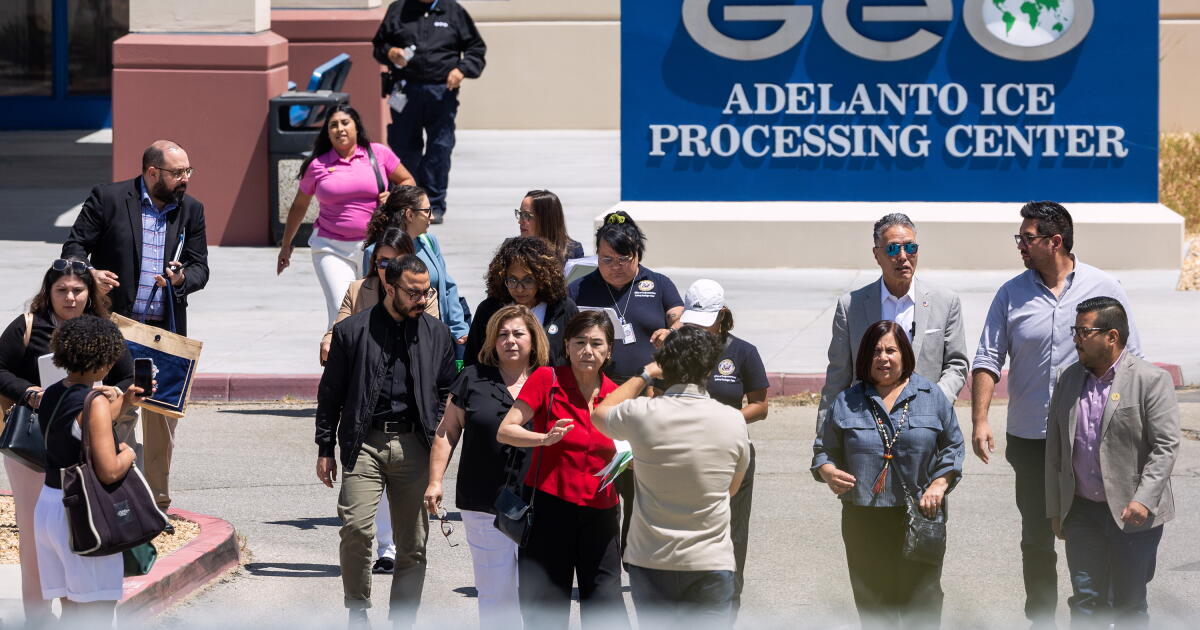
facility

DOJ to investigate California over housing of trans inmates

The U.S. Department of Justice announced Thursday that it has launched an investigation into two California women’s prisons to determine if they unconstitutionally provided housing and preferential treatment to “biological male prisoners.”

In a letter to Gov. Gavin Newsom, Assistant Atty. Gen. Harmeet Dhillon — who heads the Justice Department’s Civil Rights Division — said investigators will look into “widely reported allegations of deprivation of female prisoners’ rights” at the Central California Women’s Facility in Madera County and the California Institution for Women in San Bernardino County.

The Justice Department said in a news release that there have been allegations “of sexual assaults, rape, voyeurism and a pervasive climate of sexual intimidation due to the presence of males in the women’s prison.”

Newsom’s office referred The Times to the California Department of Corrections and Rehabilitation. A spokesperson for the agency said it is “committed to providing a safe, humane, respectful and rehabilitative environment for all incarcerated people.”

The Department of Justice also notified Maine Gov. Janet Mills of an investigation into allegations that the state “has allowed a biological male inmate to remain housed with women despite complaints that the male inmate has assaulted or harassed several female inmates.”

Dhillon said in a video posted on X that the investigations are part of a new project called the “single-sex prisons initiative” to look for potential civil rights violations in which female inmates are forced “to be in the same rooms with men who are posing as women to get access to the female prisons.”

“In California there are reports of many dozen such men housed in women’s prisons which of course is exposing these women to sexual assault and other forms of violence and harassment that, if true, are extremely troubling and could violate the civil rights of these women,” Dhillon said.

In 2020, Newsom signed into law Senate Bill 132, which gives transgender, nonbinary and intersex inmates at state prisons the right to be housed at either men’s or women’s facilities. Opponents of the law sued the following year, alleging that it was unconstitutional and created an unsafe environment for women in female facilities, with some plaintiffs claiming they were assaulted.

At the time, LGBTQ+ advocates slammed the suit as baseless and damaging.

“The way they wrote [the complaint] is saying that trans women are men and they are putting men in women’s prisons, which is completely false,” Bamby Salcedo, president and chief executive of the TransLatin@ Coalition, which cosponsored SB 132, previously told The Times. “They’re making a claim that is not accurate and not respectful towards trans women specifically.”

In an interview with the Times Thursday, Salcedo said that while there may be instances in which people have abused the law, she stressed “it is the responsibility of the CDCR to protect people who are incarcerated.”

“They should be able to not just follow the law, but also to be able to screen people appropriately,” Salcedo said.

Salcedo said she was not surprised to hear about the new Justice Department investigation, calling it “an effort for this administration to continue to deny opportunities and access to trans people in our society.”

The Women’s Liberation Front, which brought the lawsuit, announced this week that a federal court had dismissed the case but that they planned to appeal. In an emailed statement, Elspeth Cypher, Women’s Liberation Front board president, called the Justice Department investigation “welcome and long overdue.”

“I hope that this investigation provides the women in prison with some hope that finally someone is listening,” Cypher said.

Under the bill enacted in 2021, 1,028 inmates housed at male prisons have requested to be moved to female facilities, according to data as of March 4. The department had granted 47 requests and denied 132. Another 140 applicants “changed their minds,” according to the department.

State officials said that 84 inmates sought to be transferred into men’s facilities from women’s prisons. Of those, seven were approved.

According to the corrections department, 2,405 inmates identify as nonbinary, intersex or transgender. Those populations are said to experience excessive violence in prison. A 2007 UC Irvine study that included interviews with 39 transgender inmates found that the rate of sexual assault is 13 times higher for transgender people, with 59% of those surveyed reporting experiencing such encounters.

The Justice Department said Thursday that its investigation was just getting underway and that it “has not reached any conclusions regarding allegations in these matters.”

“I’m very determined to ensure that no woman who’s incarcerated in the United States is subject to potential rape, sexual assault or other violations of her civil rights as a condition of incarceration to satisfy some woke ideology by the state,” Dhillon said. “If these states are violating these rights and they don’t stop, we will make them through litigation.”

Source link

Data centers under scrutiny by California lawmakers as fears rise about health and energy impacts

Whenever the weather changes suddenly, or the skyline becomes shrouded in a windy haze, Fernanda Camarillo braces herself for an asthma attack.

Her condition has become more manageable, but the 27-year-old said it’s still scary when her chest tightens and she starts to wheeze. It was one of her first thoughts when she heard about plans to develop a massive data center next to her home in Imperial County, a farming community near the border of Mexico that struggles with poor air quality.

“A lot of people in the county are asthmatic,” she said, explaining that she worries the new center would add more pollution. “I’ve been anxious — so many of us are voicing our concerns.”

Data centers have existed for decades but are rapidly changing and expanding due to the worldwide boom in artificial intelligence, or AI as it’s known. States and communities nationwide have started pushing back, citing concerns that the projects could strain power grids, increase utility bills and have negative health and environmental impacts.

In California, state legislators are debating how to protect residents and natural resources without creating so much red tape that developers go elsewhere, taking their jobs and taxable earnings with them.

No Data Center signs are posted in the front yard of a home.

No Data Center signs are posted in the front yard of a home that is right behind the proposed site.

“We can be supportive of innovation and a technology that is needed but also protect our communities and our health and our environment,” said state Sen. Steve Padilla (D-San Diego). “We can do both at the same time.”

The California Legislature is considering bills to prohibit the projects from being exempted from the state’s stringent environmental law and to impose new tariffs on new major energy users that strain power supplies. Lawmakers also have proposed restrictions on new data centers, requiring companies to provide verifiable estimates on expected water and energy usage before they can be granted a business permit.

Imperial resident Fernanda Camarillo holds some of her medications.

Imperial resident Fernanda Camarillo, who is an asthmatic, holds some of her medications.

Members of Congress also expressed concerns. Rep. Ro Khanna, speaking at a town hall about AI last month at Stanford University, said legislators must ensure data centers serve the communities that power them.

“We live in a new gilded age,” said Khanna (D-Fremont). “What kind of future are we going to build?”

::

Eric Masanet, a professor at UC Santa Barbara specializing in sustainability science for emerging technologies, described the facilities as the “brains” of the internet. The sprawling centers are filled with banks of specialized computers that process online shopping orders, stream movies, host websites, encode Zoom and other videoconferencing apps, store data and serve as switching stations for the digital world that’s now woven into daily life.

Data centers, particularly those that power AI, use significant amounts of water and energy. The facilities accounted for about 4.4% of the nation’s total electricity consumption in 2023, up from 1.9% in 2018, according to a report provided to Congress from the Lawrence Berkeley National Laboratory. The researchers projected that figure will reach 6.7% to 12% by 2028.

Many companies, including big tech giants like Meta, Google and Amazon, are making major investments in AI.

“We are building a lot more data centers faster than we ever did — and a new AI data center is 10 to 20, maybe 30 times, the size of the largest data centers we had before,” Masanet said.

A cabinet rests on its side in the dirt on open land with houses and sky in the background.

The proposed site of the 950,00-square-foot data center is on a dusty parcel that is next to the Victoria Ranch housing community and adjacent to farmland in Imperial, Calif.

It’s unclear how many data centers are in the state. A California Energy Commission spokesperson told the Los Angeles Times it does not track this information. Data Center Map, a nongovernmental website that tracks data centers across the world, lists 289 facilities in California, with more than 4,000 nationwide.

The federal government has, so far, largely left it to states or localities to regulate data centers.

The facilities can generate significant revenue for local governments due to sales and property taxes.

But some new proposals are sparking a backlash. More than 200 community and environmental organizations, including a dozen from California, sent an open letter to Congress in December calling for a national moratorium on new data centers.

Robert Gould, a pathologist with San Francisco Bay Physicians for Social Responsibility, one of the organizations that signed the letter, explained data centers are causing a shift away from renewable energy and back toward fossil fuels because the facilities need a reliable and constant stream of power.

Cornell University researchers last year estimated that AI growth could add 24 to 44 million metric tons of carbon dioxide to the atmosphere annually by 2030, unless steps are taken to change course.

Gould said fossil fuel emissions are associated with various cancers, an increase in hospitalizations for older adults due to respiratory conditions, and asthma attacks or stunted lung growth in children. Particulate matter from fossil fuel emissions is also linked to cardiovascular events and negative effects on maternal fetal health.

Gould’s organization has noticed an alarming trend.

“These are generally placed in communities that are the least able to defend themselves,” he said.

Farmworkers toil in the noon heat to pick vegetables in Imperial.

Farmworkers toil in the noon heat to pick vegetables in Imperial. Agriculture is an important part of the Imperial Valley economy.

::

The debate over data centers is heating up in the Imperial Valley, a rural desert region in southeastern California where a proposed center faces fierce opposition from residents.

The county in 2025 granted the project an exemption for the California Environmental Quality Act, known as CEQA. The landmark 56-year-old state law has been credited with helping to preserve California’s natural beauty and protecting communities from hazardous impacts of construction projects — but also blamed for stymieing construction.

Imperial Valley Computer Manufacturing, a California-based limited liability company that started two years ago, plans to develop a 950,000-square-foot facility in the county that’s designed for advanced artificial intelligence and machine learning operations. The company says it will use reclaimed wastewater and EPA-certified natural gas generators, and create 2,500 to 3,500 construction jobs and 100 to 200 permanent positions.

“We are committed to Imperial County and to creating lasting economic opportunity,” the company website states. “The project will generate $28.75 million in annual property tax revenue for local schools, fire departments, libraries, and essential services.”

The Imperial County Board of Supervisors is moving toward finalizing the proposal.

Farmland spreads out in front of the Imperial Valley Fair.

Farmland spreads out in front of the Imperial Valley Fair near a proposed data center in Imperial.

Sebastian Rucci, an attorney and chief executive officer of Imperial Valley Computer Manufacturing, said he commissioned multiple studies assessing the proposed center’s potential effect on issues like traffic or the environment that found no or minimal harms. He threatened to pull his proposal if a CEQA review was required.

“CEQA leaves you in an unknown territory — some of the environmental groups have used it for extortion, they sue, they have no basis for the suit but they delay you, and then they can squeeze money out of you for settling the lawsuit,” said Rucci.

The exemption, however, has alarmed residents, who have spoken up at county board meetings and launched a community organization, Not in My Backyard Imperial, to protest the data center and demand a CEQA review.

“It feels like it’s us against the county,” said Camarillo, adding that many feel the board has dismissed their questions and concerns.

None of the Imperial County Board of Supervisors responded to requests for comment.

a woman stands with an anti-data center sign in a yard

Resident Fernanda Camarillo’s home is right behind the proposed site of the data center in Imperial.

The center would be a neighbor to Camarillo’s house in Victoria Ranch, a family-friendly area with beige stucco homes topped with terracotta tile roofs. She worries about noise, pollution and spiking utility bills. Power companies that have to upgrade grids to meet data centers’ energy demands sometimes seek to recoup that cost by hiking up rates for all consumers.

Camarillo, a substitute teacher, is also scared for her students. The air quality in Imperial Valley is already so poor that schools use a system of color-coded flags to signal whether it’s safe for children to go outside during gym or recess, she said.

“I think they see [the valley] as easy pickings because we are a low-income community and we have such a large population of Latinos here,” Camarillo said.

A quick drive around the neighborhood shows others share her concerns. Signs protesting the data center pop up throughout the community, displayed on front lawns or nestled into rocky garden beds.

Victoria Ranch was quiet and peaceful on a sunny Sunday in late February. Francisco Leal, a resident and lead organizer for NIMBY Imperial, said that’s a major part of its appeal.

The colorful dusk sky hovers over a Little League baseball game at Freddie White Park in Imperial.

The colorful dusk sky hovers over a Little League baseball game at Freddie White Park in Imperial. The debate over data centers is heating up in the Imperial Valley, a rural desert region in southeastern California.

Leal wants answers about everything from potential health hazards and impacts on the local water supply to whether the fire department is equipped to handle a large-scale electrical blaze. But without a CEQA review, he says residents are left to trust assurances from the developer or privately hired consultants.

Leal plans to sell his property if the project goes forward, but the thought makes him emotional.

“It’s not just a house; it’s a home,” he said. “This is the only home my kids have ever known and all of our family memories are here.”

Gina Snow, another resident, isn’t necessarily against bringing a data center to the county. But she wants the proposal to undergo a CEQA review.

“Clearly we understand that there is economic development and the potential for that to be positive for the county, but at what cost?” she said.

Daniela Flores stands on open land with shrubsn and utility poles in the background

Daniela Flores, executive director of Imperial Valley Equity and Justice, a nonprofit that works for social and environmental equality, stands on the site of the proposed data center.

::

Daniela Flores, executive director of Imperial Valley Equity and Justice, a nonprofit that works for social and environmental equality, said the community has good reason to be wary. Various industries have come into the region over the years and made grand promises that never panned out.

“We became a sacrifice zone,” she said, adding industries use the area’s resources while ultimately doing little to permanently improve the lives of most residents.

Flores said the community continues to struggle with a range of problems, including poor air quality, high poverty rates, weak worker protections and crumbling infrastructure. She believes a data center could add new and potentially dangerous challenges.

The valley has long, brutal summers with temperatures that swell to 120 degrees. If the data center strains the grid and causes a lengthy blackout, or low-income residents have their power shut off because they can’t afford the rising bills, Flores fears the situation could quickly turn deadly.

The city of Imperial also has concerns. The city has filed a lawsuit calling on the county to halt the project, arguing it should not have received a CEQA exemption.

The controversy has drawn attention from Padilla, whose district includes Imperial Valley. Padilla has echoed residents’ calls for more transparency from the county and introduced Senate Bill 887, which would ban data centers from receiving exemptions from CEQA.

“I am not anti-data center or anti-artificial intelligence,” Padilla said. But, he added, we need to “find a way to do this right and make sure there is adequate review and understanding.”

A dusty haze settles over the city of Imperial at dusk near the site of a proposed data center.

A dusty haze settles over the city of Imperial at dusk near the site of a proposed data center.

Another measure from Padilla, Senate Bill 886, would direct the Public Utilities Commission to create an electrical corporation tariff to cover the cost of data center-related grid upgrades.

Other related legislation this year includes Assembly Bill 2619 from Assemblymember Diane Papan (D-San Mateo) that would require data center owners to provide an estimate about expected water usage and sources before applying for a business license, and Assembly Bill 1577, by Assemblymember Rebecca Bauer-Kahan (D-Orinda), which would require data center owners to submit monthly information to a state commission about water and fuel consumption and energy efficiency.

While lawmakers weigh new policies at the statehouse, Camarillo said she hopes the priority will be protecting communities.

“Innovation is important, but innovation for the sake of innovation has never really been something that hasn’t had negative impacts,” she said. “Think about human lives.”

Source link

Aftermath of Iranian missile strikes near Israel’s nuclear facility | US-Israel war on Iran News

Iranian missiles struck two communities in southern Israel, leaving buildings shattered and dozens injured in dual attacks not far from Israel’s main nuclear research centre.

The Iranian strikes late on Saturday came after Tehran’s main nuclear enrichment facility at Natanz was hit earlier in the day. Israel denied responsibility for the strike on Natanz, nearly 220km (135 miles) southeast of Tehran.

The Pentagon declined to comment on the strike on Natanz, which was also hit during the first week of the war and the 12-day war last June. Russian Ministry of Foreign Affairs spokesperson Maria Zakharova said such strikes posed a “real risk of catastrophic disaster throughout the Middle East”.

Iran retaliated hours later.

Israel’s military said it was not able to intercept missiles that hit the southern cities of Dimona and Arad, the largest near the centre in Israel’s sparsely populated Negev desert. It was the first time Iranian missiles had penetrated Israel’s air defence systems in the area around the nuclear site.

The Israeli Ministry of Health said at least 180 people were wounded in the missile attacks on the southern city of Dimona and nearby Arad.

Dimona is about 20km (12 miles) west of the nuclear research centre, and Arad is around 35km (22 miles) to the north.

Israel is believed to be the only Middle East nation with nuclear weapons, though its leaders refuse to confirm or deny their existence. The UN nuclear watchdog said on X it had not received reports of damage to the Israeli centre or abnormal radiation levels.

Source link

Iran says US and Israel attacked Natanz nuclear facility | News

No leakage of radioactive materials reported in the area in central Iran, Tehran’s atomic energy organisation says.

The United States and Israel have struck Iran’s Natanz nuclear facility, according to its atomic energy organisation.

“Following the criminal attacks by the United States and the usurping Zionist regime against our country, the … Natanz enrichment complex was targeted this morning,” the organisation said in a statement carried by the Tasnim news agency on Saturday.

Recommended Stories

list of 4 itemsend of list

It added that there was “no leakage of radioactive materials reported” at the Shahid Ahmadi Roshan enrichment facility in Natanz in central Iran, one of the country’s most important uranium enrichment sites, about 220km (135 miles) southeast of Tehran.

No radioactive material was released, Tasnim reported, quoting Iranian officials. There is no danger to the population living near the facility, according to the report.

The Natanz nuclear facility was also targeted by Israel in the 12-day war between Iran and Israel in June 2025.

INTERACTIVE-Iran’s NATANZ military structure-JUNE 14, 2025 copy-1749981913

Al Jazeera’s Mohamed Vall, reporting from Tehran, said the Iranian nuclear organisation’s statement did not say how Saturday’s attack happened and what types of bombs were used in it.

“We know that Natanz is one of the key nuclear sites in Iran, towards the middle of the country, along with the Isfahan nuclear facilities,” he said.

“And we know a major goal of this war by the Americans and Israelis was about the nuclear programme of Iran, how to destroy it and prevent Iran from producing a nuclear bomb.”

Call for restraint

In a post on X, the International Atomic Energy ⁠Agency (IAEA) said Iran has ⁠informed it about the US-Israeli attack on the ⁠Natanz site.

No increase ⁠in off-site radiation ⁠levels was reported, the United ⁠Nations nuclear ⁠watchdog said, adding that it was looking into ‌the report.

IAEA head Rafael Grossi repeated his “call for military restraint to avoid any risk of a nuclear accident” during the war on Iran.

The White House has said a key objective of the war it launched alongside Israel on February 28 is to prevent Iran from ever acquiring nuclear weapons.

The Natanz site was previously hit in the first week of the 22-day war, and several buildings were damaged, according to satellite images at the time.

The UN nuclear watchdog said on March 3 that the nuclear site suffered “recent damage”, a day after Iran said the underground uranium enrichment plant was attacked.

Russia has condemned the latest attack ⁠on the Natanz facility, calling it “a blatant ‌violation of international law,” the Russian Foreign Ministry’s spokeswoman Maria Zakharova said in a statement.

Meanwhile, Israeli Defense Minister Israel Katz warned the US and Israel would intensify their strikes on Iran in the week starting Sunday.

“This week, the intensity of the strikes to be carried out by the IDF [Israeli army] and the US military against the Iranian terror regime and the infrastructure on which it relies will rise significantly,” Katz said in a statement on Saturday.

Source link

Iran’s strike on Qatar gas facility will reduce supply for 3 to 5 years | International Trade

NewsFeed

Iran’s strike on Qatar’s Ras Laffan gas facility will cut an estimated 17% of the country’s Liquefied Natural Gas export capacity for up to five years, officials say. The damage is a major blow to the global energy market, which could disrupt supplies to Europe, Asia and beyond.

Source link

Qatar says Iran missile attack sparks fire, causes damage at gas facility | US-Israel war on Iran News

Qatar’s Foreign Ministry strongly condemns attack that caused “extensive damage” at the Ras Laffan complex.

Qatar’s Ministry of ⁠Interior says civil ⁠defence teams are responding to a fire at the country’s main gas facility after an Iranian attack.

In a statement on Wednesday, QatarEnergy said there was “extensive damage” following the “missile attacks” on Ras Laffan Industrial City.

“All personnel have been accounted for and no casualties have been reported at this time,” the world’s largest liquefied natural gas (LNG) producer added.

The announcements came hours after Iran threatened to attack oil and gas facilities across the Gulf region in retaliation for an Israeli attacks on its South Pars gasfield as the fallout from the United States-Israeli war on the country continues to escalate.

Iran’s warning was directed at Qatar’s Mesaieed Petrochemical Complex, Mesaieed Holding Company and Ras Laffan Refinery; Saudi Arabia’s Samref Refinery and Jubail Petrochemical Complex; and the United Arab Emirates’s Al Hosn Gas Field.

In a statement, Qatar’s Foreign Ministry strongly condemned “the brutal” Iranian targeting of Ras Laffan Industrial City.

“Qatar considers this assault a dangerous escalation, a flagrant violation of its sovereignty, and a direct threat to its national security,” it said.

On March 2, Qatar suspended LNG production following an attack on at its giant Ras Laffan facility, as well as on a water tank at a power plant in Mesaieed Industrial City.

Source link

US attacks military sites on Iran’s Kharg island, home to vast oil facility | US-Israel war on Iran News

United States President Donald Trump has said the country’s military bombed military installations on Iran’s Kharg island, warning the area’s critical oil facilities could be next if Iran continues to block the Strait of Hormuz.

Iran, in turn, threatened on Saturday to reduce US-linked oil facilities to “a pile of ashes” if oil structures on the island were attacked, as the US-Israel war on Iran, now in its punishing third week, spilled over into a global oil price crisis already in the making.

Recommended Stories

list of 3 itemsend of list

Kharg island is where more than 90 percent of Iran’s oil is exported. Crude oil prices have surged more than 40 percent since the war began.

Trump said on Friday that US forces had “totally obliterated” all military targets on Iran’s Kharg island oil export hub, describing it in a social media post as “one of the most powerful bombing raids in the History of the Middle East”. He provided no evidence of that.

The US president said he had chosen not to “wipe out” oil infrastructure on the Iranian island, for now.

“However, should Iran, or anyone else, do anything to interfere with the Free and Safe Passage of Ships through the Strait of Hormuz, I will immediately reconsider this decision,” he added.

Iran’s semi-official Fars news agency reported, quoting sources, that more than 15 explosions were heard on Kharg island during the US attacks.

The sources said the attacks targeted air defences, a naval base, and airport facilities, but caused no damage to oil infrastructure. Iran’s Fars news agency reported thick smoke was seen rising from the island.

Al Jazeera’s Mohamed Vall, reporting from Tehran, said Iran’s potential retaliatory attacks on Gulf oil facilities would be a “catastrophic scenario” for the region, and for the “entire industry of oil and gas”.

“The Iranians are keeping this, apparently, as a card to use,” he said. “They’ve been talking about restraint and the possibility of that restraint ending if the Iranian oil facilities are attacked, as the Americans are hinting and threatening.”

US ground operation in the works?

Meanwhile, 2,500 more Marines and an amphibious assault ship are being sent to the Middle East, a US official told the AP news agency.

Elements from the 31st Marine Expeditionary Unit and the amphibious assault ship USS Tripoli have been ordered to the region, according to the source, who spoke on condition of anonymity to discuss sensitive military plans.

INTERACTIVE - Strait of Hormuz - March 2, 2026-1772714221
(Al Jazeera)

Marine Expeditionary Units are able to conduct amphibious landings, but they also specialise in bolstering security at embassies, evacuating civilians, and providing disaster relief.

“What we’re to make of this is that the US is very slowly increasing its military posture in terms of prosecuting the war, and that it is not intending to wrap things up any time soon,” Al Jazeera’s Rosiland Jordan reported from Washington.

The deployment does not necessarily indicate that a ground operation is imminent or will take place.

Trump dismisses prospect of deal

Following the attack on Kharg island, Iran would be “wise to lay down their arms, and save what’s left of their country”, Trump wrote on his Truth Social platform.

“The Fake News Media hates to report how well the United States Military has done against Iran, which is totally defeated and wants a deal – but not a deal that I would accept!” he posted separately, providing no evidence Tehran was seeking any sort of deal.

At least 1,444 people have been killed and 18,551 injured by US-Israeli attacks on Iran since February 28, Iran’s Ministry of Health says.

Al Jazeera’s Tohid Asadi, reporting from Tehran, said US-Israeli air attacks hit targets across the country, including in Tehran, Karaj, Isfahan and Tabriz. He said this was a sign that “we are not close to de-escalation.

“Iranian officials are talking about retaliatory strikes, with the Islamic Revolutionary Guard Corps talking about using what they call their most advanced weaponry, including Heidar missiles, to target Israeli territories and US bases in the region,” he said.

Source link

EPA moves to roll back recent limits on ethyene oxide, a carcinogen

The Trump administration on Friday moved to roll back Biden-era limits on emissions of ethylene oxide, a cancer-causing chemical often used in the sterilization of medical devices.

The Environmental Protection Agency said repealing the rules, which fall under the National Emission Standards for Hazardous Air Pollutants, would “safeguard the supply of essential medical equipment” — saving approximately $630 million for companies over 20 years. California is home to about a dozen such facilities.

The government said the emissions are part and parcel of protecting people from “lethal or significantly debilitating infections that would result without properly sterilized medical equipment.”

“The Trump EPA is committed to ensuring life-saving medical devices remain available for the critical care of America’s children, elderly, and all patients without unnecessary exposure to communities,” EPA Administrator Lee Zeldin said in a statement.

An estimated 50% of sterile medical devices in the U.S. are treated with ethylene oxide, or EtO, particularly those that can’t be cleaned using steam or radiation. The colorless gas is also used to make chemicals found in products such as antifreeze, detergents, plastics and adhesives.

But EtO poses health risks. Short-term exposure by inhalation can cause headaches, dizziness, nausea, fatigue respiratory irritation and other adverse health effects, according to the federal Agency for Toxic Substances and Disease Registry.

Longer-term exposure increases the risk of cancers of the white blood cells, such as non-Hodgkin’s lymphoma, as well as breast cancer. A now-deleted page from the EPA’s website stated, “EtO is a human carcinogen. It causes cancer in humans.”

Friday’s proposal specifically targets updated rules for EtO emissions that were passed by the Biden administration in 2024 following pressure from environmental justice groups, particularly those in Louisiana’s heavily industrialized “Cancer Alley.” The change sought to reduce the amount of EtO released from commercial sterilizers by 90% and lessen the hazards for nearby communities.

The tighter rules were in part based on EPA’s own scientific study that found it to be 60 times more carcinogenic than previously thought, which the agency now says should be reassessed.

If finalized, the plan would give facilities the choice between installing continuous real-time monitoring systems for EtO emissions or complying with modified pollution control requirements at facilities that emit more than 10 tons a year, the EPA said.

The proposal follows other moves by the Trump administration to rescind regulations that it says are burdensome and costly for industries, such as those governing emissions from coal power plants. Last month, the EPA repealed the endangerment finding, which affirmed the dangers of greenhouse gas emissions and underpinned the agency’s ability to regulate those emissions from vehicles.

The action around ethylene oxide would affect about 90 commercial sterilization facilities owned and operated by approximately 50 companies. Three California companies applied for and received presidential exemptions for their EtO emissions in July.

An aerial view of an industrial park

The Sterigenics facility, center, in Vernon is pictured in 2022.

(Myung J. Chun / Los Angeles Times)

They are located in Ontario and Vernon and operated by the company Sterigenics, which provides industrial sterilization technology for medical devices and other commercial products.

In January, a coalition of environmental and community groups challenged the EtO exemptions in federal court. The lawsuit from the Southern Environmental Law Center and the Natural Resources Defense Council argues that technology exists for facilities to comply with the tighter Biden-era standards without raising costs, and many facilities are already using it.

“EPA’s 2024 rule was an important and overdue step to reduce toxic ethylene oxide pollution and protect communities,” said Irena Como, senior attorney at the Southern Environmental Law Center, in a statement Friday. “Repealing this rule that is proven to significantly lower pollution exposure and cancer risks will subject even more people who work, live, and send their children to schools located near these facilities to harm that is entirely preventable.”

Sterilization and chemical industry groups support the plan.

“The EPA rule concerning ethylene oxide use in commercial sterilizers threatens to severely restrict access to vital medical products nationwide,” the American Chemistry Council said in a statement. “We commend the EPA for their commitment to reevaluating these policies.”

The EPA will hold a 45-day comment period about the proposal after it is published in the federal register. A final decision is expected sometime this year.

Source link