
Iranian drone strikes US military facility in Kuwait | Conflict
Footage captured the moment an Iranian drone struck the US military’s Camp Buehring in northwestern Kuwait, impacting with an explosion and cloud of smoke.
Published On 1 Mar 2026
Footage captured the moment an Iranian drone struck the US military’s Camp Buehring in northwestern Kuwait, impacting with an explosion and cloud of smoke.
Published On 1 Mar 20261 Mar 2026
Share
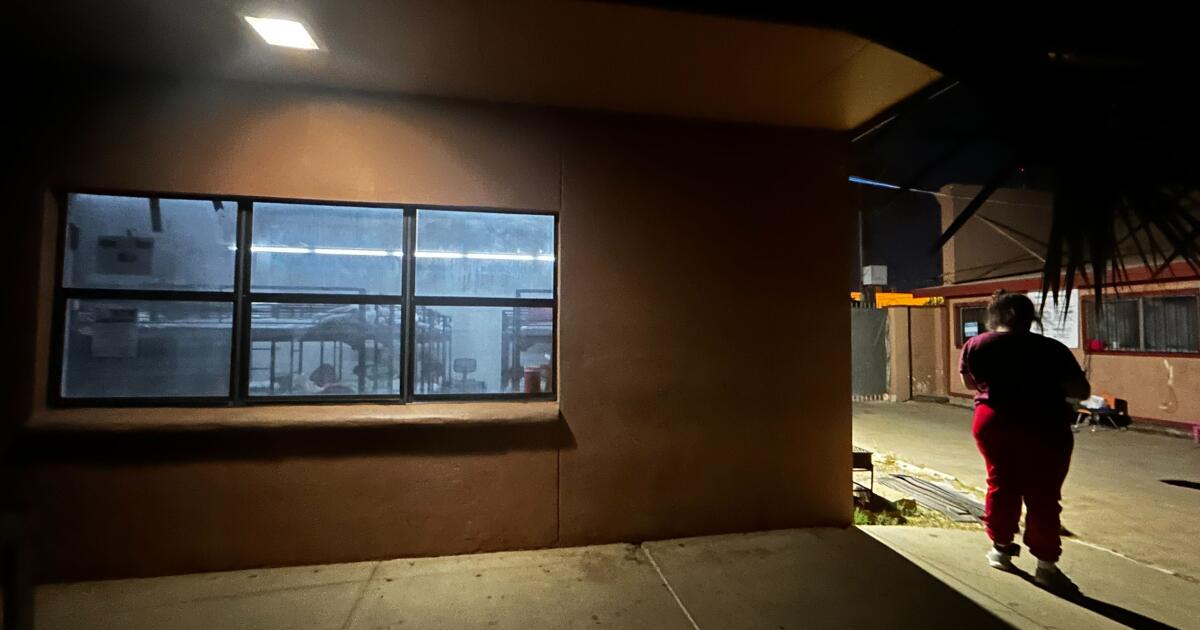
LAREDO, Texas — A month after ICE agents sent the young Ecuadoran mother and her 7-year-old daughter to a sprawling detention center 1,300 miles from their Minnesota home, they were finally free.
But when the bus pulled up to a migrant shelter in the Texas border city of Laredo, dropping off a half-dozen families lugging bags stuffed with belongings, the stress of recent weeks tracked mother and daughter like the long shadows on that mid-February afternoon.
Night after night inside south Texas’ Dilley Immigration Processing Center with hundreds of other families, the grade-schooler wept and pleaded to know why they were being held.
“She would tell me, ‘Mom, what crime did I commit to be a prisoner?’ I didn’t know what to tell her,” said the 29-year-old, who spoke on condition of anonymity for fear being identified could negatively affect their immigration case. Her husband was deported to Ecuador soon after they were taken into custody.
Many Americans were alarmed last month when photos circulated showing U.S. Immigration and Customs Enforcement agents in Minneapolis detaining a 5-year-old boy wearing a bunny hat and carrying a Spider-Man backpack. The concern followed Liam Conejo Ramos and his father when they were sent to Dilley, surrounded by chain-link fences on a dusty plain about 75 miles south of San Antonio.
But Liam was hardly an outlier. ICE has been holding hundreds of children at Dilley — many for months.
“We are all Liam,” Christian Hinojosa, an immigrant from Mexico, said by phone from Dilley, where she and her 13-year-old son were held for more than four months. They were released this month and allowed to return home to San Antonio, where she works as a health aide.
She noted that Liam and his father were released from Dilley after 10 days, after members of Congress and a judge intervened.
“My son says, ‘That’s unfair, Mama. What’s the difference between him and us?’”
When the Obama administration opened Dilley in 2014, nearly all families detained there had recently crossed the border from Mexico. Detentions at the facility were scaled back by the Biden administration in 2021, before it was closed three years later.
Since being reopened by President Trump’s administration last spring, life inside Dilley — a compound of trailers and other prefabricated buildings — has been shaped by three decisive changes.
The number of detained families has risen sharply since last fall. The government is holding many children well beyond the 20-day limit set by long-standing court order. And many detainees have lived in the U.S. for several years, with roots in neighborhoods, workplaces and schools, according to lawyers and other observers.
“Just imagine that you’re a child and you’re taken out of your surroundings,” said Philip Schrag, a Georgetown University law professor and author of “Baby Jails: The Fight to End the Incarceration of Refugee Children in America.”
Suddenly you’re in “a completely strange environment with the doors locked and guards in uniform roaming around,” said Schrag, who counseled Dilley detainees as a volunteer lawyer during the Obama administration.
ICE booked more than 3,800 children into detention during the first nine months of the new Trump administration, according to an Associated Press analysis of data from UC Berkeley’s Deportation Data Project. On an average day, more than 220 children were held, with most of those detained longer than 24 hours sent to Dilley. More than half of Dilley detainees during that period were children.
Nearly two-thirds of children detained by ICE were eventually deported, and almost 1 in 10 left the country when their parents accepted voluntary departure, according to an AP analysis of the latest comprehensive data. About a quarter were released in the U.S., requiring their parents to check in regularly with ICE as their legal cases proceed.
The number of detainees at Dilley has risen sharply since the period covered by the data, nearly tripling between fall and late January to more than 1,300, according to Relevant Research, which analyzes immigration enforcement data.
“We’ve started to use 100 days as a benchmark for prioritizing cases because so many children are exceeding 20 days,” said Leecia Welch, the chief legal director at Children’s Rights, who visits Dilley regularly to ensure compliance. In a visit this month, Welch said she counted more than 30 children who had been held for over 100 days.
The increased detention of children comes as the Trump administration has gutted a Department of Homeland Security office responsible for oversight of conditions inside Dilley and other facilities.
“It’s a particular concern that family detention is being increased,” said Dr. Pamela McPherson, a child and adolescent psychiatrist contracted by Homeland Security from 2014 until last year to inspect and investigate conditions at Dilley and other ICE facilities holding children. “Just who’s providing that check and balance now?”
Rep. Tony Gonzales (R-Texas), who represents the congressional district where Dilley is located, said multiple visits have convinced him criticism of the center is unfair.
He said he’d been impressed by Dilley’s facilities and the professionalism and dedication of staff. “They’re not doing policy. They’re just fulfilling a duty,” Gonzales said.
The Homeland Security Department did not respond to detailed questions about Dilley submitted by the AP. But both Homeland Security and ICE objected to allegations of poor care and conditions there.
“The Dilley facility is a family residential center designed specifically to house family units in a safe, structured and appropriate environment,” ICE Director Todd M. Lyons said in a statement this week. Services include medical screenings, infant care packages and classrooms and recreational spaces, he noted.
But concerns about Dilley are personal for Kheilin Valero Marcano, a Venezuelan immigrant detained with her husband and 1-year-old daughter, Amalia, in December and held for nearly two months.
When the child got a high fever, Valero Marcano said Dilley staff told her it was just a virus. Two weeks later, Amalia started vomiting, then losing weight. Valero Marcano said she took her to the Dilley doctor’s office at least eight times, and was offered only Tylenol and ibuprofen.
The baby was eventually sent to two hospitals, where doctors diagnosed COVID-19, bronchitis, pneumonia and stomach virus, she said.
ICE disputed Valero Marcano’s account, saying in a statement the baby “immediately received proper medical care” at Dilley before being sent to the hospital. Back in Dilley, “she was in the medical unit and received proper treatment and prescribed medicines,” it said.
The family’s return to Dilley coincided with a measles outbreak there. They were released earlier this month after their lawyers petitioned the court.
“I’m so worried for all the families who are still inside,” Valero Marcano said.
After more than two months in a cramped room at Dilley with three other families, the 13-year-old girl’s depression turned increasingly dark.
The eighth-grader stopped eating after finding a worm in her food, family members said. Staff sometimes withheld medications she’d long been prescribed to keep her anxiety in check and help her sleep.
When a total lockdown was imposed, a guard blocked the teen from leaving the crowded room to join her mother and sister in the bathroom. She spiraled into crisis, and used a plastic knife from the cafeteria to cut her wrist.
“She said she didn’t want to live anymore because she preferred to die rather than having to keep living in confinement,” her mother, Andrea Armero, told the AP in a video call from Colombia, where the family was deported this month. The AP generally avoids identifying people who attempt or die by suicide.
The girl’s struggles began before she arrived at Dilley. Soon after starting middle school in Colombia, she learned a family member had sexually abused her younger sister. Armero said she saw no option but to leave, and in early 2024 she and her daughters traveled to the U.S.-Mexico border and applied for asylum.
Living with family in Florida, the 13-year-old was doing well in school but sometimes experienced panic attacks about being sent back to Colombia. Under a psychiatrist’s care, she was prescribed anti-anxiety and anti-depression medications and regularly saw a therapist. Then, in December, ICE agents detained Armero and her daughters during a routine check-in.
At Dilley, the 13-year-old calmed herself by drawing, producing haunting pictures of a girl locked inside gates. But when she and other detainees took part in a protest after 5-year-old Liam and his father got to Dilley, guards took away drawing materials and ordered everyone to stay inside.
The teen’s mental health collapsed. She tried to harm herself with the plastic knife, Armero said, and repeatedly hit her head. The family was put into isolation without seeing a doctor, then deported to Colombia on Feb. 11 after a judge ordered them removed, she said.
Dilley discharge documents described “active problems,” including a “suicide attempt by cutting of wrist” and “self-harm,” in addition to a “history of post-traumatic stress disorder” and “history of anxiety.” AP also spoke with detainees and attorneys who independently described the girl’s suicide attempt.
Responding to questions from AP, a Department of Homeland Security official acknowledged there had been “a case of self-harm” inside the facility, but did not specify what had happened, or how staff handled the incident. When AP asked for details, the department did not respond to follow-up questions.
“No child at Dilley … has been denied medical treatment or experienced a delayed medical assessment,” said Ryan Gustin, a spokesman for CoreCivic, the for-profit prison company that operates the facility under contract with ICE. Gustin declined to answer specific questions about the 13-year-old girl, citing privacy rules.
On a phone call from inside Dilley, 13-year-old Gustavo Santino-Josa introduced himself to a reporter by name and the nine-digit identification number ICE assigned him when he was taken into custody with his mother.
“Until today I don’t know what we did wrong to get detained,” Gustavo said. “I’ve seen my mom cry almost daily, and I ask God that we can go out and go home soon.”
He worried they might never be released.
“My mom says that as long as there is hope it is worth fighting for,” Gustavo said before handing the phone to his mother, Christian Hinojosa, the healthcare aide originally from Mexico.
“All his friends have left already,” his mother said. “Some were deported. Some got released recently. And it hurts. It hurts to see people leaving and you’re staying here.”
Dilley was built to hold 2,400 people, housed in clusters ICE calls “neighborhoods.” Bunk beds are arranged side-by-side for up to four families, frequently putting parents with young children in close quarters.
Once in full operation, Dilley is expected to generate about $180 million in annual revenue for CoreCivic, according to the company’s recent filing with securities regulators.
In a video on its website, CoreCivic says Dilley’s “open campus layout allows residents to move freely and unescorted throughout the day.”
It does not mention that parents and their children are locked inside.
In response to questions from the AP, CoreCivic’s Gustin said the staff at Dilley includes a pediatrician, pediatric nurse practitioner and other trained medical professionals and mental health services workers to “meet the needs of children and families in our care.”
In talks with parents of children held at Dilley, however, the same problems come up repeatedly, said Welch, the children’s rights lawyer.
Kids cry often and don’t get enough sleep, in part because lights are on around the clock, she said. The water tastes terrible and causes stomachaches and rashes, so some families stick to what they can buy in the commissary.
Their children don’t eat enough and have lost weight, Welch said. There are classrooms, but instruction is limited to an hour daily, mostly filling out worksheets.
A 14-year-old girl, identified in court papers by the initials NVSM, reported there were tensions with up to 12 people sharing their room. At night when she and her mother tried to sleep, others insisted on turning up the TV.
“I feel very sad and stressed to be here,” the teen said in an account filed with the court that oversees a binding settlement governing detention and release of children. “My nerves are so high. I don’t know what is happening. My muscles will twitch because I’m so nervous and on edge.”
As the government’s detention of parents and their children came under scrutiny in 2014, an ICE official claimed that family detention centers, equipped with basketball courts and medical clinics, were “more like a summer camp.”
The characterization irritated McPherson, the child psychiatrist who, along with another physician, was retained in 2014 by Homeland Security to inspect family detention centers. Their contracts were not renewed by the Trump administration last year after Homeland Security announced sweeping staff reductions.
“Having a clean place to sleep, having food, that’s not the same thing as having family and community,” McPherson said.
The doctors’ investigations of family detention centers exposed consistently inadequate staffing and disregard by administrators for the trauma caused by detention, concerns they reported in 2018 to a Senate caucus set up to hear from whistleblowers.
At Dilley, the doctors noted a persistent shortage of pediatricians and the inability to hire a child psychiatrist from the time they began their inspections until they alerted senators.
Employees unsure how to deal with 2-year-olds biting and hitting one another placed the children and their parents in medical isolation for days, McPherson and her colleague told senators. Without supervision, a nurse at Dilley gave adult-strength hepatitis A shots to about 250 children in 2015, the American Immigration Lawyers Assn. reported.
Homeland Security responded to many of the findings by making changes before a special committee recommended in late 2016 that the government discontinue family detention except in rare cases. The first Trump administration increased family detention before the Biden administration began phasing it out in 2021.
That the Trump administration is again holding families at Dilley after so many warnings feels “dystopian,” McPherson said.
“The decision to knowingly traumatize children and subject them to chronic stress, I just have no words for it,” she said.
Huddled around picnic tables at the Laredo migrant shelter, parents released from Dilley searched anxiously for flights back to the homes they left behind. They called relatives, friends, teachers, anyone who might help with money to get there.
The young Ecuadoran mom talked of returning to Minneapolis, where her 2-year-old daughter, born in the U.S., was staying with a friend. With her husband deported, parenting will be entirely her responsibility.
That means getting her 7-year-old back in school. Then the woman, who had a work permit and a job in a Minneapolis restaurant before being detained, needs to keep her children fed.
“Let’s go home, Mom, but don’t go back to work because ICE is going to pick you up again,” the little girl said. Her mother tried to reassure her.
That won’t happen, she said, because now they have a special paper telling ICE to leave them alone.
She hopes that’s a promise she can keep.
Burke, Geller and Gonzalez write for the Associated Press. AP data reporter Aaron Kessler in Washington contributed to this report.
President Trump’s decision to strike Iran creates new risks for a significant chunk of the world’s oil supply.
The Islamic Republic itself pumps about 3.3 million barrels a day, or 3% of global output, making it the fourth-largest producer in OPEC. But the nation wields far greater influence over the world’s energy supplies because of its strategic location.
Iran sits on one side of the Strait of Hormuz, the shipping lane for about a fifth of the world’s crude from key suppliers including Saudi Arabia and Iraq. While the waterway remains open, some oil tankers were avoiding sailing through following the attacks and ships were piling up on either side of the entrance, tracking data compiled by Bloomberg show.
Oil markets are closed for the weekend, and there was no initial information on whether the attacks on Iran and the country’s retaliatory strikes across the region Saturday targeted any energy assets.
Here are the pressure points to watch in oil as events unfold.
Iran produces about 3.3 million barrels of oil a day, up from less than 2 million barrels a day in 2020 despite continued international sanctions. The country has become more adept at skirting these restrictions, sending about 90% of its exports to China.
The largest oil deposits are Ahvaz and Marun and the West Karun cluster, all in Khuzestan province.
Iran’s main refinery, built at Abadan in 1912, can process more than 500,000 barrels a day. Other key plants include the Bandar Abbas and Persian Gulf Star refineries, which handle crude and condensate, a type of ultra-light oil that’s abundant in Iran. The capital, Tehran, has its own refinery.
For Iran’s overseas shipments, the Kharg Island terminal in the northern Persian Gulf is the main logistical hub. There was an explosion on the island Saturday, according to Iran’s semiofficial Mehr news agency, which didn’t provide details or make any reference to the oil terminal.
Kharg Island has numerous loading berths, jetties, remote mooring points and tens of millions of barrels of crude storage capacity. The facilities have handled export volumes exceeding 2 million barrels a day in recent years.
U.S. sanctions discourage most potential buyers of Iran’s crude, but private Chinese refiners have remained willing customers, provided they get steep discounts. For international shipments, Iran relies on a fleet of aging tankers that mostly sail with their transponders deactivated to avoid detection.
Earlier this month, Iran was rapidly filling tankers at Kharg Island, probably in an effort to get as much crude on the water and move vessels out of harm’s way in case the facility was attacked. It was a move similar to last June ahead of Israeli and U.S. attacks.
Any strike on Kharg Island would be a desperate blow for the country’s economy.
Iran’s main natural gas fields are farther to the south along the Persian Gulf coast. Facilities at Assaluyeh and Bandar Abbas process, transport and ship gas and condensate for domestic use in power generation, heating, petrochemicals and other industries.
The area is the main point for Iran’s condensate exports. During the June war, an attack on a local gas plant sparked jitters among traders, but didn’t cause a lasting spike in oil prices because it didn’t affect any export facilities.
Iran’s Supreme Leader Ayatollah Ali Khamenei warned on Feb. 1 of a “regional war” if his country was attacked by the U.S. Tehran has claimed that a full closure of the Strait of Hormuz is within its power.
It would be an extreme step that the country has never taken but remains a nightmare scenario for global markets.
Hormuz is the chokepoint for bulk of the Persian Gulf’s exports of crude and also refined fuels such as diesel and jet fuel. Qatar, one of world’s biggest liquefied natural gas exporters, also relies on the strait. At least three gas tankers going to or from Qatar had paused voyages following the latest attacks in the region, according to ship-tracking data.

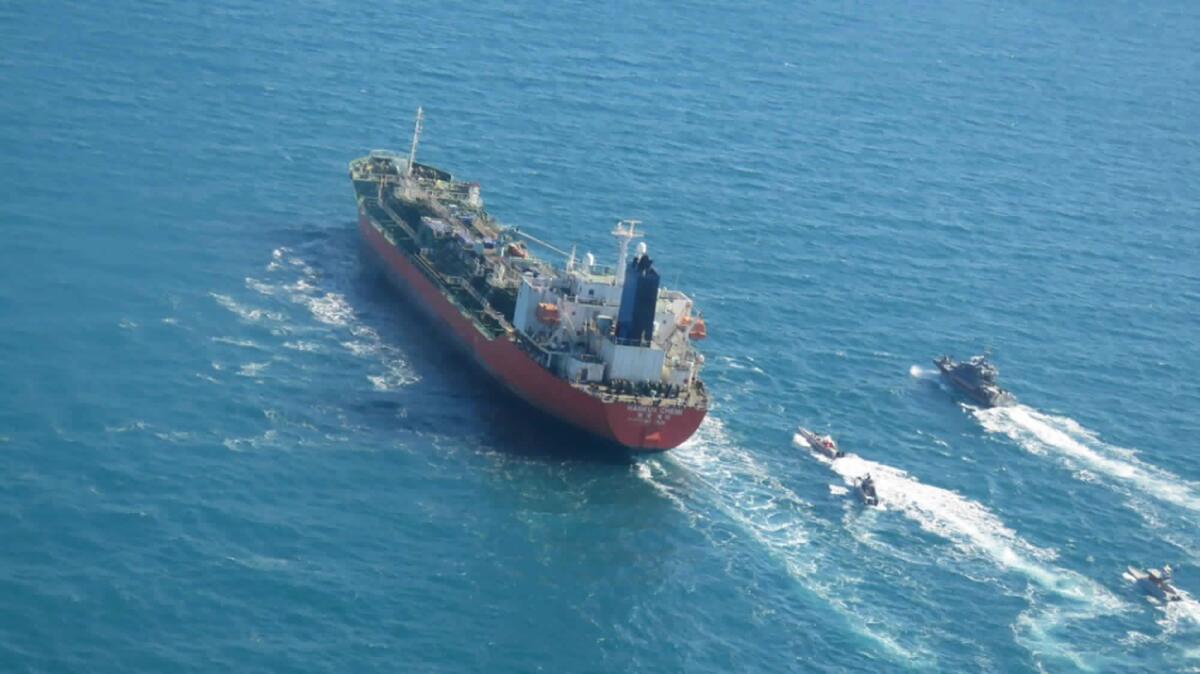
A seized South Korean-flagged tanker is escorted by Iranian Revolutionary Guard boats in the Persian Gulf’s Strait of Hormuz in January 2021. If Iran were to close the strait after the U.S.-Israel strikes Saturday, it would likely cause a massive disruption to exports and cause crude prices to spike.
(Tasnim News Agency via AP)
While OPEC members Saudi Arabia and the United Arab Emirates have some ability to reroute their shipments via pipelines that avoid Hormuz, closing the strait would still cause a massive disruption to exports and cause crude prices to spike.
There were signs that other Gulf producers were also accelerating shipments in February. Saudi Arabia’s crude shipments averaged about 7.3 million barrels a day in the first 24 days of the month, the most in almost three years. Combined flows from Iraq, Kuwait and the United Arab Emirates were set to climb almost 600,000 barrels a day from the same period in January, according to data from Vortexa Ltd.
In the past, Tehran has made retaliatory strikes on some of its neighbors’ energy assets. In 2019, Saudi Arabia blamed Tehran for a drone attack on its Abqaiq oil processing facility that halted production equivalent to about 7% of global crude supply.
Many observers say it’s improbable that Iran could keep Hormuz closed for long, making lower-impact actions like harassment of shipping more likely.
During last year’s war on Iran by Israel and the U.S., nearly 1,000 vessels a day were having their GPS signals jammed near Iran’s coast, contributing to one tanker collision. Sea mines are another long-threatened option for deterring shipping.
Oil surged the most in more than three years during the June war, with Brent crude rising above $80 a barrel in London. However, the gains quickly faded once it became clear that key regional oil infrastructure hadn’t been damaged.
Since then, concerns about an oversupply have dominated global markets, with crude in London ending 2025 about 18% lower than where it started.
Despite those fears of a glut, prices have surged 19% this year, partly due to fears of U.S. strikes on Iran.
With the main oil futures closed for the weekend, there’s limited insight into how traders are reacting to the latest attacks. However, a retail trading product, run by IG Group Ltd., was pricing West Texas Intermediate as high as $75.33, a gain of as much as 12% from Friday’s close.
Burkhardt and Di Paola write for Bloomberg. Bloomberg writer Julian Lee contributed to this report.
SOCORRO, Texas — In a Texas town at the edge of the Rio Grande and a tall metal border wall, rumors swirled that federal immigration officials wanted to purchase three hulking warehouses to transform into a detention center.
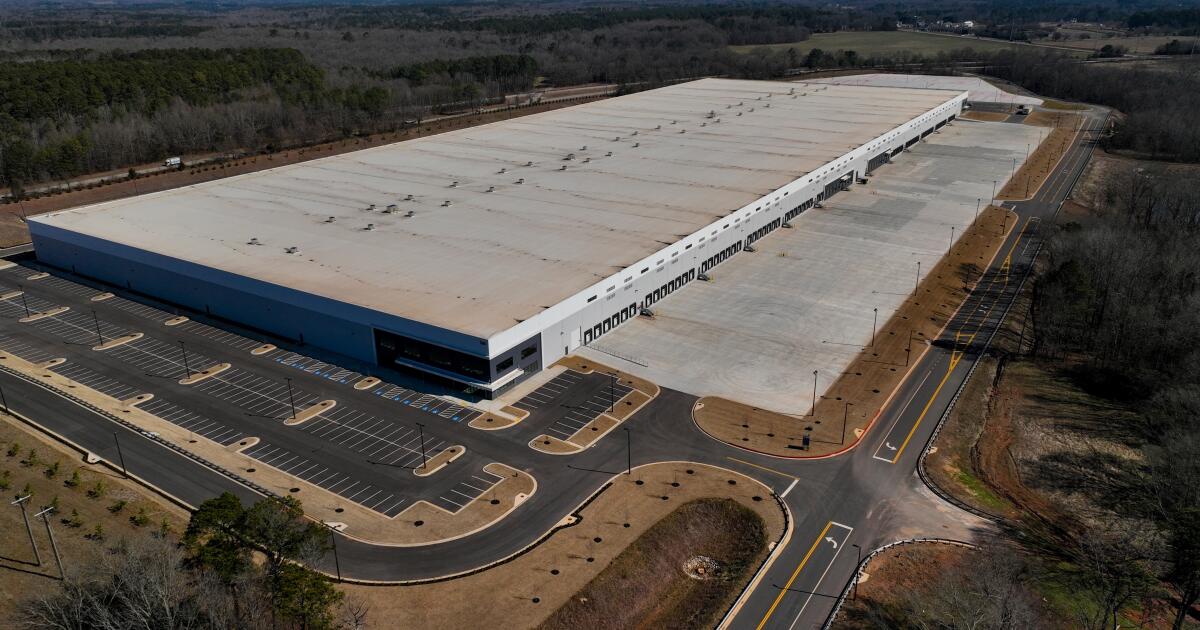
As local officials scrambled to find out what was happening, a deed was filed showing the Department of Homeland Security had already inked a $122.8-million deal for the 826,000-square-foot warehouses in Socorro, a bedroom community of 40,000 people outside El Paso.
“Nobody from the federal government bothered to pick up the phone or even send us any type of correspondence letting us know what’s about to take place,” said Rudy Cruz Jr., the mayor of the predominantly Latino town of low-slung ranch homes and trailer parks, where orchards and irrigation ditches share the landscape with strip malls, truck stops, recycling plants and distribution warehouses.
Socorro is among at least 20 communities across the U.S. whose large warehouses have become stealth targets for Immigration and Customs Enforcement’s $45-billion expansion of detention centers.
As public support for the agency and President Trump’s immigration crackdown sags, communities both red and blue are objecting to mass detentions and raising concerns that the facilities could strain water supplies and other services while reducing local tax revenue.
In many cases, mayors, county commissioners, governors and members of Congress learned about ICE’s ambitions only after the agency bought or leased space for detainees, leading to shock and frustration even in areas that have backed Trump.
“I just feel,” said Cruz, whose wife was born in Mexico, “that they do these things in silence so that they don’t get opposition.”
ICE, which is part of the Department of Homeland Security, has purchased at least seven warehouses in Arizona, Georgia, Maryland, Pennsylvania and Texas, signed deeds show. Other deals have been announced but not finalized, though buyers scuttled sales in eight locations.
Homeland Security objected to calling the sites warehouses, emphasizing in a statement that they would be “very well structured detention facilities meeting our regular detention standards.”
The process has been chaotic at times. ICE last week acknowledged that it made a “mistake” when it announced warehouse purchases in Chester, N.Y., and Roxbury, N.J. Roxbury then announced Friday that the sale there had closed.
Homeland Security has confirmed that it is looking for more detention space but hasn’t disclosed individual sites ahead of acquisitions. Some cities learned only through reporters that ICE was scouting warehouses. Others were tipped off by a spreadsheet circulating online among activists whose source is unclear.
It wasn’t until Feb. 13 that the scope of the warehouse project was confirmed, when the governor’s office in New Hampshire, where there is backlash to a planned 500-bed processing center, released an ICE document showing the agency plans to spend $38.3 billion to boost detention capacity to 92,000 beds.
Since Trump took office, the number of people detained by ICE has increased to 75,000 from 40,000, spread across more than 225 sites.
ICE could use the warehouses to consolidate and to increase capacity. The document describes a project that includes eight large-scale detention centers, capable of housing 7,000 to 10,000 detainees each, and 16 smaller regional processing centers. The document also refers to the acquisition of 10 existing “turnkey” facilities.
The project is funded through Trump’s massive tax and spending cuts law enacted last year that nearly doubled the Homeland Security budget. To build the detention centers, the Trump administration is using military contracts.
Those contracts allow for a high degree of secrecy and enable Homeland Security to move quickly without following the usual processes and safeguards, said Charles Tiefer, a professor emeritus of law at the University of Baltimore Law School.
In Socorro, the ICE-owned warehouses are so large that 4½ Walmart Supercenters could fit inside, in contrast to the remnants of the austere Spanish colonial and mission architecture that define the town.
At a recent City Council meeting, public comments stretched for hours. “I think a lot of innocent people are getting caught up in their dragnet,” said Jorge Mendoza, an El Paso County retiree whose grandparents immigrated to the U.S. from Mexico.
Many speakers invoked concerns about three recent deaths at an ICE detention facility at the nearby Ft. Bliss Army base.
Even communities that backed Trump in 2024 have been caught off-guard by ICE’s plans and have raised concerns.
In rural Pennsylvania’s Berks County, commissioner Christian Leinbach called the district attorney, the sheriff, the jail warden and the county’s head of emergency services when he first heard ICE might buy a warehouse in Upper Bern Township, three miles from his home.
No one knew anything.
A few days later, a local official in charge of land records informed him that ICE had bought the building — promoted by developers as a “state-of-the art logistics center” — for $87.4 million.
“There was absolutely no warning,” Leinbach said during a meeting in which he raised concerns that turning the warehouse into a federal facility would mean a loss of more than $800,000 in local tax money.
ICE has touted the income taxes its workers would pay, though the facilities themselves will be exempt from property taxes.
In Social Circle, Ga., which also strongly supported Trump in 2024, officials were stunned by ICE’s plans for a facility that could hold 7,500 to 10,000 people after first learning about it through a reporter.
The city, which has a population of 5,000 and worries about the infrastructure needs for such a detention center, heard from the Homeland Security Department only after the $128.6-million sale of a 1-million-square-foot warehouse was completed. Like Socorro and Berks County, Social Circle questioned whether the water and sewage system could keep up.
ICE has said it did due diligence to ensure the sites don’t overwhelm city utilities. But Social Circle said the agency’s analysis relied on a yet-to-be built sewer treatment plant.
“To be clear, the City has repeatedly communicated that it does not have the capacity or resources to accommodate this demand, and no proposal presented to date has demonstrated otherwise,” the city said in a statement.
And in the Phoenix suburb of Surprise, officials sent a scathing letter to Homeland Security Secretary Kristi Noem after ICE without warning bought a massive warehouse in a residential area about a mile from a high school. Arizona Atty. Gen. Kris Mayes, a Democrat, raised the prospect of going to court to have the site declared a public nuisance.
Back in Socorro, people waiting to speak against the ICE facility spilled out of the City Council chambers, some standing beside murals paying tribute to the World War II-era bracero program that allowed Mexican farmworkers to be guest workers in the U.S. The program stoked Socorro’s economy and population before the Eisenhower administration in the 1950s began mass deportations aimed at people who had crossed the border illegally.
Eduardo Castillo, formerly an attorney for the U.S. Department of Justice, told city officials that it is intimidating but “not impossible” to challenge the federal government.
“If you don’t at least try,” he said, “you will end up with another inhumane detention facility built in your jurisdiction and under your watch.”
Hollingsworth and Lee write for the Associated Press and reported from Kansas City, Mo., and Socorro, respectively. AP writers Holly Ramer in Concord, N.H., and Marc Levy in Harrisburg, Pa., contributed to this report.
WASHINGTON — At Immigration and Customs Enforcement detention facilities across the country, detainees go without medicine for serious health conditions, endure miscarriages while shackled and are dying in record numbers, a group of U.S. senators said.
In a letter sent Friday to Homeland Security Secretary Kristi Noem and ICE senior official Todd Lyons, 22 Democratic lawmakers alleged that a “dramatic” surge in deaths in federal immigration custody is a “clear byproduct” of the Trump administration’s mass deportation agenda and rapid expansion of detention.
“Each death in ICE custody is a tragedy and, based on the evidence available from agency records, 911 calls, and medical experts, many could have been prevented if not for this Administration’s decisions,” the senators wrote. The letter, released Tuesday, was led by Illinois Sen. Dick Durbin and signed by California Sen. Alex Padilla.
At least 32 people died in ICE custody in 2025, they asserted. That’s triple the previous year’s total and more deaths than were recorded during the entire Biden administration. ICE has reported seven deaths so far this year, as well as seven in December alone.
In the letter, the senators demanded detailed information about the agency’s death investigations, medical standards and oversight procedures.
The Department of Homeland Security, which oversees ICE, did not respond to the allegations but has repeatedly defended its detention standards. In a statement, ICE said it is “committed to ensuring that all those in custody reside in safe, secure and humane environments,” adding that detainees receive medical, dental and mental health screenings within 12 hours of arrival, full health assessments within 14 days and access to 24-hour emergency care.
The lawmakers’ warning comes amid mounting allegations that detention facility staff have withheld critical medication, delayed emergency responses and failed to provide adequate mental health care.
The agency came under flak recently after a Texas medical examiner ruled the January death of a Cuban immigrant a homicide after witnesses said they saw guards choking him to death.
In Calexico, Calif., Luis Beltrán Yanez-Cruz, 68, died after more than a month in detention, records show; the Honduran national’s family alleged that he repeatedly reported worsening stomach and chest pain but received only pain medication.
The recent rise in deaths coincides with a dramatic expansion of the detention system. Funding for ICE roughly tripled after Congress passed the One Big Beautiful Bill Act. The agency has used the funds to increase detention capacity, holding more than 67,000 people nationwide after reaching a historic high of approximately 73,000, many of whom have no criminal history, the letter says.
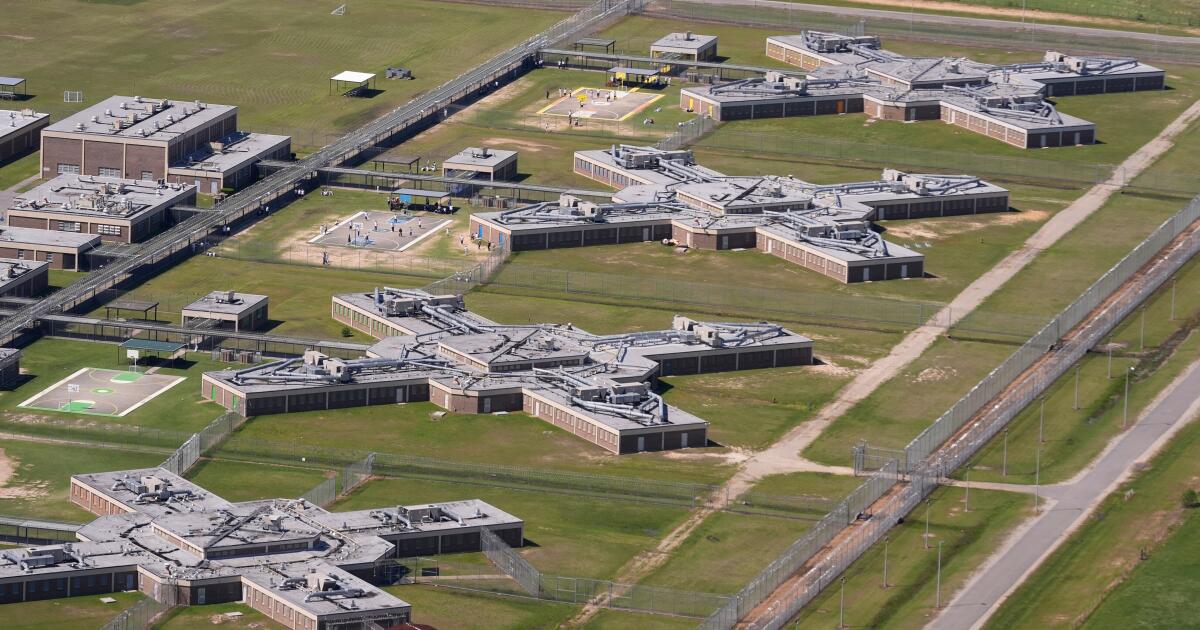
Last week, the Trump administration announced $38.3 billion in partnerships with private prison corporations, including GEO Group and CoreCivic, to further scale up detention space. One planned facility near Phoenix will cost $70 million and span the equivalent of seven football fields, according to the lawmakers. ICE has also reopened facilities that were previously shuttered over chronic staffing shortages and medical concerns.
Concerns about conditions have extended to California. Last month, Padilla and Sen. Adam Schiff toured a for-profit detention center in California City after reports of unsafe facilities, inadequate medical care and limited access to attorneys.
“It’s the tragic result of a system failing to meet the most basic duty of care,” Padilla said in a statement, citing reports of mold in food, unclean drinking water and barriers to medical care.
A federal judge recently ordered the administration to provide adequate healthcare and improved access to counsel at the facility, concluding that detainees were likely to “suffer irreparable harm” without court intervention.
In their letter, the senators argued that the rapid growth of the detention system has outpaced oversight and accountability. They cited internal audits documenting violations of detention standards, allegations that ICE failed to pay third-party medical providers for months and analyses of 911 calls from large facilities showing repeated cardiac events, seizures and suicide attempts.
“Rather than accepting responsibility for deaths in government custody and providing detailed facts about the circumstances of each death,” the senators wrote, “the Department of Homeland Security has attempted to smear deceased individuals’ reputations by emphasizing details about their immigration status and their alleged wrongdoing.”
As detention capacity continues to expand, the climbing death tallies underscore the extent to which the Trump administration has overhauled the immigration detention system, and Democrats say the results are fraught.
The opposition party has grown more unified after the fatal shootings of two U.S. citizens by federal agents in Minnesota, which coincided with reports of record high detention deaths in December.
Discord culminated in a partial government shutdown that began Friday when Senate Democrats refused to fund the Department of Homeland Security until the Trump administration agrees to reform at the agency.