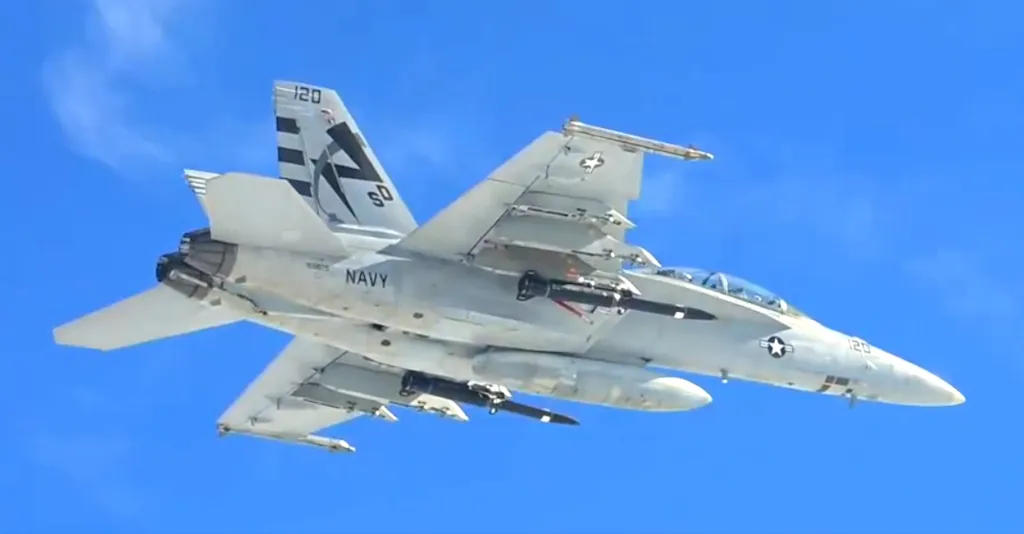
FA18

F/A-18 Super Hornets Were Just Tracked Flying Deep Inside The Gulf Of Venezuela (Updated)

Online flight tracking data shows that a pair of U.S. Navy F/A-18 Super Hornets flew right into the center of the Gulf of Venezuela earlier today, and stayed there for some 40 minutes. This is a relatively small body of water bounded on three sides by Venezuela’s national territory, and is in the same general area where American forces are known to have previously probed that country’s air defenses. The sorties represent a new escalation in the maximum pressure campaign against Venezuelan dictator Nicolas Maduro that President Donald Trump’s administration has been conducting for months now.

The two Super Hornets, callsigns Rhino 11 and Rhino 12, look to have remained in international airspace throughout the duration of their sorties in the Gulf of Venezuela today, though this remains unconfirmed. Spoofing aircraft in open-source flight tracking is possible and does happen, but in this case, considering what we are seeing, and the recent history of certain U.S. platforms making their presence very known off the coast of Venezuela, this seems unlikely.

Even flying tight orbits in the middle of the Gulf could easily have brought the jets close to the Venezuelan coast. The body of water is approximately 75 miles long, north to south, and 150 miles wide, east to west, at its longest points. The opening to the Gulf from the Caribbean Sea to the north is only some 52 miles across, with Venezuela’s national airspace extending 12 miles from either side. Venezuelan authorities have claimed the entire body of water to be internal to the country’s national territory, something the United States has openly challenged for decades.

In addition to the F/A-18s, a pair of Navy EA-18G Growler electronic warfare jets, with the callsigns Grizzly 1 and Grizzly 2, were also tracked flying orbits in the Caribbean just north of the Gulf of Venezuela. One of the Navy’s MQ-4C Triton maritime surveillance drones also flew a mission further out in the Caribbean opposite Venezuela’s coastline at around the same time. It is highly probable that other U.S. military aircraft were also operating in the same broad area, but were not visible online. That the Super Hornets and Growlers were broadcasting their positions means they were intended to be seen, and to send a clear message to authorities in Venezuela.

Junto a los Super Hornet RHINO11 y RHINO12 estaban los EA-18G Growler con códigos de llamada GRIZZLY1 y GRIZZLY2. Son aviones de ataque electrónico aerotransportado. pic.twitter.com/2o31SEZMb2

— 𝘼𝙧𝙧𝙚𝙘𝙝𝙤 (@Arr3ch0) December 9, 2025

Where the F/A-18s or EA-18Gs were operating from during their sorties has not been confirmed. However, these types of aircraft are among those currently embarked on the Navy’s supercarrier USS Gerald R. Ford, which has been sailing in the region since last month.

A US Navy F/A-18E Super Hornet lands on the aircraft carrier USS Gerald R. Ford on November 17, 2025. USN
An EA-18G Growler also seen on the Ford‘s flight deck on November 17, 2025. USN

Ford was recently observed leaving St. Thomas in the U.S. Virgin Islands. U.S. Southern Command (SOUTHCOM) also posted pictures of Super Hornets and Growlers operating from the carrier, all of which were taken back in November, on social media at around the time of today’s flights off the coast of Venezuela.

‼️🇺🇸🇻🇪NEWS: The USS Gerald R. Ford is moving toward Venezuela after leaving St. Thomas yesterday.

The nuclear-powered carrier is heading south as part of Trump’s Operation Southern Spear, marking a major show of force aimed at increasing pressure on Maduro.

See the latest… pic.twitter.com/eNdIYkgyJ2

— The threat of missiles and drones (@StatWatch25) December 8, 2025

Ford-class aircraft carrier USS Gerald R. Ford (CVN 78) conducts flight operations while underway in the Caribbean Sea.

U.S. military forces are deployed to the U.S. Southern Command area of responsibility in support of Operation SOUTHERN SPEAR, Department of War-directed… pic.twitter.com/lVP1zSJgwa

— U.S. Navy (@USNavy) December 9, 2025

Super Hornets from Ford have also been spotted recently at Luis Muñoz Marín International Airport in Puerto Rico. Since September, Marine fighters and other aircraft have been operating from the former Naval Station Roosevelt Roads on the island in support of operations in the Caribbean, as well. TWZ has reached out to the Navy and U.S. Southern Command (SOUTHCOM) for more information about today’s flights near Venezuela.

The combination of F/A-18s and EA-18Gs, with the latter flying in a standoff position, is exactly what one would expect to see during actual strikes on targets in Venezuela. The Growlers would provide electronic warfare support to help cover the Super Hornets penetrating into the threat envelope of hostile air defenses on the way to their targets. Such a mission would also include a host of additional aircraft and other assets providing command and control, aerial refueling, surveillance and reconnaissance, and other support further away from the objective areas.

Whether or not the Venezuelan Air Force made any attempt to intercept any U.S. aircraft flying around the country’s borders today is unclear. The Gulf of Venezuela, as well as Lake Maracaibo, which lies immediately to the south, and the surrounding areas, are all highly strategic locales. Lake Maracaibo, in particular, is the country’s main oil-producing region. Tankers regularly sail in and out of the area, where key refineries are also situated.

As mentioned, this is not the first time that U.S. military aircraft have operated in this same general area, and with the explicit intent of testing and otherwise gathering intelligence about Venezuela’s air defenses. Those assets do present varying degrees of risk, as you can read more about here.

Back on November 20, Navy Super Hornets notably flew just north of the Gulf of Venezuela while a U.S. Air Force RC-135W Rivet Joint intelligence, surveillance, and reconnaissance (ISR) aircraft monitored the situation from a station further out in the Caribbean. Air Force B-52 bombers, which also now regularly take part in shows of force aimed at Venezuela, were tracked in the area at around the same time. One of the main missions of the Air Force’s Rivet Joint fleet is to help in crafting so-called “Electronic Orders of Battle” of enemy or potentially hostile forces in a given area, especially air defense nodes. EA-18Gs can collect information to help with this, as well.

FlightRadar24 has now identified FELIX11, one of the “unknown military aircraft” off the coast of Venezuela, as a U.S. Navy F/A-18E Super Hornet from the USS Gerald R. Ford (CVN-78), meaning that the others; PARTY11, LION11, LION12, as well as others not seen, are also likely… https://t.co/x6kX0H1UZv pic.twitter.com/KSPC4TbG19

— OSINTdefender (@sentdefender) November 20, 2025

“They are normal operational training flights from the aircraft carrier USS Ford and platforms performing training exercises,” a U.S. official told TWZ about those sorties. “They are also testing Venezuelan sensors and responses, and it is part of the pressure campaign to show U.S. capabilities in the Caribbean.”

It should be noted here that there has been a significant buildup of U.S. forces in the Caribbean overall since August, with approximately 15,000 personnel in total now deployed in the region. This includes Ford and a host of other major naval assets, as well as various crewed and uncrewed aircraft, and supporting elements on the ground. Special operations forces are also now heavily deployed in the region. President Trump also previously confirmed he had authorized the Central Intelligence Agency (CIA) to conduct covert operations inside Venezuela.

All of this is ostensibly in support of enhanced counter-narcotics operations, now dubbed Operation Southern Spear. The U.S. government accuses Maduro of being directly involved in drug trafficking in association with an entity referred to as the Cartel of the Suns, which is now also designated as a terrorist organization. Questions have been raised about those links. Maduro has been under indictment in the United States since 2020 on narcotics and other charges, and American authorities currently have a $50 million bounty out for information leading to his arrest.

President Trump ordered action — and the Department of War is delivering.

Today, I’m announcing Operation SOUTHERN SPEAR.

Led by Joint Task Force Southern Spear and @SOUTHCOM, this mission defends our Homeland, removes narco-terrorists from our Hemisphere, and secures our…

— Secretary of War Pete Hegseth (@SecWar) November 13, 2025

The sorties today follow weeks of escalating shows of force, as well as reports that the Trump administration could be getting closer to launching strikes or conducting other direct action missions on targets inside Venezuela. U.S. operations in the Caribbean already now include routine strikes on alleged drug-smuggling boats. Serious questions have been raised about the underlying intelligence behind those strikes, as well as their legality.

“I don’t want to say that,” President Trump said just today when asked about how far he might go to remove Maduro from office during an interview with Politico‘s Dasha Burns.

“His [Maduro’s] days are numbered,” Trump added in response to a follow-up question simply about whether he would like to see Maduro out of power.

He also declined to rule out a ground invasion of Venezuela or any other kind of military action, the potential prospect of which TWZ has recently explored.

During a recent interview Trump is asked about removing Maduro from power,
He refuses to rule out any options and says “Maduros days are numbered”

Trump also added that he wanted
“The people of Venezuela to be treated well”#Venezuela
pic.twitter.com/TPCV0huV6F

— CNW (@ConflictsW) December 9, 2025

If nothing else, today’s sorties in and around the Gulf of Venezuela make clear that the U.S. government remains committed to ratcheting up the pressure on Maduro.

Update, 7:00 PM EST:

There are indications that a new contingent of tactical jets, possibly EA-18G Growlers, has deployed from Naval Air Station Whidbey Island in Washington State to the Caribbean. The aircraft may be headed to the former Naval Station Roosevelt Roads in Puerto Rico based on online flight tracking data. Land-based EA-18Gs, on top of the Growlers already in the region aboard the USS Gerald R. Ford, would not be a typical show of force, but would represent a key force multiplier for any future strike operations.

Does this mean strikes are soon to begin in Venezuela, no it doesn’t, but it is among the most interesting movements we have seen that would point to preparing for this. More on Venezuela’s air defense capabilities here: https://t.co/IYAm9hIu0z

— Tyler Rogoway (@Aviation_Intel) December 9, 2025

And these would likely be land based, not deployed to augment the carrier air wing directly. Standard stuff for the EA community.

— Tyler Rogoway (@Aviation_Intel) December 9, 2025

Update, 12/10/2025:

In response to our queries yesterday, the U.S. Navy directed us to U.S. Southern Command (SOUTHCOM). In turn, a SOUTHCOM spokesperson provided the following statement:

“We conduct routine, lawful operations in international airspace, including over the Gulf of Venezuela. We will continue to fly safely, professionally, and in accordance with international law to protect the homeland, monitor illicit activity, and support stability across the Americas.”

Contact the author: joe@twz.com

Joseph has been a member of The War Zone team since early 2017. Prior to that, he was an Associate Editor at War Is Boring, and his byline has appeared in other publications, including Small Arms Review, Small Arms Defense Journal, Reuters, We Are the Mighty, and Task & Purpose.


Source link

F/A-18 Super Hornet Shot Down By Navy Cruiser Investigation Findings Released

During its deployment to the Middle East, where it took part in combat operations against the Houthis, the Nimitz class aircraft carrier USS Truman collided with a cargo ship, had an F/A-18E Super Hornet fall off the deck, an F/A-18F careen off the deck while landing and another F/A-18F shot down by an escort ship. In addition, a tow tractor fell off the carrier as it was taking evasive maneuvers in the same incident when the Super Hornet fell off the deck. On Thursday, the Navy released summary details of the findings of investigations into these mishaps, which took place between Dec. 22, 2024, and May 6, 2025. None of the three Super Hornets were recovered, a U.S. official told us.

“Each investigation was conducted independently and thoroughly, in accordance with Navy policy, immediately following the incidents,” the Navy said in a release. “Appropriate accountability actions have been taken to address these incidents.”

The summary of these investigative findings can be found below:

USS Gettysburg Friendly Fire Incident

On Dec. 22, 2024, an F/A-18F Super Hornet assigned to Strike Fighter Squadron (VFA) 11 was shot down by the Ticonderoga class cruiser USS Gettysburg as jets were returning to the supercarrier.

The Ticonderoga class cruiser USS Gettysburg. (USN)

At the time of the incident, the Truman Carrier Strike Group (CSG) was in the Red Sea and under fire from the Houthis. The CSG “shot down two anti-ship cruise missiles (ASCM) and two one-way attack uncrewed aerial vehicles (OWA UAV) with reports of other OWA UAVs in the air,” a U.S. official told us at the time, adding that the aircraft had yet to be recovered. “The wreckage has not been located and is likely at the bottom of the Red Sea. Both crew members were successfully recovered and are back on the USS Harry S. Truman.  Initial reports are that one of the crew members has minor injuries. Both have been evaluated and released from medical.”

250925-N-DL824-2006 ATLANTIC OCEAN (Sept. 25, 2025) An F/A-18F Super Hornet, attached to the “Red Rippers” of Strike Fighter Squadron (VFA) 11, lands on the flight deck of the Nimitz-class aircraft carrier USS Harry S. Truman (CVN 75). Truman is currently underway carrying out routine operations that support the Navy’s commitment to readiness, innovation, and future fleet lethality. (U.S. Navy photo by Mass Communication Specialist Seaman Michael Gomez)
An F/A-18F Super Hornet, attached to the “Red Rippers” of Strike Fighter Squadron (VFA) 11, lands on the flight deck of the Nimitz-class aircraft carrier USS Harry S. Truman (CVN 75). (U.S. Navy photo by Mass Communication Specialist Seaman Michael Gomez) Seaman Michael Gomez

Naval Air Force Atlantic (AIRLANT) separately told us that the two-seat F/A-18F Super Hornet had been “performing a refueling mission” at the time of the friendly fire incident. Super Hornets can be configured to serve as refuelers in addition to fighters. The jet was reportedly hit by a Standard Missile-2 (SM-2) interceptor.

According to a summary, the investigation found “that a lack of integrated training opportunities between USS Gettysburg and the Carrier Strike Group, lack of forceful backup on the cruiser, and lack of cohesion across the Carrier Strike Group contributed to the misidentification, and subsequent engagement, of the friendly aircraft and near miss of another. There were no personnel casualties or major injuries.”

Collision with Merchant Vessel Besiktas-M

On Feb. 12,  the Truman was involved in a collision with the merchant vessel Besiktas-M at approximately 11:46 p.m. local time, while operating near Port Said, Egypt, in the Mediterranean Sea.

“The collision did not endanger the Harry S. Truman (CVN 75) as there are no reports of flooding or injuries,” the Navy said at the time. “The propulsion plants are unaffected and in a safe and stable condition. The incident is under investigation. More information will be released as it becomes available.”

A photo taken after the incident showed multiple large tears through a sponson on the starboard side of the stern end of the ship near one of the aircraft elevators. It was unknown at the time whether there was damage elsewhere.

Damage inflicted on the Truman after its collision with a merchant ship. (USN)

In October, a photo taken of the ship during an event with President Donald Trump showed that the damage had been painted over. The Navy told us that repairs would be made during the ship’s planned Refueling Complex Overhaul (RCOH) at Newport News Shipbuilding. “Immediately following the collision, while in Souda Bay, Greece, new bulkheads were installed inside each of the damaged spaces to establish weathertight integrity.”

The Navy explained why damage was still seen on the USS Harry Truman months after a collision at sea.
The Navy painted over damage to the Truman after its collision. (Via X) Via X

The Navy investigation found: “that the collision was avoidable. The carrier’s bridge team failed to safely navigate past the merchant vessel. No personnel or engineering casualties occurred on either vessel. The Navy relieved [Capt. Dave Snowden] the commanding officer of the USS Harry S. Truman in February due to a loss of confidence in his ability to command.”

“Following the collision, the Harry S. Truman pulled into U.S. Naval Support Activity Souda Bay, Greece. While in port, Forward Deployed Regional Maintenance Center personnel, Norfolk Naval Shipyard, and local industry partner Theodoropoulos Group removed exterior portions of the damaged ship and installed bulkheads inside each of the damaged spaces for weathertight integrity. Following the repairs, the Harry S. Truman returned to the Red Sea to resume combat operations. Complete repair of the damage is scheduled during the ship’s upcoming Refueling and Complex Overhaul at HII-Newport News Shipbuilding.”

Snowden was relieved on Feb. 20. Capt. Christopher Hill, commanding officer of USS Dwight D. Eisenhower (CVN 69), was temporarily assigned as Truman’s interim commanding officer.

Loss of F/A-18E Super Hornet and Tow Tractor

On April 28, an F/A-18E Super Hornet from VFA-136 fell off the side of the Truman while the ship was conducting evasive maneuvers in response to incoming Houthi threats, a U.S. official told TWZ at the time. A tow tractor that had been moving the aircraft also went over the side in the incident, in which thankfully only a single sailor suffered minor injuries. The Super Hornet was under tow in the hangar bay when the deck crew lost control of the aircraft, the Navy later said in a release. “The aircraft and tow tractor were lost overboard. Sailors towing the aircraft took immediate action to move clear of the aircraft before it fell overboard. An investigation is underway.”

Navy supercarriers like Truman are capable of making sharp and high-speed turns for ships of their size, including an evasive tactic, as seen in the video below.

In its investigation, the Navy found that the Super Hornet and tow tractor were lost “during evasive maneuvers in response to an incoming ballistic missile in the Red Sea. While all actions taken were within standard operating procedures, the investigation determined that the primary cause was an aircraft brake system failure, compounded by insufficient communication between the bridge, flight deck control, and hangar bay control. The crew’s quick thinking and resourcefulness prevented any personnel injuries or further damage.”

Failure of Arresting Wire Leading to Aircraft Loss

On May 6, 2025, an F/A-18F Super Hornet from VFA-11 crashed into the sea during its attempt to land. Both the pilot and the Weapon System Officer (WSO) were able to eject and were recovered by helicopter with only minor injuries. TWZ has confirmed that the arrestment failed on touchdown and the jet careened off the deck. MH-60 Seahawk squadron HSC-11 made the rescue.

Landing Signal Officers (LSO) watch as an F/A-18F Super Hornet assigned to Strike Fighter Squadron (VFA) 106, prepares to make an arrested recovery aboard the Nimitz-class aircraft carrier USS Harry S. Truman (CVN 75). Truman is underway conducting carrier qualifications in the Atlantic Ocean.
Landing Signal Officers (LSO) watch as an F/A-18F Super Hornet, assigned to Strike Fighter Squadron (VFA) 106, prepares to make an arrested recovery aboard the Nimitz class aircraft carrier USS Harry S. Truman (CVN 75). (USN) MCSN Kevin T. Murray; Jr.

The subsequent investigation found that the jet was lost “following the failure of the #4 arresting wire aboard Truman. The investigation found the failure was caused by a malfunctioning #4 starboard sheave damper. Contributing factors included inadequate maintenance practices, low manning levels, limited knowledge, and insufficient training. The high operational tempo and combat conditions also contributed to a strained environment. No injuries occurred, and flight operations resumed within hours.”

“These investigations assessed underlying procedural compliance and standards and reviewed how a Carrier Strike Group prepares for and responds to adversity during combat operations,” the Navy said Thursday in its release. “Vice Chief of Naval Operations Adm. Jim Kilby emphasized the Navy’s commitment to learning from these events and implementing changes to prevent similar incidents in the future.”

Despite these incidents, the “Navy’s sustained combat operations in the U.S. Central Command area of operations for the past two years demonstrated our battle effectiveness and ability to maintain freedom of navigation,” Kilby explained. “As we reflect on these incidents and ongoing improvement efforts, the Navy remains laser-focused on producing battle-ready Sailors and forces to ensure the Navy provides our nation with the most lethal, combat-credible, and ready force possible.”

The four investigations “reinforce the need to continue investing in our people to ensure we deliver battle-ready forces to operational commanders,” Kilby added. “Despite the challenges, the Sailors of the Harry S. Truman Strike Group demonstrated adaptability, professionalism, and complete commitment to the mission throughout the deployment.” 

More information about these investigations was revealed during a media roundtable with Navy officials at 1 p.m. We will update this story with any pertinent details provided.

Contact the author: howard@thewarzone.com

Howard is a Senior Staff Writer for The War Zone, and a former Senior Managing Editor for Military Times. Prior to this, he covered military affairs for the Tampa Bay Times as a Senior Writer. Howard’s work has appeared in various publications including Yahoo News, RealClearDefense, and Air Force Times.


Source link