Israel To Buy Extra F-15IA and F-35I Squadrons
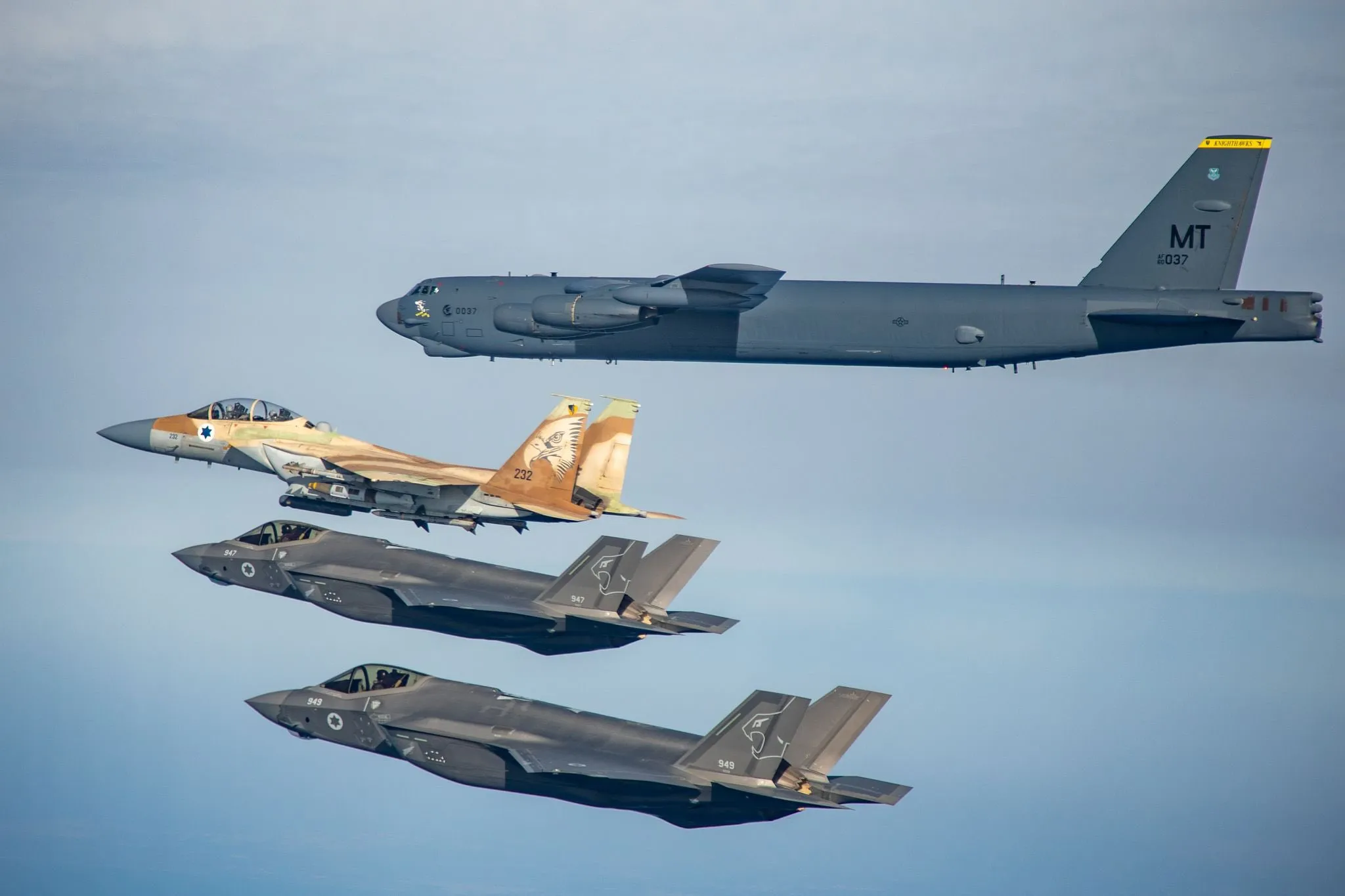
After years of high-tempo operations in the Middle East, the Israeli Air Force is set to get two new fighter squadrons, one each of the F-15IA and the stealthy F-35I Adir. This will bring the total of F-35I squadrons to four and will add a second squadron of F-15IAs. While the numbers involved were not stated, the IAF has recently bolstered its fighter inventory in the form of 25-aircraft squadrons. This is almost certain to be the case here, too, which would provide the service with an additional 25 examples of each type, for an eventual inventory total of 100 F-35Is and 50 F-15IAs.
The Israeli Ministry of Defense confirmed on its official social media channels that, over the weekend, the country’s Ministerial Committee on Procurement approved its plan to simultaneously procure two new fighter squadrons.
“The scope of the deals is estimated at tens of billions of shekels and includes the integration of the squadrons into the Air Force, comprehensive support, spare parts, and logistics,” the ministry said.
In a statement today, Israeli Prime Minister Benjamin Netanyahu referenced the two new squadrons. He also noted that, as part of Israel’s investment in military independence through domestic production of armaments and defense technology, the country “will develop groundbreaking Israeli-made aircraft.” He provided no further details about this project, although a fighter, along the lines of the failed Lavi, or even more likely, some kind of Collaborative Combat Aircraft (CCA) type drone, is a possibility, as are different types of intelligence, surveillance, and reconnaissance (ISR) platforms. We also know of the existence of at least one secretive Israeli drone, referred to as RA-01 and used for covert missions, and further developments along these lines should not be ruled out. We are trying to get clarity on this aspect of the announcement.
Now that the acquisition has been approved by the Ministerial Committee, the Director General of the Ministry of Defense has authorized its procurement delegation in the United States to proceed with signing the deals with U.S. government and military officials “in the near future.”

Neither a delivery timeline nor the likely costs of the deals have been specified.
In a statement, Israeli Minister of Defense Israel Katz explained that the two-squadron procurement is driven by “operational lessons learned from the campaign against Iran [that] require us to accelerate our force buildup.”
Israel and the United States launched airstrikes on Iran on February 28, but a ceasefire has been in place since April 8. While the U.S. Navy maintains a blockade of Iranian ports, the IDF remains heavily engaged in fighting in Lebanon.

According to Katz, the Israeli campaign against Iran, Operation Lion’s Roar, “again demonstrated the power of the Air Force and its crucial role in safeguarding the security of the State of Israel. The operational lessons learned from this campaign compel us to continue accelerating our force development to ensure the Air Force’s superiority in the decades to come.”
As well as operations against Iran, Israeli aircraft have also conducted strikes against Iranian-backed Hamas militants in Gaza and Hezbollah militants in Lebanon following the October 7, 2023, attacks on Israel. Long-range strikes have also been flown against targets in Syria and Yemen in recent years.
“The procurement of these squadrons is a central part of the ‘Magen Israel’ program, which is designed to ensure the Israel Defense Forces maintains a sustained qualitative edge,” Katz added. “Our mission is clear: to stay one step ahead of our enemies.”
Magen Israel — Israeli Shield in Hebrew — includes other investments, too. As well as the new additional new fighters, it will provide funding for what is described as “a technological leap forward in the development and integration of autonomous flight capabilities, next-generation advanced defense systems, and the establishment of Israeli military superiority — both defensive and offensive — in space.”
The Magen Israel initiative has been approved by Prime Minister Netanyahu and the defense minister and will provide a budget of close to $120 billion over the next 10 years. Some of the funding for the new aircraft will almost certainly come from the United States, which delivers billions of dollars in military funding to Israel each year, largely tied to American weapons. Since October 7, 2023, Washington has surged tens of billions of dollars more, fast-tracking arms to the IDF.

Maj. Gen. (res.) Amir Baram, the director general of the Israeli Ministry of Defense, described the procurement as the “first and central step in implementing […] force buildup for a challenging security decade.”
“In the face of evolving threats in the region and alongside immediate procurement for wartime needs, we are committed to acting now to ensure the IDF’s military superiority even a decade from now and beyond,” Baram continued. “Operation Lion’s Roar has once again demonstrated the crucial importance of the strategic partnership between Israel and the U.S. and the need for advanced air power. The combination of the two squadrons’ distinct capabilities will provide the Air Force with full flexibility to address a wide range of combat scenarios.”
Israel signed a contract, with a ceiling of $8.58 billion, for its first 25 F-15IAs in December last year. These will be the first new Eagles that the country has acquired since 1999, when it received the last of its 25 F-15I Ra’am jets.

That contract covered the design, integration, instrumentation, test, production, and delivery of 25 new F-15IAs, with an option for an additional 25, which Israel will now exercise.
Work on the first batch of F-15IAs is expected to be completed by the end of 2035. The aircraft will almost certainly feature extensive Israeli-specific modifications, as was the case with previous Eagles, especially when it comes to electronic warfare, weapons, and communications systems.
In August 2024, Israel was given U.S. approval to buy as many as 50 F-15IAs, as well as upgrade its existing F-15Is as part of an overall package valued at $18.82 billion that you can read about here.
In the past, the Israeli Ministry of Defense has said that deliveries of the F-15IAs would start in 2031, with between four and six aircraft being supplied annually.
The status of the plan to upgrade the F-15I fleet is unclear, but the additional F-15IAs will likely be earmarked for replacing the older F-15A-to-D Baz, two squadrons of which are still active.

The Baz is used for both air-to-air and air-to-ground missions, but these are mainly very old jets, with the first examples having seen combat as long ago as 1979. These jets have been successively upgraded and also bolstered through transfers from U.S. Air Force stocks. They have also been heavily employed in recent combat operations.
The Baz fleet is highly illustrative of the fact that the IAF has been working at a considerable tempo for the last few years, something that has clearly put immense stress and additional hours on its fighters, some of which are 50 years old.
For Israel, the F-15 in general is prized for its long range and impressive stores-carrying capabilities. As well as significant ‘magazine depth,’ the latest versions of the F-15 also have a notable ability to carry outsize weapons, including hypersonic missiles, another feature of the jet that will be of particular interest to Israel. The IAF is increasingly reliant upon air-launched ballistic missiles and other air-launched standoff weapons, for which the F-15 is an ideal launch platform.
The Baz is used for both air-to-air and air-to-ground missions, but these are mainly very old jets, with the first examples having seen combat as long ago as 1979. Successively upgraded and also bolstered through transfers from U.S. Air Force stocks, these jets remain very valuable to the Israeli Air Force, as demonstrated by their prominent role in recent combat operations.

Meanwhile, the F-35I is increasingly becoming a mainstay of the IAF for a range of combat missions both in close proximity to Israel and over much greater distances.
In 2023, Israel opted to buy a third squadron of F-35Is, covering 25 more jets worth approximately $3 billion, and expand the Adir fleet to 75 aircraft. This batch of jets is scheduled to be delivered starting in 2028.
Israel announced in May 2018 that it had become the first operator to use the jet on offensive operations and, since then, it has also recorded success in aerial combat against Iranian drones.
In recent months, the IAF’s two Adir squadrons have demonstrated the jet’s flexibility by scoring the F-35’s first aerial victory against a crewed aircraft, bringing down an Iranian Yak-130 Mitten combat trainer over Tehran. The type has also been flying strike sorties, including with external ordnance, demonstrating the F-35’s so-called ‘beast mode,’ featuring heavier loads on underwing pylons.

Carrying external stores erodes the F-35’s valuable stealth characteristics in return for providing a considerably larger payload. For many of the kinds of missions that the IAF flies, especially against opposition with little to no meaningful air defense capabilities, such a tradeoff is well worthwhile.
As we have described in the past, there are strong arguments for Israel to pursue a policy of procuring a mix of fighters:
“Buying the F-15IA and F-35I will provide the Israeli Air Force with two complementary platforms, both of which are among the most capable anywhere in the world, especially when it comes to long-range strike. Israeli F-15s, in particular, are also used for forward networking and command and control nodes, vital for managing long-range operations. On the other hand, both the F-15IA and F-35I are also more than efficient for air defense, including against drone threats, as well as air-to-ground operations closer to Israel, such as the ongoing conflicts in Gaza and Lebanon.”
Overall, given the still-precarious security situation in the Middle East, and the strong possibility of more combat operations against Iran and others, as well as the proven nature of both aircraft types, Israel’s decision to buy more F-15IAs and F-35Is is hardly surprising.
Contact the author: thomas@thewarzone.com