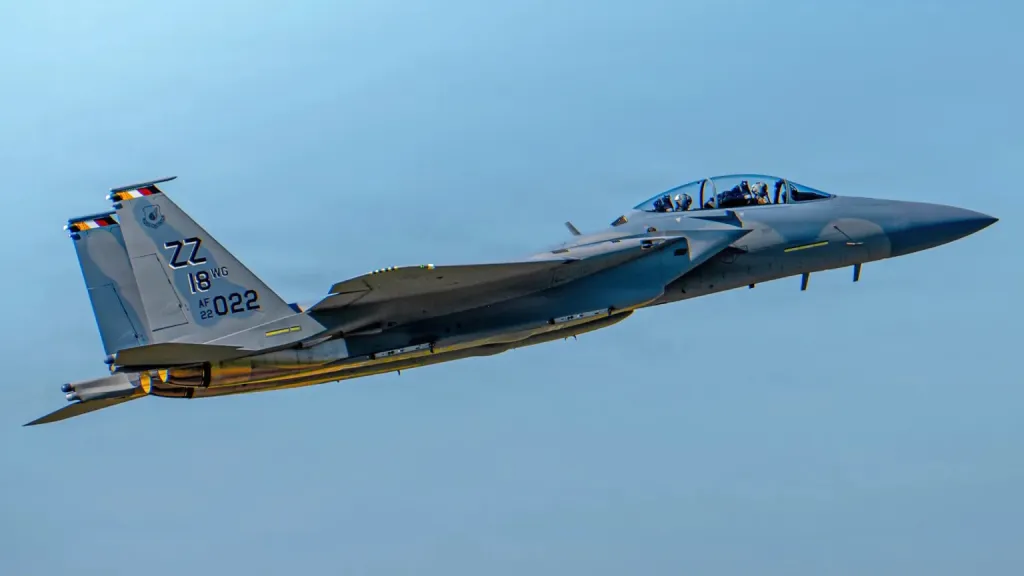
F15EX

F-15EX And Ghost Bat Team Up Over Pacific During Valiant Shield

We have long discussed the compelling case for the U.S. Air Force’s new F-15EX Eagle II to serve as a ‘drone controller’ for the service’s forthcoming Collaborative Combat Aircraft (CCA). Now, we have a first chance to see what that might look like for real, with one of the fighters operating alongside an MQ-28 Ghost Bat drone during the U.S.-led Valiant Shield 26 military exercise currently spanning the Indo-Pacific region.

The first photos of this combination were published on the official Facebook page of U.S. Pacific Command (PACAF). Taken over the Philippine Sea, PACAF says they demonstrate “the future of human-machine teaming in the theater.” The command adds: “Uncrewed systems act as a force multiplier, extending the reach and effectiveness of human pilots.”

A U.S. Air Force F-15EX Eagle II accompanies an MQ-28 Ghost Bat during the U.S.-led Valiant Shield 26 military exercise. PACAF

No further details of the extent of the integration have so far been provided, but we had already highlighted how the MQ-28’s involvement in its first multinational large-force exercise provides an opportunity for just this kind of activity, in a high-end coalition environment.

The pairing of the F-15EX and the MQ-28 — both Boeing products — has appeared regularly in the company’s renderings, suggesting that the Eagle II has been earmarked for working with CCAs.

Boeing concept artwork shows an F-15 working alongside CCAs in the form of the MQ-28 Ghost Bat drone. Boeing

As long ago as our story that broke the news that the F-15EX was in the works, we laid out how it would be an ideal platform for drone control. Key factors in this respect include its two-person cockpit, generously proportioned cockpit displays, processing power, networking, easy adaptability, and long range.

Speaking to TWZ in 2024, Maj. Aaron “Kamikaze” Eshkenazi, an F-15EX pilot assigned to the 85th Test and Evaluation Squadron “Skulls” at Eglin Air Force Base, Florida, noted:

“There’s a lot of discussion about what potential applications we might have for the back seat [in the F-15EX]. Whether it’s the existing kind of weapon system operator [WSO] role, a cyber person, or an ABM [air battle manager]. All of those options are available, and it really depends upon those mission sets as we continue to expand into the future.”

Gen. Adrian Spain, commander of Air Combat Command, right, dons a flight helmet alongside, Lt. Col. Aaron Eshkenazi, F-15EX Test Director for the 84th Test and Evaluation Squadron, before a flight at Eglin Air Force Base, Florida, March 9, 2026. As of Fiscal Year 2026, the U.S. Air Force’s current fleet of 98 F-15EX’s is slated to grow to 129. (U.S. Air Force photo by Senior Airman Christian Conrad)
Gen. Adrian Spain, commander of Air Combat Command, right, dons a flight helmet alongside Lt. Col. Aaron Eshkenazi, F-15EX Test Director for the 84th Test and Evaluation Squadron, before a flight at Eglin Air Force Base, Florida, March 9, 2026. U.S. Air Force photo by Senior Airman Christian Conrad Senior Airman Christian Conrad

While the WSO’s main role is to manage the weapon systems, as it is in the previous F-15E Strike Eagle, “We are looking at the role of the back seat [in the F-15EX] in terms of helping dictate the battlespace,” added Maj. Joshua “Viper” Judy, a WSO assigned to the 40th Flight Test Squadron, in the course of the same interview.

“Does this involve a command and control [C2] role, is it battle management, maybe a combination of things depending on the mission set — we’re talking about flying unmanned fighters out there,” Maj. Judy continued. “The whole goal of this airplane is to optimize both the front seat and the rear cockpit for whatever mission sets we’re executing as we continue to expand these roles in the future.”

At that time, CCA testing with the F-15EX was yet to begin, but Maj. Judy stressed that “from a WSO perspective, having that large area display [LAD] and customizable screens makes for much easier data synthesis compared to the F-15E with its four screens with 1980s-era monochrome. Having that additional situational awareness from the LAD and being able to customize the information that is being displayed to me is helpful in pretty much every mission set that I can fly.”

There is also the specific relevance of the F-15EX as a drone controller in the Indo-Pacific theater.

A Boeing Defence Australia’s MQ-28 Ghost Bat, a production representative test aircraft, performs a flyover during Exercise Valiant Shield 2026 over Rota, Commonwealth of the Northern Mariana Islands, June 25, 2026. Collaborative Combat Aircraft are semi-autonomous aircraft that operate under the oversight of human operators. (U.S. Air Force Senior Airman Adrien Tran)
An MQ-28 Ghost Bat performs a flyover during Exercise Valiant Shield 2026 over Rota, Commonwealth of the Northern Mariana Islands, June 25, 2026. U.S. Air Force Senior Airman Adrien Tran Senior Airman Adrien Tran

The Air Force’s future CCAs will be especially needed in the Indo-Pacific, where the Chinese People’s Liberation Army Air Force is rapidly growing in both size and capabilities.

Gen. Kenneth Wilsbach, the commander of Air Combat Command who was then-head of PACAF, said that the Air Force was “absolutely” considering fielding CCA drones at Kadena Air Base in Japan, where they would be a perfect adjunct to the co-located F-15EX fleet.

Meanwhile, having CCAs based at other locations in the region, but potentially still controlled by F-15EX fighters, would “complicate the battlespace and create chaos for your adversary,” Wilsbach added.

The decision to establish a permanent F-15EX presence in Japan likewise reflected how the aircraft’s specific capabilities are seen as hugely relevant in a potential future conflict with China.

A U.S. Air Force F-15EX Eagle II and F-15E Strike Eagles assigned to 85th Test and Evaluation Squadron, Eglin Air Force Base, Florida, land at Kadena Air Base, Japan, June 29, 2026. The test aircraft arrival supported the Department of War's effort to modernize U.S. airpower in the Indo-Pacific and prepared Kadena personnel and the local community for the F-15EX's arrival. (U.S. Air Force photo by Airman 1st Class Gracelyn Hess)
A U.S. Air Force F-15EX Eagle II and F-15E Strike Eagles assigned to 85th Test and Evaluation Squadron, Eglin Air Force Base, Florida, land at Kadena Air Base, Japan, June 29, 2026. U.S. Air Force photo by Airman 1st Class Gracelyn Hess Airman 1st Class Gracelyn Hess

A war of that kind would also see the Air Force rely heavily upon operations from austere airfields. This will be conducted under the Agile Combat Employment (ACE) concept, something that is seen as fundamental to survival in a future conflict with China.

Reflecting this, Valiant Shield saw the MQ-28 involved in a proof-of-concept Forward Arming and Refueling Point (FARP) operation for CCAs at Rota, in the Northern Mariana Islands. Photos published by the Air Force showed the MQ-28 taking part alongside Air Force HC-130J Combat King II and HH-60W Jolly Green II combat search and rescue aircraft, members of the Royal Australian Air Force (RAAF), and the Nellis-based Experimental Operations Unit.

A U.S. Air Force HH-60W Jolly Green IIs assigned to the 55th Rescue Squadron; an HC-130J Combat King II assigned to the 79th Rescue Squadron, and Boeing Defence Australia's MQ-28 Ghost Bat are shown together in Rota, Commonwealth of the Northern Mariana Islands, June 28, 2026, in support of VALIANT SHIELD 2026. Exercises like VALIANT SHIELD allow Pacific Command Joint Forces the opportunity to integrate forces from all branches of service and with our allies to conduct precise, lethal, and overwhelming multi-axis, multi-domain effects that demonstrate the strength and versatility of the joint force and our commitment to a free and open Indo-Pacific. (U.S. Air Force photo by Tech. Sgt. Tristan Truesdell)
U.S. Air Force HH-60W Jolly Green IIs assigned to the 55th Rescue Squadron; an HC-130J Combat King II assigned to the 79th Rescue Squadron, and Boeing Defence Australia’s MQ-28 Ghost Bat are shown together in Rota, Commonwealth of the Northern Mariana Islands, June 28, 2026. U.S. Air Force photo by Tech. Sgt. Tristan Truesdell Tech. Sgt. Tristan Truesdell

It should also be recalled that the Air Force’s new CCA drones are being developed from the ground up around concepts for distributed and disaggregated operations.

The Air Force has test units already set up to explore how to use CCAs operationally, including under the ACE concept of operation. These kinds of trials are now also involving the first two Air Force Increment 1 CCAs, with the YFQ-44 Fury ‘fighter drone’ prototype having been tested out of Edwards Air Force Base, California, helping to demonstrate how CCAs can be deployed and sustained in contested environments.

A YFQ-44A, part of the Air Force’s Collaborative Combat Aircraft (CCA) program, undergoes an undated captive carry test at a California test location. This test phase uses inert munitions to methodically validate weapons integration, structural performance and safety, ensuring the platform can safely carry external stores. The CCA program is a critical part of a larger, integrated system-of-systems designed to extend the reach and effectiveness of crewed aircraft, giving U.S. warfighters an overwhelming advantage in future conflicts. (Courtesy photo)
A YFQ-44A, part of the Air Force’s CCA program, undergoes an AIM-120 AMRAAM captive-carry test at a California test location. U.S. Air Force/Courtesy photo Secretary of the Air Force Publi

The new photos showing the F-15EX and MQ-28 operating together in a major multinational exercise are significant in that they provide a glimpse of how future Air Force operations will team crewed combat jets with CCA adjuncts.

There are still questions around it, however. We lack any information on whether the F-15EX was connected to the MQ-28 in Valiant Shield, and to what degree autonomous teaming software was being exercised. It could be they simply flew in formation for a photo op, or they could have been doing more extensive testing. After all, Valiant Shield is known for proof-of-concept trials of this kind.

We also don’t know whether any weapons-related missions were performed. At least one end-to-end weapons trial involving the MQ-28 has already taken place, with an AIM-120 Advanced Medium Range Air-to-Air Missile (AMRAAM) having been launched from one of the drones during Trial Kareela at RAAF Base Woomera, South Australia, late last year.

An AIM-120 AMRAAM is launched from an MQ-28A Ghost Bat during Trial Kareela at RAAF Base Woomera, South Australia. Australian Department of Defense

At the very least, this part of Valiant Shield represents an important step from the previous concept art of the F-15EX collaborating with the MQ-28 and toward operational experimentation.

The F-15EX is currently on something of a high, with the Air Force’s budget for the 2027 Fiscal Year outlining a massive boost for the program, with the planned buy now reportedly standing at 267 jets. This comes after the aircraft excelled in its Operational Test & Evaluation (DOT&E) program, as you can read about here.

As for the MQ-28, a CCA like this would be exactly the kind of system that could expand F-15EX’s sensor reach, weapons carriage, and tactical options, including via its infrared search and track (IRST) sensor, seen fitted during Valiant Shield. The drone has been flying in Australia since 2021, and the RAAF has received eight Ghost Bats in the pre-production Block 1 configuration.

A U.S. Air Force HC-130J Combat King II and Airmen assigned to the 79th Rescue Squadron, alongside members of the Royal Australian Air Force and the Nellis Air Force Base-based Experimental Operations Unit, conduct a proof-of-concept Forward Arming and Refueling Point operation for Collaborative Combat Aircraft with the MQ-28 Ghost Bat in Rota, Commonwealth of the Northern Mariana Islands, June 28, 2026, in support of VALIANT SHIELD 2026. Exercises like VALIANT SHIELD allow Pacific Command Joint Forces the opportunity to integrate forces from all branches of service and with our allies to conduct precise, lethal, and overwhelming multi-axis, multi-domain effects that demonstrate the strength and versatility of the joint force and our commitment to a free and open Indo-Pacific. (U.S. Air Force photo by Senior Airman Austin Salazar)
An MQ-28 during the proof-of-concept Forward Arming and Refueling Point at Rota, Commonwealth of the Northern Mariana Islands. U.S. Air Force photo by Senior Airman Austin Salazar Senior Airman Austin Salazar

Boeing is now building the first of a batch of nine Block 2 drones for the RAAF, which will provide a stepping stone to the fully operational Block 3 version. The Block 3 aircraft will have increased wingspan and payload, among other features. It will also have an internal weapons bay that can accommodate a single AMRAAM, two GBU-39/B Small Diameter Bombs (SDB), or equivalently sized stores.

On the U.S. side of the program, test flights of the MQ-28 have been conducted off the coast of southern California from the U.S. Navy’s base in Point Mugu. Boeing is also actively exploring potential export sales, with the Indo-Pacific having been identified as a key market.

If future testing progresses as expected, among its various roles, the F-15EX could well become an airborne command node directing multiple autonomous CCAs, greatly increasing the combat capability of each crewed aircraft and the Air Force as a whole.

Contact the author: thomas@thewarzone.com

Thomas Newdick is a staff writer at TWZ, where he covers military aviation, defense technology, weapons systems, and international security. Based in Berlin, Germany, he reports on conflicts, military modernization efforts, and emerging aerospace technologies around the world, with a particular interest in airpower and its role in contemporary warfare. His reporting is informed by deep expertise in modern and historical airpower, particularly in Europe, with a focus on military aviation, air campaigns, and aerospace developments across the continent and beyond.


Source link

F-15EX Buy Was Just Doubled By The USAF, Which Makes Perfect Sense

The U.S. Air Force’s budget for the 2027 Fiscal Year looks like it will bring a massive boost for the F-15EX program, with the planned buy now reportedly standing at 267 jets. TWZ was the first to report on the existence of what was then known as the F-15X, and has repeatedly argued in the past that investing in the Eagle II is a very logical decision for the Air Force. This is especially the case as the service looks to a future without its F-15E Strike Eagles, which have borne the brunt of combat operations for decades.

According to Breaking Defense, the Air Force’s fiscal 2027 budget, revealed yesterday, looks to buy another 24 F-15EXs at a cost of $3 billion, but this is just the start, according to the new plan. Ultimately, the service wants to more than double its previous Eagle II buy, which previously stood at 129 jets, with the total having fluctuated in recent years.

A formation of four U.S. Air Force F-15EX Eagle II fighter jets, assigned to Eglin Air Force Base, Florida, fly over the Gulf of America, Nov. 21, 2025. Secretary of the Air Force Troy Meink flew in the backseat of the lead jet as part of his visit to Eglin AFB. The flight oriented Meink to F-15EX tactics, techniques and procedures being developed and advanced by the 53d Wing to include weapons capacity, next-gen survivability, and next-generation radars, sensors and networking capabilities. (U.S. Air Force photo by Staff Sgt. Blake Wiles)
A formation of four U.S. Air Force F-15EXs assigned to Eglin Air Force Base, Florida, flies over the Gulf of Mexico. U.S. Air Force photo by Staff Sgt. Blake Wiles

The new move is primarily a response to the need to “begin to recapitalize the aging F-15E fleet,” an Air Force spokesperson told Breaking Defense.

The plan will be supported by the Trump administration’s gargantuan defense budget for fiscal 2027, which requests approximately $1.5 trillion in total funding. You can read more about this development in our previous coverage of the budget, which includes munitions, missile defense, shipbuilding, and other programs, as well as aircraft. It’s important to note that this controversial proposal still has to pass through Congress, and some changes to it will be made, at the very least.

When the budget was first rolled out, it included funding sought for another 24 F-15EXs, but didn’t include details on the dramatic change to the planned total fleet size for the aircraft.

A U.S. Air Force F-15EX Eagle II assigned to Eglin Air Force Base, Florida, flies a training mission over southeast United States, March 23, 2026. The 96th Test Wing and 53rd Wing perform developmental and operational test series on the platform including next-generation survivability, radars, sensors and networking capabilities. (U.S. Air Force photo by Staff Sgt. Blake Wiles)
An F-15EX assigned to Eglin Air Force Base, Florida, flies a training mission over the southeast United States. U.S. Air Force photo by Staff Sgt. Blake Wiles

Now, the Air Force has made clear that it wants to keep the F-15EX production line open for longer, ensuring that it will receive both fifth-generation F-35As and F-15EXs — the latest iteration of the F-15 that first entered service with the Air Force in 1976. Ultimately, a third line will spin up once the sixth-generation F-47 combat jet enters series production. As for the F-35, these are still being bought in the latest budget request, and they also get a boost, but they are not currently being delivered with radar, as the Block 4 upgrade is in limbo.

The Pentagon in its budget request says it can speed up fielding of the F-35’s Block 4 by a year, to 2030, as it increases spending on the program. This is reliant on reconciliation approvalhttps://t.co/F5NdnDxpKT

— Brian Everstine (@beverstine) April 22, 2026

Overall, the Air Force expects to see its budget increase by around a whopping 38 percent compared to fiscal 2026, to $338.8 billion. Of those funds, a significant proportion will go into procurement, driving this up by around 30 percent, although that covers all assets, and not just new fighters.

The budget also includes significant increases for weapon system sustainment and flying hours.

At the same time, the Air Force budget includes requests to retire a number of aging aircraft, something that the increased F-15EX numbers will help address.

In particular, for fiscal 2027, the Air Force wants to get rid of 20 F-15Es. These would be the oldest examples, which include the aircraft fitted with the less powerful Pratt & Whitney F100-PW-220 engines.

The F-15EX, the Air Force’s newest fighter aircraft, sits by an F-15E Strike Eagle March 11 at Eglin Air Force Base, Fla. The newly-arrived aircraft will be the first Air Force aircraft to be tested and fielded from beginning to end through combined developmental and operational tests. The 40th Flight Test Squadron and the 85th Test and Evaluation Squadron personnel are responsible for testing the aircraft. (U.S. Air Force photo/1st Lt. Karissa Rodriguez)
The F-15EX sits alongside an F-15E Strike Eagle at Eglin Air Force Base, Florida. U.S. Air Force photo/1st Lt. Karissa Rodriguez

Of course, it remains possible that lawmakers will block such a move, although having more F-15EXs to replace these jets should make it a more acceptable proposal.

Additional F-15EXs mean more capability for the Air Force.

While the F-15EX will almost certainly take on a multirole mission once it’s more established in service, the air-to-air mission is currently the priority due to the Air National Guard getting the first of these jets. These units are tasked with the homeland air sovereignty mission, which focuses on intercepting aircraft and shooting down potential barrages of cruise missiles and, now, long-range one-way attack drones. As we have outlined in the past, the F-15EX is ideal for this role, especially, and a much more reasonable proposition for this mission than a more complex fifth-generation platform:

In the homeland defense role, which is the bread and butter of the F-15C/D ANG units, the F-15EX’s payload, range, open architecture, very advanced electronic surveillance and warfare suite, and overall adaptability will be of incredible use over many decades of service. You do not need a stealth fighter to do this mission. In fact, much of what is traded in terms of reliability, performance, and sustainment cost for low observability hinders the homeland defense mission. This includes raw kinematic performance. The F-15 can get places very fast when it needs to and still has fuel left over to do something once it is there, which is critical for quick reaction alert missions.

U.S. Air Force Lt. Col. Matthew Olde, the F-15 director of programs and operations at Defense Contract Management Agency Boeing St. Louis, exits an F-15EX Eagle II aircraft at Selfridge Air National Guard Base, Michigan, June 11, 2025. Olde brought the aircraft to the base as part of a site activation task force visit, one of the initial steps to ensure that when both the F-15EX and KC-46 Pegasus missions arrive at Selfridge ANGB, the 127th Wing will be fully prepared with the right infrastructure, personnel, and support to stand them up and operate them effectively. (U.S. Air National Guard photo by Tech. Sgt. Andrew Schumann)
U.S. Air Force Lt. Col. Matthew Olde, the F-15 director of programs and operations at Defense Contract Management Agency Boeing St. Louis, exits an F-15EX at Selfridge Air National Guard Base, Michigan. U.S. Air National Guard photo by Tech. Sgt. Andrew Schumann

The customer also seems very happy with the jets.

In its 2025 annual report, the Office of the Director, Operational Test & Evaluation (DOT&E) provided an absolutely glowing assessment of the F-15EX, as you can read about here.

In terms of the air-to-air mission set, the report noted:

“Against the level of threat tested, the F-15EX is operationally effective in all its air superiority roles, including defensive and offensive counter-air against surrogate fifth-generation adversary aircraft, as well as basic air-to-ground capability against the tested threats.”

The reference to the F-15EX’s effectiveness against fifth-generation threats is especially notable. While it’s unclear exactly what kinds of threats are being referred to, a fifth-generation fighter will typically have a low-observable design, advanced ‘sensor-fused’ avionics, and generally high performance, among other attributes. In fact, very much the kind of threat that the Air Force would expect to face in a potential conflict with China.

Once the F-15EX takes on more offensive missions, it becomes even more relevant, especially as an F-15E successor, including carrying outsized payloads, among them hypersonic missiles, over long distances, which would likely be critical in a conflict in the Pacific.

But even without these offensive attributes, the Eagle II offers capabilities that are unique in the Air Force.

The F-15EX can efficiently carry 12 AIM-120s today, but that number could be nearly doubled in the futureSmaller air-to-air weapons could expand the F-15EX’s air-to-air magazine depth, too. Laser-guided rockets, now established as an F-15E weapon, would be another obvious candidate to arm the F-15EX, especially for counter-drone work.

An F-15EX fires an AIM-120D missile during a test mission near Eglin Air Force Base, Florida. The F-15EX can carry up to 12 AIM-120 missiles. U.S. Air Force photo by Tech. Sgt. John Raven

Using the F-15EX as an arsenal ship of sorts, especially when equipped with long-range missiles, in cooperation with its stealthy counterparts operating silently and forward, is a tactic, among others, we have long discussed. Equally compelling is the case for the two-seat Eagle II serving as a ‘drone controller’ for the Air Force’s forthcoming Collaborative Combat Aircraft (CCA).

Beyond all this, the F-15EX can carry a lot of payload over a long distance, to include traditional air-to-ground weapons. If the F-15EXs replace F-15Es, they will certainly have a focus on air-to-ground missions, as well.

Just as important as its capabilities and its proven airframe, the F-15EX promises to deliver a lot on the investment. The jets should provide lower operational and sustainment costs compared to both legacy and fifth-generation types, and over many decades.

In the past, Boeing told TWZ that the F-15EX has a 20,000-hour airframe service life. “This has been enabled by running a full-scale fatigue test long enough to show structure that is good beyond 20,000 hours, and structural redesigns purposely implemented by Boeing have addressed known fatigue-critical locations,” the company’s Rob Novotny explained. This is a major benefit of an extremely mature and evolved airframe. It will be able to serve for the better part of a century at common usage rates. When you amortize the unit cost over, in some cases, two and a half times the service life of most fast jets, it offers a very clear value proposition. The cost per flight hour is also well understood after decades of Eagle operations, including years of service of similar advanced variants.

The airframe life alone is key here. 20k on these! Most tactical jets are roughly around 8k then SLEP to 10k. It’s not just about the cost of acquisition, that is really a smaller factor. Operational and sustainment cost and longevity are critical factors.

— Tyler Rogoway (@Aviation_Intel) April 21, 2026

This is not the first time that planned F-15EX numbers have been boosted, after dropping to a low of just 80 aircraft with the slashing of the procurement plan in 2023.

The program was then slated to grow from 98 aircraft to 129 in the Fiscal Year 2026 budget proposal.

That decision came only weeks after President Trump made the surprise announcement that the Michigan Air National Guard, which is losing its A-10 attack jets, will be reequipped with the F-15EX.

At that point, Portland, Fresno, New Orleans, and two squadrons at Kadena Air Base in Okinawa, Japan, were slated to get the F-15EX. This plan would have required some 90 jets out of the 98-aircraft inventory. Adding Michigan, and based on those squadrons expanding to 21 jets, would require 126 aircraft. That would have left just three aircraft to satisfy test, evaluation, and training requirements.

F-15 Eagle Crew Chiefs Staff Sgts. Andrew Johnson (left) and Brian Goodman inspect their aircraft on the flight line at Kadena Air Base, Japan, on Aug. 17, 2005. Johnson and Goodman are deployed to Kadena from the 391st Fighter Squadron, Mountain Home Air Force Base, Idaho, along with approximately 300 other Idaho airmen to support Pacific Command operations. (DoD photo by Master Sgt. Val Gempis, U.S. Air Force. (Released))
F-15 Eagle Crew Chiefs inspect their aircraft on the flight line at Kadena Air Base, Japan. DoD photo by Master Sgt. Val Gempis, U.S. Air Force. (Released)

Increasing the planned buy to 267 jets opens up the possibility of creating 13 squadrons of 21 jets, with three F-15EXs left over. Exactly what final balance the Air Force decides upon remains to be seen, but whichever way you look at it, it’s a major boon for the Combat Air Forces.

It seems almost inevitable that at least some of the additional F-15EXs will be used to replace aging F-15Es.

The possibility of swapping out F-15Es for F-15EXs is something we discussed back in 2020.

In an official Justification and Approval document at the time, the Air Force stated:

“The objective of this program is to rapidly develop, integrate, and field the F-15EX weapon system to refresh/replace aging F-15C/D aircraft. A decision to also refresh F-15E aircraft has not yet been made, but remains an option.”

After four losses in Operation Epic Fury, the relatively small 215-strong Strike Eagle fleet remains in high demand with an enduring commitment in the U.S. Central Command region that leverages many impressive niche capabilities. With just six frontline Strike Eagle squadrons, at least one is always deployed. The F-15E is also capable of delivering nuclear weapons and is the first jet certified to employ the newest variant of the B61 tactical nuclear bomb.

An F-15E Strike Eagle from Mountain Home Air Force Base, Idaho, carrying a B61 Joint Test Assembly, departs Nellis Air Force Base, Nevada, for the Tonopah Test Range during DCA NucWSEP. F-15Es released B61-3 and B61-4 JTAs at the Tonopah Test Range, Nevada, to further test the F-15E’s inherent ability to deliver B61 series tactical nuclear weapons. (Courtesy Photo by Santos Torres).
An F-15E from Mountain Home Air Force Base, Idaho, carrying a B61 Joint Test Assembly, departs Nellis Air Force Base, Nevada, for the Tonopah Test Range. U.S. Air Force/Courtesy photo by Santos Torres

Replacing these critical jets is fast becoming a priority, and one that the F-15EX is uniquely suited to fulfill.

The F-15E shares similar cutting-edge technology as found in the F-15EX. It has been upgraded with the Raytheon AN/APG-82(V)1 active electronically scanned array (AESA) radar, the new Advanced Display Core Processor (ADCP) II, and it too is receiving the new Eagle Passive/Active Warning Survivability System, or EPAWSS, self-protection system.

With the F-15EX numbers outlined in its fiscal 2027 budget request, the Air Force would be well placed to replace a significant proportion of its Strike Eagle inventory.

As well as the F-15E, the Air Force needs to replace F-16s and A-10s. At least some of the planned retirements of these types could be covered by F-15EXs. Having the line healthy and warm could allow for more Eagle IIs to be bought to cover the F-15E fleet and some F-16 and A-10 retirements beyond the 267 F-15EXs currently planned. This may make even more sense as the F-16 ages and becomes more expensive to operate, in particular.

With the Air Force at large feeling the effects of years of underinvestment in new fighters, and with China presenting a massive pacing challenge, the Air National Guard is now pushing Congress to approve multiyear funding for the acquisition of between 72 and 100 new fighters each year. Again, the Eagle II could help meet this need, although there are limits to what the production line can support, especially with foreign orders.

An F-15C assigned to the 123rd Fighter Squadron, Portland Air National Guard Base, Oregon, taxis to the runway at Nellis Air Force Base, Nevada, while an F-15EX assigned to the 85th Test and Evaluation Squadron, Eglin Air Force Base, Florida, prepares to take off. U.S. Air Force photo by William R. Lewis

It remains to be seen exactly how the jets will be fielded and, as noted earlier, Congress will have to approve this budget request for it to be signed into law.

As it stands, however, the F-15EX appears to be going from strength to strength, with the Air Force increasingly enthusiastic about the latest iteration of the iconic Eagle.

Contact the author: thomas@thewarzone.com

Thomas is a defense writer and editor with over 20 years of experience covering military aerospace topics and conflicts. He’s written a number of books, edited many more, and has contributed to many of the world’s leading aviation publications. Before joining The War Zone in 2020, he was the editor of AirForces Monthly.


Source link