California’s plastic bill faces challenges from federal court and GOP attorneys general
California’s landmark single-use plastic law is slowly being eroded by pressures within the state. Now legal attacks from outside threaten to kneecap it entirely.
Earlier this month, a federal district court judge in Oregon put parts of its single-use plastic law, which is similar to California’s, on hold while he decides whether it violates antitrust and consumer protection laws.
At the same time, 10 Republican attorneys general sent letters directly to companies that are taking part in plastic reduction campaigns, telling them to stop.
They threatened legal action against Costco, Unilever, Coca-Cola and 75 other companies for participating in the Plastic Pact, the Consumer Goods Forum and the Sustainable Packaging Coalition. These efforts all include industry as an active partner in reducing plastics, but the letters say the companies are colluding against consumers “to remove products from the market without considering consumer demand, product effectiveness, or the cost and impact on consumers of a replacement product.”
Charges of corporate collusion and conspiracy are central to both cases.
Anti-waste advocates and attorneys well versed in packaging say the lawsuit and the letters to Costco and the other companies highlight vulnerabilities in several of California’s waste laws, including the seminal Senate Bill 54 — the Plastic Pollution Prevention and Packaging Producer Responsibility Act. At issue are what are known as Extended Producer Responsibility laws.
These put the cost of cleanup and waste disposal on the companies that make materials — plastic, paint or carpet — rather than on consumers, cities and municipalities.
In 2024, a report from California Atty. Gen. Rob Bonta estimated that collectively, the state’s cities spend more than $1 billion each year on litter management. In 2023, 2.9 million tons of single-use plastic (or 171.4 billion pieces) were sold or distributed, according to one state analysis.
These producer responsibility laws emphasize the idea of “circular economy”: that the producer of a material must consider its fate — making sure it can be reused or recycled, or at least reduced.
The laws organize companies into entities, called Producer Responsibility Organizations (PROs), that generally oversee the management of the laws, set fees and collect them from members.
In the Oregon lawsuit, the National Assn. of Wholesaler-Distributors alleges a state-sanctioned product responsibility organization levied fees on trade group members that were onerous and opaque.
“Their fee structure was designed in secret by board members of the PRO,” said Eric Hoplin, president and chief executive of the group.
“Oregon is attempting to build a statewide recycling system by granting vast authority to a private entity to impose what amount to hidden taxes on businesses and consumers,” said Brian Wild, chief government relations officer for the wholesalers. “This law raises prices, shields decision-making from scrutiny, and advantages large, vertically integrated companies at the expense of smaller competitors.”
The group he references, the Circular Action Alliance, is the same one that oversees California’s single-use plastic law. Amazon, Colgate-Palmolive, General Mills and Procter & Gamble are part of it.
Others, however, say California’s laws are strong.

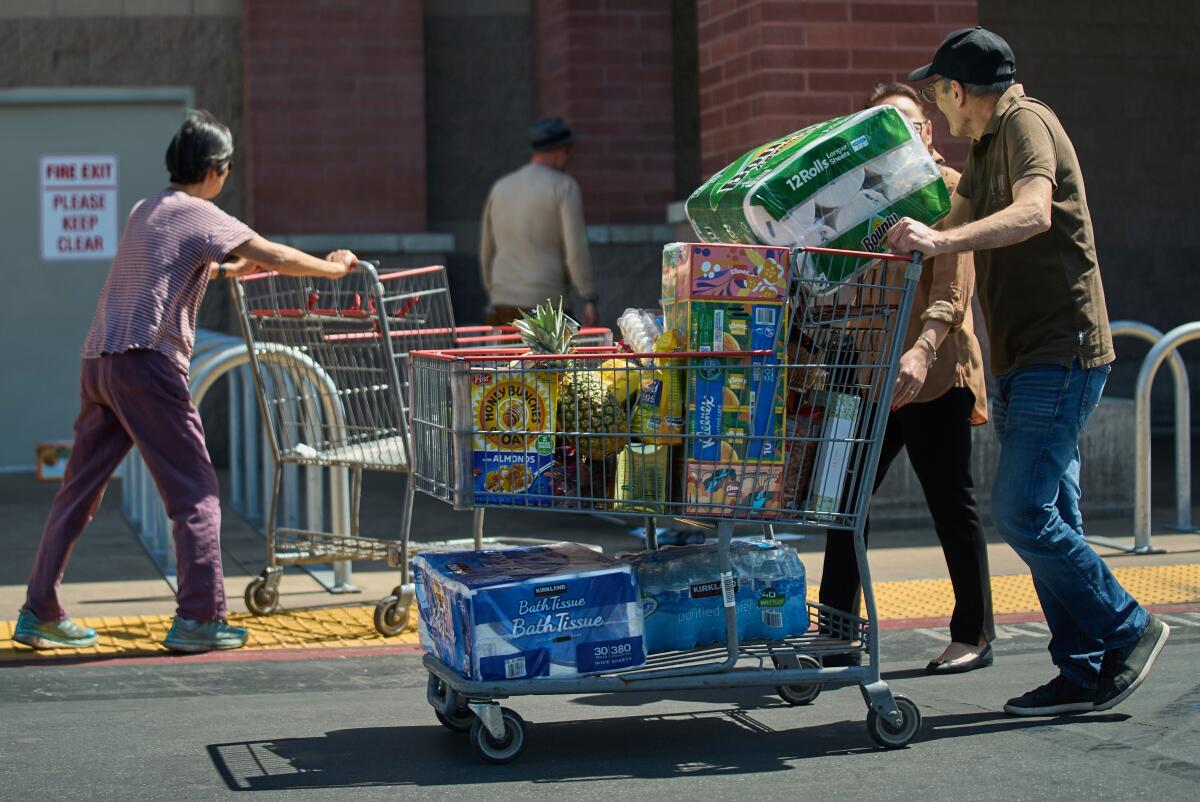
People shop at Costco in Glendale, Calif., on April 10.
(Damian Dovarganes / Associated Press)
“Extended Producer Responsibility laws are public policies passed by legislatures and implemented with government oversight,” said Heidi Sanborn, the executive director and CEO of the National Stewardship Action Council, which advocates for the laws and a more circular economy.
She helped craft many of California’s waste laws, including SB 54 and was also involved in Oregon’s law. “They create clear, consistent rules so all producers contribute fairly to the cost of recycling and waste management,” she said.
Sen. Benjamin Allen (D-Santa Monica), who wrote SB 54, said California’s plastic bill was designed to avoid violating antitrust laws.
CalRecycle declined to comment.
Some advocates actually hope the California laws fall. They include Jan Dell, of Last Beach Cleanup, an anti-plastic group based in Laguna Beach.
Extended Producer Responsibility “programs are based on the false premise that plastic is recyclable and are counterproductive because they green wash plastics and preempt proven solutions like strategic bans on the worst forms of plastic pollution (e.g. single use bags, six pack rings),” Dell wrote in an email.
Even those, however, can be problematic if they’re not enforced. Dell pointed to SB 54’s de facto ban on polystyrene, which went into effect on Jan. 1, 2025.
“There is still Styrofoam stuff sold in 250 Smart and Final stores across the state!” she said. “It is totally noncredible and outrageous to claim that CalRecycle will ever enforce regulations on thousands of types of packaging when they can’t enforce the regulations on JUST ONE!”