South Korea had 81 products that led global exports in 2024, including memory chips and face masks, a report showed Tuesday.
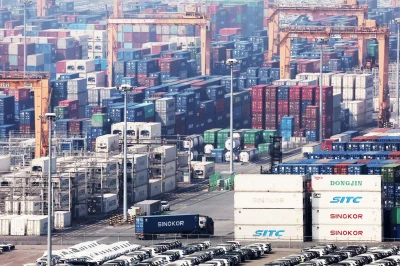
In this photo, containers are stacked at a port in Pyeongtaek on March 12. Photo by Yonhap
South Korea had 81 products that led global exports in 2024, including memory chips, solid state drives (SSDs) and face masks, a report showed Tuesday.
The report published by the Korea International Trade Association (KITA) showed that the value of 81 Korea-produced items accounted for the largest share of global export value in their respective categories.
China was at the top with 2,087 items with the largest export market share, followed by Germany at 520 items, the United States at 505, Italy at 199 and India at 156.
South Korea had 19 items ranked between second to 10th in terms of export market share, KITA said, noting the country is likely to increase its number of globally leading products in the future.
The country’s top selling items included memory chips, electrical transformers, SSDs, lead-acid starter batteries for automobiles, rubber for automotive components and sheet masks.
Notably, Korea reclaimed the top spot for memory chips from China for the first time in five years in 2024, thanks to strong demand for high bandwidth memory (HBM) and other advanced products made by Korean companies, KITA said.
In the tanker segment, Korea lost the top spot to China on the latter’s strategy of securing large volumes of low-value vessels but is expected to retake the position in 2025 on the back of the recent boom in Seoul’s liquefied natural gas (LNG) ship orders, it added.
Copyright (c) Yonhap News Agency prohibits its content from being redistributed or reprinted without consent, and forbids the content from being learned and used by artificial intelligence systems.
President Trump’s decision to strike Iran creates new risks for a significant chunk of the world’s oil supply.
The Islamic Republic itself pumps about 3.3 million barrels a day, or 3% of global output, making it the fourth-largest producer in OPEC. But the nation wields far greater influence over the world’s energy supplies because of its strategic location.
Iran sits on one side of the Strait of Hormuz, the shipping lane for about a fifth of the world’s crude from key suppliers including Saudi Arabia and Iraq. While the waterway remains open, some oil tankers were avoiding sailing through following the attacks and ships were piling up on either side of the entrance, tracking data compiled by Bloomberg show.
Oil markets are closed for the weekend, and there was no initial information on whether the attacks on Iran and the country’s retaliatory strikes across the region Saturday targeted any energy assets.
Here are the pressure points to watch in oil as events unfold.
Iran’s production
Iran produces about 3.3 million barrels of oil a day, up from less than 2 million barrels a day in 2020 despite continued international sanctions. The country has become more adept at skirting these restrictions, sending about 90% of its exports to China.
The largest oil deposits are Ahvaz and Marun and the West Karun cluster, all in Khuzestan province.
Iran’s main refinery, built at Abadan in 1912, can process more than 500,000 barrels a day. Other key plants include the Bandar Abbas and Persian Gulf Star refineries, which handle crude and condensate, a type of ultra-light oil that’s abundant in Iran. The capital, Tehran, has its own refinery.
For Iran’s overseas shipments, the Kharg Island terminal in the northern Persian Gulf is the main logistical hub. There was an explosion on the island Saturday, according to Iran’s semiofficial Mehr news agency, which didn’t provide details or make any reference to the oil terminal.
Kharg Island has numerous loading berths, jetties, remote mooring points and tens of millions of barrels of crude storage capacity. The facilities have handled export volumes exceeding 2 million barrels a day in recent years.
U.S. sanctions discourage most potential buyers of Iran’s crude, but private Chinese refiners have remained willing customers, provided they get steep discounts. For international shipments, Iran relies on a fleet of aging tankers that mostly sail with their transponders deactivated to avoid detection.
Earlier this month, Iran was rapidly filling tankers at Kharg Island, probably in an effort to get as much crude on the water and move vessels out of harm’s way in case the facility was attacked. It was a move similar to last June ahead of Israeli and U.S. attacks.
Any strike on Kharg Island would be a desperate blow for the country’s economy.
Iran’s main natural gas fields are farther to the south along the Persian Gulf coast. Facilities at Assaluyeh and Bandar Abbas process, transport and ship gas and condensate for domestic use in power generation, heating, petrochemicals and other industries.
The area is the main point for Iran’s condensate exports. During the June war, an attack on a local gas plant sparked jitters among traders, but didn’t cause a lasting spike in oil prices because it didn’t affect any export facilities.
Regional Dangers
Iran’s Supreme Leader Ayatollah Ali Khamenei warned on Feb. 1 of a “regional war” if his country was attacked by the U.S. Tehran has claimed that a full closure of the Strait of Hormuz is within its power.
It would be an extreme step that the country has never taken but remains a nightmare scenario for global markets.
Hormuz is the chokepoint for bulk of the Persian Gulf’s exports of crude and also refined fuels such as diesel and jet fuel. Qatar, one of world’s biggest liquefied natural gas exporters, also relies on the strait. At least three gas tankers going to or from Qatar had paused voyages following the latest attacks in the region, according to ship-tracking data.
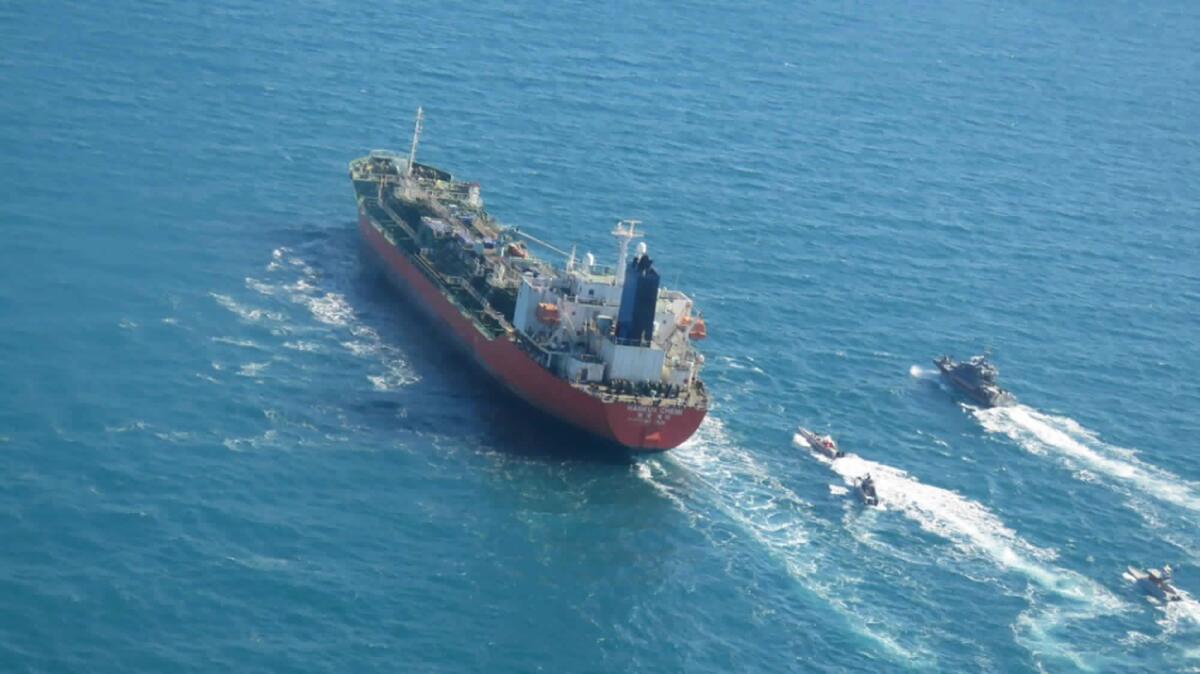
A seized South Korean-flagged tanker is escorted by Iranian Revolutionary Guard boats in the Persian Gulf’s Strait of Hormuz in January 2021. If Iran were to close the strait after the U.S.-Israel strikes Saturday, it would likely cause a massive disruption to exports and cause crude prices to spike.
(Tasnim News Agency via AP)
While OPEC members Saudi Arabia and the United Arab Emirates have some ability to reroute their shipments via pipelines that avoid Hormuz, closing the strait would still cause a massive disruption to exports and cause crude prices to spike.
There were signs that other Gulf producers were also accelerating shipments in February. Saudi Arabia’s crude shipments averaged about 7.3 million barrels a day in the first 24 days of the month, the most in almost three years. Combined flows from Iraq, Kuwait and the United Arab Emirates were set to climb almost 600,000 barrels a day from the same period in January, according to data from Vortexa Ltd.
In the past, Tehran has made retaliatory strikes on some of its neighbors’ energy assets. In 2019, Saudi Arabia blamed Tehran for a drone attack on its Abqaiq oil processing facility that halted production equivalent to about 7% of global crude supply.
Many observers say it’s improbable that Iran could keep Hormuz closed for long, making lower-impact actions like harassment of shipping more likely.
During last year’s war on Iran by Israel and the U.S., nearly 1,000 vessels a day were having their GPS signals jammed near Iran’s coast, contributing to one tanker collision. Sea mines are another long-threatened option for deterring shipping.
Market reactions
Oil surged the most in more than three years during the June war, with Brent crude rising above $80 a barrel in London. However, the gains quickly faded once it became clear that key regional oil infrastructure hadn’t been damaged.
Since then, concerns about an oversupply have dominated global markets, with crude in London ending 2025 about 18% lower than where it started.
Despite those fears of a glut, prices have surged 19% this year, partly due to fears of U.S. strikes on Iran.
With the main oil futures closed for the weekend, there’s limited insight into how traders are reacting to the latest attacks. However, a retail trading product, run by IG Group Ltd., was pricing West Texas Intermediate as high as $75.33, a gain of as much as 12% from Friday’s close.
Burkhardt and Di Paola write for Bloomberg. Bloomberg writer Julian Lee contributed to this report.