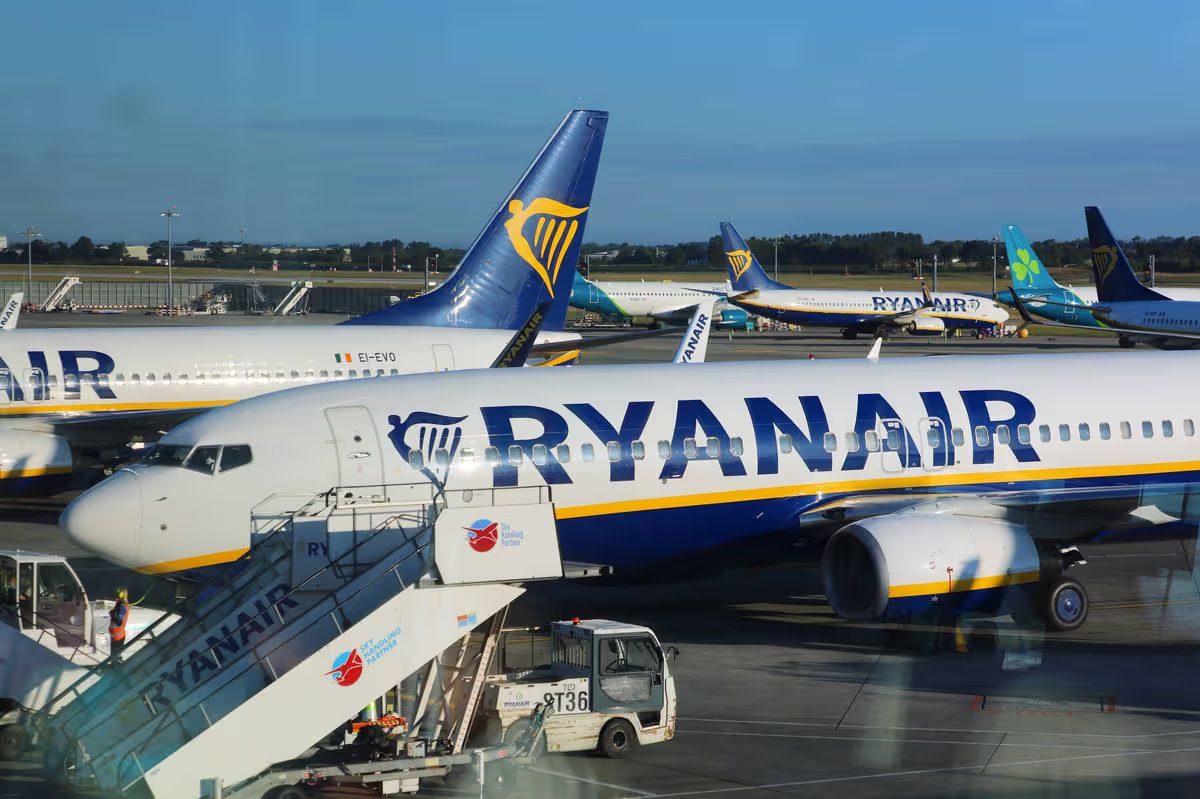
Ryanair chiefs have explained (Image: tupungato via Getty Images)
Thousands of Ryanair flights have been cancelled, with the budget carrier continuing its campaign to “keep EU skies open”.
Ryanair has set up a a petition, aimed at the European Commission, to reduce the impact of French Air Traffic Control (ATC) strikes on EU flights. The campaign has now garnered support from more than two million people, with thousands of flights scrapped – and more disrupted – in 2025 alone. In October of last year, Ryanair CEO Michael O’Leary said: “It is inexcusable that Europe’s worst performing ATCs in France, Spain, Germany and the UK continue to inflict avoidable delays and cancellations on millions of EU citizens every month.
“Despite warnings, Europe’s ATC performance is not improving, as national providers fail to properly staff and manage their operations. EU ATC needs reform and its passengers who are paying the price.
“ATC delays have already disrupted 33m citizens so far this year, with France, Spain, Germany and the UK consistently failing to staff and manage their services properly.”
The International Air Transport Association (IATA) reported last month that Air Traffic Flow Management (ATFM) delays in Europe have “grown sharply” in recent years, with this “far outpacing traffic growth”. ATFM delays, it said, “have cost airlines and passengers an estimated EUR 17.5 billion since 2015 (in 2025 prices), of which over 70% is linked to capacity shortages and staffing issues”.
The Council of the European Union said last year that “the air traffic control system is increasingly struggling to manage this growing demand”, noting that while “close coordination has been underway for many months between the European Commission and EUROCONTROL as well as ongoing planning between the EUROCONTROL Network Manager, airlines, airports, air navigation service providers and the military … resolving the issue also requires political will at the national level as each country is responsible for providing adequate air traffic services and making the necessary investments to support these services.”
Corinthians striker Memphis Depay has explained why he was using a mobile phone while on the substitutes’ bench during a Brazilian top-flight match.
The Netherlands forward was pictured by television cameras using a phone in the second half of Sunday’s 1-1 draw with Flamengo.
Depay, 32, had been taken off in the 22nd minute of the game and has said he was providing the Dutch camp with an update on his fitness before the international break.
“Just to clarify my moment with the phone was pure to communicate with the medical staff in the Netherlands at that moment,” Depay wrote on X, external.
“I came outside to show support to my team while I could’ve stayed inside the dressing room with the injury.”
Depay added that he was “upset with the result of the game” and will “keep working for better days”.
The former Manchester United and Barcelona forward, who has been capped 108 times by the Netherlands and is their record goalscorer, joined Corinthians in September 2024.
Simon Calder gave his thoughts on when travel disruption will start to ease following the strikes on Iran
13:00, 11 Mar 2026Updated 16:05, 11 Mar 2026
Travel remains severely disrupted as strikes on Iran continue
A travel expert has shared his views on when ‘people will be able to travel again’ as the Middle East conflict continues to escalate. Journalist Simon Calder, who specialises in travel, discussed the crisis and its impact on worldwide travel.
American and Israeli strikes on Iran are approaching the end of their second week, with no resolution in sight. Travel to the Middle East remains limited, with airlines cutting back on the number of flights to and from the area.
Countries such as Oman, Qatar, and the United Arab Emirates serve as vital transport hubs for destinations including Asia and Australasia. The outbreak of hostilities has left hundreds of thousands of travellers stuck.
Speaking to Sky News, Mr Calder offered his perspective on when travel might become more straightforward. He said: “We’ve already seen missiles sent to Turkey and attacks on Cyprus. Now, personally, I think the chances of anything happening to a tourist in Turkey or Cyprus are microscopically low, but I also know that people are rebooking away. They’re going to the western Mediterranean – typically Spain and Portugal – because they believe they will be safer there.
Content cannot be displayed without consent
“If you’re flying from the UK to a holiday spot such as Turkey or Cyprus and that flight is cancelled, then, fortunately, air passenger rights rules are squarely on your side. The airline that cancels the flight has to get you to your destination as soon as possible, regardless of the cost. And if you can’t get there immediately, the airline has to provide meals and accommodation, if necessary, before you are able to get to your destination.
“The Foreign Office warns against travel to Kuwait, to Bahrain, to Qatar and, crucially, to the UAE, home to the busiest hub in the world: Dubai International Airport. But I’m also predicting that, actually, that ruling is going to lift fairly quickly, and people will be able to travel again.”
Flights are still operating through Dubai International Airport, despite two Iranian drones injuring four people after exploding at the facility. The Dubai Media Office, which releases statements on behalf of the city-state’s government, confirmed flights are continuing, and that the attack caused ‘minor injuries to two Ghanaian nationals and one Bangladeshi national, and moderate injuries to one Indian national’.
Officials have been attempting to restore its flight schedule, though the airport has been targeted amid the conflict. The war has created uncertainty for travellers with flights booked in the coming weeks, prompting Mr Calder to offer his guidance on what passengers should do.
“If your flight is due to go, I’d say, a week or more from now, well, all you can do is just hope that it goes ahead,” he stated. “If you’re going imminently and you do not know if your trip is running, well, the basic news is that if you go to Abu Dhabi, to Dubai, to Doha, you will be going against Foreign Office advice. So, be aware of that; your travel insurance will be invalidated.
“I’ve got some skin in the game. I am booked to fly out on Saturday night from Jakarta, the Indonesian capital, through to Abu Dhabi and connect onwards to London. Now, at the moment, along with many, many other travellers, I’m absolutely promised the flight will go ahead as normal, and I trust that it will. But I simply do not know.
“At the moment, I’m definitely not cancelling my flight because, well, bluntly, if you cancel the flight – which is what the airlines would really like you to do – you will simply be removing yourself from the problem. If, like me, you’re booked in a few days’ time and you do have a bit of flexibility, then absolutely keep your booking open.
“If you go for a refund, first of all, the airline will be delighted because you’ll be a problem that’s removed from their cares and, secondly, you could find yourself paying three times, five times, 10 times as much to get back. Much better to remain a problem for the airline; they’ve got to get you where you need to be.”