Trump’s mail voting crackdown tests Postal Service leader who says he’s ‘not political’
WASHINGTON — Long before he was the top official at the U.S. Postal Service, David Steiner was a corporate executive surfing mid-oughts television when he came across Donald Trump on “The Apprentice.”
He was unimpressed.
“If that is leadership, if that’s what we’re telling people that our culture and our media portrays as leadership, we’re screwed,” Steiner, then the CEO of Waste Management, said during a 2007 speech at the University of Arkansas Clinton School of Public Service. “If that’s leadership, count me out.”
“And for God’s sake,” he added to laughter, “if I have to get my hair to look like that, if I have to do that to be a leader, you can definitely count me out.”
Nearly two decades later, Trump has migrated from reality television to the presidency. And onetime detractors — Vice President JD Vance, Secretary of State Marco Rubio and Sen. Ted Cruz of Texas, for example — now loyally execute his agenda.
Trump’s effort to use the Postal Service as a tool to reshape American elections is testing whether Steiner will follow a similar path.
Independent or a Trump ‘pawn’?
When Trump signed an executive order restricting mail ballots this year, Steiner moved quickly to finalize a rule implementing the measure, arguing he had little choice. But after the U.S. Supreme Court rejected the effort, Steiner told The Associated Press that work had stopped on one of the plan’s most controversial elements, a government portal for voter rolls.
He refused to endorse the Republican president’s order as sound policy, saying he was focused on implementation and letting the courts ultimately decide the matter.
“I don’t get to decide what rules that are put on us that I decide to accept or not accept,” he said. “We are an independent agency of the executive branch.”
The episode prompted fierce criticism of Steiner for allowing Trump to deploy an agency designed to be shielded from politics.
Jena Griswold, Colorado’s Democratic secretary of state, called him a “Trump lackey.” Nevada Secretary of State Cisco Aguilar, a Democrat, recently asked Congress to deploy observers to ensure postal workers can scan envelopes holding mail ballots without disruption, saying the Trump administration “has attempted to weaponize federal agencies to interfere in our elections, and the leadership at USPS is going along with it.”
Sen. Elissa Slotkin, D-Mich., accused Steiner of being a Trump “pawn” during a congressional hearing this summer. Dozens of congressional Democrats have pressed Steiner to reveal his interactions with the White House during the development of the mail ballot rule.
Some Republicans have joined in the criticism. Sen. Josh Hawley of Missouri, incensed by abandoned mail, called for Steiner’s resignation and introduced legislation to block him from receiving a bonus.
During a lengthy interview, Steiner seemed surprised at points by his reception in Washington. He insisted he wasn’t a “political person” and said he had no intention of stepping down despite the criticism. He dismissed heated congressional appearances as “theater” at odds with more substantive private interactions on Capitol Hill.
Steiner was chagrined, however, at the mention of his 2007 remarks on Trump, delivered well before he launched a political career. Steiner recalled speaking at the university but said he didn’t remember his comments, acknowledging a tendency to be “flippant.”
“That’s funny,” he said. “I don’t recall it.”
The White House didn’t respond to a request for comment on Steiner’s remarks or his stewardship of the Postal Service.
Steiner didn’t follow the traditional path to power in Trump’s Washington
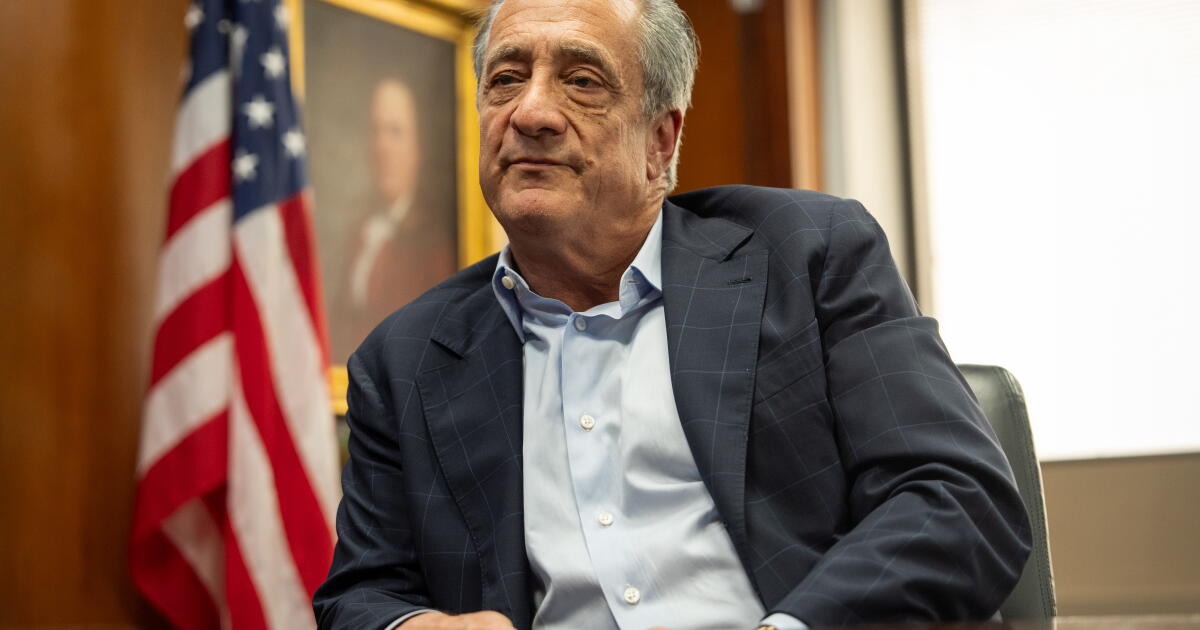
The Postal Service dates to Benjamin Franklin, the first postmaster general, whose portrait and bust are displayed in Steiner’s office overlooking the Washington Wharf. The agency has more than 630,000 employees, dwarfing many Cabinet departments.
While the quickest way to top jobs in Trump’s Washington is often by writing big checks, the 66-year-old Steiner doesn’t appear to have followed that course. He has largely donated to Republicans but also gave to John Kerry’s Democratic presidential campaign in 2004. Unlike his predecessor as postmaster general, Louis DeJoy, Steiner was not a major GOP donor or Trump backer.
Born in Oakland, California, as one of eight children to a father who spent his career at Chevron, Steiner worked in corporate and securities law before moving to Waste Management in 2000. He became CEO in 2004 and ran the company for 12 years. He was also a longtime director at FedEx, where board chairman Brad Martin recalled him as “outcome oriented” and rarely political.
“He’s going to follow the rules. He’s going to follow the law,” Martin said. “I don’t recall us ever talking politics.”
By the time a headhunter contacted Steiner about the postmaster general job, he was largely removed from daily corporate life and initially demurred.
“I talked to my wife, and we both agreed I was happily retired,” he said.
He changed his mind, he said, during a visit to the beaches of Normandy, feeling a sense of civic duty.
Now at the Postal Service, he earns about $346,000 in annual salary along with a relocation bonus that amounts to half his salary, far less than the $17 million in compensation he earned during his final year at Waste Management. His current role is designed to exist one layer removed from the political process, reporting to a board of governors that is selected by the president and confirmed by the Senate.
He was hired in 2025 by a board that was made up of five members, three of whom were Democrats. All but one were appointed by President Joe Biden. That makeup could change as four Trump nominees — all Republicans — await Senate confirmation. Steiner can be fired only by the board.
Steiner said he first met Trump along with Commerce Secretary Howard Lutnick at the board’s urging after he was already selected as postmaster general. Since then, he described a minimal relationship with the White House.
“We don’t fly on the radar,” he said.
That is, until Trump revived his effort in March to crack down on mail voting. Steiner said he “wasn’t in on the development piece” of the order and first saw it about a month before it was signed.
“They gave it to us to say, ‘Have your lawyers look at it, and how do you operationalize it?’” Steiner said.
The portal spurred a massive development effort inside the Postal Service while some states criticized it as federal overreach. A whistleblower report released by Sen. Richard Blumenthal, D-Conn., argued the system was hastily built and riddled with errors, though Steiner said he was confident it could have been unveiled around Sept. 15.
“The heavy lifting was clearly, clearly the IT work,” Steiner said.
Challenges ahead for the Postal Service
Though the Supreme Court dispensed with the rule, the dynamics for the Postal Service don’t get easier.
The agency posted a $9 billion net loss last year, and Steiner has warned it could soon run out of cash unless Congress lifts a $15 billion borrowing cap. Political hurdles have prevented potential cost savings from cutting service or closing some post offices.
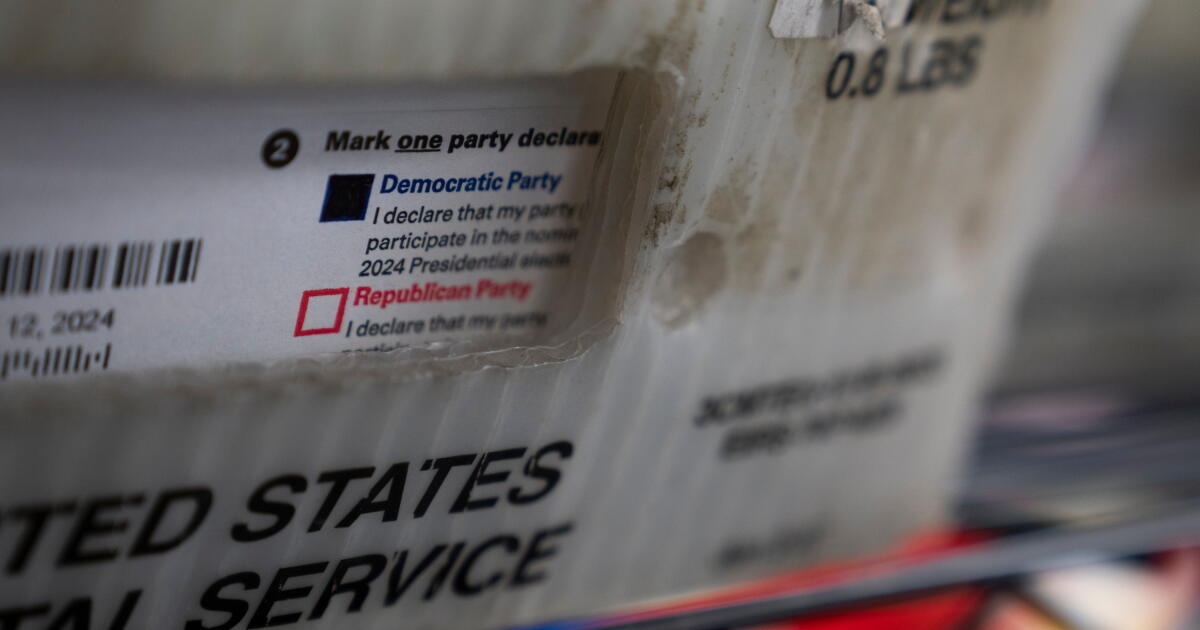
And while Trump’s executive order won’t take effect, the Postal Service will still play a critical role in this year’s elections. There are mounting concerns that mail ballots could be rejected for late postmarks. Steiner encouraged voters to get their ballots in a week before the election to avoid problems.
The Postal Service is a rare corner of government still viewed favorably with more than half of Americans, 56%, saying it was doing an “excellent” or “good” job in a Gallup poll conducted last year. That could change if the agency is seen as increasingly political.
Steiner, however, said Americans will judge the Postal Service by their experience of it.
“What they care about is when they get that wedding invitation after the wedding or when they send a package and it disappears,” he said. “If we want to have the trust of the American public, let’s be the best service provider. Everything else is noise.”
Sloan writes for the Associated Press.