Amid bets on elections, L.A. officials weigh how to safeguard voters
Los Angeles County election officials are examining steps ahead of the November midterms to respond to the rising popularity of election trading via prediction markets, including a possible ban on wagering for county election workers.
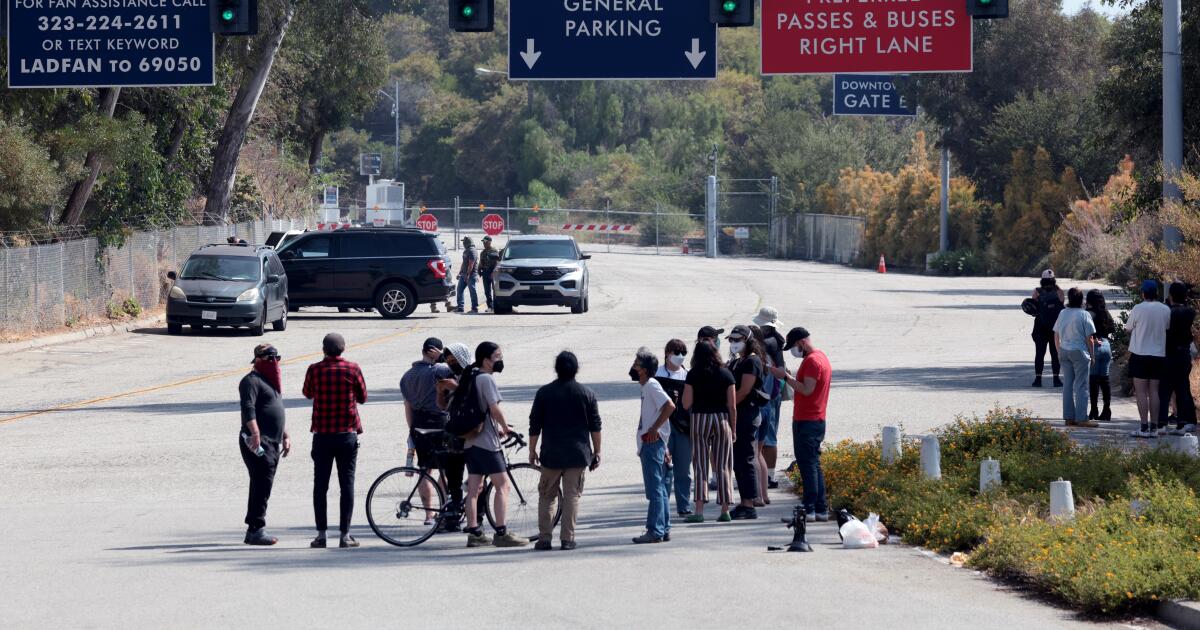
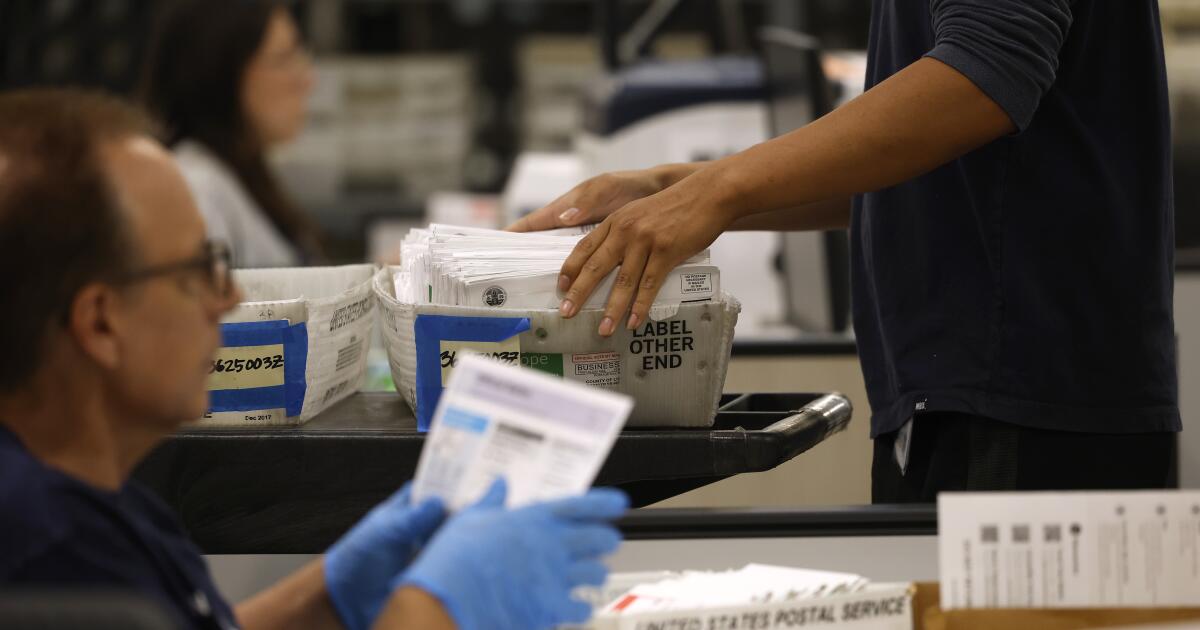
The discussions follow a fracas during the June ballot count, when a handful of influencers suggested fraud could be occurring in L.A.’s mayoral primary because the results began diverging from the market’s prediction.
That incident, the most prominent interaction of prediction markets and a U.S. election to date, revealed a new dynamic in the battle for public trust in elections. Now, election administrators around the country are considering the possible implications of the markets’ forecasts, including whether they have the power to affect voter confidence in election results.
“We’re … trying to find our way in this,” L.A. County Registrar-Recorder Dean Logan said in an interview. “It’s opened up a lot of questions that we’re grappling with.”
Three months before the midterms, with much of the American public concerned about democracy and trust in elections dropping, officials are paying attention to anything that could create further uncertainty around how elections are run.
The midterm contests are high stakes for both parties, which are battling for control of Congress amid a difficult economy, the war in Iran and low approval ratings for President Trump. And many Americans are wagering on what might happen — users have traded nearly $200 million on the midterm elections so far, a July analysis by NBC News found.
Prediction market platforms and their proponents say trading contracts on the markets is not the same as betting, likening it instead to trading on the stock market. Critics say it amounts to gambling, regardless of how the markets are set up.
The timeline for election administrators to think through the issue before November is tight, and it poses challenges for offices that already are stretched thin preparing for other possible election-day scenarios. What happened during the L.A. mayoral primary, however, has prompted discussions around the country, said Carolina Lopez, executive director of the Partnership for Large Election Jurisdictions, or PLEJ, a nonpartisan organization that represents election administrators.
“The potential effect on confidence [in elections] is significant,” Lopez said.
A spokesperson for Kalshi, one of the leading trading platforms, said the platform bans insider trading and welcomes any policy measures doing the same. The company takes “seriously our responsibility to be a responsible actor in this space,” spokesperson Jacki McGavick said.
Los Angeles could become one of the first major election jurisdictions to implement guidance or policy related to prediction markets. Delaware County, Pa., in suburban Philadelphia, already has taken such a step — adding prediction markets to an oath poll workers already were required to sign affirming that they have not wagered on the election.
Last month, Maryland’s top election official asked the state prosecutor to open an investigation into the legality of prediction markets. In late July, Wisconsin’s election administrator warned voters that it is illegal under state law to both vote in and bet on an election. That drew swift attacks from executives at Kalshi, one of whom claimed the state would “disenfranchise voters who use Kalshi.”
In L.A. County, Logan said his office is in the research stage for an insider-trading policy for staff. His office also is creating public messaging to deploy in various scenarios and factoring the potential dynamics around prediction markets into security planning.
Any potential for unrest or protests related to people’s monitoring of market forecasts is likely to come in the days following the election, while ballots still are being counted, Logan said.
Elections staff also is preparing FAQ documents about prediction markets and discussing how to talk about the issue with reporters, gaming out different scenarios, he said.
Orange County Registrar of Voters Bob Page said he advised his office’s staff before the primary, and plans to do so again before November, that participating in election markets could create a conflict of interest prohibited by county code. Staff betting could been seen by the public “as improper,” Page said he told his staff, “ which would undermine trust in the integrity of the election.”
Thirty-nine percent of likely midterm voters in a recent survey commissioned by PLEJ said their confidence in an election outcome would be reduced if the official result differed from prediction market odds. Three-quarters of those surveyed said they believed prediction markets create confusion around elections.
A majority was unable to correctly identify what prediction market odds represent, according to the survey results, with more than a third believing they showed the current number of votes for each candidate or an official projection from election officials.
The rise of the exchanges, which allow users to stake money on the chance that a given event will happen in the future, has provided a way to create predictions that some experts say are more accurate than political polling.
Leaders of the platforms have suggested they can help combat election misinformation by providing predictive insights and help decision-makers understand public sentiment. Kalshi launched what it termed a “midterms hub” late last month, which it said would contain not only market forecasts but also news, polling and fundraising data.
“Election markets have been my dream since the start of Kalshi,” Luana Lopes Lara, a co-founder of the platform, said on social media upon the hub launch. “The holy grail of prediction markets, they shed light on some of the most consequential, decentralized and human processes in the world, where good data is crucial and hard to find.”
She added: “It’s changed the way I interacted with the electoral process and made me smarter — I hope it does the same to you.”
McGavick, the spokesperson, said about 75% of Kalshi visitors view the odds without buying anything in order to understand what “the crowd forecasts.”
“Kalshi has become a leading indicator of where elections are headed,” she said.
As users trade contracts — each one representing a bet for or against a given event, such as a certain candidate winning an election — the market generates odds. On Tuesday, for instance, L.A. Mayor Karen Bass had a 61% chance of winning in November on Kalshi, while City Council member Nithya Raman had a 39% chance.
Either Bass or Raman could win, but if the public’s understanding of the markets is murky, experts say, voters may confuse their speculation for certainty.
In June, the market odds appeared to drive some public belief about what the results would be, Logan told reporters at a briefing last month — in this case, that Republican Spencer Pratt would be one of the top-two vote-getters, which ultimately did not happen.
“That put us in a position as election officials of having to respond to a whole new layer of misinformation,” Logan said. “Not only were we being asked how were the polls wrong … but [people were saying], ‘We saw numbers’ or ‘We saw odds.’”
Experts worry it could become more common for market odds to be cited by people who are dissatisfied with an election result as a new way to attempt to discredit a ballot count, adding a new quiver in the bow of election deniers and potentially confusing the public.
The existence of prediction markets “provides one more source of information” that could be used by bad actors to stir up confusion or distrust in election results, said Mindy Romero, executive director of the California-based nonpartisan Center for Inclusive Democracy.
“People might think … prediction markets are a good thing or a bad thing,” Romero said, “but you can’t deny that it is one more thing that could potentially be manipulated.”
Separately, prediction markets have drawn the attention of lawmakers in Congress for various reasons, including fears of insider trading. Members of both parties have proposed guardrail legislation this year. Several states are locked in legal battles with the federal government over whether they can regulate the markets under state anti-gambling laws.
Last week, as destructive wildfires raged in Washington, Oregon, California and elsewhere, California Sens. Adam Schiff and Alex Padilla joined with other Democratic senators from western states to urge the Commodity Futures Trading Commission to restrict the markets from offering betting on wildfires. They cited concerns that people could be tempted to influence fires or commit arson in order to “make sure their bets are successful.”
Schiff introduced a bill to prohibit such trading in March. Kalshi has a ban on markets tied directly to death and war. Kalshi and the other leading platform, Polymarket, also regularly report suspected insider trading to the federal government for investigation. Last month, federal investigators alleged that Trump’s teleprompter operator had used inside knowledge to win more than $100,000 after Kalshi spotted his activity.
In Los Angeles, Logan said his office may issue guidance by November, but the task will extend beyond the next election day.
“What we want to do is defend against anything that would devalue the elections process,” Logan said. “We don’t want voters to be discouraged from participating.”