exceeds

South Korea’s elderly population exceeds 20% for first time

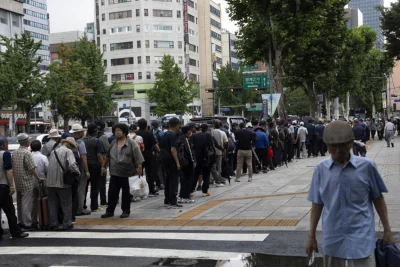
Elderly people line up to receive free meals outside the Tapgol Park in Seoul, South Korea, 10 July 2026. According to the Ministry of the Interior and Statistics, the proportion of Seoul’s 9.3 million residents aged 65 or older has exceeded 20 percent, and it is projected that one in three Seoul residents will be 65 or older by 2040. JEON HEON-KYUN/ EPA

July 28 (Asia Today) — South Korea’s elderly population exceeded 20% of the country’s total population for the first time in 2025, while the share of working-age residents fell below 70%, government data showed Tuesday.

The figures illustrate the accelerating transformation of South Korea’s population as low birth rates and rapid aging reduce the number of children and economically active adults.

South Korea’s total population stood at 51.817 million as of Nov. 1, up 12,000, or 0.02%, from a year earlier, according to the 2025 Population and Housing Census released by the National Data Agency.

The number of South Korean nationals declined by 50,000, but the foreign population increased by 70,000, preventing the country’s total population from falling.

Population growth has continued to slow. After declining in 2021 and 2022 during the COVID-19 pandemic, the population increased 0.2% in 2023 and 0.1% in 2024. Growth slowed to 0.02% in 2025.

The number of South Korean nationals has fallen for five consecutive years since 2021, largely because of the country’s persistently low birth rate.

The foreign population rose 3.2% to 2.11 million, driven partly by increases in international students and seasonal workers. Foreign residents accounted for 4.1% of the total population.

Elderly population rises sharply

The number of people age 65 and older increased by 601,000, or 5.9%, to 10.723 million.

Older residents accounted for 20.7% of the population, exceeding the 20% threshold for the first time.

A country is generally classified as a super-aged society when at least 20% of its population is age 65 or older.

By comparison, the population age 14 and younger fell by 196,000 to 5.225 million, representing 10.1% of the total.

The number of older residents was more than twice the number of children.

South Korea’s working-age population, defined as people ages 15 to 64, decreased by 393,000 to 35.87 million.

The group accounted for 69.2% of the population, falling below 70% for the first time since the current census series began in 2015.

The decline could increase pressure on South Korea’s labor market, pension system and healthcare services as fewer working-age people support a growing elderly population.

People in their 50s were the country’s largest age group, accounting for 16.7% of the population. Those in their 60s represented 15.3%, followed by people in their 40s at 14.8%.

South Korea’s median age rose 0.6 year to 46.8.

Nearly 3 in 10 adults unmarried

The census also showed continuing changes in South Korea’s marriage patterns.

Of the country’s 43.234 million South Korean nationals age 18 or older, 12.789 million, or 29.6%, had never married.

The number of unmarried adults increased by 54,000, or 0.4%, from a year earlier.

The never-married rate among people in their 30s stood at 54.7%, meaning more than half of South Koreans in that age group had not married.

Among people in their 40s, the rate was 21.9%.

Seoul recorded the country’s highest never-married rate at 37.1%, while South Jeolla Province had the lowest at 22.2%.

— Reported by Asia Today; translated by UPI

© Asia Today. Unauthorized reproduction or redistribution prohibited.

Original Korean report: https://www.asiatoday.co.kr/kn/view.php?key=20260728010010244

Source link

Trade turnover in Eurasian Economic Union exceeds €80 billion last year

Eurasian Economic Union (EAEU) countries are moving towards deeper economic integration through digitisation and AI, as leaders of the bloc met in Astana for a two-day summit.


ADVERTISEMENT


ADVERTISEMENT

During the high-level talks, member states discussed creating a unified digital environment to build a seamless market across a shared economic space of more than 20 million square kilometres.

Delegations focused on trade, joint projects and the development of shared digital tools and AI systems designed to strengthen cooperation and reduce fragmentation across the bloc.

Last year, trade within the union more than doubled, while turnover with third countries rose by 72%, while around 90% of settlements are now conducted in national currencies, as EAEU states also mull a single transit system.

With digitisation driving developments across the union, Kazakhstan’s President Kassym-Jomart Tokayev said trade turnover between EAEU members could increase by around 6%, exceeding €85 billion this year, compared with €80 billion last year.

He added that GDP growth across EAEU countries is projected at around 2.5% for 2026–2027.

Now in its 12th year, the EAEU functions as a single integrated market and free trade zone for its five members – Russia, Belarus, Kazakhstan, Kyrgyzstan and Armenia.

The bloc already has agreements in place with a number of countries including Serbia, Vietnam, the UAE, Mongolia and Indonesia. China remains the bloc’s key partner, accounting for around one-third of external trade.

Integration through AI

Kazakhstan’s Tokayev said that during its chairmanship of the EAEU, the country has proposed the practical use of AI to help implement the bloc’s so-called four freedoms, with the aim of strengthening the competitiveness of member states.

Member states also proposed developing common principles for the responsible use of AI, as well as shared computing capacity and joint model development.

Meanwhile, Russia proposed a high-level AI get-together next year to further cooperation on domestic AI models and connecting its IT and energy infrastructure, according to Russian President Vladimir Putin.

On the ground, pilot projects are already being tested at the EAEU level.

In Kazakhstan, several AI-powered digital assistants have been developed by both government agencies and startups to help citizens navigate legal and regulatory systems more easily.

According to Deputy Minister of Artificial Intelligence and Digital Development Dmitry Mun, these AI legal assistants are designed to simplify legislation, reduce bureaucracy, and make regulatory systems more accessible for citizens and businesses.

Some of these tools are now being tested to streamline processes across member states.

Trade corridors and logistics modernisation

Around 85% of goods travelling from China to Europe are routed through the Middle Corridor, according to officials.

Artificial intelligence is increasingly being deployed alongside the TDN and the Digital Transport Corridor along the Trans-Caspian International Transport Route. Together, these measures are expected to increase non-commodity exports by around 30% over the next two years.

Kazakhstan’s Minister of Trade and Integration Arman Shakkaliyev said the country also aims to leverage major transport routes, including the Middle Corridor and the North–South Corridor, to build a fully integrated logistics ecosystem.

The goal, he said, is to position Kazakhstan as a key regional hub where transport routes converge and large export flows are consolidated.

The ambition is to develop a fully functioning system by 2030, with cargo volumes reaching around 10 million tonnes. Work is already under way, including railway modernisation and new infrastructure development.

Putin visit and bilateral agreements

The summit followed Putin’s state visit to Kazakhstan, during which the two countries signed seven key pillars of bilateral cooperation, along with a broader package of agreements covering energy, transport, finance, education and industrial development.

Russia remains Kazakhstan’s largest investor, with nearly €25 billion already invested and plans to increase that figure further. It is also building Kazakhstan’s first nuclear power plant, valued at around €14 billion.

Putin said the plant would account for around 20% of Kazakhstan’s electricity consumption, adding that financing conditions for such projects are in line with international practice.

He noted that the project supports Russian industrial capacity through equipment orders and long-term maintenance contracts, while also strengthening cooperation between the two countries in uranium and nuclear technology.

For Kazakhstan, officials say the project represents both energy security and a step towards moving beyond raw-material exports to high-value technological cooperation.

Source link