Ex-Bolivian President Evo Morales accuses U.S. of fueling unrest

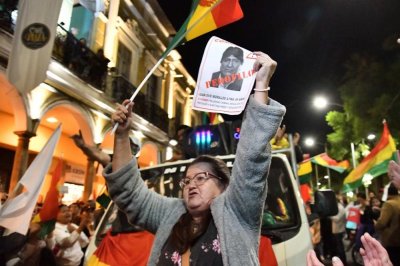
Citizens from various sectors in at least five regional capitals across Bolivia took to the streets Thursday to demand an end to the roadblocks organized by peasant unions and groups aligned with former Bolivian President Evo Morales, who are calling for the resignation of the Bolivian President Rodrigo Paz. Photo by Jorge Abrego/EPA
May 22 (UPI) — Former Bolivian President Evo Morales accused the United States of backing the government of President Rodrigo Paz and attempting to criminalize the protests shaking Bolivia.
“The United States does not defend democracy or respect international law. It finances right-wing coups. It invades countries and steals their natural resources,” Morales wrote in a message Thursday on X.
Officials from the Bolivian identified Morales as the main instigator behind the wave of protests and road blockades demanding the president’s resignation.
The historic leader of the Movement Toward Socialism party, who is entrenched in the coca-growing Chapare region, was declared in contempt by a Bolivian court this month after failing to appear at a hearing linked to a human trafficking case.
The former president was responding to a message published by Secretary of State Marco Rubio on X in which Rubiol said the United States would not allow “criminals and drug traffickers” to overthrow democratically elected governments in the hemisphere.
Morales called the remarks “a lie” and accused Washington of supporting the 2019 ouster to gain control of Bolivia’s lithium reserves.
“The United States supported the coup by the gringo against the Indigenous man in 2019 in order to seize our lithium,” he said.
In another message published on X, Morales also questioned Paz’s political legitimacy by claiming he was born in Spain, and he accused the president of “criminalizing” and “repressing” Indigenous people, farmers and students participating in the protests.
“Because he is a foreigner, he surely hates Bolivians. He criminalizes, persecutes and represses Indigenous people. He thinks and acts like an imperialist, neoliberal and neocolonial ruler,” Morales wrote.
In an interview this week with La Octava Radio Nacional, Morales called for early elections within 90 days to “pacify Bolivia,” arguing the country is facing a governance crisis.
Morales’ remarks came as Bolivia entered its third week of protests, road blockades and demonstrations led by unions, farming organizations and Indigenous groups rejecting the government’s economic reforms and denouncing fuel shortages, inflation and economic deterioration, according to reports by Bolivian media outlets La Razón and Los Tiempos.
The crisis has also begun to affect the healthcare system. Bolivia’s Health Ministry said at least four people died in recent days because they were unable to receive medical treatment or be transferred in time to healthcare centers due to road blockades and unrest in different parts of the country.
Among the victims was a 12-year-old boy, who died while being transported in an ambulance after the vehicle was unable to pass through blocked roads.
“We are calling for a humanitarian corridor,” the ministry said, according to reports by Infobae.
The Bolivian Highway Administration reported Friday that 51 road blockades were active across seven of the country’s nine departments, most of them concentrated in the highland region, including the departments of La Paz, Oruro and Cochabamba.