Halloween season is arguably the most festive time of year in Los Angeles. Is it any wonder that a city that favors make-believe would take to a holiday that inspires elaborate set dressings and creative costumes, the latter a chance to take on a role other than ourselves?
Likely not, and whether you lean spooky or playful, the days and weeks leading up to Oct. 31 are filled with events, often with no costume necessary. Consider October an excuse to throw a massive, fall-related bash.
This season there are returning staples, such as “Carved” at Descanso Gardens and Universal Studios Hollywood’s Halloween Horror Nights, but also opportunities to explore Halloween’s campier side. Our penchant for the theatrical is well represented, and even newer Los Angeles institutions such as the Academy Museum are getting in on the autumnal fun.
Whether you’re seeking an event to charm or to inspire frights, there’s plenty our region has to offer.
“Cartoon Network was better than Disney Channel and Nickelodeon.”
“Men should be required to get a vasectomy after a certain amount of baby mamas.”
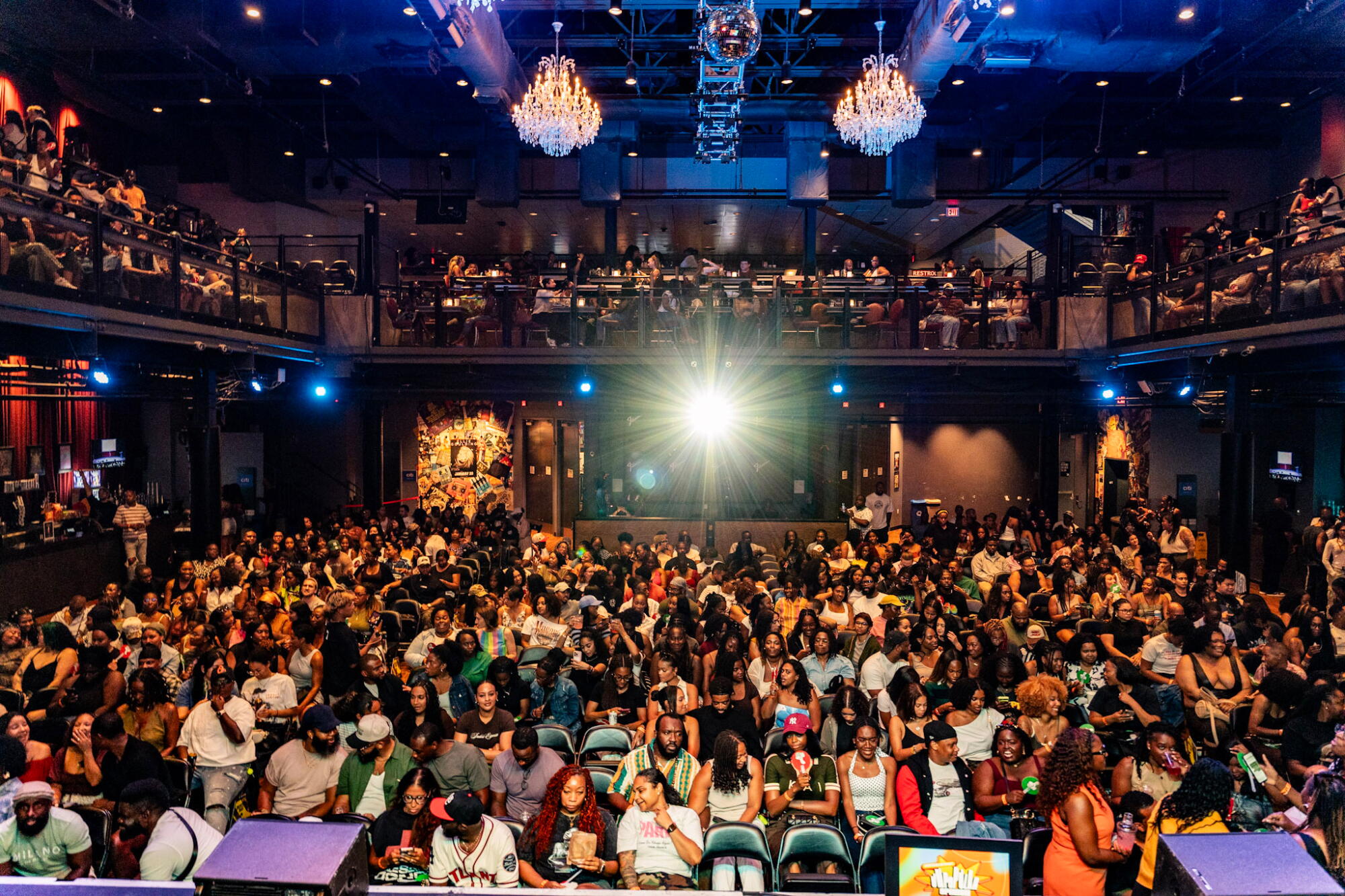
These are just some of the bold, controversial statements that have come up at “Unpopular Opinion,” a live, interactive event where people share and defend their hot takes in front of a spirited audience. To support their claims, they present slide decks filled with graphics and memes on a giant screen. Those in the crowd gasp, cheer and laugh.
The crowd from a past “Unpopular Opinion” event. The viral series is coming to the Regent Theater in L.A.
(Quest Hollis / SideQuest Visuals)
The event was created by Chance Albury and Sarah Prince, founders of the Washington, D.C.-based experiential production company Something Different. People were already having these types of impassioned conversations online, Albury says, and they simply wanted to provide that space in real life.
They debuted the series in February, and after recaps of events went viral, they decided to take it on tour. “Unpopular Opinion” makes a stop in Los Angeles on Thursday at the Regent Theater.
“Who knew rage-baiting could be such a unifier?” Albury says.
“Everyone loves to argue,” Prince adds.
Albury says that the success of the show relies on having different perspectives and opinions in the room. The slide decks are also a major draw. Unpopular Opinion is one of several events that takes PowerPoint-style presentations out of their traditional setting — the office or the classroom — and puts them front and center in a social scene. Over the last few years, slide decks have shown up at house parties, matchmaking events and even in bars at gatherings like Lectures on Tap.
Anyone who wants to present can submit their hot take through an application form. Albury and Prince receive roughly 50 submissions for each event, but only about seven to nine are selected.
Presenters defend their hottest takes on stage using slides and passion.
(Quest Hollis / SideQuest Visuals)
“There’s just so many topics that you can talk about so it can’t get old,” says Prince, adding that a lot of the speakers are funny and present like stand-up comedians.
Typically hosted at a live music venue, the vibe of “Unpopular Opinion” feels like a boisterous late-night game show. Drinks are available for purchase at the bar. A live DJ plays a mix of hip-hop, pop and other high-energy genres as a host hypes up the crowd. As an icebreaker, audience members are asked to submit their own unpopular opinions to be displayed on the screen for everyone to see.
Then the main event begins. Presenters are given 10 minutes to make their case. Unlike a traditional debate tournament, audience members are encouraged to get involved and make their thoughts known.
“There’s just so many topics that you can talk about so it can’t get old,” says co-founder Sarah Prince.
(Quest Hollis / SideQuest Visuals)
After each pitch, the host asks audience members to hold up their paddle, which has a green thumbs up and a red thumbs down to indicate whether they agree or disagree. Then a mic is passed around so attendees can share their thoughts or rebuttals.
Though the event is called “Unpopular Opinion,” there are times when the majority of the crowd agrees with the presenter. There are also times when the audience strongly disagrees. In either case, Albury and Prince ask that attendees are respectful to one another.
The presentation topics range drastically, from lighthearted social media discourse (“Women standing behind the DJ booth is more embarrassing than men”) to hot-button dating debates (“Splitting the bill on the first date is fine”) to deeper societal issues (“People hate everything about slavery but Christianity”).
Albury and Prince say they are exploring ways to bring “Unpopular Opinion” “beyond the show doors” for those who can’t make it to a live event. They already post man-on-the-street-style interviews on social media, in which they ask people to weigh in on hot button questions.
Albury says the beauty of “Unpopular Opinion” is that it shows people it’s OK to disagree. “Just because we have different opinions doesn’t mean we can’t talk about it,” she says. “We may not even come to terms on agreeing or disagreeing, but we’ve got that space.”
‘Unpopular Opinion,’ hosted by Something Different
When: Oct. 1. Doors open at 7 p.m. and showtime is at 8 p.m. Where: Regent Theater, 448 S. Main St., Los Angeles Info: Tickets start at $48.60 (including fees). Must be 21+ to enter.
Academy Award-winning filmmaker Alejandro González Iñárritu and Pop artist Ed Ruscha have a long history of admiring each other’s work. Twenty-four years ago, a nervous Iñárritu visited Ruscha’s Venice studio to offer him the role of the gynecologist in “21 Grams.” They needed a doctor with noble features and blue, believable eyes. That plan didn’t pan out, schedule-wise, but the filmmaker and the artist finally found a way to collaborate.
The result — a Ruscha-designed poster for Iñárritu’s new film “Digger,” starring Tom Cruise — was unveiled Sunday at an intimate brunch at the Los Angeles County Museum of Art, attended by Iñárritu, Ruscha and Cruise, as well as “Digger” actors John Goodman, Jesse Plemons, Michael Stuhlbarg and Ross Hatt.
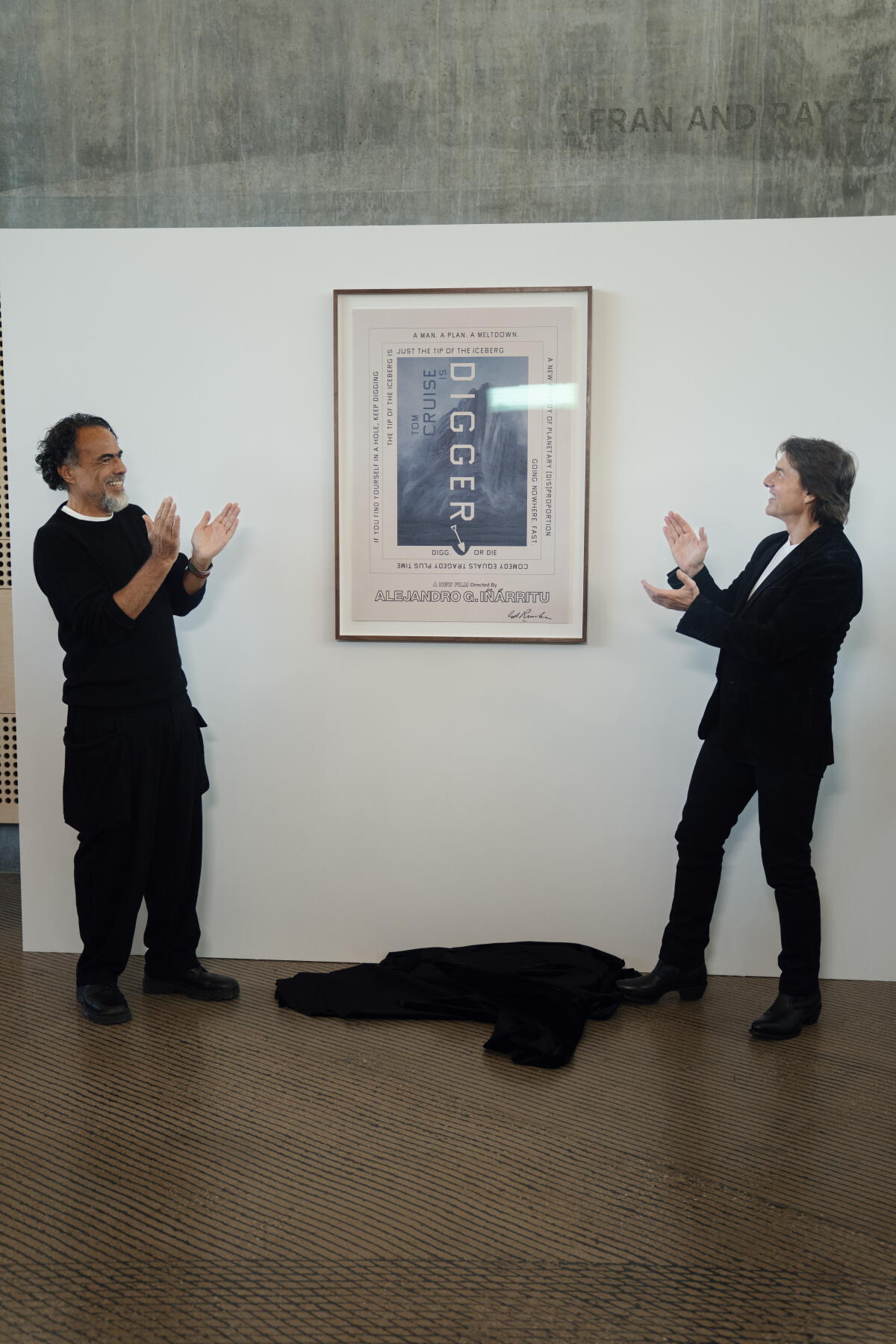
Iñárritu and Cruise laughed as they made a clumsy attempt at a countdown before whipping aside a black velvet curtain to reveal the poster for the first time: a very Ruscha, text-heavy work on a slate gray background with a beige border. A looming ice shelf in the background is surrounded by phrases including, “A Man. A Plan. A Meltdown,” and “Comedy equals tragedy plus time.”
Filmmaker Alejandro Iñárritu and “Digger” star Tom Cruise unveil Ed Ruscha’s new poster for the film. (They just pulled off the black velvet curtain on the floor below.)
(Kevin Garrison)
“Well, the movie blew my hair back,” Ruscha said at the unveiling brunch inside LACMA’s new (still unopened) restaurant, with LACMA Director and Chief Executive Michael Govan by his side. “And not only that, it parted it down the middle. It has since grown back.”
The crowd laughed knowingly. “Digger,” which opens Friday, is a satirical black comedy that follows oil tycoon Digger Rockwell as one of his drilling rigs in Greenland explodes, dislodging an ice shelf that floats away to cause a global disaster. As a dark parable for the dangers of climate change, the film has already proved polarizing, with early reviews coming in mixed.
Ruscha noted that he first saw “Digger” at a screening about six months ago, alongside Govan. “I knew I had seen an epic production, an epic product from an epic producer,” Ruscha said. “So I jumped at the idea of doing the poster. And I thought about it, and I think about this movie, and it reminded me of a kaleidoscope. It’s got so many running-around ideas. It was kaleidoscopic in its message, and its content and its humor.”
Ruscha turned his attention to Iñárritu, “It’s got something to offer to the world, and I thank you for that.”
The filmmaker loved the poster, and the fact that the ice shelf sat front and center.
From left to right — “Digger” actors John Goodman and Jesse Plemons, filmmaker Alejandro G. Iñárritu, artist Ed Ruscha, actor Tom Cruise, LACMA director Michael Govan and actors Ross Hatt and Michael Stuhlbarg — pose with Ruscha’s new poster for the film.
(David Jon)
“The billing is nature: We are human beings, we are in a war against nature,” Iñárritu said — describing what he feels the poster relays — in a phone interview from Mexico City a day before the event. “We think that we are different from nature. So nature, in a way, becomes our enemy. We are fighting a fight against nature, and the enemy is an ice shelf going to Europe. And he just put [that] in the center of it, [like] a disaster movie, which is very clever, as he always is.”
“Those decisions that he made with a very prominent element in a simple way, with one or two words, it just says so much with so little,” Iñárritu continued. “And then he [put] some lines around [it], very Ruscha, that in a way convey the spine or the character itself.”
The director had the same feelings two years ago, at LACMA’s Ruscha retrospective. He said so much with so little, Iñárritu thought, and that “less is more” thinking could hold so much power in a film poster.
Iñárritu, too, has been exhibited at LACMA: earlier this year, with the film installation “Sueño Perro,” a resurrection of lost footage from “Amores Perros;” and in 2017-2018, with the virtual reality installation “CARNE y ARENA,” which explored the human condition of immigrants and refugees.
The director’s collaboration with Ruscha is proof of concept for LACMA’s annual Art + Film gala, entering its 15th year, which seeks to highlight and strengthen the connections between film and visual art by bringing the two communities together at a splashy party — often creating lasting connections between the two groups.
Both Ruscha and Iñárritu have been honored at the gala, the former in 2012 (with Stanley Kubrick) and the latter in 2015 (with James Turrell). “This is a beautiful encounter of art and film,” Govan said at the unveiling.
“Digger” has evolved over nine years, Iñárritu said. It’s been a long journey of taking note of current events, including where the world is going, as well as people’s obsessions and fears.
“The film is a love letter for the young generation,” Iñárritu said. “I think it’s kind of a warning, or a wake-up call. But you can have fun about it, because it’s the only way to — humor allows us to have space and recognize ourselves in that absurdity. So I feel that it’s a human, urgent, now film.”
Scotland and Northern Ireland secured qualification for the Netball World Cup after a three-day event in East Kilbride.
The top two sides from the four-team tournament won their spots in the finals, which take place in Sydney, Australia, with Wales and Republic of Ireland failing to qualify.
Northern Ireland’s emphatic 73-50 win in the early match on Sunday meant they would qualify should Scotland win or draw, while Wales’ only path to qualification was through a victory over Scotland.
Heading into the final match of the tournament between the Scots and Welsh, the event hosts had their spot in the finals secured unless Wales won with an overwhelming points haul and Scotland ran out 55-48 victors.
The World Cup runs from 25 August-5 September 2027.
The once simple message, “Get out the vote,” now has a corollary: “Protect the vote.”
That message was hammered home Saturday for dozens of voting rights groups, community organizations and unions attending a rally to recruit and train poll watchers for the November election.
Organizers for several groups brought together under the banner of Love Powers L.A. offered scenarios of the threats that could materialize on Nov. 3 — from ICE raids to intimidation by the Proud Boys — and detailed strategies to counter them.
Their goal was to raise a cadre of volunteers for a Neighborhood Vote Protection Program to observe 650 polling places throughout the 11 days of voting and to turn fear and confusion sought by election deniers into a celebration of the right to vote.
“We want to make it a season of excitement,” said Jeremy Payne of the social justice group Catalyst California.
1
2
1.David Gutierrez right, of Inner City Struggle, signs up Jocelyn Elizalde, 22, and Manuel Becerra, 19, from left, to help with outreach, during an event held by Love Powers LA, representing dozens of community groups and labor unions, provide education and training to Angelenos on how to protect their vote and respond to threats of election interference at East Los Angeles College on Saturday, September 26, 2026. (Christina House/Los Angeles Times)2.Participants including Evelyn Gonzalez, right, attend a workshop for activist dance and street activation during an event by Love Powers LA, representing dozens of community groups and labor unions, providing education and training to Angelenos on how to protect their vote and respond to threats of election interference, at East Los Angeles College on Saturday, September 26, 2026. (Christina House/Los Angeles Times)
The event kicked off with multicultural music by Native American, Korean and West African drum ensembles.
“L.A. is a target for retribution and spectacle,” said John Lee, also of Catalyst California. “When they try to steal an election, it is a sign they know they are losing.”
Godfrey Plata of L.A. Forward, left, and Jung Hee Choi of We Are California present skits on how to talk to neighbors about voting during the event Saturday.
(Christina House / Los Angeles Times)
The event, involving numerous nonprofit organizations, stayed away from endorsements or political messages aimed at the coming election. But speakers didn’t hold back on their views of President Trump.
“Trump is a chicken and a loser,” said Jung Hee Choi, of the umbrella group We Are California.
Choi described two personality types, skeptics and frozen, that the group is targeting.
She urged volunteers to hold ballot parties in their homes to move skeptics “from the couch to the poll” and routine voters from the “frozen mode to the fight mode.”
“We need people out at the polls,” she said. “You are the greatest tool to fight back and grow our movement.”
The groups held their event just a day after Trump’s latest move in his attempt to reshape voting in America.
The Supreme Court upheld Trump’s expanded use of government data to search for noncitizens who are registered to vote. The impact of the decision is likely to be limited, other than to highlight Trump’s distrust of elections and his unproven claims that a large number of illegal voters are casting ballots.
Love Powers L.A., representing dozens of community groups and labor unions, provides education and training to Angelenos including Azenith Morales, Marise Roxas, and Liezl Japona, from left, of the Filipino Workers Center, on how to protect their vote and respond to threats of election interference.
(Christina House/Los Angeles Times)
Breakout sessions covered how to plan a ballot party, activist dances and street activations.
Attendee Joe Pugh, who works for the community services organization ATAP, said she planned to host a block party to push the importance of voting in South-Central.
“They’re always talking about ‘my vote doesn’t count,’” she said.
During the poll monitoring session, Emma Olson Sharkey, a partner at the Political Law Group, outlined what poll watchers should look for and what they should do about it.
Their role, she said, is not to engage. They will observe and report any attempt to intimidate voters or poll workers.
The organization provides an online report form to report incidents.
“We hope it is boring,” Payne said. “In most cases, nothing will happen.”
On Saturday, Pope Leo addressed a massive crowd in Paris at an outdoor Mass, emphasizing that true happiness comes from faith and not material possessions. The event took place on the Avenue des Champs-Élysées, attracting about 700,000 attendees who cheered as he arrived in an open-top popemobile, blessing people along the way. Notable attendees included Brigitte Macron, Marine Le Pen, Prime Minister Sebastien Lecornu, and billionaire Bernard Arnault.
During his sermon, Leo expressed gratitude for his visit to France, where he aims to restore the Church’s image after recent abuse scandals. He reminded Catholics that only faith can fill their inner emptiness. Attendees appreciated his call for peace, with one supporter highlighting his consistent peace advocacy amidst global conflicts.
The pope raised concerns about the current global leadership and warned of a crisis within the UN and similar organizations. He also addressed the potential risks of developing artificial intelligence, suggesting it could lead to a troubling future.
In France, a nation where church and state are separate, the Catholic Church has seen a decline in affiliation among the younger population since World War Two. Despite recent increases in adult baptisms, official statistics show that only 25% of young adults identified as Catholic compared to 43% a decade ago. During a visit to newly baptized Catholics before the Mass, Leo urged the Church to be realistic about this small rise and to nurture the faith within the community.
Later, Pope Leo is scheduled to visit Lourdes to meet with victims of clergy abuse, continuing his efforts to address the issues within the Church.
What happened to the future we were promised? The vision that grew out of the 1990s techno-utopianism, when the internet was still a place of freedom and experimentation. Where are the infinite possibilities the early years of the millennium afforded, when social media meant AOL Instant Messenger and GeoCities, when our cellphones were not yet smart, and when personal tech evoked whimsy and excitement rather than anxiety and dread?
On a recent night in L.A., that digital optimism still existed. Here, at a clothing store on La Brea Avenue in the Fairfax District, something that felt lost was rediscovered. People were huddling around to play 1999’s “Crazy Taxi” on a Sega Dreamcast, or 2005’s “Tekken 5” on a PlayStation 2. They were surfing a perfectly re-created Y2K-era internet, and navigating an early version of Apple’s Photo Booth to snap selfies with a first-generation iSight webcam.
Paizley Lee created Dead Internet Theory to bring guests back to an era when tech evoked excitement rather than dread.
(Jason Armond / Los Angeles Times)
Yes, almost everyone was staring at screens, but almost no one was looking at their phone. Instead, the room felt alive and buzzing with energy. Technology was creating human connection rather than isolation.
Welcome to Dead Internet Theory, an event hosted by game designer Paizley Lee that’s both a celebration of vintage tech and a place to build community. The name is a tongue-in-cheek reference to the theory that the internet today is mostly bots, AI slop and corporate algorithms, while the human element is quickly disappearing from the web.
Lee started the event earlier this year after seeing how her friends reveled in hacking old hardware but had nowhere to show off their reimagined contraptions. She said Dead Internet Theory is a space to highlight “artists who don’t see the light of day,” a cyberpunk show-and-tell of sorts. “There’s a world of knowledge that comes from that person that can share and collaborate with another artist, and that’s really the future that we were promised, right then and there,” Lee said. “It’s the ‘Hey, look at what I made, look at what I’m interested in, and let’s share that.’ ”
Benjamin Palmer shows his project called Pan and Scan.
(Jason Armond / Los Angeles Times)
One of those artists sharing his work was Dan Ruth. Atop a low credenza, he displayed a black, leather suitcase that housed inside of it an old laptop attached to an external zip drive. On the laptop’s screen was a menu of various banned books — the Unabomber’s manifesto and “The Anarchist Cookbook” among them. Ruth had recently bought the trademark rights to the digital storage systems iOmega, Zip and Jaz. “They were what we all used in the ‘90s to transfer larger files,” he explained of the era before online storage and transfer infrastructure like Google Drive.
With his setup at the event, participants could choose whatever banned book they wanted and write it to a physical Zip disk (about the size of a saltine cracker) to keep forever. If Ruth’s installation is a bit provocative, his message is less controversial. At a time when servers are being shut down, physical media is being digitized out of existence, and the subscription model is supplanting personal ownership, Ruth believes this is a way to have data autonomy.
Guests play retro video games.
(Jason Armond / Los Angeles Times)
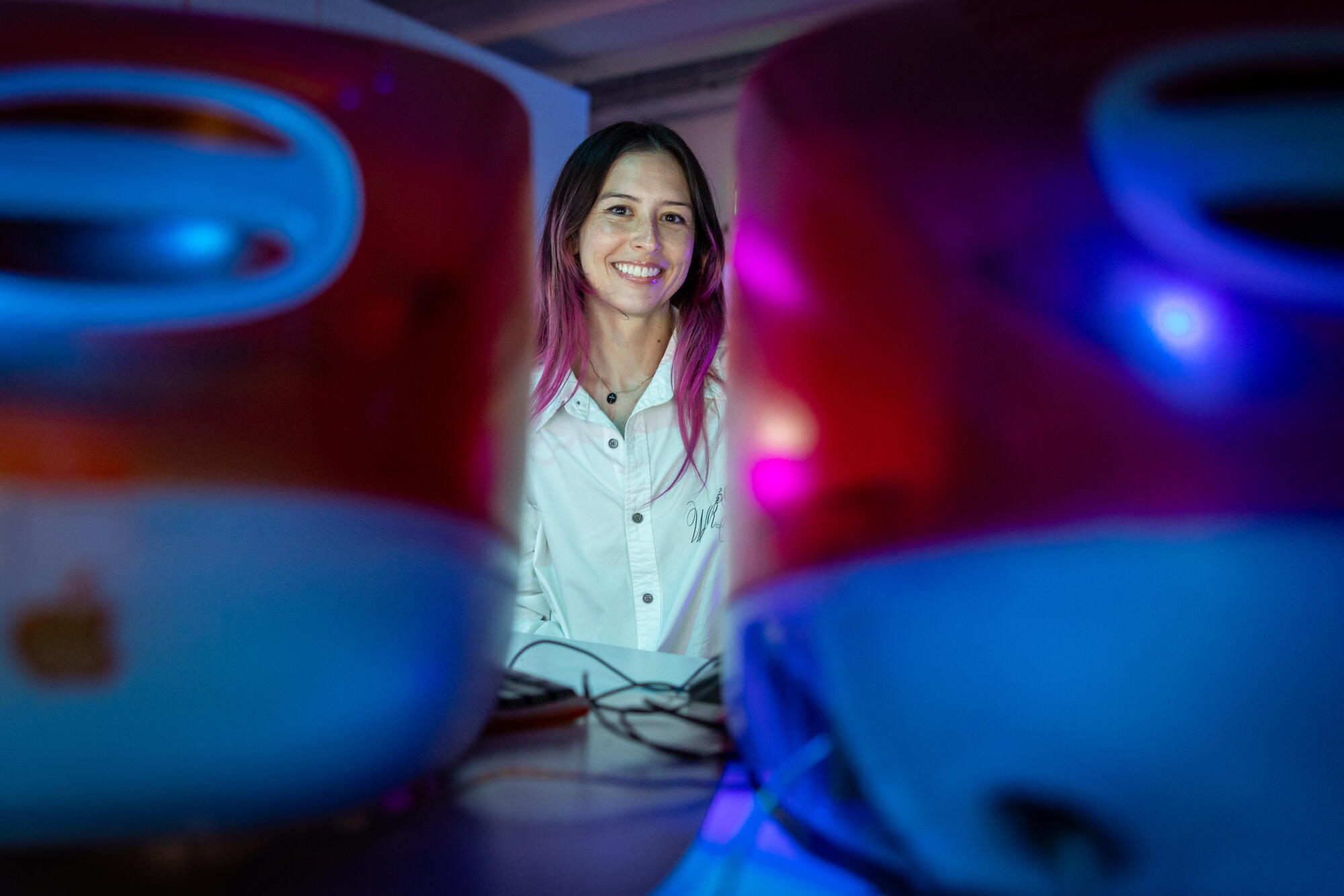
Lee’s own contribution to the evening is the full rainbow of Apple’s iMac G3 computers — those bubbly, teardrop-shaped desktops that debuted in 1998 to the famous “iCandy” ads displaying their colorful shells, and TV commercials scored to the Rolling Stones’ “She’s Like a Rainbow.” Over several months and multiple trips, Lee drove across the country collecting the G3s in their core five colors. And it wasn’t easy. She recalled sleeping in her car in the parking lot of a Cracker Barrel for a few nights because she had spent all her money on acquiring the computers.
It was the people Lee met in the months of gathering the G3s, however, that made it worth it: a single dad who collected vintage iMacs to bond with his son, an elementary school teacher who held onto the old computers because the school was going to destroy them.
“I met these really witchy, cool, queer programmers from MIT in Medford, Massachusetts, who invited me back for MIT Swap Fest, where I found Indigo,” said Lee, referring to another G3 color not part of the core five. “I met a guy who used to work in broadcast, and his wife just died of cancer. His mom moved in, and she has been trying to support him in getting rid of old things and not holding on to them too much.” Human moments made possible almost by the accident of holding onto a computer longer than most.
Lee’s pursuit of old tech hardware has always been, at its root, a means to meeting new people, hearing their stories and creating a relationship with them. “I care about people a lot,” she said. “I think every single person that touches any of my projects knows that I really care about people feeling good.”
Paizley Lee spent months collecting the full rainbow of iMac G3s.
(Jason Armond / Los Angeles Times)
With a mouse, Jaimie Wan clicks into the past.
(Jason Armond / Los Angeles Times)
When Lee finally acquired all five original colors (blueberry, strawberry, lime, tangerine and grape), plus all the additional colors (ruby, indigo, snow, graphite, sage and three limited edition colors), she began booting up the G3s computers to make sure they still worked. In the process, she discovered the forgotten digital detritus left on their hard drives: old resumes, photo albums, Word documents.
“It’s somebody’s life,” she said. “It feels weird to do anything with it, but it also feels weird to alter it.” In the end, she kept the old files and built a replica of the early ‘00s internet to live beside them on the computers. At Dead Internet Theory events, participants are given free reign to the G3s and slowly find clues Lee has left on their desktops that lead into a mystery game she created.
Back at the event, people flocked to the bank of iMac G3 computers. They clicked around, laughing, their eyes lighted up. “It’s really a trip seeing the old MacBooks,” said Shannon Stack after navigating one of the relics. “I remember having those in my elementary school classroom. Now, these are archival pieces. It’s freaky!”
Lee herself hovered around the computer bank, watching people interact with them and discovering the random documents left behind or playing one of Apple’s preset games. She asked a couple who had been tinkering around for over half-an-hour if they wanted a hint to her mystery. “No!” they respond excitedly.
While Dead Internet Theory has only been held in Los Angeles, Lee’s dream is to take it on the road. “I’ve got kids in Seattle, in Nashville, in Dallas that are emailing me and going, please bring it here,” she explained. The only thing stopping her was money, but that changed recently. A few weeks after the event on La Brea, she was approached by a sponsor. Now she’s making a tour happen, first with a pop-up event in New York City on Wednesday.
The event has become a place to gather and build community.
(Jason Armond / Los Angeles Times)
Recently, as Lee began driving across the country to set up, she stopped at a bed and breakfast near Red Lodge, Mont. When she learned the innkeeper had an old blueberry iMac G3 in her basement, she asked to take a look.
“I spent an hour getting her back on,” Lee said of rebooting the machine to give the innkeeper access. “And the face she made when it came back to life — literally priceless.”
The woman browsed through old photos of her daughters, their old school projects and other files forgotten over time. Afterward, the innkeeper gave Lee the computer, telling her it deserves a second life.
US President Trump unveiled a new White House helicopter pad as major US TV networks stayed away in protest over CNN, a member of the network ‘pool’, being banned from the grounds. As Trump spoke, the thunder of a helicopter rendered the president inaudible from start to finish.
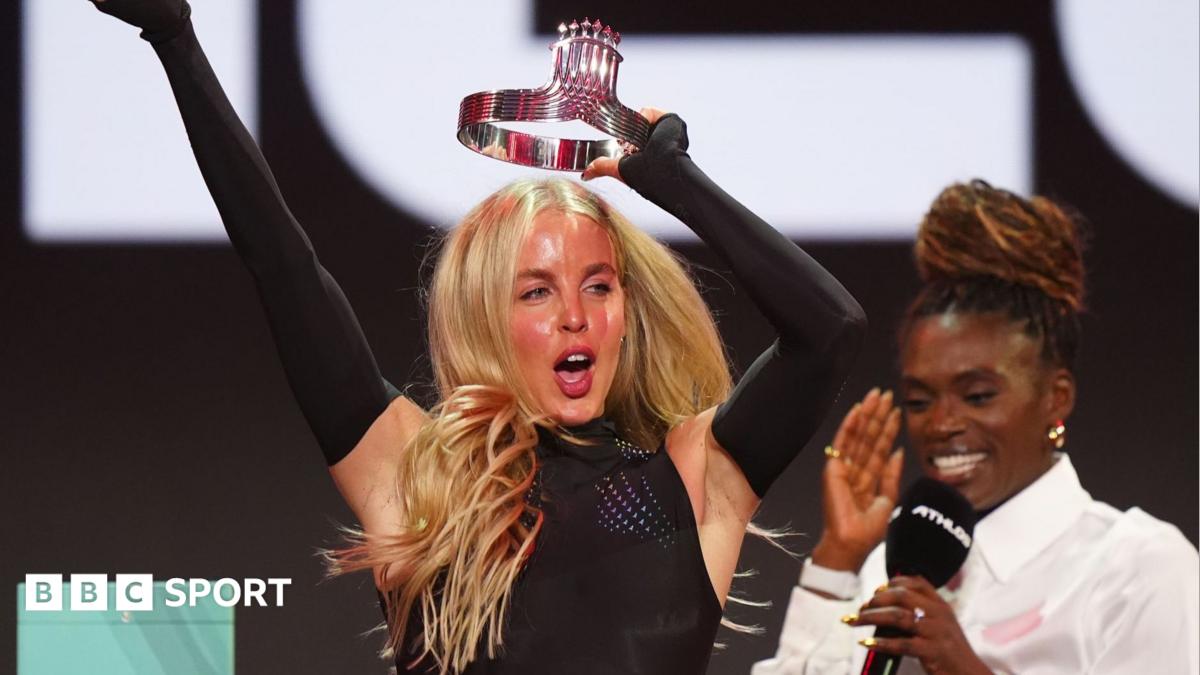
Keely Hodgkinson powered to victory in a custom-made full-body speed suit before being presented with a Tiffany & Co crown as Athlos made its London debut.
Hodgkinson was greeted by loud cheers as she emerged on to a stage and revealed the all-black aerodynamic outfit at the third staging of the all-female athletics meet.
The 24-year-old ensured she ended a mixed year with a dominant 800m victory in front of a sellout home crowd at StoneX Stadium, bursting clear on the back straight and crossing the line in one minute 56.40 seconds.
Speaking about the outfit, Hodgkinson told BBC Sport: “This has been like a year in the making. It’s a mixture of fashion and speed and science all coming together for maybe the future of athletics.
“It was a real honour for them to choose me to put this out first. We weren’t sure when we were going to wear it.
“But an all-women’s event that’s all about the glitz and the glamour and putting eyes on women, a bit of a moment, I think was the perfect way to finish the season.”
Created by Alexis Ohanian, Reddit co-founder and husband of tennis’ 23-time Grand Slam singles champion Serena Williams, Athlos was staging a meet for the first time outside of New York.
In addition to the silver Tiffany crown awarded to winners instead of medals, a top prize of $65,000 (£48,500) was on offer in each event.
The single-night meet included seven disciplines, each featuring six athletes, with money on offer for each position from a total event prize pot of $1.05m (£790,500).
American sprint stars Gabby Thomas and Sha’Carri Richardson were among the champions amid a party atmosphere which featured a live track-side DJ.
An Australian indoor fitness athlete apologized Thursday for continuing to participate in a recent competition after apparently soiling herself.
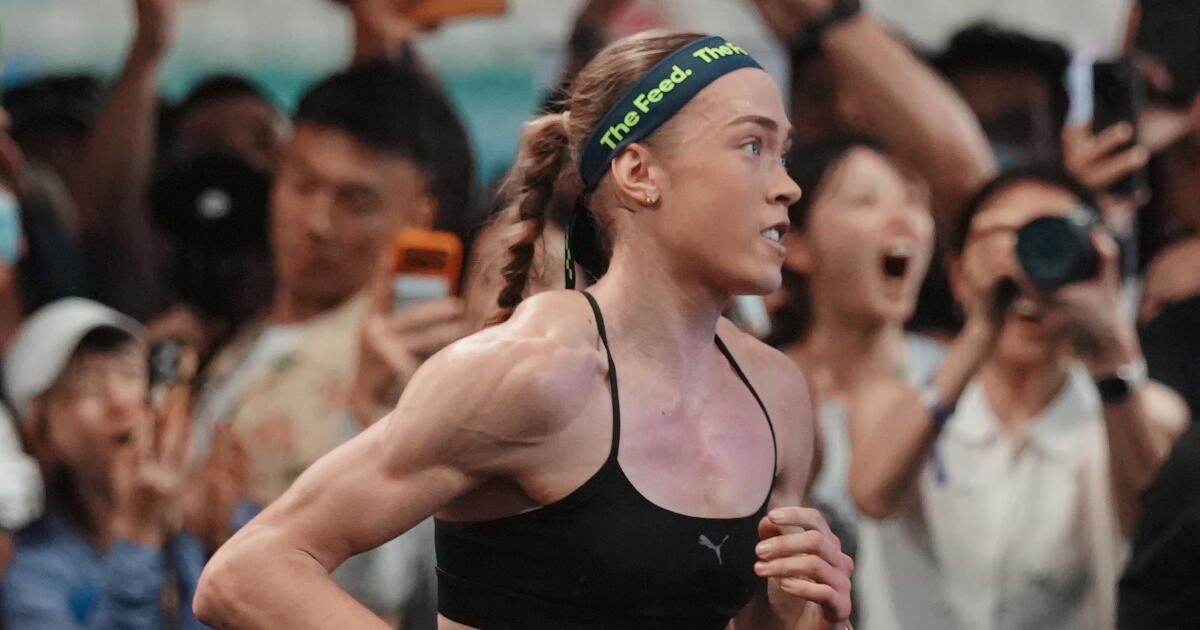
Joanna Wietrzyk, a 24-year-old Melborne resident, could be seen with what appears to be fecal matter on parts of her body as she competed in a Hyrox event Saturday in Beijing, China. Despite that, she was permitted to stay in the race — even though the running-workout event involves the shared use of equipment by multiple competitors — and eventually was declared the winner with a time of 1 hour, 1 minute and 23 seconds.
Wietrzyk has decided to “retroactively withdraw from the race and forfeit the points I earned,” she indicated in a Sept. 18 statement posted on Instagram.
“I want to offer my sincere apology to the people of China, my fellow competitors, the spectators and the HYROX organizers for what happened during the race in Beijing,” Wietrzyk wrote.
“I felt completely fit and healthy at the start of the race, with no reason to expect any illness. Looking back, I regret the decision to not have stepped off the track. I recognize that I should have made a different choice. I take responsibility for my decision to continue and am deeply sorry for the discomfort and disruption it caused.
“I know my actions had an impact beyond myself, and I am genuinely sorry to everyone who was affected. I am learning from this experience and will carry those lessons with me, including remembering that there is more to life than racing and knowing when it is right to step away.”
The message contrasted from that of a post Wietrzyk made earlier in the week that, according to the Athletic, also included a selfie of the athlete apparently in a hospital bed.
“Go hard or go home … a win is a win,” the since-deleted post reportedly said. “In all seriousness, thank you for all the support. I’ll be back soon.”
First introduced in 2017, Hyrox indoor fitness competitions are made up of eight 1-kilometer (.62-mile) runs that are separated by intense exercises at eight different workout stations (ski ergometer, sled push, sled pull, burpee broad jump, rowing, farmer’s carry, sandbag lunges and medicine ball squat/throw). Wietrzyk holds the world record in the women’s event with a time of 54:26 set earlier this year.
Hyrox co-founder Moritz Fürste posted a statement Sunday on Instagram apologizing for “the recent events in China” and indicating that the competition has taken unspecified steps to prevent another such occurrence.
“I apologise to all that were directly or indirectly affected, as well as to everyone who felt like we did not handle the situation like we should have,” Fürste wrote. “HYROX made a mistake by not reacting immediately during the race. In the end it is my job to foresee these potential incidents — and I did not.
“Of course, we started improving event processes, plus making rulebook changes immediately. As of this moment, there are new rules and procedures in place to prevent situations like this from happening again.”
The United States Republican Party – and its talisman President Donald Trump – is descending on Dallas, Texas, to host a rare convention before the midterm elections in November.
Usually reserved for presidential election cycles, Trump’s call to hold the high-cost event before the November 3 midterm vote has underscored both the president’s unorthodox campaign style and the urgency of the political moment for his Republican Party.
Recommended Stories
list of 3 itemsend of list
Trump’s approval rating has tanked in the lead-up to the midterm vote, with polls pointing to a panoply of factors, most notably the US-Israel war on Iran and its knock-on economic effects for US consumers.
The lack of enthusiasm threatens what are already considered long-shot odds in the Republicans’ effort to hold on to control of the House of Representatives. Shifting public opinion has also put control of the Senate increasingly in play, although Democrats still face an uphill battle to pull off an upset.
A loss of control in either chamber would serve as a major check on Trump’s authority in the final two years of his second term.
But not all Republicans have bought into Trump and the party’s claims that the convention will spur voter turnout.
Several, particularly those in the tightest races, have kept the event at arm’s length amid concerns that associating with the president could only further mobilise his detractors.
Here’s what to know:
When and where is the Republican midterm convention?
The convention will be hosted at the American Airlines Center in Dallas, Texas, on Wednesday, September 9 and Thursday, September 10.
The event is expected to run from 3pm to 9pm Central Time (20:00 to 02:00 GMT) on both days.
Trump is scheduled to speak on both nights, including a Wednesday address and the convention’s closing keynote on Thursday from 8pm to 9pm Central Time (01:00 to 02:00 GMT on Friday).
US Vice President JD Vance will close out night one with a speech.
A person takes pictures of signage during preparation for the Republican National Committee (RNC) Midterm Convention at the American Airlines Center on September 7, 2026 in Dallas, Texas [Brandon Bell/Getty Images via AFP]
Is this a typical political convention?
Not at all.
The Republican National Committee (RNC), the party’s official organising body, has billed the Dallas midterm convention as a “first in American political history”.
Both Democratic and Republican national conventions have historically capped the primary season before a presidential election. The emphasis has historically been on the presidential nomination process during the largely ceremonial events.
During those conventions, so-called “delegates” from every state pledge their votes for a candidate based on the primary election outcome from their home state.
A candidate who secures the required majority of delegates formally becomes the party’s presidential nominee at the convention.
Parties also typically hold several smaller meetings surrounding the event to establish and release the party’s official platform.
Why are Republicans holding a midterm convention in 2026?
To start with, there will be no nominating process – presidential or otherwise – during the event, as there is no presidential election in 2026.
Instead, the convention has taken the shape of a supercharged campaign rally and fundraiser.
It has been pitched as an opportunity to introduce candidates in punishing races to potential donors and to give a clear, if Trump-dominated, party message as the races enter their final stretch.
The RNC has promised “a primetime showcase for President Trump’s success, candidates, and causes that have propelled the 2026 midterms to unprecedented focus”.
What’s on the schedule?
There will be quite a lot. The official programme lists “53 items and speakers” on night one, followed by 56 more on night two.
The first night will focus on issues including tax cuts, healthcare affordability, immigration, border policy, trade and domestic manufacturing.
The second night will focus more on affordability and families, including policies related to taxes on tips, overtime and Social Security.
The subject areas hew closely to Trump’s wider political messaging.
The official programme gives relatively little attention to several other subjects. The US-Israel war with Iran and Trump’s aggressive tariff policy receive scant mention.
Who else is speaking?
Trump and Vance are the convention’s marquee speakers, but an array of prominent Republicans and candidates are expected to feature across the two-day programme.
Texas Attorney General Ken Paxton is likely to get a healthy amount of stage time. Paxton is running for Senate against Democrat James Talarico, whose early lead in polling has raised alarm bells for Republicans. A Democrat has not won statewide office in Texas since 1994.
“We’re going to have a lot of speakers, and the ones we want to focus on will be obviously Ken Paxton,” Trump told reporters last week. “We gotta get him elected.”
The race is particularly personal for Trump, who endorsed MAGA-aligned Paxton over Republican Senator John Cornyn, a four-term incumbent seen by many as the surest challenger for Talarico.
Will Trump’s convention help Republicans in the midterms?
It remains to be seen whether the convention will help to turn out voters in a meaningful way.
Trump has proven a canny campaigner in the past, leveraging his eye for television spectacle to build support and turn out low-propensity voters. But several factors could limit the impact.
Trump’s Thursday night speech conflicts with the opening games of the National Football League (NFL) season. The event also runs up against several memorial events for the September 11, 2001 attacks throughout the week.
Some Republican officials have also reportedly criticised the hasty announcement of the event, which Trump called for in late June, raising questions over whether organisers will indeed be able to achieve the spectacle envisioned.
For his part, Trump enters the convention with his approval rating continuing to tank, hovering at a 38 percent average in major polls. Several of the most recent polls, including a Reuters-Ipsos poll and a Financial Times-Focaldata poll conducted in late August, reflected only a 33 percent approval.
Trump entered office in January 2025 sitting at about 52 percent approval.
Why are some Republicans skipping?
To be sure, several Republicans in key races have said they will attend the convention.
They include former Congressman Mike Rogers, who is running against Democrat Abdul El-Sayed for an open Senate seat in Michigan; Ohio Senator Jon Husted, who is facing an unnerving challenge from former Democratic Senator Sherrod Brown; and Georgia Congressman Mike Collins, who is seeking to unseat Democratic Senator Jon Ossoff.
Others have been wary.
Trump’s policies in his second term have cast a long shadow, leaving many candidates calculating whether attendance could backfire and instead energise voters opposed to Trump.
Democratic primary turnout in several key states – including Michigan, Wisconsin, Texas and Georgia – has soared this year, while Republican turnout has remained steady but unextraordinary, as reported by The Associated Press news agency. That has been a worrying sign for Republicans.
Maine Senator Susan Collins, a Republican incumbent seen as vulnerable in her race against Democrat Troy Jackson, has been among those who have said they will not attend.
Several candidates in key House races have pointed to prior commitments.
Representative Mariannette Miller-Meeks told The Bulwark she preferred to spend her time in her home district in Iowa, where she faces a challenge from Democrat Christina Bohannan.
“Because I have a district that I have to be in and take care of, so I’ll be in my district,” she explained about her decision.
Miller-Meeks eked out a victory over Bohannan in 2024, winning by a margin of just 0.1 percent.
Are Democrats countering?
Several left-leaning groups are organising protests.
House Democratic leader Hakeem Jeffries has announced that four Democratic lawmakers will travel to Dallas for counterprogramming during the Republican convention.
However, the cash-strapped Democratic National Committee (DNC) has avoided holding its own midterm convention.
The committee went into debt in the wake of the 2024 presidential election, even putting up its Washington, DC-based headquarters as collateral for a $15m loan, the NOTUS news site reported in July.
The RNC has not yet released a final price tag for its convention.
WASHINGTON — Nearly a quarter century after a day “etched forever into the memories of Americans,” President Trump honored the victims of the Sept. 11, 2001, attacks on Tuesday by vowing to “never forget.”
The event at the Ellipse was spearheaded by the Tunnel to Towers Foundation and showcased a massive, 21-foot, nearly 17,000-pound steel beam recovered from the South Tower of the World Trade Center in New York, which had traveled for months across the country as part of the Steel Across America tour.
The steel beam will make its way through New York in a procession on Friday by retracing the steps of fallen New York City firefighter Stephen Siller. Trump’s presence at the event on Tuesday just outside the White House began a week of commemorations that will culminate in several events on Friday, including one at the Pentagon that Trump will attend.
“This battered piece of steel here today on the Ellipse is a reminder that America is blessed with a strength no fire can consume, no evil can conquer and no terror can destroy,” Trump said.
Trump noted that the Sept. 11 attacks were one of few moments in history that “divide time into really what came before” and after.
His remarks briefly dipped into the political, as Trump warned of people turning a “communistic way” — a reference to his frequent attacks on Democrats as more democratic socialists gain influence in the party.
During his remarks, Trump paid particular tribute to two men who died in the attacks: Jeffrey Palazzo, a New York City firefighter, and Welles Crowther, a young equities trader who became known as the “man in the red bandanna” after rescuing several people in the attacks.
Trump said the U.S. Coast Guard will commission a new fast-response cutter this weekend in New York in honor of Palazzo, a Coast Guard reservist who was working out of Staten Island’s Rescue Squad 5 when he responded to the attacks 25 years ago.
And the president recognized Crowther, also a volunteer firefighter, by awarding him the Presidential Medal of Freedom.
Crowther’s mother, Alison, and sister, Paige, accepted the award, which is considered the nation’s highest civilian honor.
In attendance were a smattering of top Cabinet officials and members of Congress, including Republican Reps. Mike Lawler of New York and Dan Meuser, whose Pennsylvania district is near Shanksville, where Flight 93 crashed on Sept. 11, 2001.
Trump praised at length Commerce Secretary Howard Lutnick, who was chairman and CEO of Cantor Fitzgerald, a financial firm that had been housed at the World Trade Center. Lutnick lost his younger brother, Gary, as well as more than 650 employees in the attacks.
“He’s done an amazing job,” Trump said of Lutnick. “He’s rebuilt Cantor Fitzgerald, and he’s given much of the profits to some of the families or the families of people who perished.”
About 150 first responders from New York, as well as some from Washington and Pennsylvania, were in attendance, Trump said.
“This steel beam represents the best of our country,” said Frank Siller, the foundation’s chairman and CEO who is the brother of Stephen Siller. “It’s important to recognize that the heroism that was exhibited that fateful day was nothing short of incredible.”
Kim writes for the Associated Press. AP writer Will Weissert contributed to this report.
Inside the Universalist Unitarian Church of Riverside, a line of masked people filed into the red-lighted chapel, one by one, to take part in the rite of confession.
The private booth was framed in flowers, and rather than a priest listening inside, it was a microphone recording their confessions, to be played at an upcoming art exhibition. The brick triangle-roofed church that held the booth has stood since opening in 1892; that night, it was the site of a masquerade, or as Riverside artist Perry Picasshoe called it, the “Masqueerade.”
Picasshoe, whose real name is Neveah Marquez, hosted the event, which had an entirely LGBTQ+ guest list and one requirement: Bring a mask, whatever that looks like to you.
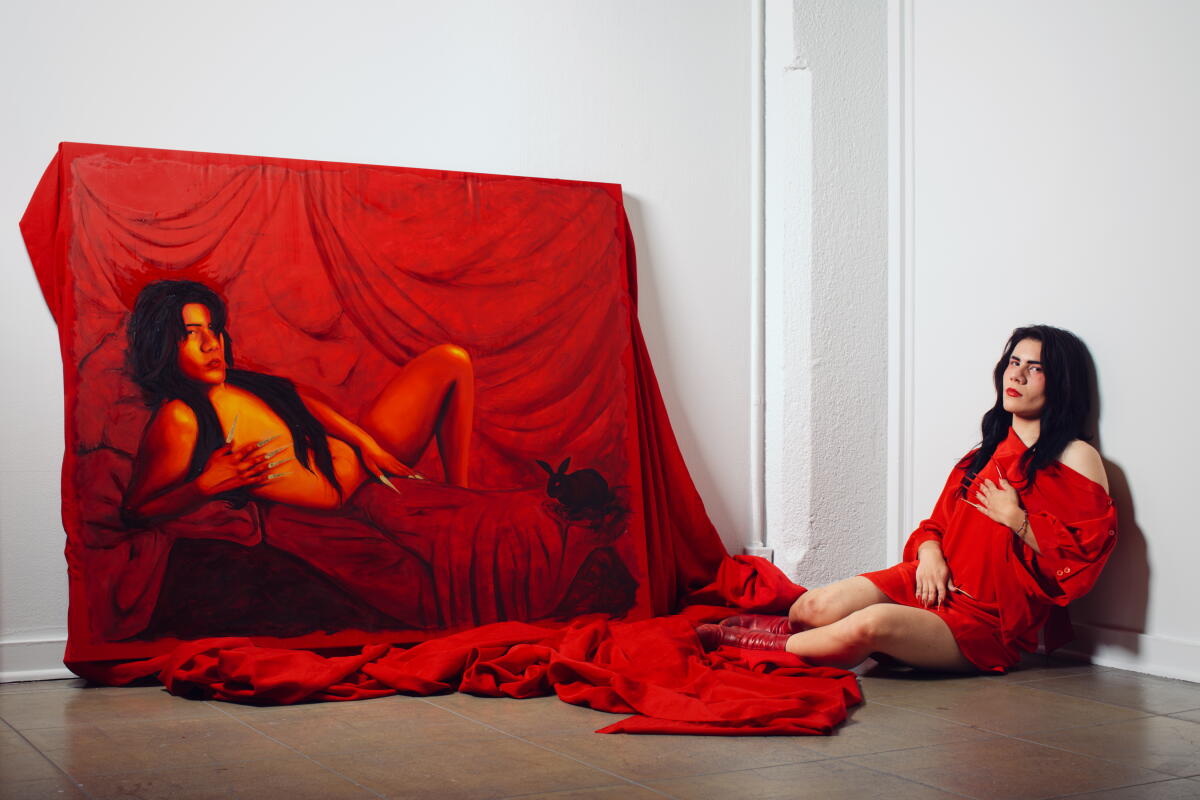
Marquez, a 26-year-old transgender woman robed entirely in red, stood at the pews and danced to the experimental electronic DJ sets and drag performances as guests entered in masks that ranged from papier-mâché deer antlers to collaged photos of eyes and lips.
The event came as a celebration ahead of the Riverside native’s first solo exhibition, “SagradX,” which will open Saturday at Riverside Art Museum and remain through Jan. 31.
The recorded confessions, layered over one another until they become an unintelligible cacophony, represent just one piece of the 25 paintings, photographs and interactive displays in the exhibition. The show explores the meaning of “sacred” as Marquez documents her most private places and experiences, and asks viewers to consider what they hold sacred.
The exhibition, she says, began with heartbreak.
Neveah Marquez (Perry Picasshoe), 26, sits inside the Riverside Art Museum.
(Carlin Stiehl / For De Los)
“The first time I started thinking about sacredness … was when my ex-partner brought somebody into our bed,” said Marquez.
“I was crying, distraught, and drove over to these hills over Lake Mathews [in Riverside] and I realized: The bedroom was sacred to me. That’s why it hurt so much. And I started thinking, if it wasn’t sacred to them, how do we decide what is sacred to each of us?”
The very headboard of that bed sits in the exhibition; on it, Marquez painted fairy-tale creatures representing the lovers gallivanting across the woods.
While Marquez’s experience with betrayal sparked the idea, the exhibition explores sanctity in many different scenarios: In one, the artist plays with the concept of the digital safe space by inviting guests to look through her phone as she is tied on a handmade iron-wrought cross. Inside the exhibition space, she uses a small painter’s brush to slowly paint the white walls red over the course of the show.
In curating the exhibition, Marquez began to look inward, painting and photographing herself in ways she never had before: through the lens of femininity. She lived the previous 26 years of her life as a man, growing up religious to the point that she once considered becoming a priest. The paintings serve as portals into a part of her that she long held inside.
“I describe it like having blurry vision your whole life and not realizing how clearly you can see, until you put glasses on,” Marquez said. “That’s how painting myself as a woman felt.”
Neveah Marquez (Perry Picasshoe) considers what is sacred.
(Carlin Stiehl / For De Los)
Though she initially identified with her male birth name, the more she painted herself in Venus-like, feminine poses and with longer hair, her understanding of her identity shifted. Illuminated by her signature scarlet red clothing and tastefully shrouded in sheets, the soft expression on her face was inspired by Raphael’s “La Fornarina.”
“I wasn’t thinking much of it in the moment, but as I kept painting these portraits, I was thinking a lot about myself and thinking about gender and my identity,” Marquez said. “Through my art process, I realized: ‘Maybe I would be a pretty woman.’ That’s what scared me the most from transitioning, was not feeling like I would be beautiful enough.”
In “SagradX,” Marquez’s body is documented vulnerably; easing into her own identity becoming a painfully honest artistic process, which the audience is now invited to watch.
“I feel like I don’t paint very often because when I do, it’s just so emotionally intense. Like when Olivia Rodrigo wrote that she’s scared of her guitar because she couldn’t lie to it, that’s how I feel about painting,” Marquez said. “I can’t lie to my painting.”
Neveah Marquez (Perry Picasshoe) wears long, flowing red clothes.
(Carlin Stiehl / For De Los)
Aside from her self-portraits, Marquez includes photographs of her ice blocks project, in which she placed 25-pound blocks where immigration enforcement raids took place in the Inland Empire last year. These were once safe places that she says have been “desecrated with fear.”
Marquez’s personal journal, which documented her inner joys and struggles over the last year, is also open on a table in the exhibition for guests to read through, draw over, or tear. For Marquez, “SagradX” was the catalyst to “let everything out.”
“If the show is about vulnerability, I need to practice that for myself as well. Otherwise, you would see in the work that there’s a blockage, you can sense when artists aren’t fully honest,” Marquez said. “I want people to question, ‘What is sacred to you?’ If I give you access to something sacred to me, what will you do with that?”