Eurostar

Beautiful European train journey that’s half the price of a plane ticket

A scenic train journey from London to Geneva via Paris offers some of Europe’s best views – and can cost half the price of a plane ticket at around £135 return

A rail journey linking three capital cities boasts some of Europe’s most breathtaking scenery—and could set you back half the price of a flight.

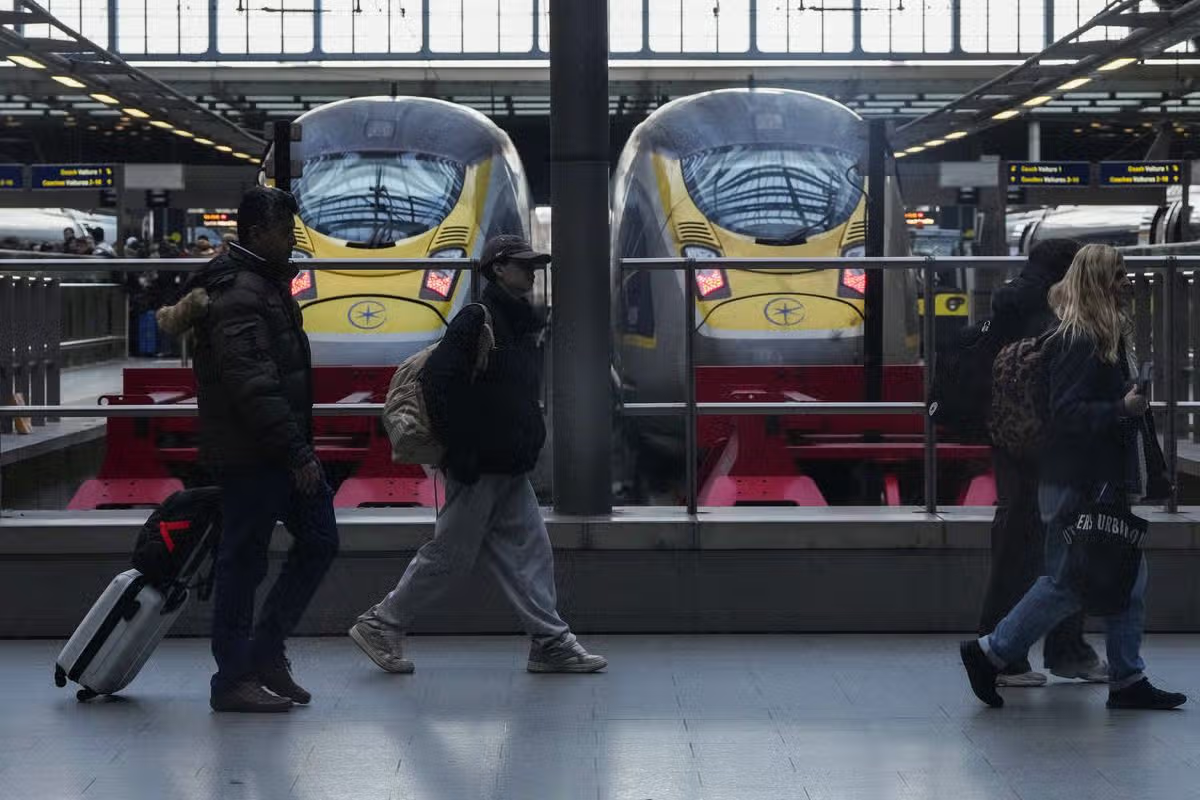
The Eurostar and France’s TGV whisk passengers from London to Geneva, making the very most of a trip that spans three nations. The train departs from St Pancras with a change in Paris before heading onwards to the Swiss capital.

It’s a nearly six-hour journey in total, passing through Montbard, Dijon and Bourg-en-Bresse, offering stunning vistas of national parks and rolling countryside. Passengers can hop off in Paris to discover the city—with landmarks including the Eiffel Tower, Notre-Dame, the Champs-Élysées, Sacré-Cœur and the Louvre.

Once the train pulls into Geneva, visitors can take in Lake Geneva, Cathédrale de Saint-Pierre, the Palais des Nations, the botanical gardens and the Brunswick Monument.

From there, it’s also a brief trip to the nearby Alps, with day excursions available from the city to ski or snowboard on the slopes and savour the local restaurants. The train can be half the price of a plane ticket. According to Skyscanner, return flights this month cost up to £394.

During the same period, return train tickets cost around £135, half the price of a flight, according to Trainline.

Families can also cut costs by purchasing Interrail passes—£482 for a family of four to travel on four days within one month, plus seat reservation charges. And expense isn’t the sole advantage.

According to the Times, four passengers journeying from London to Geneva and back by rail produce approximately 44kg of carbon emissions, compared with 108kg by car and 1,608kg by plane. The Intergovernmental Panel on Climate Change states that, to maintain climate change within sustainable limits, each person has a carbon “budget” of 1,500kg of carbon emissions per year.

Although there are a number of factors that determine how polluting different forms of travel are, such as the type of electricity production used to power trains, riding the rails is typically greener than flying.

Back in 2023, carbon calculations made by the Rail Delivery Group found that travelling by rail from London to Edinburgh creates 10 times fewer carbon emissions than by car and 13 times fewer than by plane.

One of the tricky considerations for passengers is generally cost, with budget airlines such as Ryanair, easyJet and Wizz Air typically offering cheaper plane tickets than the equivalent train tickets.

The route from London to Geneva shows that it is not always the case. The price gap between the two forms of transport may also be getting smaller.

Travellers are facing rising airfare costs and reductions in flight schedules as the conflict in the Middle East causes oil prices to soar, with concerns that ticket prices could remain elevated for months even if the war de-escalates. Cathay Pacific, AirAsia and Thai Airways are among a growing number of airlines increasing fares to offset the hikes.

While train services are also impacted by rising oil prices, fuel tends to be a much smaller proportion of their operating margins than with airlines.

Source link

I went on Eurostar standard and plus – here’s why it’s not worth the upgrade

It can be difficult to choose which class to go for when booking Eurostar. Recently, I tried Plus, and while it was a pleasant experience, here’s why I think it’s not worth the money

‘I went on both Eurostar Standard and Eurostar Plus to find out how they compare’

Eurostar offers a fast and efficient way to get from London to the continent, and if you’re doing a day trip or a short break, it can be much more time-efficient than flying.

When you choose your Eurostar train time, you’ll usually be presented with three fare options: Standard, Plus, and Premier. Recently, I took two trips in the space of a week, one on Standard and one on Plus to see how the two classes compare. With Plus tickets often costing double, triple, or even quadruple the cost of a Standard ticket, is it worth the upgrade?

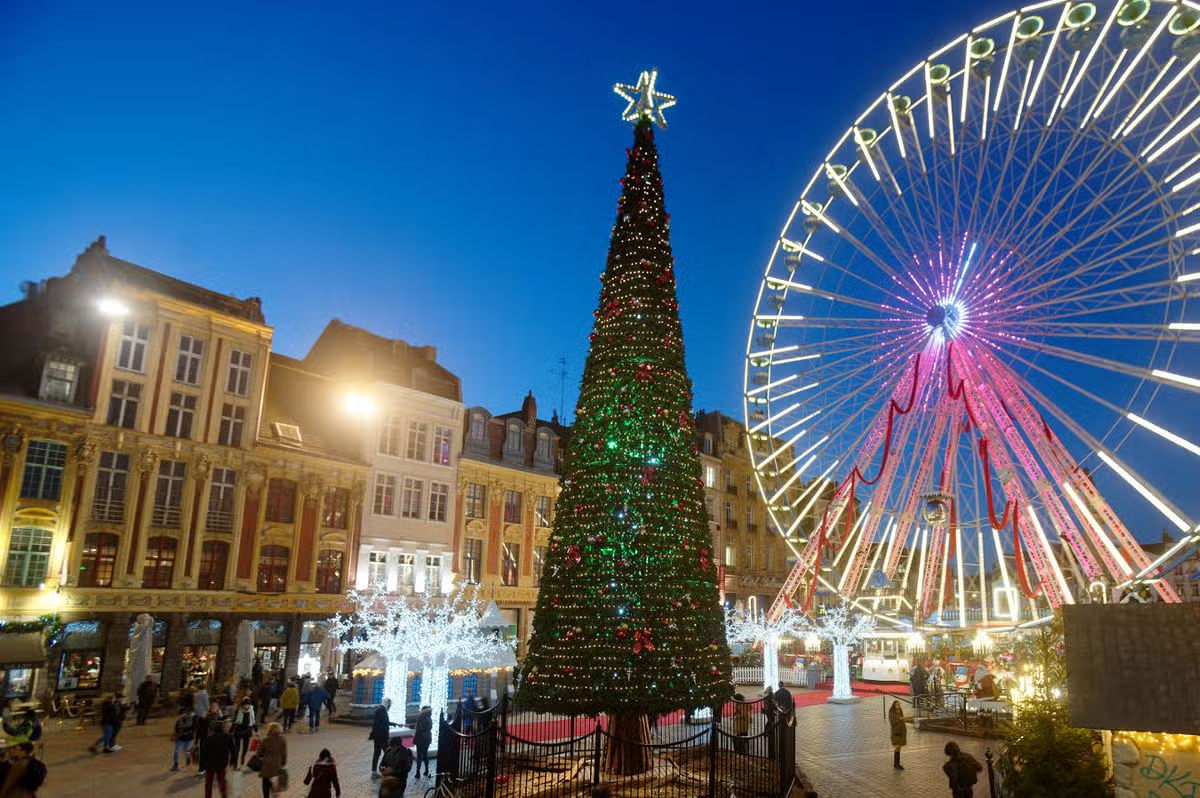
I took the Eurostar Standard from London to Lille, which at just 90-minutes is the shortest journey from London St Pancras. I managed to pick up tickets for £35 one-way in a flash sale, so going to Lille was cheaper than visiting many UK cities by train.

Standard

Standard is a no-frills service. You get a luggage allowance of two bags up to 85cm long on routes to and from London, plus a small item such as a handbag and laptop bag. There are no weight or liquid limits like you’d find on planes, although you do need to heft your bags up and down the steep train steps, so keep that in mind before stocking up on wine at the supermarché.

There are two rows of two seats, which are comfier than most UK trains and have headrests and footrests. Impressively, Standard tickets are flexible up to an hour before departure, so if your travel plans change you can swap your ticket for no fee. You simply pay the difference for your new fare.

Seats come with a power outlet, and you technically get access to WiFi, although on all my journeys, this barely worked, so bring a book. Once settled in, we had some snacks and the journey flew by, and we stepped off the train into the centre of Lille ready for a city break.

Eurostar Plus

A few days later, I tried the Eurostar Plus, this time on a journey from London to Paris. The journey through St Pancras station is exactly the same, you don’t get access to a priority queue, lounge, or boarding, so you don’t really notice the difference until you board. Luggage allowances and rules around flexibility are also the same as Standard class.

The carriages are also very similar to Standard, except with one less seat in a row, so you have two seats on one side and single seats on the other. The single seats seemed popular with business travellers who quickly whipped out their laptops, although with the patchy WiFi, I’m not sure how much work they got done.

Unfortunately, I think I had bad luck with this train: half the toilets were out of order, and the other half were less than pleasant. I had to wobble my way up and down the aisles with a child in tow, trying to find a loo.

The main upgrade on Plus is that you get breakfast or a light meal, plus a choice of drinks, including wine and beer. Dishes are served cold, so they tend to be salads with chicken or fish or pasta dishes. My salmon and lentils were tasty enough, but about on par with what you’d get in Marks and Spencer at the station.

The staff on Eurostar Plus are also extremely friendly and helpful, and it was nice to sit back and be served a meal with wine and coffee on a well-presented tray. But is it worth the upgrade?

READ MORE: Spain airport strikes warning as Easter travellers face severe delaysREAD MORE: Brit lad books Airbnb stay in someone’s garage – and sums it up in 2 words

However, I will admit that the Plus carriage did have a slightly calmer, more business-like vibe, so if you’re on the way to an important meeting, it might be worth the money. Likewise, if you’re traveling alone and don’t want to risk ending up with a chatty neighbour, the thought of booking a single seat might appeal.

Otherwise, take your own sandwich and save your Euros for when you arrive at your destination.

Have a story you want to share? Email us at webtravel@reachplc.com

Source link

This champagne-soaked city is the perfect train-travel alternative to a Paris mini-break

Writer Catherine Usher travelled by train to the pretty town of Troyes in the Champagne region, discovering art, history and – of course – the best bubbly

Troyes is only a 90-minute train ride from Paris but, compared to the capital, it’s a more compact and intimate location for a French mini-break. You’ll find atmospheric churches, attractive independent shops and chic museums, making it the ideal place to explore for a few days. Although it’s a very popular stop-off point for holidaymakers driving further south in France or onwards to Germany or Switzerland, a car isn’t a necessity. We travelled to Paris first via Eurostar –a much more environmentally-friendly option than flying – then took the train to Troyes. (It’s a 10-minute walk between Gare du Nord and Gare de l’Est in Paris.) Once in Troyes, we were able to explore much of the town on foot.

READ MORE: Beautiful European island under 3 hours from UK where residents live beyond 100 years old

What to do in Troyes

Troyes is a pretty city with lots of half-timbered buildings in the old town that were largely built in the 16th century. There are countless cobbled streets to wander down and the atmosphere is relaxed and friendly.

Two museums well worth taking a stroll around are the Musée d’Art Moderne and the Cite du Vitrail.

  • The Modern Art Museum , located next to the cathedral, is home to paintings by artists such as Henri Matisse and André Derain. The sloping ceilings on the upper floor make it feel cosy and visitors can enjoy a sense of proximity to the artwork.
  • The Cite du Vitrail is the stained glass museum and it is a wonderful, tranquil venue where you can immerse yourself in the elegance and beauty of stained glass. Located in an 18th century building, it explores stained glass from the Middle Ages to the present day and houses striking and memorable exhibits.

Making time for Champagne

Being in the heart of the Champagne region, discovering its most famous export is a must. Chassenay d’Arce champagne house in Ville-sur-Arce is about an hour’s drive from Troyes. It was founded in 1956 by five pioneers and the organisation is now made up of 130 families, with a focus on co-operation and knowledge-sharing.

Visiting its vast cellars and seeing how the bottles are produced is a real eye-opener, and the tasting workshop at the end of the tour is an obvious highlight for champagne connoisseurs and novices alike (see chassenay.com).

Troyes is a straightforward place to explore, but if you really want to find out about its history then a guided tour is a must. Hosted by Troyes La Champagne Tourisme, tours can be arranged for smaller or larger groups, of up to 30 people. Our host, Laura Dudek, was a well-informed, enthusiastic guide who tailored the experience to our interests, taking us to see many of the city’s ornate and impressive churches and cathedrals. For those who prefer to go it alone, you can explore with a City Pass, which includes an audioguide and admission to the museums.

Where to eat and drink

A flute of champagne is no doubt on the agenda for many visitors, and most of the bars and cafés have a variety of local brands to sample.

Octave is a sophisticated, rather understated restaurant located in the centre of Troyes with a beautiful courtyard, where you can enjoy dinner under the stars – usually joined by the friendly cat who lives nearby. The tapas style menu may look daunting at first glance, but the knowledgeable staff are happy to advise and we were very pleased with their recommendations.

For a speedy, fuss-free lunch while sightseeing, Tonton Farine is a welcoming bakery/canteen where everything is homemade. As it’s France, everything tastes more wholesome and delicious than a British equivalent. Most of the other customers looked like they were locals on their lunch break.

If you’re away from Troyes enjoying a champagne tour, Le Moussec in Les Riceys is a fabulous place to stop for lunch. The dishes are tasty and hearty, the restaurant is buzzing, which is always a good sign, and the staff are warm and attentive without being suffocating.

Where to stay

Two elegant boutique hotels, La Maison de Rhodes and Le Champ des Oiseaux, are located in adjoining medieval buildings and offer a combined 23 rooms. Owned and run by the same family, the welcoming hotels are a great base from which to explore the city.

Room categories and decor vary between the two properties, but guests share access to a range of amenities, such as a tranquil walled garden (we were getting Romeo and Juliet vibes), an outdoor heated pool and a small spa. The restaurant has an elegant yet homely ambiance and after your evening meal you can enjoy a nightcap in the moonlit garden. Once settled with a glass of wine, some nibbles and a book, it’s incredibly hard to drag yourself away.

How much does it cost?

Rooms at La Maison de Rhodes start from £245 and Le Champ des Oiseaux start from £174 per night on a B&B basis – see maisonderhodes.com. To book a tour of the town, see troyeslachampagne.com. Eurostar journeys between London and Paris start from £39 each way – see eurostar.com. Fares are all-inclusive with no hidden extras, children under four go free, and a Paris-London journey by Eurostar means 96% fewer CO2 emissions than travelling by plane.

Source link