Eurostar

Ryanair issues warning to customers – and it’s not down to fuel crisis

The warning comes at a time of global turmoil

Ryanair has issued a warning to passengers hoping to fly in the days ahead. The budget airline has sent emails to travellers flying from the UK to large parts of Europe.

It cautions of ‘longer queues, particularly at busy airports’. The reason is the new Entry and Exit System (EES), which has been rolled out by the European Union (EU). It requires all travellers from the UK and other non-EU nations to be photographed and fingerprinted at EU airports and border crossings.

The objective is for the new system to replace manual passport stamping and more efficiently track the 90-day visa-free limit, but there have been accounts of it causing delays stretching to several hours at busy airports. It has even been temporarily suspended at times to clear the backlog.

In a message to customers titled ‘Important: Changes to Passport Control’, Ryanair says: “From 10 April 2026, the EU’s Entry/Exit System (EES) is in place at all Schengen Area external borders. As a result, passport control may take longer for some passengers.

“You are affected if you hold a non‐EU / non‐EEA / non‐Swiss passport (e.g. UK, USA, Canada, Australia), and are flying into or out of the Schengen Area.

“Commonly affected routes include flights between the Schengen Area and countries such as: UK, Ireland, Cyprus, Albania, Montenegro, Serbia, Türkiye, Egypt, Israel and others.

“At passport control you may need to:

  • Scan your passport
  • Provide fingerprints
  • Have a facial image taken

These checks may cause longer queues, particularly at busy airports. Queues may form before security.

If affected, please:

  • Arrive at the airport early to allow for queues
  • Have your travel documents ready
  • Follow signs marked EES / Passport Control

Those who are not affected:

  • EU, EEA and Swiss passport holders
  • Flights within the Schengen Area (e.g. Spain–Italy, France–Germany)

“If you are denied entry, this will be due to EU policy, not Ryanair’s rules.”

Greece has reportedly opted to pause the EES rollout following considerable delays. A statement on the Greek Embassy website and posts across official social media channels said: “In the framework of the implementation of the Entry/Exit System, as of 10 April 2026, British passport holders are exempt from biometric registration at Greek border crossing points.”

Airport representatives and the European Commission convened a meeting on Tuesday to address issues surrounding the system. Approximately 122 passengers were left stranded and unable to board their flight from Milan Linate to Manchester on Sunday, following severe hold-ups at passport control linked to the introduction of the EES.

The Foreign, Commonwealth and Development Office has confirmed that your details will need to be re-registered every three years. A statement also warned that travellers may face longer waiting times when entering or departing a country. It states: “The European Union’s (EU) Entry/Exit System (EES) started on 12 October 2025 This is a new digital border system that has changed requirements for British citizens travelling to the Schengen area.

The countries in the Schengen area are: Austria, Belgium, Bulgaria, Croatia, Czechia, Denmark, Estonia, Finland, France, Germany, Greece, Hungary, Iceland, Italy, Latvia, Liechtenstein, Lithuania, Luxembourg, Malta, Netherlands, Norway, Poland, Portugal, Romania, Slovakia, Slovenia, Spain, Sweden, and Switzerland.

READ MORE: ‘Our home burned down after moving in – we didn’t even have time to unpack’READ MORE: Brits flying to EU issued Defra warning after foot and mouth disease outbreak

The Republic of Ireland and Cyprus are not within the Schengen area, and therefore EES is not applicable when travelling to either of these countries. If you are travelling to a country in the Schengen area for a short stay using a UK passport, you may be required to register your biometric details, such as fingerprints and a photo, when you arrive. You do not need to take any action before you arrive at the border, and there is no cost for EES registration.

EES registration is replacing the current system of manually stamping passports when visitors arrive in the EU. EES may take each passenger extra time to complete so be prepared to wait longer than usual at the border.

“On your first visit to the Schengen area, you may be asked to create a digital record at the port or airport on arrival. You may be asked to submit your fingerprints and have your photo taken at dedicated booths. You don’t need to provide any information before travelling to a Schengen area country. The checks may take slightly longer than previously, so be prepared to wait during busy times.”

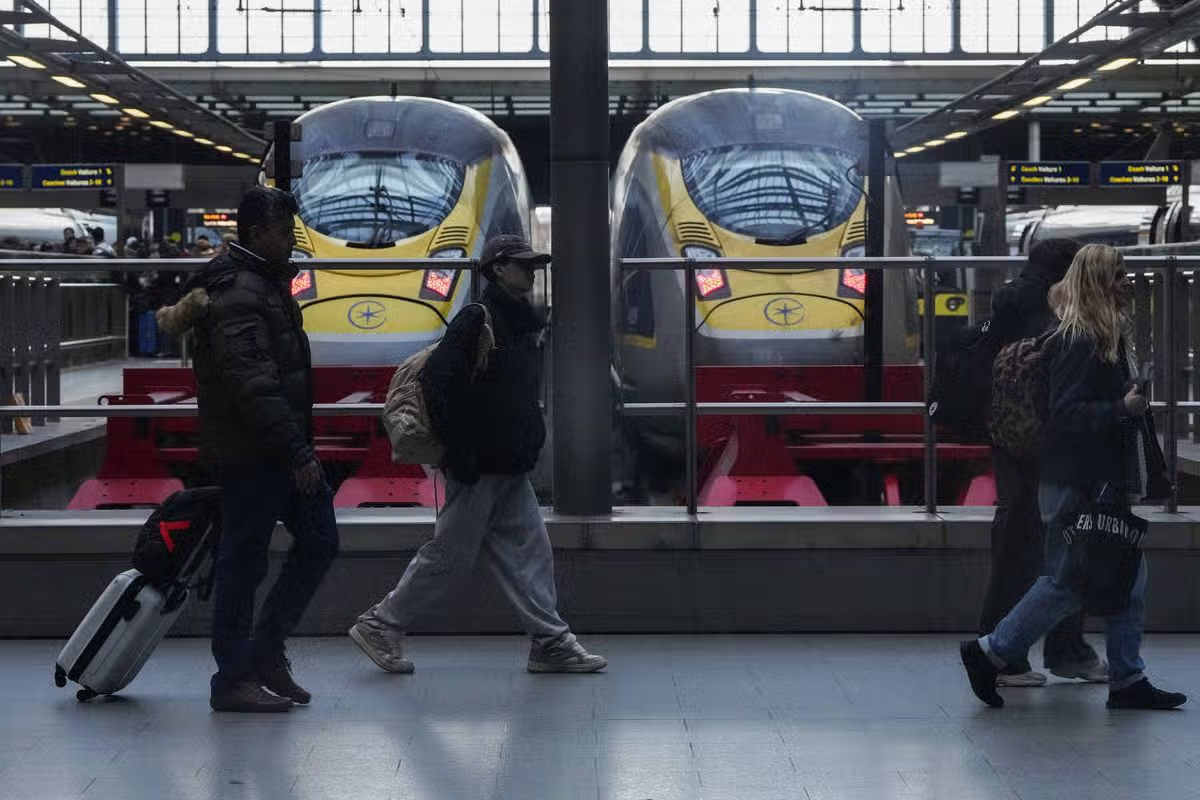
“If you enter the Schengen area through the Port of Dover, Eurotunnel Le Shuttle at Folkestone or Eurostar, St Pancras International, any EES checks will be completed at the border, before you leave the UK. You may also be asked to provide either your fingerprint or photo when you exit the Schengen area.”

“If you frequently travel to the Schengen area for work and/or leisure purposes, you must ensure that your total stay in the Schengen area is no more than 90 days in every 180 days. You must be aware of the penalty and enforcement approach for exceeding the immigration limit in any individual Member State you plan to travel to, or through.”

Source link

Eurostar launches flash sale across ALL its destinations with £35 tickets to 5 European cities – but they sell out quick


EUROSTAR has launched another huge flash sale with tickets starting at just £35 – but you’ll have to be quick. If you’re looking for your next European getaway, now’s the perfect time to book. The flash sale is across all Eurostar destinations, but the reduced tickets are only too five specific European cities. Travellers can…

Source link

Beautiful European train journey that’s half the price of a plane ticket

A scenic train journey from London to Geneva via Paris offers some of Europe’s best views – and can cost half the price of a plane ticket at around £135 return

A rail journey linking three capital cities boasts some of Europe’s most breathtaking scenery—and could set you back half the price of a flight.

The Eurostar and France’s TGV whisk passengers from London to Geneva, making the very most of a trip that spans three nations. The train departs from St Pancras with a change in Paris before heading onwards to the Swiss capital.

It’s a nearly six-hour journey in total, passing through Montbard, Dijon and Bourg-en-Bresse, offering stunning vistas of national parks and rolling countryside. Passengers can hop off in Paris to discover the city—with landmarks including the Eiffel Tower, Notre-Dame, the Champs-Élysées, Sacré-Cœur and the Louvre.

Once the train pulls into Geneva, visitors can take in Lake Geneva, Cathédrale de Saint-Pierre, the Palais des Nations, the botanical gardens and the Brunswick Monument.

From there, it’s also a brief trip to the nearby Alps, with day excursions available from the city to ski or snowboard on the slopes and savour the local restaurants. The train can be half the price of a plane ticket. According to Skyscanner, return flights this month cost up to £394.

During the same period, return train tickets cost around £135, half the price of a flight, according to Trainline.

Families can also cut costs by purchasing Interrail passes—£482 for a family of four to travel on four days within one month, plus seat reservation charges. And expense isn’t the sole advantage.

According to the Times, four passengers journeying from London to Geneva and back by rail produce approximately 44kg of carbon emissions, compared with 108kg by car and 1,608kg by plane. The Intergovernmental Panel on Climate Change states that, to maintain climate change within sustainable limits, each person has a carbon “budget” of 1,500kg of carbon emissions per year.

Although there are a number of factors that determine how polluting different forms of travel are, such as the type of electricity production used to power trains, riding the rails is typically greener than flying.

Back in 2023, carbon calculations made by the Rail Delivery Group found that travelling by rail from London to Edinburgh creates 10 times fewer carbon emissions than by car and 13 times fewer than by plane.

One of the tricky considerations for passengers is generally cost, with budget airlines such as Ryanair, easyJet and Wizz Air typically offering cheaper plane tickets than the equivalent train tickets.

The route from London to Geneva shows that it is not always the case. The price gap between the two forms of transport may also be getting smaller.

Travellers are facing rising airfare costs and reductions in flight schedules as the conflict in the Middle East causes oil prices to soar, with concerns that ticket prices could remain elevated for months even if the war de-escalates. Cathay Pacific, AirAsia and Thai Airways are among a growing number of airlines increasing fares to offset the hikes.

While train services are also impacted by rising oil prices, fuel tends to be a much smaller proportion of their operating margins than with airlines.

Source link

I went on Eurostar standard and plus – here’s why it’s not worth the upgrade

It can be difficult to choose which class to go for when booking Eurostar. Recently, I tried Plus, and while it was a pleasant experience, here’s why I think it’s not worth the money

‘I went on both Eurostar Standard and Eurostar Plus to find out how they compare’

Eurostar offers a fast and efficient way to get from London to the continent, and if you’re doing a day trip or a short break, it can be much more time-efficient than flying.

When you choose your Eurostar train time, you’ll usually be presented with three fare options: Standard, Plus, and Premier. Recently, I took two trips in the space of a week, one on Standard and one on Plus to see how the two classes compare. With Plus tickets often costing double, triple, or even quadruple the cost of a Standard ticket, is it worth the upgrade?

I took the Eurostar Standard from London to Lille, which at just 90-minutes is the shortest journey from London St Pancras. I managed to pick up tickets for £35 one-way in a flash sale, so going to Lille was cheaper than visiting many UK cities by train.

Standard

Standard is a no-frills service. You get a luggage allowance of two bags up to 85cm long on routes to and from London, plus a small item such as a handbag and laptop bag. There are no weight or liquid limits like you’d find on planes, although you do need to heft your bags up and down the steep train steps, so keep that in mind before stocking up on wine at the supermarché.

There are two rows of two seats, which are comfier than most UK trains and have headrests and footrests. Impressively, Standard tickets are flexible up to an hour before departure, so if your travel plans change you can swap your ticket for no fee. You simply pay the difference for your new fare.

Seats come with a power outlet, and you technically get access to WiFi, although on all my journeys, this barely worked, so bring a book. Once settled in, we had some snacks and the journey flew by, and we stepped off the train into the centre of Lille ready for a city break.

Eurostar Plus

A few days later, I tried the Eurostar Plus, this time on a journey from London to Paris. The journey through St Pancras station is exactly the same, you don’t get access to a priority queue, lounge, or boarding, so you don’t really notice the difference until you board. Luggage allowances and rules around flexibility are also the same as Standard class.

The carriages are also very similar to Standard, except with one less seat in a row, so you have two seats on one side and single seats on the other. The single seats seemed popular with business travellers who quickly whipped out their laptops, although with the patchy WiFi, I’m not sure how much work they got done.

Unfortunately, I think I had bad luck with this train: half the toilets were out of order, and the other half were less than pleasant. I had to wobble my way up and down the aisles with a child in tow, trying to find a loo.

The main upgrade on Plus is that you get breakfast or a light meal, plus a choice of drinks, including wine and beer. Dishes are served cold, so they tend to be salads with chicken or fish or pasta dishes. My salmon and lentils were tasty enough, but about on par with what you’d get in Marks and Spencer at the station.

The staff on Eurostar Plus are also extremely friendly and helpful, and it was nice to sit back and be served a meal with wine and coffee on a well-presented tray. But is it worth the upgrade?

READ MORE: Spain airport strikes warning as Easter travellers face severe delaysREAD MORE: Brit lad books Airbnb stay in someone’s garage – and sums it up in 2 words

However, I will admit that the Plus carriage did have a slightly calmer, more business-like vibe, so if you’re on the way to an important meeting, it might be worth the money. Likewise, if you’re traveling alone and don’t want to risk ending up with a chatty neighbour, the thought of booking a single seat might appeal.

Otherwise, take your own sandwich and save your Euros for when you arrive at your destination.

Have a story you want to share? Email us at webtravel@reachplc.com

Source link