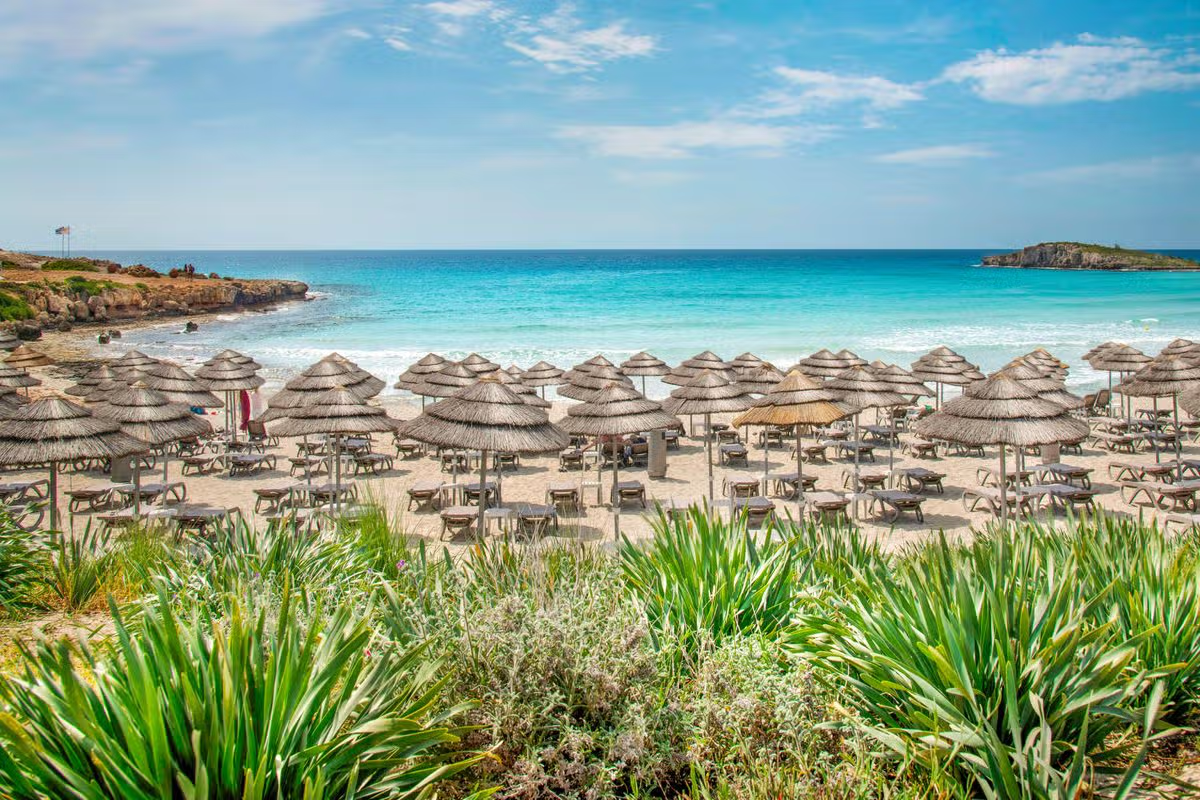
This stunning island, less than five hours from the UK, has been named the best destination for October sun
14:50, 24 Sep 2026Updated 14:54, 24 Sep 2026
This article contains affiliate links, we will receive a commission on any sales we generate from it. Learn more
Beautiful European island named best destination for autumnal sun(Image: Getty Images)
As the weather starts to drop and we head further into autumn, you may be looking for somewhere to jet off to for a week or two in order to enjoy some sun. Some of our favourite summer destinations can always carry a bit more of a weather risk in autumn, and British holidaymakers are increasingly likely to get caught in the rain while away.
With this in mind, the travel experts at Solmar Villas have looked at average weather patterns across Europe to determine the top 10 destinations for sun between September and November. Topping the list was Ayia Napa in Cyprus, with the beautiful island taking all four top spots, with Limassol and Larnaca in second and third, respectively, and Paphos in fourth.
It is perhaps unsurprising that Cyprus topped the list with an average of just 2.3 wet days per month during autumn, and an average temperature of 24°C to 29°C.
According to Skyscanner, the flight fare can be as little as £31 one-way, and will take around just four and half hours for most UK flyers.
Ayia Napa may be best known for its summer party scene, but in the autumn it begins to quieten down (although there certainly is still some nightlife for those wanting some), and you’ll certainly get a much better price than in party season.
The resort town is full of stunning beaches, from Nissi Beach with its beautiful white sands, and the clear waters of Makronissos Beach.
Taking to TripAdvisor, a September visitor to Nissi Beach wrote: “Nissi Beach is heaven just around the corner! Probably one of the most popular beaches in Cyprus—and for good reason.
“Crystal-clear water, beautiful soft sand, and that creamy, turquoise texture that makes you feel like you’re in paradise. Add the amazing atmosphere and beautiful people, and you have the perfect beach experience.”
While an autumnal visitor to Makronissos commented: “The most beautiful beach, clean, lots of sunbeds, clear warm waters, absolutely amazing. The best beach we found. Lovely atmosphere. Bravo municipality, this beach and its staff do you proud. The sunbed prices are the same on every beach, ten euros for a set, so cheap compared to most places, bravo.”
Great Britain’s Chantelle Reid and Damar Thomas will fight for gold at the European Boxing Championships after semi-final victories on Wednesday.
Reid defeated Serbia’s Milena Matovic 3-2 in her light-middleweight semi-final, while Thomas triumphed 5-0 over Azerbaijan’s Mahammad Abdullayev in the men’s super-heavyweight competition.
Team-mates Callum Makin and Dimeji Shittu are also guaranteed medals in the men’s middleweight and light-heavyweight divisions respectively after victories in their quarter-finals.
Reid, the Commonwealth Games silver medallist, was behind after the first round against Matovic, but she was the unanimous winner of the second and did enough in the third to seal victory at Asics Arena Sports Hall in Sofia, Bulgaria.
“It was a really good bout. She’s a really good girl and I hope we get to share the ring again one day,” said Reid.
“On to the next. Each bout’s gone better, each opponent’s gotten better and I’ll be boxing the best out of the weight category in two days’ time.”
The 28-year-old will face Busenaz Surmeneli in the final on Friday, after the Turkish boxer defeated Russia’s Nadezhda Golubeva 3-2.
Thomas, the 21-year-old Commonwealth gold medal winner, will face Russia’s David Surov in Friday’s final after the Russian also completed a 5-0 victory over Austria’s Ahmed Hagag.
Shittu, who had to settle for Commonwealth Games silver in August after a controversial defeat by India’s Ankush Panghal, made sure of a European medal with a 5-0 win against Austria’s Lucky Aimufua.
The 24-year-old will fight Russia’s Cheerav Ashalaev on Thursday for a place in the final.
“My first performance wasn’t the best, but that’s what I’m like, I go back to the drawing board and showed what I’m really capable of,” said Shittu.
“Credit to my opponent. He was game, he was strong, but ultimately skills paid the bills, booked me a place in the semi-finals and a guaranteed medal.
“Last time I brawled, now I want to show that I can box. And the end of the day it’s hit or not get hit. So I went out there, put on a show. Got the medal, let’s go change that colour.”
Makin, a bronze medallist at last year’s World Boxing Championships, won 3-2 against Armenia’s Marat Mikaelyan.
The 22-year-old will face Azerbaijan’s Saidjamshid Jafarov in Thursday’s semi-final.
The remainder of Great Britain’s fighters experienced defeat on Wednesday, with Lauren Mackie and Amy Broadhurst both losing in the quarter-finals.
Commonwealth Games bronze medallist Mackie lost 5-0 to Lenka Bernadova of the Czech Republic in the women’s bantamweight division, while Broadhurst was beaten 4-1 by France’s Sthelyne Grosy in the women’s lightweight.
Abdul Burton also represents Britain on Thursday, facing Turkey’s Semih Gumus in the men’s super-bantamweight semi-finals.
He and Shittu compete in the session starting at 11:30 BST, while Makin’s bout with Jafarov is among the fights scheduled from 16:00.
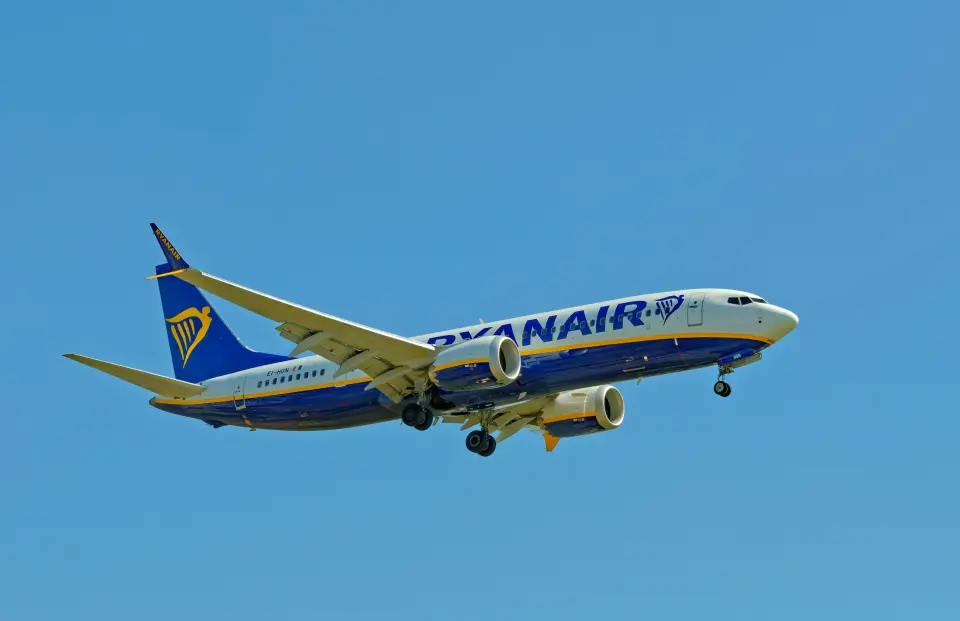
RYANAIR has announced that it is cutting more than half a million seats to two European countries before the end of this year.
The budget airline will scrap 550,000 seats from Estonia and Lithuania this winter, which means it will reduce its capacity to the two countries by around a quarter.
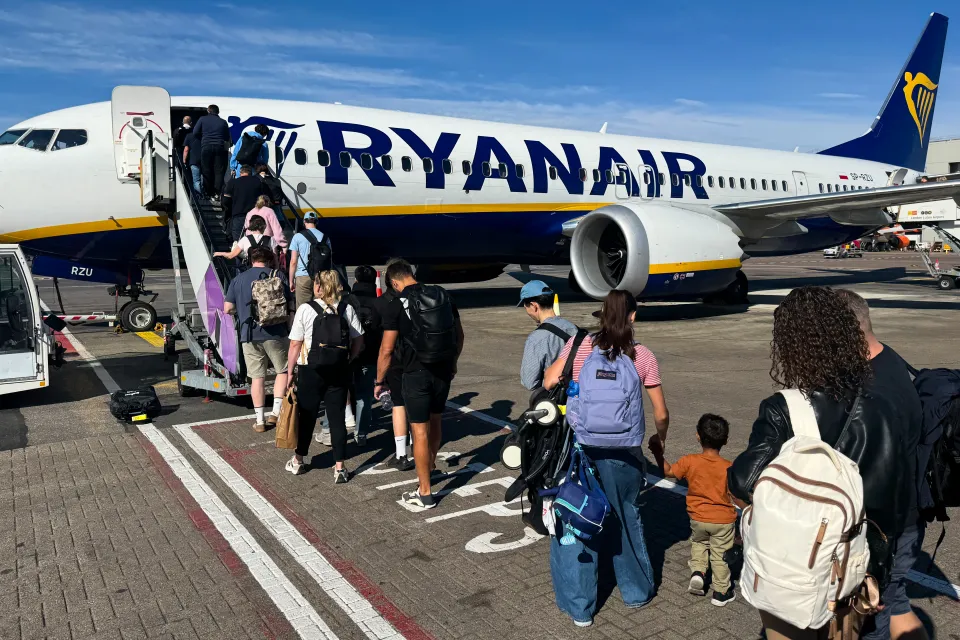
Ryanair is scrapping more than half a million seats to two European countriesCredit: Getty
The airline has said that the decision comes after higher airport costs in the two countries.
According to Ryanair, airport charges in Lithuania have risen by 30 per cent since 2023.
Sign up for the Travel newsletter
Thank you!
In Estonia, on the other hand, there has been an increase in charges at Tallinn Airport.
It isn’t clear how many UK flights will be affected, but overall it works out to as many as 3,000 overall.
Ryanair is now looking at increasing capacity in other destinations with lower airport charges.
For example, Riga in Latvia will gain around 40,000 seats this winter.
This means that the airline will operate 16 routes to Riga during this winter.
Ryanair has also decided to increase capacity on a number of other routes including Barcelona and Milan.
It is adding some seats to other destinations thoughCredit: Getty
A number of other destinations will also lose Ryanair seats this winter.
Greece is set to lose around 700,000 seats and 12 routes.
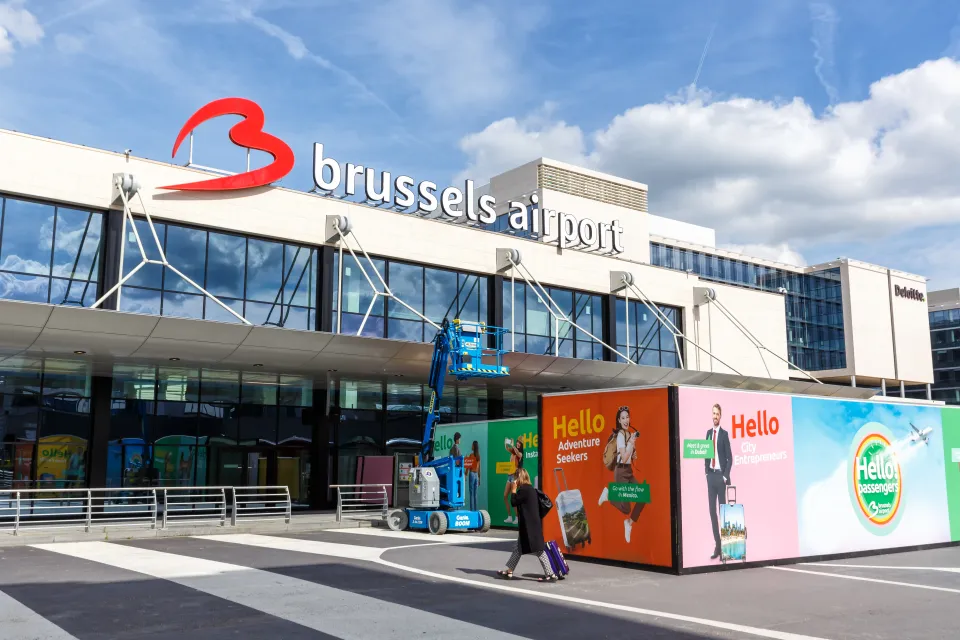
In Belgium, there will be a reduction of one million seats and 20 routes.
And the airline has already axed flights from a number of airports across Spain, Portugal and Germany.
The news comes just days after the airline said that it plans to have 11 million seats across Latvia, Estonia and Lithuania by 2031 and increase its aircraft in the region from seven to 16.
Great Britain are guaranteed at least three medals at the European Boxing Championships in Bulgaria after Chantelle Reid, Damar Thomas and Abdul Burton reached the semi-finals.
Reid cruised to a 5-0 win over Ireland’s Evelyn Igharo in a women’s light-middleweight contest at the Asics Arena Sports Hall in Sofia.
The 28-year-old Commonwealth Games silver medallist will face Serbia’s Milena Matovic in the last four on Wednesday.
Thomas won by the same margin in a men’s super-heavyweight fight against Georgia’s Nikoloz Begadze and the 21-year-old will take on Mahammad Abdullayev of Azerbaijan in the semi-finals.
Burton, 20, beat home favourite and Olympic bronze medallist Javier Ibanez 3-2 to secure a meeting with Turkey’s Semih Gumus.
“Sometimes you have got to dig in and when things went against me I had to get stuck in and show who I was,” Burton said.
“I am young, hungry and here to take over.”
Lauren Mackie, Amy Broadhurst, Callum Makin and Oladimeji Shittu are all due in quarter-final action on Wednesday, but over half of Britain’s squad of 15 are now out.
On Tuesday, flyweight Ruby White was beaten 3-2 by Olympic silver medal winner Hatice Akbas of Turkey while Emily Asquith suffered a 5-0 defeat in her light-heavyweight bout with Ireland’s Lisa O’Rourke.
In the men’s heavyweight division, Commonwealth Games champion Isaac Okoh bowed out with a 3-0 defeat by Germany’s Kevin Lebowski.
If you love a pint after a long day of sightseeing then this city break is a must-visit for autumn. Its self-serve beer fountain means you can try beers from across the region for just a few Euros
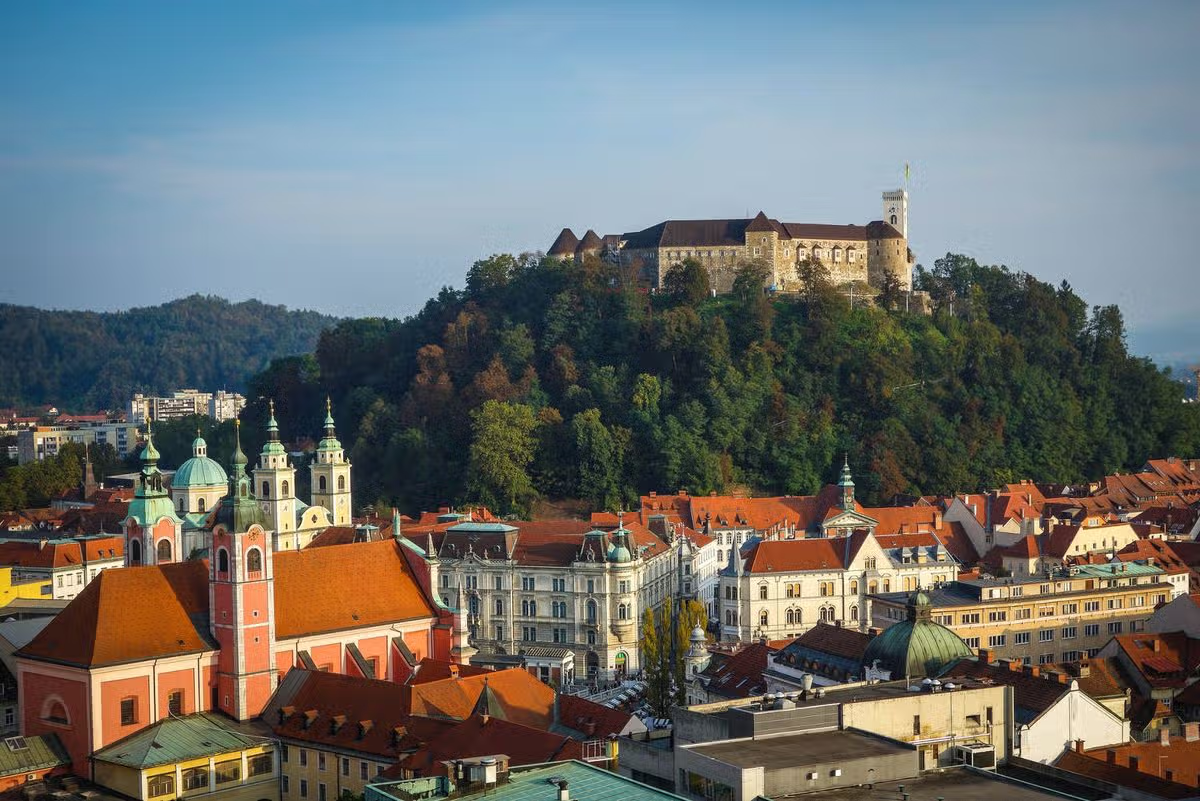
The town is just 90 minutes from Ljubljana by train(Image: Getty Images/RooM RF)
After a long day of exploring a new destination, the highlight of a city break for many of us is sitting in the town square, enjoying a nice cold pint of local, reasonably-priced beer.
And if you visit a small, but charming Slovenian town, you can not only order a pint, but pour your own from a ‘beer fountain’ that offers a variety of local brews to sample.
Žalec in the Lower Savinja Valley is a town that’s beer-obsessed. Even its coat of arms features a beer hop. The region is known as the Valley of Green Gold, named for the color of hops as they ripen in the sun, and it has 150 years of beer-making experience.
Next to Žalec’s marketplace lies the Green Gold Fountain, a unique attraction composed of a variety of shiny silver beer taps. Visitors buy a small glass for €12, just over £10, which pays for the souvenir glass plus six 100ml tastings of various local beers. The cups come with a chip, which is scanned by the fountain, so you can serve yourself.
The fountain opened in March and is set to run through October, so visitors can make the most of the crisp autumn weather while they sample local beers. The 150-year anniversary means there will be a larger variety of ales this year, with 34 craft beers from 25 Slovenian breweries expected to be on tap.
Alex Dyer, a managing director at Ski Famille, highlighted the unusual spot. He said: “The fountain is memorable enough to be one part of the day without making beer the whole purpose of a family visit. I think parents will enjoy the stop more when younger travellers have something of their own to look forward to nearby, because that keeps the day balanced rather than leaving anyone waiting around.”
The town’s visitors can also follow an official tourist route called the Path from Hops to Beer, which is just over 3-miles long, taking in a Roman necropolis and caves along the way. Once you’re back in town, the Eco-Museum of Hop-Growing and Brewing Industry is an interactive way to learn about the town’s proud heritage.
Visitors from the UK can fly from London, Manchester, or Edinburgh to Slovenia’s capital, Ljubljana, which takes just two hours and 20 minutes, making it perfect for a short weekend break. EasyJet has flights in October to Ljubljana from £45.99 one-way.
Žalec is less than an hour from the capital by car, taking you down some seriously steep mountain roads and through the untouched Slovenian countryside. But a more relaxed alternative is the 90-minute train ride, which runs along the River Sava in parts, taking you past charming traditional villages as you head to beer country.
Have a story you want to share? Email us at webtravel@reachplc.com
ONE airline has announced it is axing all flights from three UK airports next year.
It cited “high fuel costs” and “changing consumer demand” for the cancellations.
Corendon Airlines has cancelled flights from three UK airports next yearCredit: NurPhoto via Getty ImagesAntalya is a popular spot in Turkey where Brits head to during the summerCredit: KenanOlgun
Turkish carrier Corendon Airlines will reduce its schedule for next summer which includes cutting the UK airports it serves from six to three.
It will stop flying to Antalya from Gatwick, Birmingham and Newcastle in 2027.
Sign up for the Travel newsletter
Thank you!
The airline increased its offerings with additional flights from the UK just last year.
Despite the reduction, Corendon Airlines will still fly to Antalya twice-weekly from Glasgow with three flights a week from both Manchester and London Stansted.
The airline confirmed it will take a “disciplined approach to capacity for 2027 following a year shaped by geopolitical uncertainty, high fuel costs and changing consumer demand”.
UK country manager Matthew Carpenter said: “In response to a difficult trading year owing to the impact of the Iran conflict, we’ve therefore decided to reduce the number of UK airports we serve.
“We have also decided to end some aircraft agreements, with a consequent reduction in the overall fleet, which has a natural impact on our UK schedule and capacity.
“This is a short-term reaction and we plan to review the trading conditions again in January and hope to re-introduce flights to Birmingham, Newcastle and Gatwick as soon as oil prices stabilise and trading conditions improve.”
Corendon Airlines will stop flying from three UK airports next yearCredit: Alamy
Corendon Airlines will continue flying to Crete from both London Gatwick and Manchester Airport.
The airline was first formed in 2004, and launched its first flight one year later.
In 2025, Corendon Airlines reportedly carried 10 million passengers a year across Europe.
A WOMAN from the UK was stopped at the border abroad after she was told she had overstayed in Europe – despite her not.
Paula Pugh was going on holiday to Italy but was taken back to the UK after systems showed she had overstayed her limit of 90 days in a 180-day period in the Schengen Area.
One British woman was deported from Italy after an EES errorCredit: AlamyHer exit from a previous European country had not been correctly recordedCredit: Alamy
EES has been causing chaos for lots of Brits since it was first introduced earlier this year including airport delays and missed flights,
But now, it is also causing problems for passengers by incorrectly claiming they are staying too long in Europe.
Sign up for the Travel newsletter
Thank you!
Talking to The Telegraph, Paula Pugh, 60, explained how she was escorted out of Italy and taken back to the UK because of the error.
Travelling with her husband and cousin for a five-day trip to southern Italy, Paula was flagged at border control shortly after landing.
She was accused of overstaying her 90 limit in the Schengen Area despite taking just three short visits to Spain and one to France – which totted up to 22 days.
Talking to the publication Paula explained she “wasn’t allowed to go anywhere without a police presence.”
Paula was put on a flight home on the same day from another airport with Ryanair along with her family.
Her passport was given to the captain for the duration of their flight.
She added: “My husband then asked the cabin crew where I would get my passport, and we had to walk to the front of the plane.
“Somebody came onto the plane, took me off the plane, had a look, gave me my passport, and said ‘There you go.’ As though it was all over and all forgotten.
“I’m still very upset when I think about it.”
The cancelled trip and return flights home cost the family around £2,000.
EES has replaced the need for manual stampsCredit: REUTERS
Now, Paula is trying to get her record corrected.
Previously, Brits were manually stamped in and out of a country at border control. EES has replaced that with the taking of biometrics and fingerprints.
However, in some cases where EES has been turned off at airports due to faults, or delays, the exit for Brits has not been recorded and the days spent in the Schengen Area continues without them knowing.
A UK Government spokesman told The Telegraph: “While EES is anEU scheme, we recognise this is a significant change for British travellers, and advise that they read the latest Foreign, Commonwealth & Development Office (FCDO) Travel Advice about the scheme before travelling.“
In August, the UK Foreign Office altered its advice to Brits asking them to carry evidence of when they last left the EU, to avoid being wrongly refused entry.
Brits travelling from the UK to Europe can spend 90 days out of every 180 in the EU – staying over this limit will mean both refusal of entry and a fine.
In some cases a fine can be as much as £8,550.
Advice from the Foreign, Commonwealth & Development Office (FCDO) reads: “If you believe you have been incorrectly entered into EES or your record of time spent in the Schengen area is incorrect, approach border officials when you next cross the Schengen border and request a correction.
“If you are exempt, carry documentation confirming your status. If you believe your time spent in the Schengen area has been recorded incorrectly, raise this with border officials and be prepared to provide supporting evidence if requested.”
If you want to check the days left on your record before travelling, the The European Commission has anEES online tool.
A weekend in Europe might seem like an expensive option in the run up to Christmas, but these festive weekend breaks could be cheaper than the train fare to another UK city and offer unforgettable Christmas market experiences
08:30, 21 Sep 2026Updated 08:30, 21 Sep 2026
Europe has many spectacular Christmas markets(Image: Getty Images/age fotostock RM)
While the UK has some great Christmas markets, the ones found in Europe tend to be bigger and more traditional. If you’re dreaming of drinking mulled wine and wandering around wooden chalets to buy gifts, you don’t need to drain your bank account to enjoy a festive weekend away.
Here are some Christmas market breaks coming in at around £100 per person. Prices are correct at the time of going to press, but can change, especially air fares which are likely to become more expensive as the Christmas dates book up.
Christmas in Tivoli – Copenhagen – £96.50
Many Christmas markets are set in town squares, but Christmas in Tivoli takes over Copenhagen’s historic amusement park, turning it into a winter wonderland. Its beautifully decorated gardens are full of wooden stalls, often dusted with snow, and there are festive rides, freshly-baked Danish treats, and serious hygge vibes. Head to Christmas in Tivoli for its opening weekend, November 13, and you can take return flights from Bristol for £56 on Ryanair.
With just a two hour flight time it’s perfect for a weekend break, and you can return on Sunday to avoid taking extra annual leave. Generator Copenhagenis about a 15-minute walk away, or a quick metro ride, and has a lively bar, restaurant, and terrace. Stays start at £23.81 for a dorm. Another unique option, if you’d like a little more privacy, is the Urban Camper Hostel, which has indoor tents that come with twin or double beds and lockers. Prices start at £40.50 per person for the weekend based on two sharing. If you prefer a hotel, you can find stays from £82 for two nights with Kayak.
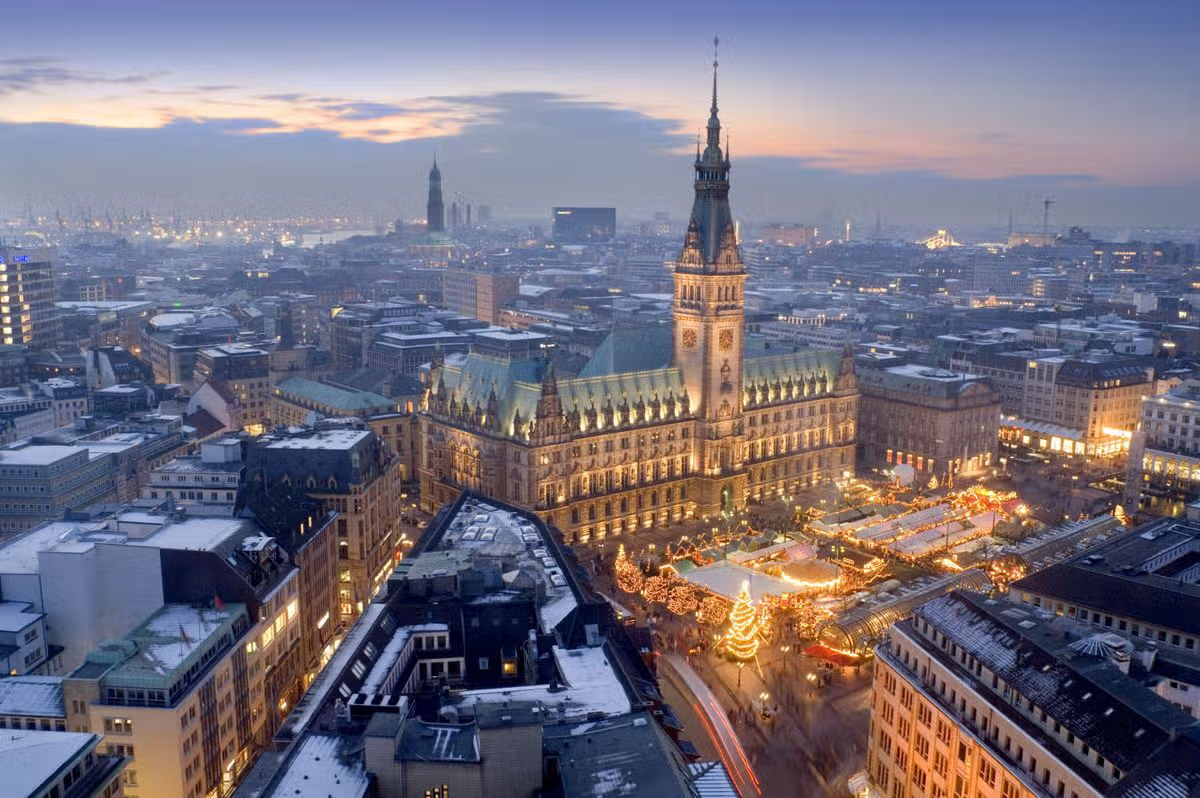
If traditional Christmas markets are your thing you can’t go wrong with Spitalerstrasse in Hamburg, which is basically a blueprint for every festive city centre event in Europe. Wooden chalets line the streets, vendors sell gingerbread, bratwurst, and mugs of glühwein, and it’s all set amid a backdrop of glorious medieval buildings covered in twinkly lights.
Hamburg has fewer options for direct flights from the UK – only London and Manchester offer this route – but there are bargains to be found. For example, if you travel between November 20 and 22, a return from London-Stansted costs £48, and the 90 minute flight time makes it perfect for a weekend away.
Next to Hamburg’s central station is the Generator Hamburghas basic dorms from £25.67 a night. Other budget options in the centre include the unique CAB20, which offers inexpensive cabin-style rooms for £164 for two nights based on two sharing.
Plaza Mayor Christmas Market – Madrid – £84.50
Enjoy Christmas with a Spanish flair at the Plaza Mayor Christmas Market, which runs from late November to December 31. The Spanish capital’s stunning historic square is the perfect backdrop for more than 100 red stalls, lit by fairy lights, where you can buy handcrafted nativity figures, unique decorations, and gifts. Enjoy freshly roasted chestnuts, turrón nougat, or churros with proper hot chocolate.
The cool weather means December tends to be an inexpensive time to visit Madrid, and if you fly from Bristol on Friday December 4, coming back Sunday, you can pick up flights from £38. If you’d like to stay in the city centre, one option is the Capsule Inn Madrid where couples can share a double capsule for £93 for two nights. Although it’s an extremely cosy space so you’d need to ensure you don’t fight at the airport before arriving.
Campo Santo Stefano Christmas Market – Venice – £94.56
Venice’s Campo Santo Stefano Christmas market kicks off on November 17, so it’s perfect for an early festive break. Stick to November dates and you can avoid the tourist crowds, and browse a wide range of Italian and European Christmas foods, artisan gifts, and canals lined with lights.
You can book flights from November 27 to 29, departing London-Luton on Wizz Air from £43, while the Generator Venice, housed in a historic building on Giudecca Island, has beds from £25.78 a night on those dates. Giudecca Island is about a 20-minute walk to the Christmas market, taking you across Venice’s bridges, or you can take a boat and enjoy the festive canal views. Meanwhile on Skyscanner you can find hotels with stays from £92 for two nights over a December weekend.
RAW Christmas Market – Berlin – £109.94
Berlin’s RAW Christmas Market is a unique experience. Set in a former railway repair yard in the hip, alternative neighbourhood of Friedrichshain, it has a medieval theme giving it vaguely Ren Faire vibes. Taking place from November 12 to December 22, you can enjoy this creative market which includes a wooden Ferris wheel, street entertainment, and lots of artistic stalls.
You can fly with Ryanair from London-Stansted to Berlin on November 20 to 22 from £51, making it an ideal time to visit the city. Continue the cool arty theme with a stay at Generator Berlin Mitte, a design-led hotel that has dorms, sleeping pods, and private rooms, from £18.99 a night. A single pod is £29.47 a night, if you’re feeling brave and not claustrophobic, while a private twin ensuite room for the weekend costs £92.82 a night.
Have a story you want to share? Email us at webtravel@reachplc.com
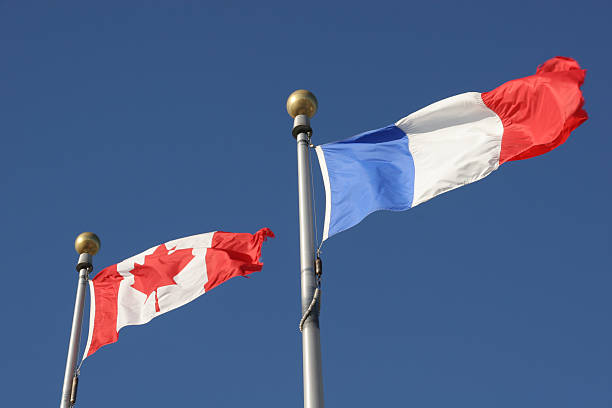
Canada and France plan to cooperate on space-launch systems and ground-based infrastructure as Ottawa seeks closer economic and security ties with Europe.
Prime Minister Mark Carney announced the initiative Sunday with French President Emmanuel Macron in Saint-Pierre and Miquelon, the French
EUROCAMP has hundreds of resorts across Europe – but there is one that has been backed by mums as being the best.
Found in Holland, Duinrell has a lot to shout about including a theme park as well as a huge indoor and outdoor waterpark.
Eurocamp Duinrell in the Netherlands has a huge theme park that’s free for guestsCredit: EurocampIt also has an indoor and outdoor waterparkCredit: Eurocamp
With all this, it’s no surprise that it’s one of the top-rated Eurocamp resorts for families – and it was voted as such on Mumsnet.
Its main draw is the enormous theme park which is completely free for guests with over 40 rides and attractions.
Sign up for the Travel newsletter
Thank you!
It has high thrill rollercoasters like The Falcon which is 72 feet tall with vertical drops, loop the loops and a top speed of 43mph.
There are other more family-friendly rides like log flumes, bumper cars, slides and climbing towers.
Something else that makes it so popular is the enormous waterpark which has a total of 21 waterslides and huge swimming pools which are both indoor and outdoors.
The complex has a lazy river, a wave pool and an outdoor Tiki pool with tipping buckets and fountains which is open in the summer months.
Inside is where families will find the Playa waterpark which is especially designed for little kids up to 12 years old, with four waterslides for children.
Guests will need to pre-book time slots and pay up to €15 (£12.88) per person for the waterparks.
Activities don’t stop there either, as families can spend hours in its arcade which has over 80 games.
There’s mini golf, air hockey, classic arcade games, including eight immersive racing simulators.
The outdoor pools and slides are open during the summer monthsCredit: Eurocamp
In the comments, one previous visitor wrote: “We love Duinrell…I would do at least a week as loads to do.”
Another added: “This is an absolutely brilliant place!! Everything about it is spot on! Between the accommodation and the theme park, it’s all fantastic.”
A third said the waterpark was the “best we’ve been to!”
The park has eating options too from a creperie to an Italian restaurant and at the bars there’s entertainment like discos, karaoke and talent shows.
As for a place to stay the Eurocamp has a selection of ultimate holiday homes which can sleep up to eight across three bedrooms.
They have fully kitted out kitchens with open living areas and spacious bedrooms.
All of its attractions mean Duinrell has been declared the best for familiesCredit: EurocampYou can stay in Duinrell Eurocamp from £23.70pppnCredit: Unknown
When the sun shines there’s an outdoor decking and a barbecue too.
For eight people to stay in an Ultimate 3-bedroom cabin next May for seven-night works out to £1,327.48 or £23.70pppn.
The Eurocamp is just outside The Hague, meaning that luckily for Brits it’s very easy to get to as it sits in between Amsterdam and Rotterdam.
Flights to Rotterdam can be as quick as 50-minutes and heading to Amsterdam can take just one hour.
The cities can also be reached by the Eurostar in three hours and 15 minutes.
For more Eurocamp resorts, here are 10 with pools, waterparks and beaches.
Looking at today’s schedule, it’s mostly arrivals into the airport after 9.30pm that are affected.
Only two flights from the UK are affected by the strike action today.
The first is a flight from Manchester Airport to Charleroi which was scheduled for 10.55pm and has since been cancelled.
The second is a flight from Charleroi to Manchester Airport which was scheduled for 19.35pm and has also been cancelled.
Ryanair has asked passengers to monitor their Ryanair App for the latest updates regarding their flight.
In a previous statement, the airline said: “We sincerely apologise for any inconvenience caused as a result of these ATC strike delays/cancellations, which are entirely beyond airlines’ control.”
Yesterday, about 40 flights in total were cancelled at Charleroi Airport.
According to Skeyes, the Belgium‘s official national air navigation service provider, the nightly strikes are expected to affect more than 800 flights.
The strike is set to continue until October 10Credit: Getty
It is now 11 years since the Cherries were first promoted to the Premier League, meaning there is now a generation of supporters who will view top-flight football as the norm.
From that perspective then, qualifying and playing in Europe might simply appear the next logical step for a well-run and ambitious club.
“It’s a brilliant win in our first European game. It’s brilliant for the club and the 2,000 fans from Bournemouth,” manager Marco Rose told TNT Sports.
Yet for the vast majority of fans celebrating a famous victory on Thursday, the whole thing still seems surreal.
Just 18 years ago, the club was on the brink. A 10-point deduction for entering administration resulted in their relegation to League Two.
To even stay in the Football League for the 2008-09 season, they had to accept a 17-point deduction and agree not to appeal against the decision after it was ruled that, as they had been unable to agree a Company Voluntary Arrangement, they had not met their terms for exiting administration.
Thoughts of a £100m-rated midfielder picking out a Brazil winger to head Bournemouth to victory in Europe was the stuff of fantasy as the Dorset club battled for survival.
But that now is Bournemouth’s reality with Alex Scott swaggering around San Sebastian, showing why there is such a clammer for his signature among top Premier League clubs, and Rayan providing another example of why the Cherries will demand every penny of a reported £130m release clause to let him go.
Bournemouth have nothing to compare it to but this was a proper European away performance.
Up against a Real Sociedad side led by a World Cup-winning forward in Mikel Oyarzabal and who beat Atletico Madrid to win the Copa del Rey last season, they were dominant for 45 minutes.
They suffocated Sociedad with their relentlessness off the ball, winning the ball back high up the pitch time and again and showing the quality on the ball to create chances – even when the defence was set.
But there is an edge to the Basque side and, poor as they had been, that they came out fighting after the break was no surprise.
The adrenaline-fueled exuberance of Rose’s side in the first half appeared to catch up with them in the second, but their desire to compete never wavered.
Bournemouth are not known for their defensive resilience and, as Sociedad ramped up the pressure as the game wore on, thoughts might have turned to leads surrendered in each of their first four Premier League games.
But the Cherries, aided by the sharp reflexes of Djordje Petrovic in goal, held on to secure a famous win.
“It was very intense and tough,” Rose told TNT Sports.
“Brilliant first half in everything. The way we won balls and the possession high up. In the second half, we needed to suffer because we were not so sharp.”
Speaking on BBC Radio Solent, former Cherries full-back Charlie Daniels added: “It is a big occasion. A big moment for the club, and they should be applauded for it.”
Senior U.S. Air Force leaders in Europe say NATO allies are increasingly looking to participate in the development and employment of collaborative combat aircraft (CCAs), even as several of those same countries pursue their own indigenous fighter and drone programs. American commanders say they are looking forward to CCAs expanding the alliance’s overall capacity, and are already pushing for such systems to work together from the outset.
Speaking yesterday at the Air & Space Forces Air, Space and Cyber Symposium that TWZ is attending, Lt. Gen. Jason T. Hinds, commander of U.S. Air Forces in Europe, U.S. Air Forces Africa, and NATO’s Allied Air Command, and Chief Master Sgt. Joshua J. Wiener, USAFE-AFAFRICA’s command chief, discussed how the command is preparing for an eventual European role in the U.S. Air Force’s planned fleet of hundreds of CCAs.
U.S. Air Force Lt. Gen. Jason T. Hinds, U.S. Air Forces in Europe – Air Forces Africa commander (far left), and U.S. Air Force Chief Master Sgt. Joshua J. Wiener, USAFE-AFAFRICA command chief (second from left), pose for a group photo with the Association of African Air Forces representatives from Kenya, Nigeria, and Tunisia at Ramstein Air Base, Germany, earlier this month.
The issue is particularly significant for USAFE, which operates a fraction of the fighter force it maintained in Europe during the Cold War, even as many of its NATO allies contend with shrinking fleets of crewed combat aircraft. This comes against a backdrop of deepening tensions with Russia and the emergence of new kinds of threats. Autonomous aircraft that can augment crewed fighters could provide the alliance with additional combat mass without requiring a corresponding increase in the number of crewed aircraft and personnel permanently based in Europe.
“I’m excited about what CCAs have in store for the Air Force,” Hinds said, pointing to recent comments from the Secretary of the Air Force Troy Meink, including the aim of having at least 500 CCAs in service by 2032.
He added that European interest in these kinds of platforms is already growing.
“I think you’re going to see a lot more interest from other nations inside Europe about what is America doing with CCAs and how they can join this party, if you will,” Hinds said.
Germany is “heavily involved,” he said, while Scandinavian countries and the Netherlands are also showing interest.
In the case of Germany, we have previously explored how that country is looking to procure CCAs by 2029. Sweden, too, recently unveiled a concept for a high-end, stealthy CCA-type drone, while the Dutch are looking to become more closely alligned with U.S. Air Force CCA efforts.
Saab has produced a full-scale concept model of a future uncrewed combat air system, known as aircraft A3. Saab
USAFE is currently using two broad operational scenarios to explain to allies how CCAs could fit into NATO’s force structure.
The first is defensive. A CCA could operate as part of an integrated air and missile defense network, potentially engaging one-way attack drones or cruise missiles without the need for expensive crewed fighters.
The second is offensive. In that scenario, autonomous aircraft could help suppress or destroy integrated air defense systems and potentially attack fielded forces during an effort to repel a hostile incursion into NATO territory.
Allies are interested in both missions, Hinds said, and want the ability to incorporate CCAs into their own force designs. Interestingly, only yesterday, Anduril shared photos of its YFQ-44A Fury configured with air-to-ground weapons, underscoring the fact that the CCA could take on an air-to-ground role in the future in addition to its current air-to-air focus.
A YFQ-44A carrying pods for 2.75-inch rockets and 500-pound Joint Direct Attack Munitions (JDAM) under the wings. Anduril
That kind of interest has already prompted work at the NATO level. Hinds pointed to a study by the Joint Air Power Competence Center, the alliance’s airpower think tank based in Kalkar, Germany, examining how NATO members could employ CCAs in a modular fashion, including issues such as sustainment, training, and exercises.
“It was a pretty long paper, but the nations wanted it,” Hinds said.
Initial experimentation is expected to take place in the United States, but European experimentation could follow, including by Sweden and potentially other NATO members.
At the same time, European countries are not simply waiting for an American CCA to arrive.
The United Kingdom has launched its own Storm Fighter CCA program. Germany is pursuing a separate loyal-wingman effort, while the United Kingdom, Italy, and Japan are meanwhile jointly embarked on the Global Combat Air Program, or GCAP, which is intended to produce the Tempest next-generation crewed fighter and associated uncrewed systems.
A rendering of a CCA concept released at the launch of the U.K. Royal Air Force Storm Fighter program, earlier this year. BAE Systems
The proliferation of national programs raises an obvious question: How does NATO prevent a growing fleet of autonomous aircraft from becoming a collection of incompatible national systems?
Hinds said the answer starts with commonality.
“The first and foremost thing is we want to strive for commonality,” he said. “Commonality means we don’t even have to worry about interoperability.”
Where common equipment is not possible, however, USAFE wants interoperability built into national systems from the beginning.
“Interoperability by design” is the preferred approach, Hinds said, with NATO data standards and other requirements incorporated before a system enters service rather than retrofitted later.
The good news for USAFE is that NATO already has extensive experience establishing common standards for interoperability, covering everything from tactics and procedures to communications, datalinks, weapons employment, and other technologies. That existing framework gives the alliance a foundation for integrating increasingly diverse national systems without requiring every member to field identical equipment.
F-35A from the U.S. Air Force’s 48th Fighter Wing and the Royal Norwegian Air Force fly tandem after a formation flight near Lofoten, Norway, March 10, 2026. The formation flight was intended to symbolize the partnership and degree of interoperability displayed between participating NATO militaries during Exercise Cold Response 26. U.S. Marine Corps photo by Cpl. Mya Seymour Cpl. Mya Seymour
Hinds did warn that some countries have previously acquired equipment that was not compatible with NATO systems, leaving them with the choice of paying to modify their own equipment or forcing the alliance to adapt its systems around it.
That problem becomes particularly important as autonomous aircraft are connected to increasingly complex sensor and weapons networks. Even more important is the requirement for a baseline command-and-control network for CCAs themselves, allowing different platforms to manage them seamlessly.
The ability to share and control CCAs across a complex battlespace is already emerging as both a major opportunity and a significant integration challenge. The U.S. Air Force and Navy, for example, have made clear that their respective CCAs are being developed with the ability to be controlled seamlessly across services, pointing toward a future in which autonomous aircraft need not remain tied to the service or platform that launched them.
In such an architecture, the aircraft, sensor, command-and-control network, and weapon do not necessarily have to belong to the same country.
As an example, Dutch F-35s, operating in Europe, have used a data-exchange system to transmit targeting coordinates to Israeli-made PULS (Precise and Universal Launch System) rocket artillery. The system, developed by Lockheed Martin is known as Keystone, and you can read more about it here.
A Dutch F-35A brandishing its AIM-120 AMRAAM missiles during a NATO air policing drill. Bartek Bera
USAFE is making “significant advances” in areas including cross-servicing, cross-loading, and cross-flying allied aircraft, Hinds said, all of which are intended to make multinational operations more seamless.
A U.S. Air Force F-35 crew chief conducts post-flight checks at Pirkkala Air Base, Finland, during the tactical exercise, Ramstein Flag 26. U.S. Air Force photo by 2nd Lt. Sarah Hedgman
The same philosophy applies to weapons.
“We want to have all the fires, right? Whether it’s U.S. built or built inside European nations,” Hinds said.
That could prove increasingly important as European countries expand domestic production of missiles, drones, and other weapons alongside their aircraft programs.
The growth of GCAP and other European defense programs comes amid broader debate over how much Europe should depend on U.S. military equipment.
But Hinds rejected the idea that allies developing indigenous aircraft and autonomous systems necessarily signals a move away from American equipment.
“No, I don’t,” he said when asked whether allies were moving away from U.S. systems.
Instead, Hinds characterized the trend as an expansion of the transatlantic defense-industrial base.
Sweden was one example he cited. The country, which recently joined NATO, continues to produce new military equipment, including Gripen fighters, while those aircraft are already being operated by NATO members.
Swedish Gripens are currently leased to Hungary, and other countries are considering the aircraft, Hinds said.
A Hungarian Air Force JAS 39C Gripen participating in NATO Exercise Ramstein Flag 24 flies over the west coast of Greece, in 2024. U.S. Air Force photo by Tech. Sgt. Emili Koonce
The broader trend toward co-manufacturing and co-production is also something he welcomed.
“I’m seeing a lot of discussions about co-manufacturing and co-production, and I welcome those discussions as well,” Hinds said.
That approach could become increasingly important as NATO tries to expand its available combat power without relying exclusively on additional U.S.-built platforms.
For USAFE, the objective is to ensure that whatever aircraft NATO countries develop or purchase can plug into a common architecture, sharing data, receiving targeting information, drawing on common logistics networks, and contributing weapons effects across national boundaries.
For a U.S. Air Force command that has spent decades trying to cover Europe with far fewer fighters than it once had, hundreds of autonomous wingmen, whether American-built or allied, could provide a significant way to generate additional combat mass.
Senior U.S. Air Force officials are now working to ensure that the networking, weapons integration, logistics, and command-and-control architecture will be in place once those aircraft start to come online.
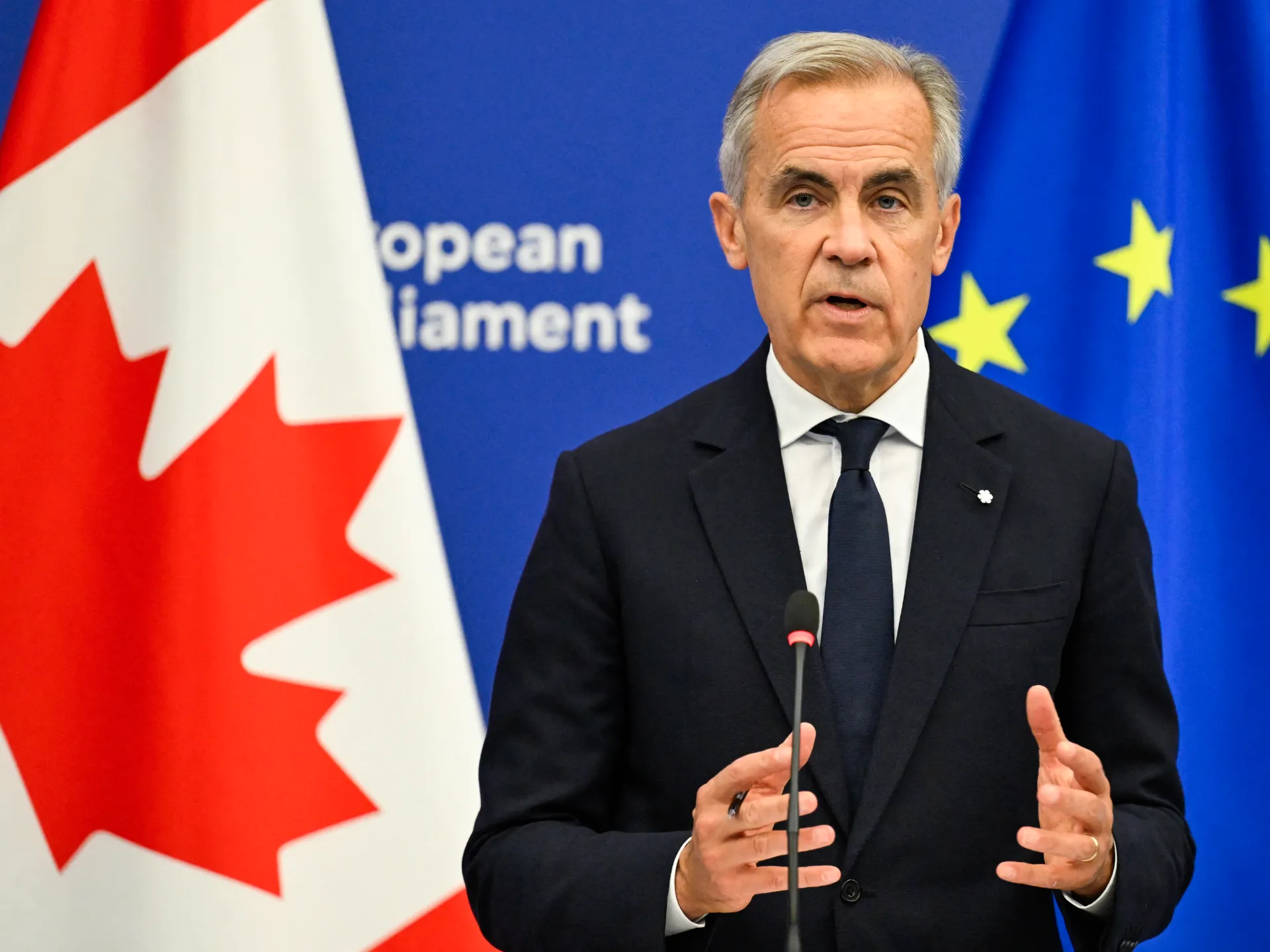
In address to European parliament, Canadian Prime Minister Mark Carney listed areas where he wants to boost cooperation.
Published On 17 Sep 202617 Sep 2026
Canadian Prime Minister Mark Carney has welcomed the prospect of his country becoming the European Union’s first associate member, saying such an alliance is aimed to be a “beacon for democracies” and not to “dominate others”.
Speaking in the European Parliament in Strasbourg, Carney said Canada “welcomes” von der Leyen’s ambition to make the country an associate member.
Recommended Stories
list of 3 itemsend of list
“We are not fair-weather allies. We do not pursue zero-sum deals. We hold common values for which we have always fought, and in whose defence we must always remain vigilant,” Carney said to applause from European lawmakers.
“Canada and Europe are each strong. Europe and Canada are stronger together.”
“I am not proposing a third bloc in order to become a great-power rival – only with better manners,” he continued. “We do not seek power to dominate others. On the contrary, we are pursuing resilience so that no one can control our open markets, impair our sovereignty, threaten our territorial integrity, or undermine our freedoms, our democracies, our rule of law.”
Carney listed a slew of areas where he wanted to ramp up cooperation.
“Canada and Europe should secure our strategic autonomy through deep cooperation in the full range of strategic capabilities, including critical minerals, defence industrial capacity, AI and compute, energy security, space and payments.”
He also said the EU and Canada should move towards “seamless digital trade” and allow young people from both sides to work and study on either side of the Atlantic.
The EU and Canada have been facing stiff rivalry and pressure from Trump’s administration on trade, among other matters, and from an increasingly assertive China.
Trump threatened late on Wednesday to take action against the EU if it moves forward with von der Leyen’s proposal of associate membership for Canada.
“If they do that, if I think it’s at all a hostile act, I will put very serious tariffs or stop trading with Europe on many things,” Trump told reporters, calling the proposal “laughable”.
“If it’s a good intention, that’s fine. If it’s a bad intention, we’ll put very heavy tariffs on Europe,” he added.
The European Commission (EC) said von der Leyen’s proposal – which is yet to be fleshed out and will need to be approved by EU member states to go forward – was not a hostile act.
“As our President (von der Leyen) made clear yesterday, the proposed strengthening of our partnership with Canada is not against anyone else, but for our common strength,” said Olof Gill, an EC spokesperson.
Investors in Europe took the Federal Reserve rate hike in their stride.
ADVERTISEMENT
ADVERTISEMENT
Both the Euro Stoxx 50 and the broader pan-European Stoxx 600 traded over 0.6% higher at the start of Thursday’s session.
France’s CAC 40, Germany’s DAX 30, Italy’s FTSE MIB, Spain’s IBEX 35, the Netherlands’ AEX and Switzerland’s CH20, all traded between 0.2% and 0.7% higher than their Wednesday close.
The UK’s FTSE 100 led the pack and rose more than 1%.
Carmakers and industrials led the Paris index, with Renault gaining more than 2%, Stellantis 1.6% and Schneider Electric 1.3%. Technology went the other way, with Dassault Systèmes falling 2.4%.
The calm followed a rougher session in New York, where the Dow Jones Industrial Average closed 1.2% lower on Wednesday and the S&P 500 fell 0.4%, while the Nasdaq was broadly flat.
Asian markets were mixed overnight with Tokyo’s Nikkei 225 rising 0.2%, Seoul’s Kospi gaining 0.9%, while Hong Kong’s Hang Seng lost 0.7% and the Shanghai Composite 0.4%.
Reactions were “pretty much expected since the rate hike was also in line with market expectations”, said Lorraine Tan, director of equity research for Asia at Morningstar, adding that the Iran war is likely to keep pressure on inflation.
A stronger US dollar and higher yields
The more consequential moves were in currencies and bonds.
The US dollar climbed to its highest in seven weeks against a basket of major currencies, lifted by the jump in short-dated Treasury yields that followed the decision.
The euro was trading around $1.146, down 0.5% from Wednesday’s open.
A stronger US dollar makes European exports more competitive in American markets, but it also raises the cost of anything priced in dollars, which includes oil and gas, which compounds Europe’s energy bill at a difficult moment.
In bond markets, the two-year Treasury yield, the maturity most sensitive to rate expectations, jumped to around 4.72% from 4.67% before the decision, holding near that level on Thursday.
The 10-year sat close to 5%, reflecting both the war-driven energy shock and mounting investor concern about American government debt.
Traders now fully expect another rate hike by December and put the odds of a move as soon as October at around 50%. Goldman Sachs became one of the first major Wall Street banks to forecast consecutive hikes, reversing its previous view that this month’s move would be the only one.
Attention turns next to the Bank of England, which announces its decision later on Thursday and is expected to hold rates steady, and to the Bank of Japan on Friday, where a hike is anticipated.
A European city with a lot of history and beauty at odds with its negative reputation is quicker to get to from the UK via train than by plane.
New research from global travel booking site Omio has identified 25 European routes where travelling by train is actually faster than flying once airport transfers, security queues and boarding times are taken into account. While many holidaymakers automatically book flights for a weekend escape, the findings suggest they’re often overlooking rail journeys that are not only quicker, but also less stressful.
They’re also much less environmentally damaging, with the emissions per plane passenger typically several times higher than those of train passengers.
A trip from London to Brussels is one of the biggest examples of where rail beats air. The Eurostar takes just 125 minutes, making it 83 minutes faster than flying once airport transfers, security checks and boarding times are factored in. Tickets start from around £148, with passengers arriving directly in the heart of the Belgian capital.
Whether or not the city is worth a visit is a different matter. Brussels is, according to some people, a boring city.
“As much as I tried, I still could not shake the feeling that Brussels was undeniably boring,” one travel blogger recently wrote of Brussels following a trip there. Back in 2008, it was awarded the title of the world’s dullest city in a survey of international travelers, who judged it duller than Zurich and Warsaw.
Having made a short visit to the city in recent years, the criticism does seem a little just. Brussels does have a functional, workman-like feel to it, thanks to the huge number of governmental buildings. And yes, it does look like an AI picture generator’s attempt to ‘simulate a standard European capital’, as one online commenter complained.
However, there are plenty of redeemable qualities of Brussels. The atmosphere is pleasant enough, many of the buildings are beautiful, and it is home to two of the Continent’s great contributions to culinary culture – waffles and chips – even if there is a distinct Sunday afternoon feel to the place.
“Brussels is an ideal destination for a short city break, thanks to its impressive medieval architecture, relaxed atmosphere and more than 100 museums. Visitors can spend the day wandering the city’s historic streets before stopping for Belgian beer and world-famous chocolate. With average July temperatures of 23°C, it’s also an ideal city to explore on foot,” writes Omio.
Given Brussels’s closeness to the UK, a day trip is well on the cards. If you do go down that route, I suggest the following one-hour tour of the city:
Starting at the famed Manneken Pis statue depicting a urinating child (who had been dressed up in a miniature gown and hat to celebrate the city’s graduating students when I was there), dash to the Monument a Everard t’Serclaes, helping the reclining lady’s leg become even shinier with a quick, traditional good luck rub.
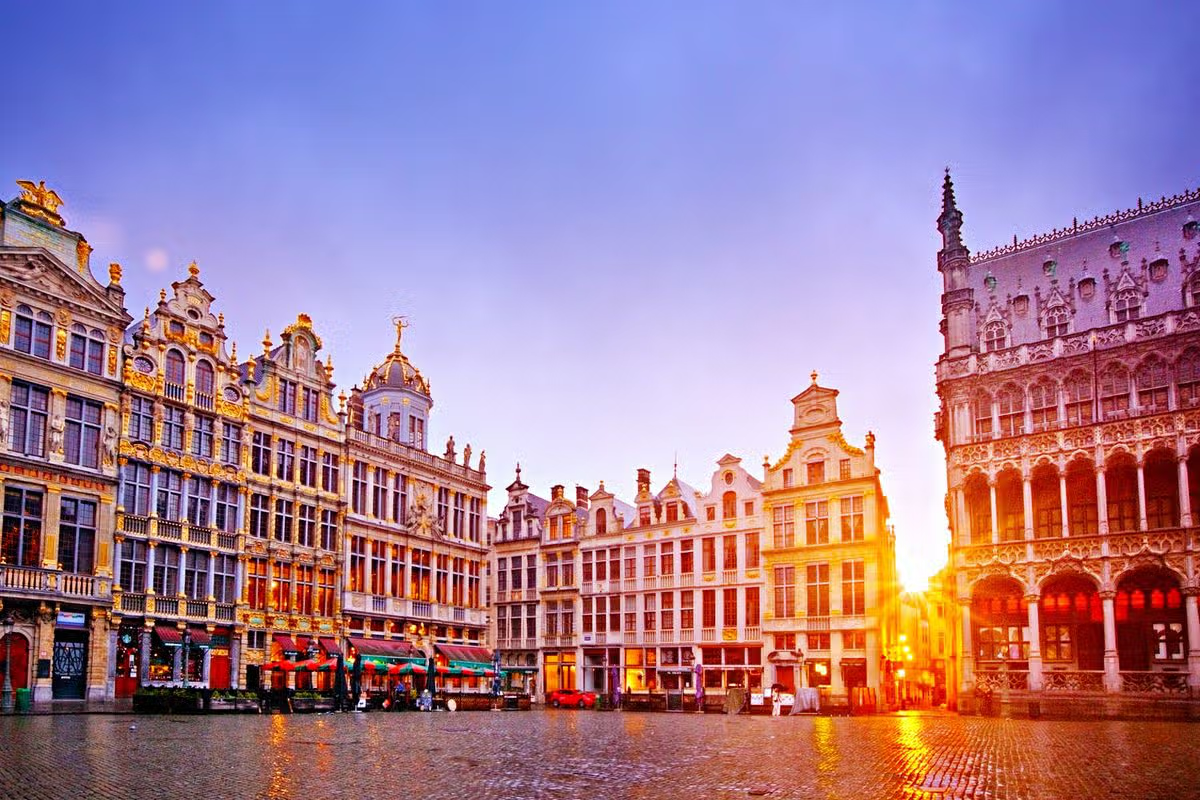
Pausing in the central Grand Place square for a moment, take in the opulent Baroque guildhalls and the neo-Gothic King’s House. Not wanting to waste any more time or spend six euros, read the first paragraph of the Grand City Museum’s Wikipedia entry while looking at its exterior.
Culturally enriched, next up was a portion of mayonnaise-covered frites eaten while looking at a René Magritte painting on the side of a house, before a crispy waffle powers you up the hill towards the Royal Palace. Glance back at the impressive view of the city’s rooftops as you barrel onto a coach and out of there, catching a glimpse of one of Auguste Rodin’s Thinkers through the window before quickly stopping to stand in front of ‘Belgium’s Eiffel Tower’, the futuristic Atomium statue.
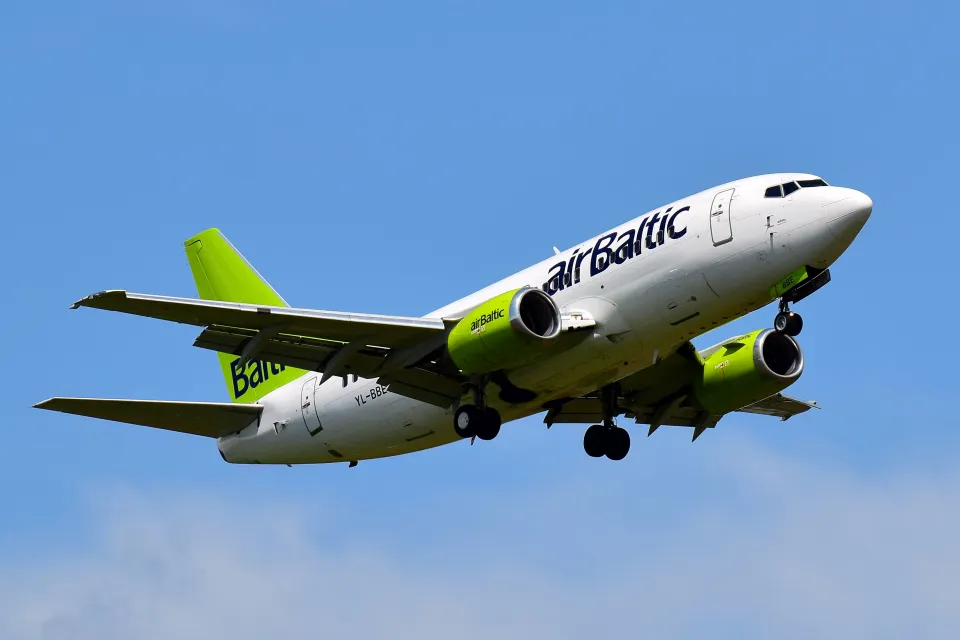
A EUROPEAN airline that carries thousands of British passengers every week has filed for bankruptcy.
The travel company organises flights to the Baltic region from both London Gatwick and Aberdeen airport.
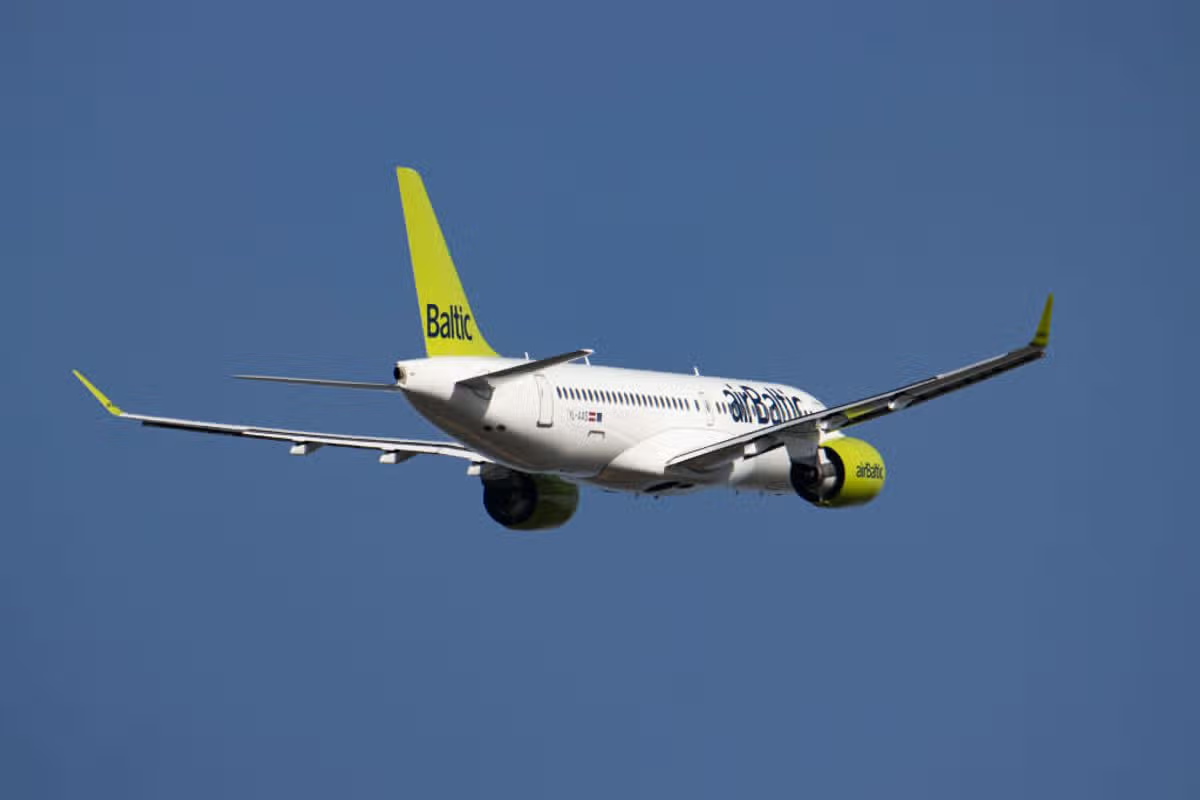
AirBaltic, which carries thousands of passengers from the UK every week, has entered voluntary bankruptcyCredit: Getty
The national airline of Latvia, airBaltic, has had its bankruptcy protection approved in a move that hopes to cut mounting costs.
Around 4,000 British passengers fly on AirBaltic flights weekly, with the airline operating direct flights between London Gatwick and Riga, along with seasonal twice-weekly routes from Aberdeen to the capital.
Sign up for the Travel newsletter
Thank you!
The voluntary decision saw the carrier file for Chapter 11 bankruptcy protection in the United States, later securing $405million in financial commitments from various financial groups.
Despite the filing, experts have warned passengers not to interpret bankruptcy as cancellation and to wait before considering changing bookings.
Anton Radchenko, CEO of AirAdvisor, said: “Cancelling voluntarily could leave the passenger subject to the ticket’s normal restrictions, whereas waiting for the airline’s decision preserves their statutory rights if the service is later changed or cancelled.”
AirBaltic has confirmed that operations would continue as usual during the bankruptcy process, which is expected to finish by June 2027.
This includes scheduled flights, ticket sales, reservations and customer service, with all existing tickets, vouchers and credits remaining valid.
AirBaltic flies to over 70 destinations around the Baltics, including Europe, North Africa and the Middle East out of its main hub in Riga, Latvia.
The carrier is majority-owned by the Latvian government and has agreements with major international airlines such as Air France, KLM and Delta Airlines.
It currently operates a fleet of 54 aircraft, but announced a business plan in August to reduce its fleet to 36 planes to improve its financial stability.
In a document sent to EU legislators and seen by Euronews, the US has threatened the EU with retaliation if it does not scrap European preference provisions in its multiannual budget.
ADVERTISEMENT
ADVERTISEMENT
EU member states are currently discussing the EU’s long-term budget (2028-2034), which includes a €402 billion fund dedicated to competitiveness that favours the production of key goods within the EU, including in defence.
The measure would potentially exclude foreign firms from EU financing to protect strategic and economic security interests.
“With further expansion of European preference measures in EU defence funds, the United States will review all potential response measures, including a rollback of the existing ‘Buy American’ blanket waivers and exceptions associated with the RDPAs [Reciprocal Defence Procurement Agreements] with 19 of the 27 member states,” the non-paper reads.
The Buy American Act requires the US government, including the US Department of Defence, to give preference to products manufactured in the US for certain public procurements, with some exceptions being granted in defence for some EU countries.
The non-paper adds that the European preference would impede “partnership” and “collaboration” with the US, and calls on the EU to introduce a “made with Europe” system – or, in the specific area of defence, a “made in NATO”.
Trade tensions
The US’s latest warning comes after the creation of the Security Action for Europe programme in 2025, already sparked trade tensions between Washington and Brussels over a European preference for joint purchases of arms and military equipment.
The “made in Europe” approach is also pushed by France and the European Commission in several pieces of legislation over the last year designed to boost EU industry, with foreign countries lobbying hard against being excluded from the EU market.
The US and EU have been at loggerheads over trade since the start of the second Trump administration, amid repeated tariff threats and disputes over environmental and digital regulations which the White House deems to be non-tariff barriers.
The Commission hoped that the conclusion of a trade agreement in July 2025 would be a step towards a more stable transatlantic relationship.
AirBaltic, the national airline of Latvia, has filed fo Chatper 11 protection in New York. The airline currently operates direct services between London Gatwick and Riga, as well as twice-weekly seasonal Aberdeen to Riga service
AirBaltic has filed for bankruptcy, casting the airline’s future in serious doubt.
Latvia’s national airline filed for Chapter 11 protection in New York on 14 September as it seeks to restructure its debts.
AirBaltic currently operates direct services between London Gatwick and Riga, as well as twice-weekly seasonal Aberdeen to Riga service. These serve approximately 4,144 passengers each week, according to AirAdvisor.
Earlier this year, the airline announced it would launch flights from the UK to Lapland in December, offering five new routes to Kuusamo in Finnish Lapland from European airports, including services from London Gatwick and Manchester.
The airline plans to reduce its fleet from 54 aircraft to 36 by the end of 2026, while some staff members may also lose their jobs. CEO Erno Hilden has said that consultations are underway regarding workforce reductions, although no figure has been decided.
AirBaltic has faced a number of financial challenges since it took a €30 million (£26 million) state loan in April 2026, the company said in a statement, “including increased fuel costs arising from the crisis in the Middle East.”
Supervisory board chairman Andrejs Martinovs said in a written statement: “We have carefully assessed the restructuring options available to the company, with one priority in focus – to give airBaltic the best possible basis to continue operating and to build a sustainable financial structure. Under court supervision and with protection from creditor claims, this process provides a clear framework and timetable for reaching agreements with creditors, including aircraft lessors and other stakeholders. At the same time, it allows the company to continue operating.”
What does this mean for passengers?
If you have a flight booked with airBaltic, you shouldn’t panic. Passengers should not interpret the word ‘bankruptcy’ as meaning the airline has stopped flying and cancel valid bookings themselves – it has not cancelled any flights.
The airline has a commitment for €350 million (£300 million) in financing, subject to court approval, and insists that scheduled flights, bookings and customer services are continuing normally.
AirBaltic said flights would operate as scheduled during the court-supervised process, which it expects to finish by June next year.
Flights departing the UK fall under UK261. Riga to UK services are protected under EU passenger-rights rules because they depart from an EU airport. In either direction, a cancellation would normally allow passengers to choose between reimbursement and rerouting.
Anton Radchenko, Aviation Expert and CEO of AirAdvisor, said: “Chapter 11 is designed to give a company space to keep operating while it restructures, so I would not cancel a valid airBaltic booking when the airline is still flying and says the ticket remains valid. Cancelling voluntarily could leave the passenger subject to the ticket’s normal restrictions, whereas waiting for the airline’s decision preserves their statutory rights if the service is later changed or cancelled.
“I would use this moment to identify exactly what protects the booking. A direct flight is not usually ATOL protected, airline-failure insurance is not standard, and the practical fallback may depend on whether the passenger booked a genuine package, paid directly by credit card or can make a chargeback claim.
If airBaltic cancels while continuing to operate, passengers should request a refund or rerouting and the necessary care rather than accepting whichever option is presented first. Fixed compensation may also apply depending on the notice and reason, but if an airline ceases trading completely, possessing a legal claim does not guarantee immediate repayment, which is why the financial protection behind the booking matters.”
Italy’s ancient cave city looks like something out of a storybook – and with October highs of up to 27C and no summer crowds, it could be the perfect autumn holiday destination for Brits
Whether it’s half-term breaks, cheaper shoulder-season deals or simply the lure of warm sunshine and guaranteed blue skies, searches and bookings tend to rise for last-minute getaways. From beach classics in Spain, Greece and Turkey to longer-haul hotspots, October has become the month when many of us “jet off” to swap jumpers and drizzle for one more hit of heat.
Italy boasts no shortage of places that deliver a sunshine fix well into autumn – from Rome’s ancient sights and café-lined piazzas to Venice’s dreamy canals and waterside walks. But if you’re after something that feels a little less “done” than the usual hotspots, Matera could be the perfect pick.
Tucked away in the southern region of Basilicata, the city is best known for its Sassi – ancient cave dwellings carved into the rock, now transformed into atmospheric hotels, restaurants and tiny bars.
It’s the kind of place made for slow exploring: cobbled lanes that twist between honey-coloured stone buildings, viewpoints that open up over terraced rooftops, and little squares where you can stop for a coffee or aperitivo in the late-afternoon sun.
Crucially, Matera tends to be calmer than Italy’s headline destinations, especially outside peak summer, which means you can soak up the scenery without battling huge queues.
October is also a great time to visit if you prefer sightseeing without the intense heat, with mild days that suit everything from wandering the old town to taking a day trip into the surrounding countryside.
And while Matera has a distinctly old-world feel, it still has plenty going on – from cosy trattorias serving local specialities to cultural sites and museums that dig into the city’s long, unusual history. For travellers looking to extend summer without the crowds, it’s an autumn escape that ticks a lot of boxes.
Content cannot be displayed without consent
Kathy, a travel content creator from New York, shared a video on TikTok offering viewers a captivating glimpse of Matera, widely known as the ‘City of Stone’.
The short clip showcases the cave dwellings and a narrow lane running alongside the stunning stone structures perched on a clifftop.
Her TikTok post caption reads: “Matera, a truly magical historical city like no other city. The oldest city in Italy and possibly all of Europe. It’s 9,000 years old!
“I highly recommend staying at least one night to fully experience the magic. Sunset is stunning, dinner in the cave-like restaurants is memorable, and sunrise is even better.”
The travel enthusiast described Matera as “truly breathtaking” and “easily one of [her] favourite places to visit while traveling through Puglia.
And judging by the comments section, people agreed with her. One travel fan wrote: “One of the most beautiful places I have visited, truly amazing.”
Another said: “Currently in Matera now, one of my favourite places we [have] visited. And a third added: “Dreamy!”
The spot has been hailed by holidaymakers as the best beach on the White Isle, and with warm 23°C temperatures in October and November it’s the perfect spot for an autumn break away from the crowds
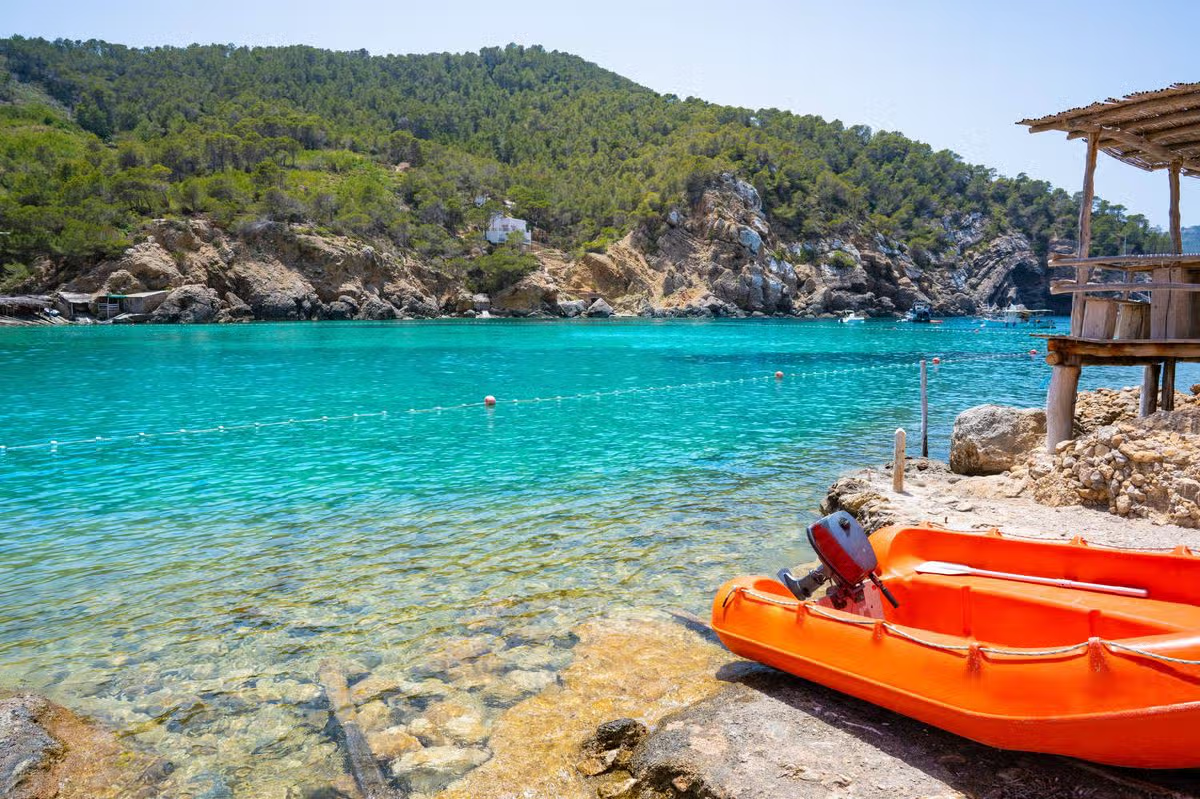
One European spot has dramatic scenery that sets it apart from other spots(Image: LUNAMARINA via Getty Images)
Tucked between pine-covered hills, the sheltered cove has a mix of golden sand and pebbles, while its clear waters are ideal for swimming and snorkelling. But it is the dramatic scenery that really sets the European spot apart.
Off the coast sits Cap Bernat, a distinctive rock formation often nicknamed the “Finger of God”. It has become an iconic part of the skyline and provides a spectacular backdrop as the sun sets over the water.
Cala Benirràs is one of the most famous coves in northern Ibiza, but it offers a very different experience from the island’s glamorous beach-club hotspots.
The beach is particularly famous for its bohemian atmosphere and stunning sunsets, with visitors gathering to watch the sun disappear behind the rocky coastline.
Benirràs has also long been associated with drumming at sunset, which has become part of the cove’s identity.
However, visitors should be aware that the traditional large-scale Sunday drumming sessions have been restricted in response to the huge crowds they attract.
Smaller, informal drumming sessions can still take place, but it is best to check the arrangements before travelling if this is a key reason for your visit.
Despite its popularity, Cala Benirràs retains a relatively natural and rustic feel compared with some of Ibiza’s more polished beach destinations. The seabed is rocky in places, adding to its appeal for snorkellers, while the sheltered bay usually offers calm, clear water.
There are also several places to eat and drink around the cove, including Elements Eivissa Beach Club, which sits directly on the beach, alongside more casual dining options nearby.
For visitors looking to experience a quieter, more bohemian side of Ibiza, Cala Benirràs offers a combination of clear waters, pine-covered hills, spectacular sunsets and its famous rock formation that makes it well worth a visit, reports the Express.
Best time to visit
Autumn breaks offer quieter beaches and warm, sunny weather, with package holiday prices often considerably cheaper than during the pricier summer period. Holding out just a few weeks for an October escape could see travellers discovering hidden gems in some of Europe’s most sought-after destinations like Spain or Portugal for a fraction of the cost.
When experts at Wizz Air pinpointed the best under-the-radar coastal destinations in Europe for the shoulder season, Cala Benirrás in the north of the island earned top marks for tranquillity.
The airline previously carried out an analysis of beaches across more than 50 European countries, evaluating crowd levels, average temperatures, and daylight hours throughout September, October, and November.
By calculating beach space per visitor, Wizz Air ranked destinations according to the amount of room available to unwind and bask in the late-season sunshine.
‘Hidden gem’
This Ibizan ‘hidden gem’ has been hailed as the “best beach on Ibiza, especially in October” by Tripadvisor user Debra H. Captivated by their visit to this tranquil corner of the White Isle, the traveller went on to say: “It’s not just a beach for a day trip or the Sunday drumming it’s a place to come early in the morning and get to know. We really liked Elements cafe, nice food sitting and chilling on the sofa as with music. Lovely family friendly and I love the rock there like a giant goddess. Highly recommend. Most favourite beach in Europe.”
Another late-season visitor, Emily S, shared the same enthusiasm, describing it as a “beautiful bohemian feeling beach, perfect place for sunset”.
They added: “We visited Ibiza at the end of October. End of season, so this beach was lovely. Not too busy, with a relaxed, friendly, safe feel. Beautiful sheltered cove with stunning views out to sea, and amazing clear waters with lots of fish.”
Ibiza boasts average temperatures of around a balmy 23°C (73°F) throughout October and November, making it ideal for those looking to soak up the last of the summer sunshine.
Cala Benirrás is just a 10-minute bus ride from the nearest town of Port De San Miguel, which is home to hotels, villas and a broad range of amenities.