Escort

U.S. Navy Won’t Be Ready To Escort Tankers Through Hormuz For Weeks

The U.S. Navy is not yet ready to escort oil tankers through the Strait of Hormuz, but it will happen. This is the synopsis provided by U.S. Energy Secretary Chris Wright in an interview with CNBC. The development comes as Iran continues to pummel international shipping in and around the critical channel, which the new Iranian supreme leader, Mojtaba Khamenei, vows to keep closed.

“It’ll happen relatively soon, but it can’t happen now,” Wright said, of the planned naval escort mission. “We’re simply not ready. All of our military assets right now are focused on destroying Iran’s offensive capabilities and the manufacturing industry that supplies their offensive capabilities.” Wright added that the Navy should be able to escort tankers through the strait by the end of this month.

BREAKING: Iran’s Supreme Leader Mojtaba Khamenei:

We will not forgo avenging the blood of the martyrs.

The Strait of Hormuz should still remain closed.

— Clash Report (@clashreport) March 12, 2026

Khamenei, it appears, is also resolute in his plan to keep the strait closed to all maritime traffic, reportedly having turned down approaches from several countries that were seeking an end to the attacks.

🚨 Lebanese Al-Akhbar newspaper, which is associated with Hezbollah: Official sources from Turkey, Egypt, India, and Pakistan approached Tehran demanding to stop the attacks in the Strait of Hormuz, but were met with a firm response stating that “security will be for everyone or…

— Raylan Givens (@JewishWarrior13) March 12, 2026

U.S. President Donald Trump said on March 3 that “the United States Navy will begin escorting tankers through the Strait of Hormuz, as soon as possible.”

Putting a date of the end of this month on the escort mission is certain to trouble markets that are already feeling the pressure of the conflict. At the very least, this is an indicator that the war or its hostile aftermath will continue for weeks to come.

Equally pessimistically, there have been reports from analysts suggesting that fully reopening the strait may require some kind of ground operation to seize the Iranian coastline adjacent to it.

“Strategic priorities, like opening the Strait of Hormuz and securing what remains of Iran’s nuclear stockpile, will likely require some ground troops if no diplomatic options are pursued,” Brian Katulis, a senior fellow at the Middle East Institute, told The Wall Street Journal. “What we are looking at is potentially a very messy situation.”

Even without boots on the ground, which now seems like a remote prospect, running a tanker-escort mission, which would involve convoys protected by warships and accompanied by mine-clearing assets, is fraught with difficulty. Military unwillingness to take on missions of this kind is an issue we have explored in the past at TWZ.

The warships involved in any such endeavor would also be at extreme risk, especially from Iranian ground-mobile anti-ship missiles, which are relatively small and can be easily disguised in utility trucks. Eliminating that threat is one potential driver for a ground operation along the coast of the strait.

The U.S. military has made extensive efforts in recent days to remove the Iranian minelaying capability, but, according to the U.K. Defense Secretary, there are now increasing signs that Iran may have started mining the strait.

While tanker traffic through the strait remains at a standstill, Iran continues its campaign against commercial tankers elsewhere in the region, with another two vessels set ablaze earlier today in Iraqi waters. Iraq reportedly halted all operations at its oil ports after the attack.

The Ambrey maritime security firm told us that a Malta-flagged crude oil tanker and another merchant vessel were targeted in an attack in Al Basrah Anchorage, Iraq. One fatality was reported. At least 38 individuals were rescued from both vessels according to the Iraq Port Authority, with further search and rescue operations ongoing as of this morning.

Video footage of the incident shows a vessel engulfed in fire with a large plume of smoke rising from the area of impact. Fire can also be seen in the water as a result of the oil spill.

Unverified reports state that the two tankers were struck by uncrewed surface vehicles (USVs).

Iraq’s State Organization for Marketing of Oil identified the two vessels as crude oil tanker Safesea Vishnu and the combined chemical and oil tanker Zefyros. While the Zefyros is Malta-flagged, the Safesea Vishnu is owned by a U.S. company but was sailing under the Marshall Islands flag. A dramatic video has appeared that is said to show the moment of the explosion that targeted the Safesea Vishnu.

The moment of the attack on the oil tanker Safesea Vishnu by an Iranian explosive boat tonight in the Persian Gulf near Iraq.

One crew member was killed. The tanker is owned by a U.S. company and was sailing under the Marshall Islands flag. pic.twitter.com/Xy2JKRoZt2

— Special Kherson Cat 🐈🇺🇦 (@bayraktar_1love) March 12, 2026

In a statement, the IRGC said that it considered the Safesea Vishnu as an asset of the U.S. military and claims that it was struck after ignoring repeated warnings and alerts from the IRGC Navy.

Iran’s IRGC says it struck a US-owned vessel ‘Safe Sia,’ a vessel considered as an asset of the US army, early this morning in the northern Persian Gulf.

The vessel ignoed repeated warnings and alerts from the IRGC Navy. pic.twitter.com/tkJDO5VUf1

— Arya Yadeghaar (@AryJeay) March 12, 2026

Ambrey also reports that a container vessel was struck by an unknown projectile 38 nautical miles north-northeast of Jebel Ali, United Arab Emirates. The strike was reported to have caused a small fire on board the vessel, and the crew was reported to be safe.

Another vessel, the Japanese-flagged container ship One Majesty, was reportedly also damaged while anchored in the Persian Gulf. The damage was only discovered later, around 60 miles from the Strait of Hormuz. There were no reports of casualties.

A Japanese-flagged container ship, One Majesty, was damaged while anchored in the Persian Gulf.

The crew felt a shock near the stern and later discovered damage while the ship was about 60 miles (96 km) southwest of the Strait of Hormuz.

All crew members are safe and the…

— Clash Report (@clashreport) March 12, 2026

The vessel seen burning in the video below, from the perspective of crew members who evacuated on a liferaft, is the Thai-flagged cargo vessel, Mayuree Naree Bangkok, which was attacked near the Strait of Hormuz yesterday.

The continued attacks on energy infrastructure and shipping by Iran, and concerns over the intensifying conflict in the Middle East, have seen oil prices spike.

The international benchmark Brent crude is back above $100 per barrel.

NEW: Iran war is “creating the largest supply disruption in the history of the global oil market,” International Energy Agency says. https://t.co/bCKgzI6Mi8

— NBC News (@NBCNews) March 12, 2026

In an effort to reduce concerns over global oil supplies, the International Energy Agency (IEA) has ordered the largest release of government reserves in its history.

Meanwhile, the government of Denmark is calling upon its citizens to reduce their consumption of fossil fuels.

Denmark’s Energy Minister urged people to reduce fuel use amid the oil shock from the Iran war, saying:

“Please, please, please — if you do not need to drive, do not do so.”

Source: CNBC pic.twitter.com/gvCQbWSfnY

— Clash Report (@clashreport) March 12, 2026

In a post on his Truth Social site, President Trump said he remained committed to ensuring Iran cannot develop nuclear weapons, despite the impact on the global oil trade.

“The United States is the largest Oil Producer in the World, by far, so when oil prices go up, we make a lot of money. BUT, of far greater interest and importance to me, as President, is stoping [sic] an evil Empire, Iran, from having Nuclear Weapons, and destroying the Middle East and, indeed, the World.”

Trump:

The United States is the largest Oil Producer in the World, by far, so when oil prices go up, we make a lot of money.

BUT, of far greater interest and importance to me, as President, is stoping an evil Empire, Iran, from having Nuclear Weapons, and destroying the Middle… pic.twitter.com/lp6As74W7h

— Clash Report (@clashreport) March 12, 2026

The day-to-day running of the conflict also comes with a high cost to the U.S. government. According to Reuters, officials from the Donald administration estimated during a congressional briefing this week that the first six days of the war on Iran had cost the United States at least $11.3 billion.

Officials from President Donald Trump’s administration estimated during a congressional briefing this week that the first six days of the war on Iran had cost the United States at least $11.3 billion, a source familiar with the matter said on Wednesday. @ReutersZengerle

— Idrees Ali (@idreesali114) March 11, 2026

The Israeli Air Force (IAF) has struck a nuclear site in Iran, the Israel Defense Forces (IDF) announced today. The targeting of the Taleghan compound was part of a larger wave of strikes conducted over the past few days, the IDF said. Taleghan is part of the Parchin military complex, located around 20 miles southeast of Tehran.

The development comes after we reported on evidence of some kind of airstrike against the Taleghan compound, including the possibility that the hardened facility was hit by 30,000-pound GBU-57/B Massive Ordnance Penetrator (MOP) bunker buster bombs. You can read that analysis, based on satellite imagery, here.

The Israeli military said that IDF intelligence had determined that Iran had been using the Taleghan compound to develop weapons and conduct experiments as part of Amad, an Iranian scientific project aimed at developing nuclear weapons.

🎯STRUCK: The ‘Taleghan’ compound, a site used by the Iranian regime to advance nuclear weapons capabilities.

The compound was used to develop advanced explosives and conduct sensitive experiments as part of the covert ‘AMAD’ project in the 2000s.

— Israel Defense Forces (@IDF) March 12, 2026

According to a statement from the Israeli military:

“During Operation Rising Lion, the IDF has operated systematically against knowledge centers and infrastructure related to the Iranian nuclear weapon program in order to eliminate the emerging existential threat to the State of Israel. Despite the significant damage inflicted on the program, the Iranian regime has continued efforts to advance and develop the capabilities required for the development of a nuclear weapon.”

The IDF added that it had recently identified that Iran has taken steps to rehabilitate the compound after it was struck in October 2024.

The IDF says it recently struck an Iranian nuclear facility where the regime advanced “critical capabilities in the development of nuclear weapons.”

The site in Tehran, identified by the military as the Taleghan compound, was hit as part of waves of strikes carried out in the… pic.twitter.com/4bYQLAv3CJ

— Emanuel (Mannie) Fabian (@manniefabian) March 12, 2026

Israel announced last week that it had struck Minzadehei, another nuclear site in Iran where it said scientists were covertly developing a key component for nuclear weapons.

“The strike is a part of the series of operations carried out throughout Operation Rising Lion aimed at further damaging the Iranian terrorist regime’s nuclear aspirations.”

Other recent targets of the IDF include Abu Dharr Mohammadi, described as the operations commander responsible for the Islamic Revolutionary Guard Corps’ (IRGC) missile unit within Hezbollah.

A member of Iran’s Islamic Revolutionary Guard Corps who was operating as a commander in Hezbollah’s missile unit was killed in an Israeli airstrike in Lebanon this week, the IDF announces.

Abu Dharr Mohammadi, who the military says was a “central figure in the military… pic.twitter.com/StV45w6qIZ

— Emanuel (Mannie) Fabian (@manniefabian) March 12, 2026

“Earlier this week (Tuesday), the IDF struck and eliminated the terrorist Abu Dharr Mohammadi … Mohammadi was a central figure in the military coordination between Hezbollah and the Iranian terror regime, while coordinating and connecting between Hezbollah and Iranian senior officials,” the IDF said.

“Mohammadi was a key figure in Hezbollah’s military force build-up as it related to missiles, focusing on rehabilitating the program following Operation Northern Arrows,” the IDF added.

For its part, Hezbollah continues to hit back against Israel.

According to the Israeli military, Hezbollah militants launched around 200 rockets and approximately 20 drones yesterday evening from Lebanon toward Israel. After reportedly detecting signs of an unusual buildup, the IDF said it carried out a preemptive strike to disrupt the firing and thwart terrorists.

⭕️ ~70 terror targets were struck including terrorist infrastructure, weapons storage facilities, central headquarters, key terrorists, and an IRGC Air Force HQ in Beirut. pic.twitter.com/T8VBtiQmup

— Israel Defense Forces (@IDF) March 12, 2026

The IDF acknowledges that it was a mistake not to update the public ahead of Hezbollah’s large rocket and drone attack on northern Israel last night, especially once Israel’s assessments of the planned barrage were leaked on social media and published by international media.

The… https://t.co/Ec9PX06xjK

— Emanuel (Mannie) Fabian (@manniefabian) March 12, 2026

The U.S. military has also continued airstrikes on Iran, with a recent video released by Central Command (CENTCOM) showing the destruction of a C-130 Hercules transport and a P-3F Orion maritime patrol aircraft (both of which were supplied to Iran before the 1979 Islamic Revolution) and an Ilyushin Il-76 Candid airlifter.

The Iranian regime is losing air capability day by day. U.S. forces aren’t just defending against Iranian threats, we are methodically dismantling them. pic.twitter.com/CrJj2nFtHB

— U.S. Central Command (@CENTCOM) March 12, 2026

Of these aircraft, the Islamic Republic of Iran Air Force (IRIAF) P-3F was especially notable, since it was reportedly the last of the type that was still airworthy in Iranian service.

IRIAF P-3F 5-8704 from 71 ASW squadron is no more.

Iran’s five P-3Fs that started the war had unique camo patterns for ID, as well as you can partially make out the 5-___4 of the tail, which in of itself is a giveaway to the airframe’s ID. https://t.co/1pPpdgJS9w pic.twitter.com/SvMBibwWdI

— Evergreen Intel (@vcdgf555) March 12, 2026

Following attacks on Mehrabad and Bandar Abbas Air Bases, the runways at both have now been blocked by parked buses and helicopters, according to satellite imagery. The reason for this is unclear, but it is possible that it has been driven by concerns about a potential aerial assault on either of these locations. Alternatively, the aircraft and vehicles may have been arranged as decoys. The same thing has been seen in the war in Ukraine, as well as in Venezuela, earlier this year.

🛰️ Satellite images show runways at Tehran’s Mehrabad and Bandar Abbas airports blocked with parked buses and helicopters.

The measure appears intended to prevent further strikes or aircraft use by making the runway unusable. pic.twitter.com/s5KcmcOw3G

— Clash Report (@clashreport) March 12, 2026

U.S. airstrikes against Iranian missile systems have also continued. The CENTCOM video below is noteworthy since it shows (around the 0:07 mark) the destruction of a ballistic missile apparently in the process of being erected from its launch vehicle.

A U.S. strike overnight on three bases associated with the Iranian-backed Ansar Allah al-Awfiya militia reportedly killed dozens of militiamen. The bases near al-Qaim, al-Anbar, were used to fire projectiles at U.S. interests in Jordan. The following video purports to show the results of the attack on al-Qaim.

ما فعله الحشد بالعراقيين من قتل و ذبح يرتد عليه اليوم

تم دفن عناصر وقادة الحشد اليوم تحت مقراتهم في القائم غربي العراق pic.twitter.com/dK2rvCAJkG

— عمر مدنيه (@Omar_Madaniah) March 12, 2026

Footage has also emerged that apparently shows a U.S. military Low-Cost Uncrewed Combat Attack System (LUCAS) kamikaze drone headed toward a militia target in Iraq. Based on the Iranian Shahed-136, these weapons were used in combat for the first time in the opening salvos of Operation Epic Fury and repeatedly since.

Overnight attacks on Iraq also struck Erbil, home to an Italian military detachment in the country. According to reports, this has led to the temporary evacuation of the Italian presence from the base.

An Italian military base in Erbil, northern Iraq, was hit overnight by an airstrike, Italian defense officials said Thursday. No injuries were reported.

The strike was first thought to be a missile but was later identified as a drone that destroyed a military vehicle.

Source:…

— Clash Report (@clashreport) March 12, 2026

NEW — 🇮🇹🇮🇶🇮🇷🇺🇸 Italy announces the “temporary” withdrawal of its forces from a military base in Iraq following attacks in the area.

— UK Report (@UK_REPT) March 12, 2026

Mojtaba Khamenei has vowed to continue attacks on U.S. bases in the region, calling for American forces to leave them immediately, or face further strikes.

BREAKING: Iran’s Supreme Leader Mojtaba Khamenei:

All US bases should immediately be closed in the region, and those bases will be attacked.

— Clash Report (@clashreport) March 12, 2026

While we have regularly seen Iranian ballistic missiles target Israel with cluster warheads, we now also have a view of how the separate munitions disperse, as seen from the vantage point of the cockpit of an IAF fighter jet.

In the United Arab Emirates, authorities have reportedly arrested a British tourist after they allegedly filmed missiles hitting Dubai. The 60-year-old Londoner faces two years in prison after being charged with a cybercrime, The Daily Mail reports.

He is reportedly one of 20 people to have been charged over videos and social media posts relating to recent Iranian missile strikes on the UAE. 

British tourist, 60, ‘who filmed Iranian missiles’ in Dubai is facing two years in prison after being charged with cybercrime offence https://t.co/rtFMqtOiwt

— Daily Mail (@DailyMail) March 12, 2026

The on-off deal to get Ukrainian-made counter-drone technology into U.S. hands has apparently taken another turn.

Taking to X, Ukrainian Prime Minister Volodymyr Zelensky wrote that he had hoped to “sign a big drone production deal with the United States, but we needed the approval from the White House.”

The deal, covering “different kinds of drones and air defense,” has not been signed yet, Zelensky added.

“I hope that maybe [our] American friends will be closer to this decision now, especially after such challenges as we see in the Middle East,” the Ukrainian leader wrote.

We wanted to sign a big drone production deal with the United States, but we needed the approval from the White House. It was about different kinds of drones and air defense. They operate as one system and can defend against hundreds or thousands of Iranian “shaheds“ and… pic.twitter.com/KZX7MLcCZG

— Volodymyr Zelenskyy / Володимир Зеленський (@ZelenskyyUa) March 12, 2026

A fire broke out aboard the aircraft carrier USS Gerald R. Ford.

“On March 12, USS Gerald R. Ford (CVN 78) experienced a fire that originated in the ship’s main laundry spaces,” Naval Forces Central Command said in a statement on X. “The cause of the fire was not combat-related and is contained. There is no damage to the ship’s propulsion plant, and the aircraft carrier remains fully operational. Two Sailors are currently receiving medical treatment for non-life-threatening injuries and are in stable condition. Additional information will be provided when available.”

On March 12, USS Gerald R. Ford (CVN 78) experienced a fire that originated in the ship’s main laundry spaces. The cause of the fire was not combat-related and is contained.

There is no damage to the ship’s propulsion plant, and the aircraft carrier remains fully operational.…

— U.S. Naval Forces Central Command/U.S. 5th Fleet (@US5thFleet) March 12, 2026

Earlier today, a U.S. official told USNI News that the initial fire had been extinguished, but the crew was still working to control the damage.

The United Arab Emirates is now using UH-60 Black Hawk series helicopters for counter-drone work, as seen in this video, which captures an engagement over Dubai.

UAE’s UH-60 Black Hawk helicopter intercepts an Iranian Shahed/Geran-type long-range strike drone over Dubai.

Burj Khalifa seen in the background. pic.twitter.com/c81YnAoRFU

— Status-6 (War & Military News) (@Archer83Able) March 12, 2026

According to a report from Reuters, citing U.S. intelligence officials, most of the Iranian leadership remains intact, and the regime is not currently at risk of collapse, despite the U.S.-Israeli campaign against it.

U.S. intelligence indicates that Iran’s leadership is still largely intact and is not at risk of collapse any time soon after nearly two weeks of relentless U.S. and Israeli bombardment, according to three ​sources familiar with the matter. @ErinBanco @JonathanLanday

— Idrees Ali (@idreesali114) March 11, 2026

Certainly, as far as public statements are concerned, the remaining elements of the Iranian leadership remain steadfast in their refusal to give up the fight.

Iranian Parliament Speaker Ghalibaf:

Any aggression against soil of Iranian islands will shatter all restraint.

We will abandon all restraint and make the Persian Gulf run with the blood of invaders.

The blood of American soldiers is Trump’s personal responsibility. pic.twitter.com/hx2Hebt7s8

— Clash Report (@clashreport) March 12, 2026

Contact the author: thomas@thewarzone.com
Thomas is a defense writer and editor with over 20 years of experience covering military aerospace topics and conflicts. He’s written a number of books, edited many more, and has contributed to many of the world’s leading aviation publications. Before joining The War Zone in 2020, he was the editor of AirForces Monthly.


Source link

US military ‘not ready’ to escort oil ships through Hormuz, official says | US-Israel war on Iran News

The United States military is “not ready” to accompany oil ships through the Strait of Hormuz, a top official in President Donald Trump’s administration says as Iran continues to block the strategic waterway.

US Energy Secretary Chris Wright told the CNBC business news channel on Thursday that the markets are experiencing a “short-term disruption”, predicting that the war would go on for “weeks, not months”.

Recommended Stories

list of 3 itemsend of list

Despite Trump’s repeated threats, Iran has largely succeeded in shutting down the strait, which links the Gulf to the Indian Ocean. The closure has sent oil prices soaring.

Wright described the effects of the crisis as “short-term pain for long-term gain”, arguing that the US is “destroying” Iran’s ability to threaten the energy market.

Last week, Trump suggested that the US Navy would escort ships through the Gulf, but Wright said on Thursday that the move “can’t happen now”.

“We’re simply not ready. All of our military assets right now are focused on destroying Iran’s offensive capabilities and the manufacturing industry that supplies their offensive capabilities,” the energy secretary said.

“We don’t want this to be a brush-off for a year or two. We want to permanently destroy their ability to build missiles, to build roads, to have a nuclear programme.”

His comments came as Iran’s new supreme leader, Mojtaba Khamenei, affirmed in his first public comment since being selected to succeed his assassinated father, Ali Khamenei, that the Strait of Hormuz should remain closed during the war.

“The will of the people is to continue effective and deterrent defence,” Khamenei said in a written statement. “The tactic of closing the Strait of Hormuz must also continue to be used.”

The Iranian military has said it would “welcome” the US Navy escorting oil ships, suggesting it is prepared to strike US forces in the narrow waterway.

On Wednesday, three commercial vessels were attacked near the strait.

Wright announced earlier this week on social media that the US Navy had escorted an oil ship through the strait, then quickly deleted the post. The White House subsequently confirmed that the claim was not true.

It is not clear why the statement was released and then retracted.

Assurances by US officials that Washington would open the strait have temporarily calmed markets, only for prices to spike again.

The price of a barrel of oil peaked at about $120 on Sunday, up from about $70 before the US and Israel launched the war on February 28. It has been yo-yoing between $80 and $100 for the past few days.

In addition to the marine blockade, Iran has targeted oil installations across the Gulf.

As one of the world’s largest oil producers, the US is largely self-sufficient. But possible shortages in Asia and Europe have put a strain on prices globally.

According to data from the American Automobile Association, the average price of one gallon (3.78 litres) of petrol in the US is now $3.60, up from $2.94 last month.

Rising energy prices could fuel inflation and affect the cost of basic goods, including food.

But Trump suggested on Thursday that the US is benefitting from skyrocketing oil prices.

“The United States is the largest Oil Producer in the World, by far, so when oil prices go up, we make a lot of money,” the US president wrote in a social media post.

“BUT, of far greater interest and importance to me, as President, is stopping an evil Empire, Iran, from having Nuclear Weapons, and destroying the Middle East and, indeed, the World.”

Iran denies seeking a nuclear weapon, and Trump reiterated for months before the current conflict that US strikes against Iranian facilities in June had “obliterated” the country’s nuclear programme.

Source link

White House disputes claim of Navy escort on Strait of Hormuz

March 10 (UPI) — President Donald Trump posted on social media that the United States has destroyed 10 inactive mine-laying vessels on the Strait of Hormuz while the White House cleared up a claim by another administration official.

White House press secretary Karoline Leavitt said Tuesday that the U.S. Navy did not escort an oil tanker through the Strait of Hormuz after Energy Secretary Chris Wright claimed it did on social media.

Leavitt said President Donald Trump may consider using Navy escorts for oil tankers on the strait but that has not happened yet.

“The U.S. Navy has not escorted a tanker or vessel at this time,” Leavitt told reporters during a press briefing Tuesday.

Earlier in the day, Wright posted that the U.S. Navy “successfully escorted an oil tanker through the Strait of Hormuz to ensure oil remains flowing to global markets.”

Leavitt said she was “made aware of this post,” but had not spoken with Wright about it.

The post was later taken down.

The price of crude oil fell below $80 per barrel briefly following Wright’s post. It climbed again after the post was deleted.

Iran has taken measures to close the Strait of Hormuz, a critical oil trade route, since the United States and Israel launched strikes on Feb. 28.

To combat the impact the military conflict with Iran will have on the global oil market, the United States has discussed plans to escort oil tankers through the Strait of Hormuz. However, retaliatory strikes by Iran have demanded more military resources, Wright previously said.

Source link

France preparing to escort ships in Strait of Hormuz when war calms: Macron | US-Israel war on Iran News

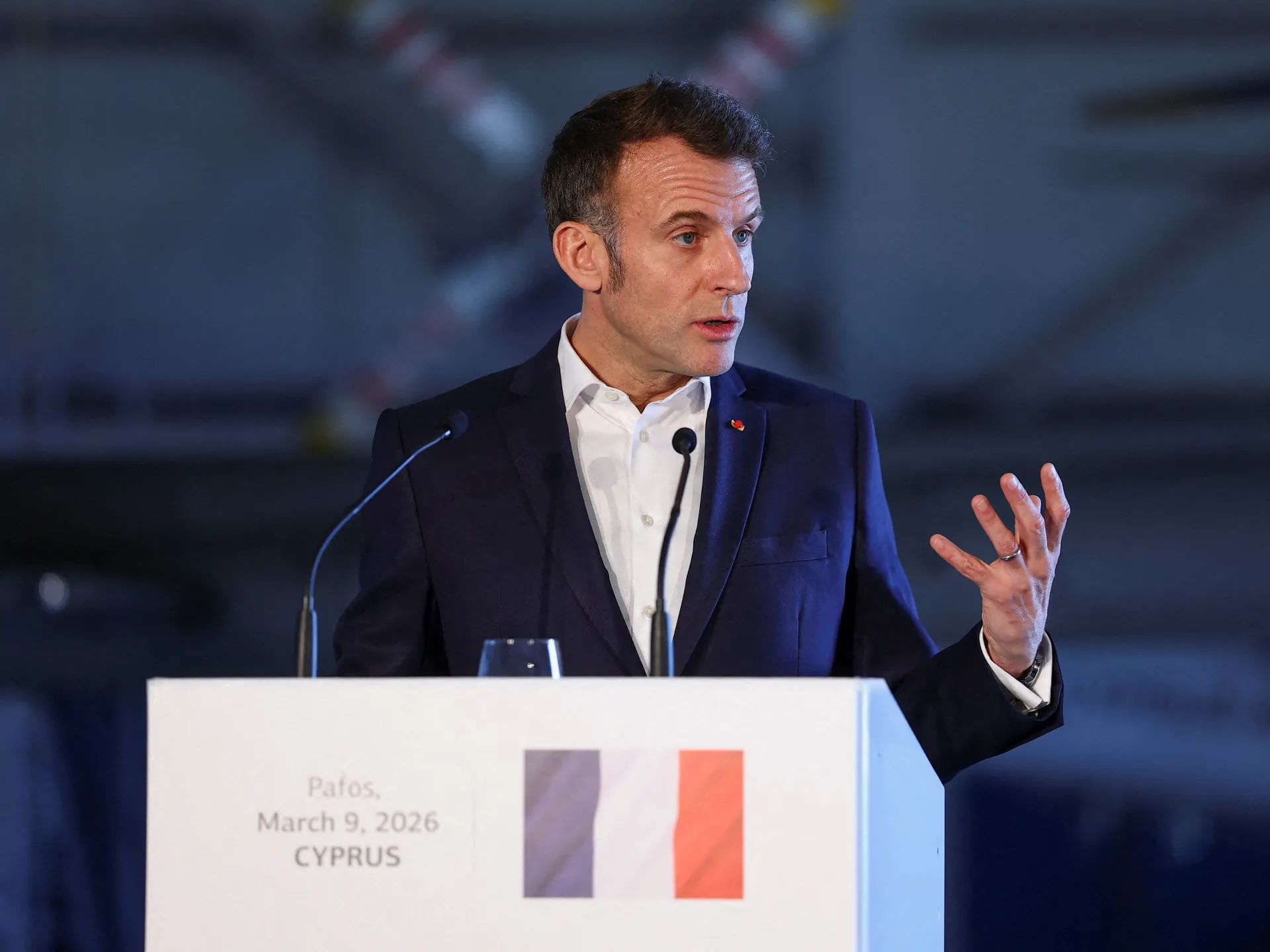
French President Emmanuel Macron has said France and its allies are preparing a “purely defensive” mission to escort vessels through the Strait of Hormuz once the “most intense phase” of the US-Israeli war on Iran ends.

Speaking in Cyprus on Monday, Macron said the “purely escort mission” must be prepared by both European and non-European countries.

Recommended Stories

list of 3 itemsend of list

Its purpose “is to enable, as soon as possible after the most intense phase of the conflict has ended, the escort of container ships and tankers to gradually reopen the Strait of Hormuz”, the French president said, without providing further details.

Macron’s comments come as global oil prices have surged amid continued attacks by the United States and Israel against Iran, as well as retaliatory Iranian missile and drone strikes across the wider region.

The war has effectively shut down the Strait of Hormuz, a strategic Gulf waterway through which about 20 percent of the world’s oil supplies pass, while Iranian attacks on energy infrastructure in the Middle East also have raised concerns.

Responding to Macron’s comments, top Iranian security official Ali Larijani said, “It is unlikely that any security will be achieved in the Strait of Hormuz amid the fires of the war ignited by the United States and Israel in the region.”

Larijani added in a social media post that security is also unlikely to be restored as a result of plans designed by “parties that were not far removed from supporting this war and contributing to its fanning”.

While European countries have been largely sidelined as the war escalates, several – including France, the United Kingdom and Greece – have sent military assets to Cyprus following an Iranian-made drone attack on a British base on the island.

Greece has dispatched four F-16 fighter planes to the Paphos airbase and its two state-of-the-art frigates Kimon and Psara are patrolling offshore Cyprus, tasked with intercepting any missiles or drones.

Last week, Macron ordered the French frigate Languedoc to waters off Cyprus to bolster the country’s anti-drone and anti-missile defences.

“When Cyprus is attacked, then Europe is attacked,” Macron said after meeting with Cypriot President Nikos Christodoulides and Greek Prime Minister Kyriakos Mitsotakis in Paphos on Monday.

The French president said he would also deploy a total of eight warships, two helicopter carriers and the nuclear-powered aircraft carrier Charles de Gaulle to the Eastern Mediterranean and the wider Middle East region, calling the move “unprecedented”.

France’s objective “is to maintain a strictly defensive stance, standing alongside all countries attacked by Iran in its retaliation, to ensure our credibility, and to contribute to regional de-escalation”, Macron said.

“Ultimately, we aim to guarantee freedom of navigation and maritime security.”

With the closure of the Strait of Hormuz sending oil prices soaring, finance ministers from the Group of Seven (G7) countries met in Brussels on Monday to discuss how to respond.

Crude oil prices have increased by about 50 percent since the US and Israel launched the war last month, with international benchmark Brent crude prices surpassing $100 a barrel on Monday.

French Finance Minister Roland Lescure told reporters that the G7 ministers did not make a decision on the potential release of emergency oil stocks amid the war. “What we’ve agreed upon is to use any necessary tools if need be to stabilise the market, including the potential release of necessary stockpiles,” Lescure said.

Paul Hickin, editor-in-chief and chief economist at Petroleum Economist, said getting the Strait of Hormuz reopened is the main priority. “That’s not going to happen in any shape or form until there’s a resolution to the conflict,” Hickin told Al Jazeera.

He explained that several countries in the Middle East, such as Kuwait and Iraq, are dependent on the strait to get their energy supplies to market.

“Kuwait and Iraq and those producers, they are really having a shut-in, and it will take a little bit of time to get back up and running,” said Hickin.

“That is the big risk, the knock-on effect … Getting those ships back, getting that infrastructure back up and running, it’s a slow process. So prices won’t come back down as quickly as many may think.”

Source link

Trump’s Plan To Escort Ships Through Strait Of Hormuz Would Put U.S. Navy Warships In The Crosshairs

U.S. Navy could soon be escorting commercial ships through the Strait of Hormuz, where maritime traffic has effectively stopped due to the current conflict with Iran, according to President Donald Trump. Doing so would demand that American naval vessels transit through the Strait, shifting them away from other duties. More importantly, it would also mean putting them right in a super weapons engagement zone full of Iranian threats that could include cruise and ballistic missiles, one-way-attack drones, explosive-laden kamikaze boats, and naval mines.

“If necessary, the United States Navy will begin escorting tankers through the Strait of Hormuz, as soon as possible,” President Trump wrote in a post on his Truth Social social media network.

BREAKING: Trump:

Effective IMMEDIATELY, I have ordered the United States Development Finance Corporation (DFC) to provide, at a very reasonable price, political risk insurance and guarantees for the Financial Security of ALL Maritime Trade, especially Energy, traveling through… pic.twitter.com/a1wavLcfYU

— Clash Report (@clashreport) March 3, 2026

“Effective IMMEDIATELY, I have ordered the United States Development Finance Corporation (DFC) to provide, at a very reasonable price, political risk insurance and guarantees for the Financial Security of ALL Maritime Trade, especially Energy, traveling through the Gulf,” he also wrote. “This will be available to all Shipping Lines.”

“No matter what, the United States will ensure the FREE FLOW of ENERGY to the WORLD. The United States’ ECONOMIC and MILITARY MIGHT is the GREATEST ON EARTH,” he added. “More actions to come.”

U.S. Central Command declined to comment when reached for more details. TWZ has also reached out to the White House.

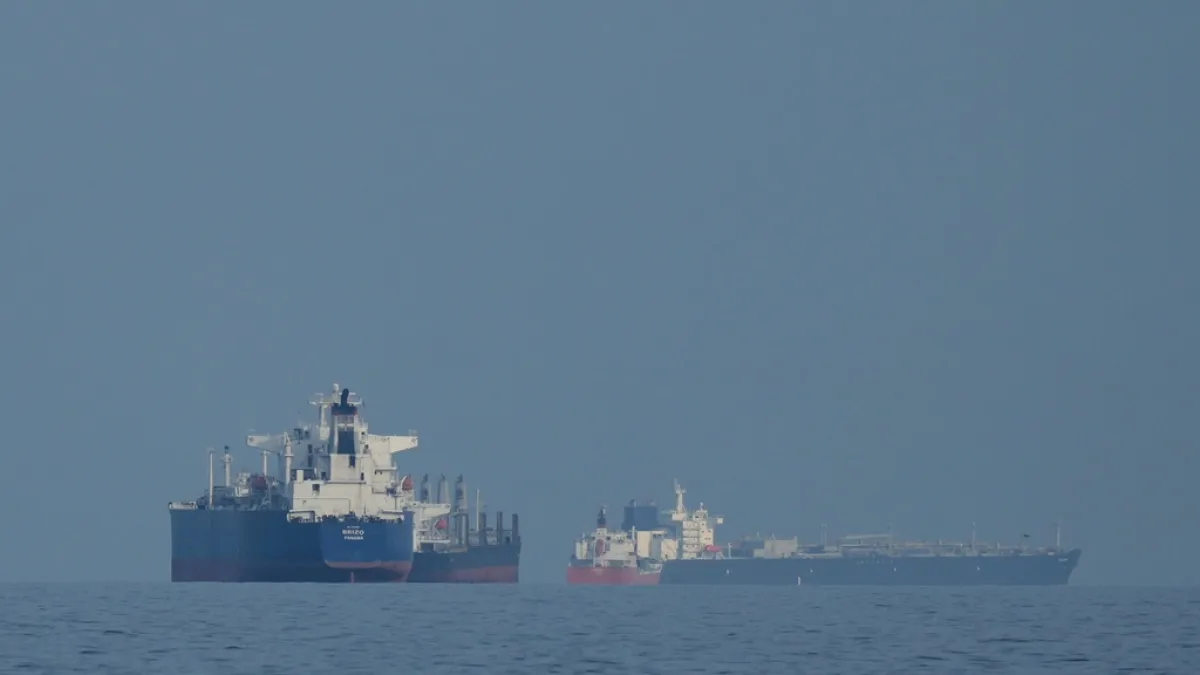
The Strait of Hormuz, which links the Persian Gulf and the Gulf of Oman, is just 20 nautical miles across at its narrowest point. A significant portion of the waterway falls within Iran’s national waters, which also overlap with those of Oman to the south. Under normal conditions, maritime traffic flows in and out through a pair of established two-mile-wide shipping lanes. Each year, roughly one-fifth of all global oil shipments, and an even higher percentage of seaborne shipments, pass through this one waterway. It is also a major conduit for liquid natural gas exports. Some 3,000 ships, including tankers and container ships, pass through each month.

Minimal vessel traffic seen in Strait of Hormuz amid reported closure

The latest #MarineTraffic playback shows visibly reduced transit density, alongside holding patterns, slower speeds, and vessels remaining outside the strait as operators reassess risk. pic.twitter.com/pfqk5rcbg8

— MarineTraffic (@MarineTraffic) March 3, 2026

Politico had earlier reported that President Trump’s administration was considering both of these courses of action, citing unnamed sources.

“It’s becoming a growing concern that the energy markets could face pressures in the coming days as the military campaign intensifies and expands in geographic scope,” one individual said to be familiar with the discussions told that outlet. “Access to the Straits [sic] of Hormuz is obviously vital for both natural gas and crude oil shipments, especially from Qatar and Saudi [Arabia].”

Lloyd’s List has also reported that Trump’s announcement came “less than 24 hours after Navy officials told shipping industry representatives that there was ‘no chance’ of escorts happening any time soon.”

Several civilian vessels have already suffered attacks in and around the Strait since the United States and Israel launched their joint operation against Iran this past weekend. Though American officials insist that Iranian forces have been unable to seal off the highly strategic waterway, maritime traffic through it has now come to a near halt amid the ongoing fighting. Some ships appear to be making the transit with the transporters turned off to reduce the chance of being targeted. The real danger of attack has been compounded by insurers cancelling war risk policies ahead of what are expected to be major rate hikes.

🚢 Strait of Hormuz traffic drops to zero

West-to-east crossings averaged ~25–35 per day through February before tankers and container lines began pulling back amid escalating Gulf tensions.

By March 2, Bloomberg daily DSET CHOKE data showed transits at zero after Iran’s… pic.twitter.com/zlhLjl4m8q

— Michael McDonough (@M_McDonough) March 3, 2026

Iranian retaliatory attacks have also been hitting port facilities, as well as energy infrastructure, in multiple Gulf Arab states. As noted, if this situation persists, the potential knock-on effects on global oil and natural gas markets could quickly become severe. Since Iranian authorities have repeatedly threatened to blockade the Strait of Hormuz in the event of a major crisis that threatens the regime, TWZ has explored all of this in detail in the past.

Iranian attack drones struck oil storage infrastructure in Fujairah, UAE, this morning, causing a large fire.

Notably, Fujairah is the only major oil export terminal in the UAE that avoids the now-closed Strait of Hormuz. pic.twitter.com/DdAbVOyRoc

— OSINTtechnical (@Osinttechnical) March 3, 2026

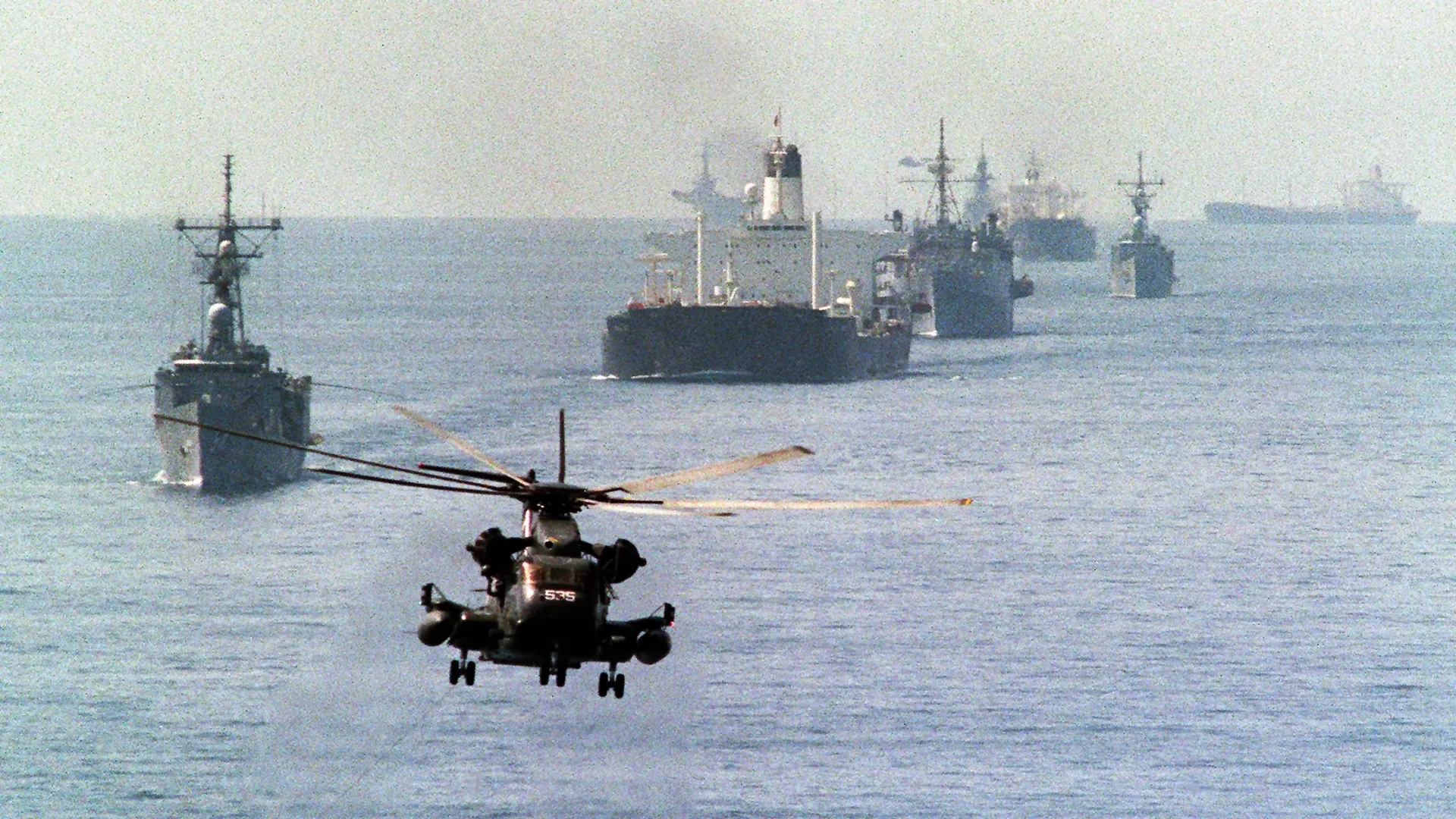
This is not the first time that the United States has been faced with this predicament or decided to start escorting commercial vessels through the region as a result. The U.S. Navy did just this in the late 1980s during the Tanker War sideshow to the Iran-Iraq War. At the same time, that experience underscores the immense amount of resources such a campaign could require, as well as the risks.

At the peak of those operations, there were some 30 American warships escorting commercial vessels to and from the Persian Gulf. Aircraft, special operations forces, and other assets were also deployed in support. The risks to American service members, as well as the ships they were tasked to safeguard, were very real.

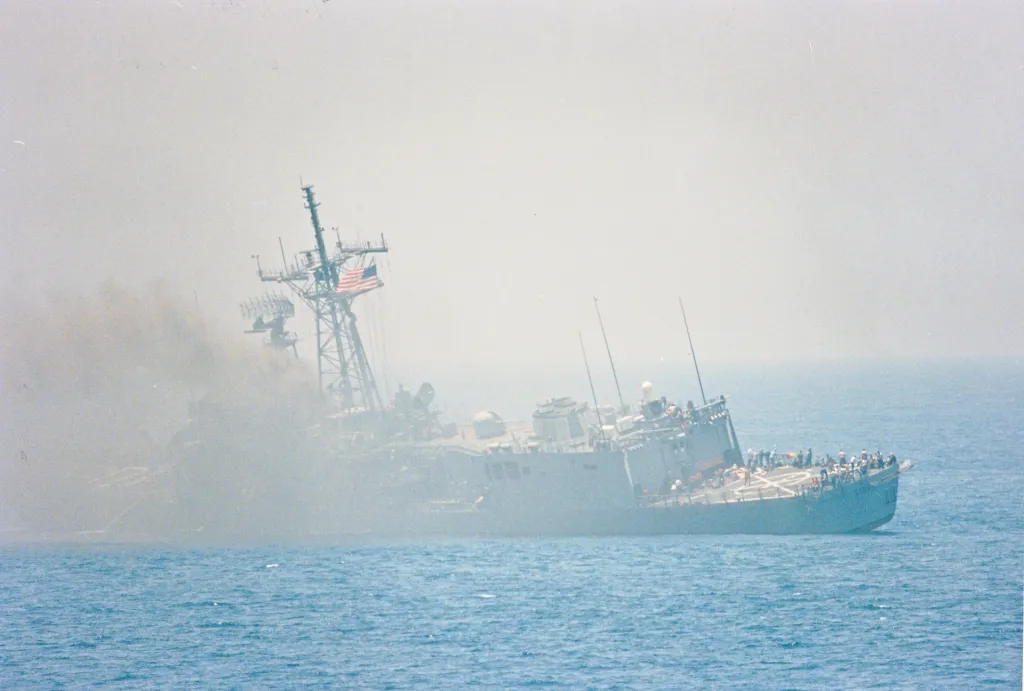
Shortly before the escort mission began in 1987, the Oliver Hazard Perry class frigate USS Stark was struck by two French-made Exocet anti-ship cruise missiles fired from an Iraqi aircraft as it sailed in the Persian Gulf. The government of Iraq, then led by Saddam Hussein, apologized, claiming they had mistaken the Americans for an Iranian tanker. In the end, 37 U.S. Navy personnel died, and 21 more were wounded.

The USS Stark burns in the Persian Gulf after being hit by Exocet anti-ship cruise missiles launched from an Iraqi aircraft in 1987. USN

In 1988, the USS Samuel B. Roberts, another Oliver Hazard Perry class frigate, was severely damaged after hitting an Iranian naval mine in the Persian Gulf while supporting the escort mission. 10 sailors were injured, but there were thankfully no fatalities.

Damage to the hull of USS Samuel B. Roberts after it struck an Iranian naval mine in 1988. USN

In the course of the Tanker War, 450 commercial ships also came under attack, and many were damaged or even sunk by missiles, mines, and other threats.

More recently, the U.S. military, as well as the European Union, have established naval task forces to help ensure the free flow of maritime commerce through the Strait of Hormuz, as well as elsewhere in the Middle East. When it comes to Iran, those forces have primarily been called on to respond to attempts to seize ships or otherwise harass them. In the past decade or so, outright Iranian attacks on ships in and around the Persian Gulf have generally been covert and sporadic.

U.S. fires warning shots at Iranian fast boats.


The U.S. Navy released the video below in 2019 in relation to an Iranian covert limpet mine attack on a commercial ship in the Gulf of Oman.

Limpet Mine Attack in the Gulf of Oman: JUNE 13, 2019


Escorting commercial ships through the Strait of Hormuz now would involve U.S. Navy warships sailing right into an extremely high-threat zone in the midst of a conflict that has already taken on a regional character.

In general, the U.S. Navy, as well as commercial shipping companies, have loathed convoy operations despite the benefits they offer. As already noted, these missions can be very resource-intensive, as well as risky. Ships tasked with these missions are then also not available for other duties, including striking targets ashore or helping defend other assets. It can also be very time-consuming to assemble maritime convoys and then escort them to their destination. You can read more about all this in a past TWZ feature here.

The US Navy’s Arleigh Burke class destroyer USS Delbert D. Black fires a Tomahawk land attack cruise missile at an Iranian target on February 28, 2026. USN

For all the lessons the U.S. military learned during the Tanker War, Iran has also significantly expanded the scale and scope of anti-ship capabilities since then, as we regularly highlight. Iran’s missile, drone, and naval forces have been degraded just in the past few days of intensive U.S.-Israeli strikes. How much Iran was able to reconstitute missile and other capabilities in the aftermath of losses during the 12 Day War with Israel last year is also unclear.

Two days ago, the Iranian regime had 11 ships in the Gulf of Oman, today they have ZERO. The Iranian regime has harassed and attacked international shipping in the Gulf of Oman for decades. Those days are over. Freedom of maritime navigation has underpinned American and global… pic.twitter.com/nzdkMVMqZC

— U.S. Central Command (@CENTCOM) March 2, 2026

The Iranian regime’s killer drones have been a menace in the Middle East for years. These drones are no longer a tolerable risk. pic.twitter.com/76yhDKI6OW

— U.S. Central Command (@CENTCOM) March 3, 2026

At the same time, much of Iran’s shorter-range missile and drone arsenal is understood to be untouched, as well as dispersed, making interdiction now more challenging. Yesterday, U.S. Secretary of State and acting National Security Advisor Marco Rubio highlighted these threats and the dangers they pose.

SECRETARY RUBIO: The United States is conducting an operation to eliminate the threat of Iran’s short range ballistic missiles and the threat posed by their navy, particularly to naval assets.

That is what the U.S. is focused on right now and is doing quite successfully. pic.twitter.com/zWKBOLVstH

— Department of State (@StateDept) March 2, 2026

Iranian-backed Houthi militants in Yemen were able to cause massive disruptions in maritime traffic in and around the Red Sea between late 2023 and early 2025 using just a portion of what Iran itself could still potentially bring to bear. The U.S. response to Houthi attacks, which included naval deployments to help safeguard commercial shipping, did provide additional valuable lessons learned. It also underscored very real risks to naval assets in environments full of missile and drone threats, as well as to aircraft, including stealth types, flying overhead.

The Barbados-flagged cargo ship True Confidence burns after being hit by Houthi missiles in 2024. US Central Command

The narrowness of the Strait of Hormuz, as well as the insular nature of the Persian Gulf, creates additional challenges and risks compared to operations in the Red Sea and the Gulf of Aden because there is simply less space to maneuver. Iranian anti-ship cruise and ballistic missiles, as well as one-way-attack drones, can be fired from road-mobile launchers, including ones disguised as civilian trucks, making it even more difficult to find and fix threats in advance. Proximity in the littoral zone to these threats only further reduces the time available to react.

The Iranian regime is using mobile launchers to indiscriminately fire missiles in an attempt to inflict maximum harm across the region. U.S. forces are hunting these threats down and without apology or hesitation, we are taking them out. pic.twitter.com/gv1SfKCrk4

— U.S. Central Command (@CENTCOM) March 3, 2026

Escort operations mean that American warships would need to transit through the highest threat areas repeatedly, as well, which would only give Iranian forces more engagement opportunities. There is a reason why U.S. naval vessels are currently operating well away from the Persian Gulf in the Arabian Sea, as well as the Eastern Mediterranean.

President Donald Trump seen at his Mar-a-Lago estate during the opening phase of Operation Epic Fury against Iran on February 28, 2026. The map seen behind him gives a general sense of where US naval forces are positioned for this operation. White House

U.S. naval facilities, as well as civilian ports, on the opposite side of the Persian Gulf have also come under Iranian attack in the past few days, and would not be guaranteed sanctuaries to shelter in. Iranian retaliatory attacks across the Middle East are already showing the limits of some of the most modern air defense capabilities on Earth, especially when faced with large volumes and/or complex mixtures of disparate incoming threats.

An Iranian one-way attack drone, likely a Shahed-136, filmed scoring a direct hit earlier Saturday on the U.S. Navy’s 5th Fleet Headquarters at Naval Support Activity Bahrain in Juffair, located in Manama, the capital of Bahrain. pic.twitter.com/O9AVD7DmzC

— OSINTdefender (@sentdefender) February 28, 2026

It is possible that U.S. allies and partners could help bolster an operation to protect regional shipping that is sufficiently separate from U.S.-Israeli strikes on Iran. The United Kingdom and France are already conducting defense missions to intercept incoming Iranian threats around the Persian Gulf, as well as in the Eastern Mediterranean. Both of those countries, among others, are also sending more forces to bolster defenses around the region. As already made clear, a protracted upending of oil and natural gas exports from the Arabian Peninsula, as well as Iran itself, will reverberate globally.

US Navy and Coast Guard vessels, including an uncrewed surface vessel, transit the Strait of Hormuz in 2023. USN

TWZ has pointed to this reality in the past as raising key questions about whether the Iranian regime would have the political will, let alone the materiel capacity, to blockade the Strait of Hormuz. For now, though, as we wrote just this morning:

“Increased targeting of Gulf Arab States’ oil and natural gas production is part of a clear Iranian strategy to put pressure on those countries to, in turn, create complications for the United States. As the economic pressure builds, the idea is that these countries will seek to end the conflict, and/or that relations with the U.S. will sour. The prospect of major, long-term disruptions in energy exports from the region has global ramifications, as well, which could bring immense external pressure to end the conflict. There is also the aspect of drawing Arab countries into the conflict, which would complicate it politically and militarily. In addition, some energy targets are not as well defended as U.S. bases in the region, for instance, and scoring hits with the now finite weapons Iran has on hand becomes easier.”

How this will continue to play out, especially if more countries begin to take ostensibly defensive action against Iranian threats, is unknown. There is a very real potential for Iran’s strategy to backfire if the crisis begins to take a toll economically well beyond the Middle East.

U.S. Navy warships escorting commercial vessels through the Strait of Hormuz could help soften those impacts, but not without major risks, as well as the expenditure of significant resources. Risks would remain for shipping companies too, who could still be reluctant to make the transit, especially with uncertain insurance guarantees.

Overall, it remains to be seen how a U.S. mission to get oil and gas flowing again through the Strait of Hormuz might materialize.

Contact the author: joe@twz.com

Joseph has been a member of The War Zone team since early 2017. Prior to that, he was an Associate Editor at War Is Boring, and his byline has appeared in other publications, including Small Arms Review, Small Arms Defense Journal, Reuters, We Are the Mighty, and Task & Purpose.


Source link