Delcy’s Dark Blue Rebrand Goes Beyond Erasing Maduro
The photo is from Workers’ Day in Venezuela, when Delcy Rodríguez, wearing a blue Ronald Acuña baseball jersey, announced a long-awaited minimum income increase after several days touring the country, campaigning for a land of peace and prosperity, free of sanctions.
Us Venezuelans know that chavismo loves a propaganda makeover. They can be good at it too, in all honesty. The aftermath of the capture of one of the world’s most loathed autocrats, and the takeover by his supposedly pragmatic, corporate-like vice president was never going to be an exception when it comes to PR reinvention.
Media outlets have noticed the changes in the Caracas landscape: the image of Nicolás Maduro (and to some extent, that of former First Combatant Cilia Flores) is starting to disappear from view. Large billboards featuring the couple, including the phrase “we want them back” (los queremos de vuelta), are getting withdrawn.
This occurs as there’s serious discomfort inside chavismo about how close the Delcy-Trump relationship has become: from the drastic U-turn in the Alex Saab case to increased “supervision” from the US embassy in Caracas and the joint military operation targeting the Tren de Aragua leader, it looks like Washington’s tutelage keeps expanding and deepening at great speed.
Delcy herself is not the main focus. The idea is to convince Venezuelans that things are improving, to encourage them to imagine how the country could thrive if sanctions are lifted.
The official strategy now seems to put Maduro on the back burner, letting him fade away from short-term memory. Getting rid of his image entirely won’t be easy, of course. After all, his face and personal brand—his Super Mustache, and the tricolor M letter from his 2018 presidential campaign which became an official emblem of sorts—can still be seen on public signs, painted in walls and even in official vehicles.
This mirrors what happened earlier with the visual trademarks of the late Hugo Chávez, like his famous eyes and rabo e’ cochino signature. Maduro had reduced their public use and replaced them with his own iconography, for better or for worse.
Blue-hued efficiency
This sudden shift in dropping Maduro’s image brings an important question to mind: what will replace it?
One option would be to have Delcy’s face in huge billboards across avenues and highways. But that has not been the case so far.
Two elements are noticeable. First, Delcy herself is not the main focus. Instead, the idea is to convince the Venezuelan people that things are improving, and to encourage them to imagine how the country could thrive if (more) US sanctions are lifted.
She has embraced a more traditional “head of state” role, prioritizing highly-publicized formal meetings where she signs letters of understanding (often disguised as actual contracts) with foreign investors as signs that the country is back on track and open for business. That completely aligns with how the Trump administration and POTUS himself sell their role here.

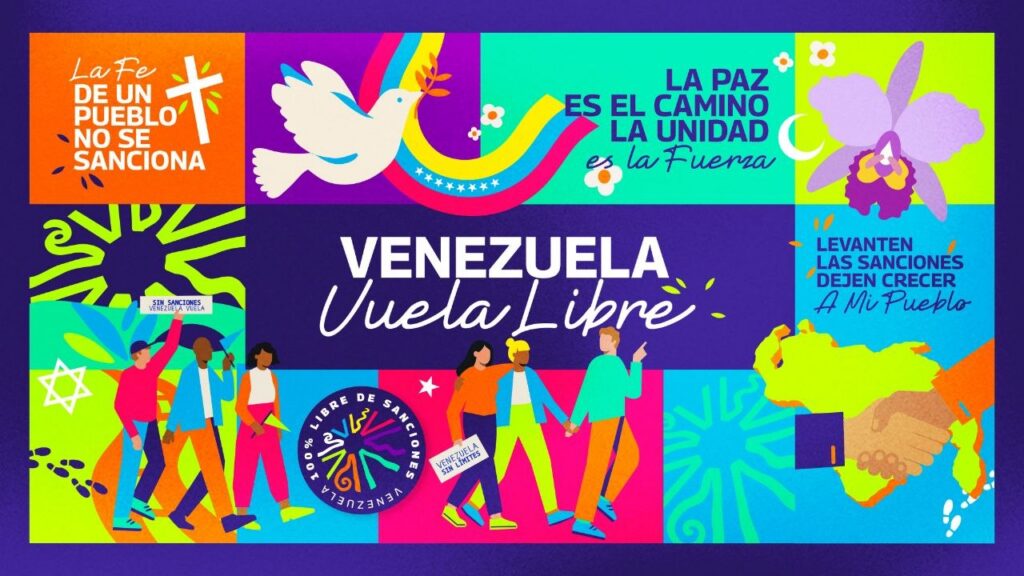
Political advertising from the Delcy Rodríguez government tries to project a nation of diverse, forward-looking citizens, which is a huge departure from the Chávez-era exaltation of the all-red masses. Note the Star of David on the left-hand side of the image above, a nod to both the US and a Jewish community famously insulted by Chávez.
Even Miraflores Palace got its own new styling for such occasions: the Cabinet Room was stripped of not only anything related to both Chávez and Maduro but also the pictures of the late Argentine President Néstor Kirchner. The room was named in his honor in 2011. In its place there’s now a large, White House-styled logo for Miraflores, which has been in use since 2018.
Then there’ the blatant decision of dropping chavismo’s traditional rojo-rojito red for a dark blue.
Curiously enough, the Rodrigato has taken advantage of the full visual rebrand of the government launched last year by Maduro, which dropped the term Gobierno Bolivariano and related symbols used since the mid 2000s.
The national flag and formal country name are front and center. The use of a broader institutional look is another stark contrast with the more personalized presentation from the Maduro years.
Delcy has used social media and trips both inside and outside the country in order to compensate for her brand-new stateswoman persona. But she doesn’t go as far as doing an Aló Presidente-style TV show or starting her own podcast like Maduro did with Con Maduro + (where Delcy was once a guest).
Delcy probably knows she is not exactly the most marketable presidential candidate. This rebrand is also an attempt to push her image in that direction while her aides and consultants still have time to sketch something viable.
So far, Delcy´s deeper involvement in mass events this year happened in late April, during the so-called “Great National Pilgrimage for a Venezuela Free of Sanctions,” better known for its shorter slogan Venezuela vuela libre (Venezuela flies free). At its core, it looks like an early balloon trial for what her campaign could look like in a snap election. On the surface, it seemed like an appropriation of the religious frenzy around the canonization of two Venezuelan saints—several months after that event, when Maduro was not in Brooklyn—and of the symbols and rituals of the Machado campaign: rosaries, people embracing a politician’s caravan across a village, blue and white clothes.
This particular change didn’t go unnoticed by former state television host Mario Silva, a longtime supporter of the revolución who has become Delcy’s most outspoken critic within chavismo. Silva recently told the Wall Street Journal: “Red used to mean combat… The pale blue is to put the masses to sleep.” The campaign itself became part of a heated debate between Silva and other figures related to the chavismo’s media ecosystem, such as Indira Urbaneja and the Argentine influencer known as Michelo last month.
Its launch was linked with the grand minimum wage announcement on May 1st after a four-year wait. It wasn’t really the real wage increase that teachers, healthcare workers and public officials were hoping for. Since January 3rd, Jorge Rodríguez regularly takes over for her sister in public events. By the looks of the recent lack of activity in the official YouTube channel, it’s currently not at the same level of the spring period. The amount of related outdoor ads and street banners seemingly will do heavy lifting this summer.
Presidential disguise
Uncertainty hangs over Venezuela’s political future for the second half of 2026, but Delcy Rodríguez is clearly capitalizing on her position, using every resource at her disposal without facing any pushback from Washington. Yet, when it comes to the raw talent of a traditional politician, her shortcomings are no secret. Her speeches tend to be quite brief and dry. She has sounded nervous when caught off guard. She lacks the charismatic oratory of Chávez and the brazen rhetoric of her brother or her predecessor. She probably knows she is not exactly the most marketable presidential candidate. This rebrand is an attempt to push her image in that direction while her aides and consultants still have time to sketch something viable.
Coming back to Maduro, the little sympathy he had outside the most hardcore chavista supporters won’t improve. People are not missing him, never mind care that Delcy is shedding his old propaganda. Ordinary Venezuelans are generally too busy, dealing with their everyday problems, to pay attention to the politics of chavista PR.
In the end, this stealth attempt to erase Maduro’s image isn’t as simple as turning the page and moving on. Delcy needs to build a whole new persona that fits both the mainstream chavismo she wants to rally (and that still represents her voter base), and the one Donald Trump can be happy with.
She may not be able to deliver the rousing speeches of Chávez in his prime, or pull off the theatrical antics that Maduro leaned on for years, but playing the dignified role of “the President” may just work for her. At least for the foreseeable future.