erase

President Trump loses again in bid to erase his hush money conviction

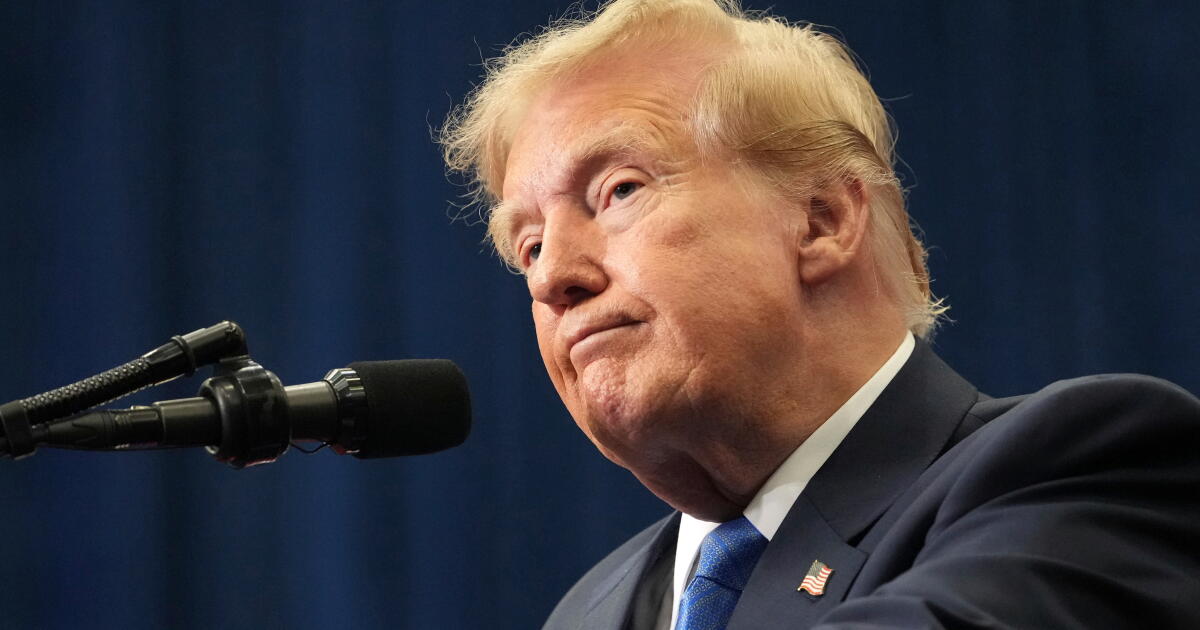
A federal judge on Friday once again spurned President Trump’s effort to erase his hush money conviction, rejecting the president’s bid to move the state court case to federal court and have it dismissed on presidential immunity grounds.

Judge Alvin K. Hellerstein reiterated his earlier finding against Trump, saying that the reasons Trump cited for renewing his request were “neither new nor legally sufficient.”

The judge added: “He has failed to show good cause and diligence.”

It is the third time Hellerstein has blocked Trump from having the U.S. District Court in Manhattan seize control of the case from the New York court where he was tried and convicted.

And, like before, Trump will appeal, according to a spokesperson for his legal team who called Hellerstein’s ruling “baseless and lawless.”

“The Supreme Court’s historic decision on Immunity, the Federal and New York State Constitutions, and other established legal precedent mandate that the Witch Hunt perpetrated by the Manhattan DA be removed to federal court, and immediately overturned and dismissed,” a statement issued on behalf of the legal team said. “President Trump will be filing a powerful appeal, and will continue defeating Democrat weaponization at every turn.”

The guilty verdict, reached in May 2024 while Trump was between terms, made him the first former — and now current — U.S. president to be convicted of a crime. Trump is also challenging his conviction through the state court appellate process, which is pending.

Hellerstein’s decision came after a federal appeals court last year ordered him to reconsider his prior denial. The judge previewed his ruling during oral arguments in February, slamming Trump’s lawyers for legal maneuvers that amounted to taking “two bites at the apple.”

State prosecutors did not immediately respond to a request for comment.

The case centered on a payment to Stormy Daniels

Trump was convicted in May 2024 of 34 felony counts of falsifying business records to conceal a $130,000 hush money payment to adult film actor Stormy Daniels, whose claim of a sexual encounter with Trump a decade earlier had threatened to upend his 2016 presidential campaign.

Trump was sentenced to an unconditional discharge, which left his conviction intact but spared him any punishment. He had long denied Daniels’ claim and said he did nothing wrong. He has sought to get the conviction overturned both by attempting to move the case to federal court and through the appeals process in state court, which is pending.

Hellerstein rejected Trump’s requests to move the case twice before. The first was after Trump’s March 2023 indictment. The second was after Trump’s trial, as his lawyers sought to nix his conviction in the wake of the Supreme Court’s July 2024 ruling that presidents and ex-presidents can’t be prosecuted for official acts and prosecutors can’t use official acts as evidence that unofficial actions were illegal.

Trump appealed Hellerstein’s post-trial ruling and, last November, the U.S. 2nd Circuit Court of Appeals ordered the judge to reconsider his decision, finding that he had failed to consider “important issues relevant” to the president’s request to move the case.

A three-judge appellate panel said it expressed no view on how he should rule but instructed Hellerstein to closely review evidence that Trump claimed was related to official acts and whether Trump could argue those actions were taken as part of his White House duties.

The judges also instructed Hellerstein to determine if Trump had “diligently sought” to have the case moved to federal court and whether the case can even be moved to federal court now that Trump has been convicted and sentenced in state court.

During oral arguments in February, Hellerstein took issue with the Trump legal team’s decision-making after the Supreme Court ruling.

Instead of immediately seeking to move the case to federal court, he noted, Trump’s lawyers first asked the trial judge in state court, Juan Merchan, to throw out the verdict on immunity grounds. Normally, such a request must be made within 30 days of an arraignment, but a federal appeals court in Washington, D.C. has ruled that exceptions can be made if “good cause” is shown.

Trump, a Republican, did not attend the arguments.

Trump lawyer Jeffrey Wall argued that prosecutors rushed to trial instead of waiting for the Supreme Court’s presidential immunity decision and that Trump’s legal team was crunched for time after the high court’s ruling because his sentencing was scheduled for just 10 days later.

Trump’s lawyers did not ask Hellerstein to intervene until nearly two months later, while their request to Merchan was still pending. The judge called that a “strategic decision” and suggested that by going to the state court first, Trump’s lawyers cost him the right to pursue remedies in federal court.

“No, your honor,” Wall replied. “It is what any sensible litigant would do” in that situation.

“Not so,” Hellerstein replied.

“That is a decision on your part,” the judge added. “You didn’t have to do that. You could have come right to the federal court. Just by filing a notice of removal, there would be no sentencing.”

Trump’s lawyers “made a choice,” Hellerstein said, “and you sought two bites at the apple.”

In his written ruling Friday, Hellerstein said Trump was asking for a “‘second bite at the apple,’ a result the law disfavors.”

The judge added that “Trump’s delay in filing for removal constitutes a ‘quintessential strategic decision,’ and the ‘fact that he later came to view that decision as a poor one is not sufficient, by itself, to establish cause.’”

Sisak and Neumeister write for the Associated Press.

Source link

LA County warns that Paramount-Warner merger could erase thousands jobs

Paramount Skydance’s proposed $111-billion takeover of Warner Bros. Discovery could result in 4,500 jobs eliminated in Los Angeles over a three-year period, according to a new report.

Los Angeles County supervisors earlier this year wanted to explore the potential economic impact of David Ellison’s proposed union of two historic Hollywood studios. The report, completed this week by CVL Economics, paints a sobering picture of the potential aftermath of the debt-laden deal, including the prospect of an estimated $1.26 billion in lost wages.

“Los Angeles County’s film and television economy is already undergoing a significant structural contraction,” the report said. “The proposed merger of Warner Bros. Discovery and Paramount Skydance introduces an additional source of risk into that already changing market.”

California Atty. General Rob Bonta is leading a coalition of 12 states attempting to block the merger on antitrust grounds. A trial has been set for March. Paramount and other groups, including cinema chain owners and some Hollywood unions, have agitated for a settlement to curtail months of uncertainty over whether the deal will go through.

The proposed merger has been controversial in Hollywood due to fears of widespread layoffs. The Writers Guild of America has brought its own lawsuit to thwart the deal.

The goal of the county’s report was to provide “a comprehensive assessment of the merger’s production workforce implications,” amid the ongoing decline of L.A. based film and television production work. Los Angeles has witnessed the elimination of more than 50,000 entertainment jobs since 2022.

The 120-page report, from the county’s Department of Economic Opportunity and Film Office and requested by Supervisor Lindsey Horvath, found that more than 15,000 corporate roles would be at risk, including an estimated 2,495 jobs based in Los Angeles County.

The two companies would have an overlapping workforce within its linear cable channel divisions, film and television studios, streaming operations and corporate functions, including marketing, technology and advertising sales.

“Effects on crews, crafts, post-production personnel, vendors, and production-serving small businesses,” could also be substantial, the report said.

Paramount, in a statement, said the report highlighted the industry’s troubles and made a case for the merger.

“LA County’s own economic report underscores what we have been saying all along: our industry is in decline, production is down and jobs are being lost — and lost for good if we don’t act,” Paramount said. “Our plan to invest $30 billion annually in production and release at least 30 films a year.”

That commitment, Paramount said, would lead to “more jobs over time, and ultimately, a stronger, more durable entertainment industry for generations to come.”

Paramount has received clearances from the U.S. Justice Department and 65 other regulators around the globe to complete the merger.

For now, Bonta’s lawsuit is standing in the way.

Paramount has promised investors the deal would lead to at least $6 billion in cost savings through the consolidation of operations. The company has said the merger would ultimately be good for consumers and workers because a combined Paramount-Warner Bros. would have greater resources to compete with tech giants that are investing heavily in entertainment.

But the report pointed to the high level of debt that Paramount would have to take on — nearly $82 billion — to buy the stock of Warner Bros. Discovery shareholders to finalize the takeover.

“If revenues underperform or planned savings prove more difficult to achieve, pressure to identify additional cost reductions could increase,” the report said.

The two companies already are carrying substantial interest costs due to their existing debt structures. “In the quarter ended June 30, 2026, the two companies reported a combined $712 million in operating income and $737 million in net interest expense,” the report said, meaning that the companies were producing less profit than what was needed to support their debt obligations.

Despite Paramount predicting cost savings and reduction in debt over time, “those savings will take several years to fully realize,” the report said.

Paramount Skydance CEO David Ellison.  (Photo by PATRICK T. FALLON/AFP via Getty Images)

David Ellison was hoping to wrap up his $111-billion merger with Warner Bros. by September.

(PATRICK T. FALLON/AFP via Getty Images)

Television production in Los Angeles could be especially vulnerable, in large part, because Paramount and Warner Bros. already have moved most of their feature film projects outside of L.A. High levels of TV production continues at Warner Bros. complex in Burbank and Paramount’s and CBS’ soundstages in Hollywood and Santa Clarita.

“The economic impact extends well beyond employment,” with an expected elimination of $547 million in tax revenue, including $78.6 million in local taxes, the report said.

It noted that Warner Bros. and Paramount films were “particularly employment-intensive.”

“Their theatrical releases carry 2.74 times as many screen credits as the average theatrical release, while their streaming films carry twice as many,” the report found.

The document also highlighted a pre-existing pull-back in production at the two studios in recent years — something that Ellison plans to correct.

Paramount was struggling to remain solvent prior to the Ellison family’s purchase of the media company last year. Warner Bros. had scaled back offerings following Discovery’s $43-billion takeover of WarnerMedia in 2022 as it struggled to contain the debt from that deal.

“Between 2019 and 2025, Warner Bros. Discovery and Paramount accounted for a net reduction of approximately 195 major U.S. releases,” the report said. At the same time, other major distributors combined “added about 67 projects.”

Ellison is looking to finalize his massive Hollywood deal — folding CNN, HBO, TBS, Food Network and the Warner Bros. film and television studios under Paramount — as quickly as possible. He must hold together Paramount’s coalition of financiers and manage rising expenses, primarily legal fees and escalating obligations to Warner shareholders.

The state attorneys general, including from Colorado, Oregon, Nevada, Washington and New York have argued that the blockbuster merger — the largest in Hollywood in decades — would violate the century-old Clayton Antitrust Act.

Paramount hoped the trial over Bonta’s lawsuit would begin in November but U.S. District Judge Araceli Martínez-Olguín set the trial for March 2.

If the deal goes forward, just four studios — a post-merger Paramount-Warner, Disney, NBCUniversal and Sony Pictures — would control 86% of movies that are widely released (in more than 3,000 movie theaters), according to the attorneys general lawsuit. Paramount has argued that projects from Amazon MGM, Netflix and Apple should be included because they compete with the traditional companies for talent and audiences.

Paramount-Warner Bros. would also own more than 50 cable channels, including HGTV, Animal Planet, BET, MTV and Comedy Central.

Source link