era

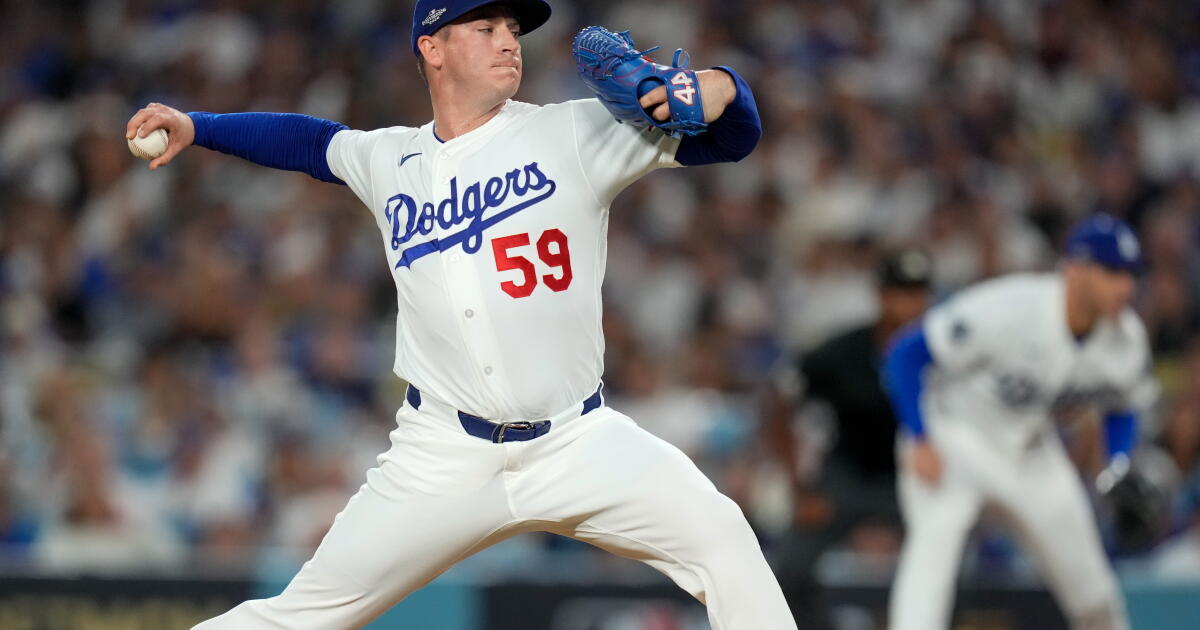
The Dodgers have one job this winter: Sign Tarik Skubal

Don’t you dare say the Dodgers don’t need him.

The Dodgers desperately need him.

Don’t you dare believe the Dodgers’ starting rotation is deep enough to withstand his loss.

It’s not as deep as you think.

And don’t you dare give the Dodgers a pass because their owner Mark Walter might have money troubles and there may be a lockout and how can they afford to spend more than $350 million on such an uncertain future?

Excuses, excuses, excuses.

Sign Skubal.

If the Dodgers are serious about keeping their swiftly closing championship window open, they will sign Tarik Skubal.

If the Dodgers are going to keep investing in their fans, they will re-invest in the best pitcher in baseball, buying the asset that was so successful as a rental, christening their new ace.

Sign Skubal.

You may have heard that Skubal, who went 5-2 with a 2.61 ERA in 10 starts for the Dodgers after being acquired at the trade deadline, is now a free agent.

You may have heard he’s seeking at least a $350-million deal, one that could be offered by several different teams, notably deep-pocketed Steve Cohen’s New York Mets.

You may have also heard that the Dodgers only have lukewarm interest in adding this big contract to their already bloated payroll, that they love their all-world rotation and wouldn’t be crushed if the new guy goes elsewhere.

They should be crushed. They should be furious. They need to do this.

Sign Skubal.

As it currently stands, Yoshinobu Yamamoto is their only starter who is a consistent reliable force. As the window closes on this aging superstar-filled lineup’s championship hopes, one stud starter is not enough, particularly in October.

Last month, in two postseason starts, Skubal had a 2.45 ERA and Yamamoto had a 3.72 ERA. The other two guys? Ugly.

Blake Snell, who turns 34 next month and has the physical makeup of someone twice that age, made only nine starts in the regular season before falling apart in October, racking up a 4.66 ERA with three homers allowed in 9 ⅔ innings.

Tyler Glasnow, who will be 34 next August and only made 13 regular-season starts, also blew up in the playoffs, with 5.00 ERA in two starts and seven walks in nine innings.

Then there’s the starters who didn’t start in the postseason, and there’s not a totally reliable arm among them.

Shohei Ohtani was 8-2 with a 1.79 ERA in 14 regular-season starts, but his pitching led to injuries that severely damaged his hitting, and this space maintains the belief that he should never pitch again.

Emmet Sheehan, Roki Sasaki and Justin Wrobleski all made more than 20 starts, and each pitched well in stretches, but all three combined would not be reason to forsake Skubal.

Check out the numbers, examine the resumes, and it’s painfully clear that the Dodgers should bring back the pitcher who belonged here the moment he arrived.

Sign Skubal.

He wasn’t a cheap rental like Manny Machado, who showed up in 2018, dogged it to first base a few times, and skipped town for San Diego.

He wasn’t an unsightly rental like Max Scherzer, who showed up in 2021, tapped out of a playoff start, and skipped town for New York.

Skubal was that rare rental that shined, hurrying into his Dodger uniform less than 24 hours after the trade, immediately cheering on his new teammates from a strange dugout while commanding respect in the clubhouse like he’s been here for years.

“The group of guys, the clubhouse, the culture they have here — it’s real,” he told reporters after the Dodgers final playoff loss. “I was honored to be part of it.”

The Dodgers were honored to have him, and they knew it.

“It’s not easy for a guy to get traded in the middle of a season to come to a new city, new clubhouse, you have set routines and you have to make those adjustments, it’s not easy,” said Andrew Friedman, president of baseball operation, in his postseason presser. “The way he was able to seamlessly transition, not just in terms of on the field, but in the clubhouse, I can’t say enough good things about the impact that he made in such a short period of time. We have a tremendous amount of respect for him on and off the field.”

So what’s the problem?

“I think a lot of it is continuing to see what this all looks like,” said Brandon Gomes, general manager, to reporters at last week’s general managers’ meetings, later adding, “Obviously, we know what kind of pitcher he is. So for us, it’s understanding what this all looks like, as far as what does our team need? What does the contract look like? Where does he end up? I don’t know. We know we love the player, we love the human, and you kind of have to let things play out to understand what that looks like, and if it’s something that we’re gonna ultimately execute.”

Don’t know what it looks like? Here’s what it looks like.

With Skubal: Championship favorites

Without Skubal: Just another contender.

At this point you might be saying, wait a minute, they finished only second in the National League with Skubal, they can do that much without him.

Please, don’t blame the Brewers’ sweep on him. The culprits were the batters, who were seemingly smothered underneath the empty uniform that was Ohtani.

They get their first offseason rest in three years, they add a couple of bats, Ohtani gets healthy, Will Smith gets refreshed, Kyle Tucker rebounds, the offense will recover enough to chase another championship.

But it is doubtful they will catch it without Tarik Skubal.

He reportedly plans to sign before the current Collective Bargaining Agreement ends on Dec. 1, after which the owners are expected to lock the players out in hopes of imposing a salary cap.

That gives the Dodgers, what, two weeks? They should do this in two minutes.

Sign Skubal.
Source link

Why the Era of Cheap Supply Chains Is Over

With global trade fracturing amid tariffs and risk, corporations are rethinking supply-chain costs.

This article appears in the November issue of Global Finance Magazine.

When a Citi analyst pressed SIG Group CFO Ann-Kristin Erkens on the company’s first-half call in July about whether its €80 million inventory build would become permanent, he was asking a version of a question finance chiefs now routinely face: How much should a company pay to protect itself from supply shocks? 

Part of the inventory increase came from valuing stock at higher input costs and part of it was deliberate, said Erkens, who has since been promoted to CEO. “There is an element of safety stock in there,” she said; whether the Swiss packaging maker works it down by year-end will depend on market volatility.

Companies that once scoured the globe for the lowest-cost production to feed just-in-time inventories now must account for geopolitical risk, surprise supply disruptions, and the price of keeping operations running when global trade falters. 

The new era of de-globalization is complicated by the need to spread costs out. Some are on the balance sheet as extra inventory. Others may be in capex as relocated or duplicate capacity. Sometimes costs appear as financing for a company signing up new suppliers. A CFO who wants to nail resilience must add up these scattered costs and figure out how much the business can recover.

Shock Absorbers

Inventory can be the quickest lever to pull, and usually the first. 

At Authority Brands, a consumer services company, some of the larger franchisees and company-run locations bought extra HVAC compressors and outdoor units in the first quarter of 2025, ahead of tariff-driven price increases, said CFO Josh Greear. 

In a normal year, those operators carry “weeks of inventory, not months.” Authority Brands negotiated with distributors on behalf of the whole system to lock in stock at existing prices. The manufacturers ended up raising prices anyway, including those building in the U.S., because every competitor’s costs had gone up.

Trane Technologies experienced the same whiplash on a large balance sheet. During the company’s second-quarter 2026 earnings call, CEO Dave Regnery said it had added four times the capacity to its applied HVAC business over the past three to four years, and guided 2026 capex to 2% to 3% of revenue. Part of that build-out runs through the P&L as production ramps up, CFO Chris Kuehn added, and may weigh on operating leverage in the very near term. 

Trane is “not going to get behind” and is “not turning away any orders,” Kuehn said.

Francois Motte, CFO of rare-earths developer Aclara Resources Inc., has worked through how to split the cost of resilience with customers and governments. 

Operating costs at Aclara, which has operations in Brazil, Chile, and the U.S., are close to Chinese companies’, he said. Its disadvantage is the cost of capital. Governments in the U.S., Japan, South Korea, and Brazil are narrowing that gap with long-dated finance, often 10 to 12 years out and in some cases up to 20. Their backing also tells customers a supplier has survived due diligence, said Motte, which can matter to buyers as much as the money.

Aclara pairs take-or-pay offtake agreements with a minimum price that lasts until its construction debt is repaid, he explained. In return, it offers customers a price cap, protecting them when supply is tight. After the payback period, Aclara is willing to move to index pricing.

Gas turbine makers sitting on years of backlog are paying up for yttrium, a rare earth that makes up about 8% of the mix in thermal barrier coatings, and yttrium now accounts for roughly 30% of the value of Aclara’s output, Motte said. Carmakers competing with Chinese electric vehicles have far less room to pay.

The Cost of Weak Suppliers

Costs that customers refuse to absorb land on suppliers. Rapid Ratings International Inc., a supply chain risk intelligence firm, modeled country-specific tariff rates, assuming suppliers could pass through only about half the added cost. Even in that scenario, the number of public-company suppliers rated High or Very High Risk for weak financial health rose 56%. Among privately held suppliers, the number struggling dangerously more than doubled. (The chart on the left shows changes in financial health scores across sectors.)

RapidRatings CEO Charlie Minutella described how painful this can be in practice. 

A manufacturer learns that the supplier of a critical engineered component is heading into financial restructuring. Qualifying a replacement, with new tooling and a production ramp, would take several quarters, and by the time the distress is visible, that window has closed. The manufacturer instead pays a sum in the mid-tens of millions of dollars to keep the supplier operating. 

“Wait for headlines or disruptions to emerge, and the only option left is writing the check,” Minutella said.

Late discoveries reach the plant floor, too, observed Catherine Cormier, chief innovation officer at Assent Inc., a supply chain software firm. Manufacturers must retool entire factories and halt production to change a product’s composition for regulators—and some must destroy finished goods they can no longer sell.

Supply chain consultancy Miebach Consulting GmbH, reviewed the sprawling production footprint of a consumer goods manufacturer, including its actual and projected P&L for the previous few years. In each year, an outside event knocked results off plan. 

“Find me a year we’ve had a white swan,” quipped Nick Banich, chief revenue officer for Miebach in the U.S. and Canada.

Nick Banich,
Miebach

Some shocks had hit more than once, Miebach’s review revealed, so the manufacturer built them into its long-term plan. That made shifting some production from Southeast Asia to Mexico look more attractive. Labor costs would rise 15% to 20% while unit costs would increase 7% to 14%, depending on the product. But cutting about 20 days of ocean transit would free up working capital, and the move would reduce the company’s exposure to another round of tariffs.

Raising inventory on everything can be an easy response, and the most expensive one. After Covid-19, many organizations “beefed up inventory, and it didn’t really solve a lot of the service issues,” Banich said. He argues for segmenting by SKU and by supplier. “It’s not going to make sense to have committed capacity with an additional supplier with machines running at 40% utilization for everything.” 

Life sciences companies already hold what they call strategic stock against low-probability, high-damage events, and he said he expects other industries to borrow the approach.

Weld Royal is a contributing writer based in the U.S.

Source link

Reliever Evan Phillips signs three-year deal with Atlanta Braves

The Atlanta Braves signed relief pitcher Evan Phillips to a three-year, $35 million contract on Thursday, bringing the right-hander back to his original team after he made a promising return from Tommy John surgery this season with the Dodgers.

Over his last 14 appearances in the regular season, Phillips had 19 strikeouts and a 1.46 ERA in 12 1/3 innings. He made five scoreless appearances in the playoffs for the Dodgers, who beat the Braves in the National League Division Series before losing the Milwaukee Brewers in the National League Championship Series.

Over the last five years, Phillips has a 2.31 ERA, the best in the NL and fourth-best in the majors among those who pitched in at least 200 games. Fellow Braves relievers Robert Suarez (2.66) and Dylan Lee (2.84) rank fourth and seventh in the NL during that span. Phillips, who joined the Dodgers in 2021, has not allowed a run in 17 career postseason appearances, winning the 2024 World Series.

He underwent elbow ligament replacement surgery in June 2025 and missed the subsequent postseason, when the Dodgers won their second consecutive World Series, and the start of this season.

Phillips, 32, will make $11 million in 2027 and 2028 and $13 million in 2029. The Braves, in their announcement of the signing, said Phillips agreed to donate 1% of his salary to the team’s charitable foundation.

With closer Raisel Iglesias a free agent, the Braves were in the market for late-inning reinforcements. Phillips appeared in 31 games for the Dodgers in 2026, posting a 3.46 ERA in 26 innings with 33 strikeouts. He made his season debut right before the All-Star break.

Phillips was drafted by the Braves in the 17th round in 2015 and made his major league debut in 2018. The native of North Carolina was traded to the Baltimore Orioles for starting pitcher Kevin Gausman less than a month later.

Source link

Freddy Peralta has gone from afterthought to World Series force

In retrospect, conventional wisdom might not be all that wise. Just check out this postseason.

The Atlanta Braves should have started Chris Sale in Game 2 of the division series against the Dodgers. They didn’t. They won.

The Braves then had an edge with Sale starting Game 3. They didn’t. They lost that game, and they were eliminated in the next game.

The Milwaukee Brewers should have considered trading rookie pitcher Logan Henderson in a package for Tarik Skubal, a win-now proposition for a team that has dominated the regular season but had not appeared in the World Series in 44 years. They didn’t. Skubal and the Dodgers missed the World Series, and Henderson started Game 2 for the Brewers on Saturday, helping them move within two victories from their first championship.

That brings us to Freddy Peralta, who starts Game 3 for the Tampa Bay Rays on Monday. Peralta was one of the top pitchers in the majors for the Brewers last year, and he has been one of the top pitchers in the majors since the Rays acquired him from the New York Mets three months ago, but in between he performed so poorly for the Mets that he cannot really explain why.

“Sometimes I ask the same question myself,” Peralta said.

So poorly that, when the league’s website ranked the most impactful trades at the deadline, the Peralta deal did not make the top 10, behind trades for six other starting pitchers: Skubal, Casey Mize and Robbie Ray to the San Diego Padres, Kevin Gausman and Clay Holmes to the Chicago Cubs, and Jose Soriano to the Toronto Blue Jays.

Conventional wisdom? No big deal.

For the Mets, Peralta put up a 4.99 ERA and a negative WAR. For the Rays, he put up an 0.79 ERA in his last six starts of the regular season and a 1.07 ERA so far in the postseason, honored as American League Championship Series MVP.

“I feel like he’s kind of come back to being Freddy Peralta with us,” Rays manager Kevin Cash said.

Peralta went 17-6 with a 2.70 earned-run average for Milwaukee last year, leading the National League in victories and posting 5.5 WAR, third behind Cristopher Sanchez of the Philadelphia Phillies and Cy Young winner Paul Skenes of the Pittsburgh Pirates.

If you wonder why the Brewers would trade Peralta, well, you don’t know the Brewers.

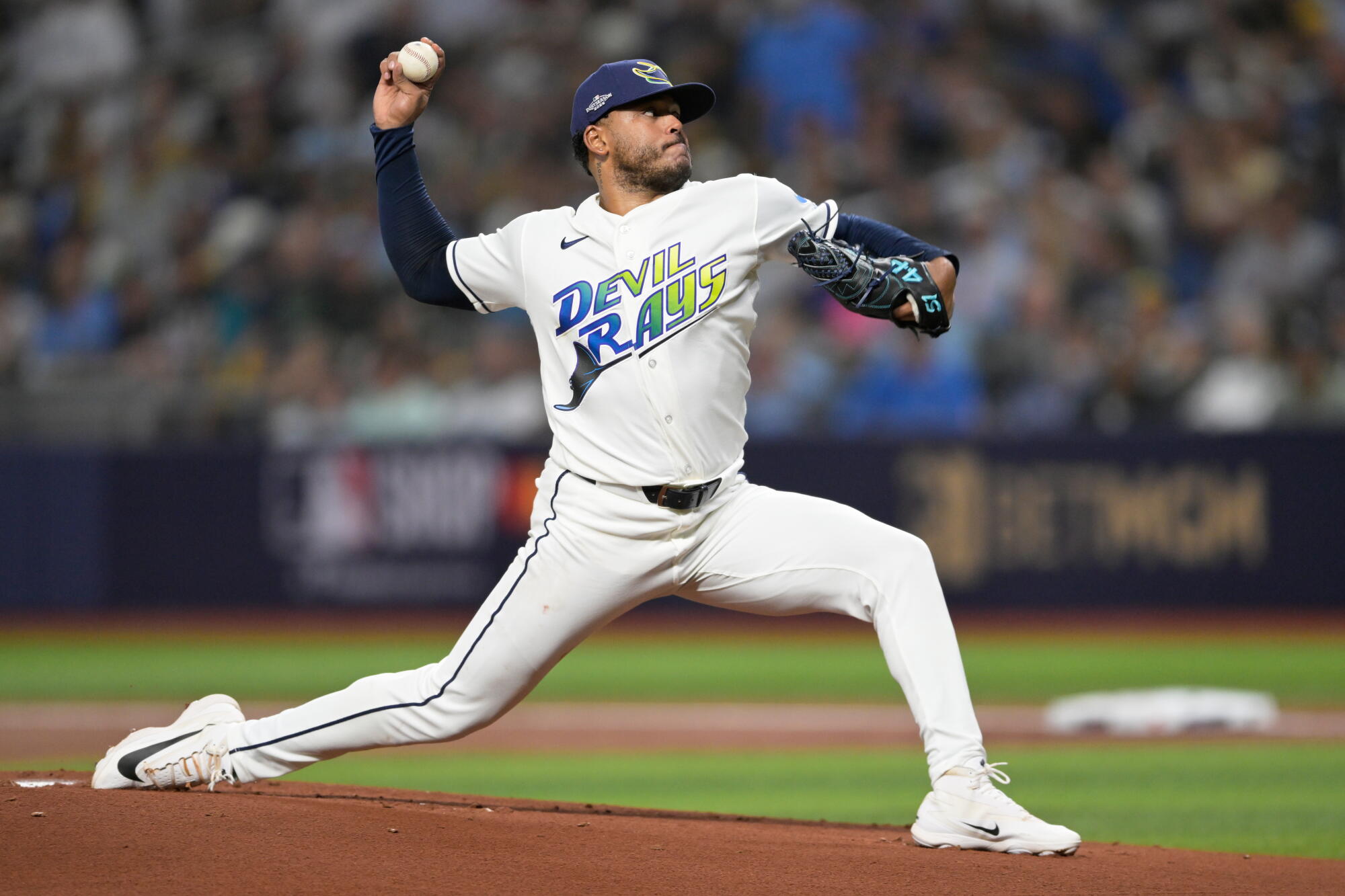
Tampa Bay Rays pitcher Freddy Peralta throws against the Cleveland Guardians in Game 6 of the ALCS on Oct. 19.

Tampa Bay Rays pitcher Freddy Peralta throws against the Cleveland Guardians in Game 6 of the ALCS on Oct. 19.

(Phelan M. Ebenhack / Associated Press)

Peralta was approaching free agency, and the Brewers routinely trade All-Star pitchers like that for prospects: Corbin Burnes, Josh Hader, Devin Williams.

This is how the Brewers restock: The Burnes trade brought two pieces of this World Series team, pitcher DL Hall and infielder Joey Ortiz. The Hader trade brought Game 3 starter Robert Gasser and journeyman outfielder Estuery Ruiz, and within a subsequent three-team trade, the Brewers swiped All-Star catcher William Contreras for Ruiz.

The Mets wanted Peralta for what they considered an inevitable playoff run, with the largest Opening Day payroll of any major league team, the Dodgers included. The Mets finished in last place, and Peralta’s ERA exceeded 6.00 in each of the two months preceding the trade deadline.

“I was feeling bad,” Peralta said, “because I couldn’t do anything.”

The adjustments the Mets asked him to make, he said, were “a little different” than the ones that reversed the course of his season with the Rays.

The Rays let him pitch from the stretch, as he had in Milwaukee. They modified his delivery, including having him start it from the third-base side of the pitching rubber. His fastball got faster: 94 mph with the Mets, hitting 97 mph in the playoffs.

“We see that he’s in his element, man,” Brewers manager Pat Murphy said. “That’s Fastball Freddy.”

In Milwaukee, it’s all love for Peralta. The fans even cheered his bullpen session there before Game 1.

He’ll start Game 3 in Tampa Bay and, after that, who knows, but he would be lined up to start a potential Game 7 in Milwaukee.

“I know how special it is to pitch on this mound here in Milwaukee,” Peralta said. “I would like to pitch here during the postseason.”

Tampa Bay Rays pitcher Freddy Peralta celebrates the last out in the top.

Tampa Bay Rays pitcher Freddy Peralta celebrates during Game 2 of the ALCS against the Cleveland Guardians on Oct. 13.

(David J. Phillip / Associated Press)

He would have liked to pitch in New York during the postseason too.

“They had a lot of big expectations for me, the fans too, in New York,” he said. “They were waiting for something great from me.”

Conventional wisdom can boomerang. The conventional wisdom on Peralta’s free agency in the spring: he should make more in free agency than any pitcher besides Skubal; in the summer: this is a bad year to take into free agency; in the fall: he should make more in free agency than any pitcher besides Skubal.

But, given what happened in New York, what were the realistic expectations in Tampa Bay?

“I was able to go to a new team that probably needed me for …” Peralta said, his voice trailing off.

The World Series?

Peralta beamed.

“Crazy,” he said. “For the World Series, yeah.”

Source link

As post-Kawhi Leonard era begins, Clippers owe more to their fans

Starting over has to start somewhere, and so the Clippers got on with it Wednesday.

While Kawhi Leonard got an NBA Finals hero’s welcome back up north in Toronto, the Clippers did what they could to entice fans back to Intuit Dome.

Not with superstars or championship aspirations. But with the promise of free parking, a jersey trade-in and a basketball team that is, at least, better than the Sacramento Kings, who they beat 121-96 in both teams’ season opener. Coach Tyronn Lue dedicated the win to suspended team owner Steve Ballmer: “Just want to say thank you for everything. We’re still fighting for him.”

Yeah, but the Clippers should focus on fighting for their fans, not the billionaire whose apparent salary cap circumvention has the organization in hot water.

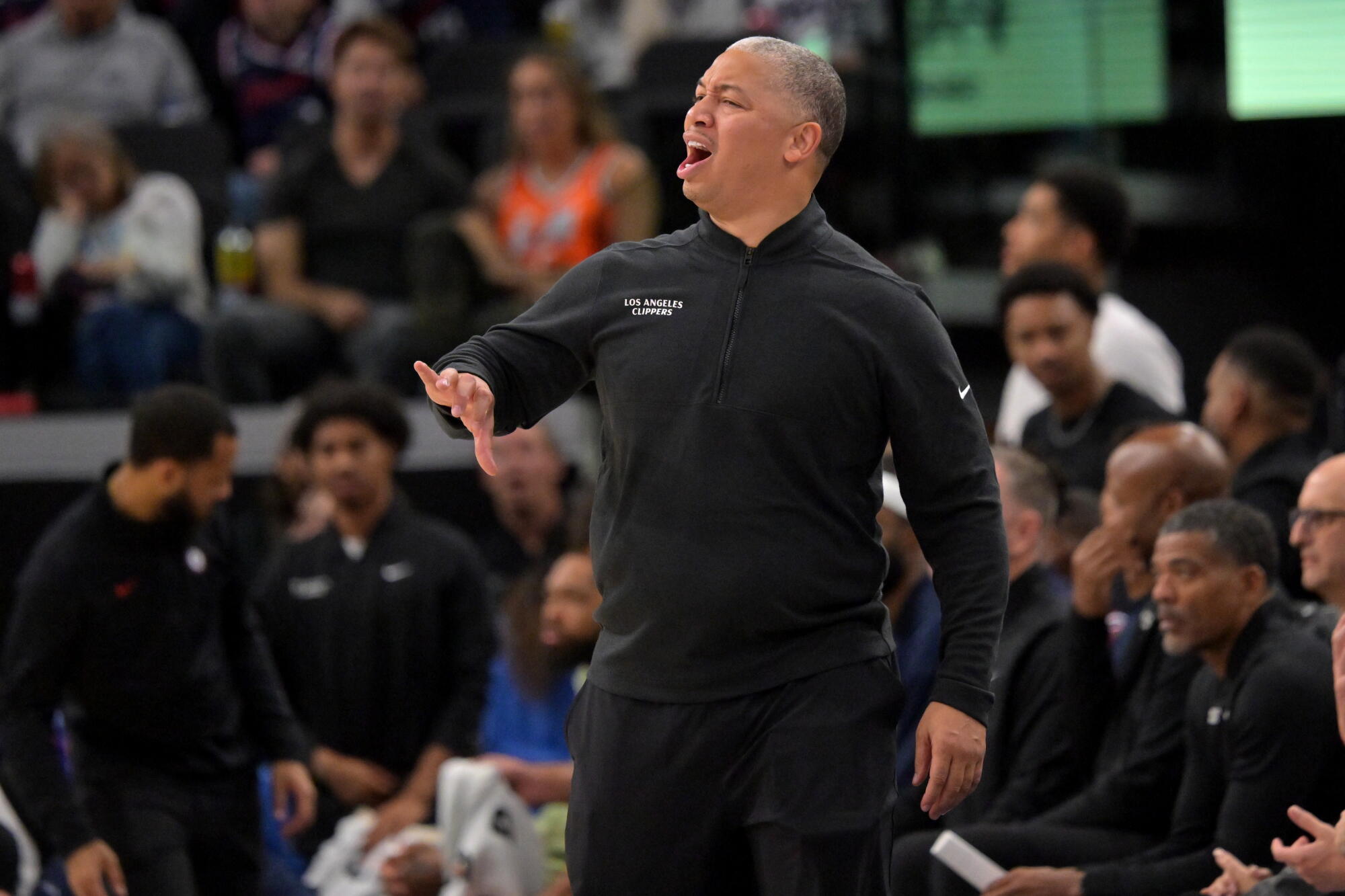
Clippers coach  Tyronn Lue directs his players during a win over the Sacramento Kings Wednesday at Intuit Dome.

Clippers coach Tyronn Lue directs his players during a win over the Sacramento Kings Wednesday at Intuit Dome.

(Jayne Kamin-Oncea / Associated Press)

Wednesday’s fan appreciation stuff was a swell gesture, as a start. But it wasn’t nearly far-reaching enough.

Not for embattled Clippers supporters who have stuck with the team through thick and thin, sickness and health, in spite of Donald Sterling, the former cheap, racist owner and now Ballmer, the wealthy, over-invested one whose salary cap circumvention cost his team its first-round picks in the 2029, 2030, 2031, 2032, and 2033 NBA drafts.

To fans, that was the most consequential part of the historic punishment dealt by the NBA, which commissioned a year-long investigation that determined the Clippers committed audacious levels of salary cap circumvention.

The league also fined the team $30 million, suspended team owner Ballmer and president of business operations Gillian Zucker for a year and president of basketball operations Lawrence Frank for six months.

And Leonard? He got a $700,000 slap on the wrist and got traded back to Toronto, where he signed a two-year, $115 million contract extension and on Wednesday, had Raptors coach Darko Rajaković saying he was “super excited for the chance to bring a Hall of Famer back home.”

“That’s one of the most insulting parts of it all, the way [Leonard] was able to walk away scot-free and the fans are left sort of holding the bag,” said Torrance’s Justin Ratterree, while he tried to dodge raindrops as he waited in line, four hours before tipoff, to trade in his No. 2 Leonard jersey.

Young Clippers fans watch the team play the the Sacramento Kings Wednesday at the Intuit Dome.

Young Clippers fans watch the team play the the Sacramento Kings Wednesday at the Intuit Dome.

(Jayne Kamin-Oncea / Associated Press)

“It’s rough right now. Defending the team this past couple months has been really rough … and I’ve kind of just given up defending. How can you defend it?”

Even Ballmer stopped doing that, releasing a statement on Sept. 13 that read, in part: “This has been a very difficult time for everybody associated with the Clippers, and for that, I have sincere regrets.

“I want to apologize to our fans, employees, and my fellow NBA team owners for the distraction and distress this matter has caused, for which I accept responsibility as principal owner.

“We are,” he added, “committing to put this chapter behind us.”

Yes, let them try to scrub the memory of Leonard, the intensely skilled and private player who demanded so much of the Clippers when he signed with them as a free agent in 2019. Who made no efforts to popularize the team, missed almost as much time as he worked, and who failed to lead the Clippers to their first championship or anywhere close to it in his seven seasons.

After his trade to Toronto went through on Sept. 23, the Clippers resisted posting the “Thank You, Kawhi” graphic that pro sports teams do when they part ways with a player.

Let them also forget to play a tribute video when Leonard’s Raptors visit Intuit Dome for the only time this season on Nov. 2.

And let the Clippers expand the jersey swap beyond the first 4,000 paying customers at Game 1; there was no official figure available Wednesday night for exactly how many jerseys were traded and how many of them belonged to he-who-must-not-be-named.

The Clippers should keep it going, offer the option all season. Set it up at the Intuit Dome’s Lost and Found — invite fans to exchange the No. 2 jersey of the player whom they lost all respect for a guy they’ve found themselves newly enamored with, likely rookie Keaton Wagler if Wednesday’s exchange was any indication.

Clippers fans also deserve more than having their parking picked up until an hour before gametime, on one rainy workday, on late notice.

They should have their parking at games covered all season — or at least substantially reduced from the typical $70 price that’s already too steep. (The Dodgers didn’t start charging $65 until the National League Division Series!)

They should do more if they want to continue to draw a crowd to watch a team whose best player is now Darius Garland, whose future is compromised, whose current best-cast scenario — the play-in! — only Clippers fans could love.

Clippers forward Rui Hachimura drives past Kings guard De'andre Hunter and center Domantas Sabonis Wednesday.

Clippers forward Rui Hachimura drives past Kings guard De’andre Hunter and center Domantas Sabonis Wednesday at the Intuit Dome.

(Jayne Kamin-Oncea / Associated Press)

Several fans Wednesday also said they would appreciate improved transparency, including in terms of player injury and availability news.

It’s the least the team can do for these patient people, who will have the type of team that they usually fall hard for, actually — a group of gamers, devoid of divas, punching above their weight.

“All this stuff that’s going on,” Lue said, “you can’t take that out on our players … that’s not their fault, you know?”

It’s not fans’ fault, either. Let’s see the Clippers go above and beyond for them.

Source link

Lakers newsletter: It’s showtime: Luka Doncic, Austin Reaves lead Lakers into new era

Welcome back to The Times’ Lakers newsletter and welcome back to real NBA games.

The regular season begins Tuesday with a triple-header. It’s the first time in eight years that the Lakers are watching the opening day action at home. That could be a small sign of where the Lakers stand in the NBA pecking order now.

Not many people know what to make of this team. There are nine new players. Another ownership change is pending. The Western Conference has two juggernauts at the top.

But within this summer of change, the Lakers managed to maintain one key partnership.

All things Lakers, all the time.

Get all the Lakers news you need in Thuc Nhi Nguyen’s weekly newsletter.

Two-headed monster

With more than half of their roster wearing the purple and gold for the first time, some Lakers might still be getting on the same page after less than three weeks of practices. Meanwhile, Luka Doncic and Austin Reaves are already playing a completely different game.

“They’re always, like, playing chess out there,” guard Collin Sexton said.

After an offseason of change, it’s still the Lakers’ two most established stars who will control the season’s fate. Doncic and Reaves were 30-11 in games played together last season. In 1,092 minutes, lineups with Doncic and Reaves together outscored opponents by 8.9 points per 100 possessions, the third-best net rating on the team for any pair of regular rotation players. Their established chemistry gives the Lakers a strong foundation for the season.

“Austin and Luka, they kind of see things before it happens,” Sexton said. “And I feel like that allows them to be so good offensively and be able to score, but also to put us in the right situation to be successful as well.”

The duo that could be one of the most offensively potent pairings in the league proved that they could have success last season, helping the Lakers surge up the Western Conference standings during a magical March. Doncic scored 600 points during the month, despite missing one game because of a technical foul accumulation suspension. Reaves averaged 5.8 assists, his highest average for a month with more than six appearances last season. With LeBron James serving as the most heralded third option in the history of basketball, the Lakers went 15-2.

It was painful but a little poetic that Doncic and Reaves — whose wholesome friendship became the envy of NBA Twitter — suffered injuries during the same game to end the hot streak.

Doncic told Sports Illustrated this summer that he “regret[ted]” coming back into the game against the Oklahoma City Thunder after he felt a twinge in his hamstring during the first half. The severity of the injury kept him out for the rest of the season.

“I thought we had a team that could compete for a championship,” Doncic said during training camp. “So I was kind of disappointed, kind of let the team down, so it’s definitely motivating for this season.”

Reaves returned during the postseason after an oblique injury, but couldn’t regain his consistency. He played in a career-low 51 games last season and missed out on what could have been his first All-Star selection.

Determined to fortify his body for another long season, Reaves hired former Lakers head strength and conditioning coach Ed Streit to work with him. He hoped that having a dedicated strength coach, which stars including James and Doncic already have, would help him take “the next step,” Reaves said.

After waiting and learning behind veterans such as James and Anthony Davis, Reaves is now an undisputed top-two player on the Lakers. He signed the richest contract ever for an undrafted player this offseason. Doncic was among his most vocal supporters.

“We talked about it even middle of last year, towards the end of last year, continuing this partnership for as long as we can,” Reaves said. “I enjoy being around him so much that coming back and being a Laker was the main thing when the season ended.”

Initially Reaves didn’t know if he would establish a close bond with Doncic after the former Dallas superstar was shockingly traded. Doncic was quiet when he first arrived in L.A. Now Reaves, who loves to hate his newest best friend, is sad to admit that they’re so similar.

They share a creative style of basketball. They’re ruthless competitors. They love golf.

The most important thing is another shared obsession.

“At the end of the day, we care about winning,” Reaves said, “and that’s all that matters.”

Survey says…

In a survey of league general managers, NBA.com found that expectations for the Lakers are tepid at best.

General managers voted on the top four teams in each conference, with four points awarded for each first-place vote, three points for second place, two for third and one for fourth, and the Lakers received 10% of fourth-place votes and 1% of total available points, which placed sixth in the total score.

The San Antonio Spurs, who were also the general managers’ choice to win the NBA title, had 53% of first-place points in the Western Conference. The Oklahoma City Thunder were effectively tied in the survey, with both teams getting 34% of the available points. With two young, deep teams at the top of the conference, all roads seem to lead to an encore of last year’s Western Conference final.

But this league celebrates its parity. Eight champions in eight years? Almost nothing compared to more than the 40 years since a repeat Western Conference finals matchup. The West hasn’t had a conference finals sequel since the Lakers and Spurs in 1982 and 1983.

The season could turn unexpectedly for one of the top teams, opening the door for another team to crash the party. NBA general managers don’t think the Lakers would be first inside the velvet ropes, but executives believe the team could be an enigma. In response to a NBA.com survey question on which team’s success is the toughest to predict this season, the Lakers received the third-most votes.

The league can’t tell the type of team the Lakers will be. They at least have their goals clear.

“Realistically, I would say championship,” Doncic said at the Spectrum broadcast desk on media day. “If that’s not your goal, I don’t know what you’re doing here.”

Poll question

Where do you think the Lakers will finish in the Western Conference?

Top-two seed (1-2)

First-round home court (3-4)

Safely in the playoff (5-6)

Play-in (7-10)

Cancun by mid-April

Click here to vote in our survey

On tap

Wednesday vs. Warriors, 7 p.m. PDT

It’s here! The opener! The Lakers should be familiar with the Warriors after playing two preseason games against their in-state rivals. Rookie Yaxel Lendeborg emerged as an immediate impact player, averaging 15.6 points and 7.4 rebounds on 56.9% shooting during the preseason.

Friday vs. Clippers, 7 p.m. PDT

Old friend Rui Hachimura returns with the Clippers, who have moved on from the Kawhi Leonard Era but begin the season without Brandon Ingram (Achilles) and Max Strus (foot). Rookie guard Keaton Wagler could be one of the few bright spots for the struggling franchise this season.

Sunday at Jazz, 2 p.m. PDT

The Lakers’ first road game is a homecoming for Walker Kessler, returning to the franchise that drafted him, and a reunion with another former Laker Jaxson Hayes. Hayes, who signed a two-year, $12-million contract with the Jazz, is in line to get significant minutes for Utah after an early injury to Jusuf Nurkic (foot).

Favorite thing I ate this week

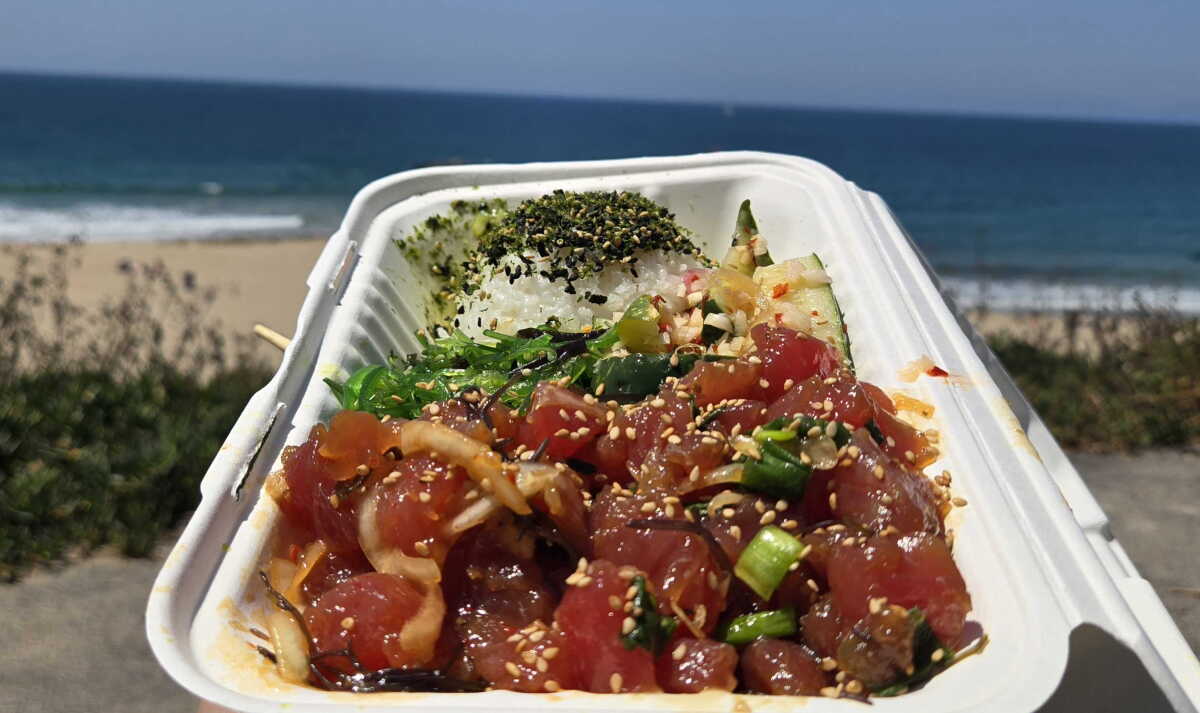
Poke from Redondo Beach's Jus' Poke.

Poke from Redondo Beach’s Jus’ Poke.

(Thuc Nhi Nguyen / Los Angeles Times)

The Lakers did not bless us with a tropical training camp (looking at you, Clippers and Warriors) so a trip to Redondo Beach’s Jus’ Poke will have to be the closest I get to Hawaii for now. The poke selections are always fresh and stand out for their simplicity and execution. No superfluous toppings and sauces. Just, as the name suggests, really good poke.

In case you missed it

Lakers waive former first-round pick Dalton Knecht before season opener

Luka Doncic, JJ Redick believe revamped Lakers can contend for an NBA title

Plaschke: The new-look Lakers have much to prove and no chance of winning it all

What we learned from the Lakers’ preseason games and training camp

JJ Redick still mulling over Quentin Grimes’ role for the Lakers

Buss family asks judge to dismiss Jeanie Buss’ petition to block Lakers share sale

Ziaire Williams looks to continue providing energy boost to Lakers

Until next time…

As always, pass along your thoughts to me at thucnhi.nguyen@latimes.com, and please consider subscribing if you like our work!

Source link