Taiwan’s Skyguard Anti-Aircraft Guns Now Equipped With Anti-Drone Nets
Anti-drone nets and cages are rapidly becoming as ubiquitous as the drones they are meant to stop, appearing on today’s battlefields, over roads, around buildings, atop armored vehicles, and even protecting naval vessels. One recent example comes from Taiwan, where anti-aircraft guns have been enclosed in netting to help defend against the growing threat of drone attacks from Chinese forces .
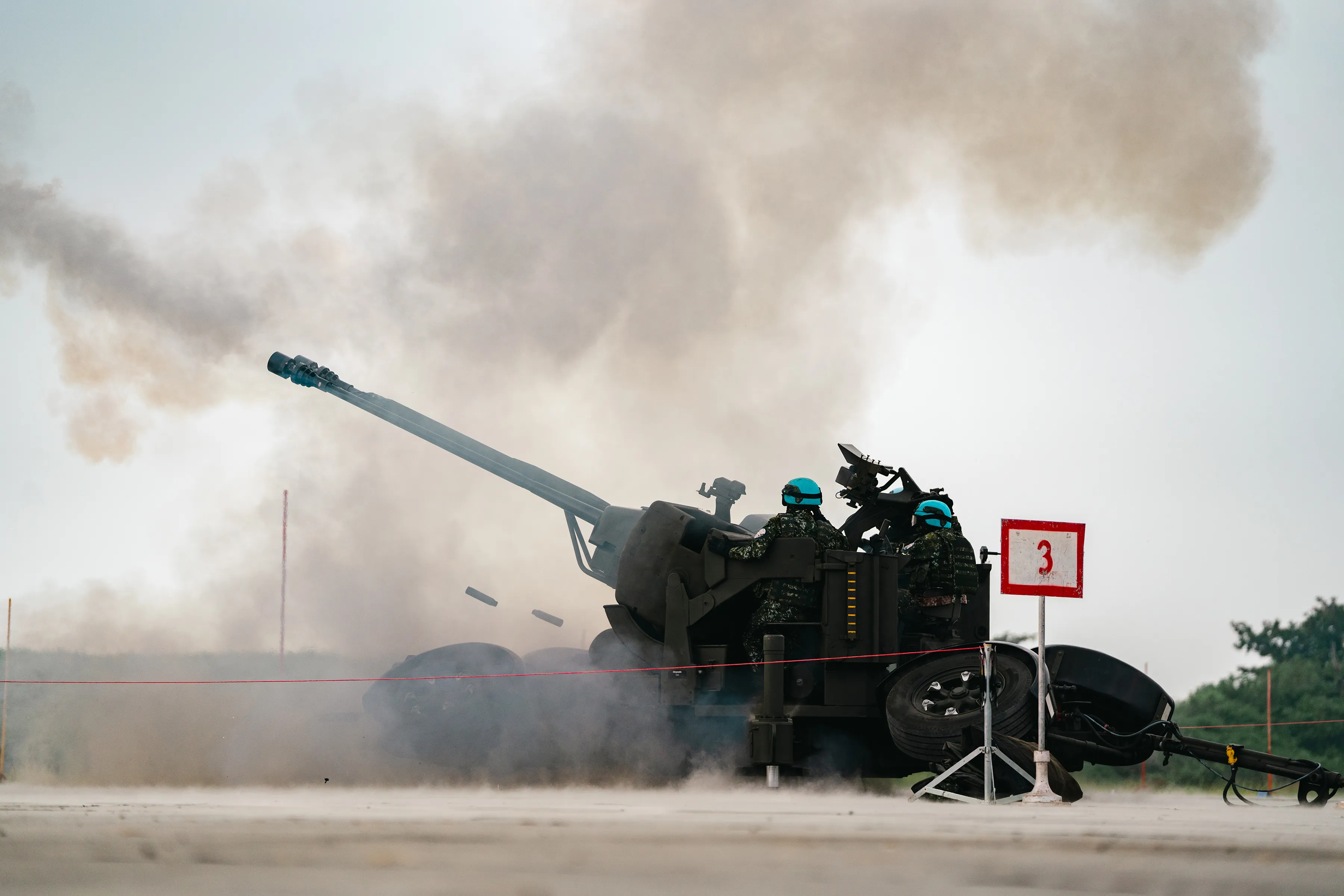
An image, heavily edited, that began to circulate recently shows a pair of Republic of China Air Force (ROCAF) Skyguard towed twin-barreled 35mm anti-aircraft cannons with geodesic, dome-like latice structures over them, covered with anti-drone netting. The twin guns protrude out into the open to provide clearance. The design appears intended mainly to defeat small first-person-view (FPV) type drones attempting to dive directly onto the guns.
The ROCAF operates around 24 of these Swiss-made systems, specifically the GDF-006 version. They are frequently deployed to protect Taiwanese airbases, which may well be the case here, too.

That the ROCAF is going to the trouble of shielding the Skyguard from drones (at least smaller, FPV types) is significant.
Despite being a legacy Cold War-era design, the Swiss-made system remains one of Taiwan’s most effective point-defense weapons against exactly the kinds of aerial threats that have proliferated in recent years, including drones and cruise missiles.
The ROCAF operates around 24 of these systems, specifically the GDF-006 version. They are frequently deployed to protect Taiwanese airbases, which may well be the case in this instance. Keeping them operational during a conflict would be critical, making them logical candidates for additional physical protection against drone attacks.

Rheinmetall Air Defence – Oerlikon Skyguard 3 air defence system
In particular, the radar-guided Skyguard can engage drones using Advanced Hit Efficiency and Destruction (AHEAD) ammunition. These programmable airburst rounds release a cloud of sub-projectiles just ahead of the target, greatly increasing the probability of a kill against small, slow, and maneuvering aerial threats. They are also effective against cruise missiles, rockets, and mortar projectiles. Besides improving lethality and speeding engagements, the airburst effect also reduces the risk of collateral damage on the ground.

Rheinmetall Air Defence: Ahead – Highly effective, programmable ammunition
As such, the Skyguard remains in ROCAF service alongside more modern air-defense systems as part of Taiwan’s layered integrated air-defense network. Other ground-based systems fielded by the air force include the U.S.-made Patriot and the indigenous Tien Kung (Sky Bow) family for long-range air and ballistic missile defense. At the lower end, Sparrow surface-to-air missile launchers can be integrated with the Skyguard’s radar and fire-control system to provide another layer of protection. Taiwan formally retired the last of its HAWK surface-to-air missile systems in 2023, later donating some of these to Ukraine.

As we reported in the past, Taiwan is also set to procure the combat-proven National Advanced Surface-to-Air Missile System (NASAMS) after the United States approved its sale to the country in 2024. As we previously examined, the medium-range system is particularly well suited to defeating cruise missiles and standoff one-way attack drones. It also has the significant benefit of being fed from the common stockpile of AIM-120 Advanced Medium-Range Air-to-Air Missiles (AMRAAM) that already arm many of the ROCAF’s fighter jets.
Meanwhile, the Republic of China Army fields an even wider array of ground-based air defense systems, including more mobile equipment and man-portable air defense systems (MANPADS). Republic of China Army anti-aircraft units are also equipped with anti-aircraft guns, namely the locally made T-82T towed twin-barreled 20mm anti-aircraft cannon, based on the M39 developed for the U.S. Air Force in the late 1940s.

Taiwan’s multi-layered integrated air-defense system is a critical component of the island’s ability to withstand any aerial assault from China, should Beijing ever go on the offensive against the island. As China rapidly expands both the quantity and sophistication of its unmanned capabilities, however, even air-defense assets themselves are increasingly vulnerable to drone attack.
Protecting the Skyguard with netting reflects this evolving threat. Chinese drones of all types would be employed not only for one-way attack missions, but also for intelligence gathering, target acquisition for standoff strikes, communications relay, and electronic warfare. Swarms of inexpensive drones could also be used to saturate Taiwan’s defenses, exposing key air-defense assets to attack while forcing them to expend valuable ammunition.
A video showing a Chinese drone swarm experiment involving loitering munitions launched from a light tactical vehicle:

中国电科陆空协同固定翼无人机“蜂群”系统
Taiwan’s airbases would rank among Beijing’s highest-priority targets in any conflict. The ROCAF already prepares for this possibility by routinely exercising from secondary airfields and highway strips. Wherever ROCAF aircraft are deployed, however, air-defense systems like the Skyguard would be essential to protecting these locations.
Even during peacetime, Taiwan faces a drone threat, especially over islands situated extremely close to the Chinese mainland. In 2022, multiple incursions led to the Taiwanese military announcing that it would shoot down uncrewed aerial vehicles that don’t respond to its warnings, a threat that it soon carried out. These moves came after Taiwanese authorities said they would deploy undisclosed domestically developed drone defense systems across its territory, and following a highly public encounter between a Chinese drone and two Taiwanese soldiers, as you can read about more here.
Imagery filmed from a Chinese drone, showing Taiwanese sentries throw rocks or other objects at the UAV:

陸無人機闖入大膽島 我官兵「丟石頭」反擊|TVBS新聞
At this point, it is also worth recalling other considerable efforts that Taiwan makes to ensure its military assets might survive a potential invasion from the Chinese mainland. In the past, we have looked at how Taiwanese tanks and other armored vehicles have been hidden in urban environments using some ingenious camouflage methods, including hiding them under junk and making them look like civilian construction equipment.

Meanwhile, whether draped over roads, tanks, artillery positions, or warships, anti-drone nets have become a defining visual feature of the drone age. Their adoption by the ROCAF to protect its Skyguard guns shows that even dedicated air-defense systems that are suited to down small drones are far from immune from attack by those threats.
Thanks to Taepodong for alerting us to this story.
Contact the author: thomas@thewarzone.com