epstein file

Lawmakers return to Washington facing Venezuela concerns, shutdown threat

Lawmakers are returning to Washington this week confronting the fallout from the stunning capture of Venezuelan President Nicolás Maduro — and familiar complaints about the Trump administration deciding to bypass Congress on military operations that have led to this moment.

Democratic leaders are demanding the administration immediately brief Congress. Republican leaders indicated over the weekend those plans are being scheduled, but some lawmakers expressed frustration Sunday that the details have been slow to arrive.

President Trump told the nation Saturday that the United States intends to “run” Venezuela and take control over the country’s oil operations now that Maduro has been captured and brought to New York to stand trial in a criminal case centered on narco-terrorism charges.

The administration did not brief Congress ahead of the actions, leaving Democrats and some Republicans expressing public frustration with the decision to sideline Congress.

“Congress should have been informed about the operation earlier and needs to be involved as this situation evolves,” Sen. Susan Collins (R-Maine) said in a social media post Saturday.

Appearing on the Sunday news shows, Senate Minority Leader Chuck Schumer and House Minority Leader Hakeem Jeffries, both of New York, ticked through a growing list of unknowns — and laid out plans for their party to try and reassert Congress’ authority over acts of war.

“The problem here is that there are so many unanswered questions,” Schumer said on ABC’s “This Week.” “How long do they intend to be there? How many troops do we need after one day? After one week? After one year? How much is it going to cost and what are the boundaries?”

Jeffries told NBC’s “Meet the Press” that he was worried about Trump running Venezuela, saying he has “done a terrible job running the United States of America” and should be focused on the job at home.

In the coming days, Jeffries said Democrats will prioritize legislative action to try and put a check on the administration, “to ensure that no further military steps occur absent explicit congressional approval.”

As discussions over Venezuela loom, lawmakers also face major decisions on how to address rising costs of healthcare, prevent another government shutdown and deal with the Trump administration’s handling of the Epstein files.

Much of the unfinished business reflects a Congress that opted to punt some of its toughest and most politically divisive decisions into the new year, a move that could slow negotiations as lawmakers may be reluctant to give the other side high-profile policy wins in the lead-up to the 2026 midterm elections.

First and foremost, Congress faces the monumental task of averting yet another government shutdown — just two months after the longest shutdown in U.S. history ended. Lawmakers have until Jan. 30 to pass spending bills needed to keep the federal government open. Both chambers are scheduled to be in session for three weeks before the shutdown deadline — with the House slated to be out of session the week immediately before.

Lawmakers were able to resolve key funding disputes late last year, including funding for Supplemental Nutrition Assistance Program benefits, also known as food stamps, and other government programs. But disagreements over healthcare spending remain a major sticking point in budget negotiations, intensified now that millions of Americans are facing higher healthcare costs after lawmakers allowed Affordable Care Act tax credits to expire on Thursday.

“We can still find a solution to this,” said Rep. Kevin Kiley (R-Rocklin), who has proposed legislation to extend the tax credits for two years. “We need to come up with ways to make people whole. That needs to be a top priority as soon as we get back.”

Despite that urgency, Republican efforts to be the author of broad healthcare reforms have gotten little traction.

Underscoring the political pressure over the issue, four moderate House Republicans late last year defied party leadership and joined House Democrats to force a floor vote on a three-year extension of the subsidies. That vote is expected to take place in the coming weeks. Even if the House effort succeeds, its prospects remain dim in the Senate, where Republicans last month blocked a three-year extension.

Meanwhile, President Trump is proposing giving more money directly to people for their healthcare, rather than to insurance companies. A White House official said the administration is also pursuing reforms to lower the cost of prescription drugs.

Trump said last month that he plans to summon a group of healthcare executives to Washington early in the year to pressure them to lower costs.

“I’m going to call in the insurance companies that are making so much money, and they have to make less, a lot less,” Trump said during an Oval Office announcement. “I’m going to see if they get their price down, to put it very bluntly. And I think that is a very big statement.”

There is an expectation that Trump’s increasing hostility to insurance companies will play a role in any Republican healthcare reform proposal. If Congress does not act, the president is expected to leverage the “bully pulpit” to pressure drug and insurance companies to lower healthcare prices for consumers through executive action, said Nick Iarossi, a Trump fundraiser.

“The president is locked in on the affordability message and I believe anything he can accomplish unilaterally without Congress he will do to provide relief to consumers,” Iarossi said.

While lawmakers negotiate government funding and healthcare policy, the continuing Epstein saga is expected to take up significant bandwidth.

Democrats and a few Republicans have been unhappy with the Department of Justice’s decision to heavily redact or withhold documents from a legally mandated release of files related to its investigation of Jeffrey Epstein, a convicted sex offender who died in a Manhattan jail awaiting trial on sex trafficking charges.

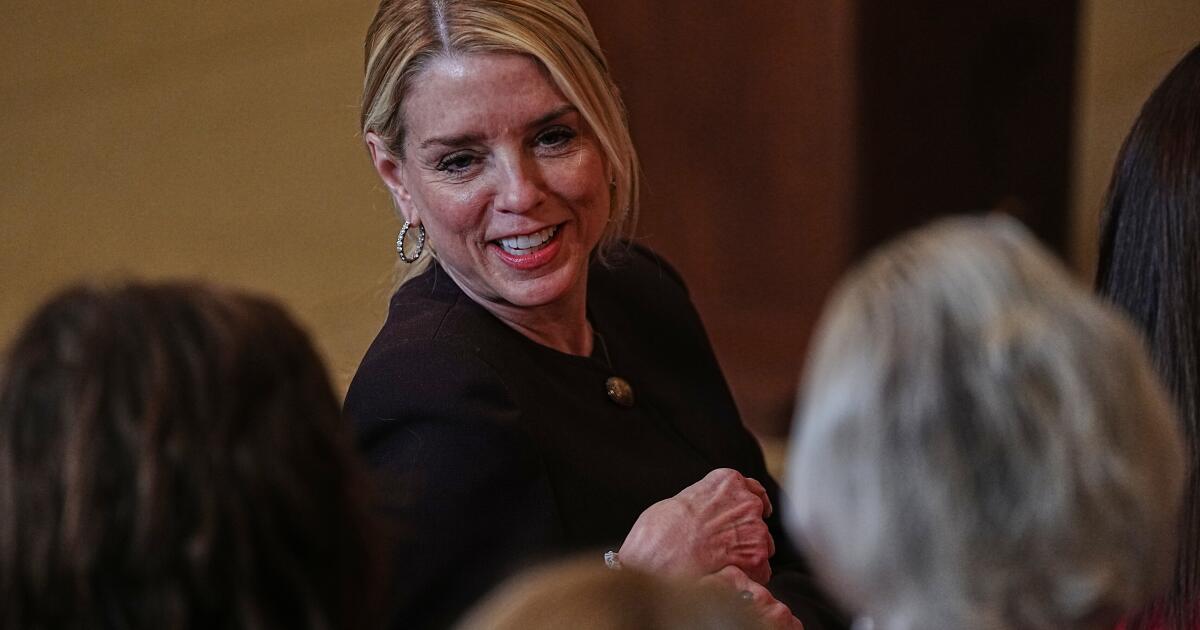
Some are weighing options for holding Atty. Gen. Pam Bondi accountable.

Rep. Ro Khanna (D-Fremont), who co-sponsored the law that mandated the release with Rep. Thomas Massie (R-Ky.), said he and Massie will bring contempt charges against Bondi in an attempt to force her to comply with the law.

“The survivors and the public demand transparency and justice,” Khanna said in a statement.

Under a law passed by Congress and signed by Trump, the Justice Department was required to release all Epstein files by Dec. 19, and released about 100,000 pages on that day. In the days that followed, the Justice Department said more than 5.2 million documents have been discovered and need to be reviewed.

“We have lawyers working around the clock to review and make the legally required redactions to protect victims, and we will release the documents as soon as possible,” the Justice Department said in a social media post on Dec. 24. “Due to the mass volume of material, this process may take a few more weeks.”

Rep. Robert Garcia, the top Democrat on the House Oversight Committee, told MS NOW last week that pressure to address the matter will come to a head in the new year when lawmakers are back at work.

“When we get back to Congress here in this next week, we’re going to find out really quick if Republicans are serious about actually putting away and taking on pedophiles and some of the worst people and traffickers in modern history, or if they’re going to bend the knee to Donald Trump,” said Garcia, of Long Beach.

Source link

A dozen senators urge DOJ watchdog to audit slow release of Epstein files

A dozen U.S. senators are calling on the Justice Department’s watchdog to examine the department’s failure to release all records pertaining to the late sex offender Jeffrey Epstein by last Friday’s congressionally mandated deadline, saying victims “deserve full disclosure” and the “peace of mind” of an independent audit.

Republican Sen. Lisa Murkowski of Alaska joined 11 Democrats in signing a letter Wednesday urging Acting Inspector General Don Berthiaume to audit the Justice Department’s compliance with the Epstein Files Transparency Act, the law enacted last month that requires the government to open its files on Epstein and his longtime confidant Ghislaine Maxwell.

“Given the [Trump] Administration’s historic hostility to releasing the files, politicization of the Epstein case more broadly, and failure to comply with the Epstein Files Transparency Act, a neutral assessment of its compliance with the statutory disclosure requirements is essential,” the senators wrote. Full transparency, they said, “is essential in identifying members of our society who enabled and participated in Epstein’s crimes.”

Murkowski and Sens. Richard Blumenthal (D-Conn.) and Jeff Merkley (D-Ore.) led the letter-writing group. Others included Democratic Sens. Amy Klobuchar of Minnesota, Adam Schiff of California, Dick Durbin of Illinois, both Cory Booker and Andy Kim of New Jersey, Gary Peters of Michigan, Chris Van Hollen of Maryland, Mazie Hirono of Hawaii, and Sheldon Whitehouse of Rhode Island.

Meanwhile, Republican Rep. Thomas Massie of Kentucky, a co-sponsor of the transparency act, posted Wednesday on X: “DOJ did break the law by making illegal redactions and by missing the deadline.”

Despite the deadline, the Justice Department has said it plans to release records on a rolling basis. It blamed the delay on the time-consuming process of obscuring survivors’ names and other identifying information. More batches of records were posted over the weekend and on Tuesday. The department has not given any notice when more records might arrive.

“The reason why we are still reviewing documents and still continuing our process is simply that to protect victims,” Deputy Atty. Gen. Todd Blanche told NBC’s “Meet the Press” on Sunday. “So the same individuals that are out there complaining about the lack of documents that were produced on Friday are the same individuals who apparently don’t want us to protect victims.”

Records that have been released, including photographs, interview transcripts, call logs, court records and other documents, were either already public or heavily blacked out, and many lacked necessary context. Records that hadn’t been seen before include transcripts of grand jury testimony from FBI agents who described interviews they had with several girls and young women who described being paid to perform sex acts for Epstein.

Other records made public in recent days include a note from a federal prosecutor from January 2020 that said Trump had flown on the financier’s private plane more often than had been previously known and emails between Maxwell and someone who signs off with the initial “A.” They contain other references that suggest the writer was Britain’s former Prince Andrew. In one, “A” writes: “How’s LA? Have you found me some new inappropriate friends?”

The senators’ call Wednesday for an inspector general audit comes days after Minority Leader Chuck Schumer (D-N.Y.) introduced a resolution that, if passed, would direct the Senate to file or join lawsuits aimed at forcing the Justice Department to comply with the disclosure and deadline requirements. In a statement, he called the staggered, heavily redacted release “a blatant cover-up.”

Sisak writes for the Associated Press.

Source link

Justice Department releases Epstein files, with redactions and omissions

The Justice Department released a library of files on Friday related to Jeffrey Epstein, partially complying with a new federal law compelling their release, while acknowledging that hundreds of thousands of files remain sealed.

The portal, on the department’s website, includes videos, photos and documents from the years-long investigation of the disgraced financier and convicted sex offender, who died in federal prison in 2019. But upon an initial survey of the files, several of the documents were heavily redacted, and much of the database was unsearchable, in spite of a provision of the new law requiring a more accessible system.

The Epstein Files Transparency Act, which passed with overwhelming bipartisan support in Congress, unequivocally required the department to release its full trove of files by midnight Friday, marking 30 days since passage.

But a top official said earlier Friday that the department would miss the legal deadline Friday to release all files, protracting a scandal that has come to plague the Trump administration. Hundreds of thousands more were still under review and would take weeks more to release, said Todd Blanche, the deputy attorney general.

“I expect that we’re going to release more documents over the next couple of weeks, so today several hundred thousand and then over the next couple weeks, I expect several hundred thousand more,” Blanche told Fox News on Friday.

The delay drew immediate condemnation from Democrats in key oversight roles.

Rep. Robert Garcia (D-Long Beach), the ranking member of the House Oversight Committee, and Rep. Jamie Raskin (D-Md.), the ranking member of the House Judiciary Committee, accused President Trump and his administration in a statement Friday of “violating federal law as they continue covering up the facts and the evidence about Jeffrey Epstein’s decades-long, billion-dollar, international sex trafficking ring,” and said they were “examining all legal options.”

The delay also drew criticism from some Republicans.

“My goodness, what is in the Epstein files?” Rep. Marjorie Taylor Greene (R-Ga.), who is leaving Congress next month, wrote on X. “Release all the files. It’s literally the law.”

“Time’s up. Release the files,” Rep. Thomas Massie (R-Ky.) wrote on X.

Already, congressional efforts to force the release of documents from the FBI’s investigations into Epstein have produced a trove of the disgraced financier’s emails and other records from his estate.

Some made reference to Trump and added to a long-evolving portrait of the social relationship that Epstein and Trump shared for years, before what Trump has described as a falling out.

In one email in early 2019, during Trump’s first term in the White House, Epstein wrote to author and journalist Michael Wolff that Trump “knew about the girls.”

In a 2011 email to Ghislaine Maxwell, who was later convicted of conspiring with Epstein to help him sexually abuse young girls, Epstein wrote, “I want you to realize that the dog that hasn’t barked is trump. [Victim] spent hours at my house with him … he has never once been mentioned.”

Maxwell responded: “I have been thinking about that…”

Trump has strongly denied any wrongdoing, and downplayed the importance of the files. He has also intermittently worked to block their release, even while suggesting publicly that he would not be opposed to it.

His administration’s resistance to releasing all of the FBI’s files, and fumbling with their reasons for withholding documents, was overcome only after Republican lawmakers broke off and joined Democrats in passing the transparency measure.

The resistance has also riled many in the president’s base, with their intrigue and anger over the files remaining stickier and harder to shake for Trump than any other political vulnerability.

It remained unclear Friday afternoon what additional revelations would come from the anticipated dump. Among the files that were released, extensive redactions were expected to shield victims, as well as references to individuals and entities that could be the subject of ongoing investigations or matters of national security.

That could include mentions of Trump, experts said, who was a private citizen over the course of his infamous friendship with Epstein through the mid-2000s.

Epstein was convicted in 2008 of procuring a child for prostitution in Florida, but served only 13 months in custody in what was considered a sweetheart plea deal that saved him a potential life sentence. He was charged in 2019 with sex trafficking, and died in federal custody at a Manhattan jail awaiting trial. Epstein was alleged to have abused over 200 women and girls.

Many of his victims argued in support of the release of documents, but administration officials have cited their privacy as a primary excuse for delaying the release — something Blanche reiterated Friday.

“There’s a lot of eyes looking at these and we want to make sure that when we do produce the materials we are producing, that we are protecting every single victim,” Blanche said, noting that Trump had signed the law just 30 days prior.

“And we have been working tirelessly since that day to make sure that we get every single document that we have within the Department of Justice, review it and get it to the American public,” he said.

Trump had lobbied aggressively against the Epstein Files Transparency Act, unsuccessfully pressuring House Republican lawmakers not to join a discharge petition that would force a vote on the matter over the wishes of House Speaker Mike Johnson (R-La.). He ultimately signed the bill into law after it passed both chambers with veto-proof majorities.

Rep. Ro Khanna (D-Fremont), who introduced the House bill requiring the release of the files, warned that the Justice Department under future administrations could pursue legal action against current officials who work to obstruct the release of any of the files, contravening the letter of the new law.

“Let me be very clear, we need a full release,” Khanna said. “Anyone who tampers with these documents, or conceals documents, or engages in excessive redaction, will be prosecuted because of obstruction of justice.”

Given Democrats’ desire to keep the issue alive politically, and the intense interest in the matter from voters on both ends of the political spectrum, the fact that the Justice Department failed to meet the Friday deadline in full was likely to stoke continued agitation for the documents’ release in coming days.

In their statement Friday, Garcia and Raskin hammered on Trump administration officials — including Atty. Gen. Pam Bondi — for allegedly interfering in the release of records.

“For months, Pam Bondi has denied survivors the transparency and accountability they have demanded and deserve and has defied the Oversight Committee’s subpoena,” they said. “The Department of Justice is now making clear it intends to defy Congress itself.”

Among other things, they called out the Justice Department’s decision to move Maxwell, who is serving a 20-year sentence for sex trafficking, to a minimum security prison after she met with Blanche in July.

“The survivors of this nightmare deserve justice, the co-conspirators must be held accountable, and the American people deserve complete transparency from DOJ,” Garcia and Raskin said.

Sen. Adam Schiff (D-Calif.), in response to Blanche saying all the files wouldn’t be released Friday, said the transparency act “is clear: while protecting survivors, ALL of these records are required to be released today. Not just some.”

“The Trump administration can’t move the goalposts,” Schiff wrote on X. “They’re cemented in law.”

Source link