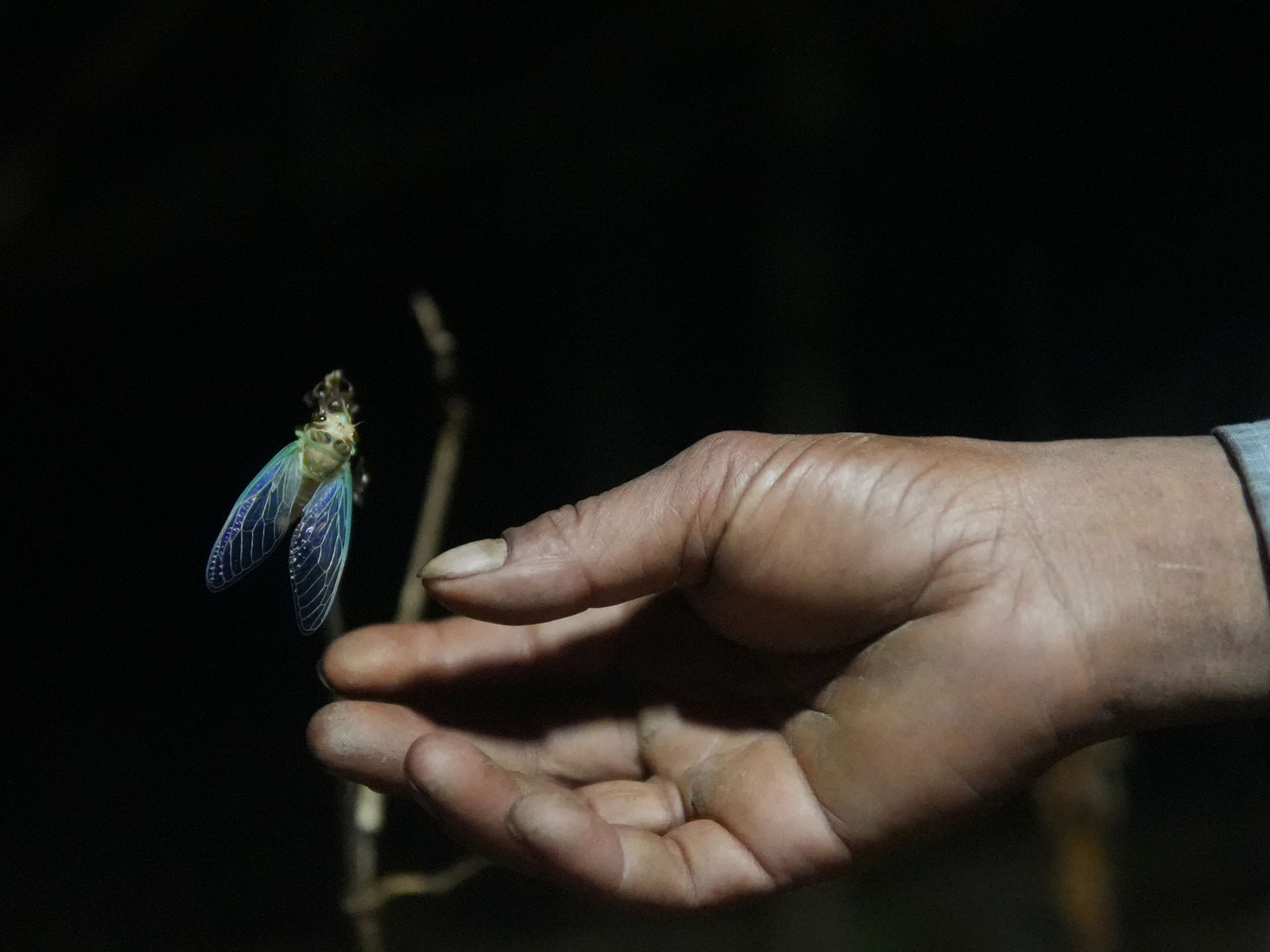
The mature cicadas, dark-shelled and spent, begin flying towards the Umrong River in large numbers and drop into the rapids. The river fills with them. Along the banks, dead cicadas collect against wet stones and bamboo roots, their wings plastered flat by the current.
Locals call it niangtaser suicide. Hajong offers a simpler explanation: Cicadas are naturally drawn to sound and movement, and the fast-moving river may trigger that instinct in their final hours.
For the fish below the surface, it is a feast. For the forest above, closure.
The journey that began four years earlier beneath the ground ends in the same river that separates Livi’s home from the sanctuary.
Not everyone has watched that cycle for as long as Kewstar Majaw.
At 92, he has witnessed more emergences than almost anyone alive in the village. He served in the Indian Army. He loves watching football. And every four years, without fail, he waits for his noisy visitors.
For Kewstar, the passing of the cicadas has become another way of measuring life. World Cups came and went. Governments changed. Forests retreated. But every four years, if the rains arrived on time and the bamboo still held, the forest sang.
As a boy, he would follow his parents into the forest carrying bamboo containers, the sound reaching them before the insects came into view. In those days, the niangtaser was everywhere. Behind houses. In the trees along village paths. Young ones, mature ones – the forest floor was alive with them.
The chorus was so loud, he recalls with a laugh, that people stuffed cotton into their ears to bear it.
The insect did not need to be searched for. It found you.
Kewstar sits quietly for a moment. At his age, he has watched the forest retreat, the bamboo thin, and the chorus fade with each passing emergence. The insect that once appeared on his doorstep now requires a torch and a walk in the dark to be found.
“It was everywhere,” he says softly. “Now you have to go looking for it.”
In a few weeks, the cicadas will disappear beneath the earth once more, keeping time in darkness until the cycle begins again. By the next emergence, another football World Cup will be under way somewhere else in the world.
Whether Saiden’s forests will still sing with them depends on what survives until then.
Protesters chant ‘Albania is not for sale’ as demonstrations swell against Kushner-backed luxury resort plan.
Published On 11 Jun 202611 Jun 2026
Thousands of Albanians have taken to the streets of the country’s capital, Tirana, in the largest protest yet against a luxury resort development backed by United States President Donald Trump’s son-in-law, Jared Kushner.
Protesters on Wednesday held signs that said “Albania is not for sale” and chanted “New Albania” outside Prime Minister Edi Rama’s office as the crowd stretched half a mile down one of the city’s main boulevards.
Recommended Stories
list of 3 itemsend of list
The project, expected to cost about 5 billion euros ($5.8bn), has provoked outrage in the Balkan country because of its location near a protected wetland home to flamingos, seals and sea turtle nesting sites.
Critics have also raised concerns about a lack of transparency surrounding the plans designed by foreign investors.
“This is the prime example of what has been happening in Albania for the last 35 years,” protester Leand Lakrori told the Reuters news agency. “So today, enough is enough.”
Protesters hold inflatable flamingos as part of a ‘Flamingo Revolution’ against Jared Kushner’s planned property in Albania, June 10, 2026 [AFP]
The protests, which erupted in the village of Zvernec on the southern coastline where the resort is planned, have been dubbed the Flamingo Revolution, in reference to the protected wetland at the development site that serves as a migratory stop for the birds.
Rama has sought to play down the ecological concerns, saying an environmental impact assessment would be completed and that the project would proceed responsibly.
“We are very proud of what we have done for the wildlife in Albania,” he said. “The European Commission has no reason to doubt our firm will to protect whatever has to be protected when it comes to wildlife and nature.”
EU warning
The European Union, which has said it could admit Albania and other Balkan countries by 2030, warned that alignment with European environmental law would be a condition of accession.
“Albania should refrain from action that could undermine the fulfilment of the closing benchmark,” said EU spokesman Guillaume Mercier. “We expect the Albanian authorities to act without delay.”
The protests are the latest test for Rama, who has been in power since 2013 and who many now blame for not eradicating widespread corruption or doing enough to improve basic services like healthcare.
Rama said he has made strides to deal with corruption by creating a special prosecution office, which has opened a series of high-profile investigations.
Still, clashes also broke out earlier this year as protesters demanded the resignation of Rama’s deputy, Belinda Balluku, over alleged corruption. Rama fired Balluku, but the mistrust remains.
“I’m here to protest, to finish this saga of the Albanian government. It’s always the same two parties,” protester Fabio Bracaj told Reuters. “We want a new era. We want a better country.”
The resort development is the brainchild of Kushner and his wife, Ivanka Trump, who described falling in love with Albania a few years ago while visiting on a yacht.
Opposition ignited last month when developers erected a fence around part of the Zvernec site. The fence was later removed following an outcry.
Rama has said the project will go ahead regardless.
For many Iranians, the most immediate threat is no longer just war, but water.
Years of drought, falling rainfall and unsustainable water use have pushed the country into severe water stress, depleting reservoirs, rivers and groundwater reserves. The US-Israel war on Iran has added further strain after reports of damage to desalination plants, pipelines and other civilian water infrastructure in the early weeks of the conflict.
Iran is classified by the World Resources Institute as facing “extremely high” baseline water stress, using more than 80 percent of its renewable water supplies each year.
In this visual explainer, Al Jazeera breaks down Iran’s worsening water crisis and what is driving it.
How Lake Urmia disappeared
One of the most striking examples of Iran’s water crisis can be seen from space.

A time-lapse display of Lake Urmia in northwestern Iran shows how the largest saltwater lake in the Middle East, which covered nearly 6,000sq km (2,300sq miles) in the 1990s, shrunk to just 581sq km (224sq miles), less than 10 percent of its former size.
A time-lapse view of Lake Urmia from 1990 to 2026 [Google Earth]
Consecutive droughts, agricultural water use, river diversion, and groundwater extraction have transformed vast stretches of Lake Urmia into exposed salt flats.
More than 60 dams built on its feeder rivers choked off inflows, while farmers diverted water into irrigation channels and decades of groundwater extraction drained the aquifers below. Rising temperatures accelerated evaporation as precipitation fell.
A view of Lake Urmia in 2014 [Kaveh Kazemi/Getty Images]
Iran’s growing water deficit
To sustain its freshwater resources, a country must replenish at least as much water as it withdraws for agriculture, industry, and household use.
Iran has long been on the wrong side of that equation. Decades of dam construction, intensive farming, and groundwater extraction have pushed consumption far beyond what rainfall can replenish.
In 2025, Iran’s 92 million people consumed around 100 billion cubic metres of water, nearly 13 billion more than its renewable resources could provide.
Agriculture is by far the largest consumer of water in Iran, accounting for about 91 percent of all withdrawals, compared with seven percent for households and two percent for industry. Yet much of that water is lost before it reaches crops, as ageing and inefficient irrigation systems waste a significant share of the country’s most precious resource.
Disappearing dams around Tehran
Iran is one of the world’s major dam-building countries, and has constructed hundreds of large and small dams to store water, generate electricity, and manage shortages.
In recent years, dozens of reservoirs have dropped to extremely low levels, leaving several to nearly run dry.
Before-and-after satellite imagery of Lar Dam, Latyan Dam and Mamloo Dam, all clustered around Tehran and the southern slopes of the Alborz mountains and forming part of the main water supply system for the capital region, reveals how water levels have declined over time as drought and rising demand strain Tehran’s water system.
Drought displacing thousands
Water scarcity is increasingly reshaping where Iranians can live.
As wells run dry and farming becomes harder to sustain, many families are leaving rural communities in search of more secure livelihoods. According to Abdolkarim Hosseinzadeh, Iran’s vice president for Rural Development and Disadvantaged Regions, only 38,000 of the country’s 69,000 villages remain inhabited, while 31,000 villages have been abandoned.
The pressure extends far beyond abandoned settlements. According to Iran’s state-owned Water and Wastewater Company, about 27,000 villages, home to more than 10 million people, are currently experiencing water shortages. In total, more than 70 percent of Iran’s villages are facing some form of water crisis.
Many migrants head towards major cities such as Tehran, Mashhad, Isfahan, and Shiraz. Yet these cities are facing water pressures of their own. Home to more than nine million people, Tehran has seen growing strain on its water system as drought and demand continue to rise.
The map below shows how Iran’s population is concentrated in the western half of the country. Today, roughly 75 percent of Iranians live on less than 40 percent of the country’s land area, concentrating both people and water demand in a relatively small region.
The effects of water scarcity can also be seen along the Zayandehrud River, once one of central Iran’s most important waterways.
Satellite imagery of Zayandehrud Dam reveals declining water levels upstream after years of drought and overuse.
Further downstream, the consequences become visible in the heart of Isfahan. The historic Allahverdi Khan Bridge (Si-o-Se Pol) was built over a river that sustained the city for centuries.
Today, residents increasingly encounter dry riverbeds beneath its arches as sections of the Zayandehrud repeatedly run dry.
The Si-o-se Pol (33-Bridge) historical bridge in 2017 [Thomas Schulze/Picture alliance via Getty Images]An Iranian man stands on the dried-up side of the Zayandehrud River as the Si-o-se Pol (33-Bridge) historical bridge is pictured in the historic city of Isfahan [Morteza Nikoubazl/NurPhoto via Getty Images]
Only a tiny fraction from desalination
Desalination accounts for only about three percent of Iran’s water needs, a stark contrast to Gulf neighbours, which depend on it for the majority of their drinking water.
Most of Iran’s desalination plants are located along its southern coast on the Gulf. As a result, desalination is largely concentrated in coastal cities, while inland areas such as Tehran, Isfahan and most agricultural regions rely on other water sources.
Sweaty, shirtless football players lying on the pitch have seldom raised eyebrows as they did last week when photographs of European players struggling to train in the heat sparked concerns over sweltering US summer temperatures at the World Cup.
Scientists have long cautioned that extreme heat could disrupt sporting events. Last month, climate experts warned that one in four World Cup games could be played in very hot conditions, affecting fans and players alike.
Recommended Stories
list of 4 itemsend of list
Those warnings materialised last week; social media was abuzz with sunburnt players — mostly from European teams used to cooler climates — dousing themselves with water to cool off. Norway’s team even opted to wear ice collars around their necks during the friendly against Morocco.
But England captain Harry Kane quickly dismissed speculation over how much the heat would affect players, saying it “won’t be a factor”, thanks to his team’s World Cup training regimen.
So, how much will higher temperatures actually affect players at the World Cup? Al Jazeera takes a look.
What have experts said about heat during World Cup matches?
Th 2026 World Cup could be the hottest on record since the tournament began in 1930 due to a sharp rise in global temperatures, explained Al Jazeera weather presenter Everton Fox.
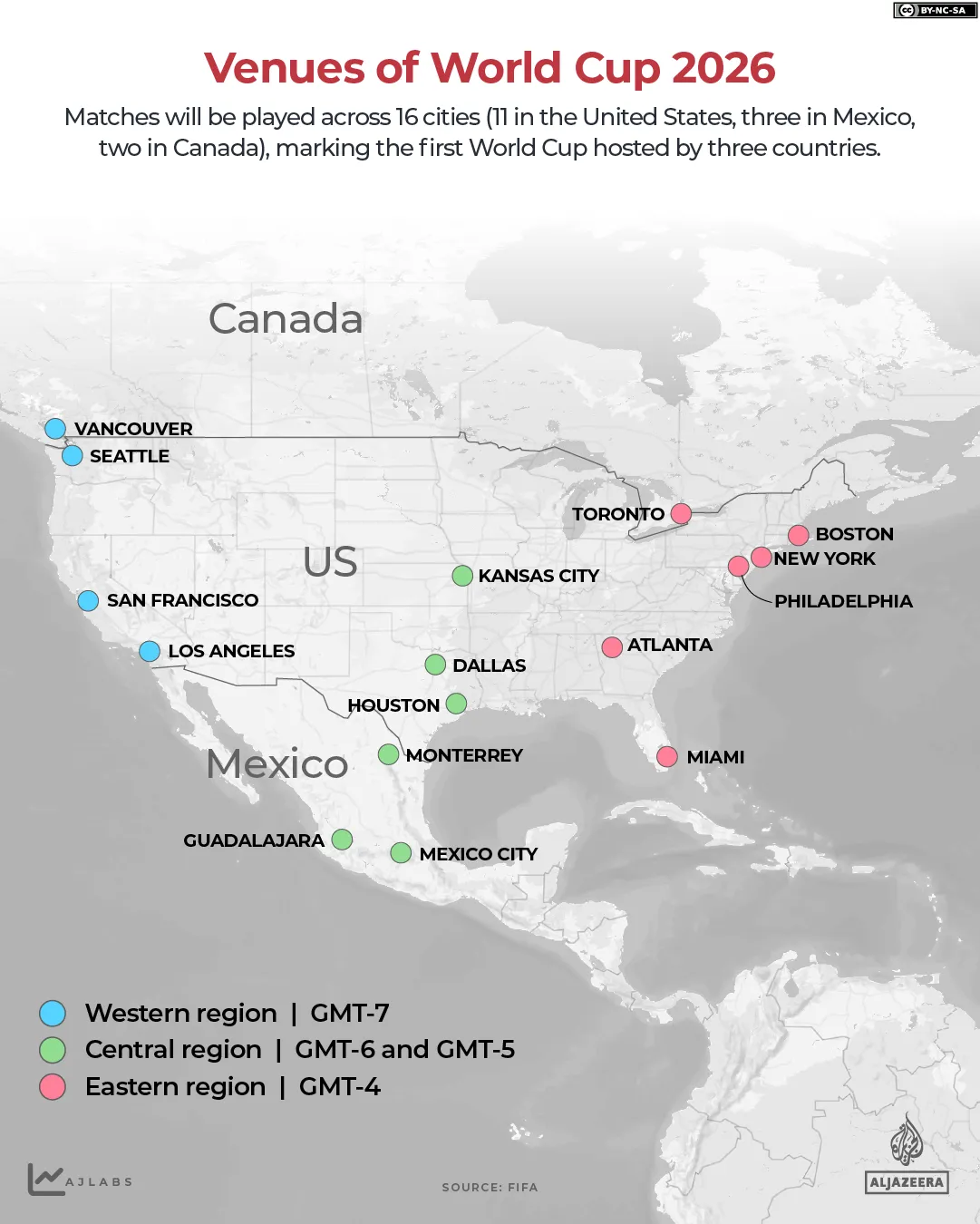
“Around half a dozen of the venues are prone to extreme heat; places like Dallas, Houston, Miami and the Mexican venues are all likely to swelter,” Fox said.
Daytime temperatures there are expected to average 28C, though the stadiums in Dallas, Houston and Atlanta have air conditioning.
Approximately 26 of the 104 matches could reach at least 26C in the Wet Bulb Globe Temperature (WBGT) index — which measures how effectively the body can cool itself — while five games are expected to be played in conditions of 28C WB or higher, according to World Weather Attribution (WWA), a network of climate scientists.
Of those 26 matches, 17 will be played in stadiums with cooling systems, reducing risks for players and fans.
But more than a third of the games with a one in 10 chance of exceeding 26C will be in venues without air conditioning.
How do hotter temperatures impact athletes’ performance?
Heat stress due to increased humidity, exposure to solar radiation and the effects of wind speed will impact players running around in direct sunlight, Fox said.
“All this makes it harder for the body to cool down as it becomes harder for sweat to evaporate as quickly,” said Fox, a senior meteorologist with more than 30 years of experience.
Physical performance coach Raiyan Abbasi explained that, although the body sweats to achieve thermoregulation – a process that allows the body to maintain its core internal temperature – excessive sweating due to heat could lead to dehydration, cramps and increased fatigue.
Are athletes used to such high temperatures?
“Yes, the majority of athletes will know how to deal with this kind of heat since they’re elite players training and competing in various conditions,” said Abbasi, who has worked as a physical performance coach for British clubs Swansea and West Ham, as well as the Pakistan national side.
Teams will have a performance coach and medical staff to make sure players are ready for the tournament, including through acclimatisation, Abbasi explained – echoing what Kane said over the weekend after his side beat New Zealand 1-0 in Tampa, Florida, where temperatures soared beyond 30C.
Do athletes from hotter nations have an advantage?
World Cup nations whose players train in hotter climates may have a slight advantage when it comes to adjusting to high temperatures in the US.
“But essentially, countries that prepare and perform well can minimise that difference,” Abbasi said, adding that heat can be used positively too.
“Heat is a significant factor in creating good athletes; one way to improve athletic capabilities is to train in the heat.
“It can make big adaptations in your body to improve body temperature.”
Could the World Cup have been held before or after summer in the US?
Fox noted that international tournaments are traditionally in the European domestic off season, which is when the 2026 World Cup is being held.
“Ideally, US weather is most conducive in the spring and autumn, but you’d then be looking at the tornado season in spring and hurricane late summer through autumn before you even begin to think about their domestic sports which locals have more interest in,” Fox said.
What measures has FIFA taken for players and fans?
FIFA said it has carried out heat-risk planning, with measures including three-minute hydration breaks in each half of games, cooling infrastructure for fans and players, adapted work-rest cycles, and enhanced medical readiness that scale according to real-time conditions.
“The hydration breaks probably need to be longer to gain full benefit, but then you risk turning it into a game of four quarters,” Fox said jokingly, although he argued that FIFA could have confined games to northern parts of the US and Canada.
FIFA has also delayed kickoff times for some matches to start outside the hottest afternoon hours.
It’s no secret that vinyl records’ resurgence has hit a new plateau, outselling CDs for the first time since 1987 as of 2022, according to a report from the Recording Industry Assn. of America. Three years later, its year-end report flaunts another statistic: Vinyl record sales surpassed $1 billion in 2025 — the first time since 1983.
But there’s an inevitable downside to anything that’s partially made of liquid dinosaur bones. Modern vinyl records are crafted with PVC resin, which makes up more than 75% of an average disk The synthetic polymer itself is made of chlorine and fossil fuel-derived feed stock.
To put its harm in perspective, a first-of-its-kind report from Vinyl Alliance, published in June 2024, found that 50% of a record’s carbon emissions come from this resin. The carbon footprint of a single LP was estimated to be roughly equal to the pollution a gas-powered vehicle emits over a three-mile trip. It adds up quick, considering that 46.8 million new records were sold last year.
Thankfully, it’s not all grim.
Organizations like Music Declares Emergency and the Music Climate Pact initiative are coming together to address the issue. A campaign by the groups — in collaboration with record labels and distribution teams at Secretly Group, Exceleration Music, Warp Records, Ninja Tune and Beggars Group — features titles pressed on 100% reclaimed material.
The release, set in tandem with World Environment Day on Friday, boasts marquee titles such as Elliott Smith’s “Roman Candle,” Bon Iver’s “For Emma, Forever Ago” and Dinosaur Jr.’s “You’re Living All Over Me.”
“What we found talking to a lot of our artists and to customers is that … they are concerned about the environment, and they want to find ways to reduce their footprint,” says Ben Swanson, co-founder of both Secretly Group and the Independent Record Pressing plant in Bordentown, N.J., where the LPs are made. “It’s about 16% less footprint than the traditional piece of vinyl.”
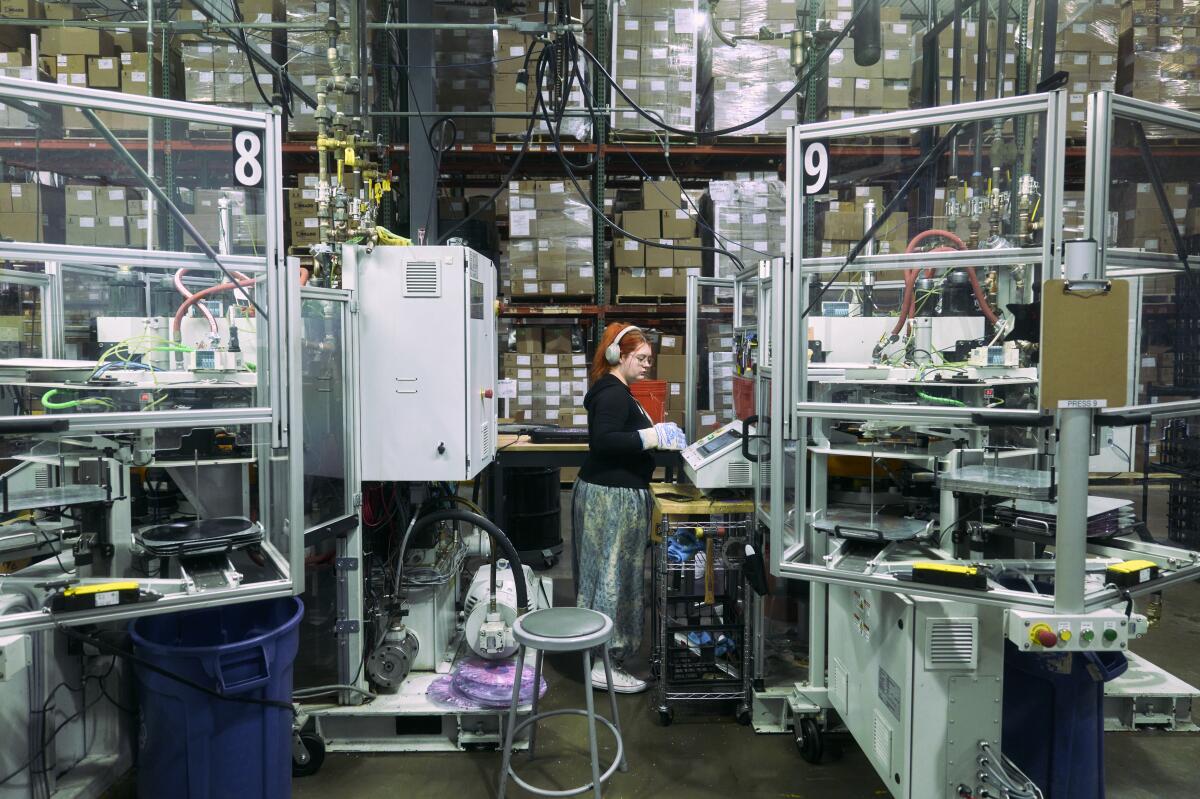
Soren Smith working at Independent Record Pressing in Bordentown, N.J., on May 26, 2026.
(Dutch Doscher / For The Times)
Largely, it’s been people like Swanson who have fully committed to the cause. He says that during the height of the COVID-19 pandemic, in an “activist moment,” several labels signed onto the Music Climate Pact, declaring their intention to reduce their emissions and be better stewards of Earth.
“It had almost no teeth to it,” Swanson explains. “A lot of people signed it, posted something on Instagram, and it sat there for a few years. For us, it was pretty frustrating … it felt very perfunctory.”
His work continued, along with a few others, thanks to support from Murmur, an organization designed to support labels and industry names, effectuating the commitments made when the Music Climate Pact was signed.
“We’re more doers than sayers,” Swanson says. “We’ve really been experimenting with what we’re calling ‘Revinyl’ — post-industrial, pre-consumer, recycled vinyl as a means to reduce our footprint at IRP.”
This is what some of Friday’s release is made of — all the trimmings, tidbits and overstock that would otherwise end up in landfills or on the factory floor. For the time being, it certainly won’t solve the climate cost of vinyl records, but it helps to mitigate it.
Between 2024 and 2025, total units produced at Independent Record Pressing increased by 41% while emissions — which also benefited from lower-carbon transportation — decreased by 34%.
“The idea is, if you can make those records 16% more efficient and also show fans of those records … that it is viable, maybe it makes it a little bit easier next year when we go out to ask other artists to jump on board,” Swanson explains. “We’re not making records that are just going to go sit on the shelf — these are records we’re continually repressing all the time anyway.”
Similarly, Ian Stanton, head of sustainability at Beggars Group, was among the first to sign the pact in 2021. His role was created five years ago to give indie labels a voice in light of minimal resources and capabilities. Though these roles do exist at larger labels, he says they have “slightly different drivers.”
When it comes to records, the pure plastic pollution that comes from them is also a concern. When old records make it to a landfill, they’re not only likely to outlive the site, but can also leach plasticizers, a Keele University report found.
“Vinyl is not like a single-use plastic; we don’t throw it away after one listen. We treasure it, we pass it on through generations, and people have a real connection with it,” he says. “But like any other product, there are ways of making it more sustainable.”
He refers to certain plastics, such as shrink wrap, as the most “visible” aspect of vinyl record pollution to consumers. From a collector’s point of view, shrink wrap can actually increase the value of a record. Though there has been discourse over the years around whether this can actually damage the sleeve, many sellers champion an “in the shrink” label as they mark up prices.
Splatter-patterned records arrive at the trim station at Independent Record Pressing in Bordentown, N.J., on May 26, 2026.
(Dutch Doscher / For The Times)
Other visible aspects, such as the paper sleeves in which the records are housed, are also harmful. However, Swanson says that swapping those for recycled materials outputs a relatively negligible difference in emissions impact, largely due to the process behind producing them.
For the time being, vinyl records made from reclaimed materials are the best that companies like Swanson’s can do, though they’re are always on the lookout for other, viable options for improving their footprint. As an example, they’re actively experimenting with how existing record material can help them.
What can the beat-up, worn-out records at your local thrift store do to dodge a landfill and keep the Earth spinning? As it stands, not much.
Stanton lists an array of challenges, including outdated materials, modern production regulations and contaminants.
“I suppose what we need with PVC for records is a really high-quality, contamination-free material to get that sound reproduction,” he explains. “When you bring in stuff from that post-consumer environment, you’ve got to make sure there’s no contamination in there, because you’re going to end up with sound quality issues.
“It’s all in process,” he adds.
For now, they look to fix the most immediate problems first, such as freight emissions, where Beggars Group has converted the vast majority of its shipping operations to sea freight, a far less harmful alternative compared with air freight.
“We want to look at the full life cycle … not only thinking from the cradle to the grave, but from the point where the raw materials are extracted at the beginning,” Stanton says. “This life cycle analysis now looks at all different environmental indicators on this — the chemical usage, the water usage, and the end-of-life impacts on that side of things.”