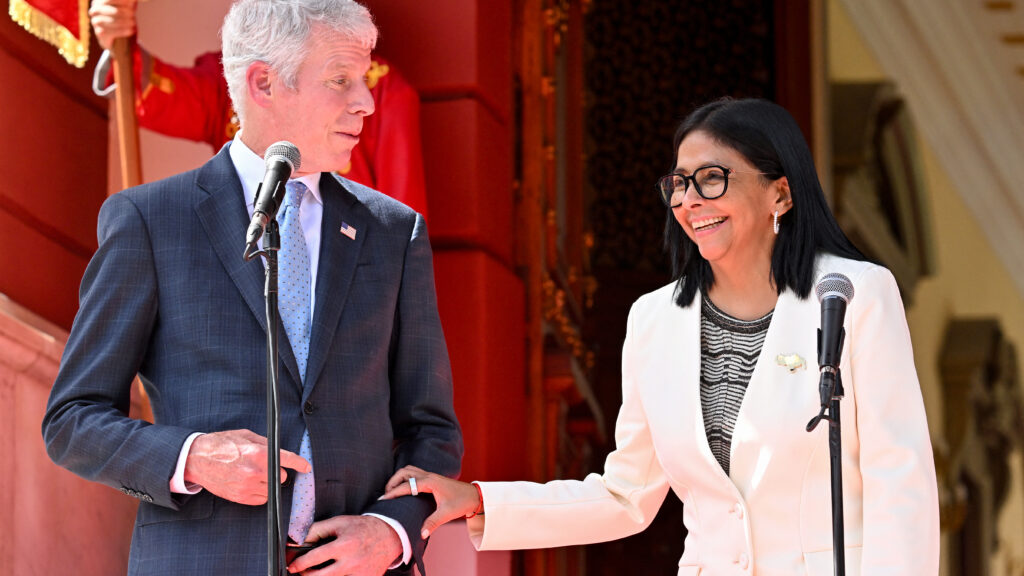
Rodríguez, Trump Energy Chief Hail Oil Deal as Venezuela Signs New Concessions
Wright visited Caracas for a second time since the January 3 US strikes and Maduro kidnapping. (AFP)
Caracas, September 3, 2026 (venezuelanalysis.com) – Venezuelan Acting President Delcy Rodríguez and US Energy Secretary Chris Wright celebrated an oil agreement between the two countries and North American Blue Energy Partners (NABEP) and a flurry of additional energy deals signed on Wednesday.
“This is a historic day in the transformation of Venezuela,” Wright said in a joint press conference at Miraflores Palace. “President [Donald] Trump has a clear mission in Venezuela: to bring peace, freedom, and prosperity to everyone.”
The US official went on to praise the “enormous deal” announced last Friday that will see NABEP, a company owned by Venezuelan businessman Alejandro Betancourt, receive long-term concessions for 17 prime oilfields in the Caribbean nation that hold 65 billion barrels of reserves.
According to the White House, the US Department of War’s Office of Strategic Capital (OSC) will acquire a 35 percent stake in NABEP through penny warrants. The US State Department will be able to purchase 20 percent of NABEP’s production at cost and hold a right of first refusal for the remaining 80 percent.
Washington will likewise control the company’s board of directors. Wright stated that the NABEP deal is “ambitious” and predicted that Venezuelan oil production would surpass 2 million barrels per day (bpd) by the end of the decade, nearly doubling the current output of 1.1 million bpd.
For her part, Rodríguez urged Wright to convey her gratitude to Trump, the US State Department, and the Department of Energy for helping secure “a mutually beneficial, win-win agreement.”
“I trust that the binational agreement will also prove beneficial for the people of the United States,” the acting president told reporters. “Venezuela is ready to welcome these investments that will boost the country’s development.”
Rodríguez had previously stated that Venezuela is estimating US $19 of revenue per barrel extracted in the project, significantly below the government take under the 2001 Hydrocarbon Law enacted by former President Hugo Chávez. The law was overhauled with US support in January to expand benefits for foreign corporations.
Both Rodríguez and Wright faced questions about Betancourt, who has faced embezzlement and money laundering investigations in Spain and Switzerland stemming from alleged corruption in dealings with state oil company PDVSA.
NABEP has operated in the country since 2024 and was awarded the project without a prior bidding process. It is currently Venezuela’s second-largest crude producer after Chevron. Wright said the US government had negotiated the agreement carefully and would exercise strict control over the flow of funds associated with the NABEP deal.
Rodríguez, for her part, said that Betancourt is not facing any judicial proceedings in Venezuela, with a 2022 arrest warrant for corruption having been dropped one year later. Similarly, Secretary of State Marco Rubio argued in an interview that the Venezuelan mogul is not the subject of any investigation in the US.
Before the afternoon press conference, Wright attended a ceremony at the presidential palace that saw the Venezuelan government sign a number of agreements with foreign corporations.
Chevron, the largest foreign corporation operating in Venezuela, saw its joint venture with PDVSA awarded two additional extra-heavy crude fields, Carabobo-1 and Carabobo-2 South, in the Orinoco Oil Belt.
The Texas-based company announced plans to invest $7 billion in its Venezuela projects over the next five years with the goal of more than doubling the current 250,000 bpd output. Chevron CEO Mike Wirth affirmed in an interview that the “strong legal protections” and “improved terms” under the reformed Hydrocarbon Law granted the company “attractive low-cost oil growth” prospects.
Italian company Eni also signed a contract to develop the Junín-5 block, one of the largest in the Orinoco Oil Belt. The project will migrate from a joint venture with PDVSA majority to a concession-type deal, called a Productive Participation Contract, which offers increased benefits for the private operator.
Eni CEO Claudio Descalzi was likewise present in Miraflores Palace and thanked US and Venezuelan authorities for backing foreign investments in the South American country.
Wednesday’s ceremony also saw Primavera secure a concession to exploit the medium- and heavy-crude Budare-Elotes block in eastern Venezuela. Primavera is an energy-investment vehicle created by billionaire Fred Ehrsam, a Trump supporter and co-founder of Coinbase, to enter the Venezuelan oil industry.
Additionally, Colorado-based wildcatter Aspect Energy received rights to study potential new oilfields in eastern Venezuela.
Finally, PDVSA and state electricity company CORPOELEC signed “strategic alliance” agreements with GE Vernova, an offshoot of General Electric, to upgrade and repair electrical infrastructure supporting Venezuela’s oil industry.
Following the pro-business overhaul of its energy sector, Caracas has signed new or updated agreements with multiple Western multinational corporations, including BP, Shell, and Repsol.
Since the January 3 military strikes and kidnapping of President Nicolás Maduro, the Trump administration has wielded significant control over the Venezuelan oil and gas industry. The Caribbean nation’s export revenues are currently deposited in a US Treasury account before the White House decides the disbursement timings and amounts.
Washington has also kept wide-reaching sanctions in place while issuing licenses for select corporations and banning dealings with companies from Russia, China, and Iran. With NABEP set to take over five oilfields previously operated by joint ventures with Chinese firms, Beijing demanded that its “rights and interests” in Venezuela be respected.
Edited by Ricardo Vaz in Caracas.