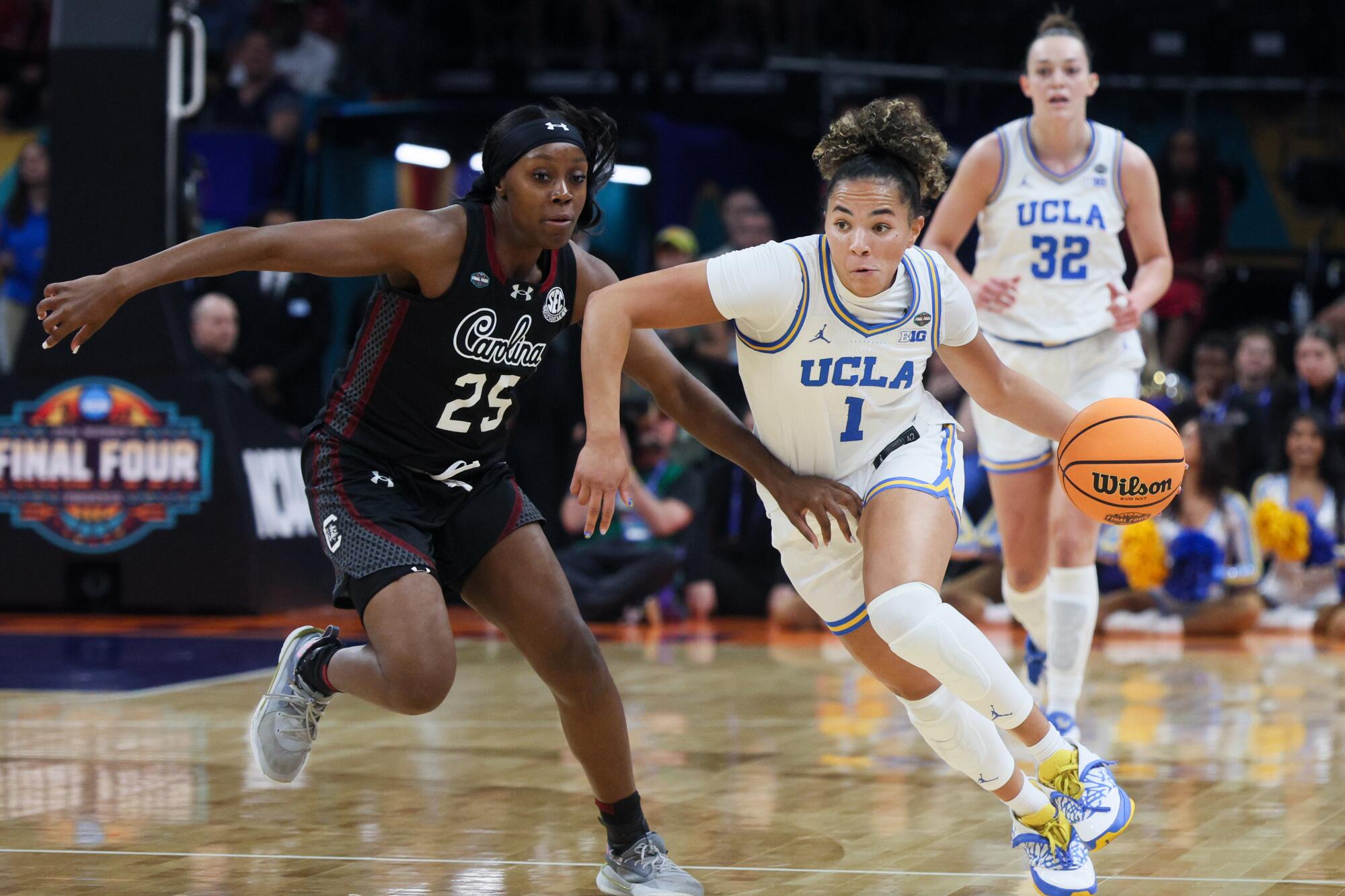
With a 30-point lead by the end of the third quarter, much of the end of Sunday’s NCAA championship victory was a celebration of what UCLA had built en route to its 79-51 victory over South Carolina.
By the final buzzer, it was a full-blown party.
It was one of the largest margins of victory in Final Four history.
UCLA won an AIAW title in 1978 against Maryland before women’s basketball was an NCAA sport.
UCLA’s Kiki Rice, right, drives around South Carolina’s Raven Johnson during the first half of the NCAA national title game on Sunday.
(Ronaldo Bolanos / Los Angeles Times)
Last season, UCLA’s 34-point loss to Connecticut in the semifinal became the worst loss in tournament history.
This season, there was no doubt UCLA was ready for the moment and it ensured it could reverse the history books.
It was perhaps the most UCLA performance the Bruins could have had. In their final collegiate games, Lauren Betts (14 points, 11 rebounds) and Gabriela Jaquez (21 points, 10 rebounds) earned double-doubles and all five starters scored in double digits. They dominated the boards (49-36), played stellar defense and most important, didn’t turn the ball over often.
After the Bruins held Texas to a season-low 44 points in Friday’s semifinal, they held the Gamecocks to 51, also their lowest total all season.
UCLA’s Lauren Betts shoots over South Carolina’s Maryam Dauda in the first half of the NCAA national championship game Sunday.
(Ronaldo Bolanos / Los Angeles Times)
The Bruins jumped out early while South Carolina struggled with the Bruins’ size and went three for 18 from the floor. Kiki Rice (10 points, six rebounds, five assists) hit a buzzer-beating three-pointer to end the opening quarter with the Bruins holding on to a 21-10 lead.
Near the end of the first, Betts came back to the bench coughing and sputtering, seemingly unable to clear her throat. At the start of the second quarter, she was at the end of the UCLA bench and used an inhaler before returning to the game.
UCLA’s suffocating defense held the Gamecocks to 25.7% shooting in the first half. Unlike Friday’s win over Texas, the Bruins’ offense recovered from a one-for-10 stretch far earlier.
South Carolina made a mid-second quarter adjustment into a zone defense and a half-court press that forced one 10-second violation and another turnover that led to a fast-break layup and and free throw from Ta’Niya Latson.
UCLA’s Gabriela Jaquez celebrates after scoring while being fouled during the first quarter Sunday against South Carolina.
(Ronaldo Bolanos / Los Angeles Times)
UCLA led 36-23 at the half.
One of the Gamecocks’ only interior presences, center Madina Okot, had three fouls early in the third quarter. With her off the floor, UCLA extended its lead to 18 off a three-pointer from Charlisse Leger-Walker.
Midway through the quarter, a sequence of a Betts layup over the South Carolina defense, a Betts block of a Latson shot and a Jaquez fast-break layup gave the Bruins a resounding 22-point lead.
The Bruins outscored the Gamecocks 25-9 during the third quarter to earn a 61-32 lead off a 13-0 run. It was the largest lead ever for a team going into the fourth quarter of an NCAA championship game.
South Carolina shot a season-worst 18 for 62 from the floor and two for 15 from three-point range.
UCLA players, including Kiki Rice, left, and Gabriela Jaquez celebrate after winning the NCAA women’s basketball national championship on Sunday.
(Ronaldo Bolanos/Los Angeles Times)
The Bruins held Latson to four points and Raven Johnson to three on one-for-seven shooting.
South Carolina had taken down then-undefeated UConn in the semifinal on Friday.
UCLA will need to rebuild with few returners, but now that her players have won a national title, coach Cori Close should have her pick of the transfer portal.
Now, Close and the Bruins have championship pedigree.
Highlights from UCLA’s win over South Carolina in the NCAA women’s basketball national championship game.
Two days with no games allowed the Lakers to fully reset as they prepare for the final stretch of the regular season and a playoff run.
They have eight games left, starting with the NBA lottery-bound Washington Wizards at Crypto.com Arena on Monday. The Lakers will play without star guard Luka Doncic because he’s serving his one-game suspension for reaching the league limit of 16 technical fouls.
The Lakers had an early practice Sunday and that gave them a chance to make adjustments with fresh bodies and minds.
“Yeah, for me, I think, based on all of them wanting to come in at 10 a.m. on a Sunday, I think it is as much mental and spiritual and emotional,” Lakers coach JJ Redick said after practice. “We didn’t want to have these guys in here long today. But we got a lot done, watched some film and cleaned some stuff up. But there is these two days for us. It’s a great reset for us.”
Doncic got his 16th technical foul of the season Friday night during a win over the Brooklyn Nets after an exchange with Ziaire Williams, when both were given double technical fouls in the third quarter of that game.
For Doncic, who earns $45.9 million per season, the suspension will cost him about $264,000.
If he gets two more technical fouls between now and the end of the regular season, he will be automatically suspended for an additional game.
Doncic is eligible to return for the Lakers on Tuesday night when they host the Cleveland Cavaliers.
“I mean, he’s disappointed,” Redick said of Doncic. “He wants to be there for his teammates, and again, I’ve talked about this all year, like he plays. He’s not a guy that takes games off. He can be banged up and he’s gonna play. He was like that when I was his teammate in Dallas. For tomorrow, we’ve gotten, I think, some great contributions from guys that haven’t necessarily been in the nine-man rotation when we’ve been fully healthy.”
Redick spoke about how Bronny James, Jarred Vanderbilt and Maxi Kleber have all had “good moments” when they were called on for duty.
And with Doncic out, Redick said it will take a group effort to beat the Wizards.
“But we’re gonna need everybody tomorrow,” Redick said.
The Wizards have the third-worst record in the NBA at 17-56. They are second to last in the league in points allowed, giving up 124 per game.
Still, this is all about the Lakers and how they get ready for the playoffs during the final few games of the season .
Half of the eight games are against teams with records below .500.
The Lakers will face a Cavaliers team that’s making a push for better positioning in the Eastern Conference. They will twice face an Oklahoma City team that has the best record in the league and a Suns team that has a 3-1 record against the Lakers.
“That’s the thing I’ve talked about all year is you need great effort and you need great execution,” Redick said. “I think the effort part has been there very consistently for weeks now. Sometimes when the games are stacked together and travel and all that, there can be some small details, execution-wise, that can have slippage, and I think for us, especially on the defensive end, we can do some things better. But I mean, look, the last 16 games we are where we are because we’ve been really good on both ends.”
Etc.
Redick said guard Marcus Smart (right ankle contusion) and forward Adou Thiero (left knee soreness) are in “that day-to-day camp” with their injuries.
“So we’re just kind of waiting for them to feel like they’re good enough to go,” Redick said.
Ranting about the decline of comedy specials while releasing a new one at the same time feels a bit like an oxymoron. But somehow it still makes sense coming from alt-comedy pioneer David Cross, who isn’t just complaining; he’s finding his own route to making specials feel special again. The only way to do that is by putting one out in the manner he’d like to see more often — starting by making the whole crowd stand up too.
Capturing the energy of a concert at the famous 40 Watt Club in Athens, Ga., was the first step in differentiating “The End of the Beginning of the End” from the typical hour you watch on a big streamer. And, with this new special, Cross is able to get back to his own beginnings of touring across the country with love bands as his openers, performing for crowds for as long as he could until he had to run offstage to pee.
Premiering the special earlier this month on his website (and on April 7, it will be available on YouTube via production company 800 Pound Gorilla), Cross is hoping the special connects with comedy fans in a way that we’ve forgotten specials could.
This interview has been edited for length and clarity
Your new special is called “The End of the Beginning of the End.” What does that title mean to you as it relates to the impending doom of what we’re all living right now.
David Cross: Well, you can look at it in a couple different ways. To me, it signifies that the beginning of the end has occurred. And we are now at the end of the beginning of the end. And from where you go with that, that’s for you to decide.
One of the things I love about the special is the fact that you shoot it at a club in the style of a live–music concert.
I’ve shot specials in theaters and it’s just different, not that one is better than the other, but they’re just different. You have a different relationship with the audience. When I first started touring, I would go to music venues and I’d have a band open for me and then I would just go up and pretty much [perform] as long as I could until I had to pee. Sometimes I’d have a band playing, sometimes two bands, then I’d go out. And I did that a couple of times, and then stopped doing that and did theaters, and I decided for the last two specials I’m going to go to, when I shoot it, I’ll go to a music venue, and I was at the 40 Watt Club in Athens this last time, I was at the Metro in Chicago before that, both places I played on earlier tours, and, you know, it’s not seated. People are standing there at the stage, and I prefer it. It’s more fun. It’s not as lucrative but, to me, a more fun show to do.
Comedian David Cross
(Jason Armond / Los Angeles Times)
The ambience of it was great.You can hear people shouting and drinking and having a good time, and the crowd work is also a little more spontaneous and fun than it would be in a regular venue.
Yeah, well, there’s more opportunity for that. But my thing has never been about crowd work. I like engaging with it, it’s kind of a nice distraction from the set that you’ve been doing 100 times, 150 times at that point. So it’s always fun to have that thing happen and that feeling of spontaneity. And like the guy [who I talk to in the crowd during the special], I could not have asked for [someone better]. I mean, even if it was scripted, it wouldn’t have been as good. The guy who [I talk to] during the stuff about hiking Machu Picchu [with Bob Odenkirk], that’s just… [chef’s kiss].
Speaking of Bob Odenkirk, you guys have this long relationship. How would you describe the dynamic of working with Bob and just how you guys bounce ideas off each other?
I mean, it’s great. We have an inordinate amount of respect for each other, both as people and as creative partners. And so there’s never any real issues. There’s things we will definitely disagree with, but we’re both decent people. So you know somebody backs off and says, “OK, let’s do it that way.” But even then, there aren’t that many of those [issues]. We just have really worked well at building something or molding it, creating it and shaping it. And our aforementioned hike to Machu Picchu, we have a documentary about that, that will be premiering at a fancy festival at some point in the near-future. And so we got that doc and we’ve been working on that. And for the way we work now, because he lives in L.A. and I live in New York, and it’s been like that for a while, he’ll write a bunch of stuff, I’ll make notes, I’ll write my things, send it back. And so we’re able to do that and not necessarily have to be in the same room because we’ve had 30-plus years of working with each other.
It’s a kind of like an unspoken language you guys probably have in terms of comedy, which is super important, I imagine, just for collaborating.
Yeah, and it’s something we discovered very early on … before there was even “Mr. Show,” what would ultimately become “Mr. Show,” when we got together to write sketches for this bigger kind of comedy collective thing, and these shows that we would all do with each other, for each other, and the stuff that we would write together was just, like, really good, easy writing — again, one person adding this thing and one person saying here’s a switch yeah and another person adding this thing in. It was fun, it’s cool, still is. One thing he doesn’t get credit for is he’s a really decent human being. And with all the awfulness in the world that’s magnified, every sense is bombarded with it — it’s just good to be hanging with somebody whose energy is a good person, a decent person and an equitable, nice guy, so that’s good as well.
Comedian David Cross poses for a portrait ahead of his comedy special “The End of the Beginning of the End.”
(Jason Armond / Los Angeles Times)
One thing you guys also have in common is you both have kids, and he has a comedy show for kids called “The Appropriate Show.” Have you taken your daughter to see it?
It’s a sketch show [in which] all the sketches are appropriate for kids to watch. And the sketches have been done in other sketch shows onstage, live. And he puts together this thing once, twice a year here in L.A. And I took my daughter to it last year. It’s just sketches that kids can [understand]. At least if they don’t understand the actual references they get the archetype. “Oh, that’s the boss, that’s that uh… And it’s great, it’s a really cool idea uh… “ And would an ass— think of [a show like] that? No, one good decent person; a good man. But listen, this interview isn’t about me, it’s about Bob Odenkirk, so let’s get back to that.
Well, speaking of having comedy geared toward kids, your daughter’s at an age where she’s probably consumed or seen some of your comedy at this point.
Not, not really. No, no.
Do you shield her from your stuff, or are you not so concerned about it?
I don’t actively shield her, but I don’t introduce her to anything. So I was a little bummed out, and I got over it pretty quickly, but when I found out that she had seen a little bit of “Alvin and the Chipmunks,” and only because I don’t want to spoil the enjoyment of what movies are and what kids’ movies are and how things work. And I feel like that would introduce an element of reality that I want her to be able to just enjoy these things without — she’s seen “Kung Fu Panda”when she was younger, like, I don’t know, three, four, five times, has no idea that I’m in that, that my voice is in there. She knows I do stand-up, she gets that now. And when she was younger, she’d say, “Daddy’s silly for a living.” … I’m just trying to ride the balance of letting her have those childhood joys and experiences.
Comedian David Cross.
(Jason Armond / Los Angeles Times)
Does having a kid make you think about what’s coming up in the future of comedy, or what kids are gonna maybe find funny, or what they find funny now? Do you have any thoughts on kid comedy in general?
Not really. I mean, I can see that she and her friends, who are kind of like-minded, are naturally funny, and then that’s kind of encouraging and heartwarming and they’re silly, but I’ll be long gone when that generation is is providing comedy. And I’m still, although I’ve kind of given up, I’m still trying to grasp what works now. I mean, it’s short-term TikTok, Instagram stuff. There are some amazing, like really, really great things being done as far as film sketches for YouTube channels. “Almost Friday,” they’ve got genius-level stuff. I mean, really good. And where the sketch goes in a place, you’re never ahead of it, goes in a place where you’re not expecting. It’s really well written and well performed.
What are your thoughts on what a comedy special is nowadays or what it should be?
I mean, that’s a great question. I think anybody who plays with the form, whether I think it’s that funny or not, is different. But I’m happy when anybody kind of tries at least to play with a form. I just went to Rory Scovel‘s taping last week of his latest special. I don’t know when that’ll air, but if you’ve seen the beginning to his first special, stuff like that where you’re like, “Wait, what’s happening? What’s going on?” I love stuff like that.
I still get excited to watch specials by some of my favorite comics, but there’s a quality that’s missing. And these are stand-ups I love, and they’re not that great. They’re not bad but they’re not special, you know? And all those guys I mentioned, and more, have great specials. Like, you can go back and they’re great. And I don’t know why that is. I mean, there’s still funny stuff, but I don’t ever want to get to that place where its just feels a little phoned-in a little bit… that is, in part, why the last two specials were shot in this more intimate setting that feels special. And … as I said, the energy’s different, it’s a little bit different, and it’s less slick. It feels like you’re in the moment. You don’t need a million dollars to shoot a special. You don’t 28 camera angles, it‘s just bull—. And it takes something away.
Comedian David Cross
(Jason Armond / Los Angeles Times)
It all should feel the right amount of unsafe as well, I think.
That’s never gonna happen at a theater show. You’re never gonna feel that. And I don’t know, it really does feel almost like maybe we peaked in a sense, like there’s too much, and because of that, these things aren’t special. They’re not revelatory, they’re not unique. I dunno, can 18,000 people in an arena really relate to a … billionaire talking about how they’re gonna get canceled. I mean, is that a thing I guess? Those other big, slick specials that are shot in, like, a 3,200-seat, 3,500-seat theater, it just feels like, “Oh this person is up there and I’m listening to their jokes.” There’s nothing wrong with that. They’re often very funny jokes, but it doesn’t go beyond that. It’s just like, “All right, tell me your joke.” It might as well be an audio thing, you know?
Well, hopefully the robots aren’t coming for your job anytime soon.
Absolutely not. I mean, this could be naive, but I feel 100% safe that you are never going to replicate an evening of stand-up at a nigtclub like that. And not sitting down at tables while you’re having drinks and waitresses are coming by. I’m talking about everybody’s up on the stage, sold-out, maximum capacity; everybody’s there, focused, we’re all sharing that thing. You can’t. AI’s not going to be able to do that.
Yeah, the robots can’t do that, Terminator can’t do that..
Oh, I forgot about Terminator. He could do that. G— it.
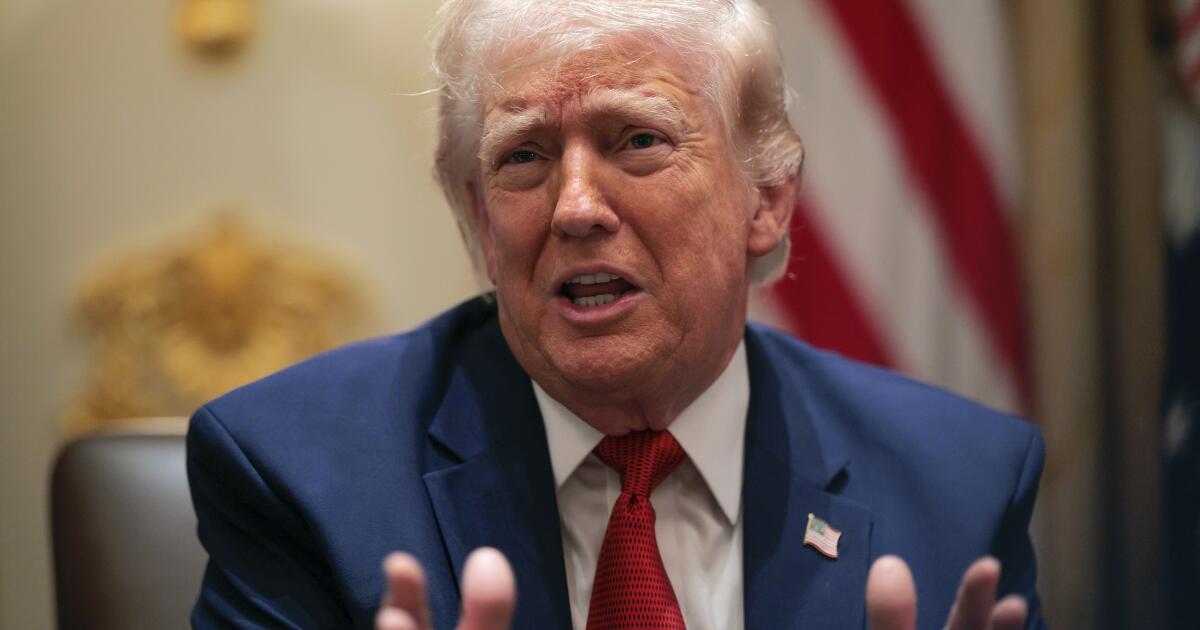
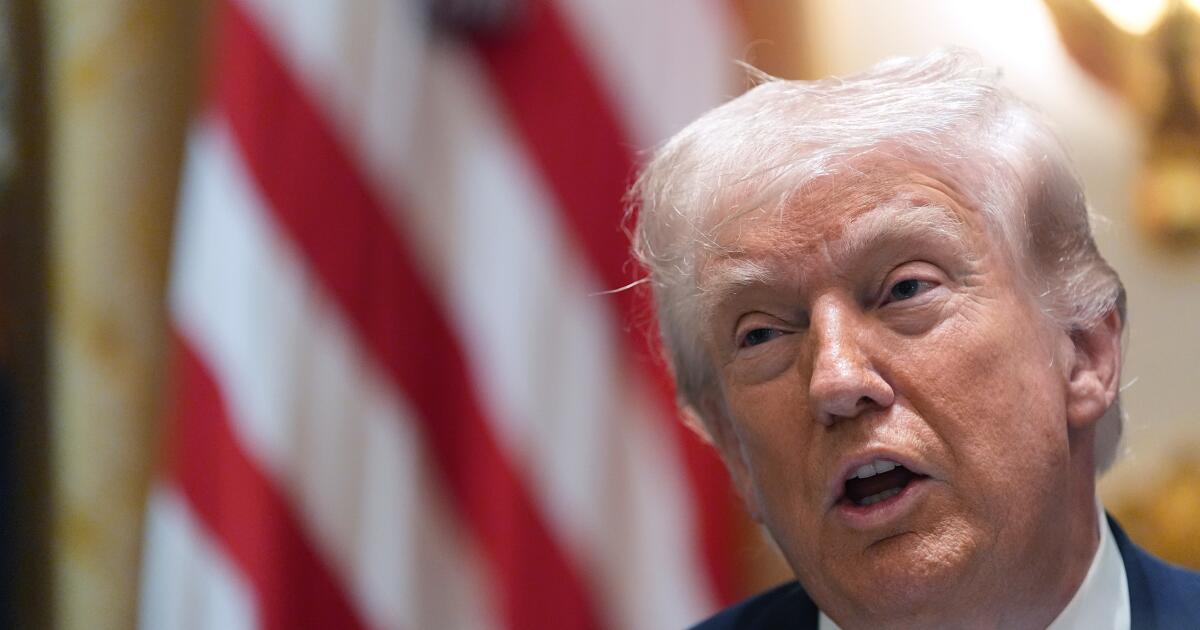
During his first Cabinet meeting since launching the U.S. war on Iran, President Trump spent 10 minutes talking about the price of ceremonial White House pens — which he claimed to have brought down, from $1,000 to $5, by switching to his favored Sharpie brand.
Trump was trying to make the point during the Thursday meeting that he’s a great money saver. He seemed chipper, joking with the other leaders of his administration at the table.
Late Thursday, when asked on “The Five” on Fox News about whether Iranian people have access to basic necessities such as drinking water and food, Trump complimented the looks of Dana Perino, the Fox host who’d asked the question, compared to when he’d met her years before.
“Now I’m not allowed to say this, it’s the end of my political career, but you may be even better looking, OK?” Trump said. “You’re not allowed to say a woman’s beautiful anymore.”
He then talked about Iranian authorities killing protesters, but said he’d been pleased with them more recently because they had given him a “present” by allowing oil ships through the Strait of Hormuz.
Through both discussions, Trump maintained a flippant, casual tone — the same he has maintained since the war began a month ago, and a vast departure from that of past wartime presidents.
For weeks, Trump has batted away criticisms of the war campaign and questions about why it was justified and how long it will last. He has derided reporters for asking questions about tactics and whether he’ll deploy boots on the ground as inappropriate and foolish, and repeatedly met concerns about the human toll of the war by shrugging them off or changing the subject.
Meanwhile, his war has cost the U.S. billions of dollars and depleted its global reserves of critical weapons systems such as Tomahawk missiles, which cost millions of dollars each and are needed to maintain U.S. security around the world, according to the Washington Post.
Entering its fifth week, the war has badly disrupted markets, with U.S. stocks falling Friday as Wall Street approached the end of its fifth straight losing week — the longest such streak in nearly four years — and oil prices rising again.
Markets have fluctuated based on Trump’s changing messages on an end to the war, planned and then postponed strikes on Iran’s power plants, strikes on oil and gas infrastructure across the Middle East and Iran’s stranglehold on the Strait of Hormuz, through which a quarter of global oil usually passes.
Trump has talked in recent days about an impending deal to end the war, but so far it has not materialized, with Iran downplaying the seriousness of the negotiations. Iran instead appeared to be formalizing its hold on the strait, including by creating what amounts to a toll on ships seeking passage through the channel from its Islamic Revolutionary Guard Corps.
The number of U.S. deaths in the conflict has held steady for days — at 13 — but the war continues to exact a daily, devastating toll in the Middle East. In Iran, thousands of targets continued being hit, with the death toll ticking toward 2,000.
Speaking by video during a Human Rights Council meeting in Geneva on Friday, Iranian Foreign Minister Abbas Araghchi accused the United States and Israel of harboring a “clear intent to commit genocide” in Iran, claiming that more than 600 schools had been damaged or demolished and more than 1,000 students and teachers “martyred or wounded.”
The discussion related in part to a Feb. 28 strike on an elementary school in Minab that killed more than 165 people, most of them children, which evidence reportedly suggests was the work of the U.S. and which the U.S. says is under investigation.
Casualties also continued in Gulf nations allied with the U.S., where Iran continues to strike U.S. military installations and other infrastructure, and in Lebanon, which Israel has invaded and bombed relentlessly in its own war with the Iranian-aligned Hezbollah force.
And yet, Trump has bounced between speaking engagements and more formal meetings with an apparent lightness — seeming unbothered by the weight of the conflict and acting as if U.S. victory were already at hand.
“We’ve already won the war. Militarily we’ve totally won the war,” he told “The Five” on Thursday.
After Trump’s exchange with Perino, fellow host Greg Gutfeld began to change the topic, saying, “I’m debating whether to be serious or not serious.”
“Do you think Biden would do this interview? Can you imagine? You think Biden — Sleepy Joe — he would do it?” Trump said.
He called the war a “little bit of a detour” from what he said were his otherwise winning economic policies, and asserted again — without providing evidence — that Iran was on the cusp of having a nuclear weapon and would have used it to cause devastation across the Middle East and to the U.S. if the U.S. hadn’t struck first, including when it bombed Iran’s nuclear sites last summer.
“You can’t let a madman or you can’t let a mad ideology have a nuclear weapon,” Trump said.
He repeated his long-pushed lie that he won the 2020 election, and suggested his support among his MAGA base remains at 100%.
An AP-NORC poll this week found that most Americans believe that the U.S. military campaign in Iran has gone too far — including about a quarter of Republicans — and that many are worried about gas prices.
During his Cabinet meeting Thursday, Trump seemed supremely confident, but also aware that the conflict was far from settled.
He said that the U.S. was “extremely — really a lot — ahead of schedule” in its war effort, and that “the Iranian regime is now admitting to itself that they have been decisively defeated.” But he also said that “even now, we don’t know if there are any mines” in the Strait of Hormuz, despite the U.S. having wiped out Iran’s “mine droppers,” and acknowledged that “if you think there may be a mine, that’s a bad thought and it stops things up.”
He said the U.S. has “decimated” about 99% of Iranian capabilities, but “the problem with the strait” is that the remaining 1% threat “is unacceptable, because 1% is a missile going into the hull of a ship that cost $1 billion.”
“If we do a 99% decimation, that’s no good,” he said.
During “The Five” interview, Trump was also asked if the CIA had told him that Supreme Leader Ayatollah Mojtaba Khamenei — who took on the Iranian leadership role after his father, Supreme Leader Ayatollah Ali Khamenei, was killed in initial strikes — is gay, which would be a crime under Iranian law.
“Well they did say that, but I don’t know if it was only them. I think a lot of people are saying that. Which puts him off to a bad start in that particular country, you know?” Trump said, in a stunning acknowledgment of a previously rumored intelligence briefing.
WASHINGTON — Pressure is mounting on Congress to end the funding shutdown that has resulted in travel disruptions, missed paychecks and even warnings of airport closures, but lawmakers have yet to resolve the underlying issue of reining in President Trump’s immigration enforcement operations.
Senators intend to vote Thursday on a Republican proposal that would fund the Transportation Security Administration and much of the Department of Homeland Security, except the enforcement and removal operations conducted by U.S. Immigration and Customs Enforcement. That plan is expected to fail.
Democrats argue it does not go far enough at putting guardrails on officers from ICE, Customs and Border Protection and other federal agencies who are engaged in the immigration sweeps, particularly after the deaths of two Americans protesting the actions in Minneapolis.
Trump, who has largely left the issue to Congress to resolve, threatened to send the National Guard to airports, in addition his deployment of ICE agents who are now checking travelers IDs — a development drawing concerns.
“They need to end this shutdown immediately or we’ll have to take drastic measures,” Trump said Thursday during a Cabinet meeting at the White House.
With Congress set to leave town by week’s end for its own spring break recess, calls are intensifying for an end to the 41-day stalemate that’s put the livelihoods of TSA officers at risk as they provide airport security without pay.
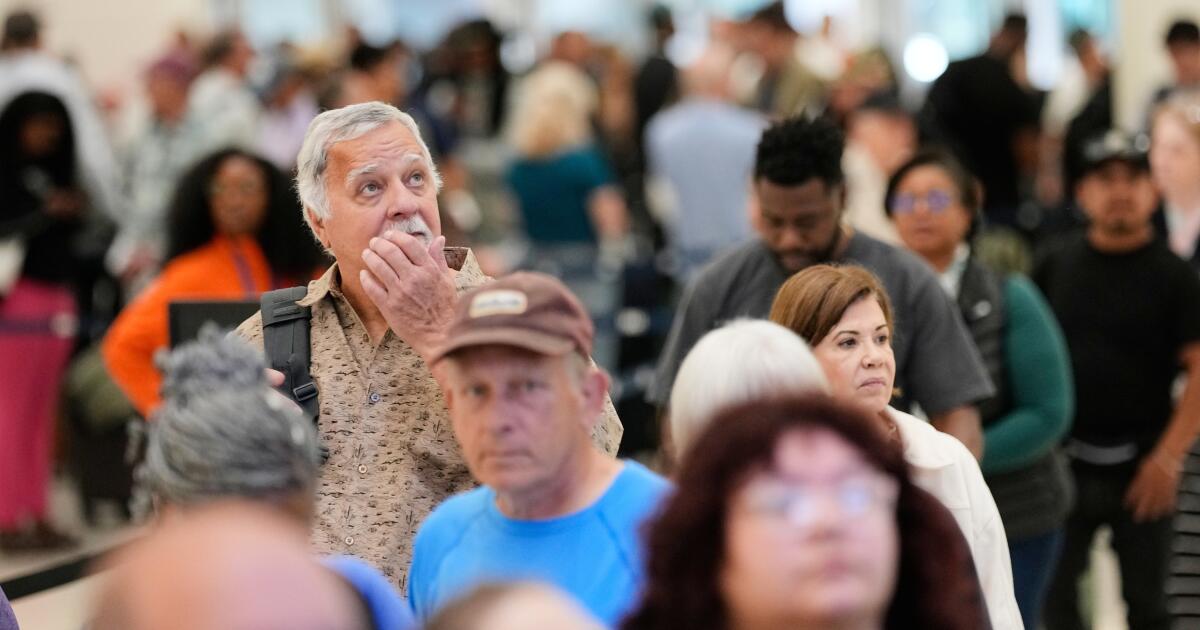
Multiple airports are experiencing greater than 40% callout rates of TSA workers and more than 480 of its nearly 50,000 transportation security officers have now quit during the shutdown. Nationwide, nearly 11% of TSA workers — more than 3,200 on a single day — missed work.
Trump stays out of the fray
The Republican president initially signed off on the plan the GOP senators brought to him late Monday. By Tuesday, he said he would not be happy with any deal.
Trump did not directly address the status of negotiations late Wednesday evening during an annual fundraising dinner for the House Republicans’ campaign committee as Speaker Mike Johnson, R-La., works to keep majority control of the chamber in the November elections.
But Trump criticized Democrats for refusing to settle their demands on immigration changes. On Thursday, he revived his campaign for senators to end the filibuster as a way to overpower opposition to GOP policies, something most Republican senators do not want to do.
The GOP’s big tax cuts bill that Trump signed into law last year funneled billions to DHS, including $75 billion for ICE operations, ensuring the money is flowing for his immigration and deportation agenda even with the funding shutdown. ICE and other immigration officers are still being paid.
The situation is partly of Trump’s making, a strategy the president put in place last fall when he cut a deal with Democrats to end a previous federal shutdown. At that time, Trump agreed to fund the federal government, except for DHS, which was then put on temporary funding that has expired.
A stopgap measure
The Republican offer added one new restraint on immigration officers, funding the use of body cameras that had previously been agreed to. It excluded other policies that Democrats have demanded, such as that federal agents wear identification, remove their face masks and refrain from conducting raids around schools, churches or other sensitive places.
Senate Democratic leader Chuck Schumer of New York said they needed to see real changes. “We’ve been talking about ICE reforms from day one,” he said.
Democrats had been in several days of talks with the White House, including with border czar Tom Homan, that appeared to be making progress toward a deal. The White House presented its own offer with several items Democrats had been demanding, including officer IDs and training.
But those negotiations broke down over the weekend.
Republicans say Democrats are putting the country at risk. They say the Trump administration has already made strides to meet Democrats’ demands and has shown a new approach to its immigration operations, swearing in Oklahoma Sen. Markwayne Mullin as the new homeland security secretary to replace Kristi Noem.
But conservative Republicans also panned the proposal, demanding full funding for immigration operations and skeptical of the promise from GOP leaders that they would address Trump’s proof-of-citizenship voting bill in a subsequent legislative package.
Senate Majority Leader John Thune, R-S.D., said late Wednesday that if Democrats put a “more realistic offer on the table, we’ll be back in business.”
Asked if Congress would consider a stopgap measure to temporarily fund the department, Thune said: “We’ll see.”
Airport lines grow as TSA workers endure hardships
Passengers are facing more four-hour waits to clear security at George Bush Intercontinental Airport in Houston.
The airport’s website said Thursday morning that travelers should expect to wait two hours, 30 minutes in the security line at one of its open terminals and four hours at the other.
Lines and wait times are expected to grow Thursday and Friday because of “significantly higher passenger traffic,” according to an update on the airport’s website.
“This is a dire situation,” the acting TSA administrator, Ha Nguyen McNeill, testified at a House hearing Wednesday.
She described the multiple hardships facing unpaid TSA workers — piling up bills and eviction notices, even plasma donations to make ends meet — and warned of potential airport closures if more employees refuse to come to work.
“At this point, we have to look at all options on the table,” she said. “And that does require us to, at some point, make very difficult choices as to which airports we might try to keep open and which ones we might have to shut down as our callout rates increase.”
She cited the growing financial strain on the TSA workforce.
“Some are sleeping in their cars, selling their blood and plasma, and taking on second jobs to make ends meet,” she said.
McNeil also said TSA officers working at the nation’s airports have experienced a more than 500% increase in the frequency of assaults since the shutdown began.
“This is unacceptable, and it will not be tolerated,” McNeill said.
Mascaro and Freking write for the Associated Press. AP writers Rebecca Santana and Ben Finley in Washington; Wyatte Grantham-Philips in New York; Rio Yamat in Las Vegas; Russ Bynum in Savannah, Ga., and Gabriela Aoun Angueira in San Diego contributed to this report.
WASHINGTON — The Transportation Security Administration may have to shut down operations at some airports as travelers are experiencing record wait times, the agency’s acting head said Wednesday, as the latest offer to end a funding impasse and put restraints on President Trump’s mass deportation agenda met fierce resistance in Congress.
The TSA’s Ha Nguyen McNeill described the mounting hardships facing unpaid airport workers — bills and eviction notices piling up and even plasma donations to make ends meet — and warned that lawmakers must ensure “this never happens again.”
“This is a dire situation,” she testified at a House hearing, warning of potential airport closures. “At this point, we have to look at all options on the table. And that does require us to, at some point, make very difficult choices as to which airports we might try to keep open and which ones we might have to shut down as our callout rates increase.”
Yet on the 40th day of the standoff involving the Department of Homeland Security, there was no easy way out in sight. Neither Republican senators, who made the latest offer, nor Democrats, who are demanding more changes in immigration enforcement, appeared closer to a compromise.
Trump, who initially appeared to have given his nod to the deal, has declined to lend it his full support or put his political weight behind making sure it is approved.
Top officials at agencies under the Homeland Security umbrella spoke for more than three hours before the House Homeland Security Committee about the potential risks of security lapses unless the partial government shutdown comes to an end.
A deal teeters on collapse
Homeland Security has gone without routine funding since mid-February. Democrats are insisting on changes to the Trump administration’s immigration enforcement and mass deportation operations after the killings of two U.S. citizens in Minneapolis by federal officers during protests.
The latest proposal would fund most of Homeland Security except for the enforcement and removal operations of U.S. Immigration and Customs Enforcement that have been central to the debate. The plan would cover other aspects of ICE as well as Customs and Border Protection.
Although the offer added some new restraints on immigration officers, including the use of body cameras, it excluded other policies that Democrats have demanded.
Senate Democratic leader Chuck Schumer of New York said they needed to see real changes. House Democratic leader Hakeem Jeffries of New York pressed for “bold” changes at ICE.
Republican leaders said Democrats are putting the country at risk.
“They know this is crazy,” said House Speaker Mike Johnson (R-La.).
But conservative Republicans also panned the proposal, demanding full funding for immigration operations and skeptical of the promise from GOP leaders that they would address Trump’s proof-of-citizenship voting bill in a subsequent legislative package.
Airport lines grow as TSA workers endure hardships
McNeill, the acting TSA administrator, told lawmakers that multiple airports are experiencing greater than 40% callout rates and more than 480 transportation security officers have quit during the shutdown.
She cited the growing financial strain on the TSA workforce.
“Some are sleeping in their cars, selling their blood and plasma, and taking on second jobs to make ends meet, all while being expected to perform at the highest level when in uniform to protect the traveling public,” she said.
McNeil also said TSA officers working at the nation’s airports have experienced a more than 500% increase in the frequency of assaults since the shutdown began.
“This is unacceptable and it will not be tolerated,” she said.
The top executive overseeing Houston’s airport said security lines that left travelers waiting four hours or more could get longer if the political impasse was not soon settled.
Lines that twist and turn across multiple floors at George Bush Intercontinental Airport have been the result of TSA being able to staff only one-third to half the usual number of checkpoint lines, said Jim Szczesniak, aviation director for Houston’s airport system.
Trump’s decision to send ICE agents to the airports risks inflaming the situation, lawmakers have said. Video of federal officers detaining a crying woman at San Francisco International Airport drew outrage Monday from local officials, although it was unrelated to Trump’s order to deploy immigration officers.
FEMA also at risk
The Federal Emergency Management Agency’s Disaster Relief Fund is “rapidly depleting,” Victoria Barton, a FEMA external affairs official, told lawmakers.
FEMA is able to continue its disaster response and recovery work as long as that fund has money, and about 10,000 of its disaster workers continue to be paid through it.
Mascaro and Freking write for the Associated Press. AP writers Wyatte Grantham-Philips in New York, Rio Yamat in Las Vegas, Russ Bynum in Houston and Gabriela Aoun Angueira in San Diego contributed to this report.
WASHINGTON — The Trump administration has offered Iran a 15-point ceasefire plan aimed at temporarily halting the war in the Middle East, as the Pentagon simultaneously orders thousands of Marines, paratroopers and a warship to the region.
The plan presented to Iranian leadership Tuesday broadly included a 30-day ceasefire and sanctions relief for Iran in exchange for a laundry list of U.S. demands, according to the Associated Press and other outlets.
But Iran dismissed the proposal Wednesday, criticizing the White House’s terms as “excessive” and out of step with reality, according to Iranian state-run media.
Those terms included limitations on Tehran’s missile stockpiles, and the permanent end to its nuclear program, its support for regional militias including Hezbollah, and of its blockade of the Strait of Hormuz, various outlets reported, citing Pakistani officials mediating the negotiations.
Several of those provisions have long been considered nonstarters for Iran, which sees its missile stockade and regional alliances as central to national security.
Iranian officials responded with defiance and skepticism.
“Iran will end the war when it decides to do so and when its own conditions are met,” an Iranian official told state media. “Not when Trump envisions its conclusion.”
The official outlined the Islamic Republic’s terms for ending the conflict, which included a halt to “aggression and assassinations,” an end to fighting on all fronts, enforceable guarantees that hostilities will not resume, compensation for war damages and a formal recognition of Iran’s sovereignty over the Strait of Hormuz.
Iranian Foreign Minister Abbas Araghchi has stated that Iran is not interested in a ceasefire but rather a comprehensive “end of war” on all fronts, including the lifting of sanctions and guarantees to allow Iran to pursue peaceful nuclear enrichment for energy and medical applications.
Iranian officials told state media that they believed the Trump administration’s diplomatic efforts were deceptive.
“You have reached a stage where you are negotiating with yourselves,” Iranian military spokesman Ebrahim Zolfaqari said in a televised address Wednesday. “Do not call your defeat an agreement.
Since the start of the conflict, Iranian leaders have voiced suspicion of any diplomatic talks with the Trump administration, pointing to prewar diplomatic efforts as evidence they were “tricked.” The Islamic Republic says it made clear in those talks that it had no interest in developing nuclear weapons, but Trump launched his military campaign nonetheless.
There have been conflicting media reports over Tehran’s exact position. Statements from Iranian officials and state-linked outlets have left open the possibility that elements of the proposal are still under review, while some reports frame the response as an outright refusal.
The Iranian response also conflicts with President Trump’s insistence that negotiations were progressing.
“We have had very, very strong talks,” he said Sunday in Florida. “We have points, major points of agreement. I would say almost all points of agreement will at some point very, very soon meet.”
Compounding the issue, Israel — which continues to carry out routine bombing campaigns over Iran — has stayed out of the talks.
Trump and Israeli Prime Minister Benjamin Netanyahu spoke about the peace deal in a phone call Tuesday. In a televised address, Netanyahu said that Trump “believes there is an opportunity” to realize U.S.-Israeli war objectives in an agreement “that will safeguard our vital interests.”
“At the same time, we continue to strike both in Iran and in Lebanon,” Netanyahu said. “We will safeguard our vital interests in any scenario.”
The negotiations are being facilitated by Pakistan, with support from Egypt and Turkey — countries that have pushed to contain a conflict that has killed more than 2,400 people, further destabilized the embattled region and disrupted global oil markets.
As Washington pursued a diplomatic end to the conflict, the Pentagon deployed an additional 2,000 troops from the 82nd Airborne Division to the Mideast. An additional 5,000 Marines and thousands of sailors are already en route to the region, where 50,000 more Marines are currently stationed.
House Speaker Mike Johnson (R-La.) told reporters on Wednesday that the deployment “sends a signal to Iran that they need to get their act together,” but denied any coming escalations by the American side. Johnson instead said that he believes “Operation Epic Fury is almost done.”
Now in its fourth week, the operation began with a series of intensive airstrikes that killed Iran’s Supreme Leader, Ali Khamenei, and dozens of other high-ranking officials. Since then, the U.S. and Israel have carried out over 9,000 strikes targeting Iranian military infrastructure and nuclear program.
Defense Secretary Pete Hegseth told reporters in the Oval Office Tuesday that while the president’s diplomatic envoys seek a peace deal, his department of war will continue to “negotiate with bombs.”
“The president has made it clear that you will not have a nuclear weapon. The War Department agrees,” Hegseth told reporters Tuesday in the Oval Office. “Our job is to ensure that, and so we’re keeping our hand on that throttle.”
Iranian retaliatory strikes have hit Gulf infrastructure and halted energy production and shipping in the region, spurring global fears of an enduring supply crunch. Meanwhile, Israel has expanded operations in Iran and sought to expand its borders into Lebanon.
Oil prices, which had surged above $120 per barrel earlier in the conflict, fell sharply this week on hopes that a ceasefire could ease supply woes.
In a statement Wednesday, U.N. Secretary-General António Guterres demanded an end to the fighting, which he said “has broken past limits even leaders thought imaginable.”
He specifically called on the U.S. and Israel to end the war, as “human suffering deepens, civilian casualties mount, and the global economic impact is increasingly devastating.”
Times staff writers Ana Ceballos, in Washington, D.C., and Nabih Bulos, in Beirut, contributed to this report.
Dodgers fans generally hiss at the mention of Frank McCourt — the former owner took the team into bankruptcy, after all — but today is about tipping our cap to him.
Without him, fans would have no option to take public transit directly to Dodger Stadium. On his watch, the Dodgers helped secure government funding for the shuttle buses that provide free rides between Union Station and Dodger Stadium.
Sixteen years later, beyond the addition of a sister shuttle from the South Bay, that’s it.
The Dodgers boast the best team in the world. Shohei Ohtani is a tourist attraction. So is their historic ballpark. The Dodgers sold a record 4 million tickets last year.
In 1990, the last year Fernando Valenzuela pitched for the Dodgers, Los Angeles County unveiled a report that suggested ways to improve access to Dodger Stadium “for those who cannot or do not wish to drive.”
The options: a monorail, people mover, or light rail extension from the Chinatown Metro station; the shuttle buses that McCourt and Metro launched 20 years later; the gondola that McCourt first pitched in 2018 and continues to pursue; and a walking path.
A passenger exits the Chinatown Metro station in January.
(Etienne Laurent/For The Times)
L.A. is all about the car. You will most likely drive to Dodger Stadium, and so will your children.
For decades, the Dodgers have promised to ease traffic by adding amenities that encourage fans to come early and stick around after the game. That has not materialized, and notorious congestion within and around the stadium is as much a tradition as Dodger Dogs.
What if you could walk, for real? What if you could head into the stadium along a beautifully landscaped and wide Dodgers-themed path, a blue ribbon of fans coalescing into a community, with decorations and food carts, shade and lighting, and chants of “Let’s Go Dodgers!” along the way?
You can walk now, sort of. It’s about a mile.
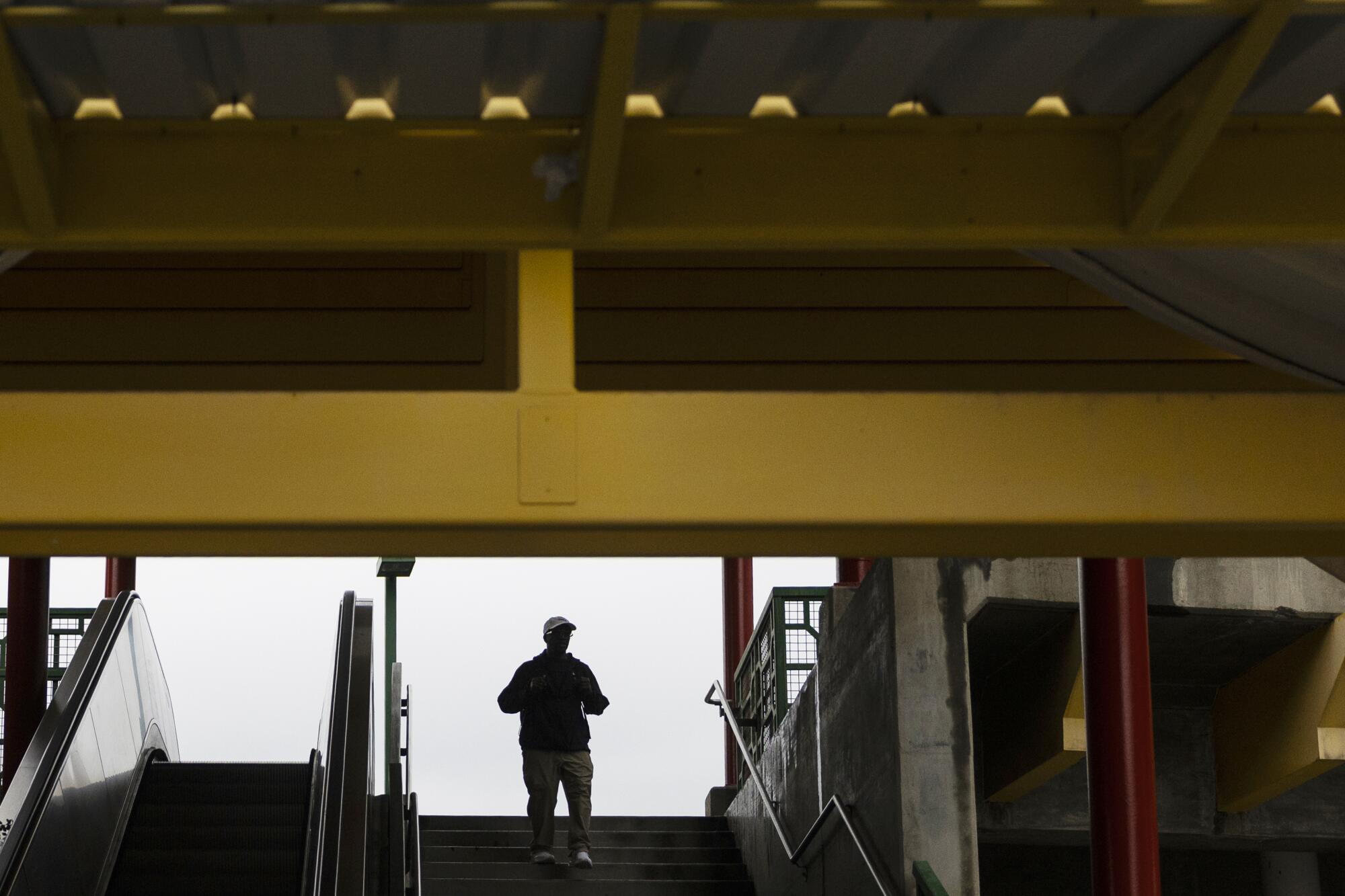
There’s a map at the Chinatown Metro station displaying the pedestrian path toward Dodger Stadium.
(Etienne Laurent/For The Times)
At one end of the Chinatown station, there is a map with a pedestrian route, in a glass case that faces away from Dodger Stadium. If you walk out of the station at the other end, or if you just start heading in the direction of Dodger Stadium, good luck finding the map.
There are Metro signs leading you back to the station from Dodger Stadium, but none leading you along the route there.
The Dodgers actually would prefer you did not take that route, or at least the last part of it. I walked it with Alissa Walker, whose Torched newsletter is the go-to place to learn how major sporting events impact the everyday lives of Angelenos.
We entered the Dodger Stadium property at an intersection with no crosswalks, where cars enter and exit the 110 freeway. We stood atop a dirt patch next to a crumbling curb.
“To go a very short distance safely with a feeling that you’re not going to die,” Walker said, “is very difficult.”
With Game 3 of the World Series underway at Dodger Stadium last October, a few folks scurried across a pedestrian bridge with LED lights and blue glow sticks.
The bridge connects Chinatown with Dodger Stadium, traversing the 110. Without this bridge, there is no walking path to Dodger Stadium.
“Our goal was, just by adding some lights, to make the really dark path at the top of the bridge at night a little bit brighter, so that it felt a little less scary,” transit advocate Jeremy Stutes said, “and to add a little bit of fun and whimsy.”
Glow sticks forming the “LA” logo of the Dodgers were placed on a pedestrian bridge over the 110 Freeway connecting Chinatown to the area where Dodger Stadium is located during the World Series and for several months after. As of last week, the glow sticks were no longer there.
(Etienne Laurent/For The Times)
From the Chinatown Metro station, the bridge is three blocks up College Street and one block down Yale Street. It’s an easy walk, and for now you pass an elementary school, a church, a row of Chinese restaurants, a dirt lot where a hospital once stood, parking lots, and an auto repair facility with a Dodgers flag hung on a wall.
When I did the walk last week, the trash at the foot of the bridge included a plastic cup, socks, a piece of rotting fruit, a half-full bottle of tequila, and half of a turkey sandwich, peeking out from torn plastic wrapping that indicated the sandwich had gone bad three days earlier. On the bridge: shopping bags, a pair of flip-flops, stray clothes scattered at one end, and graffiti everywhere.
A sign painted on the sidewalk indicates the direction toward the Chinatown Metro station.
(Etienne Laurent/For The Times)
That was the point those volunteers made last October: Clean up the bridge and light up the bridge — as they did for three days — and fans will walk there.
“It’s not that it’s not used,” Stutes said. “It’s not designed to be a safe space to use as an alternative to driving.”
When you cross the bridge, you can turn right or left along Stadium Way to get to a stadium entrance.
Turn right, as the map tells you to do, and you’ll encounter decaying sidewalks, with cracked and buckled concrete that turns a modest uphill walk into an obstacle course. Once you get onto the stadium grounds, the paint is fading along the pedestrian path, which offers you no protection from passing cars.
Turn left, and you’ll have to walk part of the way in the street, on an unprotected bike lane. You also could walk along the road behind the Fire Department training center, a path with no sidewalks and passing fire trucks. Either route takes longer than the one on the map, but you would enter Dodger Stadium through a pair of protected and brightly painted pedestrian paths. (That entrance, along Vin Scully Avenue, is a quarter-mile from Sunset Boulevard, where two Metro bus routes stop.)
If the primary choices for getting out of Dodger Stadium after a game are car congestion or Dodger Stadium Express shuttle bus congestion, a downhill walk to Chinatown Metro station — 12 minutes, Metro says — would be a nice option. That’s why those folks lit up the bridge over the freeway during the World Series.
“The lights were just a fun way,” transit advocate Kevin Dedicatoria said, “to show, ‘Hey, here’s a bridge so you don’t have to play, ‘Dude, where’s my car?’ or have to worry about waiting for the bus.’”
McCourt hails from Boston, where the local subway drops Red Sox fans a few short blocks from Fenway Park. When McCourt owned the Dodgers, I asked him if he could envision a subway or light rail extension to Dodger Stadium.
He’d love it, he said then, but the Dodgers were a private business, and government should pay for public transit.
Homes line a street in Eylsian Park, where Dodger Stadium is located.
(ETIENNE LAURENT/For The Times)
It was a fair point. The Dodgers pay taxes. In an era where teams regularly demand stadium and arena deals that exempt them from property tax, the Dodgers have paid $12.8 million in property taxes over the past three years, according to Los Angeles County tax collection records.
Would demand for public transit amid a car culture justify the investment? The Dodger Stadium Express indicates it could: Ridership has just about quadrupled since its inaugural season, from 122,273 in 2010 to 463,147 last year, according to Metro.
Even along the poorly maintained, poorly lit and poorly advertised pedestrian path, Metro said more than 700 riders returned to the Chinatown station on each of the three nights of World Series home games last year.
“As seen in social media videos during the 2025 postseason, the walking path continues to explode in popularity,” Metro spokesman Jose Ubaldo said.
Next steps?
“It’s astonishing to me that the Dodgers have not taken it upon themselves, as this great community partner, to fix this problem,” Walker said. “It is the city’s responsibility, but the Dodgers should be doing this, as part of what they want to represent to this community.”
The walking path includes segments along city streets, a Caltrans bridge, and Dodger Stadium property. Just who is the responsible party?
A Caltrans spokesman said the city is responsible for maintaining the bridge. A spokesman for the city’s department of street services did not provide an answer. A spokesman for the Dodgers declined to comment.
You could almost hear the sigh from city councilwoman Eunisses Hernandez, whose district includes Dodger Stadium.
“That’s what my job is: to bring people and agencies and organizations together to accomplish a goal,” Hernandez said. “We’re already in conversation with all these entities.
“We’re looking at some of the things we can enhance to make this a more walkable and accessible option for people.”
City Council member Eunisses Hernandez, center, talks with Circle outreach workers in Los Angeles.
(Allen J. Schaben/Los Angeles Times)
How much might those enhancements cost?
Without a look at a city-commissioned Dodger Stadium traffic mitigation study, expected to be completed this fall, Hernandez said she could not put a price tag on it.
“What I can tell you,” she said, “is that it will be less than half a billion dollars, for sure.”
By year’s end, the Los Angeles City Council is expected to vote on McCourt’s gondola project, estimated to cost $500 million and proposed as privately financed. Last November, the council voted 12-1 to urge Metro to kill the project.
Metro granted its approval, but with conditions that included a requirement to explore supplementing the gondola with other Dodger Stadium transit options, including more buses along Sunset Boulevard and a designated walkway from there to the stadium.
The walking path proposed in that 1990 study would have avoided Sunset Boulevard and the current Stadium Way routes — the ones with crumbling sidewalks, or no sidewalks at all — by using escalators and walkways to get fans up and down the hill between Lookout Drive, just off Stadium Way, and Dodger Stadium.
“Pedestrians could be directed through Chinatown,” the study read, “where numerous restaurants, shops and pedestrian amenities are provided.”
It’s hard to sell Chinatown businesses on the benefits of the gondola when fans would ride between Union Station and Dodger Stadium, soaring over Chinatown. It would be easier if a walking path led at least some of those fans through Chinatown, even if only on the way back from the game.
Even if the gondola system really can accomplish what its proponents say it can — loading 35 people into a cabin every 23 seconds — thousands of riders leaving when the game ends could mean a long line to board.
One of the entrances to Dodger Stadium on Stadium Way, the easiest access when walking from Chinatown Metro station.
(Etienne Laurent/For The Times)
“Also,” the 1990 study said, “passenger waiting following a game is psychologically perceived as being three to four times longer than actual waiting time.”
From this perspective, McCourt might win a few council votes by funding a first-class walking path. The cost, I’m told, would depend on what the enhancements include: signs, lights, trees, shade canopies, sidewalk repairs, escalators, and so on. For something close to $5 million — one one-hundredth of the projected cost of gondola construction — McCourt likely could do an exceptional job.
Is there any sign of progress here? Happily, yes.
In an internal report last December, Metro said Zero Emissions Transit (ZET) — the nonprofit organization now shepherding the gondola project — is pursuing ways to link pedestrians and bicyclists to the transit system and to Dodger Stadium. Those potential improvements include sidewalk repairs and a revitalized pedestrian pathway from the Chinatown Metro station to the bridge across the 110 and then across Stadium Way, to Lookout Drive and the hill above.
“Dodger Walk is envisioned as a series of switchbacks,” the report said, “inspired by the original walking path up Lookout Mountain that existed prior to the construction of Dodger Stadium.”
Whether such switchbacks would make the walk to the stadium longer or shorter than the current path remains to be determined.
In a statement, ZET said: “We embrace and include active transit solutions to increase pedestrian and bike access throughout the project area.” In particular, ZET said, it was “supportive” of a walking path to Dodger Stadium.
The Metro report cautioned the concepts “are in the early planning stage,” so L.A. might get an extravagant walking path, a utilitarian one, or none at all.
Here’s hoping McCourt gives us a path of some kind — whether the city approves the gondola or not — because a pretty walk generations can enjoy would be a prettier civic legacy than driving a team into bankruptcy.
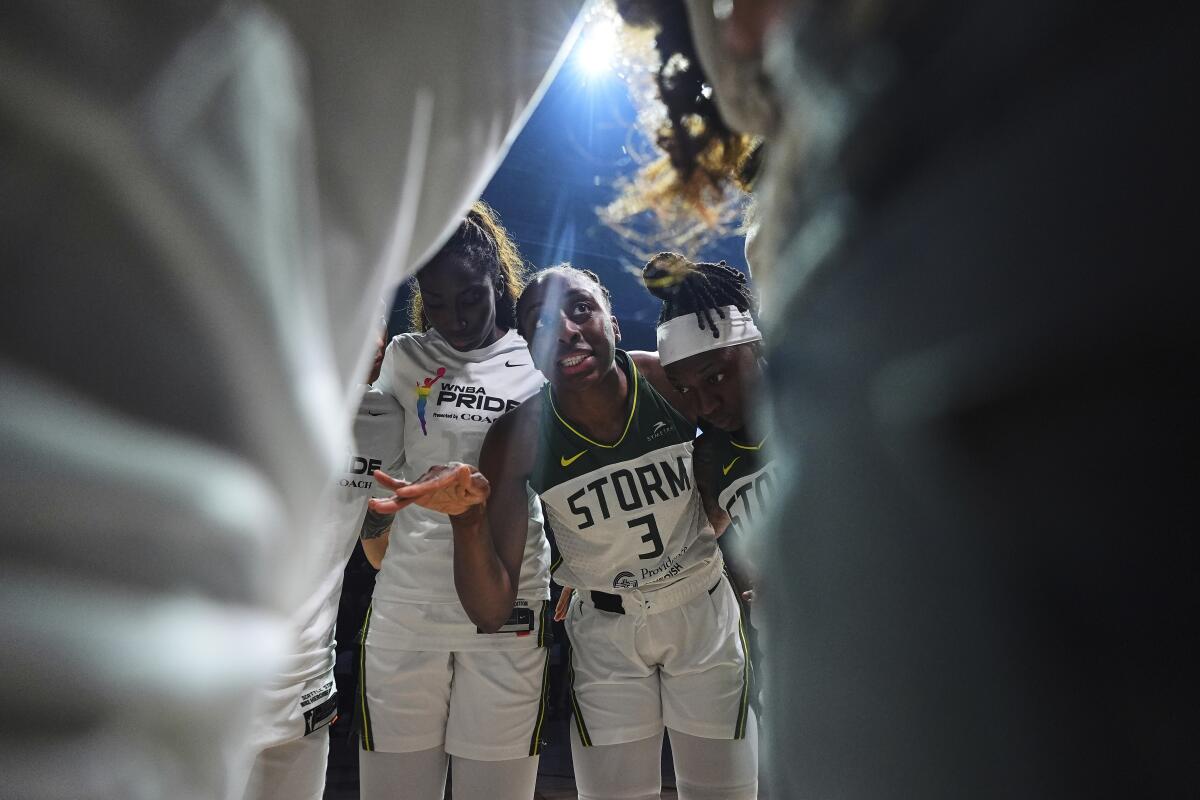
Seattle Storm forward Nneka Ogwumike (3), president of the WNBA players’ union, said for the first time, player salaries will be tied to a meaningful share of league revenue.
(Lindsey Wasson / Associated Press)
The league and players association have not made the terms public yet, but the salary cap will start at $7 million, up from $1.5 million in 2025, and the supermax will start at $1.4 million, up from $249,244 in 2025, a person with knowledge of negotiations not authorized to discuss them publicly told The Times. ESPN was the first to report the figures.
The total salary cap will jump by around 4.64 times the previous amount. The super maximum salary will be elevated by 5.61 times the previous amount. It means the top players will be eligible for larger raises than the league’s middle class.
The average salary will be $600,000, a bump from the previous average of $120,000, and the minimum salary will be more than $300,000, up from $66,079.
“For the first time, player salaries are tied to a truly meaningful share of league revenue, driving exponential growth in the salary cap, increasing average compensation beyond half a million dollars and raising the standard across facilities, staffing and support,” union president Nneka Ogwumike told reporters.
The main sticking point during negotiations was revenue sharing, and that number will be around 20% for the entirety of the multi-year deal. The league had previously offered 15.5%, a source told The Times, and players went down from their 40% ask to around 26% at the end of February, and then reached the agreement around 20% on Wednesday morning. The Athletic first reported the shift in revenue sharing figures.
Players had been negotiating for a percentage of overall revenue without factoring in expenses while the WNBA was seeking sharing tied to net revenue, mirroring the NBA’s structure that deducts expenses before sharing 50% of profits. The players secured a gross revenue deal, which gives them a cut of WNBA revenue without factoring in expenses, a person with knowledge of the deal not authorized to discuss it publicly told The Times.
“This deal is going to be transformational, and you’ll see all the details hopefully soon,” WNBPA vice president Breanna Stewart told reporters on Wednesday. “But it’s gonna build and help create a system where everybody is getting exactly what they deserve and more from on the court and off the court aspects.”
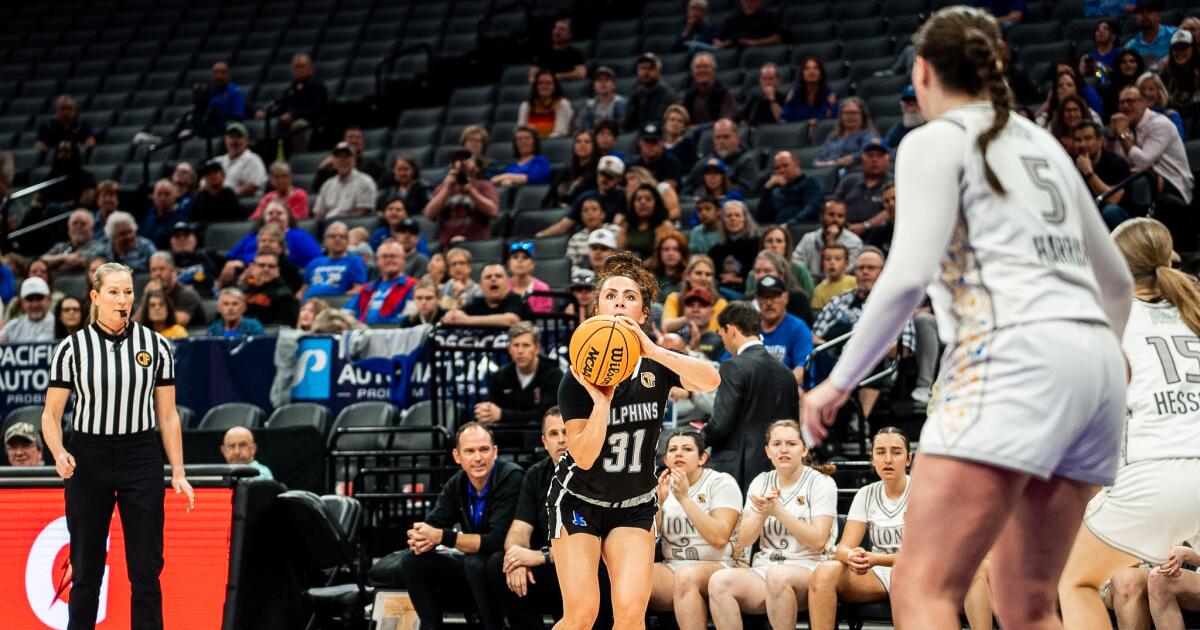
SACRAMENTO — Senior Ayla Teegardin of Palisades held her head high on Saturday morning. A 51-37 loss to Yuba City Faith Christian in the state Division IV girls basketball final at Golden 1 Center couldn’t lessen the inspiring backstory of how she and her Dolphin teammates had already won by making it to the final despite all the trial and tribulations of the Palisades Fire that destroyed a community in January 2025.
Teegardin lost her home, spent three months in a hotel and battled to regain her teenage life.
“I struggled with a lot of anxiety coming into games,” she recalled.
Basketball and teammates kept her focused. This season has been another challenging time with practices at night and at middle schools until the high school gym was finally re-opened at the end of January.
On Saturday, Palisades (16-14) fought Faith Christian (34-1) to almost a draw at halftime, trailing 29-26. But the Dolphins scored only 11 points in the second half and had no answer for Long Beach State-bound Lauren Harris, who came in as the nation’s career three-point scoring leader while averaging 31.2 points this season. She finished with 26 points, 16 rebounds, five assists, three blocks and two steals. She made a half-court shot at the end of the first quarter.
Elly Tierney of Palisades did her best on offense with 15 points and six rebounds. Teegardin finished with three points and six rebounds. Only three players scored the entire game for Faith Christian.
The Dolphins outrebounded Faith Christian 43-33 but made only 15 of 63 shots.
Faith Christian’s Lauren Harris, the national career record holder for threes, makes half-court shot. End of 1, Faith Christian 13, Palisades 11. pic.twitter.com/iWbDdKPwOf
“It’d be hard to imagine him not being on our team,” Roberts said last week. “He’s having a great spring, man. He’s just a good player. It’s good, because I didn’t really know much about him, but seeing him every day, [he’s] fun to watch.”
An All-Star with the Toronto Blue Jays in 2022, the 31-year-old Espinal muddled through a pair of lackluster seasons with the Cincinnati Reds in which he rated as a minus-WAR (Wins Above Replacement) player and slashed .245/.294/.322 over 232 games.
It led to him getting taken off the Reds’ 40-man roster at the end of last season and sent to triple-A Louisville — a minor league assignment he rejected, making him a free agent. He signed with the Dodgers on Feb. 16 on a minor league deal with an invite to spring training.
It’s an opportunity Espinal has seized.
He leads the Dodgers in home runs (2) and RBIs (9) while posting a .500/.519/.900 slash line. With utilitymen Tommy Edman and Kiké Hernández opening the season on IL, there is an opening for Espinal to stick on the club’s roster. A versatile glove, Espinal played all four infield positions and both corner outfield spots for the Reds last season. And at least to this point in spring training, he’s shown an improved bat.
“I feel like the offense part of it, I’ve been working consistently with the hitting coaches, just looking at videos, looking at little details,” Espinal said last week. “There’s either something going on with my lower body or something going on with my upper body. Where are my hands at, all this stuff, so that’s something that we literally every day just work on. So just make sure that my body feels great.”
One simple modification that has brought success to Espinal is getting the bat off his shoulder and attacking the count early. A more aggressive approach has served him well thus far in camp.
“Being more aggressive in my swing path,” Espinal said. “Make sure that it’s there. Make sure that it’s straight to the ball and not opening up and that stuff, but it’s a constant work that we’ve been doing every day and so far, it’s been great.”
The Dodgers’ Santiago Espinal rounds third base to score a run against the Seattle Mariners during during a game on Feb. 23.
(Chris Coduto / Getty Images)
The torrid hitting — which includes a two-homer game last week against the Reds — and how he’s carried himself has paid off for Espinal.
“[He’s fitting in] seamlessly,” Roberts said. “He’s a baseball player. It’s in his blood. You see it. He’s a smart player. He knows the type of player he needs to be to be a Major League player. He has fun playing, but there’s a focus when he plays. He plays with enthusiasm, which is tempered, which is great. You can see him and [Teoscar Hernández] obviously have a history. I love the player. I love the guy.”
Though he hasn’t been a Dodger for very long, Espinal says he’s been trying to learn as much as he can from the cornerstones of the team’s lineup — including his fellow Dominican and former teammate on the Blue Jays.
“When you see Mookie [Betts], when you see Freddie [Freeman], [Max] Muncy, I played with Teo, and he’s actually one of the best hitters in the game, you know you have it in the locker room,” Espinal said. “You also want to pick their brain. You also want to ask questions. And you also want to see how they work, how they go about their business. To me, I think that’s just the most important part of it, just to learn from them.”
It appears to all be leading to a spot on the opening-day roster, which considering where he was at the end of last season and even at the start of February, is quite the turn of events.
“It would be amazing,” Espinal said of making the 26-man roster. “It would be amazing, and I’ve just got to let my work talk for it. And so far, that’s what I’m doing and I’m just going to keep working for it.”