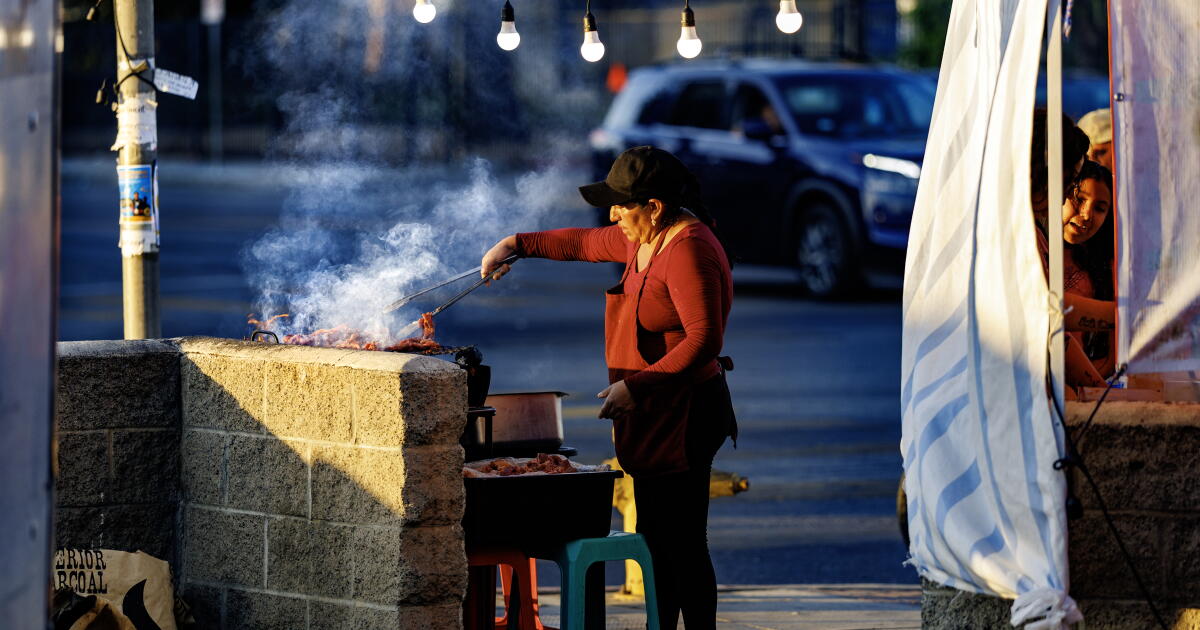
The newest battleground in the Los Angeles mayoral race is at your favorite taco stand, as Mayor Karen Bass and her opponent, Councilmember Nithya Raman, spar over how they plan to run the city and treat its street vendors.
The Los Angeles Police Department told Bass’ office it had erroneously issued criminal citations to vendors around MacArthur Park, Bass spokesperson Paige Sterling told The Times on Thursday.
Bass has ordered LAPD to stop issuing criminal citations to vendors and is working to remove any charges issued in error, Sterling said. The mayor’s office also asked LAPD to make sure that these citations aren’t happening citywide.
“The Mayor and her team will continue meeting with street vendors to implement policies and programs based on their needs. Street vending is a quintessential part of L.A.’s world-class food scene and a livelihood for thousands of hardworking Angelenos,” Sterling said in a statement.
The sudden focus on street food comes after Bass faced scrutiny for saying street vendors should not be allowed to set up in front of brick-and-mortar restaurants at a mayoral debate last week at the Sherman Oaks Homeowners Assn.
“Just like you shouldn’t have encampments in front of restaurants or in front of schools, you just should not do that,” Bass said.
Critics, including Raman, said Bass was directly comparing homeless encampments to street vendors.
Raman followed up on negative interpretations of her Sherman Oaks statement with a one-two punch, showing up with supporters and television cameras at the famous Brothers Cousins Tacos stand on Sawtelle Boulevard on Wednesday night to mark the release of a pro-street-vendor policy plan.
“When you come for our street vendors, you’re coming for the heart of L.A.,” Raman said of Bass.
In the plan, Raman hopes to create an Immigrant Economic Opportunity Hub, which would offer permitting support, microloans and legal help. Wednesday night, after a vegetarian quesadilla dinner, she said the city should provide pathways for food stands that make fresh food to get permits and grow their businesses, including potentially working toward a brick-and-mortar location.
Also included is a proposal to create special vending zones in L.A.’s iconic vending corridors, although the plan doesn’t outline where such opt-in zones could be. These corridors would include infrastructure like shared sinks, power, lighting, shade and restrooms.
“What we have in our plan is a plan for street vendor districts that can ensure that vendors and brick-and-mortar businesses are not in conflict with one another; that they’re actually able to share streets,” Raman said.
When asked the same question she faced at the Sherman Oaks Homeowners Assn., whether she would allow food stands to sit in front of a brick-and-mortar restaurant, Raman said Wednesday she believed there were ways to keep food stands and restaurants from intruding upon each other, but didn’t say whether that would be enforced by distance requirements, ticketing or otherwise.
Too many times, she said, residents of a nearby homeless encampment have partied late into the night — sometimes yelling, sometimes blasting music. The noise is especially hard on her husband, who frequently leaves for his job before 5 a.m.
“Oh my God, they don’t let us sleep,” said Aguirre, whose home sits just east of the 110 Freeway in South Los Angeles. “They do drugs in there. They play the loud music. They don’t care.”
Three years ago, workers with Mayor Karen Bass’ Inside Safe program moved dozens of homeless people from Aguirre’s neighborhood into nearby hotels and motels. Sanitation crews cleared the streets and sidewalks of trash.
But more people, and their tents, kept arriving, not just near Aguirre’s home but on many of the east-west streets that pass over the 110 south of downtown: 43rd, 49th, 51st and Vernon Avenue, to name a few.
About This Story
The Times’ reporting on Mayor Karen Bass’ Inside Safe program was undertaken as part of the USC Annenberg Center for Health Journalism’s 2025 Data Fellowship.
Unsheltered homelessness — people living on the street or in their vehicles — went up nearly 8% citywide in this year’s homeless count, dealing a setback to Bass, who is running for reelection and has made homelessness a core part of her agenda.
The streets that line the 110 Freeway between 42nd and 58th are a potent symbol of the challenges facing Bass and her program. According to records obtained by The Times, outreach workers carried out Inside Safe operations 25 times on that one-mile stretch during her first three years as mayor, returning again and again to bring people indoors.
Frank Gordon, 51, has been living on Cahuenga Boulevard at the 101 Freeway in Hollywood. Mayor Karen Bass’ Inside Safe program has moved people indoors from that location several times since 2022.
During one operation, Inside Safe brought 42 people inside. A month later, 54 more people came indoors. On other occasions, progress was measured in single digits: two people during one visit, five on another, eight on the next.
Despite those efforts, many of the overpasses and side streets still have encampments. Things have been especially grim on the 51st Street overpass, where tents, makeshift structures and huge mounds of trash lined the sidewalks. In the street, a refrigerator missing a door was on its back, overflowing with garbage.
Joel Galarza, who lives in a house nearby, said the encampment has brought crime, fires, prostitution, open-air drug use and other problems. In May, a man was found stabbed on the overpass.
Galarza said his family has called the city and the LAPD many times, only to see the situation get worse.
“It feels like there’s no more hope, that your voice doesn’t matter,” he said.
Since taking office, Bass has made the removal of street encampments a top priority, arguing that they are unsafe both for unhoused residents and for the neighbors. She said early on that Angelenos will not view her work as a success until their communities are free of tents.
Inside Safe, her signature homeless program, has moved more than 6,200 people into hotels, motels and other interim housing. But by June 30, 43% of them were back on the street, with some getting kicked out and others walking away.
Los Angeles City Councilmember Traci Park, left, and residents of Venice thank Mayor Karen Bass in 2023 for overseeing efforts to move more than 100 people into temporary housing from sidewalks in Venice.
Bass, in an interview, said she understands the frustration of people who live near the encampments. She said she hopes to overhaul the city’s approach to the crisis in the coming months by securing greater control over services such as medical care, addiction treatment and case management.
At the same time, she contends that her administration has made major strides, keeping about 80% of the locations visited by Inside Safe free of tents in recent weeks.
“Inside Safe has been a success in terms of getting people off the streets and clearing encampments,” Bass said. “What Inside Safe has not been able to do is reach the scale that is needed.”
Bass said Inside Safe has conducted 137 encampment operations so far, when many more are needed. To expand the program’s reach, the city will need to move away from expensive hotels and motels and toward high-quality homeless shelters, the mayor said.
1
2
1.A man sits with his belongings on Cahuenga Boulevard under the 101 freeway in Hollywood.(Genaro Molina/Los Angeles Times)2.A torn copy of a notice announcing a cleanup of homeless encampments hangs from a stop sign along Grand Avenue at 51st Street in South Los Angeles.(Genaro Molina/Los Angeles Times)
The repopulation issues have not been limited to the 110 corridor. By December, the end of Bass’ third year, 23 Inside Safe areas across the city — about a fifth of the total at that time — had received at least five visits from the mayor’s outreach team, records show.
Inside Safe went to a handful of streets just east of MacArthur Park 10 times over two years. In Hollywood, around Franklin and Argyle avenues, the program conducted eight operations over 18 months.
By the fourth quarter of 2025, 80% of Inside Safe encampment operations — 36 out of 45 — involved areas that had repopulated, records show. Nine were new to the program.
City Councilmember Nithya Raman, who is running for mayor against Bass, said Inside Safe is ineffective and too expensive, forcing taxpayers to pay a premium to “shuffle people around rather than get them housed for good.”
“When 40% of the people who participated in the program return to homelessness, and some locations need repeat outreach visits five, 10, even 25 times, it tells us that something is wrong,” she said in a statement.
Bass and her team said many of the most problem-plagued Inside Safe locations are at freeway overpasses, which are attractive to homeless people because they provide shelter from scorching summer sun and the winter’s pouring rain. Freeways and industrial areas are also popular because they provide some degree of privacy, they said.
In some cases, people move to an Inside Safe location hoping to be offered housing, just as previous residents were, Bass said.
In other cases, she said, people have returned to the street because they need intensive care, such as a psychiatric bed. Those beds, which are provided by L.A. County, are not always available, Bass said.
Estela Lopez, head of the Downtown Industrial Business Improvement District, which represents businesses in Skid Row, said repopulation happens for a simple reason: a lack of enforcement. Once an encampment is cleared and people are moved indoors, police should be allowed to enforce city laws and make sure an area stays clear, she said.
A pedestrian walks into the street to get around a homeless encampment on Alameda Street. The Inside Safe program went to that area 12 times over a single year.
Lopez said she regularly receives complaints about a row of encampments on Alameda Street between 4th and 6th streets. Inside Safe visited that two-block stretch 12 times last year, records show.
Last month, the area had about a dozen tents, which forced pedestrians to leave the sidewalk and walk on Alameda, where large trucks travel to and from nearby industrial businesses.
Lopez offered another reason that homeless people keep coming back.
“That’s where the drugs are,” she said. “It’s Skid Row, and Skid Row is where the drugs are, and has the fewest consequences for open-air drug use and sales.”
Bass’ first Inside Safe operation, more than three years ago, hit a stretch of Cahuenga Boulevard under the 101 Freeway in Hollywood, an area represented by Raman.
Inside Safe went to Cahuenga and the 101 six times over 18 months, according to the city’s records. Two blocks south, the program made five separate visits to Franklin and Cahuenga.
Frank Gordon said that he and his girlfriend lived in an RV on Cahuenga next to the 101 during the COVID era, when the streets were lined with encampments. Outreach workers eventually moved them into the Stuart Hotel in Westlake, he said.
From there, the couple relocated to the Highland Gardens, a hotel in Raman’s district converted into homeless housing. Gordon said they left the facility after one of their rooms was destroyed in a fire, going to yet another interim housing site.
Last month, they were back at Cahuenga and the 101. He called it “familiar ground.”
Sanitation crews remove belongings from a homeless encampment during an Inside Safe operation on Laurel Canyon Blvd. in North Hollywood in March.
Kevin Paz, who has been sleeping on the 51st Street overpass in South L.A., said he used to live a few blocks away. He still has friends in the area, including high school classmates.
“It made more sense to stay here than to live anywhere else,” he said.
Seated on the overpass on a swelteringly hot day, the 32-year-old said he picked his particular strip of sidewalk for the shade it gets from the elevated 110 Freeway carpool lane. He said he would accept a motel room if offered one.
“Honestly, nobody wakes up in the morning and says, ‘Hey, I wanna go live on that street,’” he said.
Bass’ team has highlighted the scores of locations where encampments have not returned. They pointed to the success of an Inside Safe operation at 6th and Fairfax, where the sidewalk was later narrowed and new landscaping was planted, making it difficult to camp there.
West of downtown, streets and sidewalks also remain clear around Angelus Rosedale Cemetery, where 48 people were brought indoors in April 2025. To keep people from living in their cars at that location, city crews turned a stretch of Washington Boulevard into a no-parking zone, Bass’ team said.
Even some places that had severe repopulation issues are now clear of tents.
In Harbor City, Inside Safe went to the same intersection a dozen times between 2023 and 2025. That location has been free of encampments for 17 months, said Councilmember Tim McOsker, who represents the area.
McOsker credited the mayor’s team, as well as his staff, for going to the location over and over to offer interim housing to new arrivals. He also asked a group that delivers glass pipes and clean hypodermic needles to relocate, saying the service was attracting newcomers to an area that had been cleared.
In Baldwin Hills, Inside Safe workers went to Jim Gilliam Park 14 times over three years. Last week, encampments no longer occupied the grassy area around the tennis courts on La Brea Avenue or the sidewalks along the nearby Michelle and Barack Obama Sports Complex.
Johnnie Raines III, who serves on the local neighborhood council, knows some of the people Inside Safe brought indoors. He said the program has been “life-changing” for them.
Still, Raines, 79, has no illusions about the challenges the city faces.
“If you house these three people that are in this space today, three more will show up,” he said. “That doesn’t mean that you were not successful in housing the first three people. That just means that three more people come.”
Elmer Roldan, who lives in South Los Angeles, points out the spot where an encampment burned on Grand Avenue near 54th Street.
In the neighborhoods that abut the 110 in South L.A., some residents have lost patience.
Elmer Roldan, who lives on 55th Street, said some of his homeless neighbors have been causing fires — sometimes by accident, sometimes on purpose. Earlier this year, he called 911 after seeing a man set fire to vines hanging from the freeway’s sound wall.
Roldan, who ran unsuccessfully for City Council in June, said he sees plenty of people living in their vehicles, but fewer tents. Still, he said, it’s been demoralizing to have so many come back.
“I certainly don’t want it to get worse,” he said.
Times staff writer Doug Smith contributed to this report.