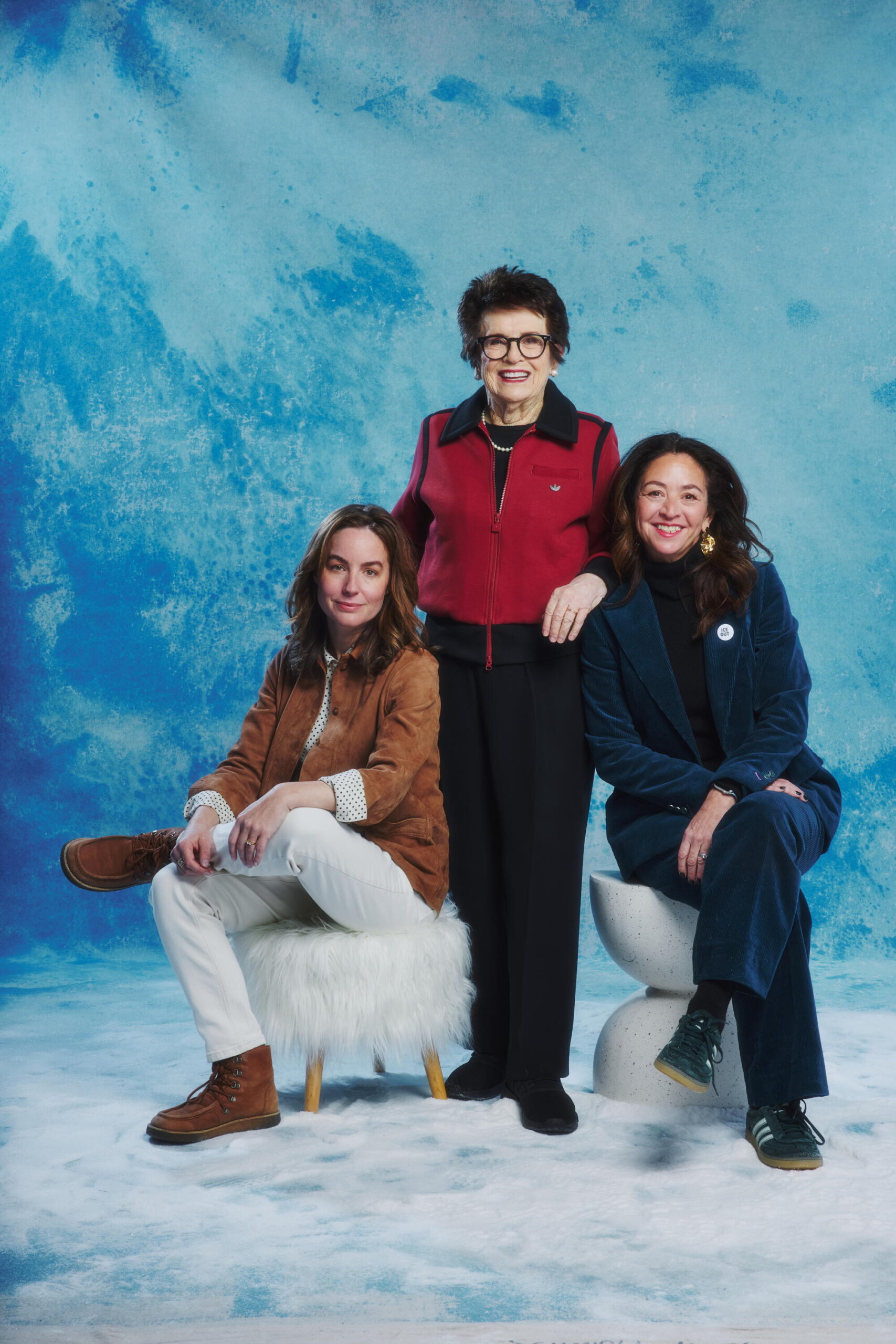
Billie Jean King wanted an unfiltered look at her life in ‘Give Me the Ball!’
As a child, Billie Jean King wanted two things, to play — and win — in sports and to change the world for the better. “Give Me the Ball!,” an intimate and celebratory documentary featuring King narrating the ups and downs of her storied life, shows that she never stopped fulfilling her dream. (The “30 for 30” doc, which premiered at Sundance Film Festival in January, is directed by Liz Garbus and Elizabeth Wolff, and debuts on ESPN and Disney+ on Sunday, King’s 83rd birthday.)
King won 39 Grand Slam titles, including 12 in singles as well as numerous other tournaments and the famous “Battle of the Sexes” match against Bobby Riggs that was an inspirational linchpin in the women’s liberation movement.
Well Documented
With networks and streamers seeking to create compelling content, many have found the answer in true stories. But with the surge in documentaries, it can be hard to sift through what’s worth your time. Each month, we provide an inside look at a documentary and others you should add to your queue.
She might have won even more, but as Chris Evert notes in the film, King was selfless in her work pushing women’s tennis and women’s rights forward. Evert recalls beating King in a tournament final only to learn that King had flown from Florida to New York and back before the matches to promote the fledgling women’s tour that she had founded. In addition to birthing the Women’s Tennis Assn., she begat the Women’s Sports Foundation and the Billie Jean King Foundation (and its ESPN Billie Jean King Youth Leadership Award), led the fight for equal pay for women in tennis and testified before Congress in support of Title IX. She has long been a relentless optimist whose dogged determination makes that optimism a reality.
While King complains that she no longer moves well on the tennis court, the woman for whom the National Tennis Center in New York is named doesn’t seem to have lost a step as an activist or a conversationalist. In an interview in which she recounted a story about a young Barack Obama watching her play tennis in Hawaii, as well as the devastating financial fallout from losing all her endorsements in 1981 after admitting to a lesbian relationship, King brimmed with as much energy as she did in my first interview with her a dozen years ago.

Billie Jean King, flanked by directors Elizabeth Wolff, left, and Liz Garbus.
(Christina House / Los Angeles Times)
You’ve done documentaries before. Why do another now?
I’m old now. When I was 12, I had my epiphany. I wanted to make the world a better place. I’ve given my heart and soul to try to make a better world.
I just want to have our history recorded for future generations. I thought I could help change the world if we could get women’s sports on the map although I just wish the women’s movement would have used us more.
I hope the film touches the hearts and minds of people and help each one in some way in their own lives and gets people to realize we’re all in this together. And I hope it ignites some of the younger ones to take up the mantle and say, “Let’s go.” Whatever your thing is, we need new leaders in everything. I hope this movie creates leadership opportunities and teaches kids.
What I wanted is not what every other athlete and celebrity has done where they produce their own documentary. Those are all fluff, with little substance. I said, “I’m not going to produce it. I don’t think I should decide what’s in it at all. A director will put stuff in that I probably wouldn’t have.”
Like you singing “Philadelphia Freedom” onstage with Elton John?
I’d have been nervous and embarrassed about that, but you have to have it in. And the footage of me playing at Cal State, but I thought it was great.
I’m sure if I live five more years, I’ll want another documentary.
Paul McCartney has a lyric, “When I think back on all this stuff that can make a life, it’s pretty hard to take it in. That was me.” Does watching this film help you appreciate all you’ve accomplished?
The film helps give me perspective, but it’s hard because I don’t really think about my past that much. I don’t rest on my laurels.
You’re moving forward all the time.
Forward, baby, forward. Go to the net. As an athlete you learn that you won today but you’ll have another match tomorrow. Even if you just won Wimbledon, it’s a fleeting moment. You’ve got to start over, baby.
But when women tell me how the Bobby Riggs match absolutely changed the direction of their life or men tell me, “It made me want my daughter to have the same as my son,” that feels good.
What’s on your agenda moving forward?
My leadership program is important to me. I want to help young people take up the mantle to lead. If I were a kid again, I would go to law school and I would try to be president of the United States. We don’t have a woman president yet, which I find extraordinarily shocking. When I was 15, an older woman came up to me and said, “I’ll never see a woman president in my lifetime, but you will.” And I thought I would.
You said your parents had been homophobic and that when you came out, your mother couldn’t look you in the eye. Did they get over that and embrace the real you?
My dad did. I think my mom always wanted me to get back with Larry, but she was very good. She said, “I know you’re so much happier with Ilana. I can see it.” I thought that was great validation and it was enough for me.
Was it difficult to talk on camera about your abortion, sexuality and eating disorder?
It was very difficult, but I think about all the people out there facing these challenges and I hope it helps them.
Therapy was huge. Without therapy, I wouldn’t be here, I don’t think. It saved me and allowed me to think through things and to be authentic myself. A good therapist calls you out on things. They know where you need to go, and it’s just about we’re going to get you there. I am really happy now.
‘The Slightest Touch’ (HBO Max, Nov. 25)
Emma Fogarty has defied the odds by living to 40 with severe EB (epidermolysis bullosa), a genetic disorder that causes skin to tear or shear off from even the slightest touch. But Fogarty must live with her parents and keep her body fully wrapped and have those dressings changed daily by a nurse; she lost part of one leg to the disease and the infections it causes have twice led to cancer.
Fogarty is resilient but realistic — she’s the oldest Irish person ever with the extreme version of the disease but knows she won’t have an average lifespan. In one heartbreaking moment she calmly notes, “Everyone has troubles but I would take any kind of normality,” adding that she loves the beach but has “never felt the sand with my feet.”
She wants to have an impact and raise money for research and care for people with rare diseases. To do it, she’ll participate in the Dublin marathon, getting pushed in her wheelchair for the last four kilometers (one for each decade) by a runner.
All that makes for a great story, but Rachel Fleit’s movie has an ace up its sleeve when it comes to reeling in viewers. Like a certain other new documentary, “Slightest Touch” features a movie star in a major role. In 2010, Fogarty met Colin Farrell at a charity event and they’ve remained friends ever since.
“Her struggle opens people’s hearts up and allows them to access their softest, most compassionate parts of themselves,” Farrell says in the film. While you can’t see everything in his life, he does talk about his addictions, his relationship with his dying father, and he introduces both his sons on camera, including James, who has Angelman syndrome. A serious runner, Farrell is the marathoner to push Fogarty to the finish line.
The film captures their sweetly moving relationship, with Fogarty noting that he’s one of the few people who isn’t shy about asking about her mental health but he also teases her about her driving skills. Their dynamic makes this poignant film heartwarming and a great holiday watch. (You can pair it with a short doc feature on HBO, “The Buffalo Miracle,” about McDonald’s employees who opened their doors to the community during a blizzard, saving numerous lives.)
‘Avedon’ (Netflix)

Richard Avedon as seen in Ron Howard’s “Avedon.”
(Susan Middleton)
In this doc, director Ron Howard captures iconic photographer Richard Avedon capturing the world on film. Avedon’s photos range from the flash and style of beautiful models to mesmerizing portraits of people like Henry Kissinger, the Dalai Lama, the Beatles and Salman Rushdie as well as stirring pictures of the civil rights movement, the Vietnam War and the working men and women of the American West.
The documentary explores how he developed his innovative style but it’s also a fascinating portrait of a man described both as a “humanist” with “incandescent energy” and as “emotionally ruthless” and obsessed with work.
The family albums of Avedon’s childhood were filled with borrowed dogs to make their life seem happier. The sadness of living in a fiction combined with a mentally fragile sister shaped how he tried to control the narrative of his photographic world. His own heartbreak enabled him to find ways to reveal the souls of his subjects.
‘Who Killed Alex Odeh?’ (VOD and Watermelon+)

Alex Odeh, center, in a family photograph seen in the documentary “Who Killed Alex Odeh?”
(Watermelon Pictures)
There are always plenty of timely crime-related docs to choose from, like Hulu’s “Get Huge: Looksmaxxing to Death” about the deaths of several followers of a dangerous health and fitness svengali, Tony Huge, but “Who Killed Alex Odeh?” is more thoughtful and powerful than most. Directors Jason Osder and William Lafi Youmans tell the story of a Palestinian American civil rights activist who was assassinated by a bomb in 1985 in Santa Ana. They place the murder into a bigger picture looking at how the U.S. government let the killers largely escape punishment and flee to Israel’s West Bank; they also tie it to the 1995 killing of Israeli Prime Minister Yitzhak Rabin, linked by the followers of far-right violence fomenter Rabbi Meir Kahane and the Jewish Defense League.