Emirates

Airline with the best food named – not British Airways, Virgin or Emirates

This European carrier serves regionally inspired dishes at 35,000ft

A Greek airline boasting a fleet of 83 aircraft has been named the top carrier for in-flight dining, beating major rivals including Emirates, Virgin Atlantic, Qatar Airways, and British Airways. A study by Canstar Travel Insurance analysed passenger reviews and meals from the world’s top 100 airlines, concluding that Greek carrier AEGEAN serves up the finest food, earning an impressive score of 7.82 out of 10.

AEGEAN treats passengers to authentic Greek cuisine and regionally inspired dishes, while in business class, meals are lovingly prepared by acclaimed Greek chefs and sommeliers. The airline’s culinary philosophy is rooted in the concept of filema, which champions “love and kindness through food”. Other carriers delivering exceptional onboard dining include Qatar, Asiana Airlines and EVA Air.

On Tripadvisor, one traveller who recently flew with Aegean wrote: “Aegean Airlines is simply amazing! The level of service is very high, and it is incredibly easy to reach their call centre whenever you need help or extra information. On board, they offer food and drinks, and everything was delicious.”

A second passenger added: “I have used British, Virgin, easyJet, Ryanair… but no one is better, always on time and sometimes even earlier at the destination than Aegean Airlines.

“Although I’m Italian, I use it instead of Alitalia when I’m travelling to my country. Warm and delicious food and choices of wines and a particular menu for any kind of dietary or religious needs.”

Airlines with the best food

  1. AEGEAN Airlines
  2. Qatar Airways
  3. Asiana Airlines
  4. EVA Air
  5. Singapore Airlines
  6. Korean Air
  7. All Nippon Airways (ANA)
  8. Japan Airlines
  9. Kuwait Airways
  10. Garuda Indonesia

Source link

Foreign Office latest ‘do not travel’ list updated from April 28

People planning holidays should check that their destionation has no new alerts or warnings

The Foreign, Commonwealth and Development Office (FCDO) has significantly expanded its ‘red list’ in recent months due to regional escalations, particularly in the Middle East and Eastern Europe. It is important to be aware of which parts of the world pose a greater risk to tourists than others.

While it is not advisable to ignore the Foreign Office’s advice, doing so is likely to invalidate any insurance that travellers have obtained. In most cases, insurers will not cover people who knowingly go against FCDO advice and take risks. If you absolutely must travel to a high-risk area, you may need to look for specialised travel insurance companies that provide specific cover for such scenarios, according to ABTA.

As of April 28, 2026, the following list summarises the countries for which the Foreign Office has specific safety advice for travelling. In some cases, it issues a blanket alert urging people to reconsider visiting countries that are unsafe across all areas. Some areas have partial warnings in place. If people are visiting the area, check the Foreign Office website for the latest updates and warnings.

Countries where the Foreign Office currently advises against all travel:

  • Afghanistan
  • Belarus
  • Burkina Faso
  • Central African Republic (CAR)
  • Eritrea
  • Haiti
  • Iran
  • Iraq
  • Israel
  • Lebanon
  • Mali
  • Niger
  • Palestine (Occupied Palestinian Territories)
  • Russia
  • South Sudan
  • Sudan (most of the country)
  • Syria
  • Ukraine (most of the country)
  • Yemen

Countries where the Foreign Office advises against all but essential travel:

  • Bahrain
  • Cuba (entire island)
  • Ecuador (coastal provinces)
  • Egypt (significant parts: Western Desert, North South Sinai)
  • India (significant parts: Manipur, Pakistan border)
  • Jordan (entire country)
  • Kuwait
  • Mexico (significant parts: Baja California, Chihuahua, Sinaloa, etc.)
  • North Korea
  • Pakistan (most of the country)
  • Philippines (significant parts: Mindanao, Sulu Archipelago)
  • Qatar
  • Thailand (Cambodian border)
  • United Arab Emirates (UAE)

Areas where people are advised against travel in all or specific parts

  • Algeria (borders with Tunisia, Libya, Niger, Mali, Mauritania)
  • Armenia (border with Azerbaijan)
  • Azerbaijan (Armenian border and former Nagorno-Karabakh areas)
  • Benin (Northern border regions)
  • Burundi (Cibitoke and Kayanza provinces)
  • Cameroon (Far North, Bakassi Peninsula, NW and SW regions)
  • Chad (borders with Libya, Sudan, CAR, Niger, and Lake Chad)
  • Congo (Brazzaville) (Likouala region)
  • Côte d’Ivoire (Northern borders with Mali and Burkina Faso)
  • Democratic Republic of the Congo (Eastern provinces and Kasaï)
  • Djibouti (border with Eritrea)
  • Ethiopia (Tigray, Amhara, and the border with Somalia/Sudan)
  • Georgia (Abkhazia and South Ossetia)
  • Indonesia (Central Papua and Highland Papua)
  • Kenya (border with Somalia and parts of the coast)
  • Libya (all areas except strictly essential business in Tripoli)
  • Mauritania (Tiris Zemmour and Adrar regions)
  • Moldova (Transnistria)
  • Mozambique (Cabo Delgado province)
  • Myanmar (Burma) (most of the country due to conflict)
  • Nigeria (Northern and Riverine states)
  • Somalia (all areas except parts of Puntland and Somaliland)
  • Togo (Northern border region)
  • Turkey (within 10km of the Syrian border and Sirnak/Hakkari provinces)
  • Western Sahara (all areas east of the Berm and border with Algeria)

Source link

Emirates airline issues Monday afternoon update to passengers

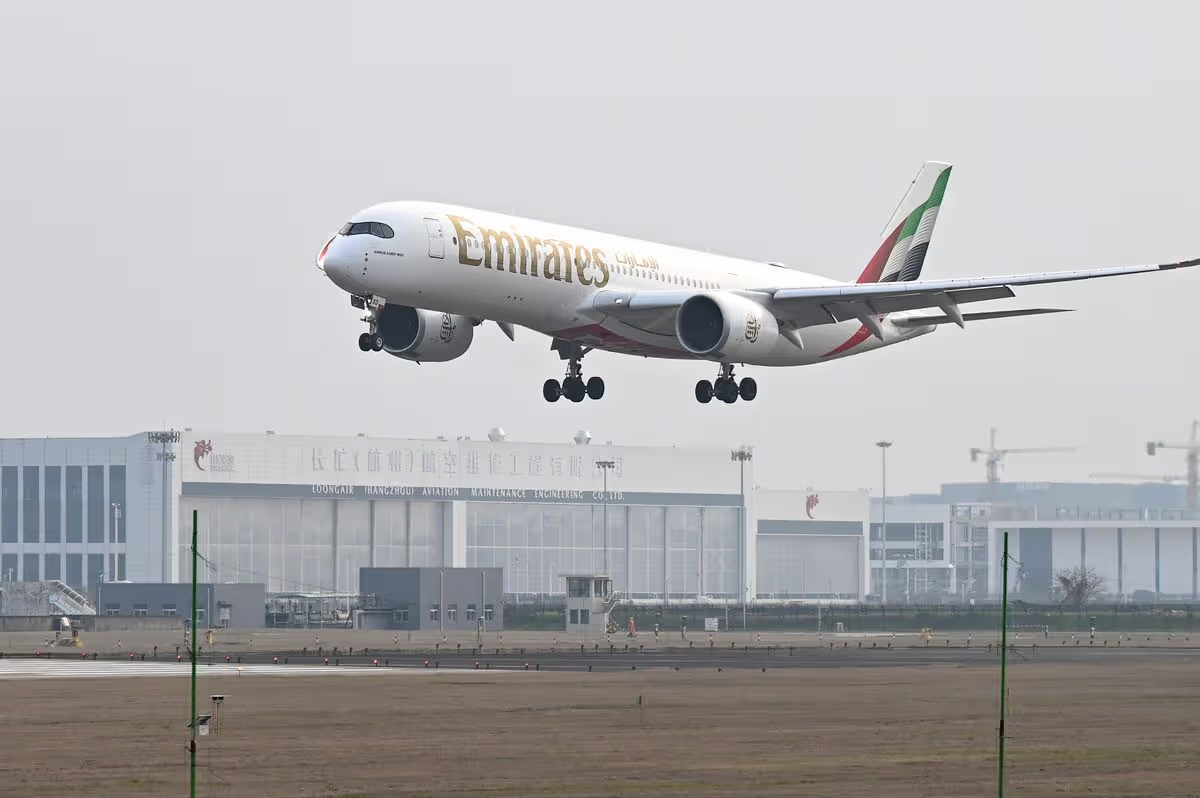
Emirates carries hundreds of thousands of UK passengers every year, including from London Heathrow, Gatwick, Manchester, Birmingham and Glasgow

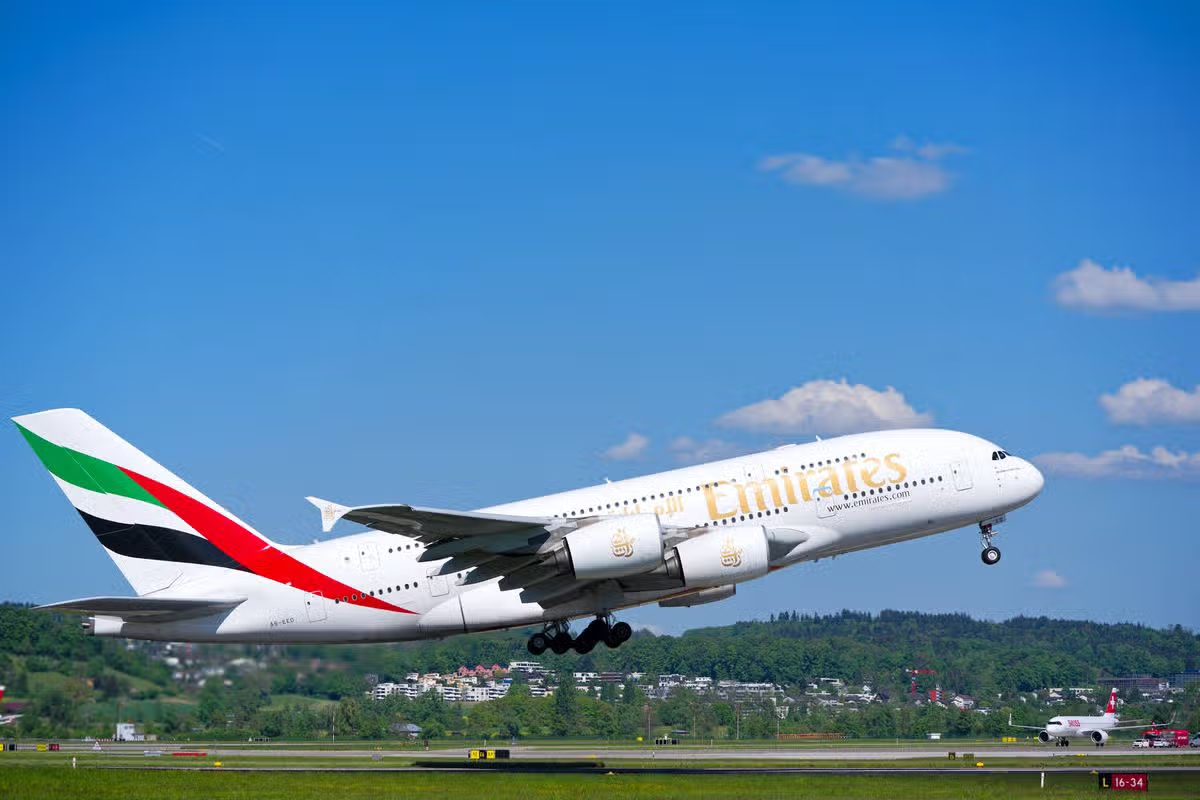
A major airline has issued an announcement to customers after an update to its service. Emirates carries hundreds of thousands of passengers on UK services every year going through airports including London Heathrow, Gatwick, Newcastle, Manchester, Birmingham and Glasgow.

Using its 615-seater A380s the route from London Heathrow to Dubai alone offers more than one million seats. Now those travelling on the aircraft will be able to access internet connections, which the airline hails as “better than at home” following the completion of the first installation of next-generation Starlink Wi-Fi onboard.

Making the announcement on Monday afternoon, the airline said: “Emirates A380 was one of the first commercial aircraft in the world to offer internet to its customers, with first generation systems offering a total aircraft bandwidth of less than 1 Mbps. Emirates’ installation of three Starlink antennas on each A380 will improve the Wi-Fi available onboard a thousand-fold – offering a ‘better than at home’ connectivity experience for customers, while flying at 40,000 feet.”

The first Emirates A380 aircraft equipped with Starlink made its return to Dubai this week, after its installation and certification were accomplished in Newquay. More A380s are scheduled for accelerated installation throughout 2026 allowing passengers to stream, game, browse, and work throughout their journey on personal devices.

The service will be complimentary for all customers. The airline has future plans to add Live TV streaming over Starlink, initially on personal devices and later integrated into seatback screens.

Making the announcement on X, the airline said: “Our A380 is entering a new era with next-gen @Starlink Wi-Fi onboard. Ultra-fast, complimentary connectivity across all cabins, customers can stream, browse and stay connected seamlessly at 40,000 feet. A fully connected journey, redefined.”

Content cannot be displayed without consent

And passengers were delighted to hear the news. One said: “Let’s go. The old system was under 1 Mbps.” Another added: “Please don’t ever ground this airplane.”

The “double-decker” Emirates Airbus A380 is the world’s largest passenger airliner. It is known for its onboard luxury including shower spas, onboard bars and lounge.

Source link