Trump says he will sign an emergency order to pay TSA agents
WASHINGTON — President Trump said Thursday he would sign an order instructing the Homeland Security secretary to immediately pay Transportation Security Administration agents as Congress struggled to reach a deal to end a budget impasse that has jammed airports and left workers without paychecks.
Trump announced his decision in a social media post saying he wanted to quickly stop the “Chaos at the Airports.”
“It is not an easy thing to do, but I am going to do it!” the president posted.
With pressure mounting, the White House had floated the extraordinary move of invoking a national emergency to pay TSA agents, while senators were reviewing a “last and final” offer from Republicans to Democrats to end the funding impasse at the Department of Homeland Security.
Details of the president’s plan were not immediately available, but a national emergency declaration would be politically fraught and almost certain to face legal challenges. Instead, the president may simply be shifting money from other sources.
Democrats have been refusing to fund Homeland Security as they seek changes to rein in Trump’s immigration enforcement operations. The Senate came to a standstill and senators, ready to leave town for their own spring break, had prepared to stay all night to reach a deal.
“The president is doing absolutely the right thing,” said Sen. John Barrasso (R-Wyo.), the GOP whip. “The TSA agents are going to be paid.”
Sen. Susan Collins (R-Maine), the chair of the Appropriations Committee, has said there is funding elsewhere that can be legally used to pay the TSA as well as the Coast Guard without declaring a national emergency.
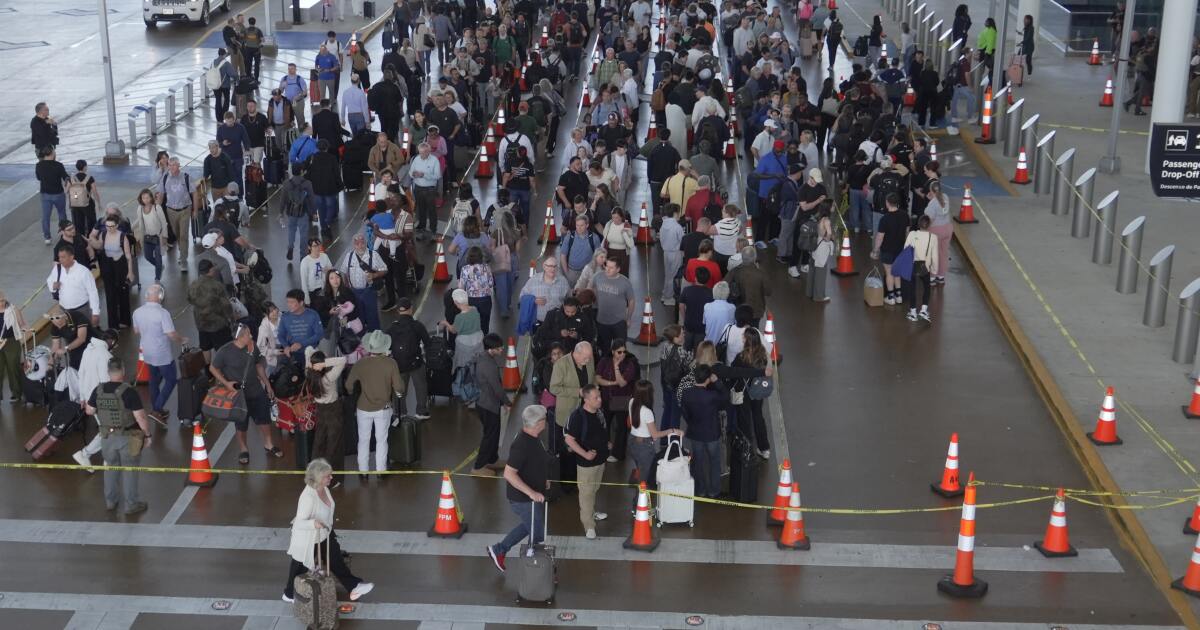
The funding shutdown, now in its 41st day, has resulted in travel delays, missed paychecks and even warnings of airport closures. TSA workers are coming up on their second missed payday Friday, with thousands refusing to show up for work.
Multiple airports are experiencing greater than 40% callout rates of TSA workers and nearly 500 of its nearly 50,000 transportation security officers have now quit during the shutdown. Nationwide on Wednesday, more than 11% of the TSA employees on the schedule missed work, according to DHS. That is more than 3,120 callouts.
Trump, who has largely left the issue to Congress to resolve, had warned he was ready to take action, even threatening to send the National Guard to airports, in addition to his deployment of ICE agents who are now checking travelers’ IDs — a development drawing concerns. The White House has been considering a menu of options.
“They need to end this shutdown immediately or we’ll have to take drastic measures,” Trump said during a morning Cabinet meeting at the White House.
At George Bush Intercontinental Airport in Houston, Melissa Gates said she would not make her flight to Baton Rouge, Louisiana, after waiting more than 2½ hours and still not reaching the security checkpoint. She said no other flights were available until Friday.
“I should have just driven, right?” Gates said. “Five hours would have been hilarious next to this.”
A ‘last and final’ offer on the table
Earlier Thursday, Senate Majority Leader John Thune (R-S.D.) announced he had given the final offer to Democrats.
Thune did not disclose details of the new framework, but he said that it picked up on what had been the Republican offer over the weekend, before talks with the White House and Democrats had broken off.
“Enough is enough,” he said.
But as senators retreated to privately discuss the new plan, the action stalled out.
Democrats argue the GOP proposals have not gone far enough at putting guardrails on officers from ICE, Customs and Border Protection and other federal agencies that are engaged in the immigration sweeps, particularly after the deaths of two Americans protesting the actions in Minneapolis.
They want federal agents to wear identification, remove their face masks and refrain from conducting raids around schools, churches or other sensitive places. Democrats have also pushed for an end of administrative warrants, insisting that judges sign off before agents search people’s homes or private spaces.
Senate Democratic leader Chuck Schumer of New York said they needed to see real changes. “We’ve been talking about ICE reforms from day one,” he said.
Any deal will almost certainly need to involve a compromise as lawmakers on the left and right flanks revolt. Conservative Republicans have panned their own GOP proposals, demanding full funding for immigration operations and skeptical of the promise from leaders that they would address Trump’s proof-of-citizenship voting bill in a subsequent legislative package.
Republicans said after a private lunch meeting that there were other options to shift money than invoking the national emergency.
The GOP’s big tax cuts bill that Trump signed into law last year funneled billions to DHS, including $75 billion for ICE operations, ensuring the money is flowing for his immigration and deportation agenda even with the funding shutdown. ICE and other immigration officers are still being paid.
Republicans say the Trump administration has already made strides to meet Democrats’ demands, particularly after swearing in former Oklahoma Sen. Markwayne Mullin as the new homeland security secretary to replace Kristi Noem. He has given a nod to the need for the judicial warrants for searches.
Airport lines grow as TSA workers endure hardships
“This is a dire situation,” the acting TSA administrator, Ha Nguyen McNeill, testified at a House hearing Wednesday.
She described the multiple hardships facing unpaid TSA workers — piling-up bills and eviction notices, even plasma donations to make ends meet — and warned of potential airport closures if more employees refuse to come to work.
“At this point, we have to look at all options on the table,” she said.
McNeil also said TSA officers working at the nation’s airports had experienced a more than 500% increase in the frequency of assaults since the shutdown began.
“This is unacceptable,” McNeill said.