“It’s Very Likely That a Different Party System Will Emerge in Venezuela”
The trajectory of the political transition that many Venezuelans await since January 3 seems to have been clarifying over the past few weeks. The first expected milestone is the reform of the Supreme Court of Justice, although it remains to be seen how many of the new magistrates will be independent and how many tied to factions of the chavista elite. The expectation is that, before the end of the year, the agenda will include a new board of rectors for the CNE and the long-awaited electoral calendar. In Panama, María Corina Machado had opened to negotiating these matters directly with Delcy Rodríguez, but the United States decided to manage the institutional opening through a small group of opposition figures, former lawmakers from Primero Justicia and Voluntad Popular in the 2015 National Assembly. The discomfort of Machado and her inner circle with this decision is no secret. The opposition leader has stated that she does not intend to stand in the way. Individuals linked to her team and party have raised doubts about the negotiation’s initial legitimacy and early progress, while other longtime opposition figures have welcomed the recent releases of political prisoners and the roadmap the US has outlined.
At Caracas Chronicles, we sat down to talk with Guillermo Aveledo Coll, a political scientist, expert in Venezuelan political history, and researcher of the ideas that have shaped its parties and conflicts. Aveledo views the unfolding dialogue favorably. He believes general elections must take place in Venezuela as soon as possible, though not without first tying up loose ends related to the broad recognition of any electoral process and the stability of future governments. He also discussed the dynamics that could emerge among political parties amid a transition, both within the anti-chavista camp and inside the chavista movement. Much like Marco Rubio in January, he made reference to the Spanish Transition. Finally, he reflected on our last transition to democracy (1958–1968) and how Rómulo Betancourt and Acción Democrática adapted to move forward in the face of adversity.
Recently, María Corina Machado used a term typical in transition frameworks. She said that the transition to democracy cannot be an elite pact made behind the people’s backs and without a popular mandate. Does the agenda unfolding between a commission of the Delcy government and the Delegated Commission of the old 2015 National Assembly fall into the category of an elite pact? You have been a defender of the legacy of the Puntofijo Pact. Is an elite pact problematic in these particular circumstances?
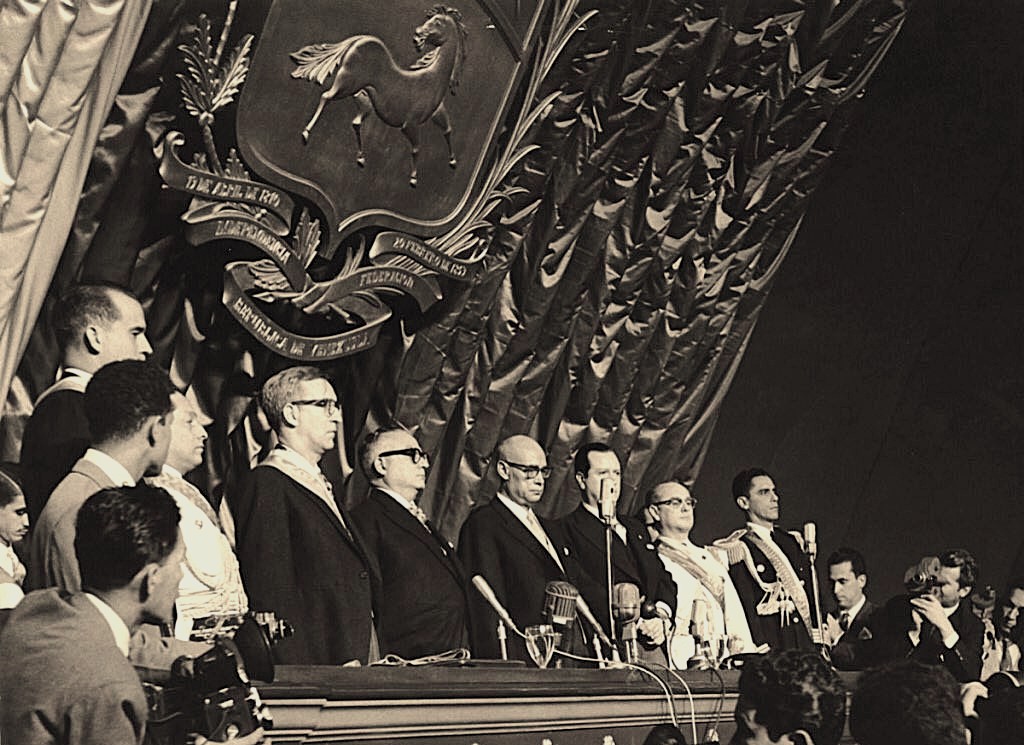
What we are seeing, which points embryonically toward an elite agreement, will have to be filtered through the will of the population, because the ultimate source of legitimacy in a democratic republic passes through it. The Puntofijo Pact was a concrete agreement on political rules among parties. However, had those parties lacked inherent legitimacy and a firm foothold, those rules might have overwhelmed them. In those elections, an independent candidate backed by one of the historic parties, Rear Admiral Wolfgang Larrazábal, obtained a very high percentage of the vote and came in second. So it could very well have been something that surpassed them, that swallowed them up.
Venezuela will need elections. It also needs the freedoms and guarantees for those elections to take place. Not because winning them without those guarantees is impossible, but because the opposition’s victories haven’t been recognized without them, while a government win leaves reasonable doubts regarding legitimacy. And if a fundamental actor in that social recognition, María Corina Machado, remains sidelined, there is all the more reason. But that alone does not fix the system; once an agreement on guarantees, freedoms, and institutional restructuring is reached to allow a new electoral process, we will be talking about another stage—the delicate process of Venezuela’s redemocratization.
Moving on to the US and the difference between what Marco Rubio says, for example, and what Machado says. I believe the US approach, at least initially, was to seek a more gradual path. Machado rejects gradualism, connecting with majorities desperate for improvements in their day-to-day lives. Do you view gradualism as desirable in this case, or does it bring risks?
Right now, it is not a matter of desirable or undesirable. It must be viewed carefully. What does gradualism mean in this context? If it means the indefinite postponement of elections, then I agree there should be no gradualism. Elections must happen sooner rather than later. Now, must other things happen before elections? Of course. Certain decisions are necessary. For many Venezuelans, the existing electoral institution is neither trustworthy nor advantageous; going to an election feels risky—not so much because of the voting machines or the system itself, but because of the allocation rules, which heavily favor the plurality or the majority.
“If you keep the current allocation system, there will be such complete steamrolling that a significant yet minority sector will find itself far more diminished than political reality dictates.”
They are rules of steamrolling. If you have a 5-4 distribution, the practical result becomes 6-3; if you have a 3-1, it becomes 4 or 4.5 to 1. That poses a problem because we are in a process that did not open through social pressure overthrowing the system. The system is still there, and its existence must be dealt with. Today, the system is making concessions that, propaganda aside, respond to external pressure. Saying that nothing will change and that all this is meaningless is a different matter. If, instead, gradualism means taking the necessary steps to promote those elections so the outcome is recognized and governance is secure, then it is logical. These processes tend to be gradual when they happen.
What should come first: presidential elections, legislative elections, or both at once?
The broader the possibility for popular expression, the better. It is convenient for a new government, of any political line, to have significant parliamentary support. In my view, general elections—or at least national general elections covering national jurisdiction, including overseas voting—are advisable. This would generate two branches of power: the Legislative and the Executive. If we maintain the proportions that society currently suggests, it would likely be a moment of overwhelming majority for one sector over another. Politically, that is not necessarily desirable. What do I mean? For the stability of the present and future process, there needs to be a form of representation closer to the national mindset. Today, the PSUV represents a significant minority, but a smaller one than in other historical moments. We will see how that translates in an environment of freedom, without infringement, and without pressure from the bureaucracy or the State as an employer. Perhaps the result could be different for chavismo now. But relying on polls that indicate a four-to-one or three-to-one gap, if you keep the current allocation system, there will be such complete steamrolling that a significant yet minority sector will find itself far more diminished than political reality dictates.
“It is likely that chavismo as an entity will take various forms and fragment. Is it convenient for it to disappear? I think doing so artificially is dangerous.”
That is not necessarily a good start. Democratic zeal and sectarianism in other transitions have weakened a democracy’s ability to respond and advance—which is ultimately what all democratic sectors want. I prefer a solid democracy with a significant, albeit limited, representation of chavismo over the alternative, simply because of what they represent in political life. Furthermore, remember: they could not be extracted—or rather, removed—from power as a structure. That carries weight. Does that mean I wish for an authoritarian leftist force like chavismo turned out to be at the height of its power? No. I believe there should be a force representing the political identity that chavismo is—as a cultural, political, and ideological identity that existed before fading due to its own dynamics. Who holds the broad banner of chavismo today? I do not know. The ones in Miraflores? I don’t know if they are indisputable figures within that movement, or if the discontent and dismay throughout this period generate fragmentation.
As happened in other transition experiences, the government party sometimes splits once it opens up, gets overtaken, and the opposition takes power. It is probable that chavismo as an entity will take various forms and fragment. Is it convenient for it to disappear? I think doing so artificially is dangerous. From 1945 to 1948, the majority force believed no other party was democratic. That gave us 10 years of harsh dictatorship. I prefer to see chavismo divide around democracy: some supporting the transition and others supporting an authoritarian or violent return to power, allowing us to face them within that framework.
A few years ago, there was much talk about the decline of Venezuelan opposition parties, even the idea that these parties are dead. A set of parties, to an extent heirs to the old two-party system, retain certain references and machinery. What are the challenges for these parties moving forward, beyond the known consequences of prolonged repression and State harassment? Can they grow stronger?
The dynamics will emerge naturally. Obviously, parties retain elements of historical legitimacy, identity, and roots, but a sifting process toward other options is very likely. My desire, of course, is for a party bloc to form around democracy. But then we face the issue of the primus inter pares. María Corina Machado is the leader and the most popular political figure in Venezuela’s recent history—the most individually popular since the death of Chávez. She holds a massive advantage, though that isn’t necessarily true for her party, Vente Venezuela. I don’t mean to diminish Vente’s value. That is why a bloc, agreements, and that collective notion are more suitable. Some argue this spirit broke after the start of negotiations, that the spirit of Panama was lost. I see it more as a pivot toward the direction Panama points. It is not the form the Panama Agreement indicated, but it aligns with the expectations it set. These are not completely unfamiliar actors; an abnormal arrangement is not being forced upon Venezuelan society.
Now, should the parties emerge? That will happen in due time. It took time for the Spanish Right to consolidate after Adolfo Suárez’s UCD and the dissolution of Francoist parties. Those fell into oblivion and later merged into a party representing that world sociologically, which became the People’s Party (PP). In the case of the Spanish Left, the multitude of cacophonous acronyms from the Spanish Civil War and exile sifted into the PSOE, which had the advantage of being a historic party. It didn’t acquire a new personality, but it began gathering people from other parties, both left-liberals and more heterodox leftists. Here, it could very well settle into one, two, or three major parties forming a bloc. What is the concrete difference between Voluntad Popular, Un Nuevo Tiempo, and Acción Democrática in ideological terms? Or between the other Democratic Unity parties and Vente Venezuela? “Oh, Vente is liberal-capitalist and the others are not.” Are the others not pro-market? Let’s be clear, they have been for a long time. It’s not that they are neoliberal, but they aren’t socialist in the sense of nationalizing the means of production. We should keep that in mind.
Regarding the Venezuelan Left, Chávez was the first major charismatic figure linked to that world who swallowed all leftist parties. That is the essence of PSUV. The Democratic Unity Roundtable (MUD) and the Unitary Platform positioned themselves as its antithesis: “What unites all of us who hold these ideological differences? The desire for democracy.” What might happen is that a single party—new or distinct—swallows the archipelago of parties that emerged under this system. But it is very probable, as seen in other processes, that a different party system will emerge. What is desirable? That they be democratic parties. What is desirable? That extremist parties, meaning those that do not believe in elections or democracy, can operate legitimately. That would be a danger to them. In its 20-year history, PSUV has opposed pluralism and free, competitive elections; that is how it operated from power. Could it act differently from another perspective? It might, as happened with other parties in different transitions. The PP is an example.
Returning to María Corina, who will likely be a central figure in the upcoming period, I wanted to discuss Rómulo Betancourt, the most prominent figure of our former transition. She once admitted he’s the best president Venezuela ever had. Betancourt both excelled at building consensus during that era and was firm in protecting his State project from extremes. Is he a useful reference point now? What lessons does Betancourt offer María Corina, and what are not lessons?
An important lesson is that he spoke with people who had sent him into exile and prison, admitting them into the new status quo. The only person directly excluded from the system was Pérez Jiménez. Of course, those individuals had also been victimized by the dictatorship, enabling new understandings. With others, Betancourt had built a wall of fire. But in general, he skillfully won over the military and business sectors—building bridges he failed to establish during his first presidency, a lesson in how radicalism can fail. I believe that is a crucial example. Acción Democrática held massive majorities, yet could not sustain its first mandate. In his second term, Betancourt did not take power with an extraordinary majority, yet he gathered more allies. Are the allies of the Unitary Platform enough to support such an administration? If tomorrow there is a National Assembly with an overwhelming majority from a pro-Machado party—whether Vente or another—and the minority or that sector is steamrolled, you will have fewer allies to govern under very difficult circumstances. You may have a non-governing minority, yes, but you will face more discontented voices outside. In that scenario, you should be striving to reconcile.
“What concerns me is that a government led by María Corina—one desired by millions of Venezuelans, including myself—could become unstable because we tried to do too much too soon.”
Of course, there is the idea that reconciliation should be with the masses rather than the elites. Fantastic—I believe that is a genuine aspiration. But one must also consider that part of these sectors belong to those parties. How do the thousands of party militants who helped execute the 2023 primaries or the 2024 voting tally collection feel? Discontent may be brewing there, which does not serve us well. Naturally, demanding total calm and moderation from María Corina—asking her to step away from her historic trajectory—is difficult. Her distrust is not entirely unfounded: major adversaries who have acknowledged her leadership in recent months and years have also acted against her. Perhaps that is why a more institutional coordination between the Unitary Platform and Vente—which I found desirable to allow greater cohesion—never materialized. That places a burden on the parties as well: how much can they demand when their representation is small?
How can an organized Venezuelan society exert influence over this juncture?
By trying to support the possibilities opening up in this scenario, even regarding the most politically committed sectors. The success of the process in Caracas depends largely on restoring, sooner rather than later, the freedoms that allow political dynamics to settle into something genuine and verifiable. It benefits Venezuelan society to lean in that direction. Society must also organize its own demands; democracy requires tolerance and pluralism, but it also requires contestation. There is significant leadership representing that, but society itself must reorganize because organization has been limited and stunted for years—with very few exceptions—by repression and constraints on civil society. Here, I would like to return to María Corina Machado.
Sure, go ahead.
I spoke of Betancourt and what that implies for her, including steadfast leadership. But there is also the need for flexibility toward the Armed Forces and awareness of that function’s demands. That said, María Corina Machado should not be afraid to be herself, to maintain her standard and vision. It has worked well for her so far, despite many problems, risks, and sacrifices. It would feel somewhat pretentious of me to tell her: “Look, María Corina, do this one way or another.” What concerns me is that a government led by her—one desired by millions of Venezuelans, including myself—could become unstable because we tried to do too much too soon.
In what areas do you see risks?
To me, the main risk is having powerful adversaries emboldened by instability and by the difficulty of building consensus around the tough decisions a new government will have to make—serious, ground-breaking decisions that will require broader support. Disregarding support and consensus as unnecessary could become a problem.
Are privatizations a concern for you, or perhaps the issue of justice?
I am concerned about the inability to make the most grave decisions. The privatization of PDVSA is largely advanced through the Hydrocarbons Law; we are heading toward a framework where PDVSA remains significantly reduced. The disarmament or political neutralization of the judiciary is already on the table, so they won’t need to drive that from scratch. But issues of redistribution, labor rights, and State restructuring—deeper discussions where initial instincts may not be fully adequate to foster understanding—could create serious challenges. I do not mean to minimize her support, but popular backing has often failed to prevent adversaries from becoming emboldened and supplanting democracy during historical transitions. And I do not want us to return to an authoritarian system.