MILAN — He’s as smooth as a bobsled track and sharp as a skate blade.
Snoop Dogg, the rap rapscallion who puts the OG in Olympic Games, plopped down on a couch in the NBC green room and muted the TV. It’s exhausting being everywhere at all times at the most spread-out Winter Games in history.
Whether he was carrying the Olympic torch, skiing with Picabo Street, sliding a curling stone or driving a Zamboni, Snoop was everywhere. He finished each day with a highlight show from the Milan studios.
So ubiquitous was the so-called Ambassador of Happiness, you’d swear NBC duped a Snoop — or maybe two.
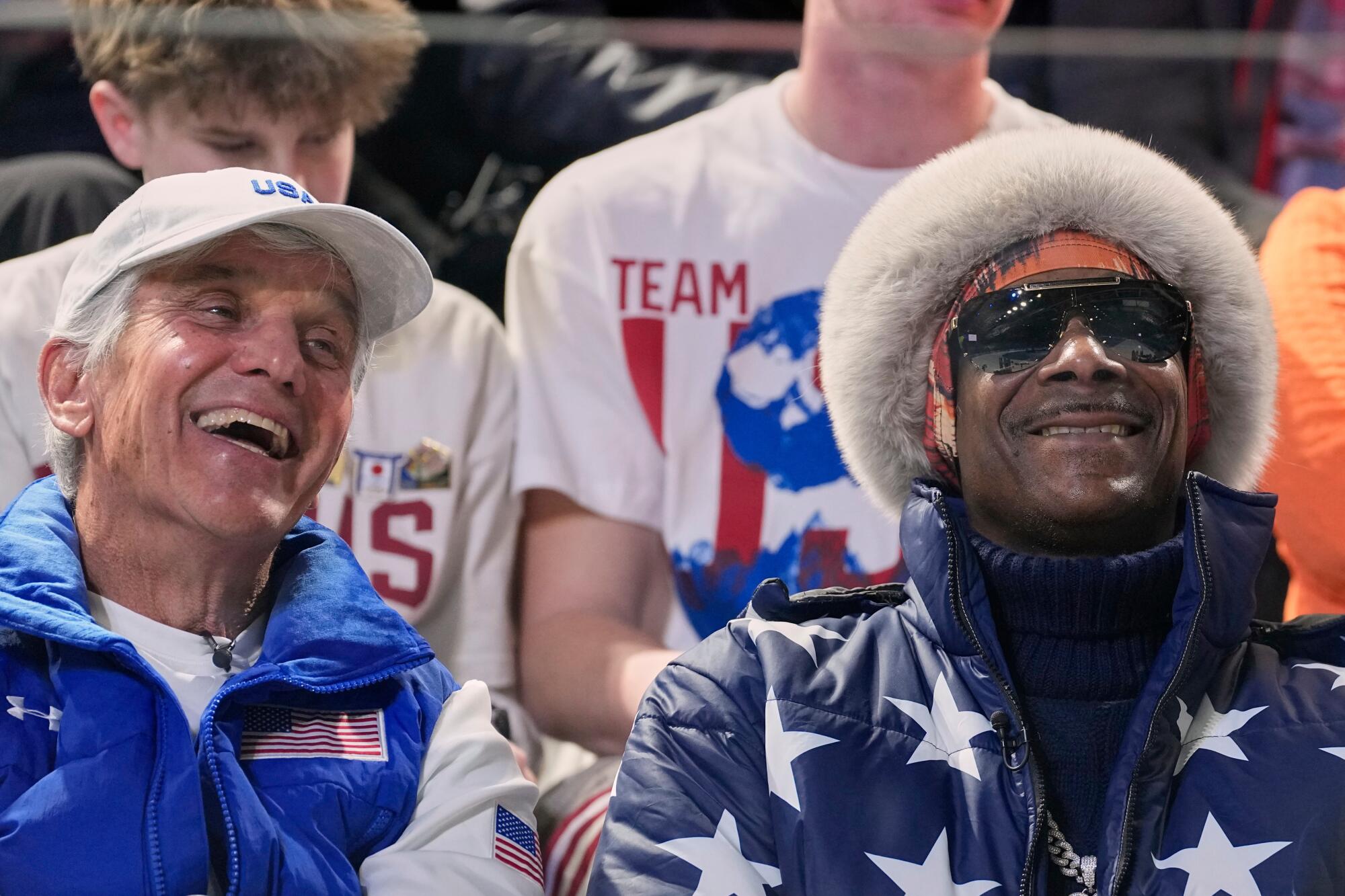
Snoop Dogg, right, and five-time Olympic gold medalist former speedskater Eric Heiden watch speedskating at the Milan-Cortina Olympics on Feb. 11.
(Ben Curtis / Associated Press)
“The Winter Olympics are underrated,” he said in an interview Friday at the network’s Olympic complex. “It’s not highly touted like it should be. This is an event that is just as good as the Super Bowl, as the Summer Olympics. There’s so much action and there’s so much happening, and it’s not just one day. It’s not just four quarters. It’s weeks of great competition — on ice, for the most part.”
It’s almost as if the angular, 6-foot-4 Snoop is on ice as he glides through the back halls of NBC’s temporary headquarters, wearing a white turtleneck under a red, white and blue leather jacket with “COACH SNOOP” across the front. He’s wearing a gold-rope chain with the Universal logo as a pendant, and gold-rimmed sunglasses that are square and lightly tinted.
He greets everyone he sees and a friendly assistant follows him, handing out Olympic pins of a tiny, cartoonish Snoop with his arms raised at his side, standing in front of an American flag.
Is it any wonder this guy creates a buzz in every venue he enters? He is the No. 1 celebrity sighting at the Games.
“Snoop has a joy about him, a childlike curiosity, and he’s also a people person,” said Molly Solomon, executive producer and president of programming for NBC’s Olympics coverage. “He wants to lift people up in all aspects of his persona.”
NBC began using the rapper as part of its Olympic coverage during the Tokyo Games in 2021 with the streaming Peacock show “Olympic Highlights with Kevin Hart & Snoop Dogg.” Many of their playful clips and humorous commentaries went viral and were especially appealing to younger viewers. Snoop genuinely enjoyed the competition, even though a lot of it was new to him.
Three years later, as the network was preparing for the Paris Olympics, executives were looking for ways to enhance the prime-time coverage, much of which would air on tape because of time-zone differences. They decided to expand Snoop’s role to give the perspective of a “superfan.” With these Olympics, his role further evolved into an experiential one, and to serve as an informal mentor and ambassador to the athletes.
“This is the biggest stage in the world,” he said. “Nobody gets to perform in front of the world like they do, with the whole world paying attention. To have all of that pressure of [something] you’ve been working for four years … Some of these girls and guys get that one shot, their event is only one time.”
As a roving correspondent, he did … well, some serious roving.
That included making the drive from Milan to Cortina for curling, sliding and women’s ski racing. That’s a four-hour van ride each way, some of it winding into the Dolomites.
“Trying to sleep with my head up against the window, with turning curves and every mountaintop,” he said. “Sliding by trains and traffic, and oh my God, I couldn’t drive out here. One-way streets. Little-bitty trains coming this way, that way. Bicycles, mopeds. It’s a lot.”
He also made a 3½-hour trip to Livigno to watch snowboarding — and said that if he had to pick a sport to compete in, that would be his choice.
“I could get good in snowboard, because I just like the creativity of when you’re in the air you have full control but you in the air,” he said. “I just feel like that’s something I could really be good at.”
So he must have skateboarded as a kid growing up in Long Beach, right?
“Never,” he said. “That’s what I’m saying. None of these sports are near and dear to me. That’s why it’s gonna be a first-time trial. But I know who I am. I don’t like to fail. I don’t like to lose. So I’m just such a perfectionist that I will get good enough to be good enough.”
He’s 54 and concedes his body can’t always accomplish what his mind thinks it can. He tried running the 200 meters at the Olympic trials in Oregon before the Paris Games and did so in 33 seconds, but he limped away with an injury. So he has a goal for when the Summer Games come to Los Angeles in two years.
“When we get to L.A., my mission is for me to run the 200 in under 30 seconds,” he said. “In 2028, I should be 56 years old. So if I can run it in under 30 seconds at 56, that’s a gold medal for me.”
Solomon said NBC is still brainstorming about how Snoop’s role will evolve for the 2028 Games.
Honorary Team USA coach Snoop Dogg throws a curling stone as Americans Daniel Casper and Tabitha Peterson Lovick watch on Feb. 6 in Cortina d’Ampezzo, Italy.
(Richard Heathcote / Getty Images)
“Of course, L.A. is Snoop’s hometown,” she said. “So he will be a hometown hero.”
Snoop said his love for the Olympics dates to the 1984 Los Angeles Games. He didn’t attend any events at the time, though, noting that for a 13-year-old kid growing up in Long Beach, the city felt “like a whole state away.”
“We were watching on television,” he said. “We never thought we could physically be there. … It just felt good to be an American, to watch us compete against the whole world and to see how great we were.”
He’s particularly interested in flag football — which will make its debut in the Los Angeles Olympics — and created a youth football league that counts among its alumni NFL standouts C.J. Stroud and JuJu Smith-Schuster.
“Flag football is a sport the whole world can grab ahold of,” Snoop said. “There are so many athletes that are in the NFL that are from different parts of the world that they’ve grown the sport from them just making it to the NFL and being an inspiration for the next generation.”
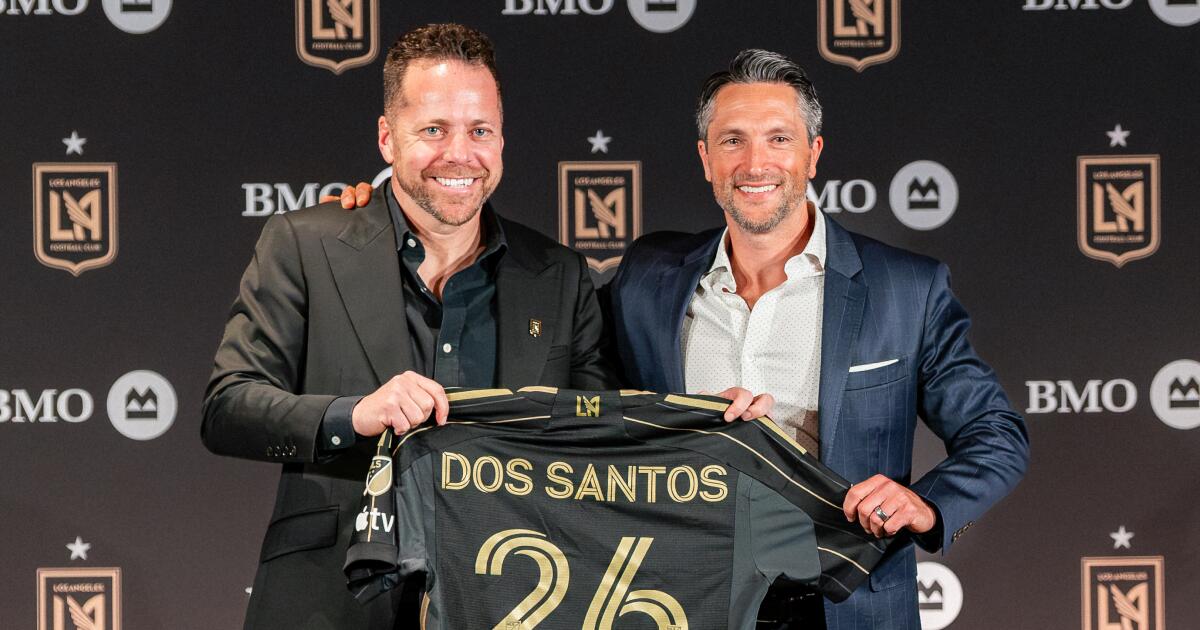
When LAFC promoted Marc Dos Santos from assistant coach to manager two months ago, there were some perks that came with the new job. A raise, certainly. A better seat on the team charter.
But not as many as you might think.
“The office is a little bit bigger,” he said. “My parking space is exactly the same.”
The biggest perk, however, could also prove the more difficult. After five seasons working under Bob Bradley and Steve Cherundolo, Dos Santos is now the guy calling the shots. And if he misfires, it will be clear who deserves the blame.
Dos Santos welcomes the scrutiny.
“I never coach with the intention of what people think or what people are going to say,” he said. “I’m focused on the group and my job; the validation that is the most important for me is from my owners, from the people in the club that believe in me.
“I’m blessed with the pressure of coaching LAFC, It’s a privilege to be under pressure. But at the same time, I want to start well.”
He’ll get that chance Tuesday, when LAFC faces Honduran club Real España in the first round of the CONCACAF Champions Cup in San Pedro Sula. The MLS season will start four days later against Lionel Messi and Inter Miami, the reigning league champion, at the Coliseum.
Dos Santos, who speaks four languages, has already started putting his stamp on the team by tweaking LAFC’s playing style. Under Cherundolo, who spent his whole playing career in Germany, the team ran a German-influenced, high-press system that combined fast-paced attacking with defensive discipline, emphasizing quick transitions and a compact defensive organization.
But Cherundolo’s teams were also content to concede the ball as much as they controlled it. Dos Santos, conversely, spent the preseason implementing an aggressive possession-based attacking game.
“Marc had a lot to do with what we thought was really good about LAFC. But he had some ideas on how to tweak things,” said general manager John Thorrington, whose team is unbeaten in four preseason games, outscoring opponents 7-3. “What is really impressive is Marc and the staff have begun implementing these tweaks. Everybody is really buying in.”
Which is good since Dos Santos won’t have much of a chance to do any teaching once the season begins. LAFC will start the year with four games in 12 days; if it advances to the second round of the Champions Cup, the team will play nine times in 33 days.
Then in late May, after 16 MLS match days, the season will pause for more than seven weeks for the World Cup.
The vagaries of that schedule will require flexibility and depth and will likely force Dos Santos to rotate players in and out of the lineup. And though LAFC’s roster, led by South Korean captain Son Heung-min and former MLS Golden Boot winner Denis Bouanga, appears top heavy, the coach lauds the depth, with offseason additions including wingers Jacob Shaffelburg and Tyler Boyd and midfielder Amin Boudri.
“People could look very superficially,” he said. “But it’s also a league with a salary cap and there’s so many players that support what are called the more known or star players. That’s important.
“The focus is to surround these players with a system and a way of playing that is going to maximize everybody.”
Dos Santos, 48, has won everywhere he’s managed with one exception: his only other MLS head coaching stint in Vancouver, where he spent parts of three seasons, two of which were impacted heavily by the coronavirus pandemic.
He got his coaching start in his native Canada, then moved to Brazil, where he coached in the youth programs of two clubs and worked as a technical director for another. He returned to North America to manage three lower-division clubs and worked as an assistant with Sporting Kansas City of MLS before Bradley named him to the first LAFC staff in 2018.
After Bradley moved on, Dos Santos returned to LAFC as part of Cherundolo’s first staff. And now, as manager, he’s brought in his own lieutenants, replacing original LAFC assistant Ante Razov with former Seattle assistant Andy Rose — who played for Dos Santos in Vancouver — and adding Spanish coach Xavi Tamarit.
“When you go from assistant coach to head coach, you have to take a few steps back. But you need to make sure you delegate to competent people,” he said. “The people that have joined are really competent and do a really good job.”
The proof of that will come on the field and Dos Santos knows he has big shoes to fill. Under Bradley and Cherundolo, LAFC was the best club team in U.S. soccer over the past eight years, winning more games, earning more points and scoring more goals than any team in MLS. It made the playoffs seven times, played in two MLS Cup finals and two CONCACAF Champions League finals, won two Supporters’ Shields and a U.S. Open Cup.
Thorrington expects the winning to continue under Dos Santos.
“I am confident that we made this decision for the right reasons,” he said. “And those who are not convinced yet will be convinced very soon.”
If they aren’t, LAFC’s famously demanding fans will be calling for the coach’s head. So even though MLS is heavily promoting the regular-season opener with Messi and Inter Miami, Dos Santos isn’t looking past his real first game in charge, which is the Champions Cup game with Real España.
“For me, the only game that counts in my head right now is the game of Feb. 17 in Honduras,” he said. “That’s where I put my energy. And then we’ll deal with the Miami game.”
The X Factor star has embraced a new “mindful” lifestyle, as she prioritises her “healing”.
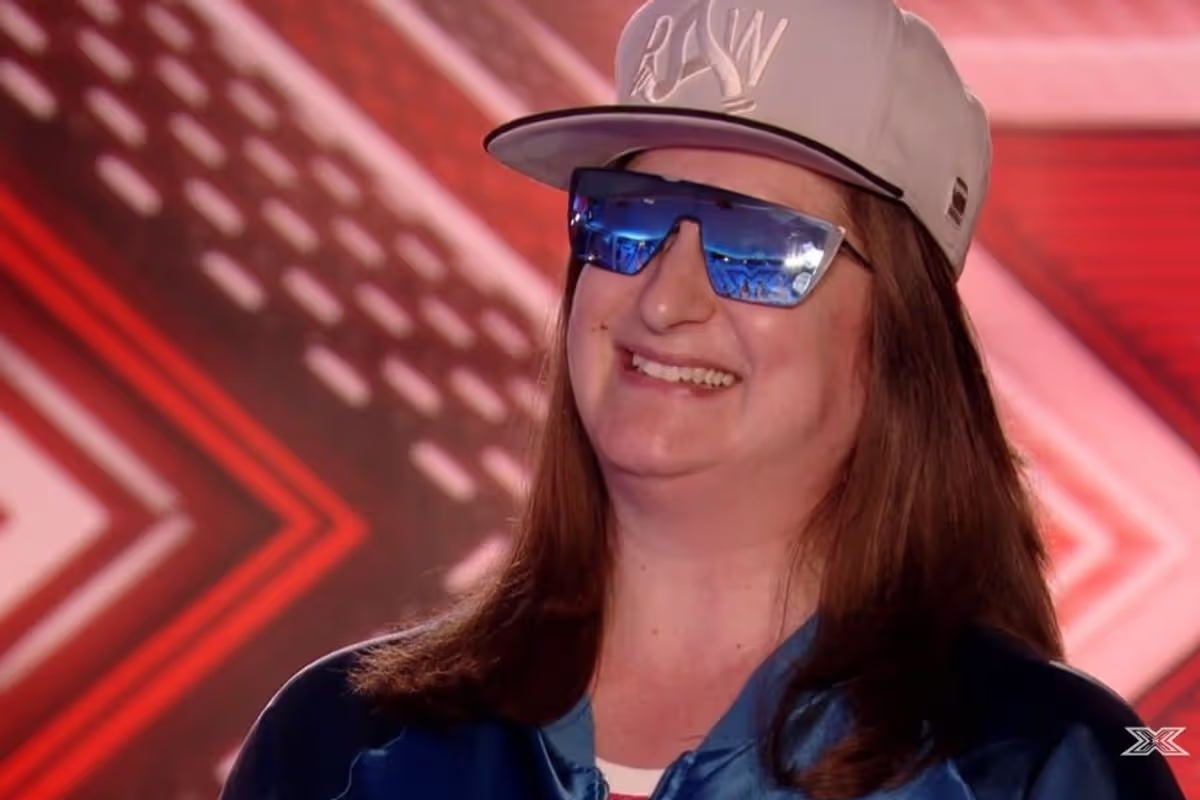
Honey G rose to fame on The X Factor in 2016 (Image: ITV)
X Factor legend Honey G is unrecognisable after embracing a new “mindful” lifestyle, ten years after she first found fame.
The former contestant, whose real name is Anna Gilford, appeared on the 13th series of the singing competition, which was won by Matt Terry.
She’s since credited Simon Cowell’s show for changing her life after admitting she was in a dark place before The X Factor.
She previously said: “I’m very grateful for what X Factor did for me, it changed me. It’s boosted my confidence. Before X Factor, I was in a dark place, and it put me in a happier place.”
Content cannot be displayed without consent
She’s now revealed that her life is completely different these days, worlds away from the look she had when she first auditioned for Missy Elliott’s Work It rap.
In a post yesterday, the TV star shared an unrecognisable picture on Instagram as she spoke about mindfulness.
Honey G wrote: “A lot of people think stress and burnout mean they’re doing something wrong — not managing their time well enough, not being disciplined enough, not trying hard enough.
“But often it’s not about effort at all. It’s about capacity.
“When your nervous system has been under pressure for a long time, even things that help — rest, journaling, movement, mindfulness — can feel hard to access. Not because you don’t care, but because your system is tired.
“Sometimes the most supportive thing we can do is stop pushing for change and start creating small pockets of safety and space, exactly where we are.
“Gentleness isn’t giving up. It’s often where healing actually begins.”
Alongside the caption, she posted an image of herself in a red headscarf and sunglasses, a far cry from the trademark cap and bomber jacket with which she rose to fame.
Her post was showered in support, with one fan writing: “So true! Sometimes we need to just relax and stop trying to do everything. It’s ok to take a break.”
Another said, “I love u, Honey G,” as a third wrote, “Thank you, Honey G, this was beautifully written. Very inspiring.”
The star has previously spoken about how she looks “completely different” after shedding two stone from gym workouts, which she often shares online.
She previously told The Daily Star in 2023: “I’ve had a personal trainer for the past two years and he’s helped me change my whole body shape. I’ve been doing triathlons as well. My body is quite robust because when I was younger, I used to be a county tennis player. But I’m combining it all with diet as well.
“It’s still ongoing, it is a work in progress, but I’m working really hard and just trying to be the best version of myself.”
She added, “The fitness transformation has given me the confidence to dress in more adventurous clothing and clothing that is more feminine. If I want to wear my tracksuits, I will rock them. If I want to put a dress on, then I can.
“I’m a strong independent woman and can rock whatever look I want and I just hope nobody criticizes me for it.”