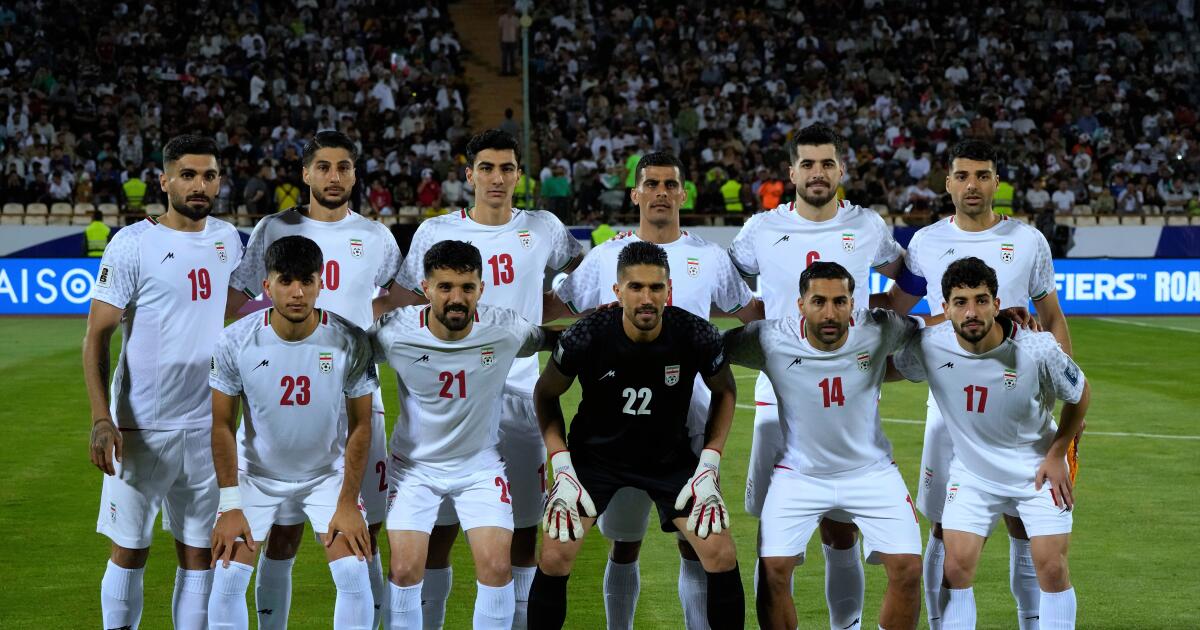
FIFA denies Iran’s push to move its World Cup matches to Mexico
GENEVA — The public wrangling between Iran, FIFA and U.S. President Donald Trump over the narrative of playing in the World Cup shifted on Tuesday to Mexico where President Claudia Sheinbaum seemed open to a suggestion by Islamic Republic diplomats that Iran’s games in June be moved to her country.
The Iranian ambassador and embassy in Mexico City said the country was negotiating with FIFA to move Iran’s three group-stage matches from the United States to Mexico after Trump last week discouraged the team from attending the 48-nation tournament, citing safety concerns.
It was already unclear whether such talks were even happening before FIFA said such unprecedented changes in World Cup history were not planned to a match schedule agreed three months ago.
Sheinbaum was asked about it Tuesday during her daily briefing.
“They are discussing with FIFA whether it’s feasible because they were going to hold the [games] in the United States,” she said. “They are looking into whether they can hold [them] in Mexico, and we will inform you when the time comes. Mexico has relations with all countries in the world. We’ll see what FIFA decides and then we’ll announce it.”
In a statement, FIFA said it is “in regular contact with all participating member associations, including [the Islamic Republic of] Iran, to discuss planning for the FIFA World Cup 2026. FIFA is looking forward to all participating teams competing as per the match schedule announced on Dec. 6, 2025.”
The Feb. 28 start of U.S. and Israeli bombing of Iran that killed the Islamic Republic’s Supreme Leader Ayatollah Ali Khamenei and senior officials immediately cast doubt on the national soccer team going to play at least three World Cup games in the U.S., which is co-hosting the most watched global sports event with Mexico and Canada.
Iran’s soccer federation has not canceled its World Cup entry with FIFA, though official comments have variously suggested the U.S. is unable or unwilling to ensure the delegation’s secure arrival and accommodation.
Since last week, Trump has variously said “I don’t really care” if the Iran team comes, that it was welcome and would be treated like all players as stars, and that the players’ safety was at risk.
In comments posted late Monday on the embassy website, Iran’s Ambassador to Mexico Abolfazl Pasandideh urged FIFA to move the team’s games to Mexico, saying the U.S. was not cooperative on visas.
“We love the Mexican people very much and for us, the best situation is for our games to be held in Mexico,” he was quoted as saying by state-run news agency IRNA.
An Iranian government spokesman and the team itself have said in recent days it is up to FIFA and the U.S. to keep the team safe during the World Cup. The Iran team’s planned training camp is in Tucson.
Pasandideh’s embassy in Mexico City also posted a statement attributed to national soccer federation president Mehdi Taj saying Iran wants to move its group-stage matches out of the U.S.
“When Trump has explicitly stated that he cannot ensure the security of the Iranian national team, we will certainly not travel to America,” the statement said. “We are currently negotiating with FIFA to hold Iran’s matches in the World Cup in Mexico.”
Iran is scheduled to play New Zealand on June 15 and Belgium on June 21 at SoFi Stadium before finishing group play in Seattle against Egypt on June 26.
Moving the games would be remarkable less than three months before the World Cup and risks being judged a failure in the history of tournament hosting.
It also is not envisaged by Iran’s first opponent.
New Zealand soccer federation chief executive Andrew Pragnell said Monday: “I also don’t foresee it as remotely feasible” to move scheduled games to another country. Tens of thousands of tickets have been sold for Iran games, including to visiting fans who have booked flights to the U.S.
“By trying to move the match schedule, you actually create more problems down the track,” Pragnell told New Zealand media outlet Stuff, adding “I don’t think it’ll happen.”
The Belgian soccer federation declined to comment Tuesday.
Trump said last week that the Iran team was welcome at the World Cup despite the ongoing war in the Middle East but “I really don’t believe it is appropriate that they be there, for their own life and safety.”
Iran’s mixed signals include Sports Minister Ahmad Donyamali telling state TV last week that it was not possible to play “due to the wicked acts they have done against Iran.”
But after Trump’s post the national team said on Instagram that “no one can exclude” it from the tournament and a government spokesman in Tehran stressed it was the responsibility of FIFA and the U.S. as a co-host nation to keep players safe and secure.
“FIFA is the organizer of the World Cup,” Iran Foreign Ministry spokesman Esmail Baghaei said. “When warnings are issued at the highest level about the environment being unsafe for Iranian football players, this indicates that the host country apparently lacks the capacity and ability to provide security for such an important sporting event.”
Soccer is followed passionately in Iran, a nation of more than 90 million people which has qualified for seven men’s World Cups and each of the past four editions. The team is ranked No. 20 in the world by FIFA and behind only Japan from Asia.
FIFA has not commented in recent days beyond an Instagram post by president Gianni Infantino last week that he’d received assurances from Trump that Iran was welcome at the tournament.
Dunbar and Pye write for the Associated Press. Amir-Hussein Rajdy in Cairo and Fabiola Sanchez in Mexico City contributed to this report.