‘The Bride!’ review: Maggie Gyllenhaal breathes fury into Frankenstein’s mate
“The Bride!” is a maniacal assemblage of ’30s musicals, ’40s noirs, 19th century literature and 21st century ideology. Every wacky second, you’re well aware how perilously close it is to falling apart at the seams. This spiritual sequel to “Frankenstein” is a romantic tale of obsession, possession and fantasy — adjectives that also apply to its filmmaker, Maggie Gyllenhaal, who expends massive quantities of energy jolting it to life. She succeeds by the skin of her teeth.
The monster’s missus comes with as much narrative anticipation as Godot. Mary Shelley’s 1818 novel has Dr. Frankenstein bicker with his creature about her potential existence before deciding against it in fear that “she might become ten thousand times more malignant than her mate.” Over a hundred years later, the debate continued, raging through nearly all of 1935’s “Bride of Frankenstein” which finally introduces Elsa Lanchester and her sky-high bouffant five minutes before the end credits, just enough time for her to make an iconic impression before her arranged husband blows them both to smithereens. Boris Karloff laments, “She hate me.” Lanchester’s Bride never speaks and quite possibly never knows what is happening to her at all.
Gyllenhaal’s empowerment story, meanwhile, feels like an unhinged scream. Jessie Buckley (who starred in Gyllenhaal’s debut, “The Lost Daughter”) tackles the dual roles of the Bride and Shelley, a hat tip to Lanchester, who did the same thing. The action starts in Shelley’s grave where she’s spent centuries seething about the sequel she never dared to write, then cuts to an American nightclub, where her spirit suddenly possesses a drunken strumpet named Ida (Buckley) — not smoothly but herky-jerky, with the angry author causing this gangster’s moll to go on the fritz. Her accent alternates mid-sentence from city gal to snidely British, Ida loudly accusing a mob boss of murdering women. She’s right and she’s next.
Our setting is 1936 Chicago, but this is an exaggerated, fictional world, not ours or even Karloff’s. Elsewhere in town, the original creature, played by Christian Bale, has lurched here from Austria still on his lonely quest for companionship. (For simplicity’s sake, he goes by Frank.) He begs the ethically gray Dr. Euphronius (Annette Bening) to help him finally experience what he chivalrously calls, “a garden of pleasure.” The blunter and crasser Euphronius asks if Frank has a specific shape of mammaries in mind. (Her maid, played by Jeannie Berlin, is a riot.)
This Bride comes alive roughly and rudely not having given her consent either. Regardless, now that she’s here, she still has to figure out her next move, with or without Frank, and often without key pieces of information. Frank has convinced her she’s an amnesiac. Also, somehow, she doesn’t even know that she’s dead.
The theme is, of course, a woman’s right to choose. But what’s interesting about Gyllenhaal’s approach is that she expands Ida’s options beyond an enthusiastic yes and a priggish no into a dim sum menu that includes a dubious yes, an asterisked yes and a no that rejects even having to answer the question. She also overuses Bartleby the Scrivener’s line, “I would prefer not to.” I would prefer not to hear that quote a dozen times in two hours, but neither I nor the Bride get exactly what we want.
A perversity in the script is that Frank is a manipulator and a gaslighter but overall a pretty good dude. Their bond is messy and thrilling, with one of the most delightful romantic montages in ages. There’s a great scene where Frank exposes his unbeating heart to her and gets rejected, yet he laughs with delight because the Bride’s stubborn spirit is exactly what he likes about her.
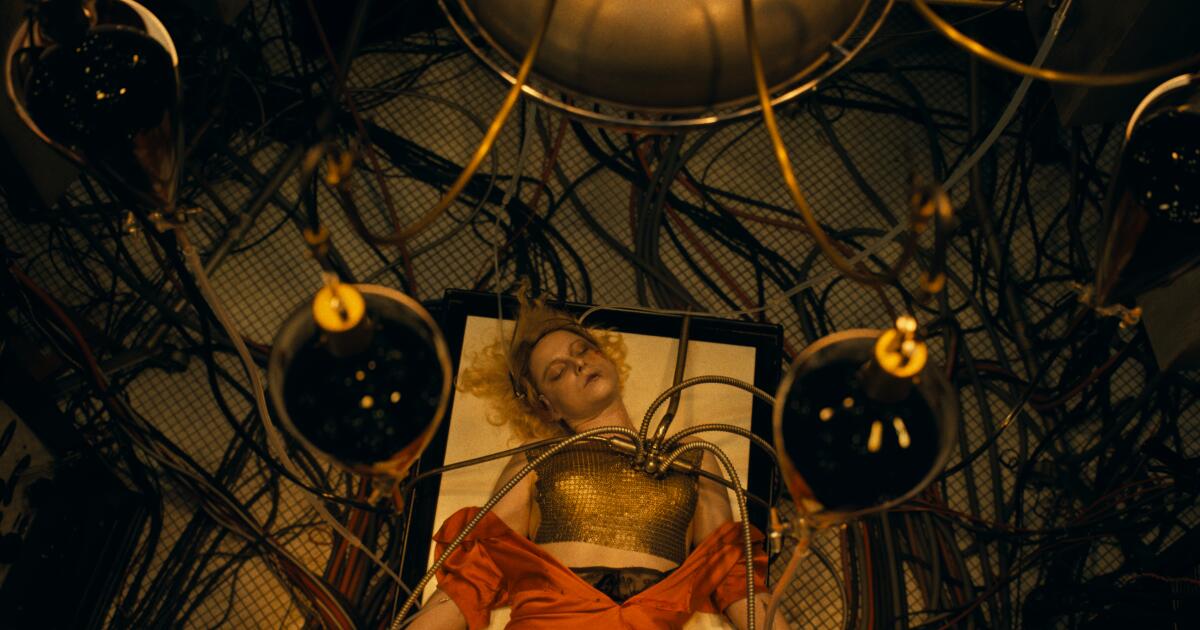
The Bride also looks dynamite in her bias-cut coral dress and peekaboo black lace bra. Her zapping turns her entire head of hair — not just a streak — shocking white à la Jean Harlow, and leaves an oddly-appealing black blotch on her cheek. It’s a fabulous look, at once sexy and frightful, with an element of cartoonishness as the movie sends her speeding around the country pursued by gangsters and the police, changing stolen cars but never her clothes.
The movie makes no secret of its phony mechanics. In one scene, the Bride is the most famous outlaw in America; in the next, a cop doesn’t recognize her at all. There are several moments that force you to accept that the characters can become psychic at will, including one where Frank somehow mind-controls a party to dance the jitterbug — heck, we almost believe that he invented it — and the smart move is just to give in and enjoy the number.
Whatever Gyllenhaal wants to do, she does, which becomes its own act of captivation and reckless empowerment. It helps that Buckley and Bale are terrific, as is the ensemble at large. The full force of Lawrence Sher’s cinematography, Karen Murphy’s production design and Hildur Guðnadóttir’s orchestral score is fabulous, combining to make something seedy, moody and extravagant.
Gyllenhaal’s love for other variations of this story is right up there onscreen with brash callbacks to Mel Brooks’ 1974 “Young Frankenstein” and the underrated “Frankenhooker.” Yet “The Bride!” isn’t just assembled from her passion for those movies. It seems to be made of every movie: a wild and playful and overbearing ambulation of references.
Almost every role is a Frankencharacter of the director’s cinematic obsessions, like Penelope Cruz’s lady detective who is named for “The Thin Man’s” Myrna Loy, acts like “His Girl Friday’s” Rosalind Russell, and dresses like Barbara Stanwyck in “Double Indemnity.” I suspect that Gyllenhaal’s favorite movie might be the same as my own, the bitterly nostalgic ’80s-does-’30s Steve Martin musical “Pennies From Heaven.” Watch it and tell me if you agree and even if you don’t, at least you’ll have seen one of the greatest films of all time.
There’s a scene in which Frank meets his own idol, an alt-world version of Fred Astaire (played by Gyllenhaal’s brother Jake, who is good at mugging and singing), and vomits his fandom at him until the actor recoils. The intensity of devotion can feel a bit like that. It also exposes that our culture is ready for its own shock of invention. Shelley spawned the entire genre of modern science fiction; today’s talents often feel like remix artists.
Like the mad scientists she’s sending up, Gyllenhaal goes too far. She triply underlines her feminist themes and nearly sabotages her own clever creation. Ironically, she doesn’t trust the audience to think for itself either. The overkill hits its nadir when the Bride repeatedly wails the survivors’ hashtag, “Me too!” But grab a scalpel and cut 10 minutes out of it and “The Bride!” would be a rip-roaring dazzler. This monster is more than alive, it’s allliiiiiive.
‘The Bride!’
Rated: R, for strong/bloody violent content, sexual content/nudity and language
Running time: 2 hours, 6 minutes
Playing: In wide release Friday, Mar. 6