James Ellroy on ‘Red Sheet,’ his new book
For 45 years, in his novels, short stories and essays, James Ellroy has been creating the definitive under-history of his Los Angeles hometown, mapping in his work the subterranean currents of power, corruption, sex and lies that have shaped the polity of the city. Ellroy’s latest is another compelling entry in his ongoing project.
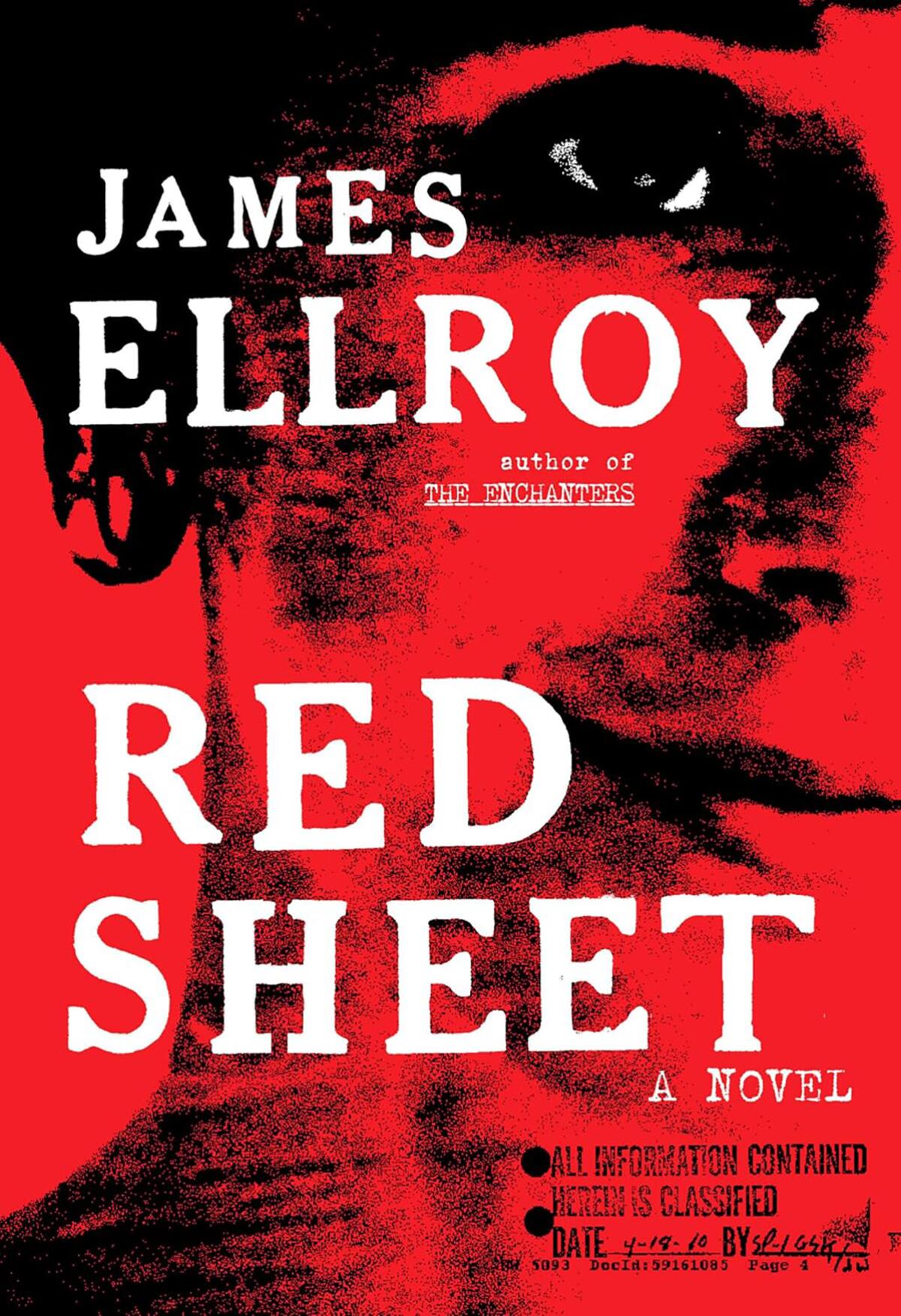
“Red Sheet” is a multilayered American epic that blurs fact and fiction, a deep dive into anti-Communist paranoia, from the corridors of City Hall to the dank precincts of the LAPD. The novel also marks the return of Fred Otash, a real-life Hollywood fixer whom the author has featured in previous novels, including his last book, “The Enchanters.” I recently talked to Ellroy about Otash, L.A. in the ‘60s and L.A. today.
✍️ Author Chat
Freddie Otash has been something of a twisted muse for you. In “Red Sheet,” Otash is an LAPD detective trying to smoke out Communist sleeper cells in Kennedy-era L.A. He was, in fact, a real person, a notorious Hollywood fixer. How did you first become aware of him?
I had seen a documentary about his specious role in the cover-up caper surrounding Marilyn Monroe’s death. I’d been hearing about him for years, and then I created the Jack Vincennes character who worked for scandal magazines in my book “L.A. Confidential,” played by the scurrilous Kevin Spacey in the vastly overrated movie of the same name.
Did you ever meet him?
Years ago I met a producer named James B. Harris, who produced all the old Stanley Kubrick movies and had optioned one of my early books called “Blood on the Moon.” I asked him if he knew Freddie Otash, and he said everyone in Hollywood knew Freddie Otash. I was planning my novel “American Tabloid” and so I arranged to meet him. He was unpleasant and charmless and way past his prime. I spent some time with him in Miami, where he was living in a place called the Jockey Club, and I had to listen to him talk about his many conquests of the world’s most beautiful and desirable women. I didn’t believe a word of it.
But he did have useful stories, I’m assuming.
Otash I used for the character Pete Bondurant in “American Tabloid.” We entered into a deal whereby I would pay him 10% of what Knopf was paying me in exchange for him keeping his mouth shut. He has become that valuable literary artifact: the great detective.

“Red Sheet: A Novel” by James Ellroy
(Knopf)
Your book deals with a piece of legislation called the Rumford Act that would tear down the city’s racist racial housing covenants in 1963, but the act in ’62 had enemies in high places, namely Mayor Sam Yorty and his power base. You were 14 in L.A. in 1962. Did you feel this racial tension?
I remember vividly how the world was changing. I knew there was de facto segregation in housing. I remember Nixon’s pathetic campaign for governor in 1962. But I remember racial barriers breaking down, particularly in school. Just talking with Black kids in school, because why wouldn’t you? And I had been this dumb, bigoted kid.
What’s interesting about the characters in your book is that their ideological alliances are quite fluid, depending on the circumstances. Communists are married to John Birchers, who may be, in fact, red-diaper babies, and so on.
People are endlessly complex. Going back to Freddie Otash again. He knew Tom Bradley in the ‘40s, when Bradley was a cop. And Freddie becomes a bag man for the civil rights movement, and the Rumford Act in particular. He’s about the most unlikely guy you would expect to support civil rights. I wanted to show [how] complex human beings and their beliefs can be, and this book is a primer on that.
You are so closely associated with Los Angeles, and you lived here for most of your life. Why do you live in Denver now?
Helen Knode is my all-time life partner, who is also my second ex-wife. Ten years ago, we decided to get back together, but she was living in Colorado. She came up with the idea of me getting a loft in her building, and we would have the keys to each other’s places, and that’s why I did it. I like it in Denver, though it’s quite hot at the moment.
Do you miss L.A? What are you feeling about the city now?
I was just there on my book tour. I feel like it’s a complete dump. It’s just totally run-down. When I got off the airplane, I noticed a smog layer, so smog is back. I saw many young, odd-looking, overly adorned young people. I don’t know. … It’s a kid’s town now, to a certain extent.
This Q&A was edited for length and clarity.
📰 The Week(s) in Books

Country music performer Kenny Chesney sat down with Holly Gleason, the co-author of his new memoir, to talk about writing the book.
(Jill Trunnell)
Greg Sarris is the chairman of the Federated Indians of Graton Rancheria in Sonoma County. He’s also an acclaimed novelist whose his first book in 28 years, “The Last Human Bear,” is loosely based on the life and teachings of Pomo spiritual leader Mabel McKay, a constant lodestar for Sarris. “An American Indian woman is as richly complicated as anybody else. I wanted to show this rich and complicated character who’s negotiated a history that she’s showing you,” Sarris tells Maddie Connors.
In “Daughters of the Sun and Moon,” author Lisa See excavates the events surrounding the Chinese Massacre of 1871. In doing so, she also digs into her own Chinese heritage in L.A. “My great-grandfather’s fourth wife was 16 when he brought her here, and she was never let out,” See tells Emily St. Martin. “My mom used to say these women would all get together, and she used to describe it as birds twittering together, because they actually had this opportunity to be with each other, but on really very rare occasions.”
Fear not, literary Cassandras: Authors can still generate online heat, thanks to BookTok and other social media outlets. So much so that more books are being adapted into streaming content than ever before. “With the advent of BookTok, it allows you to have so much social chatter around these authors,” producer Bryan Unkeless tells Gary Goldstein. “They’re becoming new rock stars, in a way.”
Finally, Kenny Chesney sat down with Holly Gleason to discuss their collaboration on “Heart Life Music,” Chesney’s new memoir. “I didn’t know if there was a story there,” the country megastar tells Gleason. “Over time you wore me down, to make me pause and … reflect.”
📖 Bookstore Faves

The interior of Counterpoint Records & Books.
(David Jones)
In a city that has so often seen its old-school retail businesses turned into nail salons and real estate offices, Counterpoint Records & Books remains an outlier. Originally established in 1979 by John and Susan Polifronio, the store on Franklin Avenue has remained, even as many of its nearby store-mates have shuttered, offering a well-curated selection of secondhand books and records from every conceivable genre. I chatted with David Jones, who is one of the owners of the Franklin Avenue store, about Counterpoint’s enduring success.
Counterpoint is an Eastside institution, but businesses along your strip on Franklin have gone under while you have survived. What is the secret to your longevity?
Firstly, we are lucky enough to own the building we do business in, which has given us a lot of freedom to be able to pursue doing business our way. That didn’t happen until we were in business for almost 20 years, but now in our 47th year we feel lucky to be able to continue to provide a physical, in-person shopping experience. I think our success is tied to this. People are looking for an experience away from their screens, and I think we provide that without being anachronistic or nostalgic by keeping up with and stocking contemporary music, digital media and all types of books.
Is your clientele mostly local? I’m guessing it’s a multigenerational clientele, given the store’s long history.
We definitely have a younger demographic these days, but we have a very intergenerational staff, and I think that attracts an all ages clientele. We meet folks daily from all over the world as a destination that people return to and tell their friends about. I think word-of-mouth is our greatest form of outreach. People say we feel special to them, as if they’ve stumbled onto a secret by shopping here. It’s something I love and am very proud of.
How have books maintained their staying power despite the countless distractions of daily life?
I think of it as one of life’s greatest luxuries. To be honest, I never thought too much about the staying power of books until the pandemic. During that time, people would come in and thank us for being open and a place they could come to escape what was happening. It was a real turning point for me. I started to think more about the importance of what we do and how much of an effect it has on people. I never took what we do for granted, but it gave me a sense of urgency that I didn’t quite have before.
Counterpoint Records & Books is at 5911 Franklin Ave. in Hollywood.
(Please note: The Times may earn a commission through links to Bookshop.org, whose fees support independent bookstores.)