Elizabeth

‘The Gray House’ review: An uninspired Civil War drama

“The Gray House,” a limited series now streaming on Prime Video, purports to tell the fact-based story of Elizabeth Van Lew, who spied for the Union in the Civil War while living in the midst of Southern society in Richmond, Va. And in very broad terms it does, though it fills up the space within those outlines with an army of imagined details and melodramatic plots and subplots.

It is not the first work for the screen that betrays history by attempting to make it more exciting than it already is, and if you go in ready not to wonder or care what did or did not actually happen, and which characters are real or invented, you may make out alright. (If you do care, there is Gerri Willis’ 2025 volume “Lincoln’s Lady Spymaster: The Untold Story of the Abolitionist Southern Belle Who Helped Win the Civil War.”)

So I will not ring a bell every time the miniseries, which admittedly bills itself as “inspired by a true story,” diverts from the record, even though in my head it may be clanging.

It’s July 4, 1860, nine months before the beginning of the Civil War. Elizabeth (Daisy Head) lives in a mansion in Richmond with her mother Eliza (Mary-Louise Parker), and the two are throwing a party. Guests, including the historical Swedish novelist and social reformer Fredrika Bremer (Oxana Moravec), congressman Sherrard Clemens (Ionut Grama), Virginia Gov. Henry Wise (Mark Perry) and his awful son Obie (Blake Patrick Anderson), unload expository dialogue and provide a primer for anyone not acquainted with the roots of the Civil War. Meanwhile, a runaway slave shows up out back, pursued by hounds, having heard that the Van Lew house is the place to run for help. The women, who are against secession and for abolition but are practiced in the art of deceiving their neighbors, are involved with the Underground Railroad in some way that’s not exactly clear.

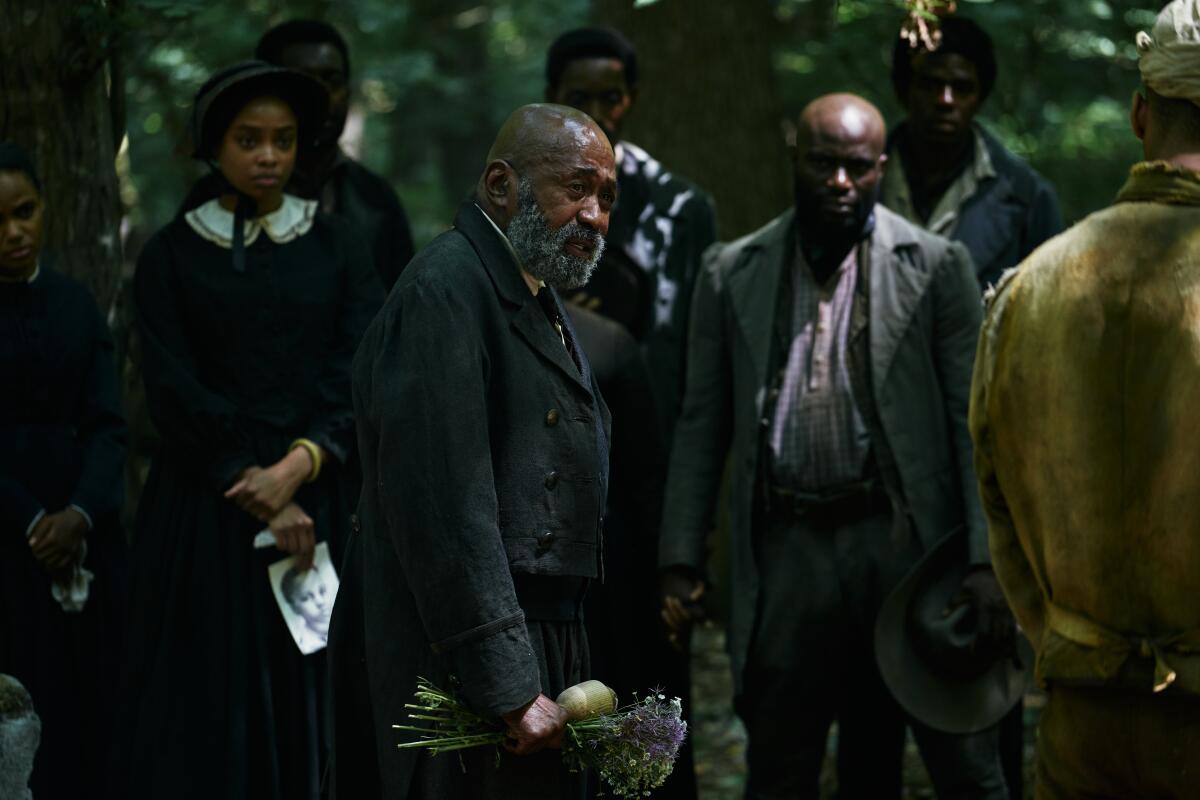
Among their servants — the Van Lew slaves were (secretly) freed upon the death of Elizabeth’s father — are head porter Isham, played by Ben Vereen, who it is a pure pleasure to see back on screen, and Mary Jane (Amethyst Davis). A well-educated, determined young woman who is just back from Liberia, which did not suit her — she calls it a “tricky little way of ridding America of free Blacks” — the series gives her a lot of agency and makes her a virtual partner in the spy ring. White and Black, they live as much like a family as is possible when some people are labor and others are management and it’s the antebellum, then the wartime South.

Also involved in Elizabeth’s tradecraft are Scottish baker Thomas McNiven (Christopher McDonald) and Clara Parish (Hannah James), a beautiful prostitute who dreams “of Bronte’s moors” and gets, of all things, a big musical number in an out-of-place Western saloon, like Marlene Dietrich in “Destry Rides Again.” (The saloon is a standing set at Castel Film Studios in Romania, where the production was based; their backlot Western street, too, makes an implausible appearance.)

A man in a dark suit walks with a bouquet clenched in one hand as a line of people watch him.

Ben Vereen as Isham Worthy, a porter in the Van Lew home.

(Bogdan Merlusca/Prime Video)

Out of the loop are Elizabeth’s brother, John (Ewan Miller), whose heart is in the right place, but who’s married to Laurette (Catherine Hannay), whose heart is not. An avaricious, envious flirt on the undisguised lookout for something better, she is angry that John wouldn’t use slave labor to build their house. She’s Scarlett O’Hara, minus the intelligence and charm.

Calling roll on the enemy, we find present Confederate President Jefferson Davis (Sam Trammell), in whose house — the eponymous Gray House — Mary Jane will be embedded, with a cocked ear and a photographic memory, to gather intel; Secretary of War (and then State) Judah P. Benjamin (Rob Morrow), who has a thing for Clara, to whom he opines on property rights while they share a bathtub; and a pip-squeak John Wilkes Booth (Charles Craddock), popping in and out no reason, unless it’s to foreshadow the death of Lincoln (who makes a rearview cameo), or just because everybody’s heard of him. Below them, but more in the action, are the nasty, thuggish Sheriff Stokely Reeves (Paul Anderson) and slave hunter Bully Lumpkin (Robert Knepper); and while thuggery and violence were endemic in a racist South, caricature and cliche do your history lesson no favors, however valuable it is.

Because Hollywood hates, let’s call it a love vacuum when it comes to screen heroines, Elizabeth will find herself the object of not one, not two, but (at least) three admirers, who prize her brains and spirit and talent for conversation. (She is no frilly, fizzy, fuzzy Southern belle, like the mean girls around her sister-in-law.) There is Hamton Arsenault (Colin Morgan), a sort of Rhett Butler lite, visiting from New Orleans with a huge live alligator, because I guess that’s something you could manage in 1860 just to make a splash at a party a thousand miles away. Capt. William Lounsbury (Colin O’Donoghue) is a dashing Union officer, escaping a Confederate prison, who passes through the Van Lew house on the way to freedom; they click together like Legos. Finally, there’s shy puppy dog Erasmus Ross (Joshua McGuire), who works at the Van Lew’s hardware store and will later have a post at a prison for captured Union soldiers, which the Van Lews will turn to their advantage.

“The Gray House” isn’t all bad, and its intentions are good, but it’s dramatically predictable and at eight episodes, some over an hour, goes on much, much longer than it needs to, letting scenes play out past profitability and wasting time on extraneous subplots involving minor characters — and minor minor characters — that do nothing to enrich the fabric of the show. A duel between two characters with no significant connection to the rest of the story exists here seemingly just because their historical counterparts did fight one, and gives the filmmakers the chance to add a duel — on horseback, like jousting with guns — to the show.

Parker is always fine, though the part requires a bit too much Southern breathiness. Davis and Head make strong impressions, masking the pedestrian, sometimes cornball dialogue. (The miniseries was written by Leslie Greif and Darrell Fetty, who collaborated on “Hatfields & McCoys”, with an undiscernable assist from John Sayles.) Keith David, who plays real-life activist minister Henry H. Garnet, gives a seven-minute speech on education as if he’s performing a Shakespearean monologue, after which he faces down a murderous sheriff like he’s Shaft. It’s a high point of the series, and the one scene I was happy to see go long.

Directed by Roland Joffé, who four decades ago was Oscar-nominated for “The Killing Fields” and “The Mission,” the production is a mixed bag; much care has been lavished on the costumes; the crowd scenes are well populated; printed material is done really well. (It matters.) Battle scenes — including Bull Run, where picnicking tourists are accurately shown in attendance — are convincingly rendered. But Romania, whether on or off the studio lot, only occasionally musters a decent impression of 19th century Virginia, reminding you, as “The Gray House” often does, that this is only a movie.

Source link

Sen. Elizabeth Warren makes first major step toward Democratic White House bid

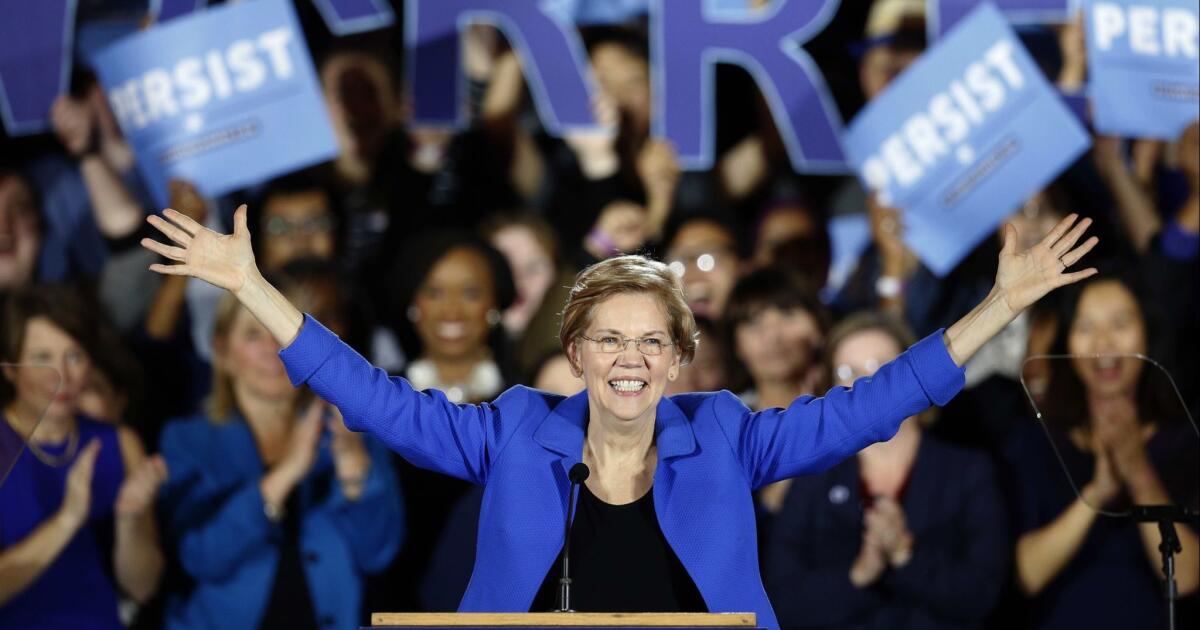
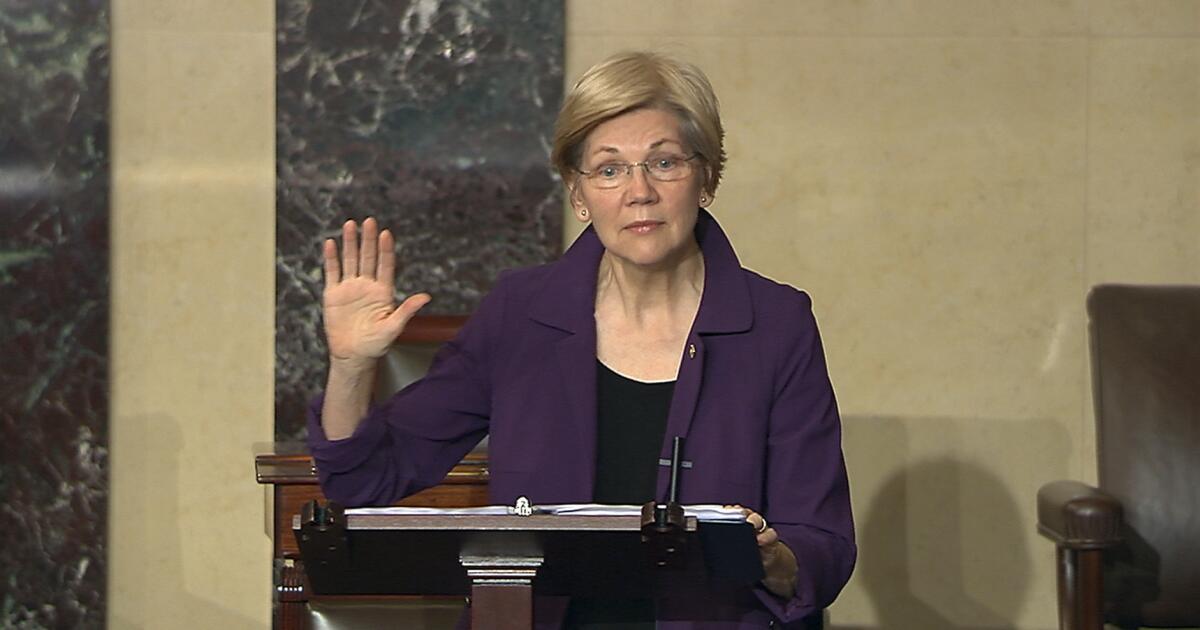
Sen. Elizabeth Warren took the first major step toward a White House run Monday, announcing a presidential exploratory committee as she attempts to redefine populism for the left in the age of Donald Trump.

“These aren’t cracks that families are falling into. They’re traps. America’s middle class is under attack,” the Massachusetts Democrat said in a 4½-minute video posted online. “Billionaires and big corporations decided they wanted more of the pie, and they enlisted politicians to cut ’em a fatter slice.”

Aside from a few images of Trump and polarizing figures in his administration, Warren’s largely biographical video steered clear of directly taking on the president. Instead, it echoed some of the complaints that brought him to power by asserting that “corruption is poisoning our democracy” and that government has “become a tool for the wealthy and well-connected.”

Warren is the biggest name to take a formal step into a race that is expected to feature a historically large primary field for a party that is eager to displace Trump in the White House.

A fundraising juggernaut who was among the first to tap into the anger of a resurgent left, Warren figures to be a major factor in the Democratic primary with a significant chance of winning the nomination.

Some detractors say Warren would have a hard time in a general election, however, both because some voters see her as too far to the left and because the former Harvard University law professor’s style can appear pedantic and lecturing to some ears. She has also been dogged by controversy over her thin claims of Native American ancestry.

But she has proved adept at capturing the frustrations and aspirations of many on the left. She’s skilled at putting core beliefs about the need for government regulation and income distribution into simple terms on videos that go viral. And she has successfully used her position on Senate committees to grill administration figures from both parties whom she has accused of going easy on big banks and other powerful players — attracting accusations of grandstanding from detractors.

“I’m in this fight all the way,” she said at a Monday afternoon news conference in Cambridge, Mass., using her favorite word, “fight,” multiple times.

The rhetoric puts her at the forefront of an intraparty debate over how best to take on the president. Warren believes in a combative approach based on a left-wing alternative to his right-wing populism.

She has long positioned herself as a fighter — years ago saying she had “thrown rocks” at those in the wrong. She relishes an image as a leader who will not back down, even in occasional battles against her own party.

“She was a pioneer of a lot of the populist themes that are coursing through the veins of Democratic primary voters, and she’s able to channel their frustration at the current administration,” said Colin Reed, a consultant who has run a campaign against Warren and later headed a Republican opposition research group.

Like Trump, Warren attempts to channel the anger in the middle class over the decline in employment in the nation’s industrial base and stagnant incomes for a large share of American workers.

Unlike Trump, she favors more government regulation and spending — including Medicare for all — to lift more people from poverty. She also opposes him on the long list of issues of cultural and ethnic diversity that have become litmus tests for both parties.

Warren, a policy wonk, is also far different from Trump in governing style and temperament.

Other potential candidates say a more uplifting message is needed to counter Trump’s grievance-filled politics. Warren, asked about her polarizing reputation on Monday, was unapologetic, saying those unhappy with her are the drug companies, big banks and others who benefit from the status quo.

In announcing on New Year’s Eve, Warren jumped ahead of several Senate colleagues who are expected to join the race soon, including Sens. Kamala Harris of California, Bernie Sanders of Vermont, Kirsten Gillibrand of New York, Sherrod Brown of Ohio, Amy Klobuchar of Minnesota and Cory Booker of New Jersey. Rep. Beto O’Rourke of Texas and former Vice President Joe Biden are also among the long list of Democrats considering the race.

Warren, who is completing her first term in the Senate, is 69, younger than Trump and other potential front-runners such as Biden and Sanders, but far from the generational change some in her party are urging.

Her early entry into the 2020 primary race, on the last day of 2018 calendar year, demonstrates the eagerness of potential candidates to stake a claim on party support, fundraising and public attention.

She is entering the primaries at a time when the Democratic Party is not only grappling with its economic message; it is also trying to come to grips with its increasing diversity. Hillary Clinton’s failure to energize enough voters of color was one of many reasons she could not defeat Trump, and many Democrats believe that they must make a stronger appeal to minority voters.

Warren, whose base of support in Massachusetts is largely white, signaled her intent to court minority voters in her launch video, which showed clips of her marching in an LGBTQ parade in a feather boa and attacking Trump’s divisiveness while pointing to the harsher effects that economic inequality has had on people of color.

Trump has gone after her repeatedly, mocking her claims to Native American heritage with the nickname “Pocahontas.”

In a Fox interview Monday, Trump continued to belittle her, saying he would “love to run against her” and attacking her mental fitness by saying “you’d have to ask her psychiatrist” whether she could win the election.

Warren’s attempts to put the Native American controversy to rest, including a DNA test this year that showed trace genetic links to Native American peoples, have largely fallen flat, drawing criticism not only from Republicans but prominent Native Americans as well.

Several reviews of her records, including an exhaustive investigation by the Boston Globe, have found that her ethnicity claims played no role in her hiring at a series of law school jobs, including at Harvard.

“Her message is a resonant one, but in terms of the messenger there are questions that weren’t there a few months ago,” said Tracy Sefl, a Democratic consultant who has been involved in many presidential races.

Sefl called the imperative to defeat Trump in 2020 “almost beyond description” and said “Democrats will be less inclined to choose a messenger who’s been called into question.”

Warren has tried to counter another potential liability — her image as part of the coastal elite — by telling her life story, which she also highlighted in Monday’s launch video.

She grew up in Oklahoma to middle-class parents. Her mother took a job at Sears when her father was unable to work following a heart attack.

A champion high school debater, she was able to make it to college and then law school while also starting a family.

Those early struggles fit within her economic argument that middle- and working-class families are often left without a safety net in the face of healthcare emergencies and other setbacks.

As a member of the Democratic minority in the Senate, Warren can’t claim many legislative accomplishments, but has succeeded in commanding attention.

She has kept financial regulation at the center of her message, the issue that brought her to prominence as an academic and allowed her to first make her mark on national politics while serving as a special advisor in the Obama administration. In that role, she advocated for and helped establish a consumer protection agency as part of the financial services and banking overhaul passed in the aftermath of the financial collapse.

Warren, a longtime critic of Wall Street, was passed over by President Obama to lead the agency on a permanent basis after Republicans made it clear they would fight her nomination. She ran for the Senate instead, winning her first term in 2012.

Despite hostility toward her policies from the financial industry, which contributes heavily to many candidates in both parties, Warren has been an especially strong fundraiser since entering politics. In her first Senate race, she raised what were then record levels of donations in both small online contributions and larger sums from the party’s big players.

She is a large draw on the campaign trail, where she gestures emphatically as she talks about what she characterizes as the “rigged” system that favors the wealthy and well-connected at the expense of middle-class people.

Warren stayed out of the 2016 race, believing Clinton was unbeatable in the primary. Since then, other contenders for the White House, including Sanders, have captured much of the attention and energy that had been directed toward her.

Questions intensified about whether her moment had passed after signs of somewhat tepid support cropped up in her home state this year.

She easily won reelection against an unknown candidate, drawing 60% of the vote, but her vote total was lower than that of Gov. Charlie Baker, a Republican, and polls showed the majority of Massachusetts voters did not want her to make a presidential run. Many Democrats preferred former Gov. Deval Patrick, who recently bowed out.

The Boston Globe editorial board, one of the most liberal in the country, urged her to reconsider a bid, saying she had become a “divisive figure” on the national stage.

“There’s no shame in testing the waters and deciding to stay on the beach,” the board wrote.

Follow the latest news of the Trump administration on Essential Washington »

noah.bierman@latimes.com

Twitter: @noahbierman


Source link

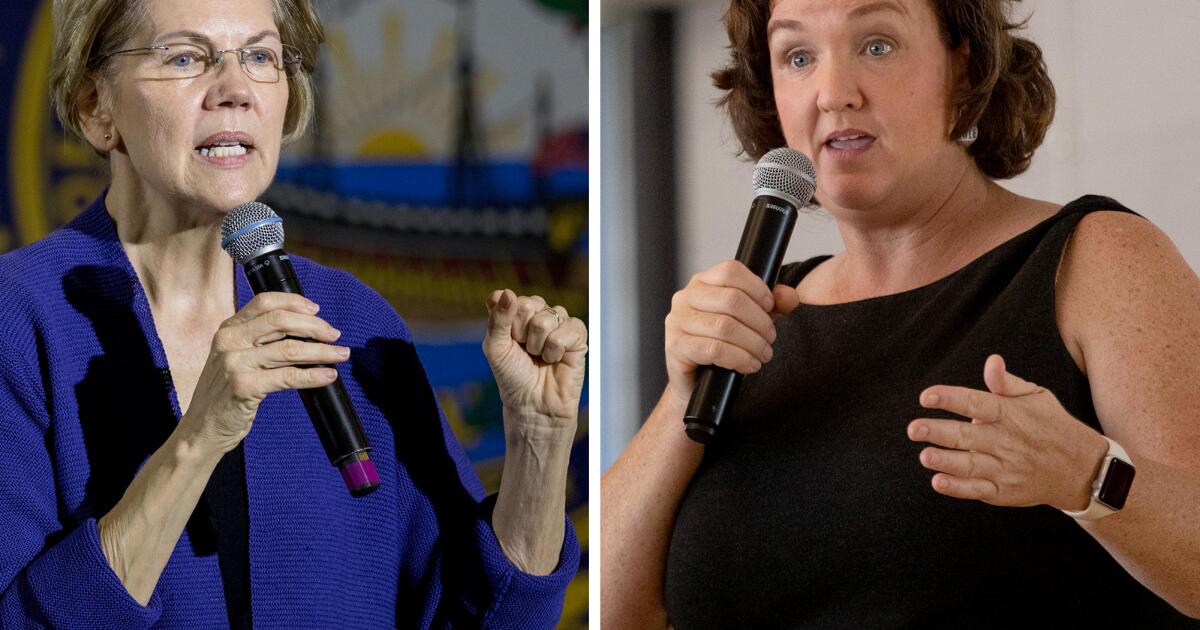
Sen. Elizabeth Warren endorses former Rep. Katie Porter for governor

Sen. Elizabeth Warren (D-Mass.) endorsed former Rep. Katie Porter, her protege and former Harvard Law School student, for California governor on Thursday.

“From the moment Katie set foot in my consumer law class, I knew that she would be a warrior for working families,” Warren said in a statement, citing Porter’s work on the foreclosure crisis as well as her questioning of corporate leaders and members of the Trump administration while wielding a white board in hearings when she represented an Orange County district in Congress.

“No one will stand up to Trump with more grit and determination than Katie,” Warren said. “But just as importantly, she will champion the kind of bold, progressive vision that California workers and families deserve.”

The endorsement comes on the cusp of the California Democratic Party’s convention in San Francisco this weekend, at a time that there is no true front-runner in the crowded race to replace termed-out Gov. Gavin Newsom.

Porter was initially viewed as having a potential edge in the race, but her prospects dimmed after videos emerged in October of the UC Irvine law professor scolding a reporter and swearing at an aide. She expressed remorse for her behavior.

Warren and Porter, who met more than two decades ago, have a long-standing relationship, to the point that the senator is the namesake of one of Porter’s children.

Porter endorsed Warren during the 2020 presidential campaign, which caused consternation among some California Democrats since then-Sen. Kamala Harris, who as state attorney general appointed Porter in 2012 to oversee a $25-billion mortgage settlement with the nation’s top banks, was also running for the White House.

Porter pointed to their shared values, such as fighting to protect consumer protection in Congress, as she responded to Warren’s endorsement.

“Senator Warren and I fought together in Congress to hold Big Banks and giant corporations that cheat the American people accountable,” Porter said. “From the classroom to the Capitol, we have made … fighting for working families our lifework. I’ll be a governor who is unbought, undeterred, and unwilling to continue the special interest status quo that has left too many Californians behind.”

Source link

Five documentaries better than Netflix’s Kidnapped: Elizabeth Smart

These true crime documentaries are much better than Netflix’s latest

Documentaries can offer substantial insight into the lives, crimes and untold stories behind some of the biggest headlines worldwide, whether they’re examining the past or exploring current affairs. The market has become saturated with stories, particularly when it comes to true crime.

Netflix’s Kidnapped: Elizabeth Smart is no exception to this rule. The streaming platform continues to captivate viewers with almost unbelievable stories and a stereotypical, predictable twist that leaves people craving more.

That’s how they draw you in each time they promote a new, never before told story. Elizabeth’s story concerns a teenage girl snatched from her bedroom at knifepoint in Salt Lake City, Utah, back in 2002.

The case is described by Netflix as “one of the most intense and widely covered missing-persons cases America has ever seen”, and whilst that may hold true across the Atlantic, it doesn’t quite resonate in the same way over here.

It’s a story told in her own words; the ending being spoiled across the numerous adverts plastered on the streets of London. The first half of the documentary would have you believe the worst had happened, but the revelation of a middle-aged Elizabeth recounting her experience living off-grid in captivity makes the entire story even more unbelievable, though not in a mind-blowing way.

In truth, once the twist was unveiled, the documentary never really gained momentum or suspense. Instead, it followed the same pattern as many other Netflix documentaries. The case of Elizabeth Smart will, regrettably, be consigned to the pile of documentaries that caused a ripple, not a wave.

This isn’t the case for all documentaries, as some continue to leave a lasting impression on me years later. Documentaries need to stir you, to provoke you, to make you question the very fabric of society.

They don’t need to be packed with twists and turns purely for the sake of shock value.

Unknown Number: The High School Catfish (2025)

One recent Netflix documentary that hits the mark is Unknown Number: The High School Catfish, which focuses on a teenage couple terrorised by a troll at the end of a phone line. It all started with a text message.

The relentless torment of Michigan high school students Lauryn Licari and her ex-boyfriend, Owen, led to an investigation that pointed to a multitude of potential suspects. Classmates, friends, even family members are drawn into the spotlight.

For this small town, it was a real-life whodunnit. The abuse hurled at the teenagers goes beyond simple bullying, with death threats, sexually explicit messages and horrific rumours lurking around every corner. The youngsters’ lives were deeply affected, as they recount the events as 18 year olds.

The most shocking part? The identity of the person behind those messages. I won’t ruin the surprise, but be prepared for your eyes to bulge and your jaw to drop.

You’ll never view an anonymous text message in the same light again.

The Keepers (2017)

In a similar vein to Netflix’s Making a Murderer, The Keepers delves into the unsolved murder of nun Catherine Cesnik in 1969.

Her former pupils suggest there was a cover-up by authorities after Sister Cathy suspected a priest had sexually abused students at Baltimore’s all-girls Archbishop Keough High School.

Now adults, the former students share their experiences at the Catholic school with those in positions of power there and within the local church, including sexual abuse, intimidation, and one student even witnessing the body of a deceased nun.

The Keepers transitions from the disappearance and murder of the nun to the concealment of abuse perpetrated by prominent members of the Catholic church, and the survivors’ ongoing battle for justice decades after the crimes. For true crime enthusiasts, sadly, there is no definitive answer as to what happened to Sister Cathy, but perhaps one day there will be.

Blackfish (2013)

There’s an old adage about not interfering with nature, and that extends to the animal kingdom. Blackfish examines the captivity of Tilikum, an orca implicated in three fatalities, including that of SeaWorld trainer Dawn Brancheau, and explores the ramifications of confining orcas in such environments.

The film reveals the circumstances surrounding Tilikum’s capture back in 1983, the treatment marine creatures endured at various marine parks, and the orca’s interactions with trainers and other orcas. It’s essential viewing, though not suitable for those easily disturbed.

This documentary will make you reconsider ever visiting or financially supporting SeaWorld again.

When Louis Met… (2000) & Louis Theroux, Savile (2016)

Having established himself as a familiar face over the decades, Louis Theroux launched his documentary career with his Weird Weekends, immersing himself in the lives of others. He explored an array of unconventional and controversial subcultures, crime and the justice system, and celebrities.

Louis’ awkwardness is also his charm, something audiences have grown accustomed to witnessing over the years. Brits will appreciate his idiosyncrasies and intellect.

His most notorious work involves his encounters with former “childhood hero” Jimmy Savile, a story he revisits 16 years after his initial documentary with him.

The first documentary examined Savile’s ascent to stardom as a TV and radio presenter, alongside his domestic life. Whilst Theroux briefly touches upon the allegations of paedophilia and sexual abuse, Savile dismisses them with laughter.

It wasn’t until 2012 that the world was made aware of the true scale of Savile’s offences, exposing a host of predatory individuals in the aftermath of Operation Yewtree. In his 2016 film, Louis revisits his past association with Savile and converses with some of Savile’s victims and those who worked closely alongside him.

Given our current knowledge, it’s challenging to look back and not see the rumours as glaringly evident. How? Who? Why? For how long?

One is almost at a loss for words contemplating how a public figure, swamped with these types of allegations, was permitted to continue, and who was shielding him. The 2016 documentary prompts not only Louis but an entire generation to question what they believed they knew.

If you want ideas and inspiration to plan your next UK adventure plus selected offers and competitions, sign up for our 2Chill weekly newsletter here

Source link

Margot Robbie wows at film premiere wearing eye-wateringly expensive necklace once owned by Elizabeth Taylor

ACTRESS Margot Robbie hits a Hollywood height at her new film’s premiere — wearing a £6million necklace once owned by Elizabeth Taylor. 

The Taj Mahal diamond is a heart-shaped gold pendant set in jade and hanging from a gold, ruby and diamond chain made by Cartier. 

Margot Robbie dazzles at the Wuthering Heights premiere in a £6million necklace once owned by movie star Elizabeth TaylorCredit: Getty
Margot stuns at the Los Angeles premiereCredit: Getty
Elizabeth Taylor wearing the necklace, pictured with Richard Burton and Grace KellyCredit: Getty

It was given to Elizabeth by fifth hubby Richard Burton for her 40th in 1972. 

Margot wore it to the world ­premiere of Wuthering Heights in Los Angeles, where she was earlier joined by co-star Jacob Elordi and singer Charli XCX, who recorded the film’s soundtrack. 

The actress, Cathy in the adaptation of Emily Bronte’s 1847 novel, said the necklace was poignant as it had “a lot of romantic history”. 

She said: “It’s our big Hollywood world premiere — we’ve got to go all out. 

NATURAL NIGE

Nigella Lawson goes make-up free & seen for first time since Bake Off job


BABY BOOM

Meghan Markle’s Suits co-star Patrick J Adams welcomes third baby

“This is Elizabeth Taylor’s necklace. It’s the Taj Mahal diamond that Richard ­Burton gave to her. 

“There’s something kind of Cathy and Heathcliff about ­Richard Burton and Elizabeth Taylor in my mind, so it felt appropriate.” 

The diamond was created for a 17th century Mughal emperor who ­commissioned the Taj Mahal.

It was later acquired by Cartier, with Burton buying it from them to give to Elizabeth. 

Following her death in 2011, it was sold at ­auction for £6million to an anonymous buyer. 

The Taj Mahal diamond is a heart-shaped gold pendant set in jade and hanging from a gold, ruby and diamond chain made by CartierCredit: AFP
Margot with co-star Jacob Elordi and singer Charli XCX, who recorded the film’s soundtrackCredit: Getty

Source link