‘The Testaments’ review: A timely portrait of women and indoctrination
When the Hulu adaptation of Margaret Atwood’s “The Handmaid’s Tale” premiered during the early months of the first Trump presidency, it was seen by many as a timely prophecy — the crimson cloaks and white bonnets of the story’s eponymous sex slaves became a symbol of protest against a president who, though not a religious man himself, embraced many policies supported by the far-right Christian minority, especially those regarding the reproductive and civil rights of women.
This was not the plan, of course, or at least not as regards the Trump factor. The book was written in 1985, the show greenlit long before Trump became president, which only proves the grim resilience of Atwood’s themes. So it shouldn’t be surprising that the sequel series, “The Testaments,” also has name-specific cultural resonance. Plum-cloaked in a YA-leaning, high school drama that owes as much to “Pretty Little Liars” or “Gossip Girl” as it does to “The Handmaid’s Tale,” “The Testaments” gives us an apocryphal version of the Epstein files.
Based on Atwood’s 2019 Booker Prize-winning novel, “The Testaments” takes place some years after the final events of “The Handmaid’s Tale” series and revolves around Ardua Hall where Aunt Lydia (Ann Dowd), having regained her Gileadean status, oversees the instruction of young women as they prepare to take up their lives as obedient wives and, Under His Eye, fruitful mothers.
Agnes (Chase Infiniti) is our initial central character and narrator. Though we know from her backward-looking tone that change is coming, her initial main worries are her mean stepmother and when (or if) she will finally begin to menstruate. She and her friends — Becka (Mattea Conforti), Shunammite (Rowan Blanchard) and Hulda (Isolde Ardies) — have all graduated from the “Pinks” (little girls) to the “Plums” (young women) but only Becka has achieved the “blessing” of menarche, which means she can now be chosen by an unmarried (or widowed) Commander or other man of lesser rank.
This particular form of reaping occurs midway through the season at a dance where all the eligible girls meet with all manner of young bachelors, only to discover that the oldest and most powerful members of the elite get first choice. Watching as the men joke among themselves before staking their claims, it is difficult not to think of Jeffrey Epstein parceling out young women to his powerful male friends (albeit not for marriage).
Though touched on throughout “The Handmaid’s Tale,” the horrifying connection between status and the systematic procurement of women is the sinister force that drives “The Testaments.” A global infertility crisis may have been the catalyzing force for Gilead’s rise but this “privilege” of power is not about repopulation; Agnes and the Plums are simply victims of sexual grooming taken to its pathological conclusion.
Becka is the only one who is less than thrilled by her “prospects” — everyone else, including Agnes, can hardly wait to be married off and, with any luck, quickly become pregnant (not that they know anything about sex, forced by the state or otherwise).
Having been raised in a beautiful home with no material wants, Agnes knows little about the outside world. Like most women in Gilead, she is not allowed to read or write, and she and her friends coolly accept public executions, torture and other means of corporal punishment as the inevitable consequence of breaking any of the many rules drilled into them. They accept that their bodies are instruments of the devil designed to compel men to commit lustful acts and that they are responsible for ensuring that this does not happen.

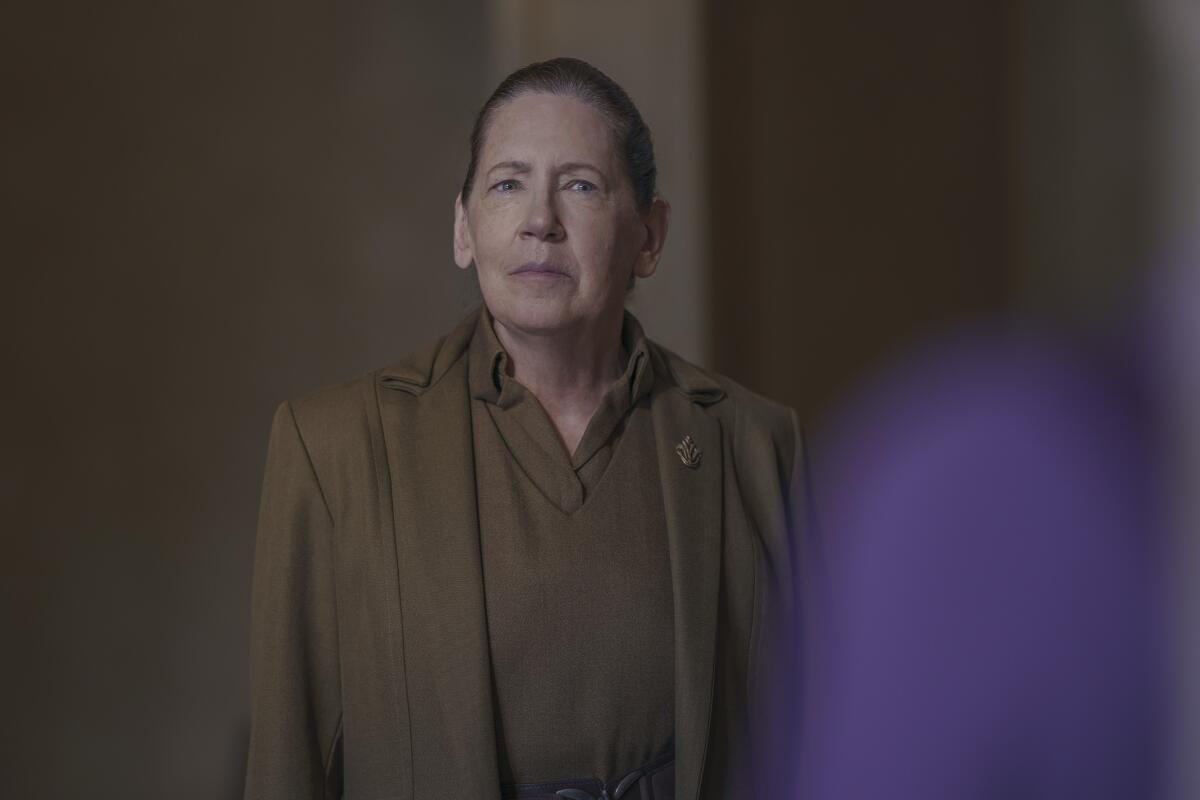
Ann Dowd reprises her role as Aunt Lydia in “The Testaments.”
(Russ Martin / Disney)
But girls will be girls and even under the stern eye of Aunt Vidala (Mabel Li) and the more kindly countenance of Aunt Estee (Eva Foote), they tease each other and romp together, compare hairstyles and trade snarky comments about the Aunts as they dream of a happy ending.
In its own way, that’s even more chilling and resonant than the horrors of “The Handmaid’s Tale.” Enslavement will always require some level of violence, but violence tends to spark rebellion — indoctrination is always more effective. Training people to believe they are fated, or even happy, to live without freedom, rights or real choice is the only way a totalitarian society can survive.
Showing this is far less exciting than the images of grown women being killed or stripped of their rights as presented in “The Handmaid’s Tale” (though “The Testaments” does offer a few very chilling flashbacks). But as social commentary, it’s difficult to beat the sight of young women, recognizable in so many ways as modern teens, complying with their own enslavement, out of ignorance and, as events proceed, the gut-wrenching fear of what the truth might mean.
Gilead’s future hangs on whether the Plums remain ignorant and compliant, as does the story of “The Testaments.” Agnes may not share Becka’s unhappiness with forced marriage, but she is soon given other things to worry about, including a growing attraction to one of the Eyes who guards her and a request to mentor one of the school’s new “Pearl Girls.” These young female missionaries, dressed in white, have been sent into Canada to draw girls to Gilead’s cause. Among the recruits is Daisy (Lucy Halliday), who Aunt Lydia puts under Agnes’ care.
Shunammite, the sharpest-tongued of Agnes’ friends, is convinced Daisy is a spy. Daisy, whose backstory includes, in the first episode, a brief glimpse of Elisabeth Moss’ June, certainly upsets things, most often by reacting to Gilead’s penchant for public atrocities the way a non-sociopath outsider would.
Over the course of the season (upon which many, many plot-point embargoes have been placed), Agnes and Daisy form a bond that threatens Agnes’ worldview, as well as her friend group. The novel “The Testaments” is a much larger and more complex book than “The Handmaid’s Tale.” Each are presented as historical records of a government long gone, but where Bruce Miller, who adapted both, had to first spin a series out of “The Handmaid’s Tale’s” relatively short and fairly elliptical story, he has much more to work with here.
He does so carefully, and perhaps a tad too slowly. Much of the first season is spent getting to know the girls, especially Agnes (whose pre-Gilead identity is obvious to anyone who read or watched “The Handmaid’s Tale.”) Coming off her Oscar-nominated performance in “One Battle After Another,” Infiniti masterfully conjures the rigorous placidity of a young woman so accustomed to holding herself in check she has a hard time recognizing the difference between her mask and her real self.
Her friends share the same disability, though to greater and lesser degrees. As their characters, Conforti, Blanchard and Ardies, deftly carve out discrete personalities beneath their plum-colored homogeneity, each playing a role that is, in turn, playing a role while also remaining desperately human.
Halliday as Daisy is the rawest nerve among them, but all the main characters, including the Aunts, are people trapped inside uniforms and all allow their intelligence to shine through state-imposed ignorance, embodying both the tense acceptance of indoctrination and the disorientation that strikes when it begins to crack.
Dowd, of course, is next level. Compressing and occasionally revealing all that she has been through in “The Handmaid’s Tale” and before, what she manages to make Aunt Lydia is both Dorian Gray and his portrait. What exactly Aunt Lydia is doing by handing Daisy into Agnes’ care is not made clear but she is obviously doing something.
Both “The Handmaid’s Tale” and “The Testaments” were written as historic documents gathered from a fallen regime; it doesn’t break any embargo to say that at some point Gilead will fall. Whether that fall begins, or occurs within, the action of “The Testaments” remains to be seen.
But we all know what happened to Epstein in the end.