Electronics

Samsung Electronics union vote begins amid backlash from DX division

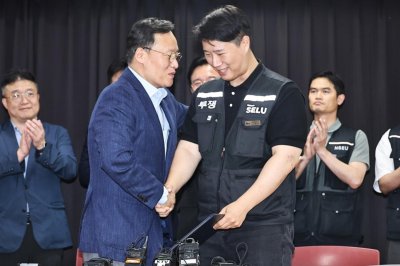
Yeo Myeong-gu (L), head of Samsung Electronics Co.’s device solutions division’s people team, and Choi Seung-ho, head of Samsung’s largest labor union, shake hands at the Gyeonggi District Employment and Labor Office in Suwon, south of Seoul, South Korea. Photo by YONHAP / EPA

May 22 (Asia Today) — Samsung Electronics labor unions began voting Thursday on a tentative wage agreement, but sharp divisions between the company’s semiconductor and device divisions are emerging as a major source of tension.

Choi Seung-ho, chairman of the Samsung Electronics branch of the Korean Metal Workers’ Union-affiliated Samsung Group labor organization, said he would hand over 2026 negotiations to the remaining union leadership and seek a confidence vote if the agreement is rejected.

“The union must follow the will of its members,” Choi said. “I will not change my direction.”

Samsung Electronics unions began voting on the tentative agreement at 2:12 p.m. Thursday. The vote will continue through Tuesday.

Attention is focused on whether growing conflict between the semiconductor-focused Device Solutions division and the Device Experience division, which oversees consumer electronics and mobile businesses, could affect the outcome.

Under the tentative agreement, employees in the semiconductor division are expected to receive large performance bonuses. Workers in the nonmemory semiconductor business could receive about 200 million won ($146,000), while memory semiconductor employees could receive up to 600 million won ($437,000).

By contrast, DX division employees are expected to receive company stock worth about 6 million won ($4,400). Additional performance bonuses also appear uncertain due to weaker business results this year.

Labor groups with many DX employees, including the Donghaeng union and the Suwon branch of the National Samsung Electronics Union, strongly criticized the agreement as rushed and overly centered on memory chip workers.

The Donghaeng union also claimed its members were excluded from the vote, raising concerns about voting rights.

The umbrella union organization said voting rights apply only to union members listed as of 2 p.m. Wednesday within labor groups participating in the joint bargaining body.

Donghaeng union officials, however, said the umbrella union had previously told member unions by email that all voting rights would be respected before later reversing its position.

The Donghaeng union reportedly grew from about 2,600 members to 12,000 members, most believed to be from the DX division.

Some DX employees argue the semiconductor division’s current profits were made possible in part because DX business performance supported companywide investment during weaker periods for semiconductors.

Complaints have also continued during negotiations that discussions were centered on the semiconductor division rather than the DX business. Some workers have even filed a court injunction seeking to invalidate the bargaining process.

For the agreement to pass, more than half of eligible union members must participate and a majority of votes cast must support the deal.

Samsung Electronics employs about 77,300 workers in the semiconductor division and about 51,700 in the DX division. The umbrella union has about 57,290 members, while the National Samsung Electronics Union has about 8,176 members.

If the agreement is rejected, negotiations would resume and the possibility of a strike could increase.

— Reported by Asia Today; translated by UPI

© Asia Today. Unauthorized reproduction or redistribution prohibited.

Original Korean report: https://www.asiatoday.co.kr/kn/view.php?key=20260522010006743

Source link

Samsung Electronics’ labor talks break down, raising fears of major strike

Choi Seung-ho, head of Samsung Electronics’ largest labor union, speaks to reporters Wednesday after a hearing on an injunction against a labor strike filed by Samsung at Suwon District Court. Photo by Yonhap

Samsung Electronics Co. and its labor union failed to reach a wage agreement Wednesday, raising concerns over a major strike later this month that could disrupt operations at the world’s largest memory chipmaker.

The breakdown came after two days of government-led mediation talks that had been viewed as a last-ditch effort to avert the strike scheduled for May 21.

Union and management have remained sharply divided over performance-based bonuses tied to the company’s earnings related to artificial intelligence (AI).

The union has demanded performance bonuses equivalent to 15 percent of operating profit, along with the removal of the payout cap and the formal institutionalization of the bonus system.

The management, meanwhile, proposed allocating 10 percent of operating profit to bonuses and offering a one-time special compensation package that it said exceeds industry standards.

“Because the differences between the labor union and management did not narrow, we requested mediation and waited for nearly 12 hours, but the proposal only worsened,” Choi Seung-ho, head of Samsung Electronics’ largest labor union, told reporters after the meeting at the National Labor Relations Commission office in the administrative city of Sejong.

Choi said some 41,000 unionized workers have expressed their intention to take part in the general strike, adding that the number could rise to more than 50,000.

“It is meaningless to wait any longer,” Choi said. “We do not plan to hold an illegal strike. We will proceed in a legitimate way.”

Choi added that the union now will focus on responding to Samsung’s request for an injunction restricting the union’s planned strike.

Later Wednesday, the Suwon District Court concluded a closed-door second hearing attended by about 30 people, including lawyers and officials from both sides.

During the hearing, the union argued that the strike would be carried out lawfully within a limited period and that it had no intention of illegally occupying company facilities, making an injunction unnecessary.

The court is expected to decide by May 20 whether to grant the injunction.

Following the breakdown in talks, Samsung Electronics expressed regret over the suspension of the mediation process, while pledging to continue efforts to engage in dialogue.

“The post-mediation process, which the government worked hard to arrange, unfortunately collapsed after the union declared negotiations broken down,” the company said in a press release. It, however, vowed to continue making sincere efforts until the very end to prevent the worst-case outcome from materializing.

The labor dispute at Samsung Electronics, the world’s largest memory chip maker and South Korea’s most valuable company, has raised concerns that a walkout could disrupt production and upend the semiconductor supply chain, as well as hurt the broader economy overall.

Observers say that if a full-scale strike takes place, losses to the South Korean economy, which is heavily dependent on exports, could exceed 40 trillion won (US$26.8 billion).

South Korea’s exports reached a record $219.9 billion in the first quarter of 2026, driven by strong global demand for AI data centers. Semiconductor exports were a major contributor, surging 139 percent from a year earlier to $78.5 billion as investment in AI-related servers accelerated.

Some observers have speculated that the government could invoke emergency arbitration powers to prevent further escalation.

Under South Korea’s labor laws, the labor minister may order emergency arbitration when industrial action is deemed likely to endanger public welfare or seriously harm the national economy.

If invoked, all strike actions would be prohibited for 30 days while mediation and arbitration procedures are conducted by the commission. Emergency arbitration powers have been exercised only four times in South Korea’s history.

A commission official declined to comment on the possibility, saying, “It is not something we are reviewing.”

Copyright (c) Yonhap News Agency prohibits its content from being redistributed or reprinted without consent, and forbids the content from being learned and used by artificial intelligence systems.

Source link