Federal distrust prompts some Democratic states to protect polling places, election records
SANTA FE, N.M. — Democratic-led states alarmed by the prospect of federal immigration officers patrolling the polls during this year’s midterm elections are taking steps to counter what they see as a potential tactic to intimidate voters.
New Mexico this week became the first state to bar armed agents from polling locations in response to President Trump’s immigration crackdown, a step being considered in at least half a dozen other Democratic-led states.
The moves highlight a deep distrust toward the Trump administration from blue states, which have been the target of his aggressive immigration tactics while threatened with military deployments and deep cuts in federal funding. Their concerns were heightened after the president suggested he wants to nationalize U.S. elections, even though the Constitution says it’s the states that run elections.
The Trump administration said it has no plans to deploy immigration agents to polling locations. Last month, the heads of Immigration and Customs Enforcement and Border Patrol told a congressional committee “No, sir” when asked if they had any plans to guard polling places. The Department of Homeland Security’s deputy assistant secretary for election integrity, Heather Honey, recently told secretaries of state it “is simply not true” that immigration agents will be at the polls this year.
But a group of eight secretaries of state wants that in writing from the nominee to succeed Kristi Noem as secretary of the Department of Homeland Security. In a letter Monday to Trump’s new pick to lead the agency, Markwayne Mullin, the group pressed for assurances “that ICE will not have a presence at polling locations during the 2026 election cycle.”
Federal law already prohibits the deployment of armed federal forces to election locations unless “necessary to repel armed enemies of the United States,” but Democratic lawmakers, election officials and governors remain concerned.
“The fear is that the Trump administration will attempt to evoke a national emergency or execute some other deployment of federal agents or military troops in order to interfere with elections and intimidate voters,” said Connecticut Democratic state Rep. Matt Blumenthal, co-author of a state bill to establish a 250-foot buffer from federal agents at local polls and other restrictions on federal intervention. “And we’re not going to let that happen.”
A potential clash between states and the federal government
Other bills seeking to ban immigration agents at the polls are pending in Democratic-led states, large and small, from California to Rhode Island.
In Virginia, lawmakers are weighing legislation that could prevent federal civil immigration officials from making arrests within 40 feet of any polling place or courthouse. But the provision on polling sites remains under negotiation, and it’s unclear whether it will be in the final bill.
The newly signed law in New Mexico prohibits orders that put any armed person in the “civil, military or naval service of the United States” at local polling locations and related parking areas, or within 50 feet of a monitored ballot box, from the start of early voting.
Under New Mexico’s new law, which takes effect in May and will be in place for the state’s June 2 primary, people who experience intimidation or obstruction at the polls from federal agents or military personnel can file a civil lawsuit seeking relief in state courts. State prosecutors and local and state election officials also can sue, and the courts can apply fines of up to $50,000 per violation.
It also prohibits changes to voting qualifications and election rules and procedures that conflict with New Mexico law, as Trump prods the U.S. Senate to approve a bill to impose strict new proof-of-citizenship requirements in elections nationwide.
Any state measures intended to counter federal election law will face legal hurdles because of the supremacy clause in the U.S. Constitution, which says federal law supersedes state law.
“It could set up a direct clash between state governments and the federal government. We don’t know exactly how that’s going to go,” said Richard Hasen, director of the Safeguarding Democracy Project at the UCLA School of Law. “Given the supremacy clause, there’s only so much states can do.”
‘We will hold free and fair elections’
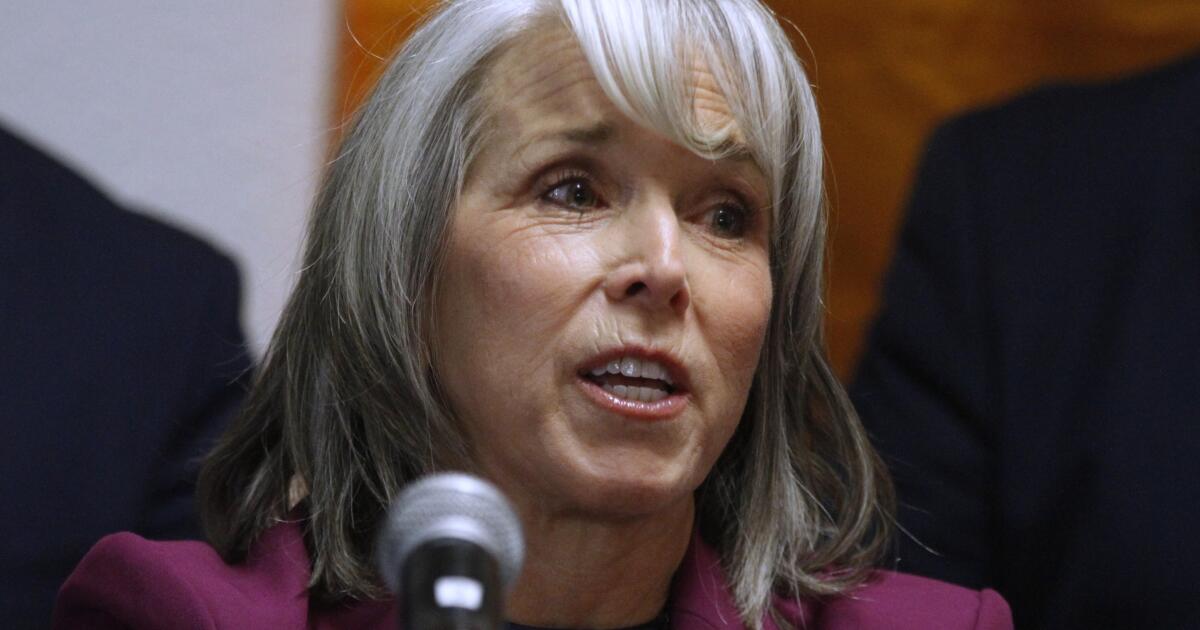
New Mexico Gov. Michelle Lujan Grisham said her own distrust of the Trump administration in election oversight stems from ongoing Department of Justice efforts to get detailed state voter data without explaining why and Trump’s continuing false claims of widespread fraud in the 2020 presidential election.
“Do I believe the federal government and people in the White House? No,” said Lujan Grisham, who terms out of office at the end of 2026.
“We are sending a message to everyone: We will hold free and fair elections, and New Mexicans will be safe in every ballot location and that’s our responsibility,” the Democrat said Tuesday during a news conference. “The Constitution says the states run their elections, and that bill makes that painfully re-clear to the federal government.”
Federal seizure of ballots and election records is a growing concern
New Mexico Republicans, who are in the minority in the legislature, voted in unison against the bill.
“I would question strongly why we have to do this other than just to have to poke the president in the eye,” state GOP Sen. Bill Sharer of Farmington said during floor debate.
State Sen. Katy Duhigg, an Albuquerque Democrat who was a co-sponsor of the legislation, said it’s “better safe than sorry with democracy.” She said she wanted to “make sure that there was some sort of tool that our local law enforcement would have at their disposal if something does happen, if the federal government does in some manner try to interfere with our elections.”
Connecticut’s bill, scheduled for a hearing later this week, also takes aim at federal attempts to seize ballots or other election material. It would require that state officials receive notification of such a move.
Blumenthal said state lawmakers can’t prevent seizures such as the January search by the FBI on an election center in Fulton County, Ga., a Democratic stronghold that includes Atlanta. But he said, “there might be an opportunity for our state attorney general’s office or the secretary of the state’s office to challenge that.”
Lee and Haigh write for the Associated Press. Haigh reported from Hartford, Conn. AP writer Oliva Diaz in Richmond, Va., and David A. Lieb in Jefferson City, Mo., contributed to this report.