El Salvador

Meet the children left without parents under El Salvador’s emergency decree | Child Rights News

Mental health burdens

Ramirez is among the advocates who say children are suffering under the uncertainty and widespread detentions taking place in El Salvador.

In 2025, El Salvador had the highest incarceration rate in the world, with approximately 1.7 percent of its population in prison — roughly twice the rate of the next highest country, Cuba.

According to human rights organisations such as MOVIR, El Salvador’s youth are among the most seriously impacted by the downstream effects of mass incarceration, especially when their caregivers are imprisoned.

“There is a very grave situation with children,” said Ramirez. “There are many children who have been left without their parents, so those who used to provide for their basic needs are not there any more.”

As a result, experts say the affected children are experiencing psychological issues.

“Anxiety issues in these children have increased,” said a psychologist with Azul Originario, a nonprofit youth organisation based in San Salvador.

The psychologist often works with children whose parents have been abducted. She asked to remain anonymous for fear of reprisals, as NGO workers and critical voices have been intimidated, surveilled and, in some cases, arrested under El Salvador’s state of exception.

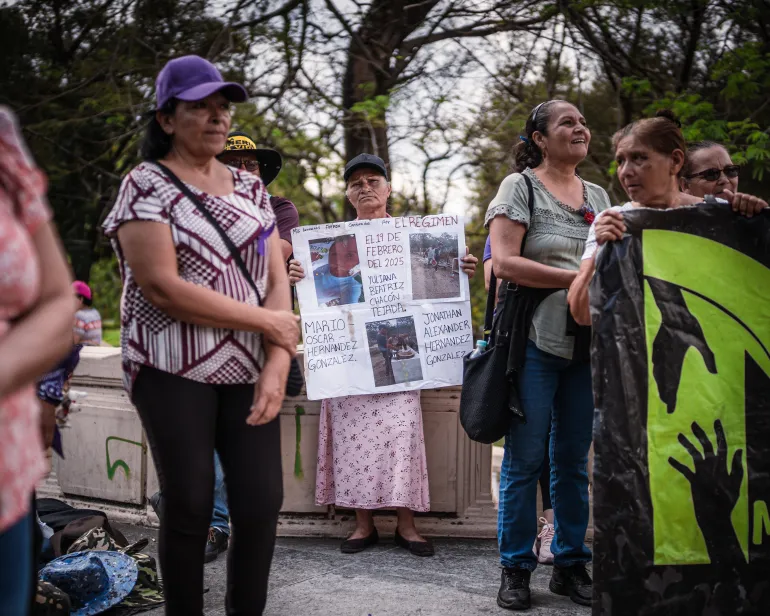
Rosalina González, 59, mother of Jonathan and Mario, who were detained under the state of exception on February 19, 2025, during ademonstration on March 8 2026 in San Salvador, El Salvador [Euan Wallace/ Al Jazeera]
Rosalina González, 59, protests for the release of her sons Jonathan and Mario, who were arrested under the state of emergency on February 19, 2025 [Euan Wallace/Al Jazeera]

“Sometimes they don’t want to do any physical activity or any studying,” she said.

“They don’t want to spend time with other children or go outside. They’re afraid of authorities, because some of them experienced the authorities taking their parents away.”

At a recent demonstration near San Salvador’s Cuscatlan Park, several families echoed those observations.

Among them was Fatima Gomez, 47, whose adult son was arrested in 2022. He left behind two daughters, ages 10 and three.

With their mother working full-time, Gomez has been taking care of the children. But she has noticed the eldest daughter seems traumatised.

“When she sees soldiers and police, she starts crying and runs inside,” Gomez said of the 10-year-old. “She says they are going to take all of us, too.”

Gomez had gathered with a crowd of men and women to demand the release of their loved ones.

Clutched in Gomez’s hands is a blue printed poster, emblazoned with her son’s face and a single word: “innocent”.

It flutters in a rush of wind from the passing traffic.
Source link

Press freedom declines in Americas, with US seeing sharpest drop: Report | Freedom of the Press News

A new report has expressed alarm at what it describes as backsliding press freedoms across the Americas, with the United States seeing the steepest decline.

The Inter American Press Association (IAPA) released its latest press freedom index on Tuesday, ranking last year as the lowest point for freedom of expression since the report began in 2020.

Recommended Stories

list of 3 itemsend of list

Researchers found that the Americas have experienced a “dramatic deterioration” in unrestricted speech, according to the report.

“This is one of the worst years for journalism in the region, marked by murders, arbitrary arrests, exile, and rampant impunity in countries such as Mexico, Honduras, Ecuador, Nicaragua, El Salvador, Guatemala, Colombia, Cuba, and Venezuela,” the report said.

It added that enhanced restrictions on free speech have occurred in countries of various ideological persuasions, whether right-wing or left-wing.

The US, however, was singled out as an area of “alarming decline”. In a ranking of 23 countries across the hemisphere, the US dropped from fourth place to 11th, indicating that journalists operate with increased restrictions.

Changes under President Donald Trump, who returned to office last year, were cited as a primary factor.

“Even though journalistic practice in the United States remains protected by the Constitution and laws, last year’s events saw the erosion of safeguards,” the report explained.

Trump, it said, had contributed to the “stigmatisation of critical journalism”. The report also pointed to developments like cuts to public media funding and the closure of Voice of America, a government-funded broadcaster, as detriments to the free press.

In total, the report tallied 170 attacks against journalists in the US last year, and it cited interactions with federal immigration agents as an area of concern.

The report also noted that Nicaragua and Venezuela continue to rank as “without freedom of expression”.

In Venezuela’s case, for instance, it cited the closure of more than 400 radio stations and the detention of 25 journalists in the wake of the controversial 2024 presidential election.

On a scale of 100, the report ranked press freedom in the country at 7.02. It remains in last place on the report’s list of 23 countries.

El Salvador also dropped in the index’s latest evaluation, now in 21st position on the press freedom list, just ahead of Nicaragua and Venezuela.

In an accompanying statement, Sergio Arauz, the president of the Association of Journalists of El Salvador (APES), denounced what he called the “escalating repression” under the government of President Nayib Bukele.

Arauz noted that 50 Salvadoran journalists had been pushed into exile in the last year amid a campaign of harassment by the government.

“There are no possibilities of practicing journalism fully without facing consequences when there is an Executive branch with virtually unlimited powers and no effective legal oversight,” said Arauz.

Since 2022, Bukele and his government have placed the country under a state of emergency that suspended key civil liberties and granted wide latitude to state security forces, in the name of addressing crime.

Tuesday’s report pointed to the state of emergency as a factor in undermining free speech, and also cited El Salvador’s new Foreign Agents Law, which gives the government the power to dissolve organisations that receive funding from abroad.

El Salvador is one of eight nations categorised in the index as “high restriction”, along with Ecuador, Bolivia, Honduras, Peru, Mexico, Haiti and Cuba.

The Dominican Republic, Chile, Canada and Brazil were ranked among the highest for protecting press freedoms.

Source link